Douglas Grant
Group Chief Executive Officer at MANX FINANCIAL GROUP PLC
Replay available
H1 Results hosted by Manx Financial Group (LSE:MFX) on Investor Meet Company, held 2025-10-02.
On 6ix: 6ix.com/event/manx-financial-group-plc-mfx-h1-results
Automated transcript · Written by software from the replay's audio. It can mishear names and figures; the replay is the record.
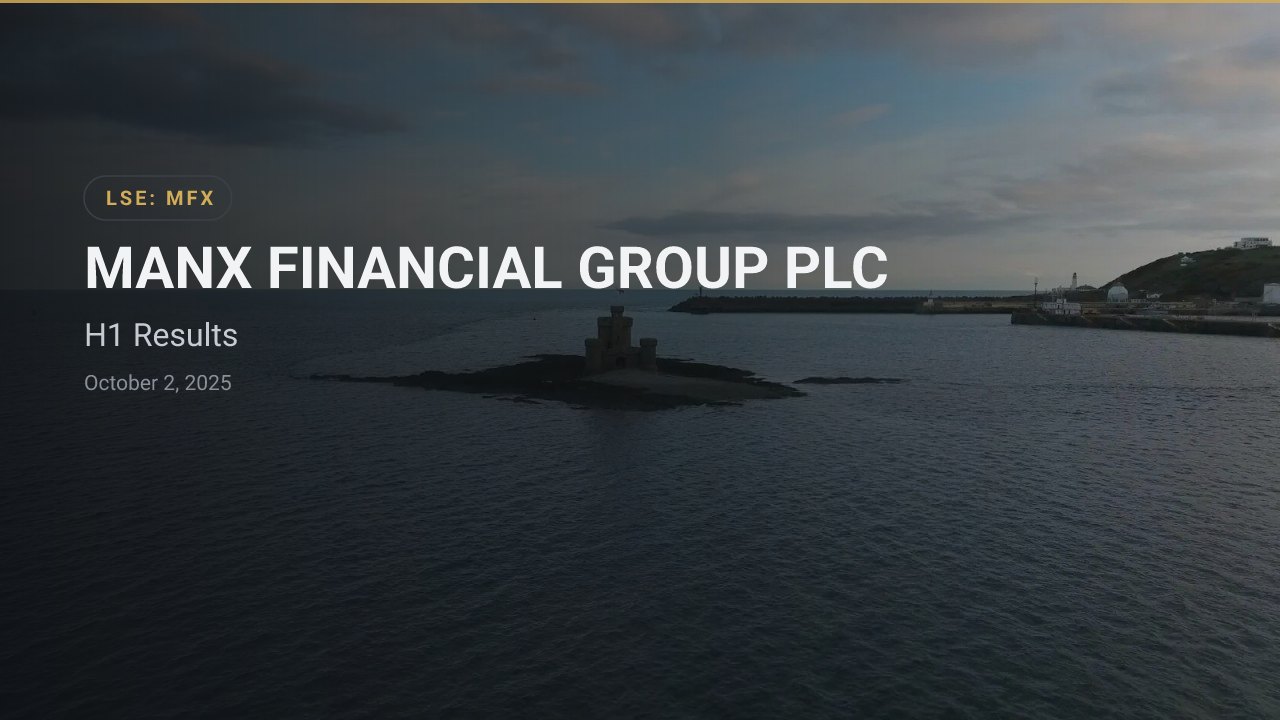
0:01 Good afternoon, and welcome to the MANX FINANCIAL GROUP PLC investor presentation. Throughout this quarter presentation, investors will be in listen only mode. Questions are encouraged, and they can be submitted at any time by the Q and A tab situated in the right hand corner of your screen. Just simply type in your questions and press send. The company may not be in a position to answer every question received in the meeting itself. Have the company handle all the questions submitted today and publish responses where it's appropriate to do so. Before we begin, I'd like to submit the following poll. I'd now like to hand you to group chief executive officer, Douglas Grant. Good afternoon to you, sir. Good afternoon. Thank you very much for giving us the opportunity to present our interim results for period ending the 06/30/2025. You may wonder about the relevance of that short video.
1:07 The castleade, as you can see in our logo, is the cast castle aid of what is called the Tower Of Refuge. It was built in 1824 by a manxman called sir William Hillary. He later founded the RNLI. Fast forward a hundred years when Coneste Bank, founders were looking for the name for the bank. They were looking for something that was showed solidity. It was rock solid. It was somewhere that would be seen by all of the island. So ninety years ago this year, the Coneste Bank, business was actually set up. But now let let's move the history forward another ninety years and talk about the prelim results for period ending the June 30.
1:56 Can we have the next slide, please? I'm sure you've all seen a disclaimer like this before a 100 times, so I won't bore you with going through all but, it'll be on our website later on if required. And we move on to the next slide. The numbers that we are about to present in more detail, they were bang in line with our own internal forecasts. We have got plenty of capital. Our capital ratio is CET1 is 12.2%, compares favorably against other investment other banks. And I think last year, that was at 12.5. We have got incredibly, amount of liquidity. We've got £74,000,000 of liquidity, and we'll touch on the use of that later. So with the sufficient capital, sufficient liquidity, and we've got bags of distribution, which we'll also touch on, we're well positioned for the remainder of '25 and set up well for '26 and '27.
3:09 As I said, the group was founded in 1935, and we're proud to be a MANX group, although we do most of our lending in The UK. The primary drivers of the profitability within the group are Coneste Bank Payment Assist and MANX Ventures. We'll touch on them in a lot more detail as the presentation, develops. Next to MANX Ventures, we have Edgewater, which is a wealth management business, situated and licensed on Yalaman. And below that is Calm Wealth, a business we acquired in January of this year, which performs the same function but in The UK. But interestingly, with Calm Wealth, we extended its very its permissions from the FFCA to include insurance broken and that will allow us to act as an insurance broker to service the million plus customers that we have, within the group.
4:01 On the top right, have an MINCIAL business we set up, from its basic beginners. We recently set it up. It's now the largest less sort of fermentation tanks in The UK, to the brewing industry. Below that is Bluestar, a broker at at soft assets, a business that we really liked. So we bought that business to take the margin that was it had so we could own the end customers. On the bottom left is BLX, which is a lending business in the subprime sector, which actually deals with sole traders and limited partnerships. Then the next two, MANX collections and the FX business do what they really say in the tin. The collections business and the FX business are businesses we set off, from zero and are now leading businesses within their sectors.
4:52 The board of directors. We have Jim Mellon, who is a well known entrepreneur, as the executive chair, and him and Greg Bailey, who's in the middle at the bottom, are a concert party. Greg is another serial, entrepreneur and both are incredi incredibly supportive of our group. Next to Jim and myself is Denham Meek, somebody who I rely on and, trust his advice. Implicitly, Denham has had far too many years, I can't possibly say on video, in in business. And next to me is James Sweet who is sitting on my left. At the bottom, have, Greg Jones, ex, partner with KPMG in the tax side. And on the right are Greg Bailey. It's John Spellman, a MANX entrepreneur who has specialties within the fintech and gaming sectors.
5:45 We have a vacancy within the board at the moment, which we will be looking to recruit into and that process will commence in the next few weeks. So the numbers that we are starting to warm up to in terms of the presentation is the market data we've seen in response to releasing our results. Obviously, the share price has increased. We've taken a snapshot there of closing September 19, and it finished at 36.1p. Earlier in the month, it had actually got to the level of 39.5. We were very hopeful and expecting to cross that 40 p barrier, and I'm sure it will sometime soon. But it's come down a little and and has subsequently up to the date of this presentation. But the story is is that MANX FINANCIAL GROUP's market value is starting to get to levels where we feel it should have always been.
6:38 43,200,000 with a multiple of 5.8 times, you can see that it is still currently undervalued, and we think there's a huge amount of growth for this stock going forward. 4,100,000 is a great result. That's the headline news of these results. PBT, 16% increase from last year half one of 3,500,000 and some other wider information there about our current net asset value and where we stand in terms of the market price versus our net asset value. And the great news is is that we've now tripped into a premium to our NAV and we're looking to stretch that premium more and more so we can get to a realistic valuation of this company. So just going through some of the financial highlights in a little bit more detail. Our advances continue to grow. We're 3.5% up from this point twelve months ago, CHF 176,200,000 of advances, a lot of that coming from Payment Assist, one of our exciting new acquisitions we've done in Financial Services Group and Coneste Bank as well, which continues to access areas in the structured finance lending, supporting SMEs, and also here on the Isle Of Man as it grows its retail portfolio.
7:46 Our balance sheet continues to grow marginally up about 1%, and the the key for us though is this basic EPS has significantly catapulted a 50% increase, returning more and more value to our shareholders. As we completed the acquisition of Payment Assist in September last year, we should continue to see that more profit coming from Payment Assist as a division is going directly into the hands of our shareholders. I've mentioned the profit before tax, which is a great increase, 15.88%, and as a result, the return on equity is increasing too. The reason why that performance metric has increased even more so than just the return on profit is because in the period as we bought Payment Assist, we paid 5,000,000 for the business. And as it was already a subsidiary at the time, that £5,000,000 was a deduction to our, retained earnings and went directly against that. So it dropped the retained earnings, which helped with the overall return to our shareholders.
8:45 So again, on the graph here, we can see what we're doing as an organization half year to half year. The, the the amount of, EPS is growing significantly, but you can see the step change really from half one twenty four to '25. That level of growth is double really where we were in terms of improvement of growth from half one twenty four to '23. So we continue to deliver greater value to our shareholders, which we're incredibly proud of as a financial services group. In terms of commentary, so we've touched on the PBT metric and the EPS metric. I think when analyze these results, one of the things we're really proud of is being able to just reposition some of the net yields. We saw in '24 that what was an important task for us was to really just work on some of the efficiencies.
9:37 If you compare twenty four's balance sheet to twenty three's balance sheet full year year on year, you'll see that we didn't actually grow our lending book an awful lot. What we're seeing in this growth is that the balance sheet is growing and the operating efficiencies within that growth has also increased too. So that's really helped us hit operating income levels of 18,400,000. And jumping over to the right, I've talked about the net yield and how that's improved at 7.3 to 7.6%. We've improved our net interest income margin from 61.9 up to seven 62.4. And this is all about us as an executive committee controlling our costs very closely, trying to keep the pressure of gross interest margins under control with as we're trying to be competitive in the market, but not compromising on yields and yet at the same time being able to reduce our cost of funds for the deposit book as we're repricing that over the last six months. So that's helped the efficiencies, very pleased with those figures. In terms of the operational highlights, we've launched FINANCIAL the strategic alliance with being an RNS on that. And what we're really saying is that we've got an exciting tech solution to bring to the market that allows us to get into the overdraft industry.
10:58 There's open banking connect to various bank accounts for customers, and we can they can open up their FINANU app. They can ask for an injection of cash to help them with their overdraft, and we will be behind that funding. So it's an important strategic step forward. We've also had a 10% convertible loan interest rate that is with also a favorable terms and strike price. So that's fantastic too in terms of aligning strategic interest together. General Insurance, we've done a variation of permission with Cam Wealth acquisition and we're looking to get into The UK area of General Insurance. There's obviously a lot of crossover with the finance areas, things like payment assist with car insurance and business insurance, which we could leverage from Edgewater on the Isle Of Man. So that's looking very strong. We did an RNS on the payment assist new agreements, which we've been launching with. We've got some fantastic new partners coming on board like E Dynamics.
11:58 So we're growing that area. We've already hit the 1,000,000 customer mark. We've got 7,000 garages, and this is really one to watch for. Payment Assist is really going to be, which we're very excited about, something that's gonna bring a lot of growth to MFG over the coming years. So it's really important to structure that well internally. UK deposit operations launch, we're taking UK deposits, that grows year on year, and we're using leveraging that license which we obtained back in 2023. And then obviously, we're looking into the Irish market, which I know Douglas is going to touch on more a bit later. Share price, touched on this already, and I think the key thing here is that we are doubling our share price and valuation of this company. I remember three, four years ago, we were at the six to eight p level. I think a lot of our investors came into MFG at that sort of price, and now we're touching 30p plus and was very nearly at 40 p.
12:58 There is some volatility as the market adjusts to a lot of these announcements we're bringing out, but this 30 to 40 p range is is where I think it's gonna settle out, and there's there's only future growth ahead. I think we should be pushing on easily eight to 10 times multiple getting at 60 p at that sort of level. So really looking to press on in that respect. Our strategic priorities coming up. We're looking to optimize our liquidity through our two deposit taking licenses, strengthen shareholder engagement. We're looking at these type of presentations and making sure we maximize those and simplify group structure. I know Douglas got some thoughts on that, so I'm gonna I'm gonna shut up here and hand it back to Douglas.
13:43 Gosh. I'll take my breath away, James. We we I touched on earlier the three main contributors to our growth. So it's MANX Ventures, Conestor Bank, and Payment Assist. Central to all is Conestor Bank. Conestor Bank, let me just click on to a slide, make it a bit easier. Conestor Bank, has a class one bank and deposit taking license on the Eiliman. That's the same deposit taking license as HSBC, Barclays, etcetera. It also has a deposit taking license in The UK. If we stick to the LMAAN license for the moment, there's over £40,000,000,000 worth of deposits on LMAAN, 20,000,000,000 in sweet spot in terms of the fixed, term or or or notice accounts.
14:30 And what actually happens is we deploy that, liquidity, but you as you can imagine, 85,000 people living in Nerleman only need so much credit. So the opportunity is the 65,000,000 in The UK. And the way we access that 65,000,000 because we don't have, a brand presence in The UK such as Virgin, etcetera. Indeed, I could spend tens of millions of pounds and never get there. But we don't need a brand presence that way. We need a brand presence that links our liquidity into the 3,000 nonbank lenders that are in The UK. These nonbank lenders are typically financed by high net worths or banks such as ourselves, and there's only 350 banks, licensed banks in The UK. So what we do is we brand ourselves into those 3,000, connect our liquidity into them. And sometimes the cost of the return we get in our liquidity isn't sufficient for the risk that we are taking. So we end up taking some equity in these businesses and that's where MANX Ventures, the second of these pillars of growth actually kicks in. We'll touch on MANX Ventures separately.
15:38 But as you can see, Conestor Bank's profits doubled half one and half one. We've got a small, market share of only 2%, but the market opportunity in The UK for the SME is 15,700,000,000. So the growth plan for Connister Bank, we want to be more efficient. So the loan deposit ratio increasing from 90% to 94%, that's basically a great efficiency ratio. That shows you how quickly we are turning the the liquidity we are raising in deposits into loans. We've got some loan book growth there in the bank of just under 5%. So you can see that plays against the 4.2%. Our capital position at 12.2% is incredibly good, solid, as is the excess liquidity that we have.
16:26 So Coneste Bank will lend an early man. It will lend for structured finance products into The UK. But what it will also do and I don't need Coneste Bank to be the most profitable part of the group. I need it to be incredibly efficient at least at raising liquidity for the other group companies. So what it will also do is it'll deploy its liquidity into the markets and sectors that we actually prefer to be in. And these are sectors that have proven to be resilient over the last four or five years. So if we go back to those 3,000 non bank lenders, they are typically in sectors such as premium premium finance, buy now pay later, asset backed finance. So they could be sector driven or they can be geographically driven.
17:15 There are are lenders out there. We only want to lend within the M 25 or might even be within the M 62 corridor. So Coneste Bank chooses how it wants to link into any of those 3,000 lenders, deploys its liquidity, and sometimes take shares and options through its sister company, MANX Ventures. Over the last ten years or so, MANX Ventures has has made 12 either whole or partial acquisitions. And what all these companies have in common is they need liquidity. So we go in there, we plug our cheap liquidity in there, they own the end customer, we take options in these businesses, and if we really like the businesses, we end up buying the whole business. So MANX FINANCIAL GROUP going forward.
18:04 I've touched on it a couple of times. We're not frightened to deal with start up businesses, and then Cassie is a very good example. Two gentlemen came into my office. They used to work for Close Brothers. Served at, DEFCON with Close Brothers. They came back and said to me, look, Douglas, we want to start up a a lessor in the fermentation tanks to the brewing industry. A compelling pair, their story was great, but they also wanted an exit, so we put the liquidity in there. We took, some free equity. We took options. We now own 95% of that business. And as I said earlier, it's now the largest less sort of fermentation tax in The UK. It's expanding its reach into the Benelux countries. It's also, broadening its product range in The UK.
18:51 It's now looking at the precision fermentation industry in The UK and it's also moving into CO2 capture machines, which obviously is incredibly good from an ESG perspective, but is also very good from a profit margin perspective. So we're not again starting businesses up. We enjoyed buying into businesses that are going through the growth phase where we can help them grow either through our board expertise or through our liquidity. But most importantly and all of this has got to be a profit element. So we monetize this strategy through dividends, growing the NAV, and we will look at possible IPOs etcetera as businesses grow if we feel that the overall the value has not been shown from a group perspective. One of the businesses that we bought in with 0% equity is Payment Assist.
19:43 So Payment Assist is the premier buy now purely business in the point of sale automotive industry. The the business has over a million unique customers and these are a million customers that's had a positive experience with. So if we just part that for one moment and also think through, we've got 7,000 garages on the roster. Each of these garages need employee liability insurance, public liability insurance, building insurance, contents insurance, machinery insurance, vehicle insurance, shareholder insurance. If we can bundle all that up through that Calmwell variation of permissions that James spoke about earlier and say to these garages, look, we'll take the admin away from you and also we'll make it easier for you to pay through a premium finance option, which is basically it's full recourse and it's it's, you're splitting an annual cost over ten months, then we can make we can actually make a great inroads into the sector.
20:42 But what you're now seeing is glimpses of our true strategy. We generally genuinely believe the macro environment in The UK and The Ireland man, which are very much aligned, are actually a positive market for us to be in at this moment. The cost 11 crisis is a real thing, and what people are looking for is short term credit to deal with that unexpected bill. So if you take a car into a garage, for example, sticking with payment assist, you need four new tires that cost a thousand pounds. Then you pay £250 to, the day you, take your card in. Then the next three months, you pay £250 a month. So it's an interest free loan. So it's incredibly good for the consumer. What the garbage does, it it gives a discount to payment assessed on the thousand pounds, and that's payment assist margin.
21:32 But what the garbage gets is that £900 plus upfront, and the credit risk hasn't been taken by the garbage. The garbage garages aren't built for credit risk. They're built for fixing your car. The credit risk lies where the credit risk should lie, which is with the finance and the funder. So it's an incredibly simple model. But if you pack that four month loan and take it and then remember that Conestors raising all this liquidity incredibly cheaply, and money at the moment wants to reside in a one year deposit. It means for that one year deposit that we are paying 4% for, we are churning it four times, so you're getting 60 to 70% return gross on the 4%. So net, you're in that mid sixties, mid seventies percent.
22:17 So short term lending is a very good market for us to be in. So you then think of FINANCIAL, which is an overdraft business that we've, got exclusive for the minimum of three years with. That is that's a a liquidity. So that's a deployment option of between two and three weeks. The churn you get on a one year deposit of that really short term lending is also incredibly positive. Premium finance, another one, it's a ten month loan. So we are focusing the portfolio on sectors that are prone to be resilient but are incredibly efficient from a liquidity perspective. That's driving increases in yield, driving increases in margin, and it's driving improvements in technology. We don't need to be the developer of technology.
23:04 We are a financial services company. What we do is we look at businesses which have a unique technology bend, such as ten years, such as payment assess, incredibly customer focused. And that's how we would make step changes in our technology to be at the front edge of the market sectors that we want to be landed within. James is stealing some of my thunder, but James mentioned the seven new agreements that we had in S recently. Payment Assist will do 225,000,000 this year as of, in its lending forecast. When we just to give you a feel for that number, when we started with Payment Assistance, it's probably doing 2 or 3,000,000 a month. It's now doing 20,000,000 a month. It did 1,250,000, one day last week. The trajectory of that business is tremendous, and there's nothing holding us back. We've got the liquidity. We've got the capital, and we've got the distribution. So you've got the three pillars of banking to actually grow this business.
24:09 So the big question, why invest now? As as I'm sure you're aware, aim listed, stock that tend to be undervalued, under the radar. We're trading at NAV. We should be trading a lot more than NAV. The multiple is wrong. We need to deal with that, and the way we'll deal with that is through presentations such as the such as these meetings, etcetera. The current environment, I do believe it's a good environment for us to operate this cost of living crisis. Big banks do what big banks do during every crisis. They pull the credit and they make it harder for customers to get credit. That creates opportunities in counterparties we wouldn't normally see. So that's where we will ensure that we will grow through this point. And our competitive advantage is we're hugely liquid, we've got a great proven, access to distribution and also as a group we've got a simple to understand continuously paying dividend policy of which we'd like to announce more about that through an RNS in the coming months.
25:15 So, this is time to say thank you for the presentation. Please note these, phone numbers, email addresses. James and I are more than happy to field questions and answer them offline subject to the usual market abuse regulations. This presentation itself will be put onto the website either tonight or tomorrow night so you can look at it again. We deliberately put a lot of detail and a lot of slides knowing that we were going to canter through them so that you can read them at your leisure. But that's enough about me. Back to the company and let's, answer some questions that hopefully have been coming in. That's great. Well, thank you very much for your presentation. Ladies and gentlemen, please do continue to submit your questions. You can do so just by using the q and a tab that's situated on the top right hand corner of your screen. We have received a number of questions both pre submitted and throughout the live presentation.
26:09 And I'll start off the Q and A with the first one that reads as follows. The growth of Payment Assist seems to have stalled this year. Why is that? And what are the barriers to growth going forward? I'll say that. Yes. So the advances this year have gone up, obviously, $3,000,000 up year on year and the profit has also significantly up $1,600,000 versus 1,200,000 So it is performing, but I agree that we want to continue to see that grow significantly. We've announced a number of new partnerships and leaning into the sort of the depth of the question. Those partnerships do take time to fully access and onboard. And even when you have a signed trading agreement, you then want to encourage the individual dealerships that may be scattered throughout the country that belong to that chain to actually use you. So there's some familiarity that needs to be built up by those dealerships. And so that takes sales reps to go around and speak to them and encourage utilizations and things like that. So there's a degree of the exciting news outlet does take some time to convert into actual sales, but those sales are coming and Douglas has already mentioned about some of the ballooning drawdowns we're seeing in power with 1,250,000 coming in a single day and that just goes from strength to strength. So it is coming and that's probably why there's some delay in the overall implementation of those agreements.
27:38 Thanks very much. Another question we have here, could you explain how we paid for the final payment of the PAL acquisition and how it was shown in the accounts, please? Yes. So we touched on that a little bit earlier in the talk. So already owned Payment Assist, have 50.1. When we made the final payment, the final $5,000,000 bought something which had very little net assets because the agreed dividend policy we had when we bought Power was to fully distribute anything that was generated as profits within the two, three years of ownership. And so with no net assets, 5,000,000 payment, already an entity that you controlled, you couldn't create goodwill, you had to deduct it from, retained earnings. So that's something KPMG assisted us with as we finalize that for our year end.
28:27 That's great. Thank you very much. What does management see as the primary drivers of the profit increase for the year under review? What will they be for this year? Well, think the being being a financial services group and with the primary asset being the bank within that group, the key is going to be advances and yields. Those are always the key. I mean, there's obviously credit risk is a major factor. I you've got your operational costs. But as long as we can really keep the credit risk and our costs under control, which we have every sign that that is happening, it's really just making sure you grow and you keep your margins optimal and if you can increase efficiency. And so us improving the LDR and net lending rate and growing the balance sheet, those are the things that's going to deliver profitability. And looking ahead, we see every sign of that. There are some challenges. We've got Rachel Reeves increasing taxes no doubt in November's budget.
29:23 The Bank of England need to respond to the interest rate sorry, the inflation rate increases is now up to 3.8% with a target of 2%. How will she how will the Bank of England respond? So there are some things we need to consider on the horizon, but in terms of what we are in control of, there's everything that looks very positive. Powell's growing, Our, interest rates and new partnerships are all all locked in. So, there's every reason why we should be growing. Thank you very much. Another question we've received here. You've said how you believe that the economies of the Isle Of Man and The UK remain favorable compared to other jurisdictions. Could you just touch on this and explain why why you believe this is the case? I may feel I may feel bad that I actually answered that question part of the presentation.
30:13 The the economists, as James has said, inflation is stubbornly high in The UK. Interest rates are gonna be higher for longer. Taxes will rise in the autumn budget statement in The UK. That will create pressure on disposable incomes for both consumers and SMEs. Our product range which is focused on a short range products for this market sector our products which will actually resonate well with both audiences. And no doubt, we're then we're seeing we're seeing an increase pick up on these products. So whilst it's not a great environment for everything, it is a good environment to be lending short term in. That's great. Thank you very much. What's your plans for the FINANCIAL project? How will it benefit your bottom line?
31:01 FINANCIAL GROUP to that suite of short term products. It's gonna have a high it's a high margin product. It's gonna have a quick churn on deposits, we're not gonna have to raise a huge amount of deposits. If I said if it's if we can churn a pot if, the average term is two weeks, then we can churn a one year deposit 26 times. So that gives you a real a real feel for how efficient that new product will be. It also put us at the forefront of the technology within this market sector. We will embed it within the million plus unique customers that we have within the group. Then we've got a strategy for, externalizing it beyond that. It has the makings of being a payment assessed in terms of its contributions to the group. That's great. Thank you very much, Douglas. Another question we've received. How have you tested balance sheet resilience in case of rate changes or funding conditions?
31:56 Yeah. So we obviously do model some of those risks I touched on earlier. We as a bank, we're part of a ICAP process where we look ahead. We're stress testing. We're as an ALCO, we're asset liability committee in the bank. We're always looking ahead, forward looking environments. We have an economist that comes presents to the committee at an ex co level and we stress test the balance sheet and income statements to making sure that we're resilient. Doug has touched on our capital resilience of which we're adequately stocked. The key is to try and get ahead and we've buying Payment Assist and having shorter term lending options with FINANCIAL coming on board, we're able to reprice the assets, our lending on a much quicker basis as we've done historically before they were locked in for long term periods and as our deposits had renewed with typically one year fixed term products, we had this disconnect between fixed rates in the long term on the lending book and short term fixes on the deposit book and that can catch you depending on which way those two items go.
32:57 But now having shorter term options, we're able to counteract that. And so as a group, we're much better positioned to deal with any adverse movements on interest rate risk than we have been before. That's great. Thank you very much, James. The next question is regarding the two loan extensions and asks what the rationale behind increasing the rate by 2% is. Yes. I mean, the non conflicted directors took advice from the Nomad. The Nomad obviously is fully aware of the the the cost of, equity within the AIM listed market. And then we negotiated the figure down to 8%. I don't think it's an unrealistic number, and then and I know they know and the nonconflicted directors fully support that increase. It should also be noted that under the terms of these agreements, it can be prepaid.
33:50 So if at some point we wanted to prepay these agreement these agreements, then obviously we can. Thank you very much. Can you talk us through your plans for European expansion? When do you expect to establish a business in ROI? That's a really good question. I should have covered that during the presentation. We've started the application process for the consumer credit license in Ireland, and we've got a meeting with the Central Bank of Ireland lined up before the end of this year. With a fair wind, we'd expect to have the license, by summer next year. The consumer credit license we're seeking as a buy now pay later license and indeed the business buy now pay later limited has been registered and as has the bnpl.ie, web address.
34:40 What we will be doing is we'll be leveraging on payment assist technology, tailing it for the consumer duty, if impact of being in the Irish market rather than The UK market. The that buying a PLA market does not have the same level of competition that we're seeing in The UK, so it should be a solid way to enter the European market. But we're not doing this as a vanity project. The dynamics of financial returns have got to be right. If we can make a great return in The UK, then we'll focus in The UK. But longer term, we see the expansion into France as, so the the expansion into Ireland has been very positive. Once you've got The U the EU license, it's the same license. You can passport through all the EU countries. The only difference or the uniqueness is the consumer duty aspects in each of those countries.
35:31 Another country in Europe which looks very favorable to us at the moment is Spain, so we're doing some early work on the Spanish, market. That's great. Another question here. How is Basel III regulation impacting Coneste Bank in the future? So, obviously, the Isle Of Man FSA regulates the Coneste Bank and it has a branch in The UK. The branch in The UK doesn't have capital requirements. It's a it's a liquidity raising institution. So that's what the branch is. Whereas the Isle Of Man is where the capital requirements are governed by. The Isle Of Man have fully embraced, Basel III, and looking at bridging some of the items around Basel four and the liquidity metrics and things like this.
36:24 But the directions which we have with the local regulator is fully future proof in some respects. We don't have any real impact from Basel IIIfour coming in that will impact Coneste Bank's capital requirements. They're already future proofed, if I can put it and paraphrase it in that respect. So no, we don't foresee any real impact for us. Nothing on risk weighted assets or any step up to capital requirements that we're envisaging or nothing of that nature. So we we feel fully ready and for anything that's coming ahead. Thank you very much. We've had another question here from investor. I'm new I'm new to the company and the question is, isn't there a risk that you'll spread that you spread yourselves too thinly with lots of businesses rather than focusing your resources on the one or two best opportunities?
37:18 The the truth is that, hopefully, I explained it, that Conestar Bank will generate their liquidity through its two banking licenses. And how we deploy that into these the the the markets that we want to serve in The UK, it'll be through a third party and that third party has a brand. That third party's brand is businesses that we some of them we have shareholdings in, some we don't have shareholdings in. So optically it might look you're spreading yourself thin but you're not. What you're doing is you're actually using that liquidity for your structured finance products, deploying them into these sectors that you're really interested in gaining market share within. Thank you very much. Another question from an investor. Do you expect further margin expansion or are we close to peak levels?
38:07 Yeah. I mean, obviously, the FINANCIAL launch is great news for us because those APIs can go up to 99.9%. Payment Assist has some fantastic opportunities ahead of it and can reach APRs at 50%, 51% around that sort of level. It really depends on the sales mix that goes through and then a lot of that is linked to the term of lending for Payment Assist. So absolutely there is growth for margin expansion, but in a favorable way. Cost of funds are generally holding. The Bank of England base rate has had some step changes down, but not significant enough to really drop the fixed term deposit market. So I see that flat lining and we touched about maybe the risk of it increasing.
38:54 I don't see much negative creep on that. I expect that to hold for the foreseeable future, but definitely on our gross lending, I'm expecting increases. That's great. How much headroom do you have to expand lending without raising additional capital? Yeah. I mean, obviously, capital requirements, we generally keep an overall ratio of about 16%. So for every pound that we lend, 16 p needs to be put to one side and resourced from our own capital buffers. Now we have capacity to grow that balance sheet by another 30,000,000 to $40,000,000 without raising any additional capital. Beyond that, we need to which is a 10% immediately.
39:42 Beyond beyond that, we then need to start looking at internal capital resources in the group, whether that be from dividends or profits from power or other group subsidiaries, whether it be relying on the resources the group can provide through the markets or through debt facilities, etcetera. And it plugs it in a temporary basis, and then when the bank then crystallizes on the profits of that lending, it then raises the capital buffers in the bank and you can free up what you had to put in and either redeploy that elsewhere or you can return that back to investors. Thank you very much. Another question on m and a. What types of acquisition targets are you prioritizing, and how do you ensure they are earnings accretive? We we have, a list of the characteristics of targets that we like, and that includes the sector resilience, it includes the management team, it includes the history of that business, it includes where we can make a difference.
40:41 The and it's let me talk about short term lending. I'm really keen on premium finance businesses at the moment. The technology needs to be good. They need to have a track record and where we can deploy our cost of funds. So if you've got a premium finance business that's doing, 100,000,000 of premium finance a year, Because of the churn of the £100,000,000 this balance sheet is probably only going to hit £50,000,000 Therefore, if it's got a facility of £50,000,000 and it's paying 10% which wouldn't be uncommon, What we can do is we can go in there and plug in 4%. So that 6% and that 50,000,000 instantly goes through to the bottom line of that business. But when we sit there and look at it we go, yeah, so we've generated all that additional profit for you as a business but our return is is negligible. It's just a margin above, the interest rate that we paid.
41:35 So that's why we look at taking, equity in businesses. So that that's kind of the strategy as to how we do it, but it's all about, at this point in time, whether the good, businesses with a proven track record and sectors that we want greater market share in or indeed sectors that we want a first exposure to. But we don't want to go in there and disrupt that market by being a new entrant and compete on price. So that way, we'd always look to go into that market with a in the form of a partnership. Thank you very much. For every question you guys answer, another one comes in, so we'll we'll keep going. Can you expand on the start of the mortgage business? What is the idea and focus? The mortgage business is is an is element product for investors. We're not aware of that. It's the largest, sector, of lending in the element. We had no exposure to it. And the the concept is that we don't and we can't compete with banks that have overnight money, which is typical typically what they use in a mortgage.
42:38 So we look for mortgage applicants which are on either the end of the the spectrum where the traditional banks will not fund them. It could be because they're the sole trader and they've haven't got three years trading history. It could be the the sixty plus, and therefore, they can't get a ten year mortgage because traditional lenders top out at the age of 65. Which I personally think is quite strange because once you get into a pension age, you've got a guaranteed income for as long as you live. So you only need to support that with some life insurance, and you've got a pretty rock solid credit risk there. But we will make money out of the mortgages, but we'll make more money out of bridging. And there is no other professional bridger on the Isle Of Man and the bridging loan fits into that short term lending product range.
43:25 Bridging tends to be less than twelve months. Its rate will be somewhere between 75 bps and 150 a month. So it's a high yield and asset secure lending and what it does obviously bridges between one house purchase and another. And we don't ever do a close bridge, so your assets secure that way. So the mortgage is a product that has a gap in the market for that product, but I don't see that as being the primary driver, seeing that as being opening the door into the bridging market. That's great. Thanks very much. Another question we have here, is the management performance optimal at the moment or can it be improved further with certain skills? If so, what are those skills that you could add? Oh, that's a really difficult one to answer, doesn't it? Gosh.
44:12 The the management team that I have around me dedicated, talented, and young. I am by far the oldest. The succession plan that we have in place, has been approved by the Bank of England, the FCA, and the Alimane equivalent regulator, the Financial Services Authority, shows that we have got a good succession plan. When you're looking at bolstering the skills of a tight team, what we have found is that the best we are doing is through acquisitions. We've acquired some great managers through the acquisition process, they have brought their own talents to the team, whether that's, a gentleman called Marcus Gregory who runs Payment Assist for us. Through The UK banking license process, we acquired a top risk guy called Howard Kay.
45:01 So I find that it's through that pushing the business forward, we're acquiring and finding and hiring far better far better people. We add to the breadth of experience of what was already a tight nucleus management team. Understood. That's great. What other financial products do you plan to develop in the future? Anything like insurance products, for example. Well, the insurance product, one, you you'll get a margin on on broken insurance. Two, you get a margin on the premium finance that supports it. We're we're interested in that short term lending space, but we do see that interest rates are gonna drop. I imagine that we might see starting to drop at h 01/2026.
45:51 So you're starting to look at what's the product range that's really gonna be required for the second half of next year, '27, 2829. We've done a lot of research over the last three, four years, and we're finding a lot of the SMEs in The UK are not invested in their infrastructure capital simply because they don't believe the economic environment is right. And I I agree with them at the moment. It's not right. They should be preserving their cash flow. But when that tide starts to change, we will see a lot of capital investment going through. So areas that I'm particularly looking forward to seeing is that investment in new technology and assets which a primary concern for SMEs, so ones that they they must have. I also think there'll be an opportunity within infrastructure projects, I use infrastructure in quite a broad sense. I think that'll be a good lending space going forward.
46:42 And dare I say robotics, I think the robotic market in The UK, it's it's in its infancy in comparison to The US, but but conversely, The UK is where a lot of these products are actually made. I think we'll see a lot of businesses develop through the robotics market in The UK. And as they grow, they're gonna need working capital. They're gonna need supplier finance for the products and leasing products from a customer, into the those products. So those, I'd say, were big market sectors that I'm I'm keen on developing into in the next two, three years. Thank you very much. Another question here. Interbanking financial sourcing, what's your position slash view on it? We we we we don't really like to have a huge amount of interbank financial resourcing.
47:36 Generally, the the markets tend to be quite volatile. So we are looking at a structured facility from one bank to help syndicate lending with us jointly funding a lending portfolio. But as a primary way of giving us as a financial institution or the bank resource, I I consider to be quite risky, particularly with the overnight exposures and the interest rates you could be exposed to. So we primarily fund ourselves through retail sources, more diversified, also getting in touch with real customers. I think that's a more sustainable basis to build a bank.
48:23 Thank you very much, James. And the final question we have for the moment. How is the customer satisfaction of The UK online deposit taking compared to competitors? Is the tech development satisfactory in the present market? The truth is our often in The UK isn't exactly where we want it to be. We need to develop that sector or that technology. And as a bank of the so for the bank's perspective, the primary reason for having a banking license is to acquire deposits. So you need to do that as efficiently, as possible and that has to be through the use of technology in The UK. The counter side to that is we've had no problem raising deposits in The UK and we've we've hitting all the markers within the Bank of England approved, banking license with the level of deposits that we need to acquire.
49:19 But by sure, and I'm I'm the first to support our technology could be far better, in relation to what we offer to our UK customers. Oh, Douglas James, thank you very much for answering those questions from investors. Of course, the company can view all the questions submitted today. We will publish the response now on the investor meet company platform. But just before redirecting investors, provide you their feedback, which is particularly important to you both, Douglas, could I just ask you for a few closing comments? Yeah. My closing comments would be it's a solid performance for half one. We've positioned the business well from through the three pillars of banking and financial services, which is, which is liquidity, capital, distribution.
50:07 It's all wrapped in an incredibly well governed business and group. We're like I say, we're governed by the Bank of England, the FCA, the LMA and the FSA. Within the group, I think we've got six FCA licenses. We actually see these licenses, which a lot of people would actually rally against. We see them as great barriers to entry because we're not frightened to be governed because we actually know that we can deal with the compliance risk side of that requirement very well. Perfect. Well, thank you once again for updating investors today. Could I please ask investors not to close the session as you now be automatically redirected to provide your feedback in order the management team can better understand your views and expectations. On behalf of the management team of MANX FINANCIAL GROUP PLC, we'd like to thank you for attending today's presentation, and good afternoon to you all.
50:59 Thank you. Thank you.
Follow Manx Financial Group PLC into a list and get an email when it puts out news.
Group Chief Executive Officer at MANX FINANCIAL GROUP PLC
Group Finance Director at MANX FINANCIAL GROUP PLC