Douglas Grant
Group Chief Executive Officer at MANX FINANCIAL GROUP PLC
Replay available
FY24 Results Presentation hosted by Manx Financial Group (LSE:MFX) on Investor Meet Company, held 2025-06-27.
On 6ix: 6ix.com/event/manx-financial-group-plc-mfx-fy24-results-presentation
Automated transcript · Written by software from the replay's audio. It can mishear names and figures; the replay is the record.
0:00 Good morning and welcome to the MANX FINANCIAL GROUP PLC investor presentation. Throughout the quarter presentation investors will be in listen only mode. Questions are encouraged and they can be submitted at any time by the Q and A tab situated in the right corner of your screen. Just simply type in your questions and press send. The company may not be in a position to answer every question it received in the meeting itself, but the company can view all the questions submitted today and publish responses where it's appropriate to do so. I'd now like to run a short video.
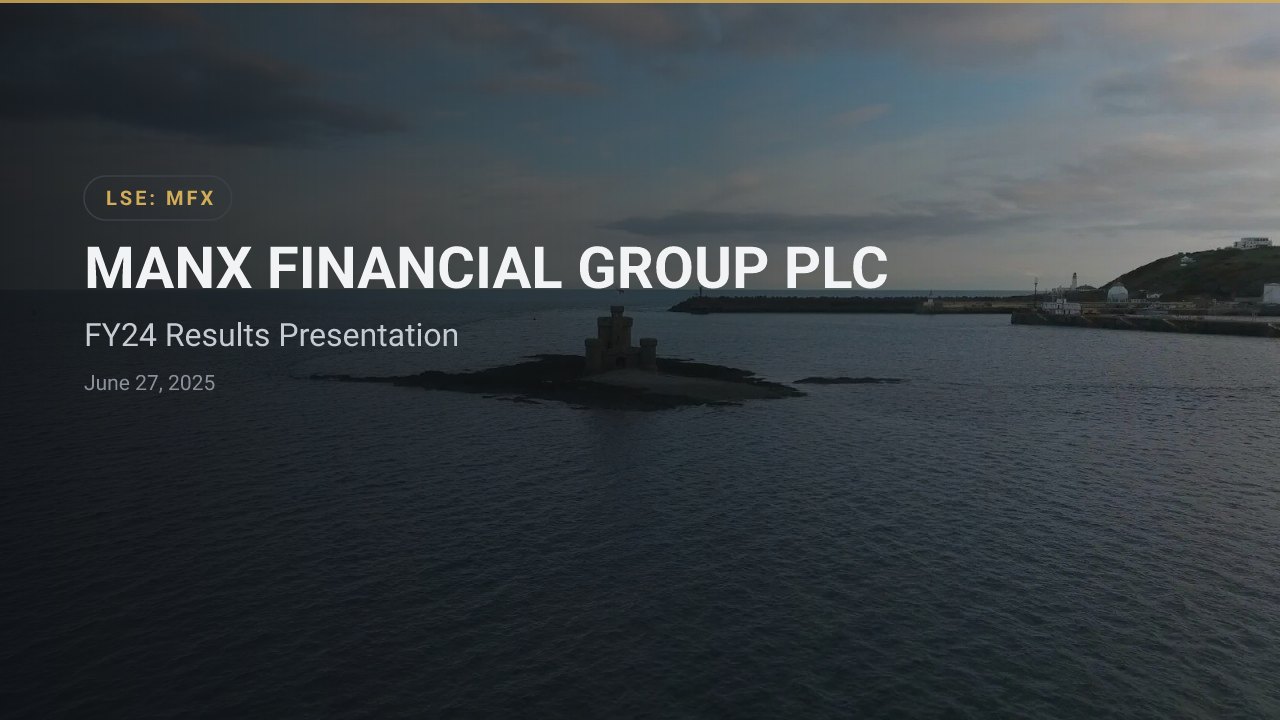
0:46 I'd now like to hand you to group chief executive officer, Douglas Crong. Good morning to you, sir. Thank you, Alexander, and good morning, everybody. Welcome to MANX FINANCIAL GROUP's annual accounts presentation. Beside me today is James Smith, the group's finance director. You may wonder why we showed you that short video. The Max Alliance of GROUP is domiciled in the Isle Of Man, and that video actually features, a shelter that was put on top of a rock called Conister Rock back in 1820 by sir, Edmund Hillary. He's best known as the man who actually started up the RNLI, just over two hundred years ago. So Conister Rock is, known locally for its kind of safe haven bastion of ever ready, stable, and all season, all weather. So it seemed quite a fitting name back in 1935 when the bank was first formed, and, of course, the bank stays today as it was then, the the bank's, central piece to its, strategy and development.
1:54 But a little bit history well, not far back history, let's talk about the history of last year. Before that, just let's flip through a couple of slides. That is the Coneste Rock with, the the shelter for sailors who were were unfortunate to strike the rocks just outside the Port Of Douglas and Isle Of Man. This is the disclaimer, which is, you've probably all seen one of these a million times. I should give you a few seconds just to read it. And I don't think there's anything that you will not have come across before on that disclaimer.
2:35 Okay. So a brief overview of who we are. As I said, that we're founded in 1935, domiciled in the Isle Of Man. We are a diversified financial services, business. We have, companies both on Ireland and in The UK, and as we'll touch on later on, the vast majority of our lending is done in The UK as 85,000 people. The population in Ireland only needs so much credit. The real opportunity lies across the waters in The UK, servicing the 65,000,000 odd, who reside there. Just looking at the slide on the top left of Conister Bank, which we will touch on later. As I said, it's central to the growth of the business. We've Payment Assist, which we acquired the outstanding shareholding back in September 2024.
3:24 So this will be our first full year of, owning payment assist, although we have been involved in the company for about seven to eight years. Next to that is MANX Ventures Limited, which is the more entrepreneurial arm of the group. And those three companies really are the pillars there that will drive the growth of the company. Next to that, we have Edgewater, which is an island man based and licensed wealth management business. Then we have Nincasa, which, again, we'll touch on later on, but Nincasa is UK's largest lessor of fermentation tanks to the brewery industry. It's also expanded into Europe and also looking at new products such as, carbon capture for the brewing industry and being involved in the precision fermentation. On the bottom left, we have the business lending exchange, which, operates in the subprime credit markets.
4:16 We have beside that MANX collections, which, has a bit of rod seal. It does what it says in the tin as does the the MFX, which is an FX business, which is a a lovely little business. Very lean staff and overhead wise and generates about for quarters of £1,000,000 year in year out, and it's really thriving in this volatile economy. Beside that, we have our latest purchase, Can Wealth, which we'll touch on. It's a wealth management company based in The UK. We're going through a process of, a variation of permissions with the FCA to make a general insurer as well as an IFA. We'll talk about that again later. And Bluestar is a business we bought, and it's typical of us as a strategy. We find sectors that we like.
5:01 We don't want to disrupt the market necessarily, so we'll go through a third party, in this case, Blue Star. But,
5:09 once you've had the relationship and you're really sure about the market you're operating in, we look to take the margin that we're getting away by acquiring that entity, and that's what we did with Blue Star. But, less about the businesses and then have a look at the MUGS Gallery, which is the the board of MANX FINANCIAL GROUP. Top left, you'll see Jim Mellon, who's our largest shareholder, 18% shareholder. And if you look at the bottom row sitting from the right, you've got Greg Bailey. Jim and Greg are a concert party, and between them, they own just over 30% of the group. The 3 Floor of the group is over 50%. Beside Jim, we've got Denham Meek, who is executive vice chairman, then of myself and James. Bob and Alan Clark, who's our senior non exec director who's returned in September, ex partner.
6:00 And next to him is Greg Jones, ex KPMG partner specializing in tax and law. And in the bottom right, we have John Spellman, who is the chairman of the bank and also nonexec director of MANX FINANCIAL GROUP. But moving on to the main, reason that we're here today is the numbers and I'll pass over to James now. Thank you Douglas and it's my pleasure to take you through the group's financial results for the year ended threeone December twenty twenty four. For those who don't know me my name's James Smeade, Group Finance Director. It's a privilege to present these because they are record profits for us as a group. The group achieved a profit before tax of 9,900,000 for the year, up from 7,000,000 the prior year. So it's a fantastic achievement for us. I'm going to explain a little bit what's made up that result in the accounts and we've tried to give a bit more granularity in the accounts this year. You'll note in the chairman's statement we've broken out some individual stat figures for companies and how they contributed to the result. Just to give you a bit more transparency, we've looked to try to engage with shareholders, you'll hear it's a strategy over the last twelve, twenty four months to really engage more with the shareholder community and raise our profile and a lot of dialogue and communications
7:31 have happened where people have asked for that analysis and so I'll take you through it shortly. I think what's been a real success for us as a group is seeing the NAV increase and grow as profits grow and then equally how that addresses the discount to NAV being the share price, what it values the group at. Currently market cap is 30,530,000 and how that relates to our net asset value of 37,300,000 shows you that we're still under underwater or under value however you want to say based on our tangible assets on the balance sheet and it's been our desire to make sure that that discount continues to erode and so we've seen that reduce from 58% last year down to 18% now and obviously our intention is to increase the multiple on earnings and we will see that discount go into a premium is obviously our intent.
8:27 So great progress on that front. So let me explain a little bit more on the individual breakout. You've got cost income ratio is down by 1.9%, it's now reduced to 41.4% in total. I still think that's high and I still think we want to try and reduce that down further into the sort of high 30s as we go through the course of next year and it's really a question of scale as we get bigger as the tangible assets increase, we will see our fixed cost base stay fixed and we will be able to deliver higher returns to shareholders as those costs stay the same. Also advances are a component to the growth and we will see bigger growth in the balance sheet as we've lend more particularly through powers, a major subsidiary of ours that we've acquired in full last year, stepping up that increase from 50.1% control up to 100%, happened in September and we're seeing a lot more lending that's happening, you'll see that a little bit more as we break out the figures.
9:37 And that has allowed us to grow the balance sheet to just under 500,000,000. We set that as a strategic objective a couple of years ago to hit that sort of scale and and with our next sort of landmark is trying to get that £1,000,000,000 bank and group financial services more widely. So that's made real progress and we would like to see that increase over the next year. And ultimately for shareholders the basic EPS has increased by 50% as earnings have increased and therefore the dividend increases by a similar magnitude and again that 9.9 strapline result giving what is a very attractive return on equity of 23.8% and if you benchmark us to our competitors whether it be Shorebrook or Time Finance or things like this,
10:29 we should be able to show shareholders just how attractive this financial services group is and the value we're bringing by our growth. In terms of the in share price, as I say, what we're seeing as we bring these results to the market is that the prices increasing as we release results out and then we see over the twelve months there tends to be some sort of lag. It kind of goes back to sort of 13.5p level that we saw just before we ended up releasing results again the last this week and we've seen that jump back up to 25.5p and that's what has allowed us to get the market cap that we really feel should be going onwards and upwards. I think for us it's trying to continue to raise profile of the group and discuss and have sessions such as this so that we can communicate with shareholders and raise awareness so that we see that share price stay at.
11:35 I think that's really something that we're keen to do. In terms of the individual components and how they've helped towards this £9,900,000 result, It can't be understated the contribution of Payment Assist. One thing we've also said, Douglas and I, over the years in giving these presentations is we're really keen to have penetration to customers. A lot of our lending being on the Isle Of Man tends to go through intermediaries into The UK and one key objective for us has been to get to customers, direct relationship. Credit risk, but at the same time it allows us to get the high yields that really can contribute towards significant results. And Payment Assist is an example of that and being able to own the business in full this year has allowed the profitability of the group to really increase.
12:33 We're obviously going have a full year of it next year and so we're very excited about and look forward to the results coming for 2025. There was some release to do with aligning the impairment model that we had in power intergroup and through expected loss and the workings we did with the auditors, aligned that to be consistent with the group and as a result there was a £2,000,000 release that went through into the impairment figures and that has obviously boosted results. So that for us is something that's worth flagging in terms of just its overall contribution is something that will be affecting next year in terms of we don't expect to have that too many windfall to reoccur, but what we are seeing as we grow the customer base and the loan book is that the underlying profitability is just increasing significantly and so we wanted to give that analysis in the breakout and that's why we've sort of given those tables there but overall it contributed £4,400,000 to the overall group result and that for us is something we're very proud of. Over to the bank it was a little bit more
13:58 difficult with the trading conditions we see in the interest environment we have that when interest rates increase we see our deposit rates are repriced a lot quicker than the lending rates and so passing on those increases is is more challenging in a rising interest rate market, but the good news is once you reprice those into the lending book we then see that the overall picture is that long term profits will stick with the banks as we see these the rates in the interest market fall because you've got that lending portfolio sticking with a higher rate whereas the deposits are starting to fall in terms of those interest rates.
14:47 Yeah over the last twelve months we did see a rise in interest rates and so the bank or profitability is slightly down as it repriced its deposit book and the lending book pretty much was sticking to the same sort of rate. As we our anticipation is as we go forward and interest rates fall you've still got that lending book churning and the deposits will get cheaper. So we're looking forward to a better outcome for the bank in the next twelve months. In terms of MFX, it contributed 750,000 to the group, continues to grow from strength to strength, 10% increase from previous year and a really good start up business that MANX Ventures did. Business Lending Exchange again another MVL acquisition that we took on subprime sector. They have contributed considerable profits £638,000 to the overall group result and is consistent with the previous year.
15:45 Edgewater had a restructure in the last financial year and it moved from a loss making or just slightly loss making 35,000 k loss to a 4 just under a 400 k profit. So again, another, important step forward in in terms of progressing that company. MANX Ventures Limited has obviously grown from strength to strength in its portfolio of investments, which I'm sure Douglas will be touching on a bit later. So I hope that's helpful in terms of just giving some of the analysis and the visibility of the individual components and what is there. In terms of the operational highlights, I've talked about Payment Assistance, just how important that is for us. The UK deposit license was also launched this year.
16:36 We did see some operational costs in the bank which I think there was a question we've had from shareholders about why is it that the bank's costs are up. That's really in connection with The UK deposit taking license and we as part of launching that and taking deposits we've really seen that we've attracted a lot of UK money and we can see that the group is ready for scale. It's a quite an exciting prospect for us that we can now raise money quickly both in the Isle Of Man and The UK and as we get these lending opportunities coming through POW and other ventures, there is a lot of money that that can be raised on a short term basis. So that's being launched this year real success for us. We're exploring going into Europe increasingly leaning Cassie rentals has already got a presence in Europe and, is looking at providing its brewing tanks into that market, but we're now seeing that, we're also looking at doing opportunity with Payment Assist and lending into that space in The Republic Of Ireland and we're in stages now of growing that portfolio, so that's very exciting for us.
17:57 Group is expanding, we've talked about the £500,000,000 of assets that the group has now reached and we're seeing continual expansion and our staff levels are going over just over 200 now. So it's something that we're increasingly proud of as the scale of this group is growing and we're making technological advances, we're investing in our IT, it's a continual focus and if we don't keep pace with the wider community we're going to fall behind. So it's really important that we continue to invest in our tech. We're looking at a deposit system, we're looking at a lending system, we're looking at what we can do to make advances in that space. So, so a fantastic year, great set of results, a real privilege to bring this to you and to go through the detail and ultimately enhance the dividend and give these return on equity percentages that we're very pleased to report to you.
19:00 Okay thanks James. When we spoke about the the group of subsidiaries the the subsidiaries that we have within the within the business, I I touched on the the the top three as being the pillars. And central to it all is Conister Bank. And Conister Bank Limited, so it's founded in 1935, but it has, a class one deposit taking license on the Isle Of Man, which is the same deposit taking license as HSBC, Barclays, NatWest, etcetera. It also now has, a branch deposit taking license in The UK. To give you a feel about the Elliman, Elliman deposit market is just north of 40,000,000, of which 22 sorry, 40,000,000,000, of which 22,000,000,000 is fixed term deposits.
19:49 So that's our addressable market. So gaining liquidity has never really been an issue. We've always been over liquid. I think the balance sheet there, year end, that said our liquidity, which is cash and near cash, was just shy of a 100,000,000. It's about deploying that liquidity. And whilst we'll deploy we we lend about 1,000,000 a week on Isle Of Man, and 6,000,000 a week in The UK to give a feel for scale, the opportunity is always gonna be across the water. But we we're never looking to have the two bank and license to have some form of equivalence or equilibrium between the lending and the deposit book. The opportunity in The UK is not just to raise deposits, but the to be regulated by the Bank of England that actually opens doors within the British business bank, within the payment rails, etcetera. So there's all these advantages behind the scene to being regulated by the PRA, which we'll start start taking advantage of.
20:44 So Coneste Bank is central to to the to the group. Payment assist, we have already touched on payment assist a few times. James has mentioned it. It's The UK's largest automotive, provider of buy now, pay later, and we'll we'll talk about that, in a moment. It's market something like I think it's £9,000,000,000. There's the market size, then you take off insurance claims. Within that market, it reduces to 3,500,000,000, but 3,500,000,000 would suggest that we've got market share at the moment just north of 4%. So payment assist is some great opportunities for us. And, MANX Ventures, that's the non inter that's the sorry. That is the entrepreneurial, subsidiary within the group. That's where the the the subsidiary that allows us to acquire businesses, take shares in businesses, options in businesses,
21:36 incubate businesses, and we'll talk about that in a lot more. And the idea there is that we keep the regulated entities within themselves. I mean, we can't reg we do not want to regulate the whole group to the standard of a bank. You want to regulate the bank to a bank, and you want to regulate anything that's got an FCA license to its FCA obligations. In other words, keep it competitive. You don't want to overregulate the businesses. So MANX Ventures allows us to ring fence all of those activities away from the regulated businesses. But looking at Conister Bank, as you can see, the we're sitting in the middle of the Odyssey population said 85,040 billion of deposit. We'd lend as much as we can in the island. We've just entered the Isle Of Man mortgage market, which is the biggest credit market, and it's the first time the bank has entered that market in its ninety year history.
22:29 The truth is we are happy to be in that market, but we will actually make more profit not by the mortgage product, by the product that sits aside it, which is the bridging product, which is short term, high yield, and and it's exactly where we want to be. It's in our sweet spot. If we look at our deposit market, a typical deposit is a one year deposit. That's where the market wants to be. If we can actually find lender which is less than one year, such as buy now, pay later, such as bridges, such as premium finance, any short term credit, then we can get a multiple of that one year deposit, which makes it incredibly,
23:07 operationally efficient for us, to to do so. So Constabanc raises the deposits. We look at The UK market, and forgive me if I'm, if you're all aware of this, but in The UK, there's a living clearing banks. There's 350 licensed banks, which means over 300 banks bank through a bank in The UK. That's a good opportunity for somebody, but that's not where my opportunity lies at the moment. I'm more interested in the 3,000 or so nonbank lenders. These are institutions which actually receive their liquidity from either high net worth or from banks such as us. And what we do is we plug our liquidity into, these nonbank lenders.
23:52 They act as a layer of credit insulation for us, and then they lend our money on our agreed credit terms to the end customer. So we've got a layer of insulation from the the credit, risk that we're taking to the end customer, which is a risk we are happy to have, with some insulation by having another company in between. So that's a great way for us to reach the customer. But as James said, what it means, though, in the end is you don't actually own that customer, so you can't cross sell to that customer. You can't sell our insurance products. You can't sell anything else into that customer base. But that market alone, the SME market, which is the market we're really focusing in on in The UK, is 15,700,000,000.
24:38 Those nonbank lenders surprisingly have over a third of that market, and we only have two less than 2% of that market. So we've got huge growth in there. We've got the liquidity, and we know how to get the sources of the the head liquidity. We've got the distribution. We know where we want to go into those nonbank lenders.
24:56 It's finding the right product. The product we use are the structured finance products, so the block products, the working capital products, the wholesale products. These are standard products that we'll compete with, Siemens, etcetera. But where we differ, there's a is our kind of sweet spot, our appetite. Our appetite will be in markets which these larger players will call niche, but for us, they're sufficiently large markets. So we're when we look at these 3,000 nonbank lenders, we're looking at them in terms of what sector are you in. Is it a geographical sector that maybe that you only lend into the m 25, or it may be your m six corridor, or it may be market specific. It could be asset finance only, hard assets.
25:43 It could be software. It could be premium finance, etcetera. So we pick and choose which lenders we want to,
25:51 link into. And, typically, con this is where Coneste Bank acts as a conduit for MANX Ventures because, typically, if we find it's a business that, that's in an early stage of its development, the the return you're getting on the debt isn't sufficient, so we look for free equity. And so MANX Ventures then takes the equity in the business. Generally speaking, it looks for options, etcetera, to enhance its, equity stake, and that's what we did with payment assist. So it's almost like you put the debt in, you've got a couple of layers of insulation, acts like a first dance. Once you get to know your partner a little bit more, you look for another share, taking a shareholding in the business, and we're payment assessed. We've ended up taking a 100% of the shareholding, over the number of years when we got very comfortable with that business.
26:40 So that's Coneste Bank. This is shows your feel for its advances growth, over the last few years. Last year, the, advances were 372,000,000. That's up 9,700,000 year on year.
27:03 Stayed steady about a million a week a million a week, and so the growth was really driven, as you can So that's our organic growth strategy. We can see the distribution. We've got the liquidity. It's about deploying that liquidity safely and onboard to these customers.
27:24 What's more about payment assist in in terms, and sort of in dispatches. But I think the key points I'd I'd pull out with this slide are that that vehicle repair market is nine is 9,000,000,000. Our addressable market is 3,150,000,000. We've got very little of market share there. Payment assist has over 9,000 carriages on its on its roster, and it's acquired in 20,000 new customers every month. It's got over a million customers now. At at any point in time, it's running with about 1,450,000 of individual loans. Its advances last year were one eight three. This year, we're expecting that number to go over the 200,000,000 mark.
28:09 You can see its profits have grown substantially year on year. And the catalyst to this is we bought this business because it had good products. We've put good management in. We've got good, cheap, liquidity and reliable source of liquidity for ourselves in this business, and we can see that it's in a market which it has competitors, but it's primed to grow. It's already regulated by the FCA. So the upcoming, regulation on the buyer and a pay later market, It will have some impact on this business. The impact will be we'll need to demonstrate affordability to the customers. It's got really good tech. The guys are on that already. What we believe will be in the prime position to take advantage of the people who are being more cavalier than this market because, ultimately, their customers will still need some form of credit. We want to be in the right position to pick up that market share when that regulation comes through, but we're not relying on the regulation alone to drive this, market share growth.
29:09 We'll do it through the acquisition of new customers, through new garages, through new franchises. As you can see, the distribution of this business about it's about 82, 84% comes from garages. The rest is kind of retail finance, which is fine. But the the ideal product for me is the garage product because we spoke earlier about the fact that we're predominantly a one year deposit company. The best product this business has is a four month product, which is an interest free product to the customer, but the business receives a discount from the from the supplier, the garage in this case. What the customer does, it pays they do is they pay 25% upfront, and then the next three months, 25% debts off. That means I can use that one year deposit three times.
29:58 Great efficiency in terms of financial engineering. Of the growth plan, we can we can see that we know we've got a a really core product which we can layer on top. Where payment assist wants to move to, if you go into a garage, you'll find that they've got three or four different payment rails. We want payment assist to be as that sole payment rail for that garage. So whether it's buying a new car, it's servicing a car, it's buying an extended warranty, it's buying spares, we want them to use our payment system. So we want to be an omnichannel for these garages. That infrastructure is more or less in place now.
30:46 We're starting to launch it through there was a press release, I think, a couple of weeks ago where the first launch was done. So we're looking to extend the or evolve the product range within Payment Assist as well as garnish market share through its traditional market. Turning to the we we have a scene in the business that if banking's exciting, we're doing it wrong. Banking should be boring. It should be running a mill. You just do it right. You make money. If you want a bit of excitement, you come to the MANX FINANCIAL side of the business. This is where we look at acquisitions. We look at development businesses that we can we currently hold we're looking at this slide here. We've got five companies. We own a 100%. We've got options in another six companies.
31:36 What we've done over time is we've actually created an incubator where we come across companies or people who want to start companies, and then Cassie is an example. So I met with two people who have come out of close brothers, They were looking to start, a business related, but not in the keg side. They were looking at the fermentation tanks and let them be the less oil fermentation tanks, of which there's very, very few in The UK. So we bought into the idea. We realized, that debt alone was not gonna give us a sufficient return, so we took equity. We had options. We've grown our stake to 90% now. That business is now the largest less sort of fermentation tax in The UK. It it's now a test and a trial in carbon capture.
32:24 The brewing generates a lot of carbon. It can capture that carbon, and then there's a lot of, drinks which actually need, carbonated. You reuse that carbon and hydrate carbohydrates over that drink. So it's a a double win. We're also looking at expand expanding that business into the Benelux country, so that started last year. The footprint is there. We're also looking at other uses such as precision fermentation. I'm not a scientist. All I really know is you put algae in the top. You spin it around an agitator, and out comes some omega three. Please, I don't wanna see any questions on the on the sidebar on that because that will that's the end of my knowledge on that particular product.
33:10 But what MNCASI has other than these assets behind it all and behind all our group companies, the plumbing, if you like, is the bank. They all need liquidity. And if we can put that liquidity in cheaper, if you've got a 20,000,000 facility and instead of getting charged 9% or 10% for it and we can put that liquidity in a four or 5%, you're saving a million pound off your bottom line straight away. If we think that through, then we we we sit there and we go, well, why would we give that million pound away? Why would we want to have a share in that company? If we believe in that company company enough to want to finance, why don't we believe enough to have a share in it and become the eventual owners of that business?
33:57 So that's what the incubation, piece does. The MAX Ventures is within that. The other businesses we looked at, I mean, when this has gone back in time. When Boris became the PM back in, was it, '17 2017, 2016, what we knew was that, we were gonna be leaving Europe, and we believed that that was likely result in the scenarios we cleared out in a recession in The UK. And of that 3,000 companies that are nonbank lenders, a lot of them have got very good front ends, but the collection system is either nonexistent or is poor. And that's because they've never really had a a hard time since 2008, 2009, that some of them had never experienced a downturn.
34:46 So we decided to set up a collections business, and it would look at our own debt and the group debt, but it'd also really be set up to garnish mandates for other companies to collect their debt. At that same time, we positioned the portfolio away from unsecured lending in The UK to more secured lending. We knew Boris had a history of large infrastructure projects supporting them, so we looked at what industries could we be in around there. So we went into the green industry sector, went into yellow plant, we went into agriculture, etcetera. Obviously, we didn't know about COVID coming around the corner, but the one thing with COVID is it actually meant if you're gonna move your portfolio, you'd have moved the portfolio the way we did. So we we bounced back from COVID within twelve months, and a lot of that was to do with exercising our growth plan through our organic businesses and then thinking that through into the portfolio in general.
35:47 Acquisitions do form part because organic growth will organic growth won't get us to where we want to be quickly enough. We need to support organic growth with acquisitions. Payment Assist was such an acquisition. We've been quite acquisitive in our characteristics of acquisitions that we like, that are companies that are gonna give us more market share than markets we're already in or companies that are in markets which we're not in, but we don't disrupt that market. Or it's a market that's IT heavy, and therefore, don't want to go through the the overhead of it cutting that, IT before you actually enter the market. So we're better off actually buying ourselves into that market. And one way of doing that, obviously, is to put our plumbing, our liquidity into somebody, a target company, and then look to acquire that company over time.
36:39 We do see great opportunities around us. I think The UK is a great market for us, and it it has been pre COVID since probably 2016. We see Europe has been a good market, as mentioned, and CASI going into going into Europe via the Benelux countries. We've, started the process of a to acquire a consumer credit license in Ireland. That will come strange enough, the company's gonna be called Buy Now Pay Later Limited. Who'd have thought that was still available? And the website the web address is gonna be npl.ie. So we've got the the know exactly what we're gonna do. We'll white label, a lot of the payment assist infrastructure then to this Irish company, which will make it very lean and get us to the market quickly.
37:33 The beauty of the Irish market is it's quite concentrated around Dublin, the number of garages, which is the first sector we're gonna go into, is also focused around Dublin. But once you have the consumer, credit license for Ireland, you can passport that around the EU. The changes in the each national government's consumer duty regulations is the only change you have to make to be able to access those markets. So we see this Irish vehicle as being a test for our European expansion into these consumer credit markets, and we see The UK license The UK banking license and the LMAN banking license has been pivotable in providing the the liquidity liquidity into these businesses. And because we have an FX business, we should be able to deal with the FX side of transacting to euros relatively comfortably.
38:30 I'm surprised that's that's just finished. Look. I'd like to thank everybody for the time. There's been a couple of questions come up. Thank you for the question of the mortgages. So, hopefully, I've answered that in terms of it is the biggest market on the LMAN, credit market in LMAN. We weren't in it. We need to be in it. We don't want to compete because we don't have the overnight cost of funds as they're clearing banks. So we need to be on the margins. We need to be the more difficult, transaction with the to do. We want to be we'll always be credit safe. But as I said at the time, I do believe the bridging market is a more will be a more profitable market than the mortgage market, but you'd really want to be in the mortgage market to get the bridging opportunity opportunities. Douglas and Grant I'll just jump in at that point. I'll thank you very much for your presentation.
39:18 Ladies and gentlemen please do continue to submit your questions and you can do so just by using the Q and A tab that's situated on the top right hand corner of your screen. As mentioned we have received a number of questions both pre submitted and throughout today's live presentation and I want to start the Q and A session off with the first one here which reads as follows: Why are you so late in publishing your account and what was it about Payment Assist specifically that caused the delay? Yeah sure I'll take that one. So when we acquired Payment Assist they were using accounting policies which were fitting for the company at the time but bringing it into the group has meant that we've needed to align those and some of that was building an expected loss model and that took a considerable amount of time with KPMG, our auditors to sign that off and get that through. Obviously as a result of that it increased results, I talked about that earlier in my commentary that it was beneficial for the group as part of the process and obviously it's increased the dividend but it's a one off exercise that we don't anticipate to reoccur, and needed to just really be got through with auditors signed off and yeah we don't anticipate that going forward.
40:41 We didn't like it I'm sure the investment community didn't like it either, usually publish our results out by March so it did mean that we couldn't get the good news story out which was regrettable and obviously it would have allowed us to go around various road shows and to engage more with the investment community to do so, but yeah that's primarily the cause for the delay. Perfect, well thank you very much. I've got another question here, will the interest rate trajectory affect your results? How do you see net interest margins moving over the coming twelve months? I mean economic forecasts did anticipate three, maybe even four reductions over the course of this year.
41:32 Obviously with the wars at a global level and some of the pressures we're still seeing coming out through the supply chain, it means that the BOE have taken a much more conservative approach and so I do expect we've obviously had one already this year I do expect another one to come over the next five months. And for us and again it came through the commentary earlier but it's good news when when certainly from my perspective when I see that the price, comes down and, I think that, what what will result from that is greater profitability for the group because as I say the deposit pricing reduces shorter term generally than lending and as a result, sorry for our deposit saving and so as a result our lending fixes for a longer term with higher rates and so the net interest income margin increases and so it churns greater profitability.
42:38 So from my perspective it's good news, yeah. Yeah The quicker and faster the drop, the better, but I agree with James. I think there's probably one more decrease this year. Perfect. Thank you very much, James. We have another question here. How do you expect to monetize your investments in MANX Ventures to create value for shareholders? Every asset we bring into MANX Ventures requires liquidity. So that means on day one, we can deploy liquidity profitably. So that there's a positive contribution going into the group from the the very first day that we deploy or bring an asset into ventures. As the asset grows and becomes more profitable, it it it, provides dividends that go up to group, and group can either hold those dividends in the form of a war chest, which we can deploy in future acquisitions, or it can actually deploy that, that dividend into the bank.
43:39 And to just go into banking for the second, once you deploy, a piece of liquidity into, a bank's rate capital base, But for the pound that you deploy, you can lend £6. So it's that leveraging that makes that makes banking licenses, worthwhile. But as you will see a private credit fund, for the pound you've got, you can lend that pound once. So it's that leveraging which is important. So that's also another positive attribute of ventures. The final point, I suppose, in this is I'd like to say, when with ventures, what it does, it it actually incubates, grows businesses. It allows us to go into other jurisdictions. And if a business gets to a certain size, then it may well be that there's an IPO that we want to do as a group because we need to release value for shareholders.
44:30 These are the kind of conversations which go on and that's why ventures is such an important arm to the the groups. Perfect. Well, thanks very much, Douglas. Just turning to the next question we have in the panel. What are the implications and opportunities to the group from coming Motor Finance ruling? Do you expect an adverse impact on MFG results? Yeah, mean we are marginally in that sector. And as you as you probably read in the accounts, we provided, £200,000, against the outcome of the Supreme Court decision, which will obviously be followed up by the FCA within, let's let's say, six weeks. They'll have given a letter address that they'll want the industry to do.
45:19 We will deal with our liability however we need to deal with the liability. We'll deal with it with integrity and transparency. I think it also provides an opportunity. There's exposures out there that are far greater than ours, and these people will require capital to satisfy their obligations. And that may well mean the selling of assets or x and of markets that we are particularly keen on. So we're keeping a wary eye on that. So at this point in time, we we view it more as an opportunity than a threat. Perfect. Thank you very much, Douglas. What's the next MANX FINANCIAL portfolio? What are you looking for? I've I've I've touched on the characteristics of what we like. We like businesses that require liquidity.
46:05 We like businesses that are in the short term credit market. We like businesses that have got a USP about them within within that market. And that could be a technology based one. It could be relationship based. It could be product. But, obviously, the where we are at the moment, we've we've got a focus on, CanWelves variation of permissions with the FCA to our general insurance permission. That will allow us to market general insurance products to the 1,000,000 plus warm customers that Payment Assist has. Don't worry about the warm customers that Constabanc has in The UK. With the insurance premium profit, we'll also package the opportunity to pay for the your annual insurance through premium finance.
46:55 So there's a double positive through that line of distribution. So we're working hard on that, and we hope to well, we should hear about the variation permissions later on this year. And, also, I've I've I've mentioned at length, I'll mention again, the Irish consumer credit license. That is a great opportunity for us. So those are the two which we've spoken about and can talk about. But, obviously, like every other business, there's lots of discussions going on with various players in various markets that we like. But, we'll notify our shareholder base through RNS' as and when we can. That's great. Thanks very much, Douglas. The next question here, do think you have touched on, but if you could provide any further color, that'd be great.
47:44 How has your entry into mortgage mortgage market performed relative to initial projections, and how do you see it evolving? Yeah. We've only been in it for six months, so we're we've had a lot of interest expressed in it. We knew we were working on the the younger side of the mortgage market, the self employed, the small partnerships, limited employment term of a sector at one end. On the other end of the spectrum, it was more people were looking to downgrade downsize or wanted a mortgage as some form of equity release, but the traditional banks don't go, don't go beyond the age of 65, for such facilities.
48:29 And in some ways, when you get to 65 or 67, and I know it might look I'm not quite there yet, But when you get to that age, if you think about your your it guarantees your pension. So if you're looking at, securing or checking affordability on somebody's pension and you wrap around that life insurance product. You have a pretty well secured position, so why would you stop at 65, 67, for the loan? I'm not saying you go into the eighties, but that that there's certainly a period beyond that, which is a relatively comfortable place to be.
Follow Manx Financial Group PLC into a list and get an email when it puts out news.
Group Chief Executive Officer at MANX FINANCIAL GROUP PLC
Group Finance Director at MANX FINANCIAL GROUP PLC