Automated transcript · Written by software from the replay's audio. It can mishear names and figures; the replay is the record.
0:37 Good morning, everybody, and thank you for joining GFT this morning as I talked through the excitement of the last quarter and where we see 2024 going. GFT going for gold, a bit of an acronym and marketing side that we look for, but I'm really excited about 2024 and excited for today too. So thank you for your interest. And with that, I'll get moving through the presentation. Just a cautionary statement here, forward looking language. Most exploration companies and geologists do make forward-looking statements. I would urge anybody listening to read and look through our forward-looking language. There are some relevant points there. When I think about GFG, we're a district-scale explorer. Ultimately, I go to our mission statement. What are we here to do? We're here to find and really develop the next Timmins gold mine. And we're trying to do it as efficiently as we can, maximizing dollars in the ground, and ultimately operating to standards that really benefit our shareholders most. It's a team that's done it before. We found gold deposits, we've created mines, we've operated mines, and we've successfully generated good value for our shareholders.
1:44 In terms of the detail and the strategy, we put together large blocks of ground and today I'm going to talk to you about Penn and Dory and Goldarm and these are big blocks of ground in Timmins and this is really our jam in the sense that we're exploring big belts of ground here looking for the next great Timmins mine and we're really trying to do it in as aggressive manner as we can. And I know it's a bit cliche, but being disruptive. And by that means, we need to look to do things differently. We need to find opportunities that haven't been, you know, taken advantage of historically or recognized historically. And you're gonna see some of our exploration strategies are just that. Before I go into the technical details, we'll just touch base on the share structure a bit. It has been a great year for most juniors. And when I ran the numbers a couple of weeks back for our board, we were roughly flat on the year and this is going back 12 months and it doesn't feel great.
2:33 The market is tough. We were the third best performing upper peer group of 11 and that was reasonable. You're in this sort of 75th percentile and so I guess what do I take out of that? Flats the new good. I'm not happy with that. I think we can do better and we really strive to push forward with it. Important to note, you know, in terms of our cash structure and where we sit, this is a year in cash number of around a million dollars. I'm gonna talk to you a bit about our financing. We launched that last week and give you an update on where we sit with that and the use of proceeds. One of the things I'm really proud of is our shareholder base. And these are seasoned investment professionals in this space. And mid-tiers like Alamos Gold and the Lundin family and even Delbert Capital and some of these other institutions. These are seasoned long-term gold sector investors, really know what they're doing and they're good strong backers of us.
3:24 Insiders, you can look at our filings, we've participated in most financings and continue to hold a good chunk of this company. Myself on the executive team all historically have worked together for a number of years, some of us as many as I think 14 years, Mark and I go back, and you know good track record, great people, good team, board of directors, These are solid people running other gold companies. Lots of successes in the space before Patrick Downey, Arnold Glasson, Brian Booth and Lisa Riley. So these are good people that are seasoned veterans of the gold space. So when we think about our financing and I'm just going to touch briefly, we have an offering in the market $3.3 million. This was launched last week. We price a hard dollar unit. We do some flow-throughs and there's 2 types of these.
4:13 In the end, there's a traditional flow-through and a charity flow-through unit and they're priced differently and that's directed from the press release. So you can see these, I think this is a really good piece of paper at the right time. Anybody interested in investing, please reach out to us as management here in the office in Saskatoon and we'll see if we can help you and bring you into it. Insiders are participating. One of the things I'm super happy about is Alamos has given us their stamp of approval and is participating pro rata as are many of our largest shareholders that I've talked about on the list already. So We're quite happy with how the financing's gone and fully expect this thing to get this over the line over the next couple of weeks and happy to see where we can get this thing and get money back in the ground. Use of proceeds, ultimately we want to maintain our momentum and relevance in Timmins.
5:02 If we think of an exploration company and the last thing any of us want to do is not explore. So if you're going into a phase where you're raising half a million or a million a year, you're not exploring. And so this is really what we need to do to keep active. We've had some feedback from shareholders, I wish I didn't do it at this price, I wish you could have done it later, I wish you could have looked at non-dilutive mechanisms. We've looked at all those. This is the time we needed finance. There are other mechanisms we look at that might bring other dollars into the cash, into the bank account in the future and I'll talk to you about some of those. But at present this is felt what we felt what we really needed to do and I think it's a good deal that we'll get over the line. So when we think about exploration side And this is the reality of what we're trying to do. We're trying to find something that's excessively difficult to do. And you better find teams that have done it before, that know what they're doing and have strong backers, or else the exploration sector is probably gonna be a tough game for you.
5:59 For us, What are we doing differently? We put big belts together, consolidated. We know Timmins, we know the belts, we know the jurisdictions, find the right shareholders, apply new techniques. What are you doing differently? What are you doing to find that next thing that somebody's missed? And ultimately, I think the best track or to find identify good teams, identify those that have done it before, and identify those that have got good backers, and that there's an exit strategy. I think working in an area like Timmins, there's logically an exit strategy with a number of pieces of infrastructure around us before. So it's a bit about how we work the gold sector and the discovery trends, increasingly crucial to find the right team and look at their strategy and believe in the strategy they're applying. When we think about Timmins, and this I called the Sir Sandbox, and it's about 150km across this belt, but there's literally 150 million ounces in this map.
6:54 Big deposits, big deposits, world-class things like Cote, where Cote is pushing 20 million ounces and if you wind yourselves a couple quarters ahead, it's going to be on the 3 or 400,000 production profile. Borden is either a large open pit, which is what it originally started as, and it's evolved to an underground mine, very productive mine. Timmins here, you can circle 70 million ounces. Wow, that's huge. You can go down and look at Kirkland Lake and Young Davidson. So the point is, is there's 2 5-10 million ounce systems across this whole map. Big structural corridors, lots of infrastructure. You know, you have 6 different mills on this map and arguably when you can look at what Newmont is doing at Borden, they're trucking 180 kilometers basically all the way across this map, 5 gram more. So you can see within this map you're already within the realm of trucking. Draw a circle around any of these deposits, look at the grade profile and you can see they could feed another mill and this piece of infrastructure does have a need for feed. So 2 big checks, endowment, Infrastructure and then we want to look at you know, what's remaining to be discovered This area is covered lots of till lots of swamps lots of cedar bogs and it's preserved some of that endowment still at a shallow Level, so this is why we put the land position here where we did. We own Penn and Dore. I'm going to talk to you briefly about those and Gold Arm off to the east. These are large land positions. It's a big map. Even
8:24 if I just looked at Dore, that's 200 plus square kilometers of ground. Big chunks of ground that we own here and next to Newmont, we are the largest landholder in this belt. I'm going to start off east of Timmins and this is the Gold Arm Block. So we consolidated this back in October 2 years ago and ultimately it was just taking and purchase and sale agreements. There's probably 3 or 4 of them put together. And our logic was, it was pretty simple. We see a break called the Pipestone Break. And this is definitely a little more immature from an exploration perspective than the Porcupine Dester, which is the Sothelia, the 2 faults that come across here and ultimately into Timmins. So we saw a good chuck of ground, good entry point, advanced asset at Montclair, which is just to the west end of our land position here. And we own the area in pink here. It's about 30 kilometers in strike length, directly proximal to things like the stock mill in McEwen, Holt Holloway of Iniko Eagle, and Pan American and Newmont both have milling infrastructure and Timmins just 20 kilometers west of us.
9:27 So we feel that anything is found in this land position is imminently truckable to a multitude of mills here. So we like the geology, we like the cover, we like the entry point, and we put this land position together 2 years ago and began exploring it, you know, and we've been very active. And here's all the press releases we put out of this timeframe. And you can see we've had some good volume indicators and you can go back and look at the initial timeframes and this vault up here. You can look at the volume indicators here and here. These are all really good drill results. Market's been terrible, but what you want to find is people and teams still doing good work, outlining economic hits, showing continuity, putting the pieces of the puzzle together, and doing that methodically, because I think that's how you build value. So I'm quite proud of the news flow we put out here, generally been active in the sort of six-week time frame putting news out.
10:22 And these are all economic hits. And I think that's extremely encouraging for a company like us, demonstrating continuity, demonstrating growth with economic results. And the progression is not just in numbers, but to me it's about the progression of thinking and understanding the system. So on the left here is really what we started with. And this was a model where we say, look, there's some old vertical holes here, there's a couple inclined holes here. And We saw a system that we quite liked and it had this duality of high-grade underground, bulk tonnage, near surface. Then we saw also some sniffs of another system at depth down at 200-300m that looked quite interesting And we said, you know what, this thing actually has good potential. We bought it for a reasonable price from IEP and advanced it subsequently over the last couple of years. And building the understanding of the shallow systems at a sub 150 meters depth, where it looks to hang together quite well, both within the main zones which are called these Felsa-Costa-Dorch units and within the lower upper football zone which is much higher grade and over in this environment here where you see lots of 8 over 8, 10 over 16 and 5 over 25. These are all really good 50 to 100 gram style intercepts.
11:38 And you'll also see this footwall system start to take shape. And as we drilled deeper over the last year, we did really recognize that this thing was quite linear. It had good continuity. It was meeting underground grades and thicknesses, so we kept on pushing down deep on it. In December, we drilled a really interesting hole down here. This is the last hole drilled back before Christmas. It showed quite a step change in the geology. This felsic unit had pinched off, the thickness of the mineralization had thickened up quite nicely, a nice broad alteration envelope and a good solid hit. 5g over 13m with a higher grade core of 10 plus grams. That's our deepest hole drilled to date. And that was really encouraging to us. So what am I paying attention is Anders and his team are, how are we building this geological model to further understanding, to demonstrate scale and to get this to be 1, 1 and a half or 2 million ounces. We're not there yet, but I believe the system has the potential to go to something like that.
12:41 This is a cross section, a plan view. That last cross section I've shown you would have been in this environment through here. So when we look at the plan view, we see the upper and lower main in yellow and we see the lower foot wall zone and upper foot wall zone here in the lower polygon. I think we're showing good continuity. That last high grade hole is up in this environment, 350 meters below surface. So you're looking at the dip of this and I believe this continues to be very much wide open as you look along strike. Good scope to grow it. And when we look at the details of this intercept, this is what excites me the most probably about some of the drilling we've done is this intercept down here has a nice thick envelope. And if you looked at just the package alterations about 40 meters thick, the system, the alteration, not all the gold because that's anomalism throughout much of the fringes of that but the high-grade core of it, 5 grams over 13 very, very compelling and you see lots of 5, 10, 20 gram intercepts through here it's not a single intercept, it's not nuggety meaning it's not carried by a single assay. It's actually quite diffuse and this is a replacement sial system.
13:54 Good sharp hanging wall, structurally controlled hanging wall, things I like to see, good strong alteration. The host rock, the host rock is really key here. This is an iron rich basalt and that simply means it precipitates and it makes the gold precipitate from the fluid. So I love this host rock and I think it's something we build into our targeting modeling regionally. So if we find this host rock 5 kilometers away and we know we've got the right orientation of structure we will go target it out there because it's a good host rock to make gold mines in. So this is what I quite liked at depth is the continuity of this lower football zone, the style, the mineralization as it moved to depth, the step change in geology, which seemed to actually make the system even more intense in our last hole that we completed before Christmas.
14:42 We're going to go back and follow up on this, no doubt, as we move through the first half of this year. And when you think about this, the opportunity as demonstrated from that system and that intercept, it's here. Now, lots of room and to move along striking here, you can move out to the Northeast. You can certainly move further on dip side of it. So I like where the system sits. We've got lots of room off to the East in the land position. So I'm quite encouraged by what we've seen in that deep intercept at Montclair. Now, in terms of Aljo, Aljo's a long ways from Montclair. And If you just do a sort of hopped in the air, flew a little balloon over there, you're 25 kilometers away. Completely different system.
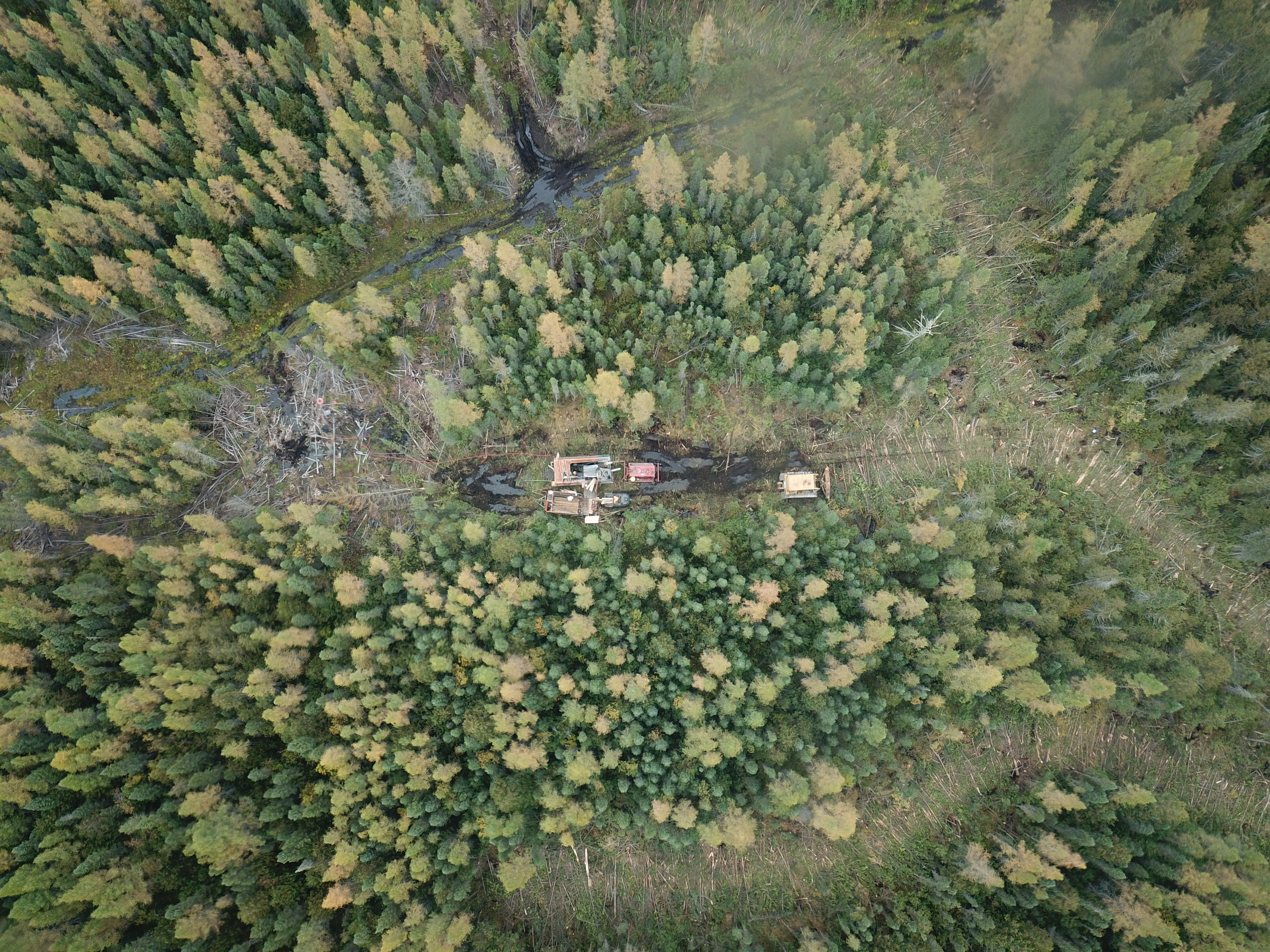
15:29 There's not continuity between the 2, but they are all along the same structural corridor. Geology on the bottom here where Alzo is an old mine from the 1920s and 30s. And here we see these underground development panels from early in the day. And GFD is following up at depth and looking at this system. And we drilled 8 holes here back before Christmas and we had some really encouraging results. Interestingly, I would flag hole 4. And hole 4 was really designed to go under the infrastructure and look at these veins and their continuity to depth at around 200 meters vertical. Interestingly enough, we hit a void in this hole, which would have been the old mine workings, right, in this environment in here.
16:16 So they did mine a little deeper than we could have modeled. That's not surprising. It often occurs where the records are incomplete. But what I did like about this is, you know, you look at this system here, there was 5 different intercepts going down this hole and mineralized started near surface. There was a nice zone in here near surface. We hit another zone there, another zone there. We hit the void and at the toe of the hole we hit 14 grams over 3.5m. A lot of these are economic hits and there's not just 1, there's 2, 3, 4 of them in a single hole. That implies you're dealing with sub-parallel vein systems. I can tell you that the deepest portions of this, or even the stuff near surface, was never mined historically. We see lots of scope to grow this system at Eljo. We did take a drill hole off to the west side here and we saw 2 grams over 20 and a 1.5 over 19 in the same hole with some higher grade components to it, some visible gold into it.
17:11 So early days and we don't quite understand the orientation of this one in fulsome degree yet but very encouraged to see grade off, you know, 2, 3,400 meters away to the west, Northwest and really like the shaping of and character of both these systems as demonstrated in hole 11 and hole 4 from our most recent press release. Still very shallow, still very early days in the sense that we've only drilled about 10 holes in this target area and 4 or 5 of them have had good economic hits. So that's a very good hit rate for early on. So really like what we're seeing at Aljo and like what we're seeing in terms of underneath the Aljo mine, but also regionally, Anders and his team are putting together the structural framework to understand and put these in place and help us target better as we move through 2024.
18:00 When we stand back and look at the big picture, this is part of the advantage of the GFG portfolio land. Our drilling so far has really focused on 2 very small portions of our land position at Eljo and at Montclair. There's a lot more work to be done here. There's a lot more targets and there's a full pipeline. Gold Arm offers a spectrum of drill targets. We're going to work those up through this year. The geophysics, the geochemistry, the till sampling, the structural modeling, the mapping, all these components that geologists and explorations do to build a drill target. It doesn't really translate to much market interest, but it is the work that goes into delivering a quality target. So I like what we've seen at Goldarm outside of Montclair and Eljo as well, and we're working up a target spectrum. And note there, I mean, there's a highway right across this property and truckable to things like Black Fox and the infrastructure of the stock meal of McEwen.
18:55 You can see how close we are to Fenn Gibb, which is Mayfair and Moneta and Nighthawk, new company called Stellar Gold just off the map to the east. So you know also 2 5-10 million ounce systems in this map and directly proximal to where we're working. So that's Goldarm and Goldarm is the most advanced asset that GFG has and it's where we're putting most of our capital to work. We have these 2 blocks west of Timmins called Penn and Dory and they're where we started and they're a quite strategic location where you have IM Gold developing Cote, you have Borden that's been in production and will be in production for another 10 or 15 years. They're certainly showing continuity of Borden that implies it's a good long life asset.
19:42 And you know, the Penn and Dory properties combined are about 600 square kilometers, Large large land positions. Penn itself is about 60 kilometers in strike length, Dory is about 35 or 40. So really good solid core land positions. We're working next to Evolution, to IM Gold and to New Montagnier. And when we look at this Penn, which is the north of these 2, I'm going to show you a detailed map here. We've worked up lots of tail samples, lots of targets. We drilled this for 3 or 4 years. We had some good results, but they weren't really anything we would translate through to resource. So that's when Gold came into our pipeline and we continued to work Penn in the background. What I can tell you, there's still good targets at Penn to be drill tested here.
20:27 There's still results to be followed up upon and we're working through and prioritizing that in our regional pipeline with Gold Arm. And we do have some budget allocation into PIN for this year as well. On the Dory front, here's a detailed map of Dory and evolution. We've been working just to the southwest of us, southeast of us, and IM Gold, southeast, and Newmont, just west of us. So we start and collected a large survey of till data in 2023, and we have some of that preliminary results coming back. And I'm just gonna flip through to the final map. And ultimately, each triangle on here is geochemical sample and we're doing a regional sample on sort of a 1 kilometer space lines and sort of half a kilometer space sample. So it's pretty broad, pretty regional, but what are we looking for? We're looking for just anomalism. We're looking for a system at this scale.
21:22 So when you see these large triangles hanging together, you see confluences of these large triangles in this environment as well. You see anomalism up in here directly tied to structural corridors. You see a corridor coming along here where there's a high grade hit, anomalism, anomalism tied to your structural corridor. That's reflecting gold mineralization along the structural corridors and that's the first phase of targeting. So we're going to work through this, we're going to get the gold grain data later this in quarter 2 and I'm optimistic we can take things like Dore to a drill phase later this year. Dore is a really exciting thing, Big systems all around us and good looking first pass geochemical data. So pay attention to Dore. We're not just a story about gold. Our impending Dore are relevant in our portfolio and we continue to allocate dollars to them as we go through this year. So when we stand back and look at what 2024 is going to look for us, we have a budget that's about 2.6 million in the ground. We have a financing in the market. It takes us through 2024 in terms of dollars in the ground, it covers our DNA, 6 to 7000 meters of drilling. And that's kind of the minimum I feel like a company needs to be to keep relevant momentum, news flow and relevant news flow in terms of drill results that are meaningful.
22:42 Really want to expand Montclair. Can we get that thing to say, you know, we see scope scale to get over a million ounces. Can we get Goldarm and Eljo to another secondary target where like, yeah, that thing is shaping up quite well. So really balanced program, touching all our properties, but most of our meters are gonna go into systems like Montclair and Elzo because that's the area that their targets are most advanced on. That's where we see biggest bang for a buck. So we need to balance the expenditure within our pipeline of first pass tests, second pass tests and things like Elzo and Montclair where we're going back for a third time and really trying to prove continuity and advance this towards a resource stage. You know, Dory and Penn I already talked to you about the balance, so I think it's a good program.
23:29 I'm excited to get out there. The exploration team is excited to get out there and spring on the ground and we'll have a drill program here in the first half moving as well. Down at Rattlesnake Hills, and we don't talk that much about Rattlesnake, but it's quite interesting. We own 100% of this asset. Some of you would have listened to me talk about the in-situ mining angle with Group 11 Technologies. In the end, they couldn't get enough traction. I think it was a fascinating path. I think they still have potential to do it. In the end, it wasn't the right time, wasn't the right financing ability for that company and they turned the asset back to us in Q3 of last year and we've moved it ahead. It's a great looking system. There's 40 plus million dollars spent here and about 100,000 meters of drilling.
24:16 A couple nice deposits, Just really fascinating Alkaline Gold District. Lots of work to do regionally. A number of targets that you can still test in the green are the regional targets. On the right here is a table where we show some of the drill results that have been published historically and really compelling results. So we're going to stay focused on Timmins, but one of the things I've really tried to do is find the right path for Rattlesnake. And look, we've been working on this angle for a couple of quarters. I wish I could tell you the deal's done and we found the perfect partner and here's how we're gonna go forward. We're not quite there yet, but I'm optimistic we can find a path for this that works, that's constructive to GFG, that helps us advance Montclair and Timmins.
25:03 And if we can find a way to move this asset to the right team and participate in some success as the asset moves forward, that's our focus. And I'm optimistic that we can find a path for that to happen over the next quarter or so. So when I can say more than that, I'll bring it back to you guys and tell you what we're gonna do. Suffice to say, we're working hard on finding the right path for Rattlesnake. And I'm really encouraged by the dialogue we've had so far. So when we think about GFG, here's a dynamic company. We have a number of district-scale assets. We have 3 in Timmins and 1 in the US. Any of these could really drive world-class discoveries. We have a team here that has found mines before. We found them in Saskatchewan.
25:50 We have been working hard and we found lots of gold systems. Nobody likes to be a technical success. We found lots of gold so far, and we have things translating towards a resource level, but we're not quite there yet. I like what we've seen. Good technical team. You want to find the right people at the right time with some backers. Can they keep financing themselves? We have some good backers here, and I think it's critical that we keep active and keep the projects moving forward. You have a promise from me, pretty transparent. We're shareholders, tell you what our GNA is. It's about 1.2 million a year. That's marketing, that's travel, that's exchange, that's salaries, and everything else is going into the ground. So if we can get 75% of our money going in the ground or something like that. That's a good balance. And I really believe we're on the right track to find the next great Timmins gold mine.
26:40 So with that, I'll open it up to some questions. And, you know, really happy for your listening today. Thank you very much.
26:56 Okay, excellent. Great presentation. Thank you for the update. For any individuals that came in a little late, we are accepting questions. You see in the bottom right corner of the chat, there was some, an individual couldn't make it and sent via email. You did answer a few, so I'm gonna try my best that if someone's watching this through and through, that you've addressed these questions already. 1 that I didn't see you answer or address, I believe, is this individual's interest in the Swayze area. Why hasn't this area been explored further? The Swayze is the greenstone belt to the west of Timmins and that is the host of Panandore. If you understand historically how the logic or the understanding of the camp has evolved over the last several decades, the Matawagami Fault sits at the west end of the Timmins Camp and it's a big, you know, contemplated being opposed to our fault.
27:54 And everybody believed back in the day that the systems changed, that they weren't as fertile and that there wasn't mines developed west of that main fault zone, and that really defined the end of the camp. And the Swayze Belt sits west of there. So despite people have been looking there, if you just looked at drill density and you took a really landscape view of the property and see How many holes drilled below 100 meters across 60 kilometers here? You'd get a number like 10. And if you looked at in Timmins, you'd be like 10,000. So initial drilling and exploration in the Swayze was really driven by quite restrictive geological thinking. And when you look at the discoveries that have been made, and you can use Great Barracks as an example, you can use Cote, you can use Borden, you can use even things up at Walbridge, Those are discoveries made along these breaks, these main structural corridors that are outbound of the main endowment as historically understood.
29:00 And it shows that the main structural corridors are very fertile. They can form big deposits, and they have been found in the last exploration cycle. So that's key. When you find deposits that have broken a geological understanding or sort of empirical relationship, you have to pay attention because they're telling you something. Great Bear tells us something. Great Bear tells us that you didn't need to be directly proximal to the Confederation assemblage and the main ultramagnetic contracts in Red Lake. You can have a bigger targeting space. So when we look at the Swayze, and even when we look at Gold Arm, those are logical deep tapping structures directly on strike from mine environments, and they're undercover.
29:46 So our philosophy has always been with GFG that these are the areas that are most fertile because you're still working in your first search space above 200 meters. You're still working directly undercover and you're working along these main breaks that have been proven to be fertile. So the Swayze is a belt that's underexplored because of this historic bias of the geologists working there. And I believe there's things to be found. The presence of Borden implies the more presence of Kote implies there's the right fluids, the right systems are at work west of Timmins. So I think the Swayze has more to offer. That's why we keep pushing on. Thank you, Brian. And at the beginning of the presentation, you showed the performance of GFG and relatively flat for the year.
30:31 You're in the middle of a financing and if you don't mind repeating it, I don't know if you mentioned it or not, but if you did, sorry, but when do you expect on closing the financing and how did you determine on the amount of 3.3 million? It's kind of a balance and act to figure out how much you want to go to market for. Yeah, our timing is always, I think it's to be very quick to close the financing 2 weeks from launch and you won't see many groups do that. Most times we've historically been in the sort of 3 to 4 week range by the time we get all the certs and the subs in and checks and the subs in and that sort of thing. Now you can close a book and then you move to closer financing. So those are 2 different components here.
31:16 So as we work through the next couple of weeks, I, BMO, a big mining conference is on this week. So that takes a lot of people and investors out of play in terms of contact and then next week's PDAC. So, you know, if we looked at sort of the 1 to 2 weeks post PDAC, that's where I'd like to see us close into financing. The second component of your question was why this number? And so when I boil it back and we look at our cash at the start of the year, 1.2 million, obviously we spent some in January and to date February, so running lower and the timing was really that we needed to go with this financing now, both from a flow through and hard dollar perspective. So when we look at the budget, ultimately we have certain strategic goals we wanted this year. We want to be able to answer what Montclair is and what's the size and what's the scale and how big can we get. And we want to be able to take another pass at Aljo and answer those same questions. We want to be able to look at Penn and Doray and when we boil that down and we maintain this sort of concept of relevance and that's obviously a bit of a gray area these days in this market.
32:17 But keeping active, keeping news going, keeping the projects advanced, I believe requires sort of the 6,000 to 7,000 meters a year and the type of holes we drill and the momentum we want to do. So that's really driving the type of program we want to lay out and the budget in the ground that goes along with that which is 2.6, 2.7 million. So when we back this all out, that's really what's driving the financing magnitude at 3.3. Could a sale of Rattlesnake make a difference for us? Absolutely. And, you know, I just can't, we can't bank on that. So it's still a good probability. It's just from a timing perspective, not something we could hang our hat on and say, yep, it's ready to go, let's do it now. So we have to put ourselves in a position of strength, raise our money to fund our budget. And we have Rattleston and Kinnear, a couple other levers that could come along that could make a real difference for us as well in terms of balance sheet. And we're working hard on those in parallel with financing.
33:20 Now, it might be too early to say given that it is dependent on the financing, but 5 to 7000 meters, are you able to say how much toward Aljo and Montclair And also based on the sampling your team conducted Dore last year, seems like at least I counted like at least 4 or 5 anomalies there that looks like you want to prioritize. Could you summarize? Are you going to do any meters at Dore in 2024? We have a budget that's split about 65-75% on Gold Arm and 30-35% on Pandora. When I talked about the weighting of an allocation towards an advanced target, we feel that is direct value build. If you can start growing ounces towards something and incorporating those as opposed to those first pass higher risk goals on a target, They need to be balanced.
34:16 So the Dory first pass drilling we need to go out there You know, we need to do some prospecting. We need to do some stripping We need to probably do some more soils or till or look harder at it And hopefully we get that to drill stage and when we look at that pool of capital, it might be half a million bucks or 600, it's in that range that we would allocate towards Penn and Dore both of them. And yes, Dore is probably going to shape up to be higher in a priority of drill targeting than maybe we might have on pen. So that's how we think about the splits between the 2 dores, definitely in the plans. And Montclair and Aljo and Goldarm would be the main focus. Do you want to elaborate on Aljo? It was relatively recent discovery, right? And how many holes have been in there? About 10 or so?
35:08 We have 11 holes, 8 holes this round, 3 holes last round. It's about a kilometer in strike length in terms of where we see sort of the fertile area and the fertile structures at work. Drilled under a historic mine that was sort of 20,000 ounces, 30,000 ounces from the 20s and 30s. So this is old vintage where your location and reliability of data is quite weak. Ultimately, it's a good high-grade vane system, pretty narrow, but also stacked. So whenever you see stacked vane systems in good grade, you know, you've got the right rocks, you've got the right fluids, you're creating dilatancy and you're creating it in multiple structures.
35:55 So that's what entices me about that setting. And It's trying to put together where can we get some scale, where can we find intersecting structures? The Kingswood shear is relevant there. The orientation, the intersections between your stratigraphy and some of these Northeast oriented structures are key. Crecys is a system that's being explored by Onyx just to the southeast of us and very encouraging results they've seen in terms of finding other veins that are parallel to the Croesus mine, this north-northeast orientation where there's some good high grades, you find a vein, hits the right stratigraphy, you get good gold. So it's finding the right structural intersections like that and I think ALJO offers that opportunity to find Cretaceous style settings.
36:49 I'm just going to the audience here, Mark has a question we take it back to Dore. He says Kote looks like it would be a monster mine for IAG. Has IAG expressed any interest in Dore which appears to be adjacent to their Colte project. Yeah, are they interested? When we speak about our corporate neighbors, I will just make a generalization in this case. We talk to them all. And if you ask us, do we have a relationship with Newmont, do we have a relationship with Evolution, do we have a relationship with Pan American and IAMGOLD, of course. We're working in the belt, we're doing exploration, we're finding economic hits and they own infrastructure. So, any interest those parties would have, they probably wouldn't be doing their job if they weren't understanding what we were doing.
37:41 And IAMGOLD is going to be a long-term, large-scale piece of infrastructure with a low-grade cut-off. One of the interesting things about the evolution of the Timmins Camp is not just going to be about trucking to the dome mill, which is 13,000 tonnes a day, and Newmont's trucking 180km, 5g ore to there. You need to think about it in the context of saying you've got the dome mill at 13,000 tons a day that needs to be optimized. You've got Alamos as young Davidson, you know 9,000 but could be expanded to 12,000 for a modest capital outlay. You've got a piece like Cote, which is 36,000 tons a day. And the variable cutoffs and the opportunity to displace feed with higher margin or ore is relevant for all of those players.
38:31 And so, you know, I am gold Really critical phase or ramp up for them take them through q2 Kote if executed through the next quarter or 2 will be a massive free cash flow generator for I am gold and it'll be a very different company when they've de-risked it to that point. And Renault and their teams have done an excellent job in getting that stage and executing it. So I wish them the best, great success. We keep exploring right next to them and our thesis has always been the fluids and the rocks at Cote are directly along the strike from us. Borden has the analogies and yes it's higher metamorphic grade but you know it's directly on strike in the same style of system as well, it's just higher metamorphic grades. So big systems around this big infrastructure, and yeah, for sure, we keep relationships going and keep our neighbors all informed because the capital markets are exceptionally tough.
39:28 And we can find shareholders through corporates. Alamos has been a fabulous supporter. They believe in what we're doing and they own infrastructure here, so why wouldn't they be supporting us? So we keep good relationships with all of our neighbors and it's also a reciprocal learning where we think of, you know, we own our claims, you know, we're not shy about how our approach and our philosophy is. They're also exploring their claims. And, you know, there's things we can learn about methodology supplied that are mutually beneficial. So that dialogue goes along across lots of the teams and the guys at Onyx would be a good example of that as well. Thank you, Brian. I'll give one more minute for the chat here for any further questions and I'll pose 1 while we wait.
40:16 I'm not sure if you're much of a macro guy or not, but I hear a lot of individuals saying the markets are tough right now. What needs to happen for that to change? Does gold need to break 2100 or is that the magic number? What needs to happen to change sentiment in the overall junior exploration market? I had a good chat with an individual yesterday and his vision and his thesis observation, I guess it is, is that relevant discovery still translates to good value. You know, and You can take those out there and you can say, a real bona fide discovery gets you 100 million. It might get you 80, it might get you 120, it might get you 60, but let's just round it and say it gets you 80 or 100 million. When you put out a first good suite of holes that show that, you do unlock that. And you can look at Snowline, or you can look at Rupert's, you can look at Great Bear, and they're all pretty similar in terms of what they yielded early on. And the variance in terms of what they yielded was probably directly related to their share structure.
41:21 But I think the market, you know, would obviously benefit from from peat gold moving through. I just think there's a fundamental shift in how we need to think about financing this space. There needs to be larger scale. There needs to be less of us. There needs to be a diversified portfolio that balances the risk we take, which is high in an earlier stage cycle. So one of the concepts I think that resonates with a challenging junior market is you need to look at 1 plus 1 is 3. You need to look at not 5, 10, 20 million market cap. You should be 50, 80,100. And you should be doing, you know, budgets that are 6 to 8 million a year on a broader portfolio of ground.
42:09 I think that addresses some of the relevance question and the relevance question is just simply that the way money is being managed, this cycle active versus passive, allocation of the precious metal sector has evolved. It's demanding and it's propagating a need for change in how companies work. And it's something we're quite active on. We're quite aware of it. And we hear it from our shareholders, Brian Marko, find a way to be bigger, find a way to be more relevant. And I think that's what the market wants is larger and more investable companies. What's going to change that? I think attitude towards scale from the corporate side, willingness to be not about management but about stakeholders in the future and maintaining relevance.
43:01 Yes, gold price moving back through 2100 or 2000 would be very, very beneficial. I think it would be beneficial not just from an investor standpoint, but from the corporate standpoint where we can see, despite running 2700 Canadian gold, your AISC margin on many of the producers has shrunk over the last 2 years. And so the inflationary piece is playing a role in cost structure. So moving gold back up, opens up more margin in the producers. The producers need to invest in a pipeline. Guys like Alamos need to make more money so they can invest in groups and companies that they think are doing good work. So I think, yeah, peak gold is one thing.
43:46 Corporate strategy is another thing. And ultimately, it still just comes down to the people and trying to find that pick that right team. So yeah, lots of things around it. I don't think this market is changing in the short term, Kyle. I really don't. I think you're seeing something that's gonna stay like this and from the companies, they have to react. They have to try to change their strategy to finance differently, look at consolidation, do things more innovatively or do things more efficiently. Those are hard to do, but we've got to push for those. No, thank you for the honest and realistic answer. Appreciate that. I don't see any other questions from the chat here. So for anyone that came in late, just a reminder, this is being recorded and will be available on YouTube afterwards But I will kick it over to Brian for any last comments before we close things off here Thanks very much Kyle and 6 as well.
44:41 You guys do a great job of it running these Anybody listening today? I really thank you for your time and your interest in GFT. We've got a good website, but if you know Mark or myself, Mark Lopage, call us up. If you're a shareholder, we want to hear from you. If you're interested in the company, we want to hear from you. I think the financing is a really interesting time. I think if you have interest in GFG, build a relationship. We're very approachable individuals. And give us a call. Look at our website. Listen to a SICK seminar. We're trying to put as much information out there as we can to get you to understand us, how we work in our strategies. So with that, thank you very much.