Automated transcript · Written by software from the replay's audio. It can mishear names and figures; the replay is the record.
0:40 being recorded and will be available to watch afterwards. So without further ado, I'll hand it over to you, Sean. Thank you, Dasha. Grateful, grateful to be here today. Grateful to be in front of the 6 audience again. I believe this is our fourth summit with 6 and so for a lot of you, you're starting to get familiar with the Dolly Varden story. I know there's new subscribers joining all the time so I just want to sort of review DALI before we get into the Corsak and I'm really excited about this summit because it's very dynamic, it's very different, it's going to be very informative and for anybody who is interested in discovery, interested in geology, interested in building value to companies, this is a it's going to be a very unique summit so it's really excited to share this with the world.
1:31 High level on Dolly Varden. We're in BC's Golden Triangle. This is a part of the world that has got one of the highest concentrations of metals anywhere in the world. Not only has it hosted some of the largest gold, silver and copper deposits in the planet. It's also some of the richest grades. So it's a very, very well endowed area. And we've got a project that's at the southern end of the triangle that has seen very, very, very little exploration relative to some of the projects in the north. So in the north, we've got projects like Eskay Creek, Premier, we've got operating mines like Bruce Jack. So those are all on the precious metal side and then a little further north we've got more base metal mineralization and some of the world's largest and richest copper deposits. So, it's a well endowed area.
2:26 We're in the southern part of the Golden Triangle, sandwiched in between endowment from Hecla's Kinskuch property and Fury's Homestake Ridge project. So we've got a project next door that's 1 million ounces of gold, 18 million ounces of silver and we're endowed currently with 44 million ounces of high-grade silver at the Daly Varden Silver Project. Our project, in addition to having a modern resource that was published in 2019, we've seen past production of almost 20 million ounces at grades ranging from 466 grams per tonne at Torbritt to grades over 1,000 grams per tonne at Daly Varden. So our resource is made up of 4 areas on the project, but the real opportunity is the over 100 silver occurrences along this horizon, this four-kilometer horizon.
3:23 And what we're going to do today is we're going to go into the core shack, we're going to show you the core, we're going to show you what our geologists see, and we're going to show you how we vector into new discoveries and how Dolly Varden has successfully added to this resource over the last few seasons and some of the tools and and some of the opportunity that lies ahead. So I'll summarize in saying, we're well held by institutions. We've got Eric Sprott as our largest shareholder at around 18%. Hecla is an 11% shareholder. We've got a strong Treasury. We've got about $20M in the bank, so we're well funded not only for this year, but also for next. And we're in the midst of an aggressive drill campaign.
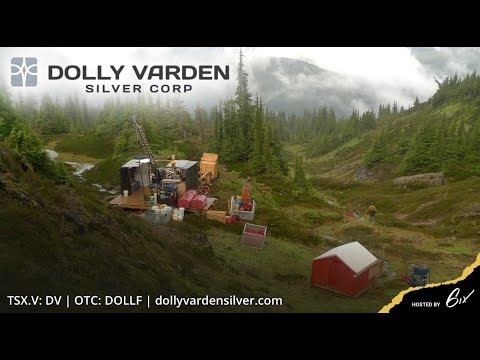
4:12 We're about 8,000m into it. We've got 10,000 plan meters in phase 1, and we have yet to put out any results. So we're going to have a very, very results-rich Q4 and Q1. And I'm going to turn it over to our chief geologist Rob Van Egmont now, who will walk you through our previous core and how we're using modern exploration tools to vector into new discoveries and our goal of achieving 100 million ounces of high-grade silver in BC's Golden Triangle. So with that, I will now turn it over to Rob Van Eggmont. Thank you. Well, hello there from Dolly Varden Silver. This is our first installment of Live at the Corshack, located in beautiful, sunny Alice Arm, about 500 meters from tidewater of Alice Arm and about 28 kilometers from the Dolly Varden Silver Project, where the drill's turning right now on exploration phase of our 2021 program.
5:17 So we did start on some drilling around our Torbert deposit, which is a volcanogenic mixed with epithermal style deposit. It's the largest portion of our current resource, about 25 million ounces of silver of the 44 million that we have reported. We are following the Torbert horizon to the northern end of the property. So, because it's a volcanogenic style deposit, it was laid down on a, there's shallow sea or somewhat muddy area. We have a lot of signs that it's probably didn't have a lot of confining pressure, so it may have even been close to being a sinter style deposit. And that's our exploration strategy here. We're following the Torbert horizon.
6:06 And it's located within the Hazleton Formation, a Jurassic package of rocks that was, in our case, laid down with a sequence of volcanic ashes and debris flow and in the case of Eskate Creek, same time frame, it was more of a quiet deep sea basin with dark shales being laid down. But the mineralizing age is about the same as the 2. So, it was a period of time in the Jurassic when there was a pull apart of the rock. So, basins were forming and you had fault bounding faults on either side as these rocks moved apart. And as those basins formed, mineralizing fluids came up along the bounding faults and deposited various styles of layered mineralization on that substrate.
6:56 So, you know, it was not a flat layer in our case. So, there are some collapsed breccias where mineralization may have fallen over some of these escarpments, but for the most part at Torbert we do see evidence that it is layered. The mineralization has a sequence and we see that throughout the deposit and in our offsets, the same sequence. So that is one thing that points to layers. Another is our sequence. So the upper layer, as we're drilling down, this is the first type of rock that we encounter. You can see the layering. It's jasper, hematitic jasperoid is the red material, mixed with baryte and silica replacement of a lot of these. This is a fine-grained example.
7:47 You can see the layers and the sequences going up. This is a coarser-grained crystallized version. So you can see here, these crystals are all pointing in the same direction and this formed on a sort of sub-aqueous environment and these crystals were growing up into a mud probably and then another layer was put on top and the crystals would start growing again. So It's a low temperature, low confining pressure style mineralization. Then as we get lower in the sequence, you can see here, it goes from the hematidic red jasperoid material and starts getting into more of a layered type of barite, fine-grained barite mixed with silica or replaced by silica. And again, you can see the layers.
8:41 Looking at it by itself, you might say it's a vein, but when you take the whole package together, you know, it points to it being a layered sequence. This material here is what carries most of the silvers. So this is the bottom sequence within this package. The upper part does have some silver numbers and lead numbers, but more sporadic within layers. But this sequence down here is what's giving us our high numbers, the 10 to 25 meters of 300 grams. And that's what our resource is made up of. And then as these sequences were laid down, there was a lot of volcanic activity going on. So there was a quick cover up of these vents. And what that did was it formed a package into which epithermal activity could happen.
9:31 So the layers stopped, but now you still have vein material coming up between these faults and cross-cutting our initial deposit. So this is typical of that cross-cutting epithermal activity. So this is where our main grade is. The epithermal activity augmented the silver values within that layered sequence at the bottom. And you can see here, Or maybe you can, maybe you can. I'll try and glint it in the sun.
10:04 But there's galena in here. There's pyrargyrite or ruby silver along the edges. And then also argentite. Argentite, which is sort of a higher temperature silver sulfide. The other end member is acanthite, but argentite forms above 175 degrees Celsius. So that's pointing more towards epithermal activity rather than a volcanogenic laid down on layers. So this material here is really what our main ore is. This is the kind of stuff that runs from 300 to 1000 grams per tonne silver and we have huge bodies of it within the middle of the Torbert deposit and we're exploring around the edges for for more of this material as well as the layered material.
10:55 But all of this epithermal activity still occurs within that layered sequence a little bit above the mineralization and a little bit below. So it cross cuts but it's still confined to that Jurassic period on the Torbert horizon. We also have different kinds of quartz. This is sort of more of a smoky quartz, and it tends to have very fine grained silver mineralization. So, so when you see this, you know, you're probably going to get anywhere from again, 300 and probably below 500. But it's really the galena and the perardite and argentite that bring up the numbers. So again, this is the epithermal. It was a very volatile environment, both during deposition of the layers as well as the epithermal activity. So we see a lot of brecciation like this. You can see large chunks of quartz within a second pulse of mineralizing fluids coming through, also silica.
11:58 Again, a lot of this dark stuff is argentite and this again is our high-grade material, up to 1,200 grams per tonne silver. And at the base of it, we get a lot of breccias as well. So even though we're lower down in the sequence, you can find material that is what you would find in the upper layers. So that red hematidic fragments, as well as quartz grain fragments, volcanic fragments. So again, this is a sampling of the whole sequence within these collapsed breccias and epithermal breccias. So that's the horizon we're after right now. And like I said, the drill is up in the north and we'll be returning down towards the south of the property and working around Torbert a little bit more.
12:49 I'll look at, I'll show you a little section now. What you can see here is a long section of the Torbert deposit. So we're looking eastward. The gray blob on here is our block model. So these are all made up of tiny 5 by 5 meter blocks. And that's what our resource is contained in. You can see some pink lines here. Those are some of our infill holes, the ones that we drilled early on in the season. So it's just an example of kind of what we're targeting. You can see here it dips down about 38 degrees. So even though it's a it is a horizon at formation, it has been folded. We're on 1 limb of a syncline and it is dipping towards the north here.
13:39 Once we started drilling this season, we were targeting where you can see holes within the block model, So it just indicates that our drill spacing at that point wasn't enough to infill it with inferred mineralization. So we're targeting a lot of those holes and bites near the edge of the deposit. You can see here it's Dipping towards the West, even though it's still that layer and that's what we're following to the north of the property. And some of these holes were testing the backside as we came down. You know, we were testing a lot of the. Edges of these faults, because what the faults generally denote is a change in in a basin. So it it was a chaotic environment as I said and there were many little basins. So as we're following a lot of this mineralization along If we cross over into another basin, you can see if it's a down drop block, you're going to get a thicker sequence.
14:36 So a lot of times you can be pleasantly surprised. And a lot of times it's thinning out. So here we have a top view, we're looking down and you can see these bites out of here, that's what we're trying to infill with the drilling. And again, in this area, for example, you know, it was another basin. So in the heart of the deposit, you can get up to 45m of, you know, 300g Silver range. And some of these basins on the edges here are 25 to 35 meters thick, whereas you're in a smaller basin, then you might get 10 meters. So, it's always nice to be testing along this horizon and within different blocks, because you can get some good surprises. So this isn't all the drilling, this is just an example of a few holes.
15:22 This is really everything that we've drilled, so we're just infilling between a lot of these holes, 50 meter spacing right now for indicated and inferred, but we're stepping this up and we have the confidence now with the holes that we've drilled that we know where we're going. So we'll be starting to get into our phase 2 which is a full definition and and extension of Torbert within the next few weeks. And we do have some leftover meters. We're on budget and on time, but we'll be dedicating those towards starting our phase 2 near the end of the season. So the labs are very busy and we will be getting lots of results in the next few months. They're starting to trickle in now And it's a very, yeah, it's exciting out here now. Last year, we were the only company drilling. Now we have 4 other companies around us. So the labs are busy, but this area, it's the sort of Southern sub-basin of the Eskay Rift period is getting a lot of attention now and I think there's going to be a lot of good news coming from us and our neighbors in the next few months as these results start coming in.
16:42 So, thanks for listening and back to you, Sean. All right, well, thank you to both Sean and Robert for taking us through that presentation of the Corshack. If anyone does have questions feel free to send them to the email and contact information on this slide here and we will follow up, Jolly Barton will follow up with you directly. And as always this has been recorded and will be available to watch afterwards on six.com. Please download the contact sheet before we close out and as always you can find more information on Dolly Barton silver corpse website.