Automated transcript · Written by software from the replay's audio. It can mishear names and figures; the replay is the record.
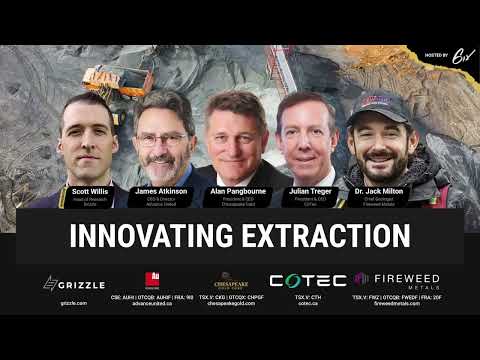
0:07 All right, everyone. Looks like we're live. I hope you're ready for an action-packed roundtable, looking at the technologies that are poised to revolutionize the mining industry. This actually is a perfect day to do this because there's some pretty exciting news that broke this morning. We'll talk more about that. I'll ask the guests about it, but it's a great day to talk about the topic at hand. So I'm your host, Scott Willis, and you're watching the innovation and extraction panel hosted by 6. Now, remember, we are live right now. So if you have questions, just look on the right side of your screen, there's a box where you can you can put your questions in. And we'll do a Q&A later in the conversation. So we'll try to get all your questions answered. We have some great panelists here today. So a huge opportunity to ask them questions. I would definitely recommend you do that.
0:52 So just to introduce our panelists, we have 4 leaders in the mining sector to discuss the future of what I call carbon-friendly mineral extraction. First, we have Jim Agio and director of Advance United and Pangborn. He's president and CEO of Chesapeake gold. We have Julian Traeger. He's president and CEO of Kotech. And lastly, we have Dr. Jack Milton. He's the chief geologist at Fireweed Metals. So glad to have you here, gentlemen. Good to be here. All right, let's jump into it. So for anyone listening who isn't familiar with each of the companies, I want to start things off, give you each a brief, you know, 2 to 3 minutes, kind of talk about what your company does and what the future holds for you today. So maybe I'll kick things off with Jim, please.
1:43 Well, just to talk a little bit about Advance United. Advance United Holdings Inc. Is a Canadian junior exploration company designed to succeed where other juniors may fail. Our expertise is in identifying, let's call them, and acquiring undervalued projects, gold-bearing projects, and developing and exploiting them to realize the value that may be there and may be unrealized. We are unique in the way this discussion will be, in that we actually have a chief technical officer, which is not something that a lot of junior mining exploration companies have. We have that because we are working seriously with developing various types of technology in our business.
2:32 We see the problem in the junior mining business as being sort of most junior mining companies are designed to fail. Only a small number survive from the expiration to let's call it production. And we think that's best illustrated by what's called the Lassonde-Serve curve. I'm not sure if people know this, but it's basically a plot of the value of stock versus time. It has a very rapid rise at the beginning when things are being explored. It has a peak at that time when some things are announced. And then it goes into what we call a valley of despair where it's being, the money is being spent on production and things like that. And the share price actually goes down.
3:17 Our model is to actually not get into that valley of despair but in fact, get our projects to the point where we are at the top of the Lassonde curve and then find somebody who's much better than we are at doing development and production and actually vending the property off joint venturing it, or maybe even just selling it. We also see as part of this whole success, the application of various types of technology on the exploration side, generally from the point of view of assisting people in finding projects, but also we think in assisting people who want projects, for instance, developers or mid-tier companies to find the people that have the projects.
4:04 And that's kind of where we see our technology working out. As I said, we have technology people on board. They're actively working in these areas. That's kind of it. I'll stop there and let the other guys have a go. Great, maybe could I have Julian go next? Julian, are you with us? Here, we'll give him time to catch up. How about we just have Dr. Milton go ahead, if you would. I'm Jack Milton from Fireweed Nettles, formerly known as Fireweed Zinc. We're a Canadian junior exploration company focused on crystal nettles exploration in the Canadian North, in Yukon and Northwest Territories.
5:01 We've been exploring the Tom and Jason deposits at McMillan Pass, which are some of the largest undeveloped zinc deposits in the world. And through use of innovative ideas and technology, we've made a new discovery at Boundary Zone, which is a new Zinc discovery. And in addition to that, we have one of the world's largest undeveloped Tungsten deposits, MacTung, as part of our project. So I'll hand it back to you there, Scott. All right. Can we have maybe Alan weigh in? Sure. My name is Alan Painbourne. I'm President CEO of Chesapeake Gold. We have a very large undeveloped gold, silver refractory deposit in Mexico.
5:51 20 million ounces of gold and 500 million ounces of silver. I guess we started a little different. We started a private company 3 or 4 years ago and had access to a technology that we believe will change how people attack refractory Gold. And in particular, it will allow us to heap leach the sulphides, convert those to oxides and then leach them as a conventional oxide heap leach. A lot of it was borrowed from the copper industry. They've been doing it for 30 years plus. And then we went looking for a project and we found Chesapeake. We did a deal with Chesapeake backed into the project and we've been working on applying technology to that deposit.
6:42 And then we'll start looking for other deposits. Why the interest? Other deposits. Why the interest? Quite simply, if you can use 90% less power, 90% less water and not have a tailings dam when you compare it to the current technology, which is all the clays and large mills, anybody who spends less power and less water has to be able to treat it cheaper than the alternative. And that economic advantage also brings green gold advantages when you're trying to permit and also your credentials with the rest of the environmental movement. Got it. Yeah, I know you're doing some interesting stuff. So I'm looking forward to diving into it a bit more.
7:28 So when we get Julian back, we'll give him a chance to talk because he's doing some interesting things at Kotech as well, but let's maybe dive into some more general questions on the industry. So I wanted to kick things off and ask the panel, why do you think the commodity extraction industry is a laggard when it comes to using, researching, incorporating new technologies? I mean, we all know there's a reason for that, but I just wanted to get your guys' take. Maybe we can have, Alan can weigh in first. I'm sure, I think there's 2 reasons. One is, I don't actually believe there is a mining industry per se. It's broken up into pieces. You've got the gold miners, the copper miners, the nickel miners, the lithium miners, and there's very poor sharing of technologies across them.
8:18 And we saw that with copper versus gold. They're both oxidizing pyrite. Yet the gold industry hasn't looked at this alternative yet. So I think that's one reason. The second reason is sometimes the risk profile of a new technology in your production, particularly if it's your only mine, is too big a risk to take. So, you know, if you think about a project, it's got to be done safely on budget, on time, and most importantly, it's got to work. Because if it doesn't work, the business goes broke. And so I think Some of it is that conservatism drifts into that. I've worked for the largest mining company in the world and they can be very conservative because of the risk profile and the negative reaction from the market when a project doesn't reach design.
9:25 It's fatal. I think just a little bit on that. I've been in the business probably as long as you have, Ellen, but one of the other things that I've come up against in several cases, including when I worked at a mine, was that's the way we've always done it. And that's definitely, I think, a real factor in this business. One of the problems that we're seeing, and again, this is sort of off topic, but not really, is the lack of young people coming into this business. And because of that, you know us old timers tend to do things in old timey ways and I think that's another factor that I think we need to take a serious look at in this business. And I'm glad to see Dr. Milton here because he seems to be a young fellow, which is perfect. Well, Dr. Milton, do you want to weigh in on this question from your perspective?
10:15 Yeah, absolutely. I think there's a couple of things there too. In addition, as to Alan, you said the risk, the cost of trying to implement a new technology is very high in the mining space. And you compare that to other spaces where, say you implement a new software platform or something with a relatively low capital cost to implement, that forms a big barrier to some companies in exploring these different processes and technologies that may innovate the extraction process and forms a bit of a barrier in that sense. I think another reason why the mining industry has been in some cases a laggard in terms of technology is that the companies who do mining are generally mid-tiers and majors and they're not set up in the same way that a tech company would be, which these very nimble, lean startups that where a lot of these technologies come out of that can operate very differently and are incentivized differently and can produce these new technologies in a much more nimble way.
11:39 Interesting. You know, so we have Julian back. Julian, I just wanted to give you a chance to tell everyone watching a little bit about Kotech because we just missed you. If you want to go ahead. Okay, can you hear me now? Yes, we can hear you fine. Okay. Yeah, I mean, Kotech should be and hopefully will be the answer to why the mining sector doesn't have an eBay or a Tesla or an Amazon. I think there's an opportunity for a disruptive challenger to the incumbents. And the strategy behind Cotech is to identify revolutionary new technologies of which there are many and then take those and apply them to other assets in the mining space, be they brownfields, opportunities, mines on care and maintenance, marginal mines, and of course, very significantly waste.
12:33 So we're very interested in retreating dumps, tailings, and using that to create a new type in company for the 21st century. And the commonality of the technologies we've invested in is that they are much less intensive in terms of heat and water. They're much cheaper and they're much more modular. And I think those are some of the ways in which the world is going to get the commodities they're going to need to get to the climate targets. Great. So just going back to this I'm wondering kind of what has changed nowadays. You know is it just is access to capital now there where if you're going to incorporate technology and decrease your emissions, there's more capital willing to fund your projects.
13:24 Is that an incentive? What are some of the incentives you think are just, what's changed socially that's now maybe pushing companies to really incorporate or look into new technologies more than they did say the last 20 years, if anyone wants to weigh in on that? I mean, first of all, there's a ton of money that's coming to the sector from Silicon Valley. So there's a much more vibrant environment for getting funding. And then people have been working on these issues for the last decade or 2. And so they're now well into past laboratory stage and are starting to be scaled. And as I say, a lot of the technologies are much cheaper and more modular. So the historic barriers to entry regarding economies of scale and the enormous amount of capital which was required to be invested to achieve change has altered, and it's a much more flexible environment.
14:27 I think we're also seeing consumers getting into it. So for instance, General Motors, Volkswagen, getting into let's say lithium business means that now we're going to have people involved in these businesses that are used to using technology and are used to having innovative points of view. And I think there's going to start to be, you know, force, let's call it force or questions from these major investors as to why this is not happening in the mining business. And I think I see that as a very positive thing. You know, when you have people from Silicon Valley, rich people, you know, getting into mineral exploration companies, they're going to start asking questions about, why are you guys doing it this way? Why are you not doing it that way? And that's certainly, I think, going to help the technological advances in this business.
15:21 Now, many of you have been in this business a long time. So I'm curious because we were hearing more about these tie-ups where some of these companies that are dealing with battery technology are kind of trying to go vertically integrated. Has this happened before where companies who aren't in the mining industry start doing partnerships with miners or is this kind of an uncharted territory? We haven't seen it to this extent. Maybe Alan Way in or... I was just going to say it's slightly different, but some of us remember when the oil companies decided that mineral exploration was pretty easy, so let's start throwing money at it. And that sort of didn't really go anywhere. I think the difference now is that in those days, the oil companies looked at it as a way to make money. These new companies that are coming in, I believe, are ways, as you mentioned, Scott, to let's call it solidify their sources and solidify their sort of infrastructure, how to get the things that they need by supporting it right down to the, let's call it even the production and manufacturing level.
16:27 I think, Scott, the other thing, If you go back far enough, 100 years ago, it was very common to have fully integrated mines, process plants, smelters all the way through to wire mills. And that got broken up as you saw globalization and downstream processing became cheaper in other places or easier to do in other places. And so you started seeing that whole supply chain breaking into pieces and dotted all over the world. I think most recently with the Ukrainian war, with the push to bring things closer to the end user, so you're seeing people coming back to Mexico, Canada, elsewhere, to tighten up that supply chain for geopolitical reasons.
17:21 And so you're seeing that vertical integration coming back again. But there's many a landlocked smelter sitting around the world that were built originally on a mine and now import concentrates and it shouldn't be there. If you're going to maintain a separate supply chain that's dotted all over the place, processing facilities should be on the coast at a port. Yeah. So yeah I think Ford historically did quite a lot of vertical integration but very expensively and unsuccessfully. The problem now is that the supply of new materials has to come from smaller companies and there isn't the public stock market support for that financing in the quantities that are necessary.
18:17 And the majors aren't gonna be spending necessarily money in this area. So there's a huge funding gap facing the world in order to get the amounts of materials that are necessary, which is probably not gonna happen because it's happening very slowly. So the OEMs and the governments have to step in in order to help the funding gap. So it looks like the OEMs are starting to, we're hearing some contracts, but it's still early days. Do you think our governments, at least in the developed world, are they doing enough to support investment? Or do you think more has to be done? I think the biggest single issue we're going to face going forward isn't finding it or being able to build it, it's getting it permitted.
19:08 You can, the governments around the world have historically for the last 2, 3 decades made the permitting process longer or arduous or constrictive. And there's a massive knot in my backyard. And until the entire world population works out, if you want to go electric, you're switching from an energy-based economy to a materials-based economy because of copper, lithium, cobalt, nickel, tin, you name it, we've got a serious problem with permitting. And although some companies, countries, sorry, like the United States are throwing lots of money in this area, at the same time they're refusing permits at Pebble for instance. So they need to get, I think they need to get their act together and decide what it is exactly they want to do. I mean, we are very thankful for what they're doing in the United States as far as exploration goes, because a lot of new technology is being applied by the United States Geological Survey in areas where it was never applied before, for instance, in the east or in the northwest.
20:21 And that's being funded by the government. But by the same token, as I said, they're refusing permits and some of the largest deposits in the world. And I'm a gold-focused company, so I feel that one. But it's exactly as Alan said, they need to decide what they want to do in this area. Yeah. So conflicting signals, it seems like. I would agree. Well, it's not just the governments. You also have to look at what's happening with the NGOs and how they're weighing in and stopping projects consistently. And so it's not just the explorer or the miner and the government.
21:07 There's third party in the room. Dr. Milton, are you having these kinds of issues with First Nations in northern BC and the Northwest Territories and Yukon? Oh, I mean, we have some very good relationships with the First Nations in the areas where we work. But in terms of what the government can do, I agree there's a long gap there in terms of permitting that can be closed but we are starting to see some things put into place for critical metals projects. For example, a critical metals flow-through incentive in Canada. And I think that, you know, with the speed at which government typically moves, we're gonna start seeing these rolled out over the next few years, but I wouldn't be surprised to see more initiatives for critical metals and whether that's, you know, financial initiatives or more favorable permitting timelines remains to be seen.
22:09 And sort of per your point about vertical integration of mining companies and their end users, We've seen that before in our space, in the tungsten market, previously in the belt where we have a MacTongue deposit, there's a Canton mine, and that was financed in part by Caterpillar, in order to supply tungsten for dozer blades. So these things, you know, these kinds of vertical integrations, whether it's been fully vertically integrated or just, you know, a financing, you know, up or down the supply chain, have been around for a long time. This was in the 70s. And, you know, perhaps what we're going to start to see more is this sort of outward integration where governments start stepping in and providing financing to critical minerals projects, such as they have done for certain tungsten projects in the States.
23:10 For metals and minerals that have a really, really tight supply in terms of their geography and their sources for these countries. Well, the Japanese and the Koreans have been doing it for 20, 30 years with offtake agreements and still do. They will support new mines if they're going to get concentrate supplies to take home? It's a supply chain issue. Who gets the supply of what and where does it go? So we've talked a little bit about the costs of technologies, but so in my mind, there's 3 costs of miners to deal with. There's social, that's, you know, local, international community, there's regulatory, and then there's the dollars and cents, economic.
23:57 Now, are the benefits to lowering mining emissions concentrated in only one of these cost areas, or do you guys think that miners can really have it all when they're putting new technologies to work successfully? Oh, I'll jump in. I think our example is exactly that. It's all 3. It's cost effective because you're using less power and less water. It's environmentally and socially acceptable because you're using, producing less CO2 and you're using less water. And water is a big, big issue with any local community.
24:42 Everybody's concerned about what impact you're gonna have on quality, quantity and availability. So I think as you move into these different technologies, whether it's something as, I think, as simple as what we're trying to do, or even all of the data mining technologies, anything that can make you use less to produce the same or produce more is a win-win around everybody. Yeah. I would agree. I mean, we are, and what we're seeing is more efficiency as well, and more recycling. So you're getting not only lower costs, but you're getting more production, as well as all the benefits that we're talking about, and particularly on the recycling front, you're going to see, you know, waste dumps, which have unattractive environmental profiles shrinking.
25:43 You're going to see the deposits, which are put up for the environmental cleanups having to shrink as well, releasing capital, I think there isn't going to be a trade-off. I think you're going to have less heat, less water, lower costs and more flexibility. And that's what we're seeing in the Kotech technologies already. And this should actually help us as investors figure out what technologies are the most likely to move forward are ones that would hit all these these costs and would you would get it all. Kind of some nice cost areas for us to look at and say, does it check boxes? Yes, it has, but kind of a decent way to look at it.
26:32 Yeah, and we'll get carbon credits coming soon as well, and taxes and carbon credits, which will help the process along as well. Yeah. Now, I wanted to flip it and ask you, Are there downsides to the industry's recent focus shift to decreasing emissions? Do you think social pressure is pushing some miners to move too fast, which in some cases could be a detriment to shareholders? I'm not sure if it's quite like that. I think there's more of an issue of you can't get the alternatives they want you to use because they're just not available yet or in your area or fast enough. So if you start looking at solar farms or wind farms or whatever, as society pushes you to go more and more green, which is fine, there are certain parts where you just can't.
27:34 Or you can't get it. If take the northeast of the US, great, you buy an electric car, but look at where the power came from on the other end of the cable. It's still cold generated. Yeah. Or, you know, other places, BC has 90%, I don't know the exact number of its power is hydro. Great, buy all the electric cars you want, but you can't transmit it to your houses. If everybody on Marine Drive plugged in their electric car tomorrow, the power generation and transmission system can't support it. So I think that will be more of an issue than we get pushed to do these things and society all goes by as an electric car and then you stuck it in brownouts.
28:25 Well, I think the other point on that is that, and this has been brought up several times, is that if society, let's say, wants us to go electric, then they better be prepared to permit it, as Alan is saying, and also to pay for it. For instance, in Ontario we have the highest electrical cost in the country, And people are pushing mining companies to come and produce in Ontario, but there's no push for them to reduce the cost for electricity. You know, the Borden mine, which is up near Timmins, was recently electrified. The whole mine is electric. That's great, wonderful. That's great for the environment, but their costs are horrendous. So, you know, there's, that's, I think, kind of the balance that has to happen. Exactly what Alan and Jason are saying. That's a balance there that has to happen.
29:14 Yeah. So we talked a little bit about that before. It sounds like maybe is the industry a little bit in la-la land as far as electric vehicles where, you know, we're seeing pretty strong uptake even in North America now, but we're not at this point where there's enough raw materials to support all those batteries, but everyone wants to get there. So, you know, governments are gonna have to realize if we really wanna hit these targets, you're gonna have to incentivize a lot more activity in these critical metals. Is that kind of fair to say? I would say yes. It's that and infrastructure, right? I live in BC, Go up to Whistler on a long weekend and try and charge your rechargeable car. Right. And I can go and fill up my car for fuel in under 5 minutes.
30:04 And there isn't a queue. Yeah. It's the governments and society need to look wider than just build a mine to supply the copper or whatever mineral you're after. It's then the entire, you've got to change the entire structure of how society operates. Now, how many people have still got gas heating? How many people have still got gas heating? How many people have still got a gas oven in their house? You want to change all of that in the next 20 years? How many years did it take us to build it all?
30:54 So maybe I can ask you guys, we're talking about technologies. Are there any technologies, what's on your radar? Which have the most realistic chance of widespread adoption in your areas of expertise? Maybe I can start with Jack. Yeah, sure. So the technology that's been on my radar for the past few years is ore sorting, particularly particle-based ore sorting. And we've trialed this method at FireEat at our boundary zone. And It works best where you have very heterogeneous mineralization that's very sort of nuggety. And the more organic it is, the better this stuff responds.
31:43 And essentially, It's something that can be implemented either in a pit or underground or just crushing. And it rejects waste before you even send it through the mill using a variety of the different sensors, either XRF or XRT, looking at either chemistry or density. And it's a way that miners can increase their efficiencies, improve recoveries, improve head grades that are being fed into the mill. And this has many knock-on effects for that operation. If your mill is your bottleneck of your throughput that is constrained to a certain tonnage per year and you are able to double the grade that you put through that, you're gonna get double the metal.
32:39 Your recoveries are likely gonna increase because typically you get better recovery if your head grade is higher. Not in all cases, but typically. And also your tailings volumes are going to be massively reduced as well. So it's one of these technologies that I think is, you know, it hits all 3 of those categories you mentioned there, Scott. It has huge economic benefits to these operations. And the social benefits and regulatory benefits of reduced waste are also very significant. And I think adopting it at an early stage in a project lets you capture that value at that stage rather than by the time it's being mined and capturing the appropriate data at that exploration level to enable that technology to be optimized in the best way for mine planning and mine scheduling.
33:43 Interesting. Now, Julian, I know your whole business is to invest in technology. So I'm curious, of the ones you're looking at or have invested in, what looks the most promising to you? I mean, we've looked at 200 technologies and we've invested so far in 3 and we have term sheets off with another 2. So the ones that we've invested in can make the pellets for green steel with arc heat, which would save 1% of the world's global emissions. And is again, modular and much cheaper. Could also be used to re-agglomerate waste. And then we've invested in a plant which can apply this technology. And lastly, so far, we've invested in a green technology to recycle magnets and extract the rare earths from them in a clean green way which would obviously help the independence of the west vis-a-vis the Chinese in terms of critical mineral and rare earths.
34:48 It's actually to leach heaps with greater recoveries and quicker than existing technologies and also add some green cement technologies again using waste which are quite... We're looking for accelerated ways of de-radiating radioactive materials. You know We are looking at the big issues and trying to come up with solutions for them which can really move the needle in terms of how the world operates. Interesting. So, Alan, I know you're using a technology barred from the copper industry. Is that kind of the most promising thing on your radar from a technology perspective?
35:41 I'm not sure. I mean, there's so many things happening and so many things going on in all sorts of areas of technology applied to mining, and has been for a long time. I think what I tend to do is watch what other parts of the industry are doing. So, You mentioned taking the copper heat bleaching of sulfides and applying it to gold. The nickel industry has just started applying heat bleaching to get away from the autoclave. So it comes back to one of the other comments about energy. You know, if whatever the technology is that allows you to do less, to produce more and use less input, improves your margins.
36:29 And there's hundreds of them all over the place, whether it's as simple as vibration monitoring to avoid catastrophic failures and the data management that you can do now. You know, there was 1 technology I installed 10 years, 15 years ago now. At the time when we first looked at it, processing speeds weren't high enough for image processing in 5 seconds of an image of meter by meter by 2. They are now. And so you can do that. You can improve your quality control. There's all sorts of things I watch. But I look for patterns. And where has somebody done it before that you can borrow it from another, within the mining industry or another industry?
37:17 Some of the things that the miners, the maintenance guys are doing for the heavy trucks and the ability to do it remotely with an expert back in a city Because you can now get, as we're doing now, 5 of us from 5 different parts of the world having a video conference. Some of the suppliers are doing it with cameras and audio, talking directly to the mechanic at the mine at 4,000 meters above sea level, talking to an expert thousands of kilometers away. Yeah. So it sounds like the increase in computing power is part of this equation. Oh, for sure. If you look at what Rio and BHP has done with remote office, remote control rooms, once you can get it into that cable, you can be anywhere in the world.
38:15 I think this is one of the things that, you know, when you ask about technology that we're looking at, you know, my focus of being an exploration company is how do we improve our chances of being successful? One of the ways is to pick good properties in the first place. And we use AI, you know, in a series of algorithms to actually tell us projects that might be of interest to us. For instance, right now we have a database of all the gold occurrences in Ontario, and we can stick our algorithms on that to come up with projects that we think fit our criteria. But alternatively, other kinds of technology that I'm interested in bringing into the exploration field is things that are being done and have been done for a long time in the oil patch. Things like downhole borehole geophysics or directional drilling or things that the oil patch guys have done for a long time.
39:08 We know that when an oil company drills a well, they know what they're going to find before they drill it. They just don't know how much is there. And that's one of the things that we need to get, you know, get a little bit better at in our business. And, you know, that's where I think technology and, you know, including AI and machine learning can help us, help us do that. Now, we've talked about technology improving the efficiency of mining, but is there other ways that it can help companies, you know, communicate or work more efficiently? Like Jim, for example, I'm looking at you with your AU marketplace. Are you guys seeing that? That seems more typical of what could be, if it could be used in say an Amazon or an Apple could potentially work at a mining company. It's just not related to the mining. It's more how processes work behind the scenes with the employees. Are you guys looking at some of that stuff? Well, we're funny you mentioned that because we like to consider ourselves as becoming the Amazon of the mining business.
40:05 And that's because we're looking at putting together projects that need support and putting them together with companies that need projects. For instance, we may get a query from a company that says, we need to look at all projects within 50 kilometers of our operating mine. Well, we don't have the people to do that, but we can sort through that based on what we have in our database and the criteria that they want and put them together. I think the other thing that's really, really significant in this business, and I really thank COVID for this, I can now talk to experts and listen to presentations by experts from all over the world. And we can do that. Like what we're doing today. Exactly what we're doing today, exactly. And there may be something going on in gold or copper exploration in Tanzania or in Australia that's gonna help us with our projects here in North America. And I think that's the kind of technology that I'm looking at to help us in our business.
41:08 Now, Julian, I wanted to get your take on this next question, because your firm has taken a unique path to incorporating green mining technologies. So you're starting with the tech and then you're acquiring mining assets where they can be applied instead of the other way around. So in your opinion, how can green mining technologies best be applied to the mining industry? Do you think outside there should be outside firms that say they go door to door kind of and they say we have these different technologies which one works best for you or should companies be incorporating it in-house in all cases? What do you think? Well there's obviously 2 models. One is the sort of service model where you take a fee for providing the technology and then the second one is where you try and capture the asset and apply the technology and get the upside for yourselves. That's the path that we're taking with Kotech.
42:02 But obviously for the majors who have the largest profile, the licensing route is the one that's acceptable to them. You know, there are technologies which are trying to be owner operators, and that's not really working well with the major. So I do think that you've got to go down both paths as a technology provider And probably you have 2 different structures. One is a service provider and the other one is a sort of principal investor route. That I think allows you to capture the best of both worlds. Now I know some of you guys are operators. Do you have an opinion? Like if there was somebody who could go around and say, we have this technology, it's proven on your type of mining, let us apply it for you and you'll pay us a fee. Would you prefer that over having to incorporate it yourself, figure out how to make it work? Does it seem easier if there was a Schlumberger of, you know, gold mining, for example?
43:10 I think some of them already exist. You bought some technologies you can buy off the shelf. You know, you're talking about IT and data management and all of those things. And the mining industry does. You know, I think there's all the multiple models that you've heard. Depends what it is. Yeah. So it's already here. It's just it's going to evolve over time. More options, probably. I think so. Gotcha. Now, I want to ask what metals do you think are most right for disruption on the technology front? Lithium. Because, well, simply, lithium batteries are being pushed because of the weight component.
44:05 So for cars, but for mass energy storage to solve the issue around solar and wind, those batteries are on the ground. Weight is not an issue. Exactly the same chemistry works with sodium. And there's an awful lot of that around. Is there room to improve the mining process of lithium too? It sounds like we're already starting to move away from the big open pits, sun drying, that whole thing. Yeah, I don't know. I think the problem right now with lithium is that there's too many people trying to promote What they have with respect to lithium and not a lot of people actually mining it at this point in time And that I think is a problem But again, the metal that I'm most concerned about is copper. If you take a look at an electric car, for instance, there's about 10 pounds of lithium in an electric car.
45:10 There's 185 pounds of copper. So that means for the million cars that are EV cars, approximately, they're on the road now. That's 180 million pounds of copper. Well, they're talking about 10 million pounds or 10 million cars in 10 years. That's 1.8 billion pounds of copper. Okay, that's what's produced by one of the largest copper mines in the world every year. And I think that's really where we're not focusing our attention very well, for 2 reasons. First of all, I don't think that we've spent enough time and effort trying to sort of get away. And this is where, you know, the stuff that Alan's talking about and also getting away from big, open pit mines. Let's go back to some of these places and apply some new technology.
45:56 I know, for instance, in the Southwest US, they're using leaching technology. Alan, I'm sure you can speak to that better than I in some of the old mines and recovering Copper from lower grade. I think that's a critical metal that I'm really concerned with. Now do higher prices fix these problems at the end of the day? I spent 15 years in the copper division. Yes. What happens in the copper market is as the price goes up, you switch to aluminium. So even though it's a poor conductor, you increase the cross section, the weight is less and you start switching to aluminium, not just for power transmission, but also to radiators, heat transfer.
46:49 It's not as efficient as copper, but there is an economic trade off and you see it. Same with recycling. Recycling goes up as the price goes up because they start pulling all the old cables out. So it alleviates it. The issue with copper is it's 20 something million tons a year. So forget pounds, you end up in too many billions too quickly. Well, I like billions. I like billions. Yeah. But, you know, 20 million tons a year or wherever it is now, 24, somewhere around there. That is 24 Escondidas and that's your biggest Copper mine in the world. I'm currently sitting in Chile in South America, biggest 40% of the world's Copper comes out of this country.
47:40 And it comes out of less than 10 mines. You can't replace them. The average time to take a fast copper project, and I built 1 10, 15 years ago, takes at least 10 years. The permitting and processing in Chile is expanded by another 2. So now you're out to 12. You can't name me the 10 copper projects that there are holes in today that are actually buildable. Yeah, they're in wonderful places like the Congo, Argentina. If they're in the US, it's pebble resolution. Resolution has been trying to get a land swap for the last 25 years and it still hasn't got it.
48:36 Yeah, that's the real challenge. The large copper mine in Northern Montana got their environmental permits in 1986 and they're still not in production. Yeah. Yeah, so it seems kind of likely you may just run into this wall where the society has to say, do we want electric vehicle adoption to go to this level because we can't get there right now the way things are going and then stuff has to change. You know, prices can go up. That'll incentivize drilling, but permitting, you can't get around permitting no matter what the price is right at a certain point. So is that kind of so for Alan, is that kind of the sticking point you think? I mean, no matter what the price is and what what drillers, what explorers want to do, if governments aren't amenable to it, it's just not going to get there in time.
49:25 Well, not just that. I mean, to put it into perspective, Escondida was building for over 20 years. They built phase 1, then 2, then 3, 3 and A04 sulfide leach, oxide leach, Laguna Seca. There you go. 8 expansions over 20 years to get them to where they are today. Yeah, it just takes time, right? You can only go so fast. It takes time. Chile is incapable of building more than 3 projects at the same time. It doesn't have the contractors, the people, the materials. There are only 2 suppliers who can put together the large shovels. There's only one supplier who installs the large wraparound motors.
50:15 There are physical limits. The big shovel suppliers, P&H and Bosiris, who's now part of Caterpillar, and P&H is now part of Komatsu, only make 1 shovel a month. That's 24 a year. Can they gear up? Of course they can gear up, but that takes time too. Yeah, yeah. Yeah. Very interesting. Now we're getting to the point where I do want to take 1 Q&A question, make sure we don't run out of time. This is an interesting one. I'll want to see what you guys think here. This is from Paul Rankin. He says, how do you think mineral processing or mining electronic technology software firms will compare in valuation to conventional mining companies?
51:03 And as you incorporate, basically, he's asking, as you incorporate more technology, do you think there'll be a valuation uplift in the mining space or does it really take profits, consistent profit uplift? What's your take on it? Profits. At the end of the day. No, because when you get into the scale of it, so many, If you look into the big miners, the level of technology that they're all using today is nothing like it was 20 years ago. You've got fully autonomous fleets, you've got remote control centres.
51:49 The oil industry today has remote control centres for their refineries from all over the world. The level of technology within the mining companies themselves, certainly the large ones, you have to see it to believe it. It really is impressive. And the gear, the stuff that the gear carries now, the number of sensors and instruments and data that you can get off of all of the gear that's operating. Yeah, and then what- Yeah, so in a perfect world, technology is going to allow costs to come down and that should lead to higher profit margins and then you would get a valuation uplift. Or you go to lower and lower growth or bodies.
52:38 Right? It goes the same way. I think a few years ago when the tech industry was raging, someone might have made an argument that because these tech companies that were raging were not making any money, in fact, they were not making any profit. It was sort of the prospect of the future. And I'm wondering if there may not be some aspects of that that can be applied in our business in the sense that, you know, we're going to get a re-rating because of the prospects of the future of us actually incorporating a lot more technology and, you know, and in the end, presumably making profits. But at this point in time, I'm wondering if not re-ratings may occur just because people are saying, hey, this is something that's going to be going to be good in the future. And it's going to be compared to, let's say, some of the tech companies that were making huge valuations before they made a cent.
53:35 Yeah, I mean, I'm thinking if you look at it, you say demand for these critical minerals is going to be higher on an annual basis going forward than it was in the past. Well, then maybe it makes sense to have a higher valuation. Well, especially if there's technology is becoming involved to, you know, to as Alan says, bring down costs or increase profits in the end. Right. Yeah. Yeah. So there's an opportunity there. It seems like I think so. Yeah. Well, but you've also got to remember the exploration model, the pharmaceutical discovery model, and the tech model back in 2000, they're exactly the same business model. They are exactly the same business model. If I drill a hole into Eldorado, my valuation goes through the roof at the front of the Sol curve.
54:23 Yeah. Call it Bre-X, call it whatever you like. It's all valued on the potential, not reality. Yeah. Pharmaceuticals the same. Tech is the same. It's the same business model. And I think bringing the tech into the, you know, into the mining, let's call it exploration, even mining, sort of has the same kind of thing. It's the model, it's the, you know, the potential of what's going to happen in the future. And having tech, I think, is going to help that potential or increase it, if you want to call it that. I'll give you another example. In Australia now, they're using 3D seismic to find the quartz veins in the greenstone belts. They're not even drilling a hole.
55:10 But it's becoming more like the oil patch. Like I said, when the oil company drills a well, they know what they're going to find. They just don't know how much of it's there. And that's what it's like becoming like in some of these technologies in exploration as well. And I welcome that. I think that's going to be great. The CSIRO in Australia has a project that can look tens of kilometers deep. That's fine. Can you buy it? Can you mine it down there? That's the thing. Anyway, yes. All right. Now, this would be kind of a question for Alan. I think or is so it's cut maybe copper related with lithium related basically asking are there other jurisdictions that you think will start to really give Chile a run for its money as a center for copper, center for lithium?
56:00 Are there other regions that you think are very prospective? So I lived in South America for 22 years. Lithium is the lithium triangle, right? Bolivia, Chile, Argentina. So which basket case do you like? Okay. Yeah. Okay. So I've worked in Argentina. The only one I haven't worked in is Bolivia. That's because most Western countries, companies won't go there. So you know, other sources of lithium, Australia is actually a big lithium producer from hard rock. There's a lot of lithium exploration in northern Canada. Again, hard rock. There's 1 that's just been supported by the US government in Nevada.
56:52 So they're out there. Mexico supposedly had some big deposits until the local government tried to nationalise it all. When it comes to copper, again there's belts and all of the Copper companies are where they are. Pakistan, Afghanistan are interesting spots. Mongolia, look at what happened to Rio and their partners. Indonesia, Chile, Peru, Columbia, they're starting to move in up through Panama, look at what Panama's just done, the 1st majestic. Yeah, there's plenty of places to go look. The Chilean government will tell you that there's a lot of deposits that haven't even been found in Chile yet.
57:44 And there are a lot of exploration companies looking for them. Yeah. And then part of it also depends on price. I mean, if prices are higher, they make marginal deposits, economic, and so that can kind of change the outlook as well. Yeah. But then the government wants more of a share too when the prices go high. Yeah, yeah. They're well aware of what the economics are on those projects. And then you just ratchet up the taxes to make it even. Right. Yes. All right, everyone. Well, there's a lot more we could talk about, but I think we're running to the end of the hour. So I just wanted to thank all our speakers, Jim Atkinson, Alan Pangborn, Julian Traeger and Dr. Jack Milton. If you liked what you heard, these guys are all doing very interesting things on the technology front, on the mining front. So check out Advanced United, Chesapeake Gold, Kotech, and Fireweed Metals. And again, this was the Innovating Extraction panel hosted by 6. So we hope we'll see you