Replay available
Highland Copper Technical Update
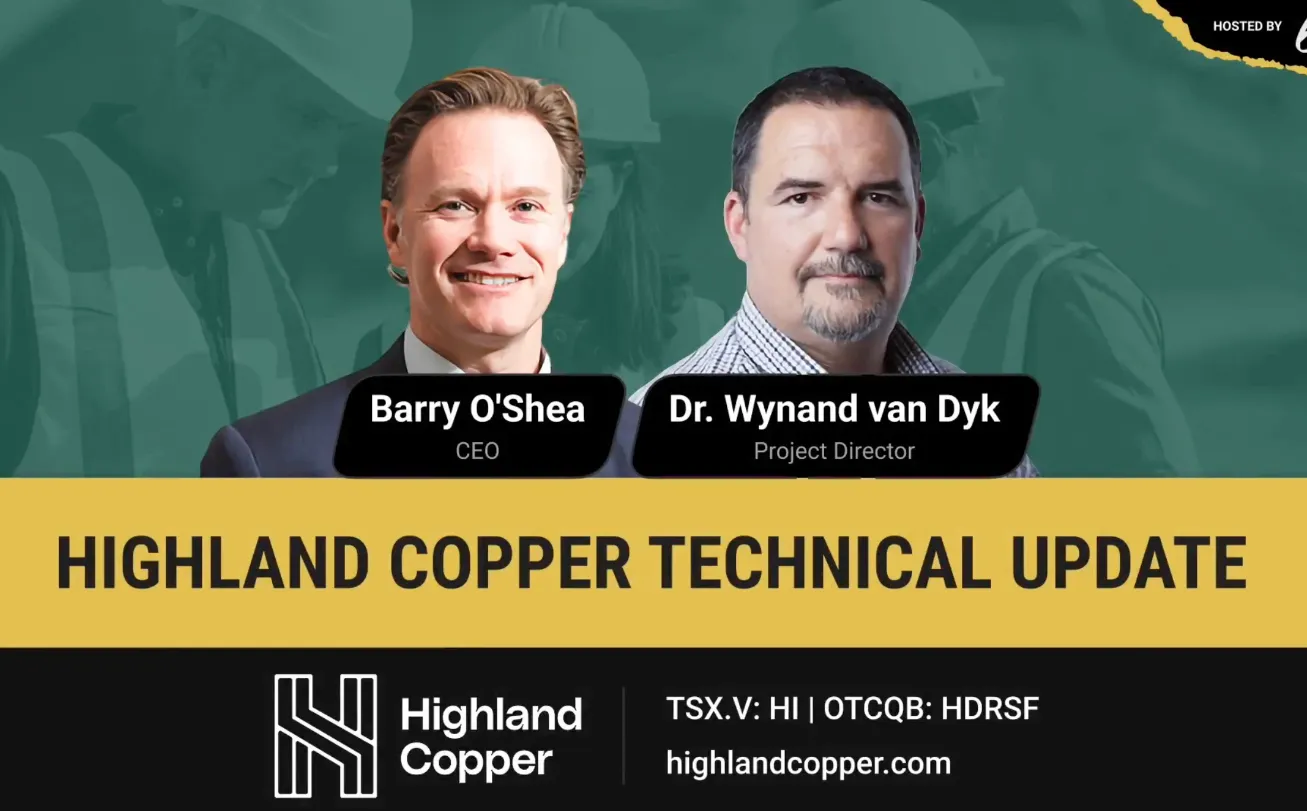
Listen to Barry O'Shea and Wynard van Dyk as they provide a technical update on the recently announced updated process plant flow sheet, demonstrating increased copper recoveries of 87.6% and reduced processing costs.
- Company
- Highland Copper Co., Inc. (TSXV:HI)
- Date
- Mon, Sep 8, 2025, 4:00 PM ET
- Replay
- Watch the replay on this page · 29 min
Replay
Transcript
Automated transcript · Written by software from the replay's audio. It can mishear names and figures; the replay is the record.
0:04 Hello, I've got with me today Barry O'Shea, CEO of Highland Copper and Dr. Vynon Van Dyke, Project Director at the Copperwood Mine for a presentation today on recent news. Because of the wild conference season schedule of September, it was easiest to do a recording today. So that is what you're currently watching. But gentlemen, congratulations on good news. How are you both feeling? Feeling good. Thanks, Romeo. Awesome. Honestly, before I get into anything else, there's no housekeeping because it is a recording. I'll just throw it to Barry O'Shea, President of Highland Copper to kick us off today. Yeah, I really, really appreciate it, Romil. And it's nice to be here today with some good positive views around the Copperwood project, something that we've been advancing for some time now. And you might know a key goal through 2025 is really to optimize the project, advance it through engineering, and really take it as a project that's been sitting at feasibility study level for a period of time and turn it into a project that can truly be built with a goal, of course, of making a construction decision in 2026.
0:59 Of course, the first step to that is putting the right team in place. A key hire that I made about a year ago, I was hiring Vinand Van Dyck. Vinand has a long history, 30 years in design, construction and operations, so really has brought that credibility to our company from a development perspective. And we're seeing some of the payoff now. You know, Vinand immediately brought in DRA Global earlier this year as one of our key engineering partners, both on the processing and mining side. And In combination, we're making some real advances both on our Phase 1 engineering, but most particularly our metallurgical test work, which we're pleased to announce and give some results on today. I'm going to steal Vinan's headlines to some degree here, But we have increased copper recoveries at lower operating costs.
1:50 2 fantastic outcomes when we think about the broad economics of the project. We've landed an 87.6 recovery relative to our feasibility baseline of 86%, a really solid increase, particularly when you layer in savings in and around reagents, power and otherwise. And naturally, Bynum will walk you through the detail that allowed us to come to this conclusion and how our partners confirmed all of our findings. Yeah, thank you, Barry. And Thank you, Romeo. I appreciate it. It's a real pleasure for just being here and being able to discuss this metallurgical update. I think right up front, They have to acknowledge the DRA team for the work they've done and the team at Basement Labs as well for their work. This has certainly been a collaborative effort and we can see the results at the end of the day and happy to talk about it.
2:48 So I'm just going to step through a presentation and taking you through how we got to these results. And then, yeah, at the back end, there's obviously going to be some time for questions. I think as a start, let's just talk about what was in our 2023 Feasibility Study update. In essence, the plant was a fairly complex circuit, treating 300t an hour. It had a single grinding step, although it had 2mls, producing a P80 of about 45 microns. And at the end of the day, the plant was producing 86% recovery or projected to produce 86% recovery at just shy of 25% copper grade.
3:34 And looking at the circuit, there was some very obvious optimization potentials for us that we could look into. And the program, it touched on most of that. I think first of all, the process never had a tailing stick and we really wanted to, from an environmental perspective, looking at options of how can we improve the needed water recovery. It was a fairly complex circuit using traditional float cells, so we looked at ultrafine floatation technology with the objective of simplifying the circuit. We looked at options of can we introduce a scalping circuit, you know, getting an early concentrate up front, missing your cleaning circuit and thereby improving recoveries. This milling circuit as it stood in the configuration is what's called the MF1 circuit. It's known that these circuits produce typically overgrind and we wanted to look at the MF2 circuit to more float and the possibility of not producing a bunch of slimes that struggle to float.
4:39 We looked at this ore storage in front of the plant, how can we optimize that. Certainly from a reagent scheme, simplifying it overall. The last piece was just down here on the regrind circuit. Is this the right type? And call it mill media that we use to grind this ore. This program set off in January. We extracted about 400 kilos of coir. 10 pea-sized drill holes were sunk. We put it in at the exact same location as the samples that were extracted in 2017 and used in the 2018 test work campaign. That's important because that test work campaign was the basis of the feasibility study.
5:27 The change that we did on this one is we excluded the top 30 centimetres, which is of what's called the gray laminate layer. And that was as per the geotechnical recommendations, if we're going to leave that behind to help us with back stability. So we left it behind from a test work perspective. And one last observation, there's a small fraction where we actually intersected the fault, but that gave us some additional material that we could do some of the initial scouting material. This material assayed a head grade somewhere around 2.14. It is elevated, but it's elevated because this is the high-grade area where we're going to go in. And that's the initial area of the mine where we're going in the first few years. So that's why we specifically targeted that area.
6:19 The first step was we wanted to reproduce the test work that was done in 2017, 2018 and just get confidence that we can get the same results. So this is the first initial test plotted against 2 baseline tests, this test 19 and test 71. These were kind of 19 was the baseline used for everything, 17 was the best results that they got which was achieved on exceedingly high NASH dosages. So we compared the results and initially we were off and then over time we got closer and closer to those results and we were comfortable at that point in time where we can reproduce the 2018 results. During that time, something became very apparent for us. If you look at these 2 photographs, when you start this float, initially it's a really high-grade froth.
7:11 It comes over the sellip quite easily. It's a fast-floating fraction. But there's clearly a bimodal flotation response. Over time, 5 minutes, 7 minutes later, you suddenly have this brittle frost structure, which in further analysis was due to this low-grade ultrafine fraction. So the question is, what could we do about it? How do we prevent creating that ultra fine fraction? Initially push more material into this fraction. And that's why the piece of work started on on optimizing the overall circuit. The first piece that we looked at was adopting what is called the NF2 circuit. So remember the original circuit had, you know, also 2 moles up front, but a single primary rougher stage.
8:02 This time around, we've actually now still got the 2 mils up front, but rather than milling down to 45 microns, we're milling to 80 microns, so we're making that quite coarse. Then we have a de-sliming step where we remove a fraction of the material and then we mull it, then a second step into a little bit finer down to the 38 micron. Now, what's interesting in this approach is this slime tail, and We've got the initial set of tests of data. We can extract or remove about a quarter of that massive material that comes into the stream without actually having grades higher than what the rougher tails are producing. So it's becoming a discardable fraction for us. In addition, about 25% of your material is coming across your primary rougher, 25% of the material goes out in that tails fraction.
8:56 So this secondary mill is actually only seeing half of the material that it saw, and That allows you to then put in a smaller circuit or a smaller mill. Long story short, we're milling finer than what we used to mill, down to 38 micron an hour, but that is a substantial power saving. Anything between 10 and almost 14% of mill power that we're not going to draw. So that was a great win for us, great start. All good to have that but the question is, what about the flotation response? Before that, during this time as well, we also looked at the reagent optimization. And there were some key changes that we made here. We removed the sodium isobutyl xanthate or SIBX and replaced it with PAX.
9:47 We removed the A249 promoter and replaced that with 407. And then we're controlling the redox and pH potential right up front so we don't have these massively high NASH dosages in the conditioning. And then 2 of the reagents that's got less favourable environmental footprints for us, we've removed out of the circuit. And the overall net result of that is we've dropped the reagent cost by about a dollar a tonne at the end of the day. We set up a process at this point in time that's lower mill power, lower reagent cost. The question is, what about the flotation response? The first piece of work here is just what happens in the roughers. If you start having these kinetic curves, you now have this step change in the kinetic curve where you previously, these were the previous baselines had a smooth curve. The front end is your primary roughers, and then that's the secondary roughers after that second wall. If you take this section here and you start plotting that out on a recovery by grade curve, what's interesting is that, you know, where the baseline we're getting rougher recoveries just shy of 90%, this new process are now giving us rougher recoveries in excess of 92%.
11:08 We saw lower reagent consumption, lower power, but increased rougher recoveries. That is a really good start. The second question was, what about the cleaners? Because if your roughers are recovering the copper, you've got to be sure that you don't lose it in the cleaning phase. We did the same kinetic bench scale tests on the cleaning circuit. These are selected results. We did almost 45 tests, I think, in total on all of this. And where we have now 2 cleaner baseline tests, 55 and 73. 55 being the standard that they've used on most of it. 73 was kind of their best performance that they got. You can see that our cleaner test straddled it and received comparable recovery. So with the increased rough recovery, comparable cleaner recoveries, but at much lower operating costs and improved ENS footprint.
12:06 We were certainly off to the races and that gave us a good start to this program. Those tests are all kinetic tests, so you want to be able to underline this or score this with lock cycle tests, because your lock cycle tests now take into consideration your closed circuit, specifically in our case around our cleaners. So we ran some lock cycle tests. This is one of those results. And we're down here at the baseline table. This is the data that was in the feasibility study, called the 86% recovery at 25% grade. We're getting comparable recoveries, but it is substantially higher Copper grade. And that is for that specific 2 runs.
12:58 You can take all of this data, you can now create a balanced grade recovery curve for the material. And what's interesting, if you look at the open circuit performance, which is this red line, and you take the balance grade recovery curve, that grade recovery curve, as soon as you close the circuit in the lock cycle test and moves to the right, which you would expect normally. So at that operating point, 33% odd Copper, if we were running an open circuit, we would have gotten 75% recovery. But because we're in the closed circuit, the operating point is now touching that 85% recovery. And the next question then is, at the higher grade, what happens if we come down to the 25% concentrate grade?
13:45 If you come down, we have our operating target of touching the 86% recovery, 85.8%. From an overall lock cycle perspective, at the better power draw on these metals, at the lower reagent cost, We now have a circuit that gives us the same recoveries and the same concentrate grades that we had previously. So that was a real win. And The next piece is then, so what happens if you then add the ultra-fine flotation technology? Some context here, we always knew that we got a more fine ultra-fine flotation as technology that's available, it's mature, There's several vendors out in the market.
14:33 We decided because of the install base to do work with Jameson, the Glencore technologies out there. And the first piece was what happens if we do this again, Now in open circuit, we look at the rougher performance. Where are we? And it's quite interesting. This is a bunch of our bench rougher tests and we compare it to a baseline test done by the Jameson circuits. Again, we get an increase in the rougher tail mass, so that shows that much better selectivity. That grade drops by its very implication. That means that the recoveries are better. And the overall, we had a system where it's similar recovery, same thing, much better grade. So you can clearly see in these kinetic curves where you have the typical, call it kinetic curve of a bench scale type of test.
15:26 The Glencore Technologies guys have got something called a three-stage dilution test, which you run using again bench scale equipment. But there's always this improvement, this uptake once you start using the Jameson cells from a recovery perspective. That gave us a lot of momentum because we wanted to then say, so how can we explore this further and hopefully drive additional recovery. So the last piece of work that we did is we put in, The first piece of work that I showed you was this running with the MF2 circuit with the 2 rougher stages. We then added the regrind step together with Open Circuit Cleaner.
16:14 And all of this work, then all of the information we sent to Glencore Technologies, they built a model for us so that we can model out what the great recovery curve would look like. If you look at this open circuit results, same results that I showed a while ago on the closed circuit Jamieson. You get the improvement in the recovery. Any movement to the left or to the right on this curve means you're doing better from a recovery. And where the open circuit, where it gave us that grade recovery curve, the Jamieson has now predicted to give us this grade recovery curve. We're at the 25% Copper grade. We have an operational target now of 87.6%.
17:03 And that is really substantial for us. If we can get to that 1.6% additional recovery. And everybody knows, once you get the ore out from underground, that's most of your OPEX cost. And if you can get additional copper out at the same ore mining cost, that certainly shifts the overall economics. It's important to realize as well, because all of this work was done at accredited labs, in basement labs, Glencore Technologies were prepared to offer us a process guarantee on this operating point, which we are truly thankful for. So let's just take a step back and recap the whole thing. We started off with a fairly complex circuit, a circuit that's got 2 auburns. It had a single milling stage comprising of a sag mill and a bore mill by grinding down to about 45 microns.
17:54 It had 8 rougher tank cells and there was 25 cleaner conventional tank cells. It had no tailing thickener and it had what's called a vertemol using steel grinding media. What all of this now looks like once we start putting this test work together on the revised circuit, suddenly we have a much more simplified circuit. We replaced 33 float cells with 6 units, which certainly makes a lot more sense. Upfront, I think the most important piece is the recovery shift, getting that additional 1.6% recovery. Up front, we now got a single silo, which is bigger than what we had, which gives us a little bit more operational flexibility.
18:44 This primary milling circuit mills down to the 80 microns, not the 45, so it uses less energy so it's slightly smaller. We have a scalper right up front and that actually extracts a high-grade concentrate which we don't send through to the cleaning circuit. That goes directly to final concentrate So you don't have any recovery losses from the cleaning circuit in there. We have a desliming stage and a secondary mill. That secondary mill now grinds down to 38 microns compared to the previous 45. These 2 stages, the rougher conchs get milled in a re-grind mill down to about 10 microns and then we got a primary cleaner with a scavenger cleaner and a re-cleaner configuration. There's a tailings thickener into the situation in the design, the water that brings us the water straight back rather than sending all of that water to the tailings dam, which we eventually get back. So it's a much more efficient circuit from that point of view. And the initial indications, we are still busy with the detail engineering regarding that is that this flotation circuit, the harder the plant will show, about a 50% footprint reduction.
19:54 Keep in mind, these facilities get built in the Upper Peninsula, so you've got to heat these buildings. So, there's some secondary benefits that we haven't quantified yet, but certainly it's looking good for us in that perspective. So with that, I apologize, it's a mouthful, but happy to report on the results and the work done today. Awesome. I do have a number of questions, actually, if that's all right with both of you. But I'll start with you. What is the significance, just so investors can understand, of those performance guarantees that Glencore Technologies is offering? Yeah, I think, first of all, you know, those performance guarantees are offered because the work was done at a credited lab. So that gives you some assurance regarding these tests.
20:43 If an independent technology company is looking at this data, you know, they agree. It's not me saying it, it's the team overall that's giving us these assurances regarding the data. So I think from that perspective, that lends a lot of credibility to the underlying data and the underlying test work that was done. Awesome. Barry, I'm just going to zoom out for a second and talk about market positioning. I know, obviously, copper being critical to the energy transition. Highland's got that great proximity to the major North American markets. How do you see copper position to capitalize on that growing demand for domestic Copper supply? Well, listen, Copper is increasingly in the headlines in the US. Obviously, the supply demand imbalance, domestically speaking, is very clear and it's only growing. So that drive for domestic production is really pushing forward in the US and it certainly puts assets like ours directly in the spotlight.
21:38 Most recently in the US, I think for the first time the USGS has proposed that Copper is determined a critical mineral. As a matter of fact, if you look just at how the US administration looks at it generally, it already is critical. But all of these things obviously, you know, lead to assets being built in the US, assets like ours. I think there's certainly a read through as well in terms of potential funding that may be available. So certainly at the right place and right time from that perspective. Great, appreciate that. And Dr. Vajna, I want to get into specifics of the economic impacts. I know the redesigned process plan is described as smaller in scale, yet more effective. So what does that mean for capital expenditure reductions? Yeah, great question, Romeo. Yeah, truthfully, that's the next piece of work that's being done.
22:28 All of this gives us the design criteria now for the pump. Phase 2 engineering will now then step into and we'll start doing the detail engineering that's associated with it, look at layouts of the circuit, but the process design is pretty much done, mass balance is pretty much wrapped up as we speak. So once that piece of work is done, that's the point where we will be able to truly quantify the impact on CAPEX. We do have a good feel in the op-ex at this point in time, but CAPEX numbers will be quantified at the back end of phase 2 engineering. Perfect. I do want to get into some of the technical details. So Dr. Ryan, I'm going to stick with you if you don't mind. That ultrafine flotation technology using Jameson cells represents a significant technological advancement, But beyond the immediate benefits we've kind of gone through today at Copperwood, how could Highland leverage this expertise for any future projects?
23:24 First of all, these cells have been around, this technology has been around. So it's not that this is unique to us. Certainly, these cells have got quite a large install base and there's 150 plus installed on Copper, most of it in Chalkasite that we've got. So certainly that gives me quite a lot of assurance from a proven technology point of view. In terms of leveraging this, as you know, we own 34% of the White Pine project. These all types are very similar, although they're not identical. Up to now, the White Pine team have not looked at the ultrafine flotation, but certainly given what we've seen here, it opens up a discussion now on, do we go down that path and do this similar test work at White Pine. Great.
24:24 I know you also mentioned that this represents a complete re-evaluation and re-engineering of the metallurgical flow sheet. What were the key breakthrough moments in this process? And how does the de-risking translate into project certainty for investors? Yeah, there were several. I think that the real breakthrough moment was when the MFT circuit started working, where you don't over-grind this material to a point where it just creates more of that very slow-floating fraction. As soon as you start overgrinding, it also consumes reagents. These fine particles have got a huge surface area. And that's partly why we're also reducing the reagent consumption rates.
25:13 I think the other one was when we got these Jameson cells up and running and working on pilot level. And certainly, you know, starting seeing the shift that in theory that had to work, but seeing the results in practice has been truly satisfying, to be honest. I bet. And last question for you before I get back to Barry. What are the next steps in terms of metallurgical work and that phase 1 engineering? Yes. In metallurgical work, we're still doing some variability test work. So Now you're adding a fraction of the waste. We want to see what this looks like as you move around the various mining areas. At this point in time, we've done this work on composite samples.
26:02 Because we have a really good scale-up factors, we're not going to do more of these Jameson tests. They consume a lot of samples, so we can actually go back to bench scale tests and be comfortable enough on from a scale-up factor. And then the last piece of work is all of this then comes together in kicking off phase 2 of the engineering. So doing the hard detail engineering work, design criteria being finalized, and then getting stuck into the detailed engineering, which should be happening shortly. Great. Dr. Vayan, thanks so much. I got one last question for you, Barry. Looking past the metallurgical improvements that we've obviously talked about today, What are Highland's strategic priorities for the rest of this year going into next year?
26:49 And how do the technical achievements we've talked about today position the company for JVs, strategic investments, partnerships, etc. As we edge closer and closer towards production? Well, Listen, like I mentioned, our goal is to make the Copperwood project construction ready in 2026. Engineering isn't the only thing that we've been doing. We've certainly reported over the last 12 to 18 months, some pretty significant site work, early impacts done at site, site clearing, setting up our stream diversion structures, and most importantly, from that perspective, doing or mitigating environmental projects and building credibility in the region. Now, the really nice component there is that, you know, the project isn't quite a greenfield anymore. You know, some good work has been done on site. We're engaging with the unions, with local contractors, so on and so forth.
27:37 Second piece, of course, is progressing engineering. As Vayanen mentioned, we're coming to the tail end of phase 1 here. So really learning what our design criteria are and most importantly, working towards optimization. You know, we did a feasibility study update in 2023, and it was a good update, but it didn't really contemplate, you know, new information and new work. Having Enviroland in place, putting DRA in place as the engineer really has advanced the project. And I think it speaks, you know, it speaks highly to our team, just the impact that's been that that's been created here, just on the metallurgical side. As we progress through the balance of the year, And this is more of a near term thing, we'll conclude our phase 1. So obviously share some of our insights and advancement on the mining side as well. I think that's going to be a very important.
28:26 But all of these pieces then lead towards, you know, next year, progressing through phase 2, getting ourselves to an engineering point where we feel very comfortable in not just in the design of the project, but technically defending it from a financeability perspective. At the end of the day, we're looking to build this project and get a start on the next year. I'm very excited about that. Awesome. Well, Barry, Dr. Viden, thanks so much for this update. If anybody has any questions that they've logged in today's chat, I'll make sure the Highland Copper team gets them. I'll get back to you as soon as they can. But Barry, thank you
Follow Highland Copper Co., Inc. into a list and get an email when it puts out news.
Latest news releases
- TSXV:HI — CEO.CA's Inside the Boardroom: "The Path Has Never Been More Clear": Highland Copper Lands State Grant · Thu, Sep 10, 2026
- TSXV:HI — Highland Copper Announces Final Approval of US$50 Million Grant From the State of Michigan for Copperwood Project · Tue, Aug 25, 2026
Companies on this call
More from Highland Copper Co., Inc.
- Sep 01, 2026 Highland Copper Announces Final Approval of US$50 Million Grant
- May 21, 2026 Strengthening the Highland Leadership Team for Project Development
- Apr 15, 2026 Funding American Projects Panel
- Jan 15, 2026 The Case for Copper: Building Exposure to Rising Prices
- Nov 25, 2025 Highland Signs Binding Offer From Kinterra To Sell Interest In White Pine
- Oct 20, 2025 Highland Copper Phase 1 Engineering Update