Lorna Blaisse
CEO at HELIUM ONE GLOBAL LTD
Replay available
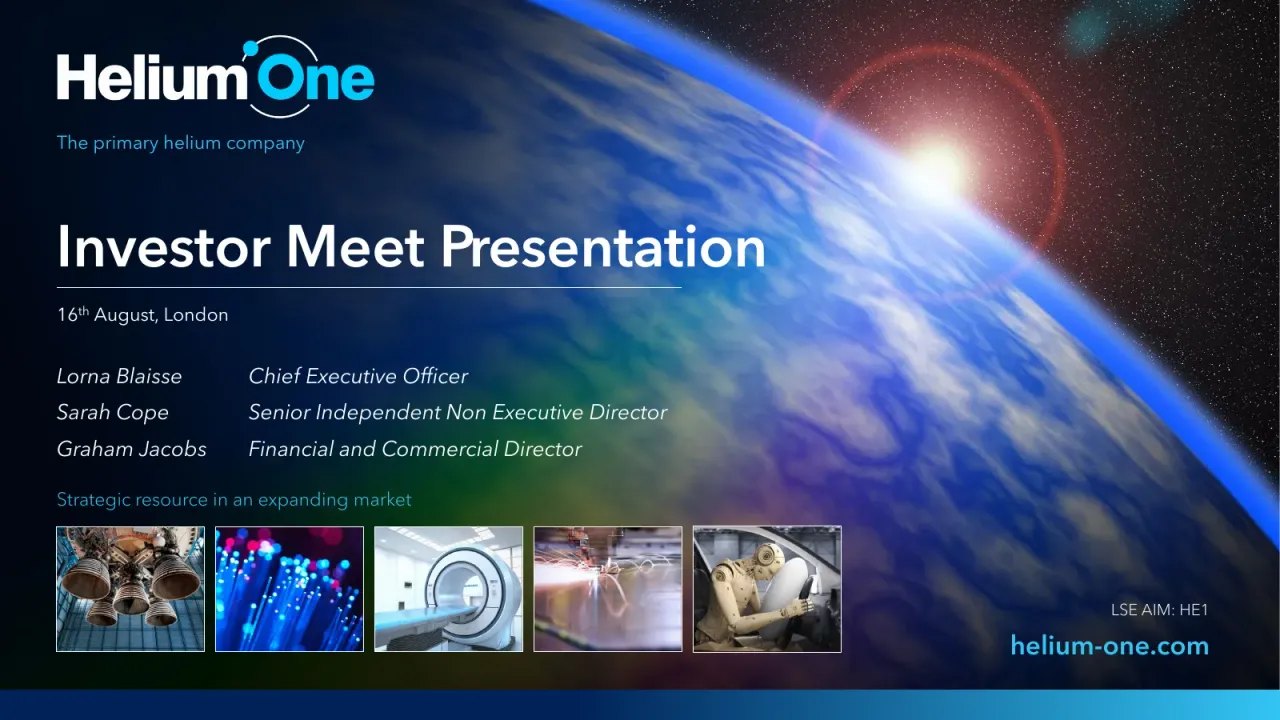
Investor Presentation hosted by Helium One Global (LSE:HE1) on Investor Meet Company, held 2023-08-16.
On 6ix: 6ix.com/event/helium-one-global-ltd-he1-investor-presentation-1
Automated transcript · Written by software from the replay's audio. It can mishear names and figures; the replay is the record.
0:01 Good morning, ladies and gentlemen, and welcome to the HELIUM ONE GLOBAL LTD investor presentation. Screen, please just simply type in your questions and press send. The company may not be in a position to answer every question it receives during the meeting itself. However, the company will review all questions submitted today and publish responses as appropriate to do so, and these will be available via your investor meet company dashboard.
0:33 Before we begin, if I may, I would like to submit the following poll. And I would now like to hand you over to the executive management team from HELIUM ONE GLOBAL, Lorna, Graham, Sarah. Good morning. Thank you, Jay.
0:48 K. Good morning to those of you joining us here in The UK, and good afternoon and good evening to the rest of you joining us from elsewhere in the world. I'm joined by Sarah Cope to my left and Graham Jacobs to my right. Sarah is our senior independent director, and Graham Jacobs is our newly appointed commercial and financial director, and I'm the CEO of HELIUM ONE. So first slide is just our disclaimer statement. So if we could move on to the next slide, please. Okay. So for those of you who are probably very familiar with our our corporate structure to date, but this is an updated slide of of late. You can see the share share chart in the bottom right hand corner showing our our trading volume, which at the moment is currently averaging around 5,000,000 and share prices, the darker blue curve on on the top of that. And for those of you who have been with us for some time, you'll recognize the the key dates on on that chart of when we drilled our first well back in 2021.
1:47 And then more recently, we have been trying to secure a rig to fulfill our q three drilling program in in the Brookwood Basin. And in a few weeks ago, in the middle of July, we were delighted to announce that not only have we secured a rig, but we had actually purchased a rig. So that obviously led to a jump up in our current share price. Currently, we are still on track for a September start of the Thai Sea well. We're looking to start that well in the second half of September. We drilled the Thai prospect initially back in 2021 with a with a minerals rig. The company was originally set up from a mineral and mining background. We used a slim hole design, That rig unfortunately presented itself with with many challenges, which were were were not were not ideal at the time. And unfortunately, the well was drilled under suboptimal conditions.
2:43 However, on the on the plus side, we we were delighted to confirm by drilling that well and using oil and gas mud logging company, GLOBAL, who were monitoring the gas wells drilling that we we encountered a series of helium shows at multiple intervals in in the Taiwan well. And for for the company, that was that was really a a changer. That that that indicated to us that there was an established working helium system in the Ripka Basin something that not only we were originally informed by the surface seeps in the Rookabur Basin, have up to 10.6% helium concentration in them. But to be able to sort of second that that dataset with a with a world was hugely sort of instrumental as to where the company is today. The Thai prospect remains our our best real prospect. It's offers us the highest chance of of geological success and lowest risk, and we very much want to revisit that prospect and and redrill it properly with a with a conventional oil and gas rig in a in a conventional setting.
3:49 Just to give you an idea with the minerals rig, we were drilling the reservoir section in three and a half inch hole. That's okay if you're coring all mineral deposits or or ore bodies, but when you're you're looking for a slightly different level of of of detail and accuracy, Ideally, in the oil and gas setting, you would be penetrating your reservoir section in eight and a half inch hole, and and that's what we will be drilling with with our new rig and and for the Thai Sea well in a few weeks' time. So we acquired a Epiroc Predator two twenty rig at discounted price. I'm pleased to announce that rig has now been mobilized to the well site. A few weeks ago, we mobilized the rig and all of its ancillary equipment and spread across 17 truckloads of equipment to the Rookford region to our lay down area.
4:42 Monday's RNS announced that we'd completed and signed off on the civils work. And now over the next few weeks, we'll be mobilizing the rig and the equipment to to the well site itself and getting everything rigged up ahead of spud. We went out and did a fundraise at the end of last year. We went out and raised GBP 9,900,000, and that enables us to be to remain to be funded to drill the Thai Sea well. We went out on off the back of that fundraise to fully fund us for an exploration well this year as well as have some some working capital to take us through to June. We're now in August. We're still funded for the well. We've also purchased a rig, and I think, you know, we've we've managed managed to do quite well with with with what we had raised. However, any future exploration will require additional funds beyond the Thai Sea world.
5:34 We've got strong management in place, a strong technical team with Africa experience, strong board as well with oil and gas experience. You would have noted that we've recently had some some changes at at at board and management level, and really that's to sort of streamline streamline the company and also focus our skill sets into more oil and gas realm rather than than than the mining experience. Helium itself is a is a is a is a clean, low carbon commodity. We're we we very much sort of pride ourselves at HELIUM ONE in in working a project that is is what we label as green helium. We know from the well that we drilled two years ago as well as the surface seeps data that's been analyzed multiple times by noble gas experts over the years that that this helium gas is not associated with hydrocarbons.
6:27 We've we've not seen any evidence of it in in the world or at surface. And so, you know, it it very much is a a helium nitrogen mix, which makes it globally unique. There's very few producing helium fields in the world that are not associated with with hydrocarbon gas as a as a byproduct. And, ultimately, we we we offer a a low CapEx view on the development for a relatively strategic sized resource. Next slide, please, Tom. We're not just operating in the Rooka Rift. We also hold licenses, prospecting licenses in Tanzania across two other Rift basins, the Balangida and the Ayasi Rifts sit on the north and central side of the country, and then the Ripra Rift, as per the map on the left hand side, sits down in the Southwest corner of Tanzania along the East Africa rift trend.
7:21 The Ripper Rift is technically more advanced. AMCO drilled two exploration wells there in the eighties for for hydrocarbon gas that that were dry. But prior to drilling those wells, they also acquired an extensive two d seismic survey. So when when HELIUM ONE was was founded, that that dataset was purchased and evaluated and interpreted, which led the company to identify where there were areas of interest around the Brookwood Basin and potential follow on or prospectivity and and follow on leads. And that's really what sort of has has hinged the the growth of the company going forward. Subsequent to that, we've we've successfully acquired two infill two d seismic surveys over the last eighteen months, which have been guiding us to work up the Thai prospect and also additional follow on potential in the southern half of the Rukwa Basin.
8:17 The the Eyasi and Balaguida Basins are on the northern half side of the country. They are on the other side of what we refer to as the Tanzanian Craton, and that becomes geological significance for the source of the helium. That is where it's generated and released deep within the deep within the crust, and it's the the mobilizing or the breakup of the of the lattice in the rocks and the mobilizing of the fluid through of the helium gas through hydrothermal fluids that's releasing it into into the the the bases that you see on either side of the craton that that we fortunately hold licenses in. So we're very much positioning ourselves, you know, within within the sweet spots of of where helium can be released and ultimately, hopefully, accumulated.
9:04 Most importantly, all three of those basins have surface helium seeps and high grade. As I said, it's a it's a globally unique project in that we are only seeing, you know, helium and nitrogen in the mix. We're not having we're not seeing evidence of hydrocarbons or h two s or c o two, which makes it incredibly incredibly unique. Helium will always preferentially migrate with the carrier gas. We'll never obtain a 100% helium, but some of these concentrations are some of the highest known globally. As I mentioned, we've got an experienced team in place who have have worked these basins previously. I myself have been involved with exploration projects in in in the East Africa Rift and spent spent five years at Tullow working the appraisal stages of the sorry, the Albertine Rift, and have also had exposure in wells in in Kenya and also Sub Saharan Africa. So very familiar with the geology, very familiar with the tracking styles and components.
10:06 Thai itself is a is a is a robust structure. I'll comment in a bit more detail in the next slide. The key point here is that we're not just targeting one interval. The the previous well highlighted to us that there were multiple perspective intervals at TIE, and we will be targeting those again, plus the basement, which we view as an additional target with the Thai Sea well. Next slide, please, Tara. So this slide highlights what we previously drilled. So the the seismic, the East West seismic section on the right hand side of the slide was a newly acquired seismic line that we acquired for the phase two infill seismic. So this was post drill. And the Taiwan 1a wellbore is projected onto that seismic line with a vertical white line with the blue circles representing where those helium shows were encountered whilst drilling.
11:01 We've ultimately got three three target intervals. The upper shallower youngest section, what we refer to as the late beds, where we encountered a a robust helium show first time around over 2% concentration. That will be a primary target this time around. And then our our secondary targets will be the deeper Karoo section and also the basement play. Unfortunately, with the first well, we didn't quite get to basement. Again, limitations of the rig, but we absolutely will be will be targeting this as as a as a play. As I said, that's where the helium is sourced. If if the basement is fractured, then geologically, there's potential there to target that as an additional additional play concept. The maps on the left hand side of the slide illustrates the our current view of the Thai prospect, and those two maps were interpreted after the after the first drill and also after the second phase two seismic.
12:00 So this is our current view. It's our our most detailed and robust understanding of the Thai structure itself. When we drilled TIE one, we actually only had three seismic lines across the structure. Now we've subsequently acquired a second survey. We've we've now got nearly a dozen lines over the structure, which has given us greater confidence and understanding as to how the how the tie structure works and and how there's potential for the helium to migrate into multiple intervals. The map on the left hand side is from the shallower interval from the interlinked beds, which is the equivalent to the yellow sorry, the orange horizon at the top of the seismic line. And you'll note that the the black circle actually penetrated that section out of closure for the Taiwan well.
12:49 That was a sort of just a a response of not not having sufficient data seismic data coverage. You know, we worked with the budgets we had available at the time and acquiring two d seismic in a in an active risk system is is always challenging without the luxury of of detailed three d, but obviously, that comes comes at a cost. So by drilling the late bed in the wall on on the down terrain side out of the fault actually meant that we could drill that section out of closure. So when we drilled Thai c, which you can see on the maps is represented by the white circle, that's about a kilometer away to the northwest. The the the Thai closure itself is about seven square kilometers in in at Karoo interval.
13:35 So it's a it's sizable prospect. The Thai Sea well will again be a vertical well, but you can see that it would be positioned within closure. So it will be on the on the correct side of the fault on the up thrown side to test the lake beds with enclosure. And then additionally, at the Karoo sandstone interval, which is the right hand map, you'll see that it will be actually targeting some uptick potential additional volume that we hadn't previously interpreted from the limited size that we had first time around. That western bounding fault has actually stepped back to the West, tightened up the mapping of that and the understanding of that, so we could upside potential in the Karoo. As well as the additional seismic, we also went out and acquired a remote sensing satellite spectroscopy study that enabled us to identify any potential helium surface helium anomalies.
14:28 So the seeps are very useful to us, and they they actually are active in hydrothermal settings. So some of them bubble up into into active water bodies, ponds. But also, potentially, there's there is potential for seeps to just come up the faults and then obviously just migrate to the gas. And that spectroscopy study showed us that there were these anomalies anomalies associated above the tide prospect, which gives us strong confidence that that there is in addition to the world that shows themselves in the world, it gives us confidence that this is an established working helium system. Next slide, please, Tara. So this is the prospect in three d view. So the the image on the left hand side shows a top basement structure map.
15:21 The warm orange colors represent the the highs. The cool blue colors represent the lows, and the western bounding fault is is coming out of the out of the slide at you towards the sort of left hand side of the screen, and that would be the western bounding fault of the structure. And you can see how on the the side closest to us, on the eastern side of the structure, the remaining component is is dip dip closed. So we've got a nice rollover into into a single fault. So we're only relying on on fault seal along along one side of of the structure, which obviously improves its its chance of of geological success. And that rollover continues at multiple levels in in the Karoo and also up in in the late first section as well. You can see the well kind of wellbore trajectory for the TIE one a well where those helium shows were encountered.
16:17 And like I said, it it it did not quite reach basement, but the intended TIE c wellbore will, and you can see how that's positioned slightly up dip targeting the more crestal closure of of the Karoo and also to ensuring we we draw the late beds on the with enclosure on the out frame side of the fault. The importance of that bounding fault is that it's a it's a deep seated fault. It penetrates right down through into basement. It's it's a long established fault. And as I mentioned in in our geological model here is that the the Tanzanian craton is is generating and releasing that helium over, you know, a huge period of time over geological timescale over four billion years and and and filling filling the system.
17:04 So the significance of that fault for us is that that will act as a main conduit to to deliver that to migrate that helium up into into the shallower stratigraphy and hopefully accumulate in in a commercial quantity. In May this year, we went out and did an independent competent persons report on the tide prospect. Always, it's a way while doing your internal numbers, but to have an independent view gives you that sort of rubber rubber stamp of approval that you can you can sort of hang hang your hat on with with confidence. We enlisted ERC here in here in London to carry out that that independent view. All they were given was was the seismic, and they they went away and mapped the structure and and came back with a with the with their volumes and risk on that. And that came back and confirmed a two year perspective resource of 2.8 BCF of of helium with an upside of 7.1 BCF of helium.
18:01 Now to put that into context, bear in mind that the current global demand for helium is around six BCF. So in a mid case scenario, a tie in the event of a discovery, we would be supplying, you know, the global helium demand for for half a year. And in terms of value, if you if you take a, you know, current market price for helium of around $500 per Mcf, 2.8, that's around $1,300,000,000 worth of helium. And, of course, it's more than double that in an in an upside scenario. Next slide, please, Tara. We don't just have time. With the with the seismic surveys that we've acquired over the last eighteen months, we the team have been been interpreting that information, and we've got a number number of other leads prospects that ultimately we we would like to drill as well in the event of a discovery at tie to help us follow on along that trend.
19:04 So in an upsides an upside scenario, we did a independent resource audit back in in 2000 by SRK in Australia, and they have come back with a a sorry. A prospective resource of a 138 BCF in in the Southern Brookwood Basin alone. So there's huge potential here for for us to look at follow on potential. Now we have our own rig as well. That is something that we would we would view to doing being able to do quite quickly. We wouldn't be in a scenario where we'd have to demobilize equipment and then mobilize in again next year. You know, we used to say save just significant amount of money by saving on those those mobile demon fees and and having our own own rig, not only in country, but obviously in the project area itself.
19:57 So, yeah, in a success case at at time, we've we've got optionality as to where where we would want to go next, obviously. Some as I mentioned on the first slide, subject subject to funding. We've also acquired ERT surveys and also the remote satellite remote sensing spectroscopy work, which has enabled us to better define these prospects in association to where there may be surface helium as well. And next slide, please, Tara. So where we are today, as you can appreciate, gearing up to operations and drilling a well is is an incredibly exciting time. This is this is a new chapter for HELIUM ONE, just having our own rig and and building this momentum over the next few weeks ahead of ahead of spud.
20:48 And a lot has to fall into place for that for that to happen with any project. The civils work alone has has taken several months. So that was that was started a couple of months ago and pleased to announce on Monday that that that has now been completed and and signed off. So the pad is now is now ready to start receiving the rig and its equipment. So when we purchased the rig and and moved it down from from Kenya, we we mobilized it to our lay down area in the Brookway Basin, which which is about 10 kilometers from the Thai Sea Well site. And once the civil's work was was signed off on on Monday, the the team are now mobilizing all of that equipment to to the well site itself. Big operation, you know, it's it's not just a rig.
21:36 It's the rig and and all of its ancillaries. And in Tanzania, tan roads actually have weight and dimension restrictions on the roads. So unfortunately, for something the size of of a rig and and even a crane has to be stripped down in Tanzania into into smaller and lighter loads. So so the rig and and all of its equipment and ancillaries would be we mobilized 17 truckloads of equipment all the way all the way to site and again now to now to the pad itself. So it's it's it's no need need for small fees. You know, it's a huge operation, and the team have been working incredibly hard in in making sure that we we're on on track and on time to fulfill our intended spud date. In addition to that, we've also appointed Baker Hughes. We've signed a contract with Baker Hughes for their services on the wireline cementing and fluids.
22:29 And I'm pleased to announce that we'll be using Geolog again, who were instrumental on the Taiwan well and contracted for the mud logging services and the gas monitoring whilst whilst drilling. And, really, that's the key information whilst drilling that will give us indications of where where the helium shows may be. And then subsequently, we'll be running wireline logs to determine whether we've got paint rules or not. And off the back of the wire line, we'll then determine whether we run run-in hole to take downhole samples under reservoir temperature conditions. So looking at about two weeks worth of drilling, plus a week for logging, and then plus another week for sampling. So, you know, within a month or so, we'll we'll start to get some results and and understand what what we have here potentially.
23:18 Next slide, please, Laura. So this is the rig itself. Top right hand picture is a photograph actually taken by by one of the team. This this was this is not in Brickyard. It's not yet been rigged up, but this was when we actually first encountered this rig last year in Kenya and underwent a testing audit on it, and this is this photograph is from when when it was undergoing that testing. It's a it's a it's a nimble rig. It's truck mounted. It's more than capable of of drilling these holes. Epiroc commissioned these these rigs a number of years ago, and they were they were engineered and designed for oil and gas operations. It's compact. It's track track mounted.
24:06 The mast that you can see in the picture, the top folds down and sits on top that you can see in in the bottom right hand picture, And effectively, you know, it it is drivable when not stripped down and and driven on the roads monitored by tan roads, which is what the bottom pictures depict just to give you a sense of of idea of the scale of this operation. So the middle photo is is actually the mast on a separate truck, and then, obviously, the photograph on on the right hand side is is of the mast put back on on the rig carrier itself. So, yes, everything has had to be stripped down and will now be in in the process of reassembling. But this also happened when we moved it from Kenya, so we've got a team in place who are efficient at doing this. We've not we've got no concerns with with reassembling it and and getting it rigged up ready ready to drill.
24:59 The rig itself is capable of drilling to depths of of 2,400 meters. Now the Thai well will be drilling to about 1,200 meters. That's that's to the basement target. So more than capable of of drilling of our our drilling requirements. And and Thai is one of our deepest deepest targets. So we've got we've got, you know, very little concerns about whether or not this this rig is capable. And, of course, for us or for me, it was it was very much a strategic approach as well for the company. Not only did we want to purchase or acquire this rig to fulfill our Q3 drilling program this year. But also, it's given us an option of potential further revenue options.
25:45 The East Africa RIF market rig market, sorry, is has been incredibly difficult. I think I think a number of our existing shareholders will will recognize that, and not just for us, for other operators in the region as well, other oil and gas operators too. So, you know, there is a market there, and this rig is capable of drilling oil and gas wells, also geothermal wells and other helium wells. So we've already been contacted by a number of companies, and we'll continue to develop that working relationship there with a view for them potentially utilizing the rig. But also for HELIUM ONE, in the event of a discovery, it will enable us ultimately to fast track to to production. We'll be able to move into that appraisal and development phase a lot quicker because we won't have to wait on mobilizing a rig in internationally again.
26:41 So aside from Rukwa, obviously, that's where all the current activity is at the moment. And as I mentioned at the beginning, it's sort of by nature because we've had the most amount of data required in the basin. But let's let's not forget the Balangida and Easi projects as well. So we lease just under 1,000 kilometers of licenses just across those two basins as well. Over the last year, eighteen months, we've undertaken new fieldwork. We've engaged with the geochemists at the
27:12 University Dar es Salaam, who we work closely with in the in the Rutgers Basin as well in the early stage of the company. And they've been out in the field several times, resampling and observing for new seats off the back of the remote sensing data that we had acquired. In addition to that, with the field work, we've also undertaken a large regional gravity magnetic study with with GTEC here in The UK, looking at at both of these basins. And that ultimately has enabled
27:43 us to better understand the rift geometry with a view that moving forward, we'll be able to higher rank areas of interest and prospectivity with a view that we can eventually acquire acquire some seismic evidence and hopefully hopefully draw some some wells there too.
28:04 Similar story in AISI. We've also, over the last, well, last six months, undertaken environmental impact assessment application. Now I think, like, everywhere in the world, it's it's very difficult to avoid these. The EASI the northern margin of the Iasi Rift actually borders the Serengeti National Park. So, obviously, hugely environmentally sensitive area. But and in in Tanzania, these each applications can take up to nine months. So we've been undertaking that. That's that's very close to being signed off soon, which is which is great news because then that gives us sort of the green light and the comfort to to start planning our work program for potential potential seismic next year. And, like Ballangida, Variasi, we've done fieldwork we carried out fieldwork and also
28:56 undertook the gravity magnetic survey with study, sorry, with GTEC to help us identify which areas of these PLs we would we would like to high rank going forward.
29:11 And for those of you who are not familiar with with investing in in Tanzania, I think, you know, it's a good message at this point to to put forward that the the Tanzanian government are hugely receptive to to foreign investment and have been very supportive of of HELIUM ONE from from inception, really. And that relationship has only been strengthened over the years. They were very pleased to hear that we had acquired a a rig for use in country. We've got strong established relationships with the mining commission and the Ministry of Mines. Our country manager works very, very closely with with the government on a regular basis. President Samir, she came into power at the beginning of 2021 and has created a very a very sort of business savvy environment and is is is very engaged with with the with the ministries on on helium exploration.
30:06 I mean, Tanzania as a country is is one of the fastest growing economies in Africa. And I think most most relevant in in in recent weeks, some of you will be aware, is that Kibangya Nickel, which is the leading nickel project in country, actually started trading on on the New York Stock Exchange, whereby the government carried that 16% free carried interest. So, you know, huge, huge milestones for Tanzania and, you know, hopefully, that will continue to strengthen and grow going forward. Next slide, please, Tara. So in terms of our ESG projects, particularly when we're operational, not just for drilling, but also the previous seismic campaigns that we've had, we've always been very engaged with communities on the ground. This is a very remote remote area, a lot of local communities who, you know, who really are not not familiar with such large scale operations, but we've got community
31:06 liaison officers on on the ground who are pretty much in the field full time, keeping keeping the communities engaged and and abreast of of what's coming. On the previous drilling campaign, we we source materials to upgrade a a school. Moving forward for this training campaign, we're we're currently looking at a health health care initiative where we can we can support the the the local village as well. So on ongoing ongoing in engagement with with the community, not just outside, but also back in Dhar. We've got a a long established relationship with the university. We've used their their students previously for for field work and whilst drilling, utilizing their knowledge and experience, but also offering that that that upskilling opportunity, which which is important to to to many graduates, not not just in Africa, but but all over the world.
32:04 Okay. And just moving on to helium itself. Some of you will be more familiar than others, but helium is is a pretty, pretty unique unique gas. It's it's a noble gas, and as a result, it it comes with a with a a fairly unique set of properties that aren't substitutable. Helium cannot be manufactured in a lab or substituted for anything else.
32:32 One of those is is is the fact that it has the lowest boiling point of any gas, and that makes it widely used for coolants. So it's it's used in the medical industry to keep magnetic coils cool in MRI scanners. It's also used in space exploration for rocket purging as a as a coolant. It also has a very, very small molecular size. And as a result, it's used again in space exploration for leak detection. So they cannot launch any any spaceships or rockets without using helium. And so that's that's that's a huge sector that's that's pushing up the the demand. The fastest growing sector at the moment is in the electronics industry. So semiconductors, fiber optics, manufacturing of electric cars, etcetera.
33:21 The the value there is the fact that it's got a very high thermal contact conductivity. And some of the analysts in the helium sector, you know, are are projecting that it will actually be the electronics industry that will, unsurprisingly, probably, will will take over the leading application of of helium by the end of end of next year. And I think we're probably all aware that the demands and the needs for space exploration are certainly not diminishing either and that will continue to grow. As I said on the earlier slide with reference to the contingent resource at Thai, the current global demand of helium is around six BCF, and that's expected to grow to around 10 BCF by 2030.
34:05 The demand is high and as a result of that, we need to find more to replenish it. Next slide, please, Tal. And because that demand is so high and the supply is so short, it's obviously driving up the pricing. We're currently in what the analysts refer to as helium shortage four. Now that was triggered back in 2019 by the closure of the US Federal Reserve in The US.
34:34 Since then, there's been other implications and other contribution factors, at least not being the geopolitical tensions in Russia. So the invasion Russian invasion of Ukraine has led to the likes of Linde, which is one of the major offtakers for HELIUM, withdrawing 25% of their their future supply of the the immune sorry, withdrawing two Bcf of from the immune plant, which is obviously equivalent of of about 25% of the future supply. Similarly, the plants in Qatar are under undergoing regular maintenance, which has led to shutdowns. Algeria is another major export of helium. They've reduced the feed gas to the helium plant because they've been focusing on on their their energy processes.
35:21 So all of these factors have sort of triggered this led to this prolonged period of the shortage. But that current six Bcf is is the equivalent of around $7,000,000,000 dollar helium market. Again, HELIUM ONE, looking at green helium, we are very much focusing on a on a primary helium nitrogen mix. We're not seeing the those hydrocarbons in the system, which makes it globally makes us globally unique. A number of the other producing fields around the world are associated with with hydrocarbons, c o two, H2S, etcetera. So that positions us very well in in the event of a discovery that we're hopeful that we will be able to market this relatively easily. Next slide, please, Tara.
36:12 So what is that demand diminishing the supply doing to the pricing? So helium is is quite unique. There is no set market price. It's very much contract driven, and there are a number of analysts in the industry who who have access to to information to to put together the pricing. It trades in US dollars. And earlier this year, beginning of this year, the the current import prices were were around were just under $500 per Mcf of helium. That, as you can see on the trend chart on the left hand side, is is currently only going one way, particularly why the high the demand is so high and there's no new supply coming in. And that's just on the contracts alone, are typically one to seven years. In addition to the contract pricing, you've also got spot pricing, which historically is much higher.
37:03 And, know, currently spot pricing for bulk liquid helium is is is just under a thousand dollars per per Mcf. So hugely, hugely valuable, 50 times more valuable than LNG, 100 times more valuable than than hydrocarbon gas and unsubstitutable. So in summary, we are focused on on securing, hopefully, a helium discovery in in Brickell, becoming one of the leading producers of green helium. We are established in in three basins in Tanzania. We currently hold those licenses a 100%. We've got evidence of the high concentrations of helium in at surface seeps in all three of those basins. We are remain focused for drilling the second half of September this year.
37:52 And by now owning a rig, it gives it offers HELIUM ONE optionality to to fast track the any discovery into a in an into an appraisal and production phase. And I think last slide is just we've obviously had some management and board changes of late, but just this is available on our website, but just to reiterate our changes of of the last few weeks with a with a new chairman in place, James Smith, with extensive oil and gas background and the addition addition of Graham Jacobs. So thank you for listening, and I believe we are now going to address some questions. Lorna, Graham, Sarah, thank you very much indeed for your presentation.
38:38 Ladies and gentlemen, please do continue to submit your questions just by using the Q and A tab that's situated on the top right hand corner of your screen. But just while the team take a few moments to review those questions that were submitted already, I would like to remind you that a recording of this presentation along with a copy of the slides and the published q and a can be accessed via your investor dashboard. Guys, we obviously did receive a number of pre submitted questions ahead of today's event. And as you can see there in the q and a tab, we've also received a number of questions throughout your presentation today as well. So firstly, thank you to all of those on the call for taking the time to submit their questions. And Tara, if I could just hand back to you to chair the Q and A with the team, and then I'll pick up from you at the end. Thank you. Thank you very much, Jake. So as Jake said, we've had a number of questions coming through, and we've tried to sort of group them accordingly. But perhaps we can start, Graham.
39:32 There's been some questions about how much the rig cost and how it was paid for whether via lease or out of free cash flow and how much of a discount versus the purchase of a new rig. Perhaps you could expand on that. Yes, indeed. Thanks, Tara. Obviously, rig has attracted quite a lot of attention. We believe that the company is going be strategically very important for us over the coming months and years. To answer those questions specifically, the rig has been paid for our current resources. It's not mortgaged. It's not leased. We own it outright and have complete an unencumbered title. The the cost was I mean, cost are relative.
40:18 The cost compared to new similar rig is is a big discount. We we obtained a a big discount to to the power of the prices. But also when comparing to the cost of mobilizing a rig into the country, paying the the lease rates, the company that, and then demobilization costs usually at the end of the the lease back to its point of origin. We've obtained a rig that wouldn't have cost us a great deal more. So I think in summary, borne out by the fact the longer we referred to earlier, you know, in terms of the budget we raised and where we are cash flow wise, it's been very, very big difference. Thank you. And will will the rig be useful slant drilling in the area?
41:07 The rig is capable of of slant or or deviated drilling. They generally those operations tend to be generally more complex and and more costly. But at this point in time, none of the targets of certainly not the tyC well. It doesn't require any formal deviated drilling program. Thank you. And we've had a number of questions on this, but and Norman, you've obviously covered it in the in the presentation. But just to to reiterate even, when do you anticipate commencing spot? Yeah. So we're working towards funding in the the second half of September. So, obviously, once we've we've got everything at site rigged up, mobilized the crew, excuse me, which we're we're partway through appointing now, we're confident we will secure that that crew. Very confident, I should say. And we're just waiting on we'll also be waiting on some remaining long lead items that need to need to come into Tanzania as well.
42:01 So that that spud the spud date we carry internally is is is is factoring all of those components, basically. But, yeah, I'm I'm very comfortable with the spudding in the second half of September. And you have an audience who are very keen for updates. Will you be be providing regular updates during drilling? Yes. I mean, we're we're obviously guided by by the Nomad as to what what goes out to the market. And, you know, it is is drilling is always exciting for everybody. So we'll we'll need to manage manage that news flow accordingly. And like I said at the slide, you know, we've got we're anticipating about two weeks worth of drilling, then pass another another week of of running the logs. And then in a success case, well, they're running the hole with an RCI tool, which will enable us to obtain downhole gas samples under reservoir temperature pressure and conditions.
42:52 The equipment we have at site through Geolog and the mud logging guys and also a portable mass spectrometer, we'll be able to give us some indication of the composition analysis of of that gas. But ultimately, those those downhole samples need to go to laboratory and be fully announced analyzed under laboratory conditions. So I I guess, in short, yes, we will be updating the market when when appropriate. Thank you. This one's a bit more technical, but the drilling of the first high well saw helium gas concentrations of up to 2.2% in the mud, while the latest 2U figure from the CPR implies a 1.3 concentration. Do you believe that there could be significant upside to the CPR figures on a success case at this drill?
43:40 Yeah. I mean, I think, you know, with any exploration well, there's there's there's a range and that range is is there for a reason. An independent CPR is always gonna have an independent view that that we we have to honor. We know from the surface concentrations that we've got up to 10.6% helium. However, you know, the limited information we did obtain for the Taiwan world, we did have 2.2%, but I you know, there's an argument there that that that data was incomplete and we didn't have the logs. We didn't have a downhole gas gas sample, etcetera. So the mid case independent CPR is is is the 2.8, but, of course, they've also modeled an upside case of of 7.1 BCF.
44:26 So I'm I'm you know, there's always an up case scenario, of course, being an explorationist by by background with I'd I'd like to always be focused on the upside scenario. So yes. And is there on that optimism, is there another drill in planning stage? And if so, how soon can that be put into to action? Yeah. So like I said, you know, the the team's been working on the size of data and the the other various data that we've acquired over the years. We we we have got other prospects in the portfolio. We've we've got follow on leads as well. In a success case at Tyre, I'd certainly like to consider exploring other opportunities. But as I said at the beginning, working capital we have at the moment is to drill the Tyre Sea wells, so any further exploration work would would require additional funding.
45:18 Thank you. And are you drilling through any potential shallow deposits on your way down to the basement? And how long do you think that it will take to get down to the basement? Yes. I think I mentioned on on the technical slides, we've got multiple targets at multiple intervals so that the shallowest target is in the lake beds, and then we've got additional targets in the crew and and also the basement. And again, I think I've probably mentioned it several times now, but two weeks worth of worth of drilling. Thank you. So we've had a number of questions on the cash position of the company. Sarah, Graham, perhaps you could expand on this. Yeah. Sure. I mean, I think as Laura alluded to in the in the presentation, we raised just shy of £10,000,000 last December, and that was to fund the drilling of the Tysee well, which was originally slated for earlier this year, but due to the delays in obtaining a rig, obviously, it will be later this year.
46:15 And and notwithstanding that there's been some delay and obviously additional working capital requirements, we're still fully funded for that for that that well. Thank you. There's a a couple of questions there's been a couple of questions about the new board board structure. Would you like to maybe talk to that? Yeah. Sure. I mean, I think, again, Lorna's touched on this in the presentation, but we've been trying to change the board into a more streamlined and oil and gas focused board rather than historically, it was more metals and mining's focus. So the focus has now changed, and it's very much we've got people with experience of not only oil and gas, but Africa as as well. And that's I think everyone's more aligned in terms of the way forward there.
47:03 And that being said, quite a few questions have come in about directors aligning themselves with shareholders and buying shares before drilling or in the coming months. Would you like to expand on that? Yeah. Sure. I think all of the directors on the board have historically supported the company by investing in shares. And I'm sure I can't speak for the more individually, but I'm sure that in consideration of their own personal circumstances, I'm sure they will do so in the future as well. Thank you. So just going back to a couple couple more questions which have come in. Lorna, what is you've met you've spoken a bit about this, but the period for determining determining success after spudding a well. I mean, you you mentioned that there there's gonna be some delay between putting the bits in the ground and and getting the data, but would you like to say anything more on that? Yeah. I mean, what we didn't achieve first time around was a robust set of wireline logs. And really, that's gonna be key for this well.
48:09 As I said, you know, bigger hole size, conventional oil and gas approach, We'll be drilling the well and then we'll run-in the hole, obtain obtain the wire line logs, evaluate those logs, have a petrophysicist evaluating them, identifying where there's any potential gas zones, and then and then we're running on and get that down downhole analysis. So, yes, I mean, within a month, we're gonna know whether we've we've we've got a discovery or not. Exciting stuff. And on that note, what what would then be involved in bringing time to production? And and have you started I mean, on on the on the relentless optimism, have you started preparations on that front? Yes. I mean, it's obviously always in in our in our minds.
48:55 One has to always try and plan for success. So the the the TIE c well is actually being designed for a success case. So we'll be running a seven inch casing with a view that in the success case, we would be able to come back, reenter that well, perforate, and test. Again, going back to the the fundraiser at back end of last year was was for an exploration well that was not for that was not for an appraisal well or or for a well test. So, you know, we would need to we would need to come back and and reenter the well and and perforate and and test. And depending on those results would then obviously take us into sort of the appraisal and and ultimately production. We we anticipate in the success case, we anticipate to be in production sort of within twelve twelve to eighteen months post discovery.
49:46 And as I said, with our own rig, hopefully hopefully, we can fast track that a little bit too. Exciting stuff. Speaking about the rig, you've you've obviously mentioned the possibility of easing easing that out. Have you had any discussions with other with parties that might be interested? So we we've had several interested parties contact us, obviously, after we we announced it and and and press released it. Some some companies have reached out. Like I said earlier, you know, the the rig market in East Africa is is very, very challenging. I mean, the rig itself, you know, is capable of, obviously, vertical holes, two and a half kilometers, deviated wells as Graham's alluded to. You know, you can also do well testing. It can act as a workover rig, you know, some projects in in Tanzania that may already be established, etcetera. So, yes, I think in in short, there are conversations occurring that our our prime focus at the moment is to obviously get our own our own well drilled.
50:43 And that brings us quite nicely to to another question. Are groundworks already being done to prepare various sites for possible future production? There's there have been some comments about satellite imagery suggesting that that might be the case, but could you comment on that? No. That sounds very ambitious given the the the budget constraints that we have. No. As I said, well, you know, this is this is an exploration well. We've prepared one pad for for Thai c as as announced on Monday that that that pad is a 130 by a 180 meters, and the pad will not only be home to the rig, but also the camp this time around as well. That just minimizes time of mobilizing crew back and forth, etcetera, because it it will be twenty four hour operations and back to that crew to cover to cover that twenty four hours.
51:36 No, very much exploration focused planning. Understood. Graham, perhaps we could maybe talk to the up to any potential offtake agreements that might have been considered. This may possibly be putting the car before the horse, but would you would you like to comment on on anything on that front? We have no offtake arrangements in place at the moment. Clearly, as and when we have a discovery and a development appraisal development program, then we will looking we will also be looking to go into with the various players in the industry with a view to reaching an arrangement with them for hopefully taking the the healing that we're be producing. But it's relatively early days from that perspective at the moment. We need to discover or or prove up the discovery and and then and then get through to production.
52:30 Fantastic. And I think we've got time for just a couple more questions. Lorna, you this one that's just come in. You mentioned in an interview that if you find Helium, it will be sent off for assessment. And there's just a question about why logging and being used to declare a discovery. I know you've you've obviously just been through a couple of those points, but is there anything further you'd like to talk to on that? Yeah. So I the wireline tools will tell us whether there is gas or not. What the wireline tools can't tell us is what type of gas that is. So that's where the the downhole samples become more important and more valuable because it's only when you carried out that gas composition analysis in a in a laboratory that you you really understand what you have. And like I said, we've we've got redundancy at at site. We'll be able to to do a first pass look that that will enable us to to to announce something.
53:28 But ultimately, it's it's the the seal of approval from from the laboratory that that will help us understand truly the the grade of of what we found. Lorna, Graham, Sarah, thank you very much. Lorna, I don't know if you want to make any closing final remarks just now we've been through, obviously, the sheer volume of of questions that have come in. We haven't been able to answer everyone's questions, but we will try and try and get back to to everyone. But if you've got any any final remarks. Well, thank you for for the opportunity to to work with IMC and and launch this. It's a very exciting stage for HELIUM ONE. I think everybody is is gearing up for the the momentum and the excitement building ahead of spudding type c. I'm I'm certainly delighted to be to be leading the company through through this next chapter. And I look forward to engaging with shareholders as and when we that the news comes in.
54:19 Thank you. Lorna, that's great. And Graham and Sarah as well, thank you very much indeed for being so generous of your time and addressing all of those questions that came in from investors. And, of course, as Tara just kindly mentioned, we will be able to give you back all of the questions that were submitted today, just for you to review, to then add any additional responses, of course, where it's appropriate to do so. And we'll publish all those responses out on the platform. But thank you once again for updating investors, today. Could I please ask investors not to close this session as you'll now be automatically redirected for the opportunity to provide your feedback in order the management team can better understand your views and expectations? This will only take a few moments to complete, but I'm sure it'll be greatly valued by the company. On behalf of the management team of HELIUM ONE GLOBAL LTD, we would like to thank you for attending today's presentation. That now concludes today's session. So good afternoon to you all.
Follow Helium One Global Limited into a list and get an email when it puts out news.
CEO at HELIUM ONE GLOBAL LTD
Finance Director at HELIUM ONE GLOBAL LTD
NED at HELIUM ONE GLOBAL LTD
IR at HELIUM ONE GLOBAL LTD
IR at HELIUM ONE GLOBAL LTD