Transcript
Automated transcript · Written by software from the replay's audio. It can mishear names and figures; the replay is the record.
0:04 Good morning, good afternoon, or good evening, depending on where in the world you're logging in from today. I did see it was a bit of an international audience. I think there's about 6 time zones represented, so I really do appreciate everybody taking the time to pop in today. I've got with me today Oliver Friesen, CEO and Executive Director of Guardian Metal Resources. Oliver, how are you today? I'm doing well. How are you doing? Good, good. So the folks in the room, here's how today's going to work. Oliver's going to run us through a presentation outlining the investment opportunity at Guardian Metal. Then I'll have a few questions for him. But after that, I'm really eager to take questions from the live audience here today. So there is a chat button on the bottom right hand of your screen. At any point during today's presentation, feel free to ask questions. I'll try to get to as many as we can towards the end of the presentation today. But even if your question doesn't get answered, I'm going to flip the whole transcript to the Guardian Metal Resources team, so they'll get back to you via email as soon as possible. I really do appreciate everybody's time today. This event is being recorded and should be available in your inbox probably end of day Eastern time, so the evening GMT.
1:01 Now when it comes into your inbox, it will also be available on Six's YouTube page and on six.com slash events. But enough out of me, I'm going to throw it to Oliver for the protein of today's event. Oliver, please take it away. Right on. Thanks for having me on. I appreciate it. Yeah, well, welcome in everyone. Great to hear that we have 6 time zones. That's fantastic. So first of all, to my faithful UK followers and investors, it's great to have you guys on here. And anyone new to the story, hopefully in North America, welcome in here. I'm sure This is probably the first time you've heard the story.
1:33 Just on kind of the UK side of things, I do apologize if we cover things that you've already heard before from me, but for today we'll do kind of a high level, 30,000 foot view of Tungsten, of Guardian Metal Resources, and then subsequent presentations we'll get into more meat and bones, But I think it should provide a good kind of jumping off point for the story, which is, as I think you'll hear, is it's a good one. So yeah, welcome in. Guardian Metal Resources, that's the name of the company and I'm the CEO, Oliver Friesen. And what we're focused on here today is tungsten. And Tungsten is probably a metal I would venture to guess that you've heard of in the last few weeks. It's starting to gain a lot of attention right now. We're seeing a lot of tightness in the market. The price started to move up. We've been in this space for 5 years now.
2:20 We acquired our flagship project called Pilot Mountain about 5 years ago, which hosts the largest tungsten deposit in the entire United States of America. So we positioned ourselves, we took a contrarian view, We acquired a very, very important asset and the tungsten market has kind of come to us, right? The stars are aligning and I think the timing now is absolutely fantastic. Just to be clear, so you'll see here on the bottom, we are London listed. That's our home listing, but we have a listing in the US as well. The OTCQX.
2:51 Really most of the marketing we've done since we IPO'd about 2 years ago has been focused in United Kingdom. But given how strategic this story is, given how important this story is for US national security specifically, we're really shifting gears here. So we're doing a lot more North American outreach. A lot of North American investors don't know who we are. A lot of US investors don't know who we are. So you're very early if you're seeing this, But I think as we continue to ramp up efforts here and really us as a board and as a team start to really push the story back into the USA where I think you know, US and North American investors care deeply about things like this tungsten and critical metals and national security. So you're going to start to hopefully hear this story a lot more going forward. But hopefully for a lot of you, this is the first time, and hopefully not the last time that you'll hear the story. So with that, we'll kind of launch into things. Standard disclaimers here. I encourage you to go back and read through that at your own leisure.
3:47 But the main kind of focal point of our business, as you'll see at the very top there, is we're strongly positioned to help America regain defense metal independence, moving supply chains back onto US soil, and in this case, supply chains of tungsten, which is a very key critical, but probably more importantly right now, defense metal. So we'll just start off with a few data points just to kind of warm everyone up to what we're doing here. So number 1, as I mentioned, Pilot Mountain is an asset we acquired over 4 years ago, which hosts the largest tungsten deposit in the United States of America. So very, very key asset. It's funny, when we first acquired the deposit, it was actually more of a copper play, if I'm being completely honest. As a geologist from Vancouver who'd spent most of his career in the United States, in Western North America.
4:35 Tungsten was not a metal I came across. It was copper exploration, porphyry exploration, that's kind of more what I was involved with. So there's a tremendous copper porphyry angle as well. We probably won't have time to touch on today, but that's what really kind of drew us in at the start. And then what happened was, you know, fast forward probably 2 years from when we acquired it, and we were kind of getting smart on tungsten and looking at the market. And if you Google tungsten at the time, nothing came up. No one was talking about it. No 1 cared about it. But we were kind of seeing sort of cracks in the tungsten market. We realized there was China was a major player, Russia, North Korea, also big suppliers, mine suppliers of the metal. And then I think what really sort of switched things in the high gear, to kind of change things over, was really, I think it was the Russian-Ukraine war. And what happened in the wake of that was a lot of Western world countries, you know, UK, Canada, the US realized, wait a second, we actually can't rely on unfriendly adversaries for key defense and critical metals. It doesn't work. We actually need our own safe, secure supply because a lot of metals and commodities were starting to be weaponized. So things that weren't mines in America, well, the likes of Russia or China can say, we're not going to export that metal anymore.
5:54 The key thing is with a lot of these important metals, they're so important for the defense industry. They're so important for the likes of Boeing, Lockheed Martin, Raytheon, Baker Hughes, and Schlumberger. They all need these metals. All these car manufacturing companies need these metals. If one of those metals is not there, that can shut those supply chains down. We're seeing that now. I think it was Volkswagen in Europe recently in the last week said, if we don't get these rare earth magnets, we're shutting down. And we're at the point now where a lot of these metals are becoming really, really restricted. And without a safe, secure domestic mine source, there's going to be issues with US supply chains and US resilience. That's where we come in. Tungsten is a very important metal. We believe at Guardian we have the leading position when it comes to tungsten exploration and development in the United States of America. You'll see why that is with the 2 key projects that we have, but we're pushing as fast as we can go. There's currently no domestic mined tungsten in the United States of America.
6:58 The US has not mined tungsten for over 10 years now. And as you'll see here, just to really put things into perspective, China produces over 80% of total global supply of tungsten. And you add Russia and North Korea to that list, who are top 5 global producers, that's almost 90%. So almost 90% of the total global tungsten that we consume comes from those 3 countries which I think really highlights the need for companies like Guardian to push these projects for as quickly as we can and to produce start producing a domestic safe mine source in the United States of America, right for United States industry for US defense purposes. So it's a really important story. What we've seen as of February 4th was China actually put an export ban. They said, we're not going to export any more tungsten outside of China.
7:52 And that's really key because if as a good sort of blueprint that's been laid out for us in the critical metal space that many listeners are probably familiar with is antimony. And what happened in antimony was it was less than 2 years ago now, maybe 18 months ago, China actually turned the taps off and said, no, no, we're not going to export any more antimony. And what's happened since then is the price of antimony has gone from 10,000, ballpark 10, $10,000 a ton to now it's trading around $60,000 a ton less than 2 years later. So to see a 6X move in a commodity like that, that's very rare. That's not a good thing that's happening. And it's the reason why the likes of Perpetual Resources, which is a gold company in the United States of America, which has actually a very important antimony byproduct, has received such tremendous attention from the U.S.
8:41 DoD, from the Ex-Im Bank, from the federal government to permit it because they're saying, hey, there actually is a source of Antoine that we can mine in the USA. It's in Idaho, let's push that project forward. Let's make sure they have the support they need. And that company Perpetua has gone from, I think it was around $200 million market cap to they're approaching $2 billion now. And that just shows you how important it is to have US-based projects and the support that you can garner from the United States government. So the reason I mentioned all that is because we've seen this antimony story play out, right? It's been in motion for, call it 2 years now. We're early in the tungsten story. You know, a baseball analogy, we're maybe in the top of the second, if that, in the tungsten space because as of February 4th, so only 4 months ago, did China actually first turn the taps off on tungsten.
9:35 And the reason that's so important is a lot of consumers of tungsten will buy, you know, a few months worth of supply. But as that starts to run out, they have to go back into the market and say, hey, we need this material. We know Boeing needs it to build a 747. If it's not there, the production lines can get shut down. So now we're seeing the price start to react. And you'll see here at the bottom left data point, since February 4th, we've seen prices move up approximately 30%. So before China turned its apps off, it was at just over $300 in MTU or $30,000 a ton. Now the print as of last Friday was $427.50
10:17 or $42,750 per ton. The price is starting to move here. As I mentioned, antimony went up 6x. I don't know what will happen in tungsten, but what I can tell you is with 80 plus percent of the global supply being turned off, as you can imagine, the market is incredibly tight. And another important reason why I mentioned antimony is antimony and tungsten are 2 key defense metals. So you'll see here in the top right, tungsten and antimony are key input metals into the production of munitions specifically. And that's really important because we're seeing across the globe, rearmament, building up of munition stockpiles. Again, that consumes a lot of tungsten, that consumes a lot of antimony. And without tungsten, you cannot build those units, period. It's also used in tank armors, personal armors.
11:05 It's used as counterweights in civilian and military jets. It's used in cutting parts for solar, for wind, for electric vehicles, for quantum computing, nuclear fusion, you name it. Tungsten is a very key metal. It has very unique physical properties, making it almost irreplaceable in a lot of these important technologies. So the long and short of it is the US needs it. It needs it now. And us at Guardian, we are leading the charge towards the reshoring efforts that really, really matter right now, and trying to bring US-mined tungsten supply chains back onto US soil where we believe they belong. Final data point before we move on here, and I alluded to the importance of being in the USA specifically. And I've worked as a geologist all across the globe. I've worked extensively throughout Canada, throughout the United States. I used to live in Nevada.
11:59 I've worked in Europe, I've worked in Africa, I've worked in Australia. In my view, Nevada is the best place in the entire world to explore, develop and mine, which is why we built this company around a really important jurisdiction. And that's where we're at now. So not only are we in the state of Nevada, but we're also in the country of the United States, where we're seeing tremendous amount of support coming from the new administration. And one of the ways they're supporting projects is through government grants. The Department of Defense specifically has what's called the DPA 3 program. We've seen the likes of perpetual resources get, I think it's 3 grants now through the DoD to help fast track and get that project into production so they can have a safe mine source of antimony on US soil. So there's a tremendous amount of money available for projects like Pilot Mountain for offerings that like what we have here at Tungsten in the United States of America. And we do believe we are in a strong position to tap into that funding at some point in the future as well as the other tailwinds available through the US government, which we'll go into more detail.
13:05 So we talked about some of the tailwinds. Here's just a quick overview of some of the executive orders. I mentioned the federal funding through the DPA3 program, Department of Energy as well. We're seeing a lot of federal funds being reallocated from other sort of non-core efforts, according to the new administration, and redirected towards things like critical and defense metal production on U.S. Soil. So a lot of things that are set to benefit companies like Guardian and our projects in the state of Nevada. The other, I think probably important one just to highlight here is the discussions and the executive orders surrounding permitting. Truth be told permitting mine projects in the Western world has been challenging. It's the reason why the likes of China and Russia and North Korea control the supply chains of mine tungsten, because the requirements on the environmental side and the permitting side are a lot less over there. Now, it's important that those high environmental standards stay in place, which they will, but just trying to clear up some of the backlog and try to make things a bit more efficient and cut down some of the red tape is what we're seeing happen. And For instance, there's executive orders mandating that permits, that would normally take 12-24 months under the previous system. There's a mandate to get those permits worked through in 14-28 days. Tremendous amount of support on the permitting side, which means projects like Pilot Mountain and Tempa Ute can move quicker from where we're at now
14:35 into production. So there's federal funding available. There's the permitting reform almost you could call it, plus a lot of other tailwinds that are there set up for mines in America, for projects that actually exist in the United States of America. So really important backdrop right now. A lot of really important tailwinds that have never been there before. And that's why we're seeing a huge resurgence and interest in US projects because there's nowhere else in the world where you're seeing these types of benefits. And that's why we're so thrilled with the position we're in having 2 very key defense critical metals projects in Pilot Mountain and Tempayut in Nevada, in the USA, where we're seeing the support and we're seeing a lot of efforts trying to help us get into production, which is what we're trying to do here and reshore Tungsten back in the U.S.
15:28 So why Tungsten? We talked about the military applications. That I think is what's really driving the narrative right now. You'll see here defense is only 10%. So it's a very unique metal as I mentioned. Now just to make a note here, 10% is defense specific. There's a lot of other sort of peripheral defense uses as well that don't count that 10%. So when you look at the other kind of adjacent uses, cutting tools and things like that, defense consumption is higher than that. But defense specific for munitions and tank armors and stuff like that is about 10%, but we're seeing that increase on a year over year basis significantly with the increase in defense budgets in the US and globally. So you'll see here on the third bullet down 2023 to 2024 defense consumption specifically up 19%.
16:20 And if you go back 2022 to 2023, it was up 26%. And we don't have the numbers from 2024 to 2025 yet. But as you can probably imagine, the year over year consumption for defense purposes is on the way up again. So we're seeing tremendous amount of increase in consumption for defense purposes. Now we talked about some of the other use cases of drill bits, that's a big one, likes of Schlumberger, Baker, Hughes, all the drill bits for oil and gas and drilling. There's a considerable tungsten component there. Transport, so counterweights, engine parts, you name it, for Boeing and commercial and military aircrafts, mining, construction, energy. We're seeing that number go up. Nuclear fusion is a space to watch really closely, the amount of tungsten that's needed in that industry.
17:09 But the long and short of it here, and just the main takeaway from this slide, is high density and very high melting point, which means it is effectively irreplaceable in a lot of modern technologies, which means regardless of what the price does, you need this metal for a lot of the things that you see on this pie chart here. So that's the reason why us at Guardian really taking it upon ourselves to get these projects moving as quickly as we can. So there can be a safe domestic mine source of tungsten for the US industry. Just to give you a quick kind of highlight of the global landscape, about 115,000 tons of tungsten is consumed per annum globally. And that represents about a $4-5 billion per year market. So it's a lot bigger than I think people realize. I mean, Antimony as a comparable is about a $2 billion per year market. So it's a lot bigger than people realize.
18:03 But it's just it's so controlled by the likes of China and Russia and North Korea that I think until those taps got turned off, a lot of people in the Western world didn't hear about it. But I think now we're hearing about it because you know, there's industries in the US and companies that need it and potentially won't be able to access it in the future here. Corporate overview. So I guess the main takeaway here is, is, is our probably the pie chart on the bottom right. We IPO'd in London just over 2 years ago. We have an OTC listing, as I mentioned. We are actually, our ambitions as a company are to achieve a senior US listing. So we're working, certainly, you know, looking to put some pieces in place to get to that point. We think that a story like this would be really well supported with a major senior listing in the United States of America. So that's part of our vision here and our goals longer term.
19:00 But you'll see here on the pie chart a few kind of big chunks there. The main takeaway here is since we IPO, we have done subsequent equity investments with strategic and high net worth investors. We have not done retail raises. We focused on on ultra high net worth individuals, institutions who understand the story. They understand the position we're in with these 2 fantastic projects in the US and they understand the opportunity that we have over the next couple of years here while this Tungsten bull market unfolds and we have the ability to bring tungsten supply chains back onto US soil. So you'll see here, power metal resources, that is a RIC rule backed company incubator. We have UCAM, which is a UK private natural resource investor. And then we have, as you can see here, some high net worth institutional investors and management. So between those 3 big pieces of the pie, almost 60% of the shareholders are represented by those holders. So really good, strong, supportive shareholders who understand what we have at Guardian and what we can do over the next couple of years here. With that being said, market cap, just a few kind of closing remarks here on this slide.
20:10 The share price is up a bit today, so we need to update this, but it's around 60 million pounds, US. US, that's about 80 million US dollars. So we think we're early, as I mentioned, the recognition of Tungsten and specifically Guardian, it's early innings. We've done almost no marketing in the United States of America, that's changing. Myself and our chairman will be in New York for the 1 to 1 conference next week. Lots of meetings with high net worth investors, family offices, institutions, and for a lot of this will be the first time they've heard this story. So we're really shifting gears. We love our UK investors. They've been very supportive of the story, but I think the important thing we do now is with everything going on in the US and how important these assets are for national security, that we really work towards getting this story out to North American investors.
20:58 And that's why you're watching this right now, partnering with 6 to make sure that we can access a new group of investors in North America who haven't heard this story because it's a really, really important one. So on the property package side, just a quick time check. 2 key co-flagship projects here, Pilot Mountain and Tempeyut, both in the state of Nevada. Pilot Mountain 100% owned, Tempe Ute we have an option to earn 100%. You'll see where we're located here in Nevada, fantastic mining jurisdiction. You'll see all the little mining symbols. This is why we love Nevada because there's so much going on there. As soon as you leave Las Vegas or Reno, it's mining country. If you've never been to rural parts of Nevada, it's mining. That's what it is. People love it. They support it. They want to get behind it. So that's why we focus on this jurisdiction.
21:45 What we have are 2 very similar deposits. They are polymetallic tungsten copper silver zinc scarves. In terms of how you get to them, fly to Reno, drive about 2 and a half hours, you get to Pilot Mountain. It's just east of a town called Mina in Nevada. Drive for another 2 and a half hours, you get to Tempe. That's the newer acquisition that we've acquired, a property that we've acquired. And we'll talk about that one in a bit more detail in subsequent presentations. And then another 2 and a half hours, you're in Las Vegas. So the analysts love it. It's a great site visit. You can fly to Vegas, hit both the projects and end up in Reno. So really, really well located. And you're in the mining country in Nevada. So they're fantastic projects. So just quickly on Pilot mountain and what we're doing there. This is a property outline as you'll see here.
22:34 I think that the key takeaways are number 1, the in-ground resource right now, 12.53Mt, which represents the largest in the United States of America. That's at 0.27% W3. That comes with copper, silver and zinc, all 4 metals, which are recoverable. However, if you look at the breakdown, the revenue breakdown in a production scenario, the vast majority comes from tungsten. These are tungsten primary projects. A few kind of key takeaways here. So we have an LOI offtake signed with a company called Global Tungsten and Powders in respect of a tungsten offtake. That's really key because one of the questions that we get asked is when you look at rare earths, you look at antimony in the United States of America, even if you mine those materials in the US, the processing capacity does not exist. A lot of times, those columns have to go to China for processing, which defeats the purpose of a Mines in America source. The great thing about tungsten is the fact that the processing capacity exists in the US and GTP has a fantastic facility in Tawana, Pennsylvania that can take in concentrate from Pilot Mountain and on-site. They can turn that through a chemical process into usable finished tungsten products. On top of that, there's actually
23:52 APT facilities that exist in Nevada as well. So there's an APT facility in Fallon, Nevada. We don't have any agreement with the company that owns it, But just to show you that the capacity does exist in the US and there's a facility in Fallon that theoretically could take concentrate from Pilot Mountain, which is about an hour and a half away by truck from this project. So the downstream is all there. The only thing missing in the US is the mine supply. There's no mine supply and that's why we have these projects and why we're pushing them forward. So just you'll see here, Desert She Light, this is the main focal point of this project. We've been drilling nonstop for almost a year there at Desert She Light. So we drilled 51 resource hills to complete the updated resource. That work is all now complete. Final results will be in hand shortly. All of those results are ready to go to the block models, to the resource geologists to do an updated resource for a PFS study. That's what we're moving towards is a PFS for this project. On top of that, the geotechnical drilling is now complete. We completed that about 2 weeks ago. So all those routes are with the engineers to do the geotech work for the open pit mine plant.
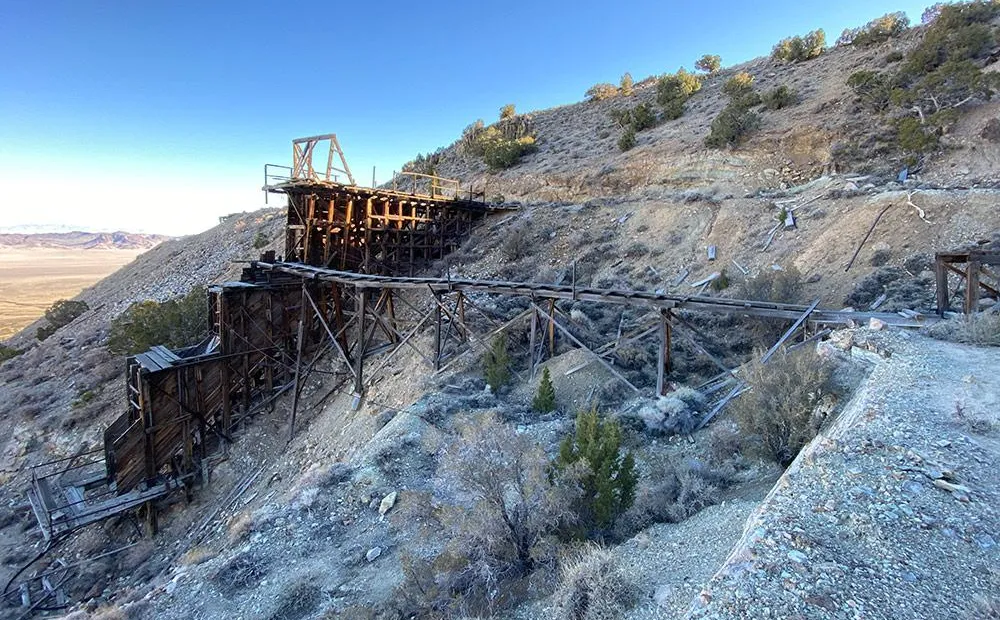
25:00 Where we're at now is we're drilling exploration resource holes at Garnet and then Gun Metal. So we have a fantastic in-ground resource at Desert She Light, open pittable, but there's a tremendous exploration opportunity here at Pile Mountain. We have other zones that really have been overlooked historically. So We're looking at adding tonnage from these other zones supporting either higher throughput or a longer mine life from this project. Just moving on here, you'll see here what the shape of this tungsten scarring body is. On the top here, this is actually in the middle of Desert She Light. This actually was in production in the 1940s and tungsten came out of this mine to support the World War II efforts actually. So it's really, It's a restart in a way because this has been historically produced for United States war efforts during World War II. So obviously a much bigger story here. This was a very small open pit at the time.
25:56 You'll see here this scarring body continues at depth. We've hit some fantastic drill holes since we've been drilling this. Just one example, almost 40m at 0.735% W03 with almost 40g Silver, almost 0.5% Copper. On a tungsten equivalent, that's just over 1% Copper, about 3.5%, and that's from 66m. As I mentioned, open pitable resources. We own the water rights. There's power lines within 2.5 miles of the project. They're road accessible. They're in Nevada. Check, check, check. We've done the environmental baseline. There's no impediments to development. So we think these are projects that can move quickly while we know they are. And that's what we're looking to do here. So in terms of next steps, updated resource, geotech drilling complete, as I mentioned, and those are with the engineers right now and then tying this all together into a pre-fee study. So there's gonna be a lot of news here. As I mentioned, we're drilling some of these other zones as well. So we'll have drill results from those.
26:56 If you look back to our press release on our website, you'll see we are an active business. Since we've IPO, we are pushing things forward, we are adding value, we're delivering news for our shareholders, that will not change. We're into a very, very busy period for the company. And with all the talent from the US government, we think it's going to be a tremendous time going forward as we push this towards PFS and then onwards from there.
27:20 I'll probably give just 2 minutes, 3 minutes on Tempayut, and then we'll wrap up and go to questions. But the way that this opportunity came to us was we looked at the market back in 2024 And we obviously have a fantastic opportunity with Pilot Mountain. But we've said, hey, you know what, we're watching the price of man to money go up 20, 30, 40,000. We believe that tungsten could also have the same effect once China announced an export ban. And we thought that an export ban was coming. So what we did is opportunistically, we looked at every other deposit in North America and said, what else could be out there that we could acquire that could be complimentary to Pilot Mountain? And as soon as we saw this asset, Tempayu,
28:02 we needed to have it. It needed to be in the portfolio. So we got a deal done quite quickly on this asset. This is before Tungsten Prices started doing what they do. So this was a time when no 1 cared about Tungsten, really. And there was no one else trying to look and find these deposits. I know now there's a lot of new companies popping up looking for tungsten. So we were opportunistic and made sure we got the assets we wanted before the move happened. And this project is absolutely fantastic. It was one of the largest tungsten mines in North America in the 1980s. It shut down when China flooded the market. That's the reason it shut down. Fantastic deposit. High grade historical production came from this deposit around the 0.45%, almost half percent W03 level. You'll see there the infrastructure. Probably the 3 main things that really drew us in was number 1, the infrastructure.
28:52 We know there's a need for Mines in America tungsten now, not 10 years from now. There will be a need 10 years, but we want to fill the gap as quickly as possible. Because of the in-place infrastructure, it means you can get things up and running more quickly, obviously. So you'll see here on this list, the ore loading and conveyor foundations, the substation, the mill foundations, mill building, the loadout bays, access roads, water pipelines, it's all there. And we can utilize it in a restart. So that's really important because as you can see here,
29:22 in 2003, about $18 million of value was appraised for the in-place infrastructure. And that's all stuff we can use in a restart. The other key thing was the fact that the majority of the resource here is located on patented mining claims. Now those are really important because you not only own the mineral rights but you own the surface rights as well. And anyone who knows
29:46 United States mining knows that if you can get your hands on patent mining claims, those are the best claims possible when it comes to permitting and pushing things forward quickly. So we have the patent mining claims, we have the in-place infrastructure, and most importantly, it is a significant mineralizing system. This project has been mined intermittently for over 60 years. As early as the 1910s is when it started. They've been mining tanks in there, Union Carbide owned it. Very large mineralising body. We have the infrastructure, we have the patented mining claims and we believe we can push this project forward very, very quickly because of that. And potentially in terms of timelines to production, Tempai, you could actually almost leapfrog Pilot Mountain because of these added benefits. So 2 fantastic deposits
30:33 owned by Guardian Metal Resources in Nevada, the tailwinds that are blowing, we're seeing tremendous amount of interest in tungsten. We think the market is early innings and we're just starting to get this story out to North American investors. So hopefully that's a good overview and kind of gives you a good kind of taste as to what we're doing here. And I guess I'll stop sharing Romeo. We can go to questions. Let me just see here. Okay, perfect. Did that work? Yeah, it was great. And I'll text Ivy then I give myself credit for it. There we go. No you did great. That was wonderful. I appreciate the overview. Now there are a lot of really great questions in the chat. I got a couple myself. Sure. So a couple of
31:12 those just before we get into those questions in the chat. First I want to talk about your competitive positioning. And I know you went over this in the presentation, but I do think it bears repeating. So I want to get into it. You own what's believed to be the largest undeveloped tungsten deposit on US soil and that existing infrastructure, Tempe, it's worth what, 17.9 million. So I'm curious, how does this strategic position translate into competitive advantages and that value creation for shareholders? Yeah, I mean, I think, as you mentioned, 2 very key assets. I think what's really the angle that we have is when you look at timeline to production, right? Because as I mentioned, we need tungsten right now. And when you have these projects that are moving forward, when you have the infrastructure, when you have the pattern mining claims, that gives you an advantage, right? I've seen a lot of new companies pop up with earlier stage assets, which are great. You know, those are important assets because we're gonna need them for the next cycle. But you know, they need to drill it. They need to put a resource together. It needs to, it's gonna take
32:10 them a lot more time to spool those up. Whereas, you know, Boeing might need Tungsten tomorrow, right? We're not gonna be there to provide it, but you know, we are going to try to get there as quickly as we can so we can start supplying that to the U.S. Market. So I think timeline to production is really, really important right now. And what we're targeting from both of these projects, subject to the relevant engineering studies, we believe both of these could potentially be in production before Trump leaves office.
32:36 We're not 10 years from now. When you look at these projects, you look at the infrastructure, you look at all those added benefits, it means we could move quick. Also, on top of that, with these new executive orders, we don't fully know how they're going to play out, it's early innings still, but we're seeing evidence that these executive orders are working and projects with key defense and critical metals are being pushed along and moved along to say, hey, we need these metals now. So we're trying to just answer the port of call. And these are advanced assets. That's the key thing is there's a lot of great earlier stage assets that on a normal market I would love to look at and acquire. But it's a rush to production and we're going quickly and we have the assets that we think can deliver. Awesome. I do want to talk grade briefly, just for folks in the room might not know what the comparatives are there. Your recent drilling results show pretty exceptional grades, including that 39.3 meters of 0.735 tungsten trioxide equivalent. So I'm curious, how do these results compare to other tungsten projects and what does it suggest about the quality of the resource base that you've got?
33:43 Yeah, of course. So most of the deposits are in China, So we don't have a ton of information. That's why there's not a ton of transparency in the market, unfortunately. So if you look, if you try to figure out what the grades are in China, you won't find out. Anecdotally, I've heard they're sort of below the average grade is below 0.2 now. A lot of those mines are underground because they've been mining at a very high throughput for decades and decades and decades. A lot of those mines are being depleted and mined out. So that's a small comment on China. I don't know if that's true or not. That's what I've heard.
34:15 But for open pit resources, I mean, these stack up against, you know, in our view, all the major deposits globally. There are some higher grade deposits without a doubt, but, you know, a lot of those deposits come with their challenges. So, you know, we have the higher grades at Temp Iyut, you know, historically mined at around 0.45%
34:33 at pilot 0.27, but that's open pit. That's key. The higher grade deposits are underground. On top of that, we have the Copper, Silver and Zinc. When you add those in and they're all recoverable at pilot amount, we have the PFS network to prove it, those are added benefits. When you look at the economic model, you have your tungsten revenue, but you also have your copper, silver, and zinc. So a lot of other projects that might have slightly higher tungsten grades potentially don't have those byproducts, which as you know, really matter when it comes to the economics.
35:03 Sure. And one thing I do want to talk about strategic value, obviously went over this in the presentation, but it is kind of a remarkable situation where there's 0 domestic US tungsten production and China's got 80% of the supply. So I really want to 0 in on what that means for Guardian Metal.
35:20 How can this contribute to U.S. National security and do you expect that element to be able to attract strategic investors in addition to the government partnerships? Absolutely. I mean, I think just look at Antimony and look at Perpetua. That's the blueprint. We've seen the story. We've seen this movie before and it's Antimony and it's Perpetua. And what's happened was China turned the taps off. And just to compare, I think China controls about 53% of total antimony global supply. Whereas in Tungsten, it's over 80% plus Russia and North Korea. So we've seen it play out, right? As soon as those taps are shut off for antimony, a lot of number 1 investors go, I want exposure to this metal because we know what's going to happen. The price is going to go up. And there's, there's companies that exist. You know, the reality is all of these metals that, that the United States imports right now, you can mine them on us soil. So let's do it. Right. Let's support these projects. Let's, let's make it easy for companies like guardian and perpetual to get into production.
36:19 So yeah, I mean, the, the recognition is happening now and I think Perpetua and Antimony is a very good blueprint that we believe Tungsten
36:27 and Guardian, obviously our projects are much different, but that's kind of the same blueprint that we hopefully can follow here. And with that recognition happening and the doors that can open for companies like Perpetua, which are designated grant recipients from the likes of the DoD, then a lot of people can get behind and say, hey, this is important. We need this metal, let's support it. So we got Exum that was able to support it. And even before Trump got into office, Biden gave Perpetua the full federal permits. It wasn't Trump. So that was even, you know, it's bipartisan really, because the US needs these metals for US excellence, for US national security. So it's,
37:04 everyone you speak to right now goes, I get this narrative, I like it, and I understand why people want to invest in it. So it's all spooling up in the timing. It's very exciting for us. And like I said, Tungsten, we're early innings. Now we're top of the second in my view. And for your listeners, probably a lot of them, it's the first time they've heard of Tungsten. And most likely the first time they've heard of Guardian, but it's not the last time, I can tell you that much. So awesome. I do wanna talk about Tungsten price action for a second, because I know, to your point, prices are up 30% since February already. I'm curious, and please indulge me in some crystal ball gazing if you don't mind, but what catalysts do you reckon could drive prices towards that $500 plus levels? And what does that do to Guardian's economics? Yeah. I mean, it's, like I said, the majority of the revenue, if you look at our economic models comes from Tungsten, right? So you take a $300 Tungsten price in the model, you cross that out, you change it to 500, you can imagine what it does to the numbers.
38:01 And it upwards from there, right? And we've seen with, with antimony, you know, 10,000 to 60,000, I don't know what will happen in Tungsten. I know the market's incredibly tight. I think some of the factors to look out for China, US relations, you know, if, if, If those taps get turned back on, obviously that would alleviate the market a little bit. But even what we're seeing in China, which is very
38:23 unexpected, I guess you could say, is when the taps got turned off, you would expect that all of the tungsten that normally would be exported is now there for domestic purposes. Therefore, the price should go down. But the price is going up. So what that means is that there's maybe not as much tungsten in the Chinese market as people realize, or they're stockpiling, or they're using it for defense, who knows. But the market is tight in China as
38:48 well. So potentially, you know, watching us China relations, even if China and the us, you know, are able to sort of get over some of these trade barriers. I still think there's a huge push for minds in America. I mean, You'd rather mine it in Nevada and have it shipped to Tawanda, Pennsylvania or Fallon, Nevada and process the material there. I mean, it's just it's it's it supports US economic resiliency and national security. So we think regardless of what happens, you know, the US looks very favorably towards a Minds in America source, and that I don't think will go away. So the things I'm looking out for is obviously China US relations, I don't get too involved and kind of worry about Oh, if what is you know, what's this tweet saying about this? You know, we're focused on these projects and getting them into production. It is an important factor.
39:38 The DLA is a big one to the Defense Logistics Agency in the US. That's a stockpiling agency.
39:43 There's been some discussions that they may start stockpiling tungsten again. So that would certainly squeeze the market. And then also on top of that, a lot of companies, as I mentioned, will buy a few months worth of supply. So we're now 4 months past the initial export ban and no new material has flown, has come across the Chinese border. I'm also told that they're cramping down. There's little bits that can leak out and they're really trying to cramp down on that right now. So as some of these groups come to the market and say, hey, we just ran out of those stockpiles, we need more material.
40:16 That I think could really, will really start to see then what the price of tungsten is going to do and what the market looks like. So I think we're at the point now and probably why we've seen consecutive increase in prices from fast markets. We're at the point now where groups are running out and going, I need it and I'll pay whatever it's going to cost because without it, I'm not going to produce X, Y, and Z, which is a pretty unpalatable option. So, yeah, DLA is a big one. But right now, we're seeing a tremendous amount of tightness in the market. The rubber band is tight. And it just gives us the further push and impetus to say, hey, we need to get these projects into production because the US needs a mine source like now. That's a good push. I did want to talk briefly about the grants. I know you mentioned the DPA3 grants as potential non-dilutive financing. I was curious if you could spell it out for the audience. How significant could the grants be in an accelerating development timeline?
41:07 Yeah, I mean, like I said, there's lots of tailwinds right now for US projects. You know, we're even seeing gold projects being designated through some of the permitting regime changes. So that's that's one part of it is the grants that are available. DPA3 specifically are targeted for defense metal projects. That's really their mandate is to focus on metals that are needed for the US military. Just look, once again, look at Perpetua, right? And Not to say we're in no way the same company, but that is a blueprint that's been laid out, which is they received their initial funding grant from the DoD. Now, these are non-dilutive grants. These are not repayable. These are funds that are earmarked for boots on the ground, engineering, drilling, let's get this project moving quickly.
41:54 So after the first DoD award that Perpetua got, they've since gotten 2 more. So they've been able to tap into more funding And that has allowed them just to move quicker. And that's really what it's there for is, hey, cause as you know, roaming a lot of your listeners, as a public company, you know, we need to go to the market to raise capital. Sure. But if the government can step in and say, hey guys, Just crack on, just get this into production, because we need this metal more than anything. That can really change the whole narrative, right? So like I said, we don't have any grant support here at Guardian, but we acknowledge there are grants available, and we do believe that we are in a strong position, given everything we've discussed today, to tap into US funding sources in the future. RGP I appreciate that very much. Now I had a couple more questions, but you actually already tackled it. So good mind.
42:40 There are some great questions in the chat, though, that I'd want to get through. There's 2 on listings. TB and Paul both had questions on listings. One is, do you have any intent to list on the NYSE? And somebody is asking if you have a Frankfurt listing as well. Frankfurt, I believe we don't actually have one, but I'm told you can trade on the Frankfurt chain. I think you can find us. There's a few market makers which picked up our stock. So I believe you can actually buy in Frankfurt. I don't know the details. I apologize. On the US listing front, what I can say is Our goal as a company is to list this on a senior US listing. So we have an OTC right now. So the senior ones would be the NYSEs, the NASDAQs.
43:28 That's where we wanna go. And that's where we think we'll get the best valuation for this story. So a lot of this will need to be covered in press releases. But what I can say is as a company, as a board, we have ambitions to list this on a senior exchange in the United States of America. Because that is, I think, is where US investors can most easily get access to this story and the stock. OTC is a good market and we're seeing a lot of U.S. Investors go to that market to get exposure to what we're doing, but there are barriers there on the OTC and NYC can really just open this story up. So that's part of our vision here. Part of our strategy is to get this to the market where we think we can garner, number 1, the volumes that matter in this market, but also the valuations for what we think we have here with these 2 key projects in the United States.
44:18 Great. 2 questions are kind of similar from the chat. Wesley asks, and you already touched on this, but I think it's good to go through. Are there any other tungsten projects in Nevada and how far along are they? In Nevada, there are early stage. Early stage. Yeah. These are, in our view, obviously bias you, but I'd like to be challenged on this. We believe that these are the 2 most important assets in the United States of America. Temp-wise, we didn't mind. Yeah. Okay. Mike from the chat asks, just notes that the new CEO of American Tungsten says he can deliver Tungsten in 18 months with investment. And he's curious, Mike in the chat, if this affects Guardian Metal in any way.
45:06 No, no, it doesn't. I mean, the US consumes 12, 13,000 tons a year. I don't know what volumes they're looking at. I don't know their project that well, being full disclosure. So I'd have to look under the hood to figure out what they're doing there. But I know Temp-I-U was the largest Tungsten mine in North America in the 1980s, Pilot Mountain the largest Tungsten resource. What I'll say is it's going to take more than just us, right? Sure. It's going to take more than 1 company to solve this. So we cheer on the other companies doing it. We think we have the best position with these 2 assets and the fact that, you know, we, We've been doing this for 5 years now, but we cheer all those companies on because we know if the US could mine all 12,000 tons, that would be a home run story. And we can't do the full 12,000. Right. So it's going to take us, it's going to take other companies to push other projects.
46:00 Once again, we do believe we have the 2 best assets in the US. I am biased, but I could challenge anyone on that. But yes, I don't know exactly what they're going to need to look into it. But if they can produce in 18 months, I don't know what the volumes are, but there's a huge need for Guardian plus others to spool these things up and get them going as quickly as we can. Great. No, appreciate that. Jackson, the chat, and I know you went through this, but I think it's worth repeating. Yes. How supportive is Nevada right now? And how long is permitting as you lead towards a construction decision? Nevada is very supportive. And this is not new, right? Nevada has been ranked top 1, 2 jurisdiction in the entire world by Fraser Institute for as long as I can remember. So It's a state, and for your listeners who've been in Nevada and left Reno or Las Vegas, you'll realize why it is the mining state it is.
46:54 Because it's rural, it's small town, and it's mining towns, and I love it. You go to Nevada, You go to a bar in one of these small towns and they're happy you're there. Hey, we want the jobs. We want, how can we work together? How can we help you guys? So you see that all the time in Nevada. Most places I go in the world for mining or for exploration, that's not the reception you get. So Very receptive. Nevada's always been that way. So that's nothing new. What we're really seeing is the support shift on the federal level. So the Department of the Interior, led by Secretary Doug Burgum, that's where they're making a lot of changes right now, because the White House, that's a direct kind of initiative. We're seeing things change in Nevada as well, but Nevada has always been a positive regime and then positive area to mine and permit.
47:39 So, depends on what permit you're going for. As I mentioned, Tempai Ute, patent and mining claims, That's really key because we own the surface rights, but also the mineral rights, which means you can permit those projects very quickly. But the kind of the, I guess the example I can give to the question is, there's an executive order which mandates permits need to be delivered between 14 and 28 days. Now, that's that just kind of came out recently. And these are permits that normally would take, you know, potentially 12 to 24 months. It's a moving, everything's moving right now and changing really quickly. So we don't know quite yet how it's all going to shake out, but we are seeing, I can say firsthand, we are seeing a shift change right now from the administration, from the permitting agencies. Hey, let's help you guys out. Let's work with you guys. Let's get these things moving. Because instead of working against you, which doesn't help anyone, if we work with you, and mind you, it's still important, all the environmental permits, all the regulations, those are a very high bar in Nevada, right? That's, That's another reason why we love mining in Nevada is it's supportive, but you gotta do it the right way. You gotta mine these things the right way. You gotta keep in mind all the local stakeholders, the floor and fauna, that's all really important. But it's just about simplifying the process and tearing down unnecessary red tape, which is what we're seeing happen now, all with the same standards being met and that as a company is what we intend to do.
49:08 Oh, great. Appreciate that extra context. Paul from the chat asks, do you need to do a raise this year? I mean, we don't. We always as a company have cash in the bank to run at least 18 months. That's what we do. We're always prudent with spend. We have very low corporate GNA. We have a good cash position now. We just finished a warrant period that brought in just over $2M USD on top of the cash balances we had before. The answer is no, we don't need to. Will we? Potentially. We have the funds to push forward Pilot Mountain and Tempe Island. That's what we're doing now. As I mentioned, there is potential government support that we'd love to get access to, which would help cover a lot of these bills.
49:56 But what I can say is, is the mandate right now is to go quick. So we're not gonna, you know, we could be conservative and go, well, we're not gonna spend any money. We're gonna, we're not gonna get 2 rigs. We're gonna have 1 rig and we're gonna just be really, no, no, no, no, no, no. That's not what we're here for. We're here to go quick, right? And our investors should ask of us to do that, which is go quick, move these projects, because this is a tremendous window. We have an administration in power that is very supportive of mining. We have a tungsten macro environment that's very supportive of Western world sources. And we have a fantastic position at Guardian Metals. So we don't need to, we always at any point, we could go full hibernation and we could last 18 months. That's how we run things as a business, but we wanna run quick. So at some point in the future, like I said, we do have a very strong cash position now, But if the mandate is to go quick, and it is, at some point in the future, we'd probably look to bring in capital on top of whatever we have or whatever government support we can get to make sure we can move really quickly. But right now, we're in a fantastic position.
50:59 And we'll just keep cracking on with the cash reserves we have and pushing these projects forward. Awesome. One question on marketing, Howie asks, are you doing the fall conferences? I assume he means the North American fall conference. Yes. So my chairman, he kind of manages the conference schedule. I need to check in with him. I know Beaver Creek, I believe we'll be at, which is probably one of the ones he's referring to. Like I said, we're really shifting gears back to the US right now. So historically, we've done almost no marketing in the US. It's been all in the UK, just really trying to spool this up and get UK investors to follow the story, which I think we've been successful doing. But now given where the landscape is, no offense to our great UK investors, we're going to the US. That's where you get the volumes of liquidity when you get, It is a much, much bigger pool of capital. So yes, the answer is yes. I'll need to confirm which ones we're doing.
51:51 But what I will say is, and anyone on the chat or following this live stream who has followed the company knows You can reach out to me at any point. My door is open. I really do mean that. I will speak to anyone. My wife hates it because I'll have calls at 9pm on a Friday with a potential investor out of Eugene who maybe only wants to buy a few thousand dollars worth. I don't care. Right. It's my job as a CEO to get this story out. Everyone who's reached out to me, either through info app or directly to me on Twitter, I always respond. Doesn't matter how big, how small, I don't discriminate. I wanna talk to my shareholders. I wanna know what they're saying. I wanna know what they care about. So even if there's a conference that you're at that I'm not at or we're not at, reach out, please reach out. We can set up a phone call. I actually have a phone call at 5.30 tonight with a potential investor out of Oregon. He said, hey, I'd love to chat to you.
52:42 I said, let's set up a call, 30 minutes, let's do it. So our doors are always open. My door, JT, reach out to us if you can't get us at a conference. I prefer face-to-face, so we'll try to make sure we're doing a lot of the circuit this fall in the US specifically. But doors always open and I travel through the US all the time. And I'm Canadian originally, so I go back to Canada. So I'm in Toronto, Vancouver, you name it. So I can always try to meet up with investors who are in those cities as well. Great, so one thing I love to end these kind of conversations with, what are you most excited for in the second half of 2025? Oh man, I'm just excited about getting this story out. I mean, what is so exciting is we're unknown. Like I've had a few calls the last few weeks and the first question I always ask is, What do you know about Tungsten and what you know about Guardian? And the answer almost unanimously is 0 and 0. Great. I love that. That's where I want to start. I want to get you up to speed on Tungsten. I want to get you up to speed on Guardian. Because every time if I tell the story right, People go, I get it. That makes sense. So I think right now we're unknown. We're known in the UK, but even in the UK, when I do non-deal roadshows, I'm sitting with people who go, I've never heard of you. I don't know who you are. So we're early.
54:00 We're getting the story out now. It's kind of our coming out party now, almost in a way. And that's exciting because to be an unknown company, but to have a fantastic proposition and then to get the story out. I mean, next week alone, I don't know how many meetings we have, but it's, you know, we're going to be in front of 20, 30, 40 people who have never seen it before, all in the US who care deeply about things like this. So looking forward to getting the story out. But more importantly, all the news that we can talk about all the drilling results, all the engineering, all the PFS, all the tailwinds, all the things the US government is doing to support this. So really, really busy time, a lot of support from the government and just running around North America, like a crazy person getting this story out because right now they don't know it and I think they're gonna love it. Awesome, well, Oliver, thank you so much. I think it was a great overview of the company. Thanks everybody for joining today. I think we got to most of the questions, but I'm going to send the transcript through to the team.
54:52 So if there are any followups, please do let me know. And as Oliver said, you can always reach out directly to the company for any followup. It sounds like he'll get back to you quite quickly. Oliver, thank you so much. This is great. Hope you have a great day. Thanks, I appreciate it. Let's do it again soon.