Replay available
Positive Tempiute Tungsten Drilling Results
Join us for a great event!
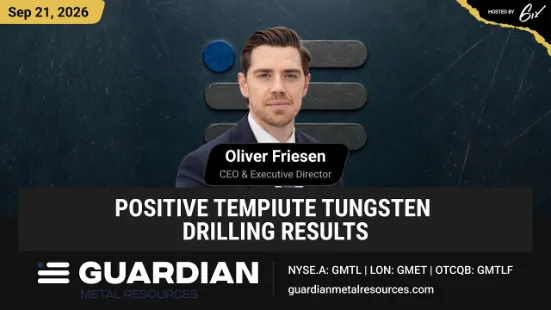
- Company
- Guardian Metal Resources (LSE:GMET)
- Date
- Mon, Sep 21, 2026, 2:45 PM ET
- Replay
- Watch the replay on this page · 21 min
- Results news release
- Positive Tempiute Tungsten Drilling Results · Mon, Sep 21, 2026
On 6ix: 6ix.com/event/positive-tempiute-tungsten-drilling-results
Replay
Transcript
Automated transcript · Written by software from the replay's audio. It can mishear names and figures; the replay is the record.
0:00 So Oliver, welcome back. Let's start with the number everybody's gonna 0 in on because it's the one that interests me certainly the most. It's 92 meters at 0.34% tungsten, and hole 46 at Schofield. I was wondering just for viewers who don't look at tungsten intercepts all day, fair enough. Could you put that in context? What does a hit like that sit in the global tungsten world? Yeah, it's interesting. I was thinking about exactly that last night, and obviously all we can quote is the Tungsten, which is what we should do. But I almost want to put in a Copper equivalent or something just so investors can understand the magnitude of that. But obviously the width is there's, that's an easy 1, 92m is a pretty chunky section of core. But I think a good way for investors just to understand what that looks like. And once again, we can't put it in our press release, but you take the price of tungsten, which is about $300,000 per ton.
0:59 The price of Copper right now, I know it's on the move right now, but I think for all intents and purposes, it's about $10,000 a tonne. So chunks of that current price is about 30 times more valuable. If you want to convert it yourself, You can take the relative values of the 2 metals and figure out what that looks like. But certainly in a Copper equivalent world, I think investors and followers of the industry would really appreciate how good that intercept is. But I think it just shows that investors are still getting up to speed on tungsten. It's a new metal. I'm pretty confident that in the fullness of time, with more and more drilling results coming out, that that will definitely stack up as one of the better ones out there. I'm obviously super excited that it's in an area of the project that really hasn't been drilled for quite some time and just shows that there's obviously there's historical tungsten mine there, but our view is that there's quite a bit of material that was left behind. And I think that that result certainly is further proof of that. Awesome. And inside that 92m, you've got nearly 13m running over half a percent plus zinc, silver, copper riding along in the assets. Is that byproduct potential something investors should start pencilling in now or is it way too early for that conversation? Well, I mean, they can and they can't. I mean, it's obviously We need to prove economic recovery and all the bits and pieces that really show that we will produce multiple set-level concentrates.
2:27 We as a company always take a view to under-promise and try to over-deliver. I think what investors can look at is this system geologically is very similar to Pilot Mountain. So far as both of these projects and both of these mineralising systems formed around the same time. So it's not like we're dealing with 1 deposit in Nevada and 1 deposit in New York State, where the geology would probably reasonably be very different. These are part of the same, what's called a metallogenic event. They sort of were placed around the same time. So you can naturally expect you're going to see similarities in terms of the alteration, the mineralization. And sure enough, you're seeing sort of a similar makeup of metals and those intercepts as you see a pilot. So we've now shown a pilot with the metallurgical work we've done, what will be sellable concentrates or metals for that project. Not to say it will be the same necessarily for Tempayu, but the metals are there.
3:32 As part of the process forward, we'll look at how we can maximize value effectively from any rock that would come out of that project. Certainly the Copper, the Silver, the Zinc, the Gallium grades, we didn't quote them in this press release, but we've quoted some of the Gallium grades before. So more metallurgical work is needed there. But yeah, it's a polymetallic system. Certainly the majority of the value will be coming from the tungsten, but it's our job as a company pushing it forward to try to find a way to maximize value across all the different metals. One thing that struck me is you've got lab results back from 4 of the 28 phase 2 holes that you've drilled, and you guys already pulled the trigger on rehabilitating the underground. So walk us through that call. What are you seeing in the core from the other 24 holes that gave you the confidence to move before the assays landed?
4:22 What I think is unique about Tungsten, Romeo, that maybe some of your listeners aren't familiar with is it's actually one of the only minerals that you can actually see with your own 2 eyes. When you're drilling for Gold, yes, if you drill visible Gold, you can see it. But 99% of the time you drill a mineralized vein and you really have no idea or you don't have a great idea until the assay is done. That's why you don't make decisions until you have the full analytical package. That being said, tungsten is different. And we've put out a few different photos of our core, but effectively, SheLight, which is the tungsten mineral that both of our projects have, is a mineral that fluoresces under UV light.
5:10 What we do with the core shack is we turn off all the lights and we have these big black lights and we just shine them on the core. And it's, you know, if you're in a, if you're in a scarred zone, it looks like a starry night sky because all the she likes sparkles like, you know, like, like, like stars in the sky. So, you know, obviously it gives us a steer within, you know, plus or minus, I don't know, we're pretty good at it now. We know visually what converts to the assays, but, you know, I would say probably within 20, 30% is certainly where the team's at now. So what we can do is we can look at core that comes directly from the drill rig and say, hey, we think it's roughly going to be this percent Tungsten. We do have a bit of an advantage in that we don't have the actual assays for the other holes you mentioned, but we have the visual assays.
5:59 What we're seeing there is obviously, we're seeing that areas around where it was historically mined from the 1980s. There's material left there. That's always been our view. So where we're at now is where we want to get to that material as quickly as we can with a drill bit, obviously first and foremost. And if that proves to be successful, we want to find the quickest way to move Tempa back into the US supply chain for Tungsten. Underground rehab is next. There are some site things we're getting ready now so we can start the underground rehab. It's a different status of project when you're actually in the underground and working. And safety is super important here. So, we want to make sure that's all in place. Once we're confident with that, the underground contractors come and start the rehabilitation.
6:46 So, We can access the underground portals. We can sort of crib them up, improve them. They're actually in pretty good shape right now, even though they last were used kind of 40 plus years ago. And then once that's done, we're going to mobilize underground drill rigs. It's so much easier to access underground panels of mineralization when you're underground. Much shorter holes, much quicker. You can fan the drill rig in multiple directions. Right now we're at surface drilling and it's get underground. We can effectively prove up these panels of mineralization much, much faster. That's part of the decision. Obviously, if that all is successful, then you have underground workings that you can then utilize to start development effectively towards a panel that you'd want to mine in the future. More steps involved to get to that stage, but just kind of laying out what the steps are, what the stage gates are and what success could look like here going forward. Cool. Now on the regional program, 20 of 41 holes hit tungsten, including 32 meters at head frame, deeps with nearly 2 meters slug grading, 2% Tungsten. That's a pretty serious hit rate for first pass exploration drilling.
7:53 What's phase 1 telling you about how big this system is beyond the old mine footprint? It's just telling us that it's bigger than I think was originally appreciated. I think one thing just to note, Romeo, and I give a lot of credit to what we classify in the industry as the old-timers, who were doing things in mining. They were crawling all over Nevada in the 1800s looking for Gold. Then it changed and Tungsten was first discovered at Tampa Ute in the early 1900s. I give a lot of credit to those guys. They were undermanned. A lot of times they were on donkeys and doing things that us in the modern world would never even fathom. But they were pretty good at sniffing stuff out. They seemed to usually find the mineral.
8:43 But once again, they were just limited. They didn't have drill rigs up until a certain point. And a lot of it was just sort of done with pickaxe and pack milling hand. They found a lot of mineralization at Tempe, which is why it's been in operation on and on for over 60-65 years. It's been on and off. Sure enough, those areas, we know about them and now we're drilling with modern drill rigs and underground drill rigs to understand how deep the system goes. But one thing that they didn't really get the chance to do was look much more broadly beyond what was really just outcropping and hitting them at surface rate. That's typically the low hanging fruit. So what we've done is we've taken a view that you have 2 big mineralizing plugs or what we call kind of causative intrusions, which is a technical term. Those are the big intrusions that bring up all your tungsten rich fluid.
9:40 And so, you know, naturally what you want to do is look around other parts of these intrusions to figure out if scarns could have been developed there. Actually very similar to Pilot Mountain, right? The Tremor zone that we just discovered was the same concept, right? We have a positive intrusion. We know there's a well-developed tungsten scarn on the Northern end. Why don't we try the Eastern end to see if there's scarn development there? And sure enough, that was the case. So same idea with Tampa U, we don't want to reinvent the wheel. We have big, big kind of these intrusions. We've mapped out the intrusions and it really was as simple as, hey, let's start drilling around other areas that have never been tested before. And sure enough, almost 50% of those holes hit Tungsten. So a lot more that we can go after in due course. But I'd say the focus right now is on the underground rehab. It's on drilling those panels that are near to existing known workings and also are on patented mining claims as well. So that's really the focus now is given some of those exciting results that the zones we referenced, we want to start to learn more about those areas as quickly as we can to start to drive next next steps and decisions.
10:44 Great. Appreciate it. If you don't mind, I want to talk about the macro for just a second, because I know Western APT is essentially decoupled from Chinese domestic pricing. I know you and I have talked about this before, but in the Western market, it's holding above 3000, while prices inside China corrected over the summer. So someone building American tungsten supply, what does that now really confirmed split between the 2 markets tell you about where this is headed? Yes. Truth be told, I think the Chinese market, there's always question marks there. We get certain bits of data and bits I think are probably withheld. But yes, the price is softened in China. But I think what we're seeing here and really what needed to happen, I think quite some time ago, and we're seeing this across other metals as well, is we're seeing a bifurcation, right?
11:32 Typically or historically, there was 1 price. And effectively, what happened was China was willing to subsidize domestic mines and that allowed them to flood the market over time. And that's actually the reason Temp-IU shut down in the 80s was because China flooded the market. Nothing to do with the mine being mined out effectively. So we've seen that having one price, I think opens the market up to manipulation. And that's led to right now where the US has no domestic tungsten mines. China, Russia and North Korea control almost 90% of the global mine market. So we're seeing I think a bifurcation now. We're seeing a Western world, typically it's the fast markets, APT, Rotterdam price and then a Chinese price. I think that's healthy. I think that's what we need to see here.
12:20 We need to see the fact that, you know, if you're a Western world mine, there is a price that you can sell into. And if you're a Chinese mine, there's another price, right? And there's going to be some amount of convergence between the 2 over time, I think. But I think you're going to see those prices be in a lot of cases materially different, right? Because the market fundamentals and dynamics for each of those markets is so different. And in particular, we just under invested in tungsten mining in the Western world for so many decades now. So obviously the price in the Western world has remained very robust. I think we expect to see defence demand and stockpiling demand start to pick up here in 2027 onwards, which I think should be another kind of further support for the mine supply and the need for new Western world mines.
13:09 But yeah, at the end of the day, China announced an export ban. We're seeing those export numbers now And effectively, a lot of countries are getting 0 across the board. Just got another 0. The US has been 0. So that's why we need 2 prices, right? Because ultimately, we were in a position where one country could announce an export ban. And next thing you know, we're all kind of fighting for available material, which just doesn't work. Right. It doesn't work for a country like the US, a global superpower. So it's healthy to see a bifurcation. I think those prices will continue to stay bifurcated. I think we're going to continue to see those prices at different levels controlled by those markets. But we're very constructive and we're very, I would say, bullish, obviously on the Dunstanton market. Obviously, high prices brings on new production, but at the same time, demand across defence, nuclear fusion, which not many people are talking about, I think will really surprise people. So we think that the market here has changed forever from where we were at 2 years ago, and we're going to kind of see what that looks like going forward here. But demand growth looks really good across some key sectors and certainly in the supply side, we've been under-investing. There's not a whole bunch of new mines. They're going to just turn the account.
14:22 It takes time to build a mine. And certainly one of the advantages we have at Guardian is we started that pilot over 4.5 years ago. You've got to do 2 years of basing, you've got to drill for resources, then reserves. You've got to do a PFS. You've got to do an FS. These are the things you need to do to build a successful mine. We were working through that and now we're in a position now where we can deliver new mine tungsten sources before the end of the current administration. Okay, exciting. One thing that was pretty deep in this release that I want to pull out, you're assessing permits to mine a near surface load sitting on patented claims. For folks who don't live in Nevada permitting world, Why do those 2 words, patented claims matter so much for how quickly you could be pulling fresh tungsten out of the ground? Yeah, so I want to be abundantly clear, right? We make it in the announcement, there's more work to be done. We got to understand the permitting pathway. We got to understand, we got to do more studies to really understand that opportunity. But we do want to include it. We want to sort of show the potential direction of travel for investors.
15:24 So next step is underground rehab, underground drill rigs, accessing that panel. But yes, the vast majority of the historical workings at Tempe are located on, as you described, patented mining claims, right? So what that means is it's a very unique type of mining claims that actually, they're actually quite hard to find in the US because I think, I encourage you to go to Claude or your listeners to go to Claude and just look up difference between BLM load claims and patent claims and unpatented claims effectively just to understand the differences. But effectively what you have with patent claims is not only the mineral rights, which is what a normal claim would hold, but also the surface rights as well. And I don't know which year they stopped granting patent claims, but I would think it was in the 60s or 70s. So if you had proven a discovery up to that point in mining, the government was able to hand over patented mining claims. So they gave you the surface rights and the mineral rights. And effectively just what those claims mean is that it's akin to if you own a house in the US and say you effectively own the patented claims, which is you own the surface rights for your house.
16:35 So there's certain things that you can do in your backyard that you couldn't do on public lands, on BLM lands. So we own the same rights. If you own a house in Vegas and you have a backyard, effectively those mineral rights include the same surface rights that you own as a landholder. So it's just another layer here that can help speed things up, make it easier to operate. So for instance, you know, we have fences around the patents, which says private property, no trespassing, understand your ground laws in Nevada. I can't remember. I think like, So don't, don't worry. But effectively, those are really valuable claims. And it's one of the reasons we really wanted to add Tepli to the portfolio was because when you have those claims, just your ability to do things and your ability to move things forward is different than on federal claims. So an added layer there, that's quite interesting. We wanna do more work to understand that opportunity, more tests to be done, but certainly, you know, our goal is to start mining new tungsten material to support the US supply chain as quickly as possible.
17:38 And certainly, the mineralized panels that we're seeing near to the historical workings are areas that we're looking at to see if that's possible. So we always want to sort of measure twice, cut once, under promise, over deliver. So we just kind of put that in there to say we're looking at it. And once we know more about that opportunity, we'll certainly bring that out to talk about what that could look like. But yeah, it's a unique opportunity. And just based on what we're seeing in the drill, the drill results thus far and the visual results, you know, as expected. And as we thought, there's a lot more material there at Tempayut than what was mined in the 1980s before it got shut down because of the anti-competitive practices of China. Jim, now I want to close on the bigger picture, for Guardian generally. You got a completed PFS at Pilot Mountain, new zones like Tremor and Good Hope are really delivering there, and now Tempayut is, in my opinion, sprinting toward a resource with underground access on the way. So walk us through from here the news flow that investors should be watching between now and let's say end of year.
18:40 Yes. So more drill results at pilot. So we were drilling at other exploration targets there. So we'll start to continue to show what those results look like. Certainly the same attempt by you. We make it very clear that the majority of the results are pending. So we'll certainly kind of put those results out once we've compiled those QA, QC, done all the work we have to do. And then on the engineering side, working towards DFS, which is targeted for Q2 of next year. So we'll certainly be able to put out sort of some news around what that looks like, what the DFS is focused on. We've alluded to it a little bit here and there, but really trying to give the market a clear picture as to exactly what is being done as part of the DFS or the FS.
19:27 And then I would say certainly on Tempayut as well, We've shipped the first batch of legacy ore to Montana. We want to see if the facility there is capable of milling that down and turning that into an actual usable tungsten concentrate. We'll have some results there coming out. Tempayut tailings as well. We've done a bunch of drilling there. So waiting on results to look at what that opportunity looks like. But I would say just general macro, we're obviously heavily involved with US industry, the defense industrial base. We want to now, as we sort of roll out our commercial program, Pilot Mountain now, we know schedule, we know volumes, we know product specs. So we're now putting together a commercial strategy to support a financial decision and construction decision for that project. So looking at how the project is going to really directly plug in to the defence industrial base to support the needs of various players in that space.
20:27 So we're doing a lot of work there. We're obviously very busy in Washington DC and on Capitol Hill. JT, our chairman, does a lot of work over there. So we're very involved with all the various parties and work streams ongoing. And really what we just want to show to the market is how this project and these projects are going to really plug in to support the defence industrial base in the US and ultimately at the end of the day, really support national security concerns, which is, hey, we need this metal to shore up security, to build munitions, to make tanks, to build nuclear fusion facilities, solar, wind, drilling, The list goes on and on and on. But certainly it's a metal the US needs new mine supply of and we're looking to deliver 2 of those during the current administration. That's our goal. Awesome. Well, all of our exciting results. Thanks for running through them with me and talking a little more broadly about the market as well.
21:16 Thanks so much, Romeo. I appreciate it.
Follow Guardian Metal Resources into a list and get an email when it puts out news.
Latest news releases
- LSE:GMET — Total Voting Rights · Wed, Sep 30, 2026
- LSE:GMET — Positive Tempiute Tungsten Drilling Results · Mon, Sep 21, 2026