Automated transcript · Written by software from the replay's audio. It can mishear names and figures; the replay is the record.
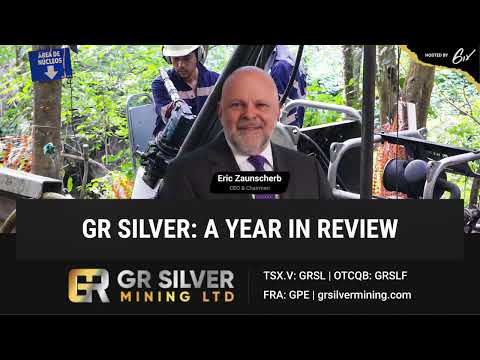
0:39 Thank you very much, Cam. Really appreciate being here and, and welcome everyone really appreciate your attendance as well. It's been a spectacular year for GR Silver, I have to say, and obviously I'm biased, I'm a shareholder and the position that I have, so I'm very, very pleased to be here. So let's start by saying that 2021 wasn't necessarily our best year from share price performance. 2022 has been a very ugly year, not for us specifically necessarily, but certainly as a general comment. As a former analyst, this has been one of the worst years in 40 years in the junior mining space. Obviously we are looking at a different market coming up in 2023.
1:27 We are looking at the potential for silver to do extremely well as we see a potential pivot for the US Fed coming up. Silver also has a very strong industrial component, about 0.5 demand is industrial and in total of about 12 to 15% of silver demand is for photovoltaics, so used in solar panels. That's a very important growing demand feature for silver. And I'd also underline that physical silver inventories have plummeted. So that's a very positive outlook for silver equities in general. And I'd like to suggest that GR Silver is in a good position to be part of your portfolio going forward. But if we're coming back to 2022 and how that's been, it's been a fantastic year for us. As I said, I would suggest that we have done some very, very strong geological sleuthing.
2:21 Our founder and President Chief Operating Officer, Marcelo Fonseca, has done a fantastic job in building this project portfolio in the first place and now in mentoring and guiding a fantastic geological team in Mexico has made some very important discovery proofs of concept. So let's get into that if we may. So I will be making some forward-looking statements, maybe I've already made 1, and getting into the project as I mentioned we are in Mexico. The Plumosis Project is located in Sinaloa State. So if we look at the location map, 1 flies into Mazatlan and then drives for an hour, pardon me, 45 minutes by highway to El Rosario. The El Rosario district has a long history, 250 years of mining, so mining is in the DNA of the people.
3:10 And then from El Rosario 1 goes on for an hour and a half by dirt road to access the Plumosis Project. The Plumosis project is owned 100% by GR Silver, covering 430 square kilometres in the core area and then we have another 300 square kilometres of non-core extending off to the northwest. One of the distinct advantages of the Plumosis project is not only great road access, but it features 2 former producers, and as such has power, grid power directly to site. So in the southwest one has Trinidad, which is a former open pit oxide gold heap leach operation that was originally started by El Dorado Gold and then in the northeast one sees the Plomosis mine that was a base metal mine operated by Grupo Mexico from 1986 to 2001.
4:03 We have all the production data from that. The mining concessions are in place. HIDO agreements are in place. And so there's a definite advantage from a point of view of advancing the project and de-risking the project. So now you'll see these 3 dotted lines running across the project. These are representations of the strong northwest structures or faults that run across in this district, in the region actually. These are important geological features. These deep-seated structures act as the plumbing system that allow for metals flow and metals deposition along those structures. And so we have over 75 kilometers of strike length of these, These are extremely important from a geological perspective.
4:50 To this point, we've been focusing entirely on that structure that's located up in the Northeast that features the Plumosis Mine, and then 5 kilometers to the south is the San Marcial area. So really those have been our focus for this year. Moving on to the next slide. We've drilled a great deal. Since putting out resources, we have now drilled over 19,000 meters at both areas and approximately 240 holes. So there's an awful lot of information that has flown into these 2 projects that will ultimately see a resource update integrated for both areas and that will be delivered in the first quarter of 2023 as we've been guiding all year.
5:43 So in the San Marcial area, It's all about resource expansion and to accomplish that we've gone to depth at San Marcial on an existing resource and a new discovery has been made and I'll get into that shortly. At Plumosis it's all about demonstrating a higher grade and to achieve that there's been an infil drill program, very surgical, very targeted, that has been demonstrating a higher grade than is expected from the resource that was published last year. So we'll get into the details of that as well, But the main point is that we will be delivering in the first quarter of 2023 a very important catalytic event. Focusing on San Marcial, you can see the green field up to the north, that is the upper volcanic package 1 sees in the area, and the yellow is the lower volcano sedimentary package.
6:38 And the San Marcial deposit lives at the contact between the upper and the lower volcanics. That contact also is featuring northwest structures, similar to what 1 sees on a regional basis, and that structure is an important part of the geological story. So if 1 looks at the contact, 1 can see that that extends off to the southeast. That contact's been mapped for over 5 kilometres heading off to the southeast. We have another 30 to 40 kilometres before the edge of the concession. Now that contact also makes an interesting jog sort of in the middle of the map there, And that jog is always something that gets the geologists salivating. So with some detailed mapping 1 can see that there's some interesting structures that crosscut running off to the northeast.
7:29 That structural corridor is an excellent target for exploration. And so the other thing that was done was, aside from geophysics, which shows a very strong chargeability anomaly, we're also seeing lithige of chemical samples. We took over 14,000 lithogeochemical samples on a grid sampling every 25 by 25 meters and what emerged from that, those 7 ellipsoids, those gray anomalies are silver anomalies, so silver at surface, which is suggestive of some potential leakage from down below. So all of that came together in an excellent target. So let's put a drill hole in there. So we announced in August, beginning of August, The results from hole number 10, which you can see in there, hole number 10 delivered 101.6 meters of 308 grams per tonne silver. Not silver equivalent, but silver.
8:28 So that's obviously a significant discovery, a 250 meter step out if you will from the existing San Marcial resource and that therein lies a real potential for further discovery is repetition of that geological environment as we go off to the southeast. Now this is another look through it if I go back to the slide there you can see the AA prime section, the long section along that contact. This is a view now towards the southwest and you can see at the top that hatched area, that's the original San Marcial resource that came out in 2019 based on 52 holes. And then some excellent geological sleuthing looking at the geological structures that occur in there. It was predicted that there should be a plunge down towards the southeast. And so the team expanded a tunnel that existed that would come out of the page here if you're looking at the screen And then 8 holes were drilled at the end of 2021.
9:34 And you can see the results from 2 of those 18 meters of 770 odd grams of silver, as well as 30 odd meters of 200, over 200 grams per tonne silver. So 2 excellent solid hits to depth and 1 can see that we're adding tonnage there, that we're expanding San Marcial's depth. You can also see to the left of your screen that new southeast discovery within that structural corridor. Again, 101.6 meters of 308 grams. And it's always interesting to see within that are some higher grade hits of over a kilo over a meter. So some very interesting things. Now what was then done was to drill a fan going in different directions to understand what the geometry of that body is in the Southeast Discovery area. And so now we've put together a number of holes.
10:27 There's a very solid feeling that this is also going to contribute to the tonnage at a very decent grade to San Marzio and we'll see this in that updated resource that will be coming out in the first quarter. Very important new geological discovery. I'd also point out, and you can see the blocks in there that are colored yellow, is that we're beginning to see and understand where there is also gold mineralization here. You can see a meter of 50-odd grams and a meter of over 200 grams, gold, not silver. These are located or associated with these cross structures, right? So that's an important part of this. Moving on now, over 5 kilometres, just over 5 kilometres to the north from San Marcial, we get to this Plumosis area.
11:23 Now Plumosis I mentioned is a former base metal mine operated by Grupo Mejico from 1986 to 2001. And so when you look at those production records, we know for a fact that first of all, they were chasing base metals and that the average grade of the by-product credit to them was 190 grams per ton silver over the life of the mine. Some years were over 300. And that there was also a gold credit there that averaged over life of mine, 0.96 grams per tonne gold. That's all well and good. We took that historical data, over 500 drill holes from the past, and put out a resource that was based on the drill holes that were provided and the sampling that was provided and some additional modern holes. And we came up with an average grade of around 45 grams per tonne silver.
12:17 Now, obviously that's not economic. And of course the market in August of 2021 looked at that, let's say not in a favourable light. But we needed to get that data out there into the public domain. We needed to draw a line in the sand and say, okay, this is what we've got now, folks. But there's a huge difference between that 45 grams and 190 grams. So why is that difference? Well, let me make it very clear that in the past, when the base metal miner sampled core Where they saw sulfites where they saw sphalerite where they saw galena they sampled They did not sample outside of that and we know from over 5,000 samples underground as well as now from detailed drilling, that that is not where the silver and gold necessarily are.
13:10 So we started with the concept, the hypothesis, after putting out that resource, that if we do detailed drilling, okay, these are short holes on average from surface and underground, we averaged around 60 meter holes. That would provide new core that could be sampled fully to capture some of those precious metal areas and demonstrate and replace those 0 grade samples from before, the areas not sampled. And so that is the whole hypothesis here is if we do a surgical drope program will we increase the grade? And I think you would agree that if you look at the news releases that we've put out from Plumosis that there is proof of concept, that we have intersected areas that are in the more resource model for less than 100 grams that are coming in well above 100 grams. And we're seeing areas as well where we're seeing well over a kilo of silver and silver equivalent over significant widths. And so that's the whole premise here is replacing those non-sampled areas with new sampled areas.
14:22 So as I said, we've drilled a lot of holes there. We've drilled 186 holes just under 12,000 metres. We've put out some very good results. And so we've demonstrated that there are unmined areas there that are carrying very attractive grades. Can't promise 190 grams per tonne comparable to the past production but we are definitely moving up from 45 grams per tonne. Now there's another interesting thing here about this area, and that is that at Plumosis, we see these massive stopes from the past areas, from the past production. So you can see a picture to the right here of a very large stope at the 775 level of 25 metres height. Now this is not in the main hydrothermal breccia, that main polymetallic area. This is in a stock work area.
15:12 We're seeing small veinlets and things over very significant widths and it's also running very well in terms of grade. And so if I then move on to the next slide, this was published in the news release just a couple of days ago. And you can see some very high grade gold and silver mineralization here in these intersections. Some really nice stuff including 12.4m of 2.6g gold and 7.3m of 8.7g gold as well as 55g silver. These are very attractive intersections. We're looking at a different style of mineralization in these stop works. We're seeing cross-cutting structures, and that's something we're going to hear a lot more about, cross-cutting structures in the Plumosis project, both in the Plumosis mine area as well as in the area of San Marcial.
16:07 So these are high-grade structures, these are younger structures, younger faults that acted as plumbing systems. There are some intrusives at depth that acted as the heat engine, as the supply of fluids, and they come up and they hit the rock in the area of the mine and it's trapped there. These fluids are depositing higher grade precious metals. And that's a very new thing, a very good example of geological smoothing that the team has done to deliver that mineralization here. So that's a very, very important feature here that we're very excited about.
16:49 Another thing we're very involved with, although it's not something we've celebrated and formalized an awful lot, is the ESG component. And I know everyone talks about ESG right now, And it's not something, as I said, that we've celebrated, but it's something that we just inherently do. Mining and exploration have gone on here since, as I said, 1986. And so the people understand mining, they understand exploration. We have a fantastic relationship with the communities. We have existing relationships with the Ajidos, with the agricultural co-ops that are active there. And, you know, we see things like forestry programs, reforestation that we are involved in funding and teaching in the schools.
17:38 We have a very strong safety program with 2 full-time safety officers, given that we have the 2 underground exploration programs at various times. And we have 2 nurses and ambulance on staff on location. So these are all extremely important. We were able to work through COVID because of very strong, strict protocols. One couldn't go to site, for example, without having a negative test. On site, everyone masks and distances and their temperature is taken before every meal. So if someone's running a fever, immediately get isolated, nurses look after you. And that sort of care, that kind of professionalism is appreciated by the community. Just last weekend there was a really nice celebration on site attended by over 200 people, employees, family, community members, AHITO officials and so on.
18:36 And people were recognized not just for great accomplishments through the year, but through their dedication. I mean, there was one person who's worked in the company for over 20 years and she was thanked for her dedication to the project, to what's going on, even the different owners of course, we've been involved just the last few years. But that relationship, that strength is an extremely important component for the company, and I think a strong differentiator. It's why we have had no issues with the community in the time that we've been present. So that's extremely important to us. Capital structure, 231 million shares, 288 million on a fully diluted basis. I would note that none of the options and warrants are in the money at this point in time. We do have a strong institutional following, some great long-term shareholders that have been there for us.
19:33 First Majestic has over a 9% interest. They have that interest as a result of vending one of their properties into this project, helping to make it one of those big projects. From a management perspective, management clearly has some skin in the game as well. In terms of value, we're currently trading at $1.03 US per ounce of silver in the ground on a measured and indicated basis. The mean is closer to 2. So there's a very significant discount there. But that discount is, that gap is closing. In July, at the depths of the market and at the depths of the way that this company was being viewed, we were down to 41 cents US per ounce.
20:19 That was in July. And since that time, our valuation has increased dramatically, over 150% relative to the peers. And so we're quite pleased with that performance. It is an improving performance. There's a lot more that we can do and there's a lot more that we are doing. As I said, we've had an extensive drill program to demonstrate these different aspects of the project. We're excited about those results and the valuation is beginning to reflect that. So as a former analyst, the thing I always looked for were the 4 P's, right? And so those were project, place, people, and price. And I think that given where we're located, the infrastructure that we have, the project that we have that is scalable.
21:06 There aren't too many projects out there that have over 430 square kilometers attached to them that have that length, strike length of perspective structures to look at. So that takes care of the project. In terms of the people, we have a spectacularly experienced management group. As I've said before, Marcio had the vision to create this project. We have Trevor helping out as VP Exploration and VP Corporate Development, Blaine, a very experienced CFO, and Brenda, who's doing a really great job increasing the profile of the company, and 1 can see the result. In terms of the board, I always point out Laura Diaz. Laura is a mining lawyer based in Mexico City and the former director general of mines in Mexico. So she knows how the system works.
21:58 And of course, also Jonathan Rubenstein, some of you may recognize as being former chair of MagSilver, one of the most important silver discoveries over the last 2 decades. So the people are in place. And in terms of price, as I said, we're trading at 41 cents per ounce in the ground. We're up over a dollar, and the mean is close to a dollar 75. And so for me, if I go back to that valuation slide, as we deliver more ounces in the first quarter of 23 at a higher grade, something that looks more economic, we should be moving up to the right on this chart. And that's something that we're looking forward to as a re-rating as we come into that first quarter. So this is a great opportunity if I could to start the question portion of this portion.
22:54 Absolutely, Eric. I really appreciate the great presentation. And just as a reminder to everyone in the audience, if you do have questions, now's the time. Please submit them in the Q&A chat on the right hand side of your screen. But Eric, we've already had a couple of questions come in. So let's get started. Albert has a question. Can you elaborate on whether the company has been in discussions with independent consultants or geologists who will provide key input into the upcoming mineral resource estimate? If so, how are discussions going in comparison to last year's resource estimate? I think that on various levels, if you look at, for example, the high-grade results that we put out over large widths, And the fact that San Marcial looks like a silver deposit rather than a silver equivalent deposit, a polymetallic deposit, that has brought a lot more attention. So we've had a number of parties that have been to site, mining companies that are looking at what we're doing. And the nice thing is when you do get a producer that comes in to look at your project, they invariably also have opinions on what we're doing and how we're doing it. There've been a lot of compliments about how things have been done. So that's always a good validation for how things are going.
24:04 Pardon me. We've also had a number of consultants that have come in. I mentioned the importance of the structural geology and understanding those cross-cutting structures. And so if we go back to the slide in SunMarCL here, you can see this extension to depth from the existing resource. That was something that's part of a structural interpretation. And that's really, really important to understand that structural interpretation. So consultants help out in interpreting the structural geology. Now of course when you're putting together a mineral resource update the QP is involved. We have had the QP was to site recently has gone through the models for both submersible and plumbosis intricately and the conclusion is that things are going very well in the way we're approaching things.
24:59 So yes, there has definitely been involvement from third parties looking at what we're doing and validating what is being done. Awesome. Okay, great. Locke wants to know if you could just provide some color on catalysts for next year. You know, is there going to be an updated study post MRE, no refurbishing plans, et cetera? Yeah, that's always an important question. We have been very focused on delivering that mineral resource update in the first quarter. That's the key. We will be doing that in the first quarter. That will be catalytic, should be catalytic for the company. And that will be providing a sense of what the grade is here. And that provides in turn a sense of the potential economics of a project like this.
25:50 We are looking at this from an integrated perspective. So whereas San Marcial is to the south and Plumosis is to the north, Plumosis has underground access over almost 8 kilometers worth of underground development. San Marcial has limited access, but it does have some underground access. All of these things need to be taken into consideration if you're looking at this from an economic perspective. The long answer, the longer answer, getting longer, is that we have not established a budget for next year. That's partially going to be obviously dependent upon market willing what kind of a market are we coming into. But it also is dependent on how economic this looks. If we get encouragement from the grade like we expect it is logical to assume that at some point in time we will work towards a preliminary economic assessment.
26:38 That could also be very catalytic. We will not turn our backs on the idea that this project has a lot of potential to add ounces. So we will work towards demonstrating economics here, but we will also be demonstrating the potential size, delivering ounces, if you will. Great, okay. Matthew wants to know what the exploration budget for 2023 is. We also have another question, just in case that doesn't get answered here, about the meters you're looking at for 2023 and what your current cash position is. Yeah, in a way I already answered that in the sense that we need to deliver those resources. We need to see what the grade is and that's going to help drive what the budget is for next year, both in terms of exploration and potential evaluation of the economics of the project. So that's consistent with what I just said vis-à-vis the previous question.
27:28 So it's too early to talk about metres, too early to talk about the amount of money to be spent. In terms of what we have, at the end of September, we had 3.6 million Canadian. We're burning at anywhere, depending on the month and how active we are, anywhere from 700,000 to 1 million. So very clearly, we're coming into the first quarter with the need to raise more money in the first quarter. Market dependent, we'll be able to do market raise as we did in 2022. In 2022, we raised just under $13 million in very, very difficult market. We greatly appreciate the support of our not just our existing shareholders, but new shareholders that came from the extensive marketing that we have done, but also appreciate the support of the capital markets partners that we have, that Econ and Red Cloud and Echelon have done a great job for us in that regard.
28:23 Great. Another question. So you're near completion of the extensive drill programs on your Polimosus project. Yeah. What are the most important things you've learned from these programs? Yeah, to sort of some of the points I've covered already, but I think to summarize, you know, what's really been important is that there have been a number of concepts, a number of hypotheses. If you remember your high school science experiments, you start off with a hypothesis. So we had 5 hypotheses, if you will. One is that there was a depth extension to San Marcial to death, right? Tick. Proven. 2 is that we postulated that as you go southeast along that contact, and I'll just zip back to the slide here, along that contact to the southeast.
29:11 So if you look to the southeast and you have these silver anomalies, The hypothesis was that we could repeat what we saw at Saint-Marciel further along to the southeast. Well, tick. Southeast discovery, 250 metre offset to the southeast exists. The interesting thing will be for 2023 is to do further drilling as we go along to the southeast. We have mapped additional cross-structures that would suggest the potential for additional mineralization. 3. At Plomosis, the focus of the past was to mine in the hydrothermal breccia. Fair enough. We have demonstrated that there is additional hydrothermal breccia, that main body, polymetallic, that remains unmined.
30:00 Tick. Demonstrated. 4 is the belief that cross structures at Plumosis would deliver high-grade silver mineralization. Demonstrated, we've done that. And then 5 is, you know, there's sniffs of gold here and there. Is any of that cohesive? Well, we have demonstrated, if you see the release that was just put out, that there is definitely gold mineralization associated with these cross structures. And we're beginning to demonstrate continuity on those structures. So that's 5 important concepts that have now been proven through 2022. We're very pleased to have accomplished that. Yeah, that sounds awesome. Another question, what are the key differentiators you consider GR Silver has relative to your peers?
30:48 Yeah, that's a great question. I mean, one of the things when I'm marketing, I'm talking to the institutional investors, is they say, oh, there's just all these exploration companies in Mexico. There should be consolidation. Why should we be interested in you? And so for me, there are some very important differentiators. There are, there's a moratorium right now on the issue of concessions in Mexico, okay, as the government catches up with the work that's been done in the past. They've prevented additional concessions being issued. We have not just our core, but 430 square kilometers. We also have 300 square kilometers in addition that we consider to be non-core. And so there aren't very many companies that have that much ground and that much available in Mexico. And so consequently we have a strong currency from a ground perspective.
31:43 That's a differentiator. Secondly is our core property, as I mentioned, covers about 75 kilometers of these key northwest structures. There are very few companies that have that kind of potential. And along those structures, we see a lot of artisanal workings, a lot of historical workings, a lot of positive indications from a geological, geophysical, geochemical perspective. So there's a lot of smoke that has to be investigated as we have been focusing on San Marcial and Plomozas going forward. In terms of other differentiators, I mentioned the strong relationship that we have with our neighbours, with our employees. And 1 hears quite regularly about blockades and challenges in working with people on a local basis.
32:30 We have had no issues. We're very, very proud of that strong relationship. And I love the passion that Marcio shows when we're talking about how that relationship is built and maintained. So that's quite an important differentiator going forward. Absolutely. This next question, so all companies suggest that they're undervalued. Why do you think, and you've touched on this before, but why do you think the GR Silver is undervalued? Maybe it bears repeating. Yeah, I mean, first of all, the question is, is it undervalued? And I think as I pointed out in this particular slide as we're trading at just over a dollar US per ounce in the ground, the peers are significantly higher. We are in the doghouse if you will.
33:17 Our valuation, especially last summer, reflected the resource that we put out at a very low grade. And so as we've demonstrated with the news releases that have come out this year, The market has responded. It has moved from that low 40 cent range up to a dollar, which is great. And it's really appreciated that the market is understanding what we're doing. But it's also important to point out that we are still amongst this peer group anyway, and obviously we picked the peer group, that's how it works. But if you look at the Mexican peers, we are at the bottom of that. And I think that, as I said earlier, that as we deliver more ounces at a higher grade that looks economic, and we continue to show the potential for more ounces, that people will appreciate that, the market will appreciate it, and there's a great re-rating that's associated with that.
34:08 Absolutely. Well, listen, Eric, that looks like all the questions we've received for today. So I want to thank you and everyone in the audience, especially those who've asked questions for coming on today and going through such a great presentation and Q&A period. But before we wrap up, I wanna pass things over to you for some closing remarks. Thank you very much. 2022, Cam, has been a really great year for us. In delivering additional drill results, clearly we're going to see more ounces in that resource update. We're going to deliver what we promised that we would deliver. And so we're very excited about the fact that we're able to deliver, that we were able to finance, that We had the support of our shareholders. We were able to attract new shareholders and consequently, in a very, very difficult market, deliver on those promises.
34:56 In terms of proof of concept, as a former geologist in the bush, it's a science. We can't forget that. Of course, luck is important. But the systematic approach that Marcio, Trevor and the team in Mexico have exhibited has paid off. They've peeled the geological onion. They've given us new discoveries. They've given us more ounces focused on higher grade and that's a beautiful thing to see. And then so ultimately it's very pleasing to see the market beginning to respond to that. GR Silver has been one of the better performers in that peer group through 2022 and we're very much looking forward to getting the resource out in the first quarter, building a budget and a plan, a strategic plan for 2023, which will incorporate more exploration and potentially, if we have the encouraging grade, working towards some economic answer to what this represents.
35:53 All right. Well, Eric, that sounds great. I hope you and everyone in the audience has a good rest of the day. We're wrapping up now. So have a good one. Cheers. Thanks very much, Cam.