Transcript
Automated transcript · Written by software from the replay's audio. It can mishear names and figures; the replay is the record.
0:08 Thanks, Kyle. Hello to everybody who's joining and watching us on YouTube. My name is Darcy Viss, and I am the VP Exploration at Golden Access, a brand new Gold exploration company based in British Columbia. We can just launch right in here. There's going to be a bunch of forward looking statements, so watch out for those. This presentation, we're going to discuss a number of key things. I really hope the key takeaway for everybody is that you'll have a better understanding of what Golden Access is as a company, what the fish property is like and what all the fuss is about the property. We've got a lot to get through. It's a key introduction to the company since we are fairly new, so we're going to go right from the very beginning through to where we are now and what we're looking at into the future.
1:04 So let's get started here. Golden Access is a company, brand new. We just listed in July, July 21st actually, on the TSX-V. Our stock ticker is INXS. For those of you who are Aussie rock fans, you'll get a good chuckle out of that and hopefully it's memorable for you. Keep an eye on that. The stock's been doing fairly well and we're hoping for it to do better into the future as we start to get more traction and release more results and do more things.
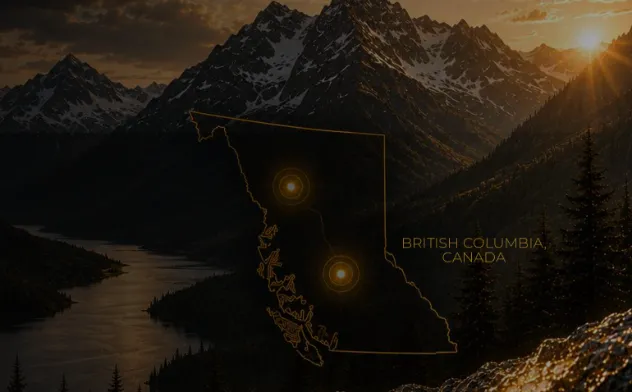
1:38 We're based in British Columbia, tier 1 mining jurisdiction, ranked 13th overall in the Fraser rankings. We've got 2 projects in BC, the Fish Pot, which is our flagship project, which will be the bulk majority of what I'm discussing here today, as well as the Miller property in the Golden Triangle, which many of you may recognize. The Fish Pot project, we're targeting as a Blackwater style deposit, so similar to the Blackwater mine, of course, which sits only 65km away from the property. We've done a significant amount of modern exploration on the property, really bringing it up into the modern era before feeding it into our first drill program. We've got upcoming catalysts.
2:24 We're currently actually today wrapping up our induced polarisation survey. We're using that information to develop and really hone in our initial drill targets. And then we'll be starting drilling within the next few months. So pretty exciting time to be getting in on this opportunity. So we'll go through a couple of the things first, before we dive right into the technical details, we've got a really tight capital structure for the company. Currently, we've got about $35M outstanding shares. Just over $8M of those are held by insiders, so really tight
3:01 control of the company, as well as a lot of skin in the game for a lot of the management and directors. Fully diluted with our warrants and stock options is $46M. You can always look us up on your favourite brokerage website. Leadership, we've got Barry Miller, who's the Executive Chairman and Director. Nick Michael, who's our President and CEO. Carlo Regalio is our CFO. Yours truly, I'm the VP Exploration, as well as a Director. We've got Tara Asfor as our VP Corp Dev. Directors, we've got Al Fabro, Stephen Sook and Christopher Kelly. Really, this is a pretty tenacious team with a significant amount of background in exploration and mining, capital markets experience. We really built this team to be a high-level team and we're aggressively exploring these projects that we have and looking to build this into something bigger.
4:00 Getting into it, the 2 projects are in British Columbia. The Fish Pot project is just south of Prince George, which is about a 7 hour drive from Vancouver. And then we've got the Miller project in the Golden Triangle, which is in the Northwest region of British Columbia. So today I'll mostly be talking about the fish pot, but I'll also touch on the Miller. So here's the fish pot property. You can see here, this is sort of, this is an image of the property. This is what it looks like there, rolling hills and really good access.
4:34 So in talking about access and infrastructure in British Columbia, one of the key things that we always have to be cognizant of is that a lot of areas in the province are hard to get to, especially if you're looking at Alpine targets or anything of that nature. Here, we don't have that problem at all. We are located, it's about 100 kilometer drive from Quesnel as you drive, but as the crow flies, it's about 80 kilometers west of Quesnel. Quesnel sits on Highway 97, which is a major infrastructure corridor. There is this line here, that's a rail line that comes right through. This red line here, this is the road that goes into Nazco PC. It is paved, it has power going to the community here. And then this remaining amount is a large logging haul road. And there's also actually a couple of small quarry pits and stuff that operate as well. And this is what that road looks like. So I took this photo in 2024.
5:33 Here in the background, if you can see my cursor, that's actually the fish pot property right on that hill there. Really good access to infrastructure. You just don't get that in a lot of places. If we do find anything of interest there, It's going to be pretty easy to get into and to explore. And it's making our drill planning and logistics pretty easy. Stepping back a little bit, this is the regional geological context. I'm a very technical person, not a professional geoscientist, so I always approach things from the technical and the rational sort of standpoint. And so this presentation will be slightly more technical, but hopefully I can sort of merge the 2 and it's not confusing. So here we've got a more regional overview of the project.
6:22 So you can see these are all deposits or targets along this corridor. This is a geological terrain called Stikinia. You may know it from places such as the Golden Triangle, sort of the same rock package that comes down to the South. Just about 65km away, we've got the Blackwater mine, which is currently producing. They've got an 8M proven improbable Gold resource there. That's this one right here, Artemis Gold. They're upgrading their mill and they're producing a significant amount of Gold there. To the North as well, we've got the Indaco mine, which is an operating Molybdenum mine that's been on and off operating for quite some time. Equity Silver was also a mine back in the day. It's currently on maintenance and that's the same with Huckleberry. So we're in a really good area, active mining area.
7:16 We are in the similar rocks to the Blackwater, which is a good sign. Similar age volcanics. And then to the south, there's the Clabasco property, which was just recently optioned by Evolution Mining. Evolution has been kicking tires in the region for a little while and quite interested. There's been several other major companies very interested in this region for good reason. There's a lot of potential in the region and a lot of it is quite, it's covered in soil and things, so it hasn't been discovered yet. And so we're hoping to be one of those discoveries moving forward. You also have the 3 Ts here, which recently put out news called Independence. They've been drilling epithermal veins there for quite some time.
8:00 Going a bit closer into the property. So the fish pot property itself, it will be 5,700 hectares. You can see here, the stuff that's outlined in the solid is the yellow, yellow here, that's claims that we have. The stuff in the hatched color is claim applications. Those applications have been with the BC government for a little bit now. So we're expecting to get those approved any day. It's just sort of a time thing. So yeah, we'll see how that goes, but hopefully we'll get those locked in before we start drilling, but it doesn't really matter. We've got the core part of our property here, which is where our main sort of targets are. So on this image here, you can see our make deck survey that we completed last year, identifying a few targets and some of our geochemical anomalies, which I'll get into shortly.
8:51 Here's a couple of quick photos from the property. So this is what the property looks like. There was a significant wildfire that happened a couple of years ago. So it's almost a barren wasteland at this moment in time, which I think they're starting to grow back, but it really has given us an unprecedented level of access to explore the property. We've got really good rock exposures. It's easy to see everything in terms of ground disturbance. I mean, the ground's already been disturbed and here we've got Jerry Lee, which is one of my employees from TriPoint on the property as well. They were there around this time last year. Well, this is actually in October. So yeah, just a really easy place to explore and look for mineralization. History on the project.
9:39 We've got most of the things started in the 1980s. In 1988, Resources in 1989 did a bunch of work. They collected several rock samples, up to 1.7g per tonne Gold, up to 3% Copper, 37g per tonne Silver on the property. They completed a whole bunch of soil samples, did airborne magnetics. They got Phelps Dodge involved at the time. Phelps Dodge went in, drilled 2 holes, called it a day and left, like they did on so many BC properties at that time. It was a big campaign by them. They moved on and then it sort of sat fallow for a little while. Kootenay Gold staked in 2011. And so 2011 is when the Blackwater mine was really starting to understand it a bit more. They collected some samples and then left it.
10:32 And then in 2020, Golden Tiger, which is Barry Miller's company, staked the property. They did a data compilation. Ted VanderWaart, a geologist, he went out and did a site survey, took some nice photos. And then in 2023, there was some remote sensing and some samples. And then 2024 is really when I got involved. So Barry Miller and myself, we were in a bar in Toronto chatting about things. And he mentioned that he had this property, the fish pot property in British Columbia. And so he sent me a couple of the reports and I reviewed them and a few things really stuck out to me. The main one was the alteration that was identified and described by Ted, to me just seemed very favourable for an epithermal style deposit.
11:23 He also was talking about these silica ribs, which you can find in these deposits as well. So I thought that was pretty interesting. We had actually at that time started talking about Gold in Excess as a company name as well. So that was really when I got involved. And since then we've built the company. In 2024, I went and did a site visit, saw surface alteration and mineralization. Last year we did a magnetic survey, which we'll get into. My team went out and collected over 90 rock samples and we did a whole bunch of alteration geochemistry on that. And then now into 2026, we're looking to refine those targets and really build up our first pass drill program, which will be happening in this fall.
12:13 Getting into a bit of the nitty-gritty here. Geochemistry, I really want to outline why I like the property and what's really important from my perspective, and why this is exciting at this stage. Getting into a bit of nerdy stuff, I apologize. We've got these overlapping geochemistry. We've got Gold, we've got Silver, we've got Antimony, we've got Bismuth, Arsenic, Copper, and they're all coincident within these key zones. And so that to me, it adds a lot of layers to potential and for our potential drill program that we're targeting the right areas. And they're quite zoned in there. It allows us to really identify, okay, we have these things on surface, what's going on at depth?
13:00 The rock samples that we collected last year, we also did a lot of really high level, like yeah, a lot of technical things with it. We did a shortwave infrared. My resident geochemist, Dr. Carter Grondahl, reviewed all of the data. We identified these key alteration zones and geochemical pathfinders. We also did some alteration in geochemical vectors and basically threw everything that we had at these rocks to try and extract as much information out of them as possible. I'm not going to get too far into the weeds of this. The key takeaways here is that we've got these really bleached and brecciated lithologies. To me, that means we have potentially mineralising fluids flowing through the entire area. It's a very good place to look. We've got coincident enrichments of different elements.
13:49 We've got really good ratios, pathfinders, and we have really good mineralogy that's favourable for alteration towards a hydrothermal magmatic system, but in essence, it's an epithermal style deposit.
14:06 So the geology as well, we did a lot of geology mapping and everything. So here's some, you know, no presentation is complete without some rock photos. Those of you who know me and maybe you follow me on LinkedIn, I'm a big rock guy. So here we actually have a lot of these really interesting looking rocks. So this rock here, this is the highest Silver sample. So the Silver seems to be associated with these Quartz veins. This is 11g per tonne Silver. Over here, this is our 5.65g per tonne Gold sample. It's really interesting, sort of brecciated with these dendritic sulphides. This is a sample that I collected there in 2024. We got these really chunky quartz veins with this black oxidized material in between, which looks pretty cool.
14:57 And then this is a good example of what we're seeing on the ground. So This rock was actually at one point much, a lot more what we call mafics, so darker minerals. Those have all been replaced by these light minerals. And you have all of these quartz coming in here. So if you're a geologist or have a geology background, probably will get you excited to see that. Geology is quite a visual science, so I was pretty excited to see all these things. And really that just culminates into, yes, we're looking in the right place for this deposit style, for a Blackwater-style deposit. Taking all that together, basically we've got these key overlapping zones within the centre of this area. We've got geochemistry, alteration, geology, and that's really key. We also have geophysics.
15:44 Last year, we did a magnetic survey. You have these magnetic highs and these magnetic lows. So it all overlaps. And when you have that much proof, you really have to do something with that. And the best thing to do is just go and see what's down there and drill it. Right now, that's what we did previously. That's what we've been busy doing the past couple of years on the project before even our IPO or getting listed or anything. I really like to have a lot of information before we put ourselves on the line and really building a strong foundation to the geology and the technicals helps everything into the future. Once you get listed, once you start drilling, things start to move fast. We wanted to lay the groundwork for a solid deposit style and target And that's exactly what we did.
16:33 Right now, the catalysts that we have operating at this very moment, we're doing a 3D induced potential survey with SJ Geophysics. And so that's really going to give us a lot of information in terms of 2 things. One is going to be chargeability and one's going to be resistivity. What I'm most interested in is resistivity because quartz veining and silica, which is often associated with our deposit type, is going to be less, it's going to be resistive. And so anywhere we're going to see resistivity high is going to be a potential target. And we're hoping that those are going to overlap with what we already know. And then the chargeability could tell us the presence of sulfides as well. So that's really going to allow us to hone in on our drill planning. Those results will be coming out in the next little while, once we are able to actually consolidate and review and interpret the data.
17:27 The other thing, recently we put out a news release that we're in the middle of our IP survey, but also for this thing called virtual drill. So Robert Ripplinger in the US has a system that's called elemental harmonic resonance tomography. Basically it's a satellite based system. It picks up certain elements in the subsurface. So we're going to be running that new technology on the program. Right now is really the best time to be testing these things because the proof is going to be in the drill bit. We're going to see if it works. If it does, it's going to allow us to explore a bit more readily the rest of the property and the region. But for now, we're going to see what happens.
18:13 It'll be really interesting. Stay tuned for those results as well. Now, of course, these 2 things are leading into our ultimate goal, which is to really hone in our drill program and tighten our drill targets. So in the next couple of months, we're going to be starting the inaugural drill program on the fishpaw property. And what that's going to look like is we're looking at about 2000m of drilling. It's going to all be skid-based. We're looking at about 8 to 10 pads. Average hole depth will be about 200 to 250m. And we're going to be looking for key things, but the main thing is mineralization. We're going to be looking for Gold, Silver, Copper. We're going to be looking for alteration. We're going to be trying to hit this thing as hard as we can, as well as we can.
19:03 So a pretty major catalyst coming up with that drill program. There's really going to be a lot of proof. We're putting a lot onto that and we're doing a lot of work in the background to make sure that it is as successful as possible and that we can find the best that the fishpaw project has to offer. The other project that we have is the Miller. I'm just going to touch briefly on this. A lot of data coming out of the fishpaw, but basically we've got this project. It's in the Golden Triangle. It's just downtrend from, well, formerly known as Dolly Varden, now Contego and the Quetzal Valley. We've got a team going up there this year to do some surface sampling. Up until recently, the project was covered in Glacier. That's all since receded, so we have a lot more rock exposure.
19:52 So stay tuned for those results coming out as well. The key takeaways for this is we've got a very tight share structure with Gold in excess. We've got a lot of room to grow and expand, and we've got very good shareholders. We've got a very tenacious leadership. Barry has really been a key driver in this. We've got a very strong technical team and good people involved. I think we're going to get the best out of what we have. The fishpaw property has very convincing geology. Hopefully you got something of interest out of that. If you want more of a breakdown or discussion, I'm available and happy to chat.
20:40 But basically, the key takeaway is we've got multiple layers of data supporting our exploration thesis that it is looking like a Blackwater-style mineralization load, intermediate sulfidation, epithermal system. That's really what we're targeting in terms of grade and potential size. Of course, more work has to be done and we have to drill it. Near-term catalysts, we're wrapping up our IP survey as we speak. We'll be releasing those results in the near future and then we'll be leading into our drill program. That'll be starting up within the next couple of months and be completed before the end of the year. So we're ideally posed for exploration success and we're going to find the best of what we can find.
21:30 Thank you.