Transcript
Automated transcript · Written by software from the replay's audio. It can mishear names and figures; the replay is the record.
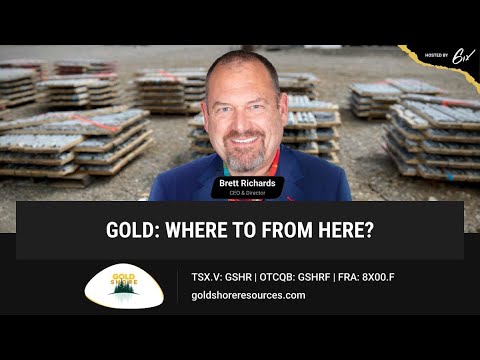
0:07 Hello, everyone. Welcome to Goldshore Resources Live Investment Summit today, hosted by 6. I'm joined today by Brett Richards, Goldshore's CEO and Director. Brett's going to take us through a presentation in the recent PR, and after we'll be entering into a live Q&A session, I'd like to remind everyone in the audience that you can ask questions using the Q&A tab found on the right hand side of your screen at any point during today.
0:28 And at the same time, Today's recording will be available on demand on six.com for you to review later. But Brett, I'd like to hand things over to you to kick us off. Yeah, thanks, Cam. I appreciate it. And good morning, everyone, and welcome to the summit. You know, I thought today what we do is something a little different. I'm not going to go through the usual routine or usual deck. I am going to update everybody as to where we are, but I really want to talk about the bigger picture and we'll get to that. But as just a brief introduction, as everyone may know or may not know, we own the Moss Lake Project, which is located up in Northwestern Ontario. And the Moss Lake project has a historical resource of about 1 million and a half ounces of indicated and 2.5 million ounces of inferred gold resource.
1:23 It's a historical resource and really that's our starting point. But we have a project with significant infrastructure availability. We have a project that has a sizable historical resource. We're in a low-risk jurisdiction being in Ontario and it's one of the attractions, and I've said this from day 1, this is one of the attractions, many of the attractions of why I'm interested in this project and why I'm driving it and why I'm pushing it. Because in my view, this is going to be a project that goes into construction and into production 1 day. So, you know, I certainly, I want to highlight our people because they have done an amazing job. Pete Flindale is our VP of Exploration.
2:08 Marla Sassine is our CFO, and they've done a wonderful job orchestrating the work on the ground and the work behind the scenes and getting this company to where it is today. And I will speak to the market in a minute, but these guys have done a great job. And I have a very, very strong and supportive board of directors, led by our chairman, Gail McNamara, and really driven by guys and ladies in our team, as you can see on the screen here, and great collaboration with many of our strategic advisory board along the way as well. So we've got a very, very strong, reputable, very demonstrated track record.
2:54 Pete and I have over 36 years of experience. We built 3 mines together. And quite frankly, everyone on our board has very similar strengths and skills and experience and some very deep knowledge in this industry. So the team is well positioned to take this forward. This is kind of where we are in Northwestern Ontario. And as I spoke about the historical resource, there's not too much that needs to be said here with the exception that there is extensive infrastructure. We're on Highway 11, which is Yonge Street in Toronto, but we have access to an international port, international airport, we have road, rail, water, you know, natural gas, people, contractors, and we have 10 cent kilowatt hour power that goes right by our site. And I challenge anybody that's working in the Northern Arctic, Northern Quebec, or extreme Northern Canada, or other parts of the world. And I've worked in many places around the world.
3:55 Infrastructure is extremely important and more important than people give it credit for. And we have everything at our disposal here to build a big, large district-size mining camp. We have about 143 million shares out. We've got about 8.8 million options out and we have just a little under 10 million in cash in the bank today. I'm gonna jump forward here to ESG, because I think it's extremely important. We signed an exploration agreement with one of our host nations, First Nations communities back in June and July, and continue our collaboration with them and continue the work that we've done in the community.
4:45 Pete and his team were just at the SENSEC conference in Thunder Bay. And we continue to support, you know, both locally, educationally. And, you know, I think we've started a very good footprint in the Thunder Bay area. Environmentally, we have one of our host nations affiliated companies conducting our baseline study and it's well advanced. It's been going on for more than a year now, probably go on for another year and a half to 2 years as we develop the resource. I'm going to save the VTEM survey for a little later because what I want to do is talk a little bit about what we found in this resource.
5:30 As everyone remembers, when I talked about this, it revealed 29 high-priority drill targets and demonstrated almost 11.5km strike length of known mineralization with 150,000m of historic drilling that has been done in all of this area. So, this was, again, this was our starting point and this was kind of the contrast that we put together to not only validate some of the resource work that was done historically, but also to guide us going forward with significant drill targets. You can see we had some very high grade intercepts early on in our program. I think this went out on March the 2nd, we had 58 meters at 6.3 grams near surface.
6:18 And this is quite meaningful because I'm going to toggle right now to our press release we put out yesterday. And I think this is a telling tale here because you can see the historic resource that is on this plan view document. You can see the recent drilling that we have done. And this came out yesterday where we announced, I think it was 29 meters at 2.99 grams. So really significant higher grade than the typical deposition we have. And you can see in red here where we've got higher grade areas over some very, very large intervals that are over 1g.
7:10 When I talked earlier about what is the strategy going forward, When we acquired this, we had collectively between the indicated and inferred 4Moz, although we're not supposed to promote it like that. We're supposed to promote it individually 1.5Moz of indicated and 2.5Moz of inferred. What we saw was that this is going to be much larger than the historic resource indicates, simply because we're getting hints well outside of the historical resource. And the VTEM survey shows that this mineralized trend is around 11.5 kilometers, not 2.5 kilometers like the historic resource was. So We felt that there was a lot of scope to take this up to, up to, you know, call it 10 million ounces, maybe more.
8:07 But in the process of, you know, understanding that and in the kind of, I'll say the results driven, you know, strategy that we have, we started to hit these high grade areas. And I think it really changed our focus for a couple of reasons. I'm not losing sight of the fact that this is a very, very large region, a very, very large resource under our land package, and it may well deliver north of 10 million ounces 1 day, and 10 million economic ounces 1 day. I think what we need to understand is what does this market want today? What does this market need today, given the kind of the macro environment?
8:54 And I'm gonna speak in some detail about the macro environment in a second. But you can see these high grade areas that are gonna create a phase 1 starter project that is, let's call it 1 million ounces, maybe it's 2 million ounces. I don't know what the answer will be at the end of the day, but it'll be somewhere around 2 grams, not 1 gram. And I think that gives us the entry point to get something into production, generate cash flow so we can see a visible path to positive cash flow with this massive global resource behind it, supporting a 20, 30 or larger year mine life over kind of a longer period. I think that is now the approach we have to look at. And it's because of the macro. It's because I don't think inflation is transitory. I don't think it's going anywhere anytime soon. I think we're going to live with 3.75% to 5% interest rates for some time to come. I think we're going to live with 5% inflation for some time to come. We're not going back to the last 15 years that we've enjoyed next to 0 interest rates, free money borrowing and very, very low inflation.
10:14 I think times have changed and I think they've changed again, not temporarily. I think the times have changed permanently. So we've had to take another look at how this project is gonna manifest itself. So I go back to, you know, what is going to drive this? What is going to move this needle. We obviously have had to push out our schedule because my job as a CEO is about managing risk. Yes, it's about developing this project, but it's about managing risk, understanding the market, understanding kind of what the market wants so I can create shareholder value.
11:01 That's my whole purpose is to promote, manage risk. And yes, I know it sounds a bit pedantic, but we do SWOT analysis, we do PESTEL analysis every day, every week. We look at obviously the strengths and weaknesses and opportunities and threats against this company. And we have to put it in the context of the political, the environmental, the sociological, technological, the legal and the environmental risks. So we manage those things every day. You know, I'm embarrassed to say kind of how this market has treated us and I can't control that, but the reality is we IPO'd over a year and a half, about a year and a half ago, June 1st, June 4th, we listed at 65 cents. The market has had a tremendous pullback in 2022.
11:58 We opened the year at 65 cents And we had a lot of good liquidity last year. But as time went on, we raised $10 million in March, closed it in April 6. And I felt that at that point in time, we were on the cusp. We as a let's call it the global mining community were on the cusp and the reason I say that is because we didn't know whether the macro was going to get better or it was going to get extremely much worse. And we made a decision to ramp up our drilling program from 4 rigs to 7 rigs because first of all they were available, second of all we had the finances to do it, and third of all our view was we can always scale back if we need to. But let's get ahead of the curve.
12:51 Let's get ahead of the game. And quite frankly, we got it wrong. And we and we had to make a very quick decision. You know, soon out of the gate, and we went back to 2 rigs. And that delays our development timeline. As you can see, we're well past the halfway mark in our 100,000 meter program, but we were not where we wanted to be in a normalized market and now this is going to push us to a resource update into 0.5 one of next year. And then we'll look at what we do as far as a PEA or what we do as far as some form of study. And the reason I say we'll look at it is because, this is probably more educational than anything.
13:43 A preliminary economic analysis is a snapshot in time. We take the resource that we have, and we put together a scope of a project around that, relative to everything we know at that point in time. And let's face it, we are in hyperinflationary times today. And, you know, our operating costs, if we were to take a snapshot today, would be 50% higher than they would have been a year ago. And that's even in Ontario and with the infrastructure we have. So today it doesn't make much relative sense because I think although we're at a very high inflation level and we're at a very high, I'll say crisis in the marketplace and it's illiquid, it's volatile at times, it's illiquid at times and it's polarized.
14:33 And you make 2 steps forward, and the first crack of a crisis, you take 10 steps back. And that is the way our share price has performed. So my view is we're going to stay the course here. We're going to keep 2 rigs running. We're going to continue to get on with our program and we are going to try and get, we're going to try and get through and, and understand where the market takes us at the end of the day. But, you know, and I had, I was on a panel yesterday and again today, and I'm gonna take a lot of questions today because I want people to understand that although this market is temporary, I think some of the fundamentals of this market are going to be with us for some time. And that is going to impact the gold price. It's going to impact how mining companies perform.
15:27 Because we have to use many assumptions. When we do a PEA or a feasibility study, we make a lot of assumptions, not just about gold price. We make assumptions about power, about labor, about consumables and the cost of construction and steel, et cetera. We get firm quotes when you're at a feasibility study, but at a scoping level, a PEA level, you're going to be getting kind of assumption costs based on history. And they're gonna be inflated with inflationary numbers, but using long-term gold prices of $1,600 when we're trading at $1,700 today, I think is reasonable. But the majors are using $1,200, they're using $1,400 for pre-fees, They're using $1,200 gold shell assumptions for feasibility studies.
16:21 And that's prudent, but it really shows you that they're being very, very conservative. And as a result of that, fewer projects are getting built and we end up lowering production levels globally and lowering the supply in an environment that has a constant demand. And you would think with all these macro drivers that historically drive gold price that we would see a much stronger gold price today than otherwise we would. If you look at gold, why gold, it has a 3000 year track record of insurance to let's call it civil unrest or political unrest.
17:07 And there's very few places that you can go for as an investment standpoint that has an inverted return to normal equity investments. You know, whether they're financial investments or real estate investments or whatever they are at the end of the day, it's very difficult to hedge the market. And gold has been that insurance policy against crisis. And the fact that it's tangible versus ETFs, which are not tangible, it gives people comfort and it has always been that inversion to crisis. Well, I don't think we've seen bigger, let's call it geopolitical, socio-economic crisis than we're seeing today. You look at the macro picture, yes, you've got the geopolitical events of Russia and the Ukraine, and they are having a downstream effect on energy and gas prices in Germany, the EU, and we're gonna be running into an energy crisis in Europe and the UK come the winter. And so you've got 1 geopolitical crisis creating another crisis.
18:16 It's also the Russia-Ukraine situation. Ukraine supplies 100 percent of its wheat into, I wouldn't say 100 percent, 90 percent of its production is exported And there are 13 countries in Africa that solely rely 100% of their imports on Ukrainian wheat. And this is a big problem because they've missed the growing season and there's hardly any distribution coming out of the country, exporting or transportation coming out of the port. And it also has affected potash, which is a fertilizer used for agriculture in Africa and other places in the world. And what this is going to create is a food crisis. So you can now see the rippling effect of all this. And I'm going to get to the, I'll say the end game here when we talk about the impact on gold, because it has a very, very strong impact.
19:12 So macro geopolitical, we also have China and Taiwan tensions and US tensions around that. We have North Korea that pops its head up every once in a while. And this is just creating an environment for investors to be scared and for them to be completely risk off. And this is what we saw in March, April, May, and we really saw it in June and July, even though the summer months tend to be a little less liquid than other months. But here we are, September the 9th, and we're still seeing that, I'll say that risk off mentality. We're seeing 10% of usual trading on Goldshore stock. Many other juniors are the same. The GDXJ is down 26% for the year.
20:02 And we're down 60%. It is not a great place to be. But again, and I compound the macro with the US dollar, the strength of the US dollar. And I would almost call it, I wouldn't say artificial strength, but it feels like that. The US runs a $4 trillion deficit a year and have $31 trillion of debt that they are going to be servicing with 1 trillion dollars a year come 2024. Their budget is 5 trillion dollars in 2024 and their deficit will be 35 trillion dollars. And if you rewind the clock, in 2000 the U.S. Deficit was 5.6 trillion and it's going to be 35 trillion in a couple of years. This is, it should be disturbing because it is going to weaken the US dollar.
20:59 But the reason it hasn't weakened is because where is the alternative and every place else in the world is just as bad or worse off given kind of that macro picture. So we're seeing gold depressed from where it normally would move to as a result of the strength of the US dollar.
21:25 And we have started to come now to, and I'll say globally, where we were working towards globalization and electrification of the world. And that all bodes good for minerals and the R types of minerals. And it does bode well for gold indirectly. But we've gone from globalization to extreme protectionism and some of that was driven by the US through their last political hierarchy, their last president and not so much this president, but potentially the next president. And that protectionism has led to mineral strategies in the US and in Canada, where we have a critical mineral strategy. And gold is not on that list, but you've got certainly the battery minerals and you've got many other, I'll say, what they've deemed critical minerals to the country's security and supply.
22:27 China has a dominance in this area And China has a dominance in green energy. And as we start to experience these climate change impacts, big heat waves, big droughts, et cetera, I'll say the solutions to some of these things, whether that's solar, solar panels, electric batteries and electric vehicles and decarbonization and green tech generally, China has anywhere from 60 to 90 percent of the global resources in this area. So we've gone to an area where every country is trying to protect themselves. And again, that increases risk. And it should be good for gold. And it hasn't been. And I'm not going to sit here and say, you know, what gold is going to do over the next 6 months, 12 months or 18 months, because I will 100% get it wrong.
23:20 And most people will. What I can say is the environment is trading for gold to be much stronger than what it shows today. And I think we put together kind of an argument of physical gold and physical gold equities versus synthetic products, simply because of certainly the macro and the US dollar, But where this is going to come out in a year, 2 years and 5 years. And do I think gold is still going to trade between $1800 and $2200? I do. And we're at $1700 today. And I've always said that there will be pullbacks due to these macro type environments or US dollar strength. And there is. And I also said there's going to be events that may drive it above $2,200.
24:10 And I still believe that. But because the globalization and the global economy today is so polar and the political views are so polar, you can see where volatility in the gold price, you know, may be impacted as well. You may see big spikes up 2 or 3 or $400 in 1 week as a result of events. So let's drill that down into kind of why gold equities. The history of gold is strong. The history of why people hold it as an insurance policy to social unrest and crisis. And let's face it, we're in a world right now with extreme political and social disorder. Personally I think we need a bit of a moral revolution in the US as we and leadership will drive this but there needs to be some change.
25:06 And when you talk about gold, you can't help but talk about why gold equities. And gold equities give you a leverage and a premium to the gold price because of their growth model. And in a rising gold price environment, which, you know, the consensus tends to, to look at the contango curve and, and we tend to be in a rising gold environment, that leverage of growth, you actually get you a premium to actually just holding physical. And I think, again, I look at the supply side of this as much as the demand side of this. There is a lack of replacement of reserves. Albeit there's too many gold companies in this world today and some of them shouldn't be there because they don't have real projects that can be litmus tested and stress tested down to $1500 or $1400.
25:56 But there are some that work at $1000 and $1100 and they should be in this business. But the lack of reserves is only going to compound the decrease in supply over a medium period of time, which is going to put pressure on the gold price. And There are 55,000 tons of total gold resources that are known and to be mined in this world. And I think you're going to see in the next 5 years that demand curve exceed the physical supply curve. So that's why you play gold equities. And my point here is why GoldShore? And you look at us as that leverage in the premium to gold price.
26:43 And I'm an investor in this company all day long. And this is the biggest, greatest, most powerful buying point of GoldShore that we've ever seen. And I think that we'll ever see. We're at 20 cents today. This is the greatest entry point that we have witnessed in our short life as a gold company. But I think we're now in that turning point where I think you're going to start and see a little less risk off, Assuming the macro stays where it is, or even gets better, if the China-Taiwan tensions to dissipate, if the Russia-Ukraine situation dissipates, and I think the world is fairly fatigued about both of them right now, investment appetite comes back. And you've seen it in the Dow. The Dow has been, you know, reasonably strong, but gold equities have absolutely been hammered. This has been the worst period, 6 month period in the last, I'm going to say 24 years, 25 years that we have seen a decline in the majors, the mid-tiers, the Purdue junior category of gold company has been hammered.
27:59 And is it the bottom? Well, if it's not the bottom, I got to believe we're pretty close to it because on a historical resource basis, we're trading with a $24 million market cap. And I'm not going to do the math on the combined historical formula that translates into. But I can tell you one thing today, it costs us $30, $25 to $30 an ounce to put an ounce on your resource statement at the inferred level. To move it up to measure and indicate it, it takes another $50 an ounce. And to move it up to a reserve, it's about $150 an ounce. So that's the cost of finding ounces.
28:45 And we're, not just us, but all of our peers are trading at $10, $15, $20, $25 an ounce. And they have a material mineral resource inventory and a resource statement. So They're working on the premise that they're severely discounted to what it actually costs to find these. And you can't continue, this market can't continue because obviously we have difficulty raising capital and we also don't want to raise capital, in our case, at 20 cents. So this is what I would say is one of the greatest buying times of GoldShore that we've seen. And I don't think going forward, you know, there's room or scope for it to get much worse. Now, never say never, and I'm not the pundit or the person who is gonna predict this, but I really do believe things are going to get stronger as time goes on and gold will get stronger as well because the US dollar can't help but weaken. And we will see a dissipation in inflation, but inflation is going to stay here at a certain level. So, you know, that's my view of kind of why GoldShore, you know, We have, like I say, yes, we have a historic resource.
30:07 We understand the potential of this and we're getting great hits on step outs. We just hit 3g over 29m on a step out down dip. So again, this deposit, as we've been saying, is much bigger, it's much longer, it's much deeper than the historical resource relates to. I just need to prove it. And we've been over, I'll say overachieving
30:34 to our expectations as to what we have delivered to the market so far. We have press releases out every 2 weeks, but we're in a market nobody cares. Nobody cares about Gold Shore. Nobody cares about Gold. August, July and June were horrible. I actually put out a press release in August and we didn't trade 1 share for 6 hours. And by the end of the day, we were down 1 cent. And it was a tremendous, a tremendous press release with great high-grade results illustrating the growth potential of the resource and really conforming to our mantra that there is a low CapEx, a higher grade phase 1 project here. And so that's kind of why Gold Shore.
31:23 And I think the gold price will be what it is over time. But You've always had my view of where I think gold is going to trade, and I still maintain that view. Although it's difficult to say that when gold's trading at $1,700, and it's very difficult to see kind of where the light is at the end of the tunnel. But I think we're coming out of the worst period, the worst 5 months, 6 month period in the last 22, 23 years. And quite frankly, I think the trajectory is now up for not just for GoldShore, but for gold equities generally. And I think we are better positioned than other gold equities simply because of how far we've fallen. But also our starting point, this is not a risk to a discovery risk.
32:13 We have a discovery. We actually have a historical resource. It's about validating it and it's about increasing it from the 0 base we're starting from. So yes, we have a historic resource. We're starting at 0 And we can only add to that from 0. So I'm quite comfortable that we have around $8.5 million, $9 million in the bank today. We have a situation where We have 8 or 9 months of runway. And again, I go back to what my job is. My job is about managing risk and making sure my shareholders are protected. And we will continue with that mantra, but we're not gonna stop the process and we're not gonna stop the project in order to kind of wait for the traffic light to change to green or double green.
33:12 It is amber right now And we're very cautious and we look at these risks every day. But I am so encouraged by the work that our people have done on the ground. I'm so encouraged by the results. And we have first results coming out on Monday for Cold Stream. And I'm excited. I'm really excited about where this project is going. And so that's really what I wanted to talk about today. You know, there's always kind of the macro that has never been more important than it is today. But I think the opportunity is entry today into Goldshore. We just had Laurentian Bank put out their target for us. They're analyst independent.
34:03 Their target for us is $2. And it always has been $2, but it's still $2. And from where we are today, that's a 10 bagger. And I think people understand that, but there's still that fear out there. And my job is to mitigate the risk enough so people don't have the fear to engage with and buy Goldshore. So that's the opportunity. I think, you know, it's good to know, you know, I am extremely active. I do investor meetings every day. I did through the summer and I'm gonna continue doing these. I do them one-on-one, I do them five-on-one. And like today, we're doing it 50-on-one. So I am gonna be presenting at Beaver Creek at the Precious Metals Summit next week. And following that, I'm going to be presenting at the Denver Gold Group.
34:55 And I believe we have around 50 or 60 investor meetings aligned up for both of those. And then I'll also be presenting in Zurich at the Precious Metals Summit and the Deutsche Goldmast in November. So we have a, this is conference season right now. This is the period of time when we get out there and we tell our story to new investors, investors in new jurisdictions. And the US is a great market for us. Germany is an absolutely great market for us. I've got a lot of German investors and a lot of people I talk to weekly from Germany, Switzerland, Austria, who really love this story. As you know, I'm based in the UK, and although I get to site quite regularly, I have a lot of investor contacts in Europe who follow this story, and I need to have more of them.
35:46 And we need to have more of them in the U.S. And other jurisdictions as well. So that's where we're going to be. Pete Flindell will be joining me in Denver and we'll be telling the story to as many people who will listen. So you know I'd be remiss if I didn't pass on wishes to the Royal family for the passing of the Queen, our thoughts and condolences there. But I'm happy to take some questions if anybody has some questions. So Cam, maybe you can tee any up if there are some. Absolutely, Brett, thank you for the great presentation and conversation so far. I'd like to remind everyone in the audience that you can ask questions using the Q&A tab on the right hand side of your screen. Brett, we already have a bunch of questions. Stefan wants to know how important are the byproducts, Cobalt and Copper, economically?
36:37 They're important. They're important to understand. We haven't had the opportunity to go up and drill in the areas where we did some assaying of some historical North Cold Stream core where we found 0.4% cobalt. That is extremely material, and I would really love to expand upon that as quickly as possible. We will get there, But it's going to take some time. So Cobalt up in that area is important. I think the unknown here is the Copper dynamic. And although there is a historic Copper mine on our project, North Cold Stream, they made a Copper Gold con for many, many years.
37:25 They never assayed for Cobalt. It was probably a by-product that got the benefit of the smelter. But I'm really excited to kind of fully understand Cold Stream, Iris Lake. And as we get up into the white metals property that we are earning into, up into Iris Lake and Vanguard, I think we're probably going to see possibly some some copper expressions up there. I don't know the answer to it But I do know one thing is that we are testing for everything. We're trying to understand this Comprehensively so that we don't miss anything, you know, Are we out there hunting for gold? Absolutely. But are we assaying for multi-element assaying for everything? Absolutely. We want to understand this holistically. No, fair enough.
38:13 Russell asks, given all the developments by the BRICs, creating a new reserve currency, Do you see this as a major catalyst in the near future? Well, you know, I'm not an economist. I just have a view. I don't think we're going to see any changes in the reserve currency and the fiat currency. I don't think we're going to see any changes in the reserve currency and the fiat currency. I don't think we're going to see any changes in it in our lifetime. And I'm an old guy, so maybe that's not very long. But you young people out there, you're still going to be trading in US dollars. Gold's still going to be priced to the US dollar when you get to be my age. So I think we still have 50 years of this dynasty. And if you believe in dynasties, they last 250 years and the US is coming to the end of their 250 year dynasty.
39:03 So maybe there's a change in the future. Again, more macro, that's super ultra macro as to kind of where these things take us. But we're not going to see any change in the reserve currency anytime soon. It's still going to be driven as it has been historically. Andrew is wondering if you can go further into depth or reiterate any of your thoughts on the gold price in general. He references building recession fears, but at the same time, the price of gold is still going south. Yeah, it is. There's just no strength for it because of the strength of the US dollar. And let's face it, we were, When I went to London 14 years ago, the pound was 220, it's a buck 60 something today.
39:51 The Euro started at a 185 or 186. It's just around the US dollar today. So again, I say that The US dollar has strengthened by default because of the weakness of others and the uncertainty in the EU and the uncertainty in the UK and the long, sleepy Brexit process. And then you compound all that with all the other events going on in the world, you would think that gold would be $2,500 today, but it's not. And because the alternative is the US dollar. So again, I think we've tested boundaries now. We've tested the floor. I think $1,700, we traded down to 1670 or 1680 last week. So I think we've tested the boundary.
40:46 I think we're on the floor today and I think we're going to start and see minor increases as the dollar kind of stabilizes. We've got good, I'll say reasonable oil prices. We've got reasonable, I'll say 80 to 130 dollars a barrel is a range where you're going to see some stability. The problem is gas prices as a result of all the other geopolitical tensions, all the other issues around the world, drove gas prices up to crazy levels. Like we were paying, I think in Canada that you were paying like $2.30 for gas, the US $7.50 for a gallon, and even more extreme in Europe.
41:37 Yes, that's inflation, but the inflation, this is not a demand pull inflation. This is a cost push inflation. And quite frankly, I think there's a lot of companies that cost push. I think oil companies really put it to when inflation numbers started to hit high and they could you know increase their revenue as a result of it. Compounded by the supply chain issues and the transport issues, I think they really took it to us. In that environment, in a cost push inflationary environment, gold should have performed better And it simply hasn't. And I think it is part of the US dollar. But I think we're gonna be building in inflation.
42:24 Inflation is gonna be here. There is gonna be a COLA, a cost of living allowance that is gonna be 3 or 4% now where it was 0% before. I think we're going to start to see that now. But that is like an aircraft carrier trying to make a 360-degree turn. It takes some time. And for all these things to flow through, whether it's wages or whether it's other cost components of the cost of goods, it's going to take time to turn it all around. And quite frankly, gold will continue to perform as it has. And as I say, trade in this range, This is just my view. My view is that we've seen the bottom, we've tested the bottom, and we're going to dance around this range for a while. And I think if unless something dramatic happens over the next 2 years, we're not going to see $3,000 gold.
43:16 We're not going to see, you know, $2,500 gold. We're going to just play in this range for a while. All right. Fair enough. Vlad wants to know if you're planning to continue with just 2 rigs so far. And do you feel that a resource update in H1 2023 is ambitious continuing with your current capacity? A great question. The second part of it. The first part of it, yeah, we are gonna continue with 2 rigs. As I said, we don't wanna stop the progress. We don't wanna stop the story and sit on and preserve capital. You know, you know, we're we're we're in a position where, yes, we are. We have a lot of things and some of these things will be announced soon as far as what we've done for. Cutting her capital, but we have to continue on to tell the story and advance the story and develop the project. And that's 2 rigs right now.
44:10 Comfort rigs continue on with 2 rigs. I think there's going to need to be a sustained rally for at least 6 months before we would continue ramping up to more than 2 rigs. So getting to the second part of the question, Vlad's right. It's going to be difficult for us to get our resource estimate done as because we're not going to get through the hundred thousand meters this year we're probably going to go into early into next year but we're doing we have enough data now let's face it there will be 250,000 meters of drilling that we will have the data for. We'll do a very good internal mineral resource estimation to see where we're at and to look at all the permutations of what a potential project looks like.
45:03 So you've got that small, as I said, low CapEx phase 1 starter project. We'll look at that, but we're also going to look at, you know, the global resource behind it, because I think that is the attraction that, you know, big mining companies want generational sized mines. They don't want to spend $500M and be out in 10 years. They want to spend more than that and be for a generation. And I think we have the making of something like that. Certainly this district is large enough and we have white metals to the East of us. We are earning into their land package but they also have a project East of us. And there's other explorers around us that really make for a really decent district story here. So, you know, do I do, I think we're gonna be, is that ambitious to say we can get a resource estimate done next year, independent 1?
46:00 I think it's ambitious. I think we can get it done by the end of 0.5 1 next year. We're going to keep the market current with us wherever we are in the world, in our drilling program world. We're going to keep everybody current. We're going to keep everybody up to speed. We don't hold back. We don't play games. We're just very transparent. And we have to be because that's who I am. But we also have to be because you as an investor need to know where we are and take a view on where we're going and what this looks like. And quite frankly, I've told you my view. I've told you my view that I think this is a very, very strong project that will be in production 1 day, because I think not only as the macro world has changed permanently and we're not going back to what 1980 looked like or 2000 looked like or 2011 looked like, we're not going back to those times.
46:59 We're in a different time now. It's much more volatile. It trades on, let's face it, things trade on fake news, things trade on political lies, things trade on fake politics. That's unfortunate. But what we have is a real story and we have a real project and we just need to continue to advance it and advance it. And we'll get there. This is a journey that is gonna take 6 months. This is a journey that I need for at least another year. This is a journey that I need people to be with us on for the next year, because we will continue to deliver the results required to make this where it should be. And I go back to our target price from Laurentian at $2.
47:51 And we have a target prices of other analysts at 80 cents and 90 cents and a dollar. That is where our next steps are. And my job is to promote and to tell the story and to be transparent and get the real data out there so that people can make their own decisions and can appreciate the value of this company. Absolutely. Stefan wants to know your thoughts on what he posits here, that historical inflation comes in 3 waves and that the first wave may have seen a tie or we're going to see it soon. But that after that, inflation may come down, port ramps up again. So, again, do you have any thoughts on that? Well, a lot of these things have that dead cat bounce and I think the Fed will overcorrect.
48:43 Again, it's this aircraft carrier turning, they have their blinker on and they're trying to turn it in a different direction. And they'll probably overcorrect and oversteer and then have to drive back into their lane. You're exactly right, there will be an overcorrection and then they'll have to normalize it. And that just tests the boundaries at the end of the day. So yeah, I do believe it, but I think inflation is now going to be built in. In the 80s, we had cost inflation around 4%. I remember it because I started working in the early 80s and we were getting cost of living adjustments of 4%, 3%, 4% every year because that's what inflation was and wages automatically increased, cost of goods automatically increased.
49:30 You didn't see it flow through on everything, but you saw it flow through on many things. And that was the norm. I think we're going back to that built-in inflationary environment because it really is. What we've seen are inflationary extremes now because of all these other crises that are happening. The energy crisis, the food crisis that we haven't really seen yet, the climate crisis that we haven't really seen the impact of that yet, although there's more frequent droughts, there's more frequent forest fires, there's more frequent hurricane and climate events than there ever has been. So that's real, and that is gonna drive inflation as well. And I think there's also another factor of all this, And I go back to the age component. There's a big demographic change in this world. China is actually having a decrease in their population over the next 40 years.
50:26 By 2040 and 2050 and 2060, China's population will be lower than it is today. The rest of the world will be much higher and we're gonna hit 10 billion people in this world in the next 12 years. But the demographic change is kind of the old versus the new. And I think the current generation, call it XYZ, anything post baby boomers are, I think, disgusted with the generation before them and how they've, how they've run this world and where the world is today and the things they've done, whether it's energy, whether it's climate change and carbonization, let alone, you know, the fact that we're trying to decarbonize now, I really think that the younger generation has a different mantra.
51:17 And that mantra is they work to live. And quite frankly, our generation live to work. We've all worked hard all of our lives. And I think the balance in the next generation and this demographic change, don't care about those things, but they do care about the environment and they do care about political unrest and they do care about politics and fake politics and news and lies. So I think we're seeing a big, big change here, not just demographically, but socially, that will impact all of these things. And when I look at, and I listen to a futurist sometimes, and I just listened to Peter Zion recently, He has a book out called The End of the World is Just Beginning.
52:04 And, you know, all of these components that he talks about in 30 and 40 year swings, all relate back to the gold price. And you heard me earlier say, it has stood the test of time 3,000 years as a trading tool that is a protection against crisis. I think even the younger generation will find their way now. And I think you'll see less of an emphasis on crypto and Bitcoin and those types of currencies as we get back to tangibility and tangible resources. Because natural resources are really what's going to drive the solutions to all of these things like climate change, like green energy, like the energy crisis that we have today.
52:52 It is all going to be driven by natural resources and all the elements at the end of the day. So anyway, I hope that kind of answers your question, you know, in a long roundabout way, but I really do think, you know, this is the new environment we are, is gonna have built in 4% inflation for some time to come. No, fair enough, Brett. Just looking at time, we probably only have just enough for one more question from Vlad. How do you assess your runway with available funds? Would what you have be sufficient to get updated resource without additional funding rounds? Hey, again, full transparency, the answer is probably no. Can we get through an internal mineral resource estimation? We probably can.
53:43 Do we take that and do it independent based on the data that we'll have from just 2 rigs running for the next 6 months? We probably could, but again, I go back to my job. My job is risk management. My job is managing the coffers and making sure that we never get into distress, making sure that we never are in crisis. So will we probably put away some money at Christmas or before Christmas? The answer is yes. You don't need to be a rocket scientist to go through the math and say we're putting $7,000 a month and we have 10 million or just under 10 million in the bank. Sure, we may have 10 months of run that way, but we don't run these things down to nothing before we raise money.
54:29 No, absolutely. Well, Brett, we are coming up on time. So I want to thank you for going through the great presentation and this Q&A. Mark, Russell, I see you have questions still that have gone unanswered. I'll make sure that those get over to Brett and he can follow up with you directly. But I want to thank everyone in the audience, especially those who participated in the Q&A. Brett, before we wrap up for the day, I'd like to hand things over to you to close us out with some final remarks. Yeah, thanks, Cam. Yeah, I appreciate everybody's time today. And it's a really delicate time. And I think we all have to be close to this. We all have to watch this very closely as this market starts to make its turn. And I know everyone will, and I know everybody does, because they're all looking at their 401ks, they're looking at their pension, their investments, and they see the impact that this market has had. It's not forever.
55:18 Things will rebound. And I think there is certainly hope at the end of the day that this market does make a really good rebound from where we are today. And that starts with the risk tolerance of investors and moves to equity trading, it moves to commodity trading, it moves to the gold price. And I think we'll see that balance, maybe not in the next month or 2, but I think we'll see the balance start to come to fruition by the end of the year. And I think 2022 will be known as the worst year in the last 30, and it will be the most volatile in the last 50. But I think 2023, we'll start and see some light at the end of the tunnel. But anyway, I really appreciate everyone's time today. Thanks for joining, look forward to the next summit and I'll probably do 1 after we get back from Denver and I can give everybody an update as to kind of what the feedback was from investors and in Denver.
56:21 So late September, early October, watch the space and stay safe. You