Automated transcript · Written by software from the replay's audio. It can mishear names and figures; the replay is the record.
26:58 What's important about that is that that sample did have 45 gold grains in it, but 100% of those grains were pristine. And that's very rare. That means that you're very close to a gold source in that the gold grains were not abraded by transport or anything like that. They are basically pristine and you're very close to the source. So when we track that bedrock anomaly along the strain zone and move 1.3km to the northeast and we see a golden till hit with very pristine grains, it tells us that this is a very fertile shear zone. Of course, we don't have much information, but this whole corridor now for us has become very interesting.
27:45 To be honest, you can go an entire career and not have a target of this scale under a swamp where not a single person's ever prospected and not a single drill hole has ever tested the system. That's what we have at this moment here. I think that's why there's so much enthusiasm for the target. Not only did you see some sulphide, not only did you see the right rocks, but you had a 2 plus gram per ton intercept and that's just very, very rare to do that. In the same area, if you look at this transect circled just to the northeast of Muskego, we also have some really interesting geology.
28:30 So When we went back and reinterpreted some of the bedrock samples that were taken 3-years ago, what we found was that we have some really interesting rocks, some fragmental rocks that could be conglomerates or they could be volcanic fragmental rocks. Those are really important from a Timmins Gold generative model and structural setting scale. And then we also saw Quartz Porphyry. These Quartz Porphyry, they're all over Timmins, just off of the main breaks. They're very important, maybe not so much from a genetic Gold perspective, but they set the plumbing setting and they create locuses for gold mineralization along major structures.
29:18 So whenever you have these types of intrusions along major structures in the Abitibi, particularly this close to the Porcupine Dester Fault, which is about 1 and a half kilometers to the south of us, it puts you in a very, very good setting for Bulbinozation. That's just a little bit of a background of what we're seeing. If we look at this area in a cross-section, now we've taken an east-west slice through the ground, right on that Muskego B sonic line. We're looking at the Gold sample on the second hole from the left, which is Muskego B05. You can see in there the bedrock sample is highlighted by the pink box there. That's where we intersected the Gold within the bedrock.
30:07 What's really interesting about this particular hole is that when we looked at the Basal till, so going back to the till sampling that we did across the property and looked at the heavy minerals in the sample. Though that till profile, that till sample that was sitting directly on top of bedrock is highly anomalous in sheolite, which is a tungsten bearing mineral, Wolfermite, another tungsten bearing mineral, Bismuth and Tellurium. And those 3 are some of the strongest orogenic gold pathfinders that you'll find anywhere associated with these systems. So if you go to West Africa, Burimian deposits, Western Australia, South Africa and many places in the Abitibi and Shield Rocks and look at Gold systems within the orogenic systems, they will very often have that Gold Pathfinder setting.
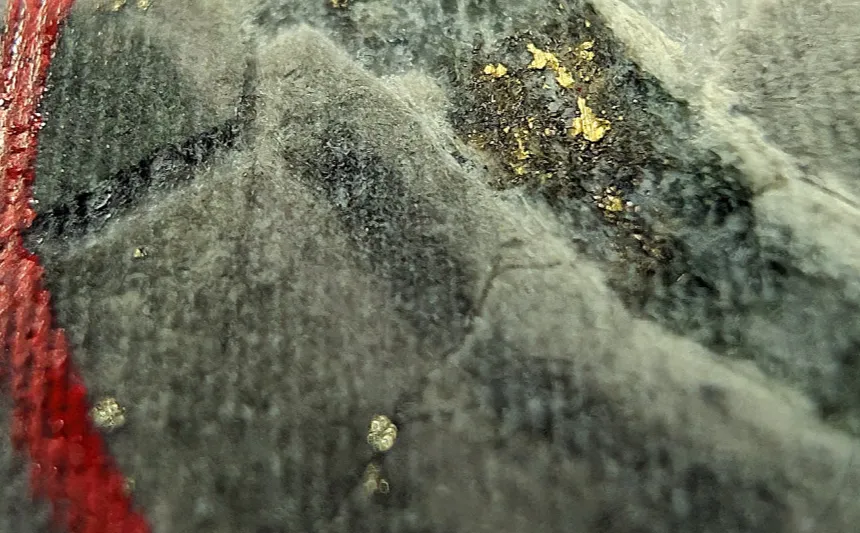
31:06 To see these Gold Pathfinders highly associated and elevated with respect to Gold Pathfinders directly in contact with that rock that's also grading Gold. That puts those 2 in direct contact and creates a very interesting story. That's how mines are found, to be honest. You find this association and Then the next question is, you know you've got the right association, you know you've got bedrock, how big can this thing be? Having a look at these bedrock samples, here are 4 different slices. What stands out right away is just the amount of sulphide in them. So this kind of Gold colour, most of this is pyrite. So we do have some petrography, some mineral assemblage work done on this, but the majority of this is Pyrrhotite with lesser Chalcopyrite and Svalorite as ink-bearing mineral.
32:11 When we looked at these with some instrumentation, some ICP work, what we found is some pretty high grade, so up to 17g per tonne Gold associated with the sulphide. That's felt obviously very promising. There is visible Gold in these samples as well, very fine, but it's certainly there. Just Visually, when we generated the target in terms of going back and finding the data, pulled it and then looked at the rocks and saw what they looked like, you've got quartz veining, you've got very ductile fabrics where you have these really nice sulfide-rich bands wrapping around these quartz-Lithons, these ovoid quartz things that have been pulled apart in this high strain zone.
32:59 I think for Brian and I and the team here, that was when we were like, okay, this is more than just a geologic anomaly. This could be something very significant. And to be honest, this is probably up there with some of the most intriguing targets that Brian and I have tested together going back 13-14 years to the clode days. For us, it's very exciting. Just to see the mineralogy now that we're starting to get a better handle on is really interesting. What we're looking at here is a thin section, so you've got a fraction of a millimetre, a thin section of those rocks that we just looked at on the previous slide. Now we're looking at the sulphide species.
33:51 Dominantly, like I said, Pyrrhotite was the dominant mineral in the area with 20-25% sulphide overall in the samples. What's really interesting here is that sandwiched between 2 sphalerite, so zinc-bearing sulphide grains that are in the dark blue, you've got a really nice Gold flake or whatever you want to call it, mineral form interstitial between the Sphalerite grains. What it looks like in the petrography and in the mineral work that we have so far is that Gold is likely associated with the Pyrrhotite and the Chalcopyrite. You see all of those phases here in this setting.
34:39 Really interesting. Great to see the free Gold in the system. That's exactly what you need to see at this scale. We are going to continue and do more work on these samples, but this is just something that came in back in the last few days. This is the first bit of mineralogical work at a microscope scale on the petrography that's ever been done at Muskego. So we're obviously pretty excited to see this. Okay, so just stepping out regionally again, the Muskego setting here, so the backdrop here is a magnetic map from our 2018 magnetic survey across Penn. What we came up with was, trying to, Brian and I trying to think about, okay, how do we get more out of this target? How do we pull more out of the data? And so we went back to a electromagnetic airborne survey that was done by the OGS in 1989.
35:37 And so we pulled those data in and, you know, we were able to see a few things that were really interesting. So just in the block model that we see on the bottom right, we're looking at a reinterpretation of the 2018 magnetic data, and we're looking at a vertical slice through that area, and we're kind of looking oblique to the northeast. And so you can see on the block model there, the white dots are all of the holes that were drilled in the SONIC program across the swamp, and the golden bedrock one, we're highlighting it here. And so when we did this inversion of the magnetic data in the last couple months, we needed to get a handle on, okay, we know there's a lot of pyrrhotite in these rocks, so the rock is going to be magnetic, we can see that, you know, with our instrumentation, and we also, you know, know that it's going to be conductive because Pyrrhotite is a conductive Sulphite.
36:36 What we wanted to get here was, how do we approach it? How do we drill it? Can we get a dip off of the magnetic data? This shows a very steep dip to the southeast and it matches the fabric of the rock that we saw in the bedrock sample, which is good. And so now we can think we can see this kind of geologic domain, this area within the magnetic imaging, which is great. What we also pulled, like I said, was the EM data, and it would be similar to VTEM that's a bit more modern now. And what we found is a sizable VTEM anomaly, 600 meters long, about 100 meters off of the trend where we have this golden bedrock.
37:24 We don't have any other samples in this area for what we're looking at. You can see the golden bedrock located. We think we're on a high strain zone that is about Northeasterly. So kind of right on that linear magnetic trend. And now we've got a pretty strong EM anomaly that you're actually seeing through a swamp, which generally tends to mute those signals, but we're still seeing it as quite a strong signal. And so now we've got a conductive anomaly with a magnetic anomaly with gold mineralization along a high-strain zone. And So for us, going back 6 months to when we started to put the data together here, I think every layer that we've tried to bring in to the fold and try to understand Muskego better has only added to our enthusiasm and brought things together instead of tearing it apart, which is the scientific process that you have to go through. But I think from our side, very encouraged to see all the right things coming together and the target making sense from a geologic perspective.
38:32 So this is one of my favourite pictures, Mark and Brian were good enough to put it on the intro slide. So that's what we're looking. We're looking directly west, a few hundred feet up. This is a drone picture, looking oblique at the Muskego Swamp. Now you're standing on the Penn property, hovering above the ground, you're looking straight to the west and you can see the drill trail from 2022 that was cut through the swamp in the winter and the samples are 250m spaced across. This is just to bring in some of the features, the VTEM, the magnetic anomaly and the high strain zone shown in yellow here. Instead of showing it on a map, try to visualize it from a distance. If you were there, this is what you'd actually be seeing.
39:25 At a 250m space sampling, you hit 2.5g per tonne in what location with the Gold Triangle. I think for me, when you try to explain the scale of a target, it's really hard. Maps look really small and you always just default to the scale you're looking at. But here you can see the river in the background. The Penn property ends a couple of kilometres beyond the river here, but this is a huge area. The swamp is 4x10km wide and it's a massive area. There are no drill holes within anything that you can see here in the area. And particularly, there's no prospecting over done, there's no outcrop.
40:12 This is why GFG was formed, to come into a large belt, put this type of land package together and go out and test your best targets. So, very exciting, but this is a great slide to visualize where we actually are. Thanks for that, Anders. And so he's done a great job of talking to you about one of the targets at Muskego. And just for scale, the area we looked at would have been kind of showing you about this distance. You know, so you can generally see about a kilometer off that drone. That's one of the targets, but when we stand back and think conceptually about many of these belts and how Gold deposits form, we also have strong signatures to the North in Sonic Line A.
40:59 Up in this environment, these rocks also look very interesting, structurally great area, Strong Gold in till with the right pathfinders. Altered diorites, all the right signs in that next line. That's a kilometer to the north. These 2 lines to the south also show indications of both tungsten and gold signatures associated with east-west structural corridors. Also very good structural settings. Other concepts that we put out there is like if we have these fertile structures come through, what happens when they come up against the basin contact, which is, we all know, a major deformation corridor and structural break. This is the real big picture of what Muskego comes across as.
41:48 It's a district scale target. There's 4 or 5 different targets here. We're going to start testing these in Q1 of this year. We stand back and think about GFG as a whole. Many holders of ours might ask us, why are you trying to do so much? Why not just focus on Aljo? We started this presentation speaking about great results at Aljo and it's our first priority and we're drilling here in 2024. I expect us to have great results in this year, but also we are in the planning phases next year. As we look at what 2025 may bring us at GFG, I think you're going to see us continue to push at Gold Arm and continue to push Aljo to say, can we get this thing to something that's a resource stage target and a good aggressive program testing down to about 500m vertical and advancing that regional pipeline at Gold Arm. That still sits in our priority basket. And then we add in Penn and Muskego next year and advancing not just the core of the Muskego target, which is that one conductivity mag anomaly with Golden Bedrock, but also building the other Greenfield targets into a drill stage target, which is either geophysics or more geochemistry, and continue to work across that Muskego area.
43:04 The one property we didn't speak about was Dore and Dore is still fascinating. It sits between 20Moz at Cote and 5Moz at Borden and it's a 200km2 package. Dore is not irrelevant in our pipeline, but when we think about pipeline and capital allocation, there's no coincidence that we talk about these and show these boxes in this scale. Gold, Alga, Muskego and Dore, that's really the vision we see pushing ourselves forward into 2025. So once, when I think about GFT, going for gold, gift from God, whichever 1 you want to take, we've set about putting together an immense land package in Timmins and 5, 6 years of work. This doesn't come short timeframe, takes a lot of work and thought, changing of people at times, but these are truly district scale assets and district scale targets that are extremely captivating and I think have good potential to yield the next great discovery.
44:01 It doesn't come though without strong people. And I think the reason we do these presentations and host webinars is convey to our shareholders and stakeholders that here's a technical team, here's what we're doing technically, here's the sort of the thesis behind and the science behind our methodology and results. I think you can see we're a very strong technical team. And when we think about being a strong technical team, you also need this capital piece. The whole warrant exercise piece and stronger balance sheet allows us to get good runway and traction and to go test these targets for the next 12, 18, 24 months without going back to the market. So I really feel it's a great statement, very strong shareholders. The feedback we've had from a warrant exercise.
44:47 Anybody that writes a check to exercise a warrant share is showing their support for us. So I think that piece is very, very compelling. And we're also owners. So we'll own about 5% of the company. We do our best to put the dollars into the ground and compensation is all public, but it's about $1M a year to run this company and everything else goes into the ground in terms of exploration to the Timmins. As we think about investing in GFC, go back and think about Timmins as a camp. 2, 5, 10, 20Moz deposits are scattered across this camp and it is one of the most well-endowed areas that still offers immense discovery potential. I think Timmins is just a great place for us to focus on. And I really think with CFT, you see a very technical, very driven and a well-funded exploration company. So with that, we'll wrap up and happy to take any questions you may have.
45:46 Amazing. Thanks for the thorough presentation, gentlemen. 14 minutes for Q&A. For anyone that just entered, feel free to submit your questions. I have about 12 in the queue, so it'll be a little rapid fire here to get through them all. We'll start with the chat here regarding Doug's question. Just curious if there are any whiffs of economic silver? We ask for silver. I wouldn't say there's anything economic. Economic silver needs to be 100g plus silver numbers. So You generally will see a 10 to 1 ratio in Gold and Orogenic systems of Gold to Silver. 10 to 1, 5g, you're seeing 1g or so of Silver. I wouldn't say to date we've seen anything on an economic concentration of Silver, nor have we really seen it in the Petro. That being said, you do see it as a pathfinder.
46:39 Geochemically, it's there in the till. Geochemically, it's there in the soils and the rocks. So we use the Silver data as a proxy for Gold, but to date, nothing economic. Thank you. Mike is looking for a confirmation regarding drilling at Muskego. Given that it's a swamp, it must be in the winter? Yeah, that's right. We're actually working with contractors right now to start packing snow, making ice in areas that we want and just grooming the trails and things like that at Muskego. But exactly right, Mike, this will be a key one target. We would be very pleased to see drilling at Muskego late in January, early to mid-February. The other follow-on to that, Andrew, is also that you do have portions of those targets.
47:30 There's 5 or 6 targets that could be tested throughout the year. It's a cost trade-off. If we wanted to drill, let's just say we went out there and had great success and we wanted to follow up in Q2 and Q3, we can do that. It will just cost us more money in terms of putting a platform out there and an elevated drill cost. To do it most efficiently, January, February, March, April. If you wanted to test it throughout the year, achievable, it's just going to cost you some more. Gotcha. Now, your team noted that the current drilling at Aljo only tested around 250m, while your new program would target depths of up to 400m. What geological indicators give you confidence about the potential mineralization at these deeper levels?
48:18 I think just The analogy to most orogenic systems and using Timmins deposits as an example, those deposits started surface, the deepest ones are almost down pushing 2km. You go down Collinger and you go down to look at Hoyle Pond, those are deep systems that have roots down 1.5km plus. Nothing in the systems tells us that there won't be vertical continuity. As we look to explore Aljo, an obvious place to find continuity is at depth and certainly we're quite excited to step over in the program that we have now and full anticipation of the veins and the results we've seen continuing with depth. The press release mentions multiple distinct zones, football, main, hanging wall and now the Northwest zone.
49:10 Could you help us understand the structural relationship between these zones and whether you see any particular zone emerging as potentially more significant than the others? Yeah, we discussed this a bit ourselves too about trying not to confuse the market. We have the Aljo mine, and the Aljo mine as we've defined it right now has a hang wall zone, a main zone and a footwall zone. And those are all directly associated with the proximal footprint of what was mined historically. The old mining was really just the main zone. And if we had to say the area that's most focused for us, That's where we saw the high-grade intercept coming back into August and September. We're in that main zone of the Eljo mine.
49:56 Those sit structurally above us. The Hanging Wall 1 is in the Hanging Wall, the Football 1 is in the football and those are all generally oriented either northeast or northwest. When we step out to the northwest several hundred meters away, there's a group of veins out there we're calling them the northwest zone. Hole 14 showed 3 different intercepts about 5g associated with that Northwest zone. Previous drilling last year had 20m intercepts at 1.5g to 2g. The relationship of those is still yet to be determined, but we've grouped that whole area as the Northwest zone. That's the relationship between the 4 various zones as we've outlined them. And to date, so far, the most promising area has been the Algem line and particularly the main zone of that target area.
50:43 Thank you. So You've intersected multiple stacked vein sets in several holes. Could you please explain why this is important and does this influence your approach as you advance to the 2 resource definition? Yeah, when we think about it, and I'll just go back to some of the mines I've worked in historically, when you start seeing sacked veins, it tells you A, the system is quite robust, B, they're parallel to each other. So if you just think about capital intensity, the dollars per ounce of gold to recover it, you can be much more efficient with your capital. And so to me, some of the most profitable mines in the world have high ounce per vertical meter and high grades.
51:29 And we're seeing stacked veins here. If you continue to show continuity and you have stacked veins, you generally start creating something that has high ounce per vertical meter and those are good signs of an economic war body. It's a reflection of the system, which is positive, and it's a reflection and direct correlation with capital intensity and economics of future development should we get there. Those are the real reasons we really like the stacked vein scenario. This next question actually ties in with your answer rather nicely. How does Aljo compare to other major deposits in the Timmins camp? And can you please expand more on the system's depth potential? Yeah, lots of similarities. Andrew's talked about the Mafic host rocks at Muskego, but obviously Aljo as well, Mafic Ultra, Mafic Coast Rocks, the Quartz Veins, the Visible Gold.
52:22 These porphyries, they just hang around the ore bodies and whether they're genetically or spatially or empirically related to them, 1 or all of the above is often the conclusion. So the Porphyry Association is still quite good at algae. Proximity to a big break. So you generally need plumbing and the Pipestone Break offers you that plumbing system and here we sit, you know, about a kilometer away from it. So lots of analogies to the main Timmins systems at Aljo and using that analogy, many of those systems have deep roots and continuity to depth to justify shaft infrastructure down the line. So, I think lots of the geology directly analogous to Timmins and the depth potential of those systems we see as well at Aljo.
53:12 Thanks, Brian. I believe you might have touched on this topic on your second last slide, but the system has obviously grown significantly. Can you explain how do you plan to balance following up on these high-grade intercepts for testing the numerous other targets on your Golden Arm property in 2025? Yeah, sorry. Yeah, I think into next year, we've got a rough outline for 4,000m at Aljo to follow up on results that we'll have here in December. That is getting it closer to a resource stage in the main part of Aljo. Let's advance to that next phase, which would be preliminary resource.
53:59 If we can get there, stepping down dip on the veins, looking at other areas and trying to build that together. That's what we're really looking to do at Aljo, is get to that next phase. And then at Muskego, it's to really go out and test it for the first time. If we can be successful with the first couple of hits, which would be targeting right below this bedrock anomaly, then we can step out and get into the next phase of our drill program and really start to explore strike continuity, different targets. We're not going to focus too much on 1 area to begin with. I think when you're in a district setting, you always get further ahead by testing a bigger area early and then focusing on when you have a better idea of what you have actually got.
54:50 It'll definitely be two-fold between Aljo and Muskego in 2025. Hopefully, we have more success at each target and we can grow our drill programs based on success. That would be the best-case scenario. But Aldro looks like it could be a success. Why don't you just focus there for now? I think going back to Ron and I's approach to district setting, building a pipeline. When you're trying to build a pipeline, something robust and get as many targets pushed up the pipeline to a resource stage as possible, It's great to have 1 target that's looking like Aljo, that's what we really hope for. But if you push a number of targets together at the same time, some of them will no doubt fall to the wayside and not quite work out. But the more targets you push in the pipeline and pay attention to earlier on, the more success you're going to have with those 1 or 2, as we know the odds are never with you in this business.
56:02 So, By having a robust pipeline and ranking our targets and looking at it from a geologic and economic perspective, we do a much better job of advancing the right targets at the right time for GFG. So great to have 1 good target, but Ryan and I came from working in a mining complex where you've got hundreds of targets and it's not easy to always pick the best ones. So we will take a very broad approach to the work, generate multiple targets and advance 1234, to resource if we can. But by pushing them all and giving them all a fair chance, you do the best job for your company and for your portfolio in terms of getting the best targets to the end goal.
56:56 As we're nearing the end of this discussion, Anders did do a thorough presentation regarding Muskego but an individual did ask, from all the data on Muskego, can you please explain in plain language why you're so excited about this target? I would just say, take any Gold system in the world that's a mine, randomly put dots over the Gold system on a line that are 200m spaced across and tell me the percentage of times you actually intersect or grade within that Gold deposit. I would guess it would happen maybe 1% or 2% of the time. Outside of the massive systems that have kilometer scales of minimization, those ones are very rare. If we went back to the CB camp or Santoy camp and put this type of spacing blind, you don't have any outcrop to deal with, and put that type of spacing across, I'd be surprised if you even hit the right rock package, let alone any Gold in the sample.
58:03 That would be the first thing I would say, and it's what we talk about a lot here, is the chances of hitting 2 plus grams per ton at that spacing. That's the very first one. And then when you add in the structural setting, the geologic setting, you're 1.6 kilometers North of the Porcupine Dester fault here, you're in the Western Abitibi, you've got quartz porphyry intrusions and all the right rocks in the area with the alteration and the Gold, it's a very compelling target. But I just go back to that, what is the chance of hitting Gold in a mineralized system at that spacing on first pass, blind over a swamp? I'll tell you it's almost nothing. So yeah, that's what I would say.
58:52 Gentlemen, we have one more minute here. Are you guys, is it a hard stop or could I ask a couple more questions? No, I just think keep asking the questions there, Kyle. Sure, Okay, so I'll go back to the chat for a couple here. ScanFix is wondering regarding the assays, they've taken a long time to be reported. I noticed XRF assays on Muskego. How accurate have XRF been to be, have been to he slower assay so far? On Q4 Drillin, will you report XRF figures possibly before lab results? They're really just qualitative, they're not quantitative. For gold, the reason we did XRF was simply to tell us is there gold associated with pyrrhotite?
59:41 So it's not a compliant assay method, they're not to be relied upon, there just is a gold there or not. So you're never going to see us report assays from an XRF, like from a press release. We use it from a technical understanding. So as opposed to waiting for a month, we make it at least an indication of gold associated with the sulfide. Don't look for us to report them technically. It's an exploration tool we use. We report it in a presentation like this because it gives us confidence and actually better understanding of the system. Gotcha. And ScanFix just has a follow-up question. When you assay, do you assay for pathfinders as well? So yes, we do. We will do a fire assay for gold, but we will also do a full IPG suite, which would be base metals and minor elements as well. There's a suite of 36 elements that we get, including all the base metals, gold and silver you also get in that package, but that's only a partial digestion. So that's to be used, you know, qualitatively and not quantitatively, but yes, we do get full path finders in all of the prospecting, all of the till sampling and all of the drilling.
1:01:04 Thank you. Steven Parsons is inquiring, while early days for Muskego, is there a geological analog, Abitibi or elsewhere that is being considered and informing your views on the targeting guide and plans for exploration? This one evolves a little bit with time. We do see good analogies, and Andrew spoke about pore-free association, the direct contact or proximal contact to the porcupine basin, the quartz veins, even the pathfinder signature. The other piece that's relevant here is these diorites kicking around many of the host rocks. So, you know, both Borden and Cote are dioritic associated host rocks in stratigraphy. So We can see analogies in the host rock and the host ores to things like Borden. We can see some host rock analogies to Kote, but we also see direct affinities to the controlling structural orientations. When you think about things like a oil pond, where there you're on a sedimentary contact basin or proximal to it, and you're on this Northeast oriented structure, which we are on it, Muskego, and you're sitting proximal to a mafic-ultramafic contact, all those analogies are present at Bell Creek and Hoyle Pond in the main Timmins Camp.
1:02:28 I wouldn't say there's a specific or direct analogy. What I would say is we see affinities to all the systems around us. Mike has a question in the chat. The first round of drilling in Muskego is early Feb. Could there be a second round in April when it's still frozen? When you think about this target, well, let me just think about logistics. April and May are often tough, and they're tough because it's wet, swampy. It's not, it's spring, it's mucky. So, What I'd like to see us do is get the first phase done January, February, March. If we go back out there as a phase 2, my guess is it's probably into summertime and we would look to do it off a different exploration platform as opposed to something that's in April.
1:03:20 That's just early stage Mike, so you know let's see what the results come back with and how urgently we want to get back up there and follow up them. What I can say is that if we step out to Muskego and have, you know, some good results there, we're going to do our best to get back out there as quick as we can. Thank you. I have 3 quick more questions here. 1, who made the decision to make the latest assay announcements? And what was the logic for the time and that resulted in no apparent interest at the time? Yeah, I saw that one come in. It's interesting. When we think about disclosure, we want to get the relevant pieces to our shareholders in a reasonable amount of time. This particular lease was compounded by the desire to get the rig turning again in Timmins before we put this thing out.
1:04:10 Al Jolie wanted to make the statement and be confident to say, yes, we've achieved everything we need from the logistics and getting out there and drilling. Here's the results and the rig is turning there. The timing perspective of the release and the impact of a US shareholder probably feels it was probably muted because it was a US Thanksgiving holiday that week and you generally have lesser uptake on that time period. So there was a cognizance of that. Ideally, we would have started this program a couple of weeks earlier. There was some logistical and input parameters that prevented that. And so we weren't able to get the release out. In the end, the timing of the press releases is always management's call. So we'll own that timing. I think this was a trade-off where there could have been better timing earlier or later. This is when we started the program.
1:05:02 So that's really what drove us when we wanted to put the press release out. Then just 2 more questions regarding financials. Could you provide an update on the Rattlesnake sale? We're moving to try to close Rattlesnake in the next week or 2. Under the agreement, there was 120 days post-signing of the definitive agreement to close the deal. That 120 days is up here in mid-December. So I expect us to move to closer, and I've seen final draft components of the agreement and closing documents that have been moving through various lawyers. So I expect to see that in the next couple of weeks. And that's important. It brings in 1.2 million of cash. It opens up both $300,000 of bond refund, so 1.5 million of cash back to us.
1:05:52 It provides us an equity position in the resulting vehicle that we sold the asset to, and it solidifies the path to move into transfer the asset. So good important step for GFT hopefully in the next couple weeks. And final questions regarding warrants. If all the warrants come in, what will the cash balance be at the end of the year? So let's just take there's $3.8 million of warrants. If we had 90% of those warrants come in, it's $3.6 million. The cash as we sit on right now is around, you know, a million to million 2. Add those 2 numbers together, you get about 5. You got the rattlesnake in, you get about 6, 6 and change, maybe we'll end up with 6, 6 and a half depending on the bond comes back in. So I'd love to see us in that sort of 6 plus or minus range at your end.
1:06:39 Excellent. Gentlemen, thank you so much for your time. Thank you for going over the allotted time here. Any closing remarks before we close off for today? No, just like to thank everybody for their interest. Always good to see an engaged audience and questions. Mark, myself or Anders are always open to more feedback and conversations. Please do reach out to us in the office in Saskatoon by email, by our website. And thank you as well, 6, for putting on such a great forum as we always seem to get good traction with these. Excellent. Thank you so much, gentlemen, and thank you everyone in attendance. I'll make sure our team gets the recording up here shortly, but Thank you all for joining us today. Thank you. Thank you.