Automated transcript · Written by software from the replay's audio. It can mishear names and figures; the replay is the record.
5:52 like Cripple Creek. You know, Cripple Creek is a massive operation that's been in production for almost 100 years. The Wharf Mine in South Dakota, these are all alkaline, eosin-aged systems, both epithermal. Some of them have porphyry characteristics in the eastern side of the Cordilleran. So when we look at this setting, great place to do work. Very strong historic expenditures. There's 100,000 meters of drilling being completed here. That is great value to be unlocked. The whole belt is under control. And ultimately, what we're seeing is a great opportunity to partner with leaders in the ISR space to bring ISR technology to gold and to the Rattlesnake Hills. Now, when we look at the land position here, it's about 10 miles across, very strong tenement. This is the entire district under control by TFG and a hundred percent owned. And it is all in this option agreement that we're going to talk to you about today.
6:50 Now in light pink here are the Eocene intrusions. These are the causative intrusion. These ultimately are what source the Gold and they reflect and control the mineralization. In the central portion of this land position is 2 main deposits, one of those North Stock and one of those Antelope Basin. Now we see very good scope to grow a significant resource here to make further discoveries and the green targets on this map reflect our vision and our view for what else could be out there in this belt. But the question we have to ask ourselves, what's the best path to unlock value in this asset? And I think what we're presenting today is something that's really out of the box that can significantly unlock value and all this legacy expenditure and really brings something special to the industry.
7:37 Zooming in a little more, this is the detailed view of the 2 deposits in the central core of the land position. Antelope Basin on your left, Norstock on your right. One of those is a Monza diorite hosted system, which is an old basin. The other one's a diatrium hosted system. You can see the level of drilling. You can see the spatial and the distribution of the Gold here. This is a very, very broad Gold system. It's about a kilometer across, hosting the 2 mineralized bodies. I think there's a few things I can point out. Obviously, the table on the right has some extremely high-grade intercepts, broad 100 to 200 meter wide, 1 to 2 gram intercepts, and some very high-grade narrower components as well. What I think is really relevant is look at the character of the systems here. And I put a few points on the bottom here that are relevant.
8:24 So when we think about North stock, let's think scale. Okay, it's about 7 or 800 meters long. It's about 125 meters wide, and it's been drilled down to about 400m or 500m. That is a great rectangular box of mineralization. And I think that is very key to applying some of this technology. Look at Antelope Basin. It's about 50m wide in the dike, but it also has a low-grade halo around it. It's 450m in strike length and it goes down to about 200m, a nice flat bottom. These are strong characteristics that make it amenable to what you're seeing and you're going to listen to today. So I think from my side, the key points are it's oxidized down to about 130m to 150m depending on which deposit you're looking at. It comes to surface. It is a disseminated Gold system and it's structurally controlled and it's expandable. These are all very key salient points to make this system very appropriate for what we're talking about today.
9:19 So this is the deal we announced. This was a really exciting day for G11 and GFT yesterday. And over the last 3 months, we've been working with G11 to come to the right framework of deal that really represents a win-win. And I think what we put out is an exciting structure that works for all parties. And that's really key. You need something that works for all parties. So it's a four-stage agreement. In the end, G11 can earn to 70% of this project by taking it through to commercial production. There are some sequential equity and cash payments that go along with it. In the end, GFD would be a relevant shareholder of G11, and we would be a 30% holder at the asset level. The Stages really reflect what we're trying to achieve in this process. Stage 1 is metallurgical testing of legacy core, potentially testing some PQ holes. This would occur in the next 12 to 18 months.
10:14 Stage 2 is really where you start testing the technology in the ground. ISR technology, 5-Spot Well, things like this. That's stage 2. That's another 12 months, sorry, 18 months. And then it comes to stage 3. Stage 3 is where ultimately you put this thing into production and start really testing it at a commercial level. Stage 4 is the step after reaching commercial production where G11 has the option to take it to 70% through equity and cash payments, the GFG. So in the end, this creates a very strong partnership to advance the Rattlesnake Hills project. And I think it's a win-win for all parties involved here. Now, before I turn this over to G11 and Bill, and they're gonna talk to you all about the technology they're bringing.
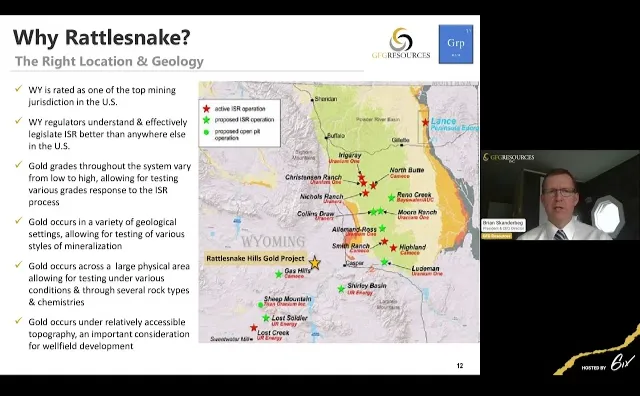
11:05 One of the things that we're both going to talk about is why this asset. This is a key point. But if you look at the history of Rattlesnake Hills and the understanding of the local area. This is the right location and it's the right geology to test the system. There's a few points I'll make here. Wyoming has a strong number of existing in-situ mine and development projects. So the permitting path is well established within this state. Surrounding us, let's look at the green and the red stars there. These are in-situ or proposed in-situ development projects. The yellow star is Rattlesnake Hills. This is why this project works, because the Wyoming regulators understand and effectively legislate ISR better than anywhere else in the US.
11:55 Also, deposit characteristics. There's a wide variety of geology. There's a wide variety of oxidation phases, different structural settings, different grade profiles. This all makes the deposit really amenable to developing and honing this new technology. And when you look at the bottom here, I think these are some other key points. Topography, this thing works because it's not up on a mountainside. Yeah, there's some hills here, but they're actually gentle and manageable from an ISR perspective. And also when you look at the various geology and hydrostatic conditions, These are all things you want in the deposit. Suffice to say, we feel, and I'm sure G11 feels as well, that this is the right project to do the initial commercial till testing of ISR to gold. So With that, I'm going to turn it over to Bill, Bill Sherriff, and Bill's going to talk to you a little more about this slide, and then to also on to the ISR dynamics and the details of what to expect from there going forward. Thank you very much. I'll turn to you, Bill.
13:03 Thank you, Brian. Thank you. We're very excited to be on the Rattlesnake project. I've got a long history with the Rattlesnake going back over 10 years and followed its development and was involved with some of the early days with it. So being familiar with that and the in-situ that Encore has been developing, it's the perfect opportunity for us. And when I approached Brian, I said just that, this is the ideal opportunity. And We'll get into why ISR and why it is perfect. Brian highlighted an awful lot of the major segments here, but I want to first introduce you to Group 11 and the concept behind what we're trying to do and why we're trying to do it and bringing in transformational disruptive technology to the mining industry.
13:53 It won't be overnight, but we think it's a worthy challenge and we've got the team to do it and now the property and corporate team to put it together as well. So with that I'll ask to start the video. When you think of the metals we use in everyday life, you probably think of Traditional mining, something like this. Or maybe this. You probably don't think of this. This is in-situ recovery, the most well-known form of in-place metal extraction. It is the future of metal production. How does it work? A solution is pumped into the ground where it selectively dissolves the target minerals.
14:42 Then the mineral rich solution is drawn up extraction wells to a water treatment plant. Minerals are removed from the solution and the solution is recycled through the system. When the process is complete, reclamation is greatly simplified. In situ recovery techniques are currently being used in several sectors including uranium and copper in locations around the world with lower costs and significantly reduced environmental impacts. The Group 11 Technologies team includes inventors, innovators and pioneers from the earliest stages of ISR. The latest breakthrough is an environmentally friendly solvent made entirely of food grade materials. Group 11 is working to revolutionize traditional concepts of gold, silver and other metal production, moving towards a future that is safe, sustainable, and economically viable.
24:03 How did the company come into existence? Encore had been looking for another allied direction to go with its elite ISR team. And so it really led the formation along with EnviroLeach Technologies. So we're the 2 major shareholders at 40%. It is a private company, I'd like to emphasize again, it's a Delaware-based company. And then Golden Predator who operated the first SRU unit and actually developed it, utilizing the EnviroLeach solution and with their input is also the 20% holder. Additional funding will be raised through private equity sales. So these shareholdings will go down. I think it's also important to mention that there is no ongoing expense to any of these 3 shareholders in terms of Group 11 going forward. It will be funding itself through private means. Also, we'll probably remain a private company for quite some time.
24:59 So what is in-situ recovery? I think the video really explained that quite well. I was certainly able to take more questions afterwards and hone in on it a little deeper if you'd like, but it is a proven technology. And even in other metals, other than Uranium and Copper, there's a half a dozen other metals that it has been successfully, at least on a pilot scale, conducted around the world. And so we feel like all of the pieces to the puzzle to make this a commercially viable operation are there. And we simply need to combine those pieces to where they work efficiently together. And here again, that goes back to all of the different geologic parameters, the oxidation states, everything that Brian had mentioned about rattlesnake. And that's why we think it's the ideal test laboratory that happens to be sitting on probably a million ounce resource when we get through with it, and potentially much more than that.
25:50 So it's an ideal spot for the laboratory to evolve into an operating mine. And you can see the obvious benefits between the little box there, the picture on the right where there's very little disturbance versus the picture on the left where it's extremely labor and heavy equipment operated intensive. So let's look at the actual solution that EnviroLeach has come up with versus the industry standard, which is cyanide. You can see in the lower left a series of boxes. Cyanide obviously is very efficient and very inexpensive as a solvent goes. It's environmentally safe and sustainable. Obviously, it has a pretty good track record, not flawless, but it's the industry standard, and you have to take certain cares to make certain of that.
26:39 But it's certainly a lot more difficult to transport and handle, socially acceptable. Anytime you start permitting a cyanide mine, you have a lot of NGO and local opposition. There's a whole series of aspects you can read there for yourself. None of these are encountered with the EnviroLeach process and their chemistry. We think it's the coming industry choice moving forward, and especially if we can get that proven in not only in situ, but existing applications. So we'll be looking at those as well. And these are just some test results from when the Golden Predator did conduct its SRU or secondary recovery unit operations in the Yukon. We had a gravity mill, just as a bit of background here, operating on an orogenic vein.
27:30 And we recovered about 60% of the gold on a table or in Nelson concentrators. That is in free gold state. But a third to 40% of it was tied up in the sulfide concentrate. And this was several reasons. Some of it was actually attached to 2, not inside the matrix, but attached to very fine-grained arsenopyrite. And also some of it was free gold. Here again, so fine-grained that we couldn't recover through gravity means. So Our first approach was to send this concentrate to a smelter, which is probably the ugliest end of the environmental chain of mining. And of course, not only the expenses, but shipping the concentrates across border, not an easy situation. Your choices of smelters are certainly limited anymore in the world with the green movement.
28:20 But cost and return to the company were significant factors. So we started building our own on-site cyanide reactor, at least planning on that. And shortly thereafter, became involved with EnviroLeach. Decided we were demonstrated that it worked in a lab setting, and so we altered our unit to utilize their solvent. And our first test returned a little over 80% recovery, which for your first experimental test is phenomenal. And as you can see after that, we were up in the high 90s on every subsequent test. So we were quite happy with it. The gold bar you see Jeff holding is part of the product of this and it worked incredibly well. So you can see the competitive advantage right away. No cyanide, that means your permitting time is reduced to an insignificant amount.
29:13 Our permitting in the Yukon for use of this solution involved putting up an MSDS sheet or just a safety sheet on the chemical we were using. No environmental restrictions on the components. And we were off and running. And obviously where we were using it in a closed system, there were no cleanup concerns. But in a ISR, where you're returning the groundwater to its state of pre-existing standards, the fact that there's nothing bad in it is a real, real big plus, and obviously saves you time. And time is money, and millions of dollars, tens of millions of dollars less expensive. So with our first test project and it being the ideal one, Rattlesnake, the first thing we'll be doing is testing the chemistry, not in situ but in a laboratory environment through column testing of a variety of different geologic materials throughout this very large project, encompassing different forms of mineralization, that'd be stock work, disseminated, vein type, a whole array of different types of mineralization.
30:19 And each of those is made of rock types as we can get to. And there's a number of these there as well. So we'll take the core, we will crush it slightly. And We've already got the core existing, which is nice. So that saves us an enormous amount of money to start with. So we take a select core doing that and then preparing column tests and running the solution through the column test and assuming that we get some recovery, then we'll start trying to maximize the crush size, go back with a bit coarser, obviously the coarser the grind or the coarser the material, the better for in situ, less work, less money required. So we'll be doing that at the same time we'll be comparing, sorry, compiling all of the geologic data, paying particular attention to the water table and the oxidation, the redox boundary, huge factors in the ISR process.
31:08 And then we'll be just moving into a full assessment of the ISR potential once we've perfected the columns and figured out, you know, it's not, in our wildest dreams, it won't work on absolutely every possible combination. We'll be quite happy if it works on 1 our first time through. And then, of course, you can tweak the solution. You can play with the chemistry. You can change a variety of different parameters and optimize it. And at that point we would be moving into an actual 5 spot, which is a well configuration with a central well surrounded by 4 other wells inside a containment ring to prove the actual process. So basically, it's an ideal partnership with the property and with the innovative geologic outlook that GFG brings. And partnering with the pioneers and experts and ISR along with the very forward-looking geologist, It makes for a great opportunity to bring about a very environmentally friendly mining, cutting edge opportunity.
32:09 We're in a jurisdiction where the permitting is ideal. There's always permitting and it's always a bit of a process, but it's clearly outlined in Wyoming and we're very excited about that. We'll be, both sides of this will be fully funded. We'll be doing it out of private equity. And then of course, our partner will be taking it from there with the funding from group 11. And obviously it's gonna be, with any luck, there'll be quite a bit of news coming out about our process and our progress. It'll be exciting. I think that pretty well sums it up. We think the future is at hand. It's not going to happen overnight, but with some good hard work and that same entrepreneurial spirit that Dr. Stover led before in the creation of Uranium ISR, we think we can greatly broaden its use and really change the face of mining going forward.
33:04 Thank you. Great, thank you so much. I think now's a great time to jump into some Q&A. There's a few questions here already And I have one for you, Bill. Where did the idea for the combination of ETI solution and ISR come from? And where do you see it going in the next 20 years? Well, it's a good open-ended question. So we can blue sky on that a bit. But the idea came out of really the depths and depression of the uranium industry being in a 10-year trough and survival, basically. We had a very elite ISR team at Encore Energy, one of the founding partners. And we were looking for ways to apply our knowledge base and our skills to an industry that wasn't too far away from uranium.
33:58 And so in a sister company, Golden Predator, where we'd actually used the process in the secondary recovery unit, it started just becoming a meshing of ideas and have the in-situ technology available, have a chemical that's not toxic. Maybe we should try something that hasn't been done too many places and never before in terms of using an environmentally friendly chemical. It just seemed to be a very clear way to go. And where it'll be, I think we'll meet with initial success on a laboratory scale, field testing. But in 20 years, I think you'll see a significant presence for ISR in the industry as being a mainstream, just as you see in uranium now and copper is evolving across a wide array of metals. I really think it's the key to the future.
34:49 Great, thank you. And Brian, why did GFG choose this unconventional option to advance the project? Is there a resource there and what is the grade? GFG has been looking for the appropriate path for this partner for the last 12 months. For those of you that follow us, we would have previously had a joint venture with Newcrest who did approach the asset quite differently, looking for a deep blockade, porphyry route to this system. Now when we went about looking at our options, we fully realized the scale, the great potential, great potential, potential size of this system. And what we found with G11 was that they were the best path to unlock value in this project because their technology and their process will make best use of the US$40M plus spent in the ground already. Ultimately, that's the win.
35:45 Taking advantage of 100,000m of drilled off Gold deposit. Now, there's no published 43-101 resource here. Let me be clear on that. There is a lot of drilling. If you scope the scale of it, you might say there's half a million ounces, you might say there's 700,000oz. It's probably in that range. There's no 43-101 resource here. Is it drilled densely enough? Probably, but there's never been 1 published. So that's some guidance maybe on scale of the system. It's certainly open and expandable. The grades you're looking at, you're probably looking at 0.5 to 0.7 grams per ton in that range of things. And we really feel that the path and the combination with G11 was the best way to leverage that historic dataset, to leverage this asset and to advance it in a way that can create value for our shareholders.
36:37 And we looked at a lot of various options. This was by far the best one for us. Great, thank you. We have a question here from Mark. So down the road, are you interested in licensing the technology or will you operate like a services company? I assume that's for you, Bill. Yeah, yeah. No, Obviously, if this works, we want to be involved. We don't want to be a service industry. The enormous upside in this, making a multi-billion dollar enterprise is in actually owning and exploiting the resources. Would we come in as a partner level, such as we've done here to provide value for both sides, certainly. But this, it's gonna take a few years to get this into a commercial production. It won't happen overnight.
37:25 But even considering that, we're gonna see a shorter timeline to production than with a conventional mine. Most people don't realize it, but a conventional mine is usually a decade at a minimum getting into production when you take into consideration the permitting. And if you go back to the exploration, which were already a benefit of a decade of exploration, it's 2 decades. So, You know, that puts us on a really good timeline, but we want to be involved with actually installing and operating for our benefit and ultimately our shareholders' benefit. Great, thank you. What other competing products exist and is there an intellectual property patent? There's a number of patents on in situ and they'll continue to evolve because of the unique applications of each installation.
38:13 And of course, EnviroLeach has their own series of patents on the chemistry. Hanif might want to address that briefly. And that's what's passed on in my recent work. Yeah, Hanif was having a bit of trouble with his audio, but they do have, I believe, 2 patents, and it covers that, and those are evolving as well. There's applications in, I believe, for additional ones, and certainly they'll be, it's evolved considerably just in the couple of years that I've been familiar with them.
39:03 So certainly continually adapting and increasing its application and recovery standards and regeneration. All right. We have a question here from Bob. How do you address hydrological contamination concerns? Well, here again, that's basically is a function of pulling slightly more water out of the formation than you pump into it. And Mark believes that might be 1 for Mark to tackle too, because you basically have a cone of depression that confines your fluids and keeps them flowing in the right direction. Mark, are you on? I am. Can you hear me? Yes. Yes. Yes, within situ there is a greater amount of water withdrawn than there is injected.
39:56 And it causes water from the outside to dry in and the water is to be contained in the mine area. Bill, I didn't hear the question because it was so much static. Maybe you can say it again and I'll try to give a better answer. Yeah, how do you address hydrological contamination concerns? Well, in the case of this, the EnviroLeach chemistry is easier to deal with than uranium because it is a food-grade material. But Water is contained in the uranium world, water is contained in the well field by over extraction. And it's monitored and monitoring is conducted around the well field.
40:43 After in the uranium world, after mining is complete, groundwater is restored to regulatory standards. We think that we'll be using similar processes here with monitoring and then reclamation after production is finished. Great. Thank you. Lionel is asking which chemicals do you use in the copper Arizona? Does process return apply if gold is not attached to it? I'm not sure I've got that, but I know I've got the first part of it. Yeah, sulfuric acid is used in Arizona copper, which obviously has some environmental concerns. Most instances there, They're producing through limestone or buffering solution with limestone, so it drops the acidity down. But that's the concern there.
41:38 And with uranium, it's not so much the concern because with 1 exception in Wyoming in a test field, all of the ISR chemistry in the US is basically an oxygenated water fortified with oxygen. But there of course you have the radiation issues of uranium that you're concerned with. So it's not so much the solution, but it's the liberated metals in the solution. Ours, on the other hand, neither the metals that we're liberating are of concern, nor is the solution. So it's a huge advantage on both sides. All right, thank you. Mark is asking what needs to happen to make ISR, not just for Gold, more competitive with conventional methods? Well, I think, anybody here, feel free to jump in. I don't mean to hug all the questions here, but really it's cost competitive now. I mean, when you're looking at the uranium industry which is the one that's got the most widely applied use of ISR, your timeline to production is a fraction of that of a conventional mine. Your permitting is a fraction of the time and cost of a conventional mine. Your CapEx is a fraction of the CapEx to buy your large equipment array, et cetera.
42:54 Just as an example, in one of our South Texas operations where we're starting to look at the operation at Encore in a ISR Uranium aspect, the plant we already bought, but if we were to rebuild it, it would be about US$30M, about US$5M or US$6M to start the wealth. So your capex there is US$35M, US$40M. Compare that to a typical underground mining of US$200M or US$300M. And the timelines to production are a lot shorter, so your paybacks are quicker. So in general, ISR, at least in Uranium, is highly competitive and in many instances much lower on a total basis than conventional. In copper mining, it's coming along. I think it will get the bugs out of it to where it is, so highly competitive.
43:41 And in terms of in use of gold, the solution itself is more expensive than cyanide. There's no doubt about that. But that's not the way you look at it. You look at it from what is your total net cost, because with cyanide you've got so much permitting ahead of you. You've got so many environmental concerns from NGOs and the local communities that it takes years to get the permit. And you've got a continual public relations ongoing issue. And then when you decide to decommission and clean up, you have another detoxification issue and years dealing with that. So When you look at it on a complete basis, the actual cost of the chemical can certainly bear 4 or 5 times the cost of cyanide. We haven't done the actual work yet to come up with a multiple, and it'll vary from site to site as to what that is over cyanide to be cost effective and cost competitive.
44:31 And I'll say it's not in terms of in situ or in terms of heap leaching probably competitive yet, but it's close. I think you'll see it evolve to where it is highly competitive through either more of this chemistry that goes into it being available cheaper or through greater efficiencies. So it's being worked on and it is competitive in certain areas. So we've got that history to build on to turn it into a very competitive proposition in other metals. Great, thank you. This one's for Brian. Will GFG continue to grow the deposit? G11 is the operator. So when we look at how we structured this asset and this deal was that the thesis really is this is an ISR project and we're going to really advance it as such.
45:25 There's no doubt that GFD is going to stay involved and through the technical committee of the joint venture in providing what is our legacy and geological modeling and understanding and how we've grown to know the asset. I fully believe the existing drilled off mineralized area is expandable. I fully believe there are other systems within the land position to be found. That being said, I think the real crux of this partnership is about applying and improving innovative technology on the existing area that's been pretty well established from historic drilling. So we'll be happy to work and support our partners as operators through the management committee of the joint venture.
46:13 Great. Thank you. John is asking, Is the Gold locked in pyrite? I don't think so, Ryan. Ultimately, when you look at these systems, the depth of oxidation is a reflection of the presence of pyrite. This system is oxidized down to between 130 and 150m to depth. Above that level, you're generally seeing free Gold and a completely oxidized host rock. So you don't have the issue of having the Gold blocked in the pyrite. Metallurgical test work has been done on some of the sulfides as well. So there are sulfides below that level. And yes, in those characteristics in those areas, going down to 300,400,500 meters, you have gold blocked in the sulfide.
47:01 Yes, fine-grained pyrite. And studies have shown various recoveries on those, anywhere from 10% all the way up to 100%. So to me, the legacy matte testing, as it's been applied to this, really only shows the redox boundary from what is oxidized at surface down to what is sulfides below kind of plus or minus 150 meters depth. And I think that will play a very material role in how G11 applies the technology here and where they choose to apply the technology. But what I can say is, above, say, 130 meters, and it's variable on each deposit, these redox surfaces aren't a flat plane. They're an undulating surface. You're dealing with a largely oxidized material.
47:48 And the sulfides have been converted to other minerals, and the gold is free. All right, thank you. Ira's asking, Are you close to where Energy Fuels has some of their NSUCHI projects? We are probably 150 miles from Nichols Ranch, which is their only ISR project in Wyoming. Their other IS, energy fuels, other ISR uranium projects in South Texas. So we're many, many miles away from that one, but we're fairly close to the Nichols Ranch operation in Powder River Basin. OK, Perfect. Bob is wondering, how does ISR differ from fracking?
48:35 Wow. Fracking is a very generic term that's, you know, the oil industry has been fracking since the early 1900s. It only became controversial in the last decade probably, when they started doing overpressure fracking along lateral or horizontal wells. And not to get into a great deal of discussion there, because A, I'm not an expert on it, but B, not really the focus here. But they have huge amounts of water that they inject along with huge amounts of hydraulic sand. And they overpressure miles and miles of drilling and frack huge reservoirs. It's not very targeted. It's not very confined. And there in come some of your concerns where you've probably seen the exposés on television with the horror stories, which are isolated. Most of the time, it's not a big deal, but we're doing nothing on that scale. Ours is very targeted and controlled and in a relatively small area.
49:32 So also, we aren't dealing with any hydrocarbons escaping because we don't have hydrocarbons and gold deposits generally. All right, thank you so much. Liam is wondering if you could explain the timeline to production. He's saying it seems long. Well, here again, I think I touched on that. Any conventional mine is going to be a decade or more. And I think that even where we are now, that's not an unreasonable target for us, given the fact that, you know, the testing should take 2 or 3 years, maybe 4, to get there, assuming things work, right? We have to prove it works first. And, you know, that's the key. Like I say, all the pieces of the puzzle are in the box, we just need to assemble it. At least that's the way we view it.
50:19 So, you know, we're highly optimistic, but no assurances can be made that we'll be successful, obviously, until we are. We have to prove that. But in general, timelines for ISR mines are considerably shorter than conventional. There's less permitting. There's less construction time. There's shorter reclamation time. So in general, it is shorter. Great, thank you. So Ira, it says, very impressive webinar, excellent management team. Would you also consider recovery of rare earth minerals? And then says, thank you for a seat at the table today. Very excited about this project. Interestingly enough, We are going to look at a wide array of minerals. Why we pick gold first is an interesting question no one's asked, but it helps answer this.
51:09 They're all experimental in terms of being able to perfect it into a commercial application. There are a couple of instances of rare earth applications on test scale for ISR that have shown encouraging results. I won't say here again, they aren't using as good a chemistry as we are in terms of environmentally friendly. But we picked Gold because obviously getting something back to help offset the cost test, Gold is the highest dollar commodity in a known deposit. So, even if we're getting 20% recovery, which would not be what we're after, it would certainly offset the cost of what we're doing. So we picked the high dollar value. The other aspect is gold is interesting in that it occurs in a myriad of different environments and forms.
51:55 And so it's an ideal metal to go after testing because so much is known about it geologically and it occurs in so many different places. It's the perfect starting spot. Perfect. William is asking, do you expect significant differences in recovery or operational procedures between oxidized and primary mineralization? And does the mineralization differences with the di-rem-lay mineralization require different handling? I'm not sure what the second part of that die was, but In general, we're starting with the same basic issues that the Gold mining industry has always had in terms of oxidation, not just Gold, Copper, a lot of the metals, oxidation versus sulphide or primary mineralization.
52:44 The Oxide is clearly easier for us to deal with. More is known about it. The chemistry is easy for it. The chemistry is somewhat unique in that it has a high oxidation potential itself. So that's Hanif's, he might want to make some comment as to its applicability to sulfides, but I suspect that's something they're working on. I think it's evolution of chemistry probably that would get us there. Hanif, do you have a comment on the sulfide end of this? Yes, we have done thousands of tests of different types of materials for The chemistry is all the optical on many of these ores.
53:40 And we always, when we try to analyze the applicability, compare our chemistry with conventional methods. And the part of our ability has been similar or compared to the conventional methods. I think you're breaking up again. Just in general, you are making some progress on sulfide? Yes, we are. We have done several tests, many tests on different types of pores, sulfides, carbonaceous, and oxides. And the chemistry has been very applicable on these cases.
54:26 Great. Perfect. Can you hear my voice? Yeah, the audio is way better if you're closer to the camera. So thank you. That's perfect. Our next question is from Liam, and he's asking, will Group 11 own the rights to the chemistry, or does EnviroLeach retain it? EnviroLeach owns the chemistry. We have an exclusive license towards the in situ application of it. And also on the small unit for the secondary recovery unit. But of course our emphasis is on the in situ, but they do retain full rights to the chemistry. We have it under exclusive license for our application. Perfect, thank you. All right, there's a lot of questions and too little time. So our next question is from Richard. He's asking, will group 11 do any exploration at RSH property or solely focus on the success of the production process until hopefully reaching commercial production?
55:23 Yeah, I don't see us doing any exploration work. Our work's gonna be focused on production and developing the process to prove it's commercially viable. And so plenty of time for expansion, but there's plenty of areas drilled out sufficiently for in-house resource from what I've seen, even though there's no published resource. So we're quite confident after having looked at it that the resource definition is adequate in a number of areas to start a pilot scale operation should we be able to perfect the ISR technology. And once we figure that out, then obviously we would continue the exploration to expand because there's an awful lot of blue sky there. And the deposit may end up being considerably larger than it is now.
56:10 All right. And Ron is asking, what was the grade on material where 80 to 90% recoveries? That was on the SRU where we were dealing with the sulfide concentrate, not raw ore. And the sulfide concentrate was in hundreds of grams per ton of gold. And it was coming off, it was after a concentration of original, the head grade of the original ore was roughly 25 to 30 grams. Okay, thank you. I think we have time just for one more. What are the recovery differences between lab crushing and actual N-suti crushing? Boy, that's a perfect one to end on as well. Stay tuned. Okay. We'll give you the answer after the test.
56:56 Perfect 1. All right. Well, thank you all so much for joining us today for the great presentation and taking us through the live Q&A. I also want to thank everyone who submitted all these wonderful questions. If I didn't get a chance to ask your question, or if you think of another one after the summit, we will be sending out a short survey where you can leave your contact information and the GFG resource team and Group 11 team will be happy to follow up with you directly. And obviously, you can also find more information on their website, gfgresources.com and g11tech.com. So with that, I'll just pass it back to Bill and Brian for the final word. Yeah, thanks very much everybody for joining us today. It's been great to introduce this structure and this deal and this revolutionary technology and I'm really happy for everybody to participate in the great questions we had.
57:51 It truly is revolutionary and we look forward to keeping in touch with all of you. Bill, myself, Mark, LePage, all very reachable and I'll be happy to entertain questions and follow up. That's it from my side, Bill. I'll leave it to you. Just echo those comments. We really appreciate the interest. It's innovative, it's cutting edge, and we think it'll be the future, so it's exciting. ♪