Venkatraman Srinivasan
Executive Chairman at eMudhra Limited
Replay available
eMudhra (NSE:EMUDHRA) Q2 2027 earnings call, held 2026-11-05. Watch the replay and read the transcript on 6ix.
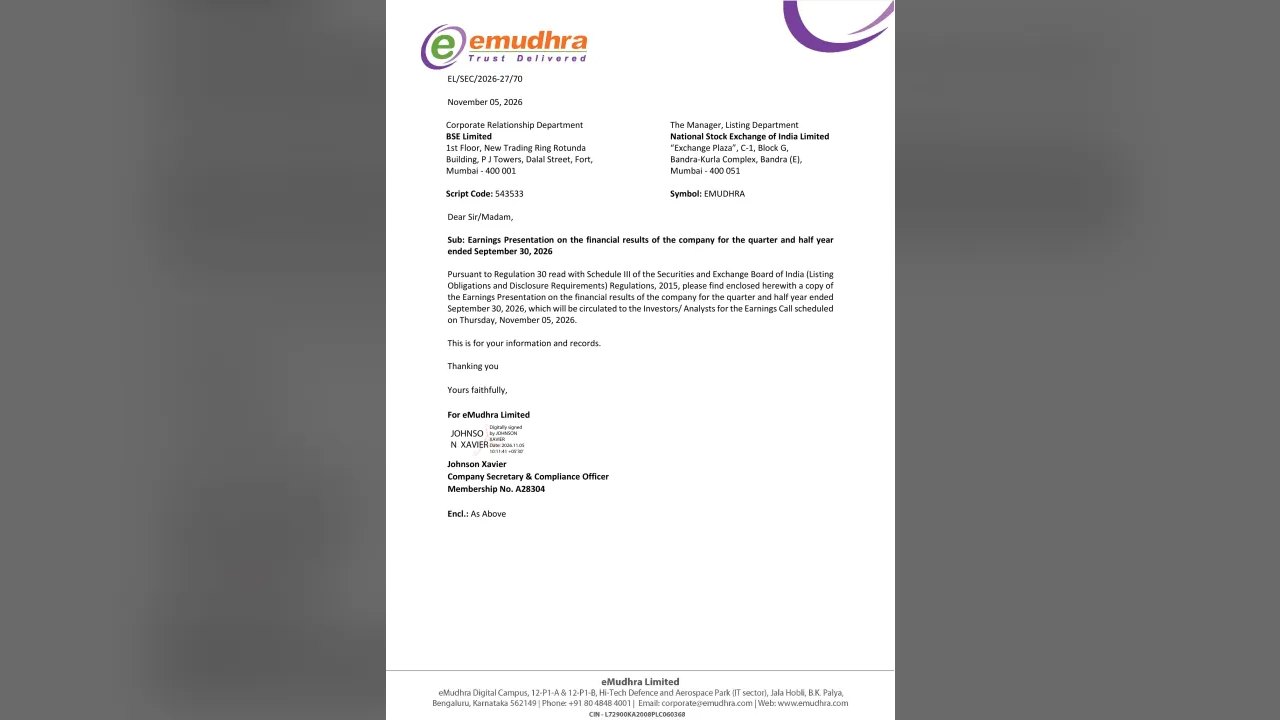
On 6ix: 6ix.com/event/emudhra-limited-emudhra-q2-2027-earnings-call
Automated transcript · Written by software from the replay's audio. It can mishear names and figures; the replay is the record.
0:00 Ladies and gentlemen, good day, and welcome to the eMudhra Limited Q2 FY twenty twenty seven Earnings Conference Call. We have with us today from the management of eMudhra Limited, Mr. Venkatraman Srinivasan, Executive Chairman Mr. Kaushik Srinivasan, Full Time Director Mr. Arvind Srinivasan, Director Mr. Riteshraj Pariani, Chief Financial Officer. As a reminder, all participants will be in listen only mode and there will be an opportunity for you to ask questions after the presentation concludes. Please note this conference is recorded. I now hand over the conference over to Mr. Venkat Raman Srinivasan, Executive Chairman.
0:49 Thank you, and over to you, sir. Thank you. Good afternoon, everyone, and thank you for joining us for eMudhra's Q2 and First Half FY twenty twenty seven Earnings Call. Today I want to speak about two things. The first is a strong quarter for our core business. The second is a certificate security incident in our TLS business which took place in October after the quarter closed. I will walk you through our results, what happened, what it means for the rest of this year and why our long term direction is unchanged. Let me start with the numbers. In the second quarter, total income was $20.09 crore, up nearly 20% over last year. The EBITDA was 51.3 crore at a margin of 24.5% and profit after tax was 33.4 crore, up 26% on year on year basis. For the first half, the total income was $40.02 crores up 23% and PAT was 65.4 crores up 27%.
2:00 The margins year on year expanded on both lines which tell us we are going with discipline. It is important to note that the growth is coming from enterprise solutions built on our own five product platforms that grew 36% and now makes up two thirds of our revenue. International markets also contribute two thirds of our revenue. This is a more product led and more global eMudhra, less dependent on any single market or single line of business. As our scale has increased, so have our working capital needs. Receivables have grown in line with the business however, in terms of the number of days, it remains around the same level. Though the revenue has increased, we have paid the creditors without delay resulting in decline in creditors in spite of the increase in revenue. This has weighed on the operating cash flow in the first half.
2:59 Our incremental planned CapEx for the year is around Rs. 23 crore. We continue to open new doors this quarter. In Africa, we won the national PKA for Nigeria's settling authority regulator our entry into that market. In CAS, we secured our first win in Kazakhstan with a defense entity and our pipeline in Kazakhstan and Uzbekistan is growing. We added significant clients in Indonesia, The Philippines, Germany, Qatar and Abu Dhabi. Cross selling with cryptos brought in three more large enterprise clients in Europe. In UAE, our trust services pipeline keeps building as we await our license. The market is moving in our direction.
3:44 Customers now face fixed deadlines on post quantum migration, on identity for machines and AI agents, and on data privacy. These are now board level topics especially in banking and regulated industries. We have moved early. Our platforms already support hybrid post quantum certificate authorities and dozens of hybrid post quantum certificate types. Because we own all our IP, we move at our own pace without depending on anyone else's roadmap. Now let me turn to the incident. On October 17, an independent researcher reported weak keys in eight intermediate certificates within one of our public TLS hierarchies created during a key generation ceremony in April 2023.
4:34 We revoked all eight the very next day. None of them had been used to issue any certificate to end customers and our root keys were not affected. Our infrastructure was not compromised, no data was breached, and security controls remained intact. As a precaution, the browser programs have disrupted the related route. We moved potentially affected customers to replacement certificates from other trusted providers at no cost to them. We have appointed KPMG as an independent external reviewer and a full review of our Selmini procedures underway. We take this seriously and we will share what we learned. In the last two weeks, we did see some impact on our reputation as customers sought to understand what the incident meant for them. The impact has not been as pronounced as it might have been thanks to our diversification across geographies, across product, across service lanes and brands, and it is slowly settling down. We continue to be transparent about what happened, what we have learned and how we are committed to improving ourselves.
5:44 I also want to be clear about the scope. This affected only our publicly trusted TLS business, which was about 1% of our revenue. Our digital signatures, e sign, and all five enterprise platforms are not affected. Given the limited returns from TLS relative to our overall business, we have decided to exit the sale of publicly trusted TLS certificates and focus fully on our core platform. In The US, the only customer, University Federation, who will be directly affected was using our CertiNEXT product and TLS certificate. They have decided to continue to work with us and asked us to provide the TLS certificate to any other TLS vendor on a subcontract model.
6:30 This is a big morale boost for us, and this is likely to considerably reduce our reputation risk in The US market. We are actively working with the University Federation to transition its members smoothly. We had to walk away from a couple of deals that were directly tied to TLS, but we continue to pursue private PK opportunities there where we are seeing a healthy pipeline. More broadly, there is enough global opportunity for our platform and we will course correct to focus where we see maximum traction. We expect the incident to reduce our FY27 total income by about INR20 crores to INR23 crores and our PAT by about INR10 crores to INR12 crores, largely in the second half. At the start of the year we guided a revenue of about $8.25 crores and PAT of about 137 crores, about 25% PAT growth.
7:25 We now expect our revenue to be about 800 crores and the PAT of around 125 crores. In our opinion, the impact of the incident may only last for next two quarters after which it will be business as usual. Our priorities for the second half are simple complete the external review and strengthen our processes, keep growing our enterprise platforms in our focused markets and turn our new market entries into lasting business. To sum it up, while we went through the incident, the core grew 23% in the first half and the demand for trust identity and post quantum readiness keep raising. I am confident about the road ahead.
8:11 We proposed hold on an investor meet in Trade and Hotel Mumbai on December 2 and we welcome all of you to attend that meeting. Thank you for your continued interest in eMudhra. I will now hand it over to Ritesh to walk you through the financials. Thank you, Chairman. Good afternoon, everyone. I am pleased to share the highlights of our Q2 and H1 FY twenty twenty seven financial performance. Starting with Q2 performance, our total income for Q2 FY twenty twenty seven was INR 2,019 million, marking a 19.6 year over year growth. Gross profit for the quarter grew 19.6% year over year to INR $1,167,000,000 with a margin of 55.8%. EBITDA for the quarter was INR513 million, registering a 21.6 year over year growth with a margin of 24.5%.
9:04 Profit after tax for the quarter was INR334 million, reflecting a 26.3 year over year growth with a margin of 16%. Now coming to H1 FY twenty twenty seven performance. Our total income for H1 FY twenty twenty seven was INR 4,018 million, marking a 23.4% year over year growth. Gross profit for the h one grew 27.2% year over year of INR 2,230 million with a margin of 56.5. EBITDA for the h one was INR 1,017 million, resting at 30.2% year over year growth with a margin of 25.3%. Profit after tax for the H1 was INR $654,000,000, reflecting a 27% year over year growth with a margin of 16.3%.
9:52 That concludes my remarks. Thank you, and we may now open the floor for the question and answer session. Thank you very much, sir. Ladies and gentlemen, we will now begin with the question and answer session. If you have a question, please press star and one on a telephone keypad and wait for return to ask the question. If you like to withdraw your request, you may do so by pressing star and 1 again. The first question comes from Survi Soni from Wellweather Capital. Please go ahead.
11:07 Yes. Hi. Thank you for the update. Just wanted to get some sense on how large is The U. S. Private PKR business as a percentage of the total enterprise business that we have in India. And like you mentioned, sir, that you believe that private PKR business would continue to grow and outlook was healthy. Would it be possible for you to share in any outlook on that side from a three to five year perspective? You see The US business US business, we have two services business which was occurred through icon and two ninety eight international. And the last year, around $6,000,000 is the solution business.
11:52 So out of that solution business also... 9? 9,000,000. 9,000,000 is solution business. Out of the solution also, we have the mCiner and the other product as well as this certain next product. So in the certain next product, it is not affected. Only the TLS business we are withdrawing. In The US TLS business, total TLS business was around 8 crore. On that, The US TLS business alone was only 4 crore. Even Certinex, even this in common, which is the university consortium, they now have decided to continue with us and use our certain product. They are saying through your product only, you source the TLS certificate in the back end instead of our EMUDHRA and TLS. Source it from some other provider, and you only continue to front end everything and handle us. So what may be affected is only the TLS, and TLS was only 4 crore up to now. But two, three other deals we were discussing on the TLS, which may be around less than a million dollar, maybe $607,100,000 dollar. Now those things we will withdraw because we have decided to withdraw from the business.
12:58 So that's why the the reputation effect, it may not be contained only to the TLS business. It could be on other things also. That's why overall considering the diversified geographies, considering the brand name used in each geography, brand name which is different part of the business is sold, all these things, estimated almost in the next two quarter, 23 crore of top line may be affected extra. We could become 800, but that effect will gradually wind down. And on that very important point is since the affected customer itself and this entire incident just affected only one customer. All other people thinking that they could be potentially affected because if our other routes are also distrusted, that's why we have changed all of them to SecTIGO or some other provider's SSL certificate, but actually, in reality, they are not affected. The affected is only one customer, which is this university of iteration in The US. Now the good thing is they have decided to continue with this, so that will... That in itself will contain the reputation risk in a big way. So that is where we estimate 25 crore revenue reduction and maybe $10.11 crore profit. I think maybe after two quarter, the effect will wane away. Yeah.
14:10 But to also address your point on the opportunity for private PKI, pretty large because anything outside of website certificates, if you're doing devices, IoT devices, wearables, and so many other things, those require private PKA. And those are sort of the opportunities that we now go after along with that. That's very helpful. And second question is on the India side. There are opportunities on the DPDP side and LEI. Especially on the DPDP side, have you started doing any POCs, with the customers? And what kind of timeline should we look at in terms of, you know, revenue recognition on the VDP side and contracts being materialized? We already won a deal in the last quarter itself for DPDP. This is for a NBFC.
14:58 There is quite a bit of momentum in the current quarter. We should be winning many more deals for the data privacy. And I think next year should be, you know, where... Because the DPDP getting enforced by a certain timeline, we should see a lot more traction in the next year. So a number of conversations are going on with b two c banks and VFCs, private sector. It's across the board because the PPTP legislation applies to everybody. LEI, we launched, but we did not, you know, seriously start marketing our... Obviously, attention was focused on this. But now we will again refocus on the LEI business as well. Kashik, on the DPDP side, typically, what are the deal sizes you're, say, if you were to implement this for, say, a large India fee or, say, we're talking three banks in India.
15:45 Then, typically, how would a deal size looks like here? These are typically in the range of $40.50 lakhs to 1 crore, 2 crore for larger entities, but mid sized entities is about 40 odd lakhs. Understood. And except in this year, say, from FY '28, '29, and '30 onwards, how should one think about margins going ahead at a consolidated level? EBITDA margins are around the 25%. That we will try and maintain because, obviously, our focus is more on the solutions business, which is anyway slightly high gross margins. As we continue to focus on that, EBITDA margin should kind of be at that same 25% level. Got it. Got it. Thank you. I'll fall back in the queue. Thank you.
16:32 Thank you, ma'am. The next question comes from Sagarika Chetty from Antique Stock Broking. Please go ahead. Yes. Hi. Am I audible? Yes. You're audible. Yes. Yes. So I just wanted to understand the service performance in the cloud service. I mean, are we are we... Is that the important behind this, or can we extend the softness of credit company for the rest of the financial needs? Can you give more clarity on that? And my second question is how has credit cards performed in this quarter? Is there anything broadly changed in line with what it has been in the last two or four quarters? Or if you can also quantify the contribution from crypto. Could you repeat your first question? I understood the second question was on Cryptas because your voice became a little feeble.
17:23 The first question was on... Just the clarity on the sluggishness around the digital cloud services business. Right? I understand that you had sort of explained the issue, but going forward, what... At least for the rest of FY '27, what kind of trajectory are you expecting in this segment? If you can give me clarity on that. On the... First question was on the trust services, is it? Yes. Yes. Yeah. Trust service has already indicated with us. The no new use cases given by the government and all that. So that way, even we had not projected much growth for the test services. It was projected to be around 10 to 12% growth only. So that kind of growth may be there, but even if it is slightly lesser, it will be more than compensated by the solution business and all that.
18:13 Yeah. And then... In Cryptas, the revenue run rate for the quarter was around... This quarter, it was around 30 crores.... 30 crores. And they have... I mean, so more and more deals they are selling with eMudhra's products. Obviously, to that extent, the margin profile for cryptos is improving. So this year, I think they should Make almost a million dollar on it through a million dollar EBITDA. EBITDA. Up to December. Okay. Okay. Thank you so much. I'll join that with you. Thank you, ma'am. The next question comes from Pankaj Chastava from Abyss Capital. Please go ahead. Yes. Good afternoon, and thanks for the opportunity. My quick question is on the trust services again. So last time, you were given to understand that Q2, the disruption may continue, and it will get normalized starting Q3.
19:05 So just wanted to understand what is the status from a numbers perspective on that? That's one. And second, the related question is that last quarter, we saw disruption in first first services. And this time, we had the TSM issue. Is there something which we should be kind of assuming that is that is a normal part of the business? Then disruption in the service was majorly in token. Because in the token, they said instead of a... They... It has to be a fixed level of a fixed one forty level three compliant token. And it was only released in September middle or something like that. So that's where the token revenue got affected. So the third, fourth quarter, it will improve. But through a pure DSC side, because in the token, if you see, the margins are less. Whereas in the... If you see the DSC itself, the second quarter had a little better volume, third and fourth quarter because second quarter is the main season, in third quarter, October is the season, but November, December may not be the season.
20:03 So maybe it will be around the similar levels only. Cannot be a bigger growth. And even we had projected only a 10% growth in the entire... But on the other side, eSaint is growing very much. Is also in the trust service. ESaint is interested in. Yeah. ESane is growing. More and more eSane, remote saying those kind of interface related product will grow in a bigger way. Almost to you, one year back, we were doing one lakh, two lakh eSane. Now we are doing almost seven, eight lakh eSane per day. So those things will grow, but pure trust services, which is the conventional digital signature, may be flat to $8.10 percent only. Yeah. But the other question that you had was more related to the incident. It's not really... I mean, it was basically a problem and widely covered in the sense that our TLS line of business kind of had an incident, right, to which we have spoken about extensively through stock exchange filing. So the first one was more industry led. Second one was more eMudhra, but it's not normal in the sense that disruptions are... I mean, so these things happen, but it's not expected to continue as such.
21:08 Got it. Yeah. Thank you. Thank you, sir. The next question comes from Deepak Kumar from IGP India family office. Please go ahead. Yeah. Thanks for the opportunity. My question is on this incident. If be... Because of this incident, are we, like, reviewing the other statement also? And so there is no direct impact, but in AI world, means what we have learned from this incidents for... Specifically to other segment?
21:56 No. That segment of business ways will not be affected. But from a technology perspective, whatever possible, are talking and analyze with the help of the AI and see what are the further securities to put in place. That work is parallelly going on. It will be done. But business ways, those thing, other business are not affected, and this business is a very small 1% business. So that's where instead of... And 1% business also, there are other four phase reason why we discontinued the business. Because if you see earlier, the global heat was allowed to issue eight hundred and twenty or eight and forty days certificate. And then later on, gradually, it is coming down to one year. Then one year, it has come down to ninety days. Ninety days is coming to forty six days and all that. This is one side. Then the other side, the earlier, there were DV, OV, EV.
22:44 And EV was a very high price item. Gradually, the browser started not giving any importance to EV, so people are not buying EV. That is another side. And the third most important side is the Google itself started issuing all the DV certificate free of cost, ninety day. So Google also issues ninety day free. We also issue ninety day at a cost, so nobody will buy from us. So that is why in spite of doing this business for six, seven years, even after we went live in 2021, it is almost five year. We could not improve it to more than 1%. So considering all these... But the compliance requirement is very high. And then again, nowadays, what is happening because every geography want their data center to be in their respective location. So that also adds to the cost. So considering all this only, came out of that. But the other business are not like that. So I don't think any effect will be there, and other business will continue. But we based how to improve security by using the AI that we are continuously...
23:46 Our technology teams are working at. Yeah. So some sort of analysis and external agency, and then this is the only other segment of the business really help if if we can do that on the other segment. We understand that that was only 1% of the revenue, but the concern on the other segment rises because of such incidents, so that will be helpful. Thank you. If see the other segment, except the trust service segment, all the other product segment, we are not storing any data or we are not doing anything. So these are all going to government to be able to pay and all that on a license basis where this... The data is stored at their risk and they are storing wherever they want to store. So this kind of risk cannot come in that business.
24:42 Only in India trust services, can come that we are more singently securing it. So that way, I don't think any big risk is there in the other segment. Got it. Thank you. Thank you, sir. The next question comes from Prane Jay from Banyan Priyadbe. Sir, please go ahead. Hello, sir. Can you hear me? Am I audible? Yes, You're audible, sir. Thank you. Thank you for the opportunity. I had three questions. Number one was, can you let me know what was the constant currency growth for the enterprise business, both like services as well as the enterprise solutions business on the international side?
25:30 That will be question one. Should I ask the other two questions together? Or No. We will go one by one. You see our total business, roughly around in 800 crore, almost to $2.73 crore is the India business. Yeah. Balance almost 525 and 23 crore is the international business. Yes. The international business, again, if you see currency wise, it may be 5 rupees or something like that. So constant currency also, it is a big growth. Maybe one or 2% on the overall, maybe only due to currency. Other thing will be on a dollar to dollar basis itself. Understood. So far, €520, you can work out what was the dollar price at that time now. That will be the only difference.
26:20 Okay. Got it. Got it. Secondly, my question was whether when we sell our CertiNEXT product, was the bundling of TLS an important element when CertiNEXT was getting sold earlier? And will it have an impact going forward? No. Not required at all. CertainTex is a neutral product. With CertainTex, we can connect any SSL given by any vendor. So in lot of cases, it is sold standalone. It is not sold along with the TLS. In this case, in Incommon, it was sold together. In some cases, only SSL is sold and not Suttionext also. Is not affecting the TLS itself, it will not affect. Now when we sell certain next, we will... Either we may bundle or depart itself directly by the SSL from Septigo, SSL from ssl.com or go to IDR from DG CERT, and then they use it through the set next.
27:18 Understood. Yeah. Got it. And my last question is on... So, like, will you be facing issues in terms of retaining customers as well or the the cut in your revenue estimates is more to do with the new deals that you were expecting to win? I will explain to you geography by geography, then you will get a better sense. For example, if you see India, in India, our revenue is not likely to be affected at all because now now everybody knows the the America versus India sentiment, the way Google distress something and various things. Though these browsers distrusted us, it is not unique. So many other people know SecDegu has done some 108,000,000 certificate wrong.
28:07 Then some other gold ideas, then some face at $5.05 lakh certificate wrong. Then I think I have done something wrong. But let's say people know that's why somebody distracted us. So from this geography, that reputation risk is not at all there. And the segment in which our products are there, we are unique and mostly if, let us say, government banks do not choose our product, they may have to choose the American products. So we do not... We... I don't think we are facing any reputation risk. And even we saw immediately, even on that date, next date, next to date also, whatever digital signature sale, e signature sale, everything was increasing or around the same lane. Nothing got affected. Then if you take Europe cryptos, again, what is happening? Because everything is sold in the brand name of cryptos and Preme same, not on the eMudhra brand. Right? Our product is also sold in their branding because it's a acquired company.
29:01 And another thing is they are all in European language, so they do not read this English language with different LinkedIn by which a lot of unwanted messages are all passed to that. They are isolated from that. So it is not affecting them. Then you go to US. In US, what are we doing? Two service business acquired by Icon and two ninety five international. They are all sold in that respective brand name. So they are not affected. Then even what product we are selling, we were earlier selling... We had a subsidiary company called CertainX, and under CertainX powered by EMUDHRA and all this. But immediately, we removed the... Because of all this messaging, we removed the eMudhra linked to certain next and trying to brand the certain next into an individual positioning.
29:46 Still, some business may be lost, predominantly, still all the customers, all the conversations are continuing. And Africa almost isolated. Middle East, little bit affected there. And Far East, you see Philippines and Indonesia, almost no effect. So that's where the reputation risk is contained to US and a little bit of Middle East. That's where we estimate only intra INR $8.23 crore to INR 800 crore could be there for the year as a whole. That also within two quarter we will work on. Under the major booster is the client who is directly affected himself with continuing with our certain extra product and also through a subcontracting for the SSL. So that itself is a big positive thing. Right. Right. Understood. If I can just ask one more question. Yes. I wanted to understand, you know, while you've spoken earlier about AI being a tailwind for the industry, We see a lot of vulnerabilities that AI is being able to catch.
30:48 So do you see that as a threat for the incumbents? Threat for the... Yeah. It's a threat for the general bank, any financial service, and you see all those industry. A could be a threat, but they have to strengthen their security architecture and all that. For us, a could become a positive also because before them, we also strengthen everything, then we can also send it as a proper session to them. Maybe I will ask Kaushik to explain better about the AI, what are all positive for us. Yeah. So AI, in many ways, has significantly accelerated our ability to deliver products at a faster pace. And because AI has now significantly increased the attack surface for many organizations and our products mainly focus on user identity and device identity and data security, it's probably a big plus as enterprise trying to bring this zero trust posture, right, where everything has to be verified.
31:44 So identity management, authentication, strong authentication, strong encryption of data, all of these are becoming big needs of the hour. And more with this transition to quantum computing, everybody is now mandated to to adopt post quantum cryptography. That is also an active area where people are looking to invest. So the areas of cybersecurity investments broadly fall in the line of the products that we have already developed and put in place, which is why we see, hopefully, continued opportunity for our products in the market. Understood. This was very helpful. Thank you, and all the best. Thank you. Thank you. Thank you, sir. The next question comes from Subam Sahani from RSPN Ventures. Please go ahead.
32:51 Yeah. Hi. Thank you for the opportunity. So I wanted to understand your view on the DPDP side of the business you're planning to do with private test. Right? So what all things are you planning to do in the whole life cycle of the d p d p? Actually, there's consent management, and there is also the whole life cycle of the data that stays with the company. Right? And then you have to delete it after the data usage is complete as per the d p d p law. So what are the products are you trying to build on it? And if you could provide any guidance on how big this opportunity could be in terms of number, top line, bottom line, whatever you have in mind. Yeah. So from a product perspective, our product is fairly comprehensive. It deals with consent management. It deals with data discovery, data classification, data protection, basically, data retention, governance. It deals with third party vendor, data management, their life cycle, their workflows, data subject access requests. So pretty much the entire stack that somebody needs to put in place for DBDB compliance as a whole and not not just limited to consent.
34:00 So that's where... And also the whole audit trail access records, historical use of data. So the whole life cycle of as soon as you collect data to what you do with it, to where you send it, and how, you know, it's protected, etcetera, is kind of fully captured in the product. The idea is next year, how do we capture, let's say, 40, 50 clients with the kind of value that we had, you know, ascribed earlier? That's the immediate scope because typically, the first phase will largely look at entities that are, you know, somewhat, you know, focused on customer data and meaningful scale and give some kind of a value of, let's say, $40.50 lakhs, 1 crore. And that's probably the opportunity size that we are kind of looking at. Although there may be a much larger universe, there will obviously be a phased implementation of many capabilities over the next two, three years. But this is our target market in the first year.
34:52 And also, do you see any other companies who are building in the same space? Because DPDP had compulsates, like, all the major companies in India, and this could be a major opportunity going forward. There are quite a few companies that are building various capabilities, but many of them are focused on only one or two layers. There are a very few select names that are focused on the entire DPDP stack, and our whole expertise has been on data protection, which is where we score very strong. So while some of the layers of DPDP could get commoditized with many players, the consent management is not... You know, it's pretty commoditized. But as you go more deeper into data protection and data retention governance and data loss prevention, then the number of players that do the kind of capabilities can start becoming very limited. Okay. Great. Thank you.
35:41 Thank you. Thank you, sir. Star and one on your telephone keypad. We have a follow-up question from Survi Soni from Bellwether Capital. Please go ahead, sir. Yeah. Hi. On the 23 floor investment that you mentioned, can you spend some time on where and which product seats would this be directed towards? The 23 crore incremental CapEx is mainly on completing the data privacy stack. Obviously, we have developed most of the modules, but, incrementally, there are few modules that need to get developed.
36:26 And also some improvement in mSigner mainly for certain... Adding certain AI capabilities, and also for certain ID verification that we have to build as part of our global TLS operations. Oh, okay. Sorry. Global digital signature operations, not TLS. Got it. Got it. And on the post quantum side, have you started receiving any inbound inquiries or any any POC that you have started on the PQC side itself? Yeah. Yeah. Quite a few POCs are ongoing. Some of those will materialize. So I think one has materialized into an order. Many more will happen in the next quarter next year onwards, Raj, because deadlines then start coming. Deadlines are related to PQC. PQC adoption and migration. Basically, 2029.
37:16 So many companies are kind of planning. They will start planning from next year onwards. Understood. Cool. Thank you so much. Thank you, ma'am. Ladies and gentlemen, if you have any questions, please press star and one on your telephone keypad. Moderate, think we have a question. Maybe you can request. Okay, sir. The next question comes from Amit Chandra from HDFC Securities. Please go ahead. Yeah. Hello. Thanks for the opportunity. So my question is that, you know, with these events, which has happened, obviously, you explained about what the implications are. So are we seeing any kind of, you know, like, pushback from our existing clients in terms of, you know, the issues which are being there in terms of the certification issues or overall, you issues related to cybersecurity and all? And in terms of the existing contracts or the contracts which you have won, is there any kind of delays that we're seeing in terms of ramp up, especially on the RBI contract that that we announced sometime earlier?
38:31 So if you can give some clarity, it will be helpful, sir. Thank you. No. From a existing business or existing contract, no effect at all. And as I said, the only affected party was the US university. Nobody else is affected at all because we had not issued any that we get out of these things and all that. So that way, there is no effect at all. But even that US University of Edition, they continue to work with us. So from existing contract, absolutely zero termination, zero anything. So nothing at all. Out of the new customer also, only the potential TLS customer because we are withdrawing from the business, they are not acting, and other people little bit getting delayed. But, otherwise, nobody... Because this is distressing or canceling the certificate and all this in this industry is very common, and the customers are aware of this. Because several time, even the interest has canceled, not a certificate. Security has canceled, not a certificate.
39:26 Then GoDaddy has canceled. Every... All the ssl.com has canceled. So that way, it is not new to the cybersecurity and industry people, though the media blew it up in a very big way. So that way, the impact is very minimal. And as I said, the impact may be only confirmed a little bit to The US market and Middle East market. So that's where we estimated around $8.23, it could be 800 and back maybe 10 crore, less kind of thing. And next year, it will become normal. Almost it is getting normal even today. Okay. So just a clarification that the enterprise overseas, these... I don't So 60% of our revenue within that, we have the cybersecurity. Within that, you know, over the overall cybersecurity business, we have, like, SecurePass and.
40:16 So this TLS was a part of yours, you know,, which is, like, you know, the device device identity and authentication service. So in in the press release, you said 1% revenue from TLS. So that's the only standard device identity and nothing. TLS one is only a website identity and authentication. Trusted. Yeah. That is the only thing. So that was only 1% because as I explained earlier, gradually, this become... Business is become... Because Google is issuing ninety day free certificate, and a lot of large customers are all renewing certificate through ACME protocol with automatic renewals. And so nobody is willing to pay money to get the certificate. So that's why this business is not a growing business. It's a declining business, and that is the reason...
41:06 And further, the compliance and other things are very... That is the reason our board also decided to come out of it. So it is not a big business at all, and it is not always bundled with the... Our CLM, certain next product also. So certain next is independently sold. This is independently sold. So the offering that is the TLS certificate while IT management, that is all... That is a great offering, or is it because the... I know most of the enterprises to manage their, like, certificates also is a big challenge for them. So that certificate management business is a part of the certain next offering, or is it separate from the existing 1%, like, deal...... Different from the existing 1%, Amit, because the 13 x as a platform is independent of the TLS certificates that were sold.
41:57 And most of the places where we sold the 13 x platform, the certifying the... Basically, the TLS provider was a third party. So it did not involve eM sign per se, our own TLS. So it's completely independent. Okay. So that that business is not impacted. Right? The TLS That business is not impacted. Understood. So I know, obviously, it's very encouraging to hear that that it's not going to have any kind of an an impact. But the point is the only concern that we had is, you know, in the short term, obviously, we're not seeing any impact. But over the longer term, maybe some of the, like, newer initiatives that we are planning or some of the newer, you know, contracts which are there in the pipeline, Do you see any kind of risk in terms of conversion of these contracts?
42:48 No. We have spoken to most of our prospective customers. As chairman had indicated, the only contracts were couple of them in The US where the service itself was to directly provide the TLS certificates. And that is obviously the one that is getting impacted, which is what we have revised our kind of top line and bottom line guidance. Beyond that, there is no other impact. Okay. Okay. Thank you, sir, and all the best. Thanks. Thank you, sir. There are no further questions. Now I hand over the floor to the management for closing comments. Thank you. I would like to thank everyone for joining the call today. We remain focused on delivering consistent performance and innovative solutions that enable secure digital transformation for our clients across the globe. For any additional information or queries, kindly get in touch with us. Thank you once again. Thank you.
43:41 Ladies and gentlemen, this concludes your conference for today. Thank you for your participation and for using Doosebumps conference call service. You may disconnect your lines now. Thank you and have a pleasant evening.
Follow eMudhra Limited into a list and get an email when it puts out news.
Executive Chairman at eMudhra Limited
Full Time Director at eMudhra Limited
Director at eMudhra Limited
Chief Financial Officer at eMudhra Limited
at Wellweather Capital
at Antique Stock Broking
at Abyss Capital
at IGP India family office
at Banyan Priyadbe
at RSPN Ventures
at HDFC Securities