Automated transcript · Written by software from the replay's audio. It can mishear names and figures; the replay is the record.
0:32 Thank you, everyone, for joining us on our first presentation. This is actually a new presentation, a new corporate presentation that we've prepared for July. So I'm excited to present that to everybody. Of course, at EDM, we have a near-term mine going into production in a tier 1 jurisdiction, we hope as early as next year, and we're working towards that. So it's a zinc-lead and gypsum mine in Nova Scotia. We have a 2021 pre-feasibility study with some very robust results. You can see on the screen 174 million in pre-tax net present value, 69% of pre-tax IRR and a payback of just under 1.5 years. We're also working on an updated pre-feasibility study to include design improvements and revised commodity prices, and that's in progress, and we expect to complete that this year.
1:27 Our forward-looking statement, of course, this presentation, we have some forward-looking statements as to what the company intends to do this year and how we're going to go about that. Of course, we've completed a number of different 43-101 instruments from mineral resource estimation back in 2020, a pre-feasibility study in 2020. That was the inaugural preface for the company and for the project. And that was the first ever NI 43-101 reserves. And then we updated that in 2021, including gypsum with gypsum mineral resources and a updated pre-feasibility study.
2:16 In terms of EDM's investment highlights, of course, we are an advanced stage developer in Nova Scotia, which is a tier 1 jurisdiction. And as we see it, there are 6 major investment highlights at the moment. First of all is our near term production. We're working on the Scotia mine, which is destined to restart as early as 2026 next year. And that's of course, an open pit zinc, lead and gypsum operation with one major permit remaining. And that major permit is the second point, which is the Fisheries Act authorization currently with the Department of Fisheries and Oceans Canada. That's going through a review process by the DFO with engagement with the First Nations. We've posted our bond of 1.6 million dollars, which is a performance bond required by the DFO.
3:09 We expect to have that permit fairly soon. We're going to talk more about that in this presentation, but that's the second point. The third point is, of course, there's over $400 million of infrastructure in place as we estimate it. That's the mill, tannings, power, roads and water, and a lot of permitting behind that. So That's what enables us to have a very low restart CapEx of about $31 million Canadian. 0.25 point here is when you look at all the economics that we did in those pre-feasibility studies, and of course the 2021 pre-feasibility, very resilient project economics. Like I say, very robust economics because we have a 69% pre-tax IRR, short payback period, and very resilient project under higher capex and lower zinc costs, which is our stress test. So always protecting the downside.
4:07 In that situation, the project economics is of course very strong. The fifth point is that once we are in production, Because of our location, our infrastructure, and of course, the open bid operation, we're forecast to sit in the 25th percentile of global zinc producers. And that's on the basis of our life and mine C1 cash costs of about 50 cents a pound on zinc equivalent. And the last point is our exposure to zinc market. We see the global demand projected to outpace supply by roughly 3 million tonnes to 2031 alone. And we have a direct exposure to that, which is of course a structural deficit. The next slide, okay, the Soka Osa mine, what is it? Where is it? It's a past producing asset in Nova Scotia near the international airport, near Halifax and of course near ports. So by distance, we're only 11 kilometres to the CN Rail, we're 33 kilometres to the airport, and 62 kilometres to a deep port. That means that logistically, we're in a great position.
5:18 And as I mentioned, we have a lot of infrastructure in place from the buildings and roads and power and water. And of course, that takes a lot of permitting and many, many years to have that in place. So we've basically leapfrogged, I guess, ahead of that because of this operation being a past producer. The latest pre-feasibility study was completed in November 2021. And as I mentioned on the opening, we're looking at updating that with some design improvements. And of course, the changes in improvements in the commodity. Overall, that PFS produced about, oh, just under 700 million pounds of zinc, zinc equivalent, plus over 5 million tonnes of gypsum.
6:07 And in addition to that, we have a non-spec gypsum, which is also a part of the equation we're working on for the updated pre-feasibility. The company, EDM, also has about $60 million in non-capital tax losses, which we can use against future income for the project. Overall, though, Nova Scotia is a stable mining-friendly jurisdiction with the Tier 1 regulatory framework. So we've been very pleased with Nova Scotia, particularly over the last 2 years, as the Premier and his departments have sought to remedy some of the changes in the past in terms of development from mining. And they've been a very positive influence over Nova Scotia and the resources industry. And so we're quite excited about what the province is doing to encourage mining and of course, help us on the path to production.
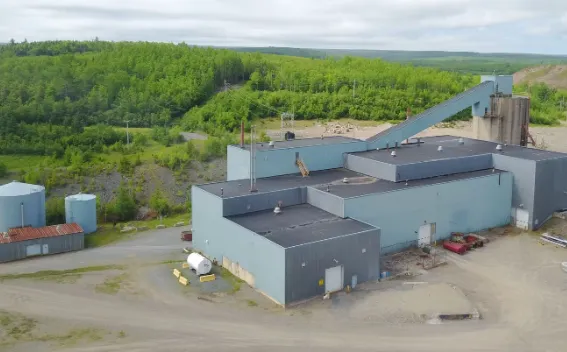
7:04 In terms of the mine site, you can see in the picture there, we have a very large land position. The last Prefess designated the mill to have a 2,700 tonne per day capacity. Of course, we have grid power from Nova Scotia Grid on site. We have water on site, of course. We have existing facilities, not only the open pit, which has water currently at the moment, but also we have the permitted turning facility, waste dumps and, of course, we're only 300 metres to an all-season highway. In addition to that, we're surrounded by other operators. There's National Gypsum, which you can see my cursor in the background. It's the largest open-pit gypsum mine apparently in the world.
7:49 And next door to us, there's a new project being developed by Sanguvar, which is a CertainTeed Canada subsidiary. And they're working on, of course, a gypsum project next to us.
24:27 US offtake for half of our gypsum and half of our off-spec gypsum, which is also including anhydrite. So that was a very big deal for the company, which we completed last year. In addition to that, we also completed a silver royalty with Silver Crown Royalties, who paid us basically $1 million in cash and marketable securities and $250,000 worth of securities turned into $1.2 million after we sold that. So that was a great little win for the company and Silver Crown Royalties continues to lift their share price and negotiate a different deal royalties on their side. So the share price is going up considerably.
25:20 We also have 60,000 warrants in Silver Crown royalty, which are currently worth about $900,000. So on a basically on a net basis to us. So that's also additional non-dilutive capital available to the company if we need it. I also mentioned we're working on the zinc and lead offtake. Again, as you know, we had IXM who were provided a financing of about US$24 million. We're negotiating that with them and others to include silver and also our gold as payable mineral in the offtake. In terms of our ownership, a very tightly held company, as most issuers like to say.
26:12 But reality is we are. We have about 80 million shares outstanding. Most of those are held by 46% retail, brokers and so forth that we're very good close with, institutions, and of course, insiders like me and the board of directors and major shareholders who basically looking to get this project in production and opportunity to create value for other shareholders. As you can see there, we're listed now on the German market, the Frankfurt market, but also on the OTCQB and listed under civil EDMFF. And we're expecting the DTC to go live on that in the next week or so.
27:01 As you can see, our 52 trading has been quite good from 8 cents through to as recently 72 or 74 cents just the other day. We are well capitalised. We have about $2.2 million in the treasury, additional $400,000 in the performance bond. And we have a number of additional warrants that are also in the money, which may bring in roughly $3 million if they were all exercised. So the company is now in the best position it ever has, and we're just waiting for the next permit, the final permit, to announce our next steps. Of course, going into production as soon as we can to create value for our shareholders.
27:53 So how do we sit compared to some of our peers? We've got Titan mining, which are in New York, Canadian Copper, and then Bunker Hill, and then 4N, which is under a takeout. And I'll go through some of those just quickly. But in the appendix to this presentation, we've got some detailed analysis of where we got that number. But you can see there, just on the chart, that EDM, we're sitting at about a 0.4 of our price to NAB comparison on a post-tax basis. So we should be somewhere north of that. And you can see some of the other peers actually are. So Titan, which are just nearby an underground operation, they're almost double us.
28:43 Sorry, Canadian Copper almost double us, Titan, fairly comparable, but obviously their share price is much higher. Bunker Hill is roughly 4 times their net asset value. So that's probably one of most, our strongest comparison, Bunker Hill. In terms of our investment cases and why we believe EDM is a good investment, Firstly, this is a built asset. It's existing mine, mill, $400 million worth of infrastructure. This is not a greenfield built. The second point is that economics are very strong with a 69% IRR and a short payback period.
29:32 We expect that to be even higher now, but once we complete our pre-feasibility study. So even on 2021's basis, we have very strong economics. The DMS upside, you can see there we had a very good result out of the testing and that demonstrated a reduced, or sorry, increased grade, feed head grade from the DMS, which would also reduce our processing costs. In terms of insider support, we've had, I would say, pretty much a very strong, unprecedented insider support, and that's resulted in over $1.5 million of warrants being exercised last month. We have a low cash burn right at the moment during our permitting phase. We spend roughly 110 Canadian per month to get us through the permitting and do what we need to do to keep the mine in good stead from compliance perspective, of course, advance us through to a production decision.
30:35 We have that single permit, the major permit from the Fisheries Act authorisation. So that's also our strong investment case where almost permitted, finally permitted in terms of being able to announce a production decision. The revenue, we have strong offtakes for the gypsum, the silver royalty in place, and we're working on the Zinc and Lead, which as most of the market would know that we had that in place already and now so that are getting updated terms in place and communicated to the market. We have an interesting gold optionality. We're working on that. We're very surprised that we had that high level of gold in our concentrate, but there has been in the past that they've been seeing gold in the concentrate to the previous offtakers.
31:30 And so that's why we've kicked off the 2 phases to try and understand where it's coming from. And hopefully that may result in a phase 2 program and more intensive field work on looking for that goal. The next point, of course, is tier 1 jurisdiction. Nova Scotia has been very stable. We've been happy with how the province has been turning around the permitting. And one of my friends says it used to be no in Nova Scotia. I think it's now a yes in Nova Scotia. And so we're very excited about operating in in Nova Scotia. And of course, the capital, the final point is we've had a lot of non-diluted financing to the project over the last couple of years.
32:20 The Silver Crown Royalty, of course, the offtake, the gypsum offtake and the exercise of the warrants have all resulted in an effectively non-diluted financing to the company, which strengthens our very strong investment case. In terms of the appendix, I won't go through this column, but for the readers and I guess listeners on this webinar will post this deck onto our website in the next couple of days. And so you can go and see some of the transformational growth and additional information on the project and how we've got to this position right now.
33:06 So I'm happy to go through and answer some questions. Great. Great investment case. Very interesting story, Mark. Thank you for the thorough presentation. Mark, for those newer to the story, can you walk us through what originally drew you to Scotia Mine and why you believe it stands out among zinc development projects in North America? Well, I guess the first thing, Kyle, is that Nova Scotia is in Canada. It's a very stable province and of course our mine is in Nova Scotia. So we have roads, we have paved roads, we have grid power, we have rail nearby, deep water ports nearby of course, only 62 kilometers away.
33:53 Nova Scotia and Halifax has a very skilled mining workforce. A lot of the mining people can't get jobs in Nova Scotia, so they go out to the oil patch, for example, or they go to other provinces seeking work in the mining industry. So I believe that this project will attract them to come back. So that's one of the reasons it brought me forward. Of course, it was a mothball project back then, a brownfields project with significant investment. The previous mining demonstrated that district can support production. So not as if you're isolated project and you have to work it out. Having it built and having the infrastructure and having a lot of the engineering and environmental work already completed brought me to it. Also, because we could see that the zinc market was improving.
34:48 And of course, zinc is a major commodity that we're mining at Discotia Mine. And we see that obviously is improving. As I said, the demand for zinc is increasing. We didn't know that right at the time, but you could see that as a critical mineral, zinc is being used for steel galvanizing and infrastructure. So there's an increasing demand for that. So we're kind of lucky in that the market has advanced so much since that time. But that was one of the things I looked at is what is the market doing for Zinc? And what about the other things? I didn't even know about the gypsum, but that's actually the gypsum prices basically doubled since it took over. So that basically all creates an opportunity to unlock significant shareholder value.
35:40 Now, once we finish our permitting, we do our engineering improvements, we have the financing in place. So that's my approach. And the process of that in that context is to de-risk the project and de-risk the project step by step. So we're getting into a solid position of going into production. So that's what drew me to Nova Scotia, to the company. Great. Let's talk about de-risking. The Fisheries Act authorization is really the last major permit standing between EDM and a production decision. You noted recently that the application is processing well and is now in the First Nations engagement period. Can you expand on how that review process has gone so far and what the remaining steps look like?
36:30 I must get this question asked virtually every day, but it's an extremely important one for us, of course. The Fisheries Act authorisation is a procedural mechanism by the Department of Fisheries and Oceans, which requires us to submit different studies, groundwater, surface water studies, of course, a test for salmon DNA, Atlantic salmon DNA in river systems. So it's a very, very extensive technical requirement to submit an application. So I was very happy with the consultants who perform that work. It took about 2 years, I think about 2 years and a lot of money in order to get that submission ready and we put that of course submitted to the government in February.
37:30 So what I'm excited about that is that that work, I believe, was extensive. We also did considerable Indigenous consultation during that period, and working with the different First Nations groups surrounding the mine. And so we had, I think we have a very good relationship with the First Nations and of course with the communities. And we're very encouraged about the progress on that. The timing, of course, we can't predict it, but the submission was deemed complete earlier this year.
38:17 And as I understand it, that's now at the stage that the actual documentation for the approval is—they're working on. So I'm encouraged by that. We just have to wait. But my view was always if we can get that over summer and the fall of this year, whilst we do all the other preparatory work, then we're in good position. And so I would say that the Fisheries Act authorization is on track. It would have been nice to have it 3 months after the prescribed DFO period, but we could have it any day. We just don't know. We're available to help with the department and with the First Nations on any questions. And we have fielded some questions in the last couple of months, which have helped that process.
39:15 We remain encouraged about that process. And as I said, like we expect to have that this year, hopefully this quarter. We're still on this topic, but why don't you do me a favor and go ahead and hit the stop screen share button so we can bring us up nice and enlarged here. No need for that anymore. But there have been quite a few questions in the chat and we're running low on time so I do want to start getting to them. Sticking on with what we were just chatting about, Do you mind just elaborating further on what led to the permitting decision being delayed? Originally, it was expected to arrive around July 7th. Okay, so We do actually have a Fisher's Act authorisation in place. It's like an old one based on the extension of the BIP, but the DFO believe that we should submit a new application.
40:14 And so part of that submission is that they have to review all that. So the government's process, the DFO's government process is that they have a 90-day review period, which is where they look at the submission, they deem whether it's complete or not, and then they go through their process of analysis, which they are doing. And also part of that is their First Nations engagement, and that's a separate thing. So during the application period, they essentially review that, and then they send it out to the First Nations parties for comment.
41:03 They take those comments back. They analyze that, I believe, ask us questions, and then they formulate a Fisheries Act authorization, which would include all that information. So the July 7th was the 90-day DFO period that they do for their analysis and assessment. But in terms of sticking to that or stopping that or pausing that, that's completely up to them. And we have to be available to answer additional questions. That's why we always said that, Although we submit it, we could have it as early as the 90 day period from submission, but we always expect to have it within the 6 months or so because of the need to engage with First Nations.
42:00 Thank you for that. There's still a couple more nuanced questions here. 1, sticking with this agreement, is there a need for a benefits agreement with First Nations to move this forward? We, under our EAs, There is no need, and I don't think any other mining companies need to do benefits agreements under the EAs, but we want to. And there's no requirement under the Fisheries Act authorization to have a benefits agreement. That's not part of it. But the company in our engagement with First Nations over the last 20 years, and of course, since I've been with the company, is to actually have a benefits agreement in place. And so we've communicated that to the First Nations groups that we've been working closely with, that we'd like to do one. We see that as a strong partnership going forward in production, but it's not part of the Fisheries Act authorisation.
43:04 Right, fair enough. That's great. The Scotia Mine industrial approval expires in February 2027. Given this delay, what is our plan to manage that renewal slash expiry? So we've been working on the industrial approval amendments with the government of Nova Scotia. And I mentioned that in our last press release that we're expecting the amendment to be received. And so basically, it's just amendment to to that and extension. So we've been working on that for the last 3 years, I think. Right. Our mineral resource estimate can also support a larger throughput. What is your thinking around that? And what kind of incremental CapEx would be needed if you pursue that path in say 2 to 3 years post restart?
43:57 So I guess when you talk about mineral resources, you're talking about gypsum as well. Now we know that the gypsum footprint is a lot bigger than what we defined in our mineral resource estimate because we just constrained that to the current pitch help. So there's an opportunity to expand, I think, on the gypsum resource line. And if you like, that's a separate, kind of a separate operation to the zinc and lead. And so I think that has an incremental cost because it's be stripping some waste, but also considerable benefit because it's near surface. On the Zinc and Lead, we know that the deposit is open along the strike, it's open along depth.
44:44 Cut-off grades, as a mining engineer, when you look at the economics and cut-off grade analysis and pit optimization, we know that by changing, by reducing the cut-offs, you can move some of your mineral resource, i.e. Your zinc and your lead, which was basically waste or mineralised waste into the ore category. So that would, that lowering the cut-off grade, doing the PFS analysis that we're working on for the optimisation part of the mining, mine planning aspect, is likely to increase the overall reserve of the mine. So increase the overall reserve, you match that with the mill. And so I believe that the mill throughput could be increased.
45:31 And we're working on part of those design changes to do that. And I'm not talking about changing the methodology of the project, but if we can process a higher throughput per day, let's say up to 3,500, then we make more concentrate and we make more money. So we're looking at that. That's all part of the updated pre-feasibility study we're working on. Great. Looking forward to it. An individual in the chat is wondering if you could provide further information regarding the Gold Exploration Program. Is the re-assignment of historically produced output still ongoing? And what exactly is the sequence of actions the company is planning in this regard?
46:17 Right. So the gold exploration program, when I first came here, I saw they had gold in the concentrate. And they were shipping that off, and they weren't getting paid for that. And so we looked at some of the core that we had available on site, which is not very much, and we analyzed some of that looking for the goal. So we had to put a pin in it until we could get other things developed. When I was doing a sweep of the concentrate for rare earths and as part of just looking at what other opportunities are available for the mine, That's where we found the Gold. So then when we did a further analysis of the previous production reports, and we saw that they actually had some Gold coming out in various stages through the previous operators' mine life, which wasn't very long. But they had some in the middle, some at the end, I think, and some at the start.
47:26 So we think that as they were mining various parts of the pit, They were actually inadvertently mining gold mineralisation. And currently our thesis is that, well, our internal thesis is that we don't think it's coming from the zinc and lead mineralization, namely the Mississippi Valley style carbonate, but it's from beneath that or somehow associated with the maguuma. And so that's an interesting thesis. We know we're getting gold on site, we just don't know where it's coming from. So the phase 1, to answer your question, Carl, the phase 1 is about looking at the concentrate independently and looking at concentrate and see where that could be coming from when you look at their mining development and processing, like kind of month by month, but trying to piece it together.
48:26 And so that's exciting for us because we know it's there somewhere. Is it in decent enough concentration that there is an area of the pit we can drill? So the phase 2 part of it is once we have those results, which may be, okay, here's an area of the pit that has a lot of structural events or faulting. We don't know. This is very much in the hands of the geos now. If it's having that, is that a drill target? Or can we go back to the core in the Nova Scotia facility and access some of that core? Now we have accessed some of that core from a visual point of view And it seems to me that, me personally, that there's something going on there. There's quartz, there's dirty quartz, if you like, which means it's got some oil associated with it.
49:29 We really don't know yet. And that's why I've given a task to our expert geos to look into this and come up with the plan. So if it turns out that underneath the carbonate, underneath the zinc and lead mineralisation, there's gold, That would be a great windfall. Of course, that's a poor looking statement if you ever heard 1. That's our opportunity. And this is why I've always been excited about EDM, right from the get-go, is that this had a lot of, low-hanging fruit, I guess, if you like, a lot of hair on it, and the opportunity to just keep on presenting themselves for this project.
50:19 And so that's really what we're doing is we're leveraging off some of the infrastructure, the $400 million dollars in replacement value infrastructure. We've already got a great, robust economics, just mining the zinc and the lead, and of course the gypsum, what else can this project can provide? So that's why we're very encouraged about what we're doing and the de-risking aspects of my involvement with EDM. So thank you for a thorough explanation. One piece of the puzzle is finding the gold. The other piece of the puzzle this individual is wondering is regarding the gold in the concentrate. Will you have to do metallurgical work on this or what potential possible processing costs? Yeah. So I think that's pretty early.
51:07 I think once we complete this first phase and our geo has come back, we're saying, OK, where where it could be, we don't know the nature of that. It could be disseminated inside the dolomites, which is basically not part of the carbonate but beneath the carbonate and in between the carbonate and the maguma or part of the maguma. So once we see that, I think then we'll have a better handle on the recovery aspects of it. Of course, at the moment, and I've mentioned in other forums that it looks like the previous operator had between 1 to 3 grams a tonne in the concentrator. And so they were getting value for that at the smelter. So what I've been doing is putting payable metal for silver and gold into an off-take agreement. So even if we don't get the physical Gold from the mine in terms of the current concentrator setup, then maybe we get it from the smelter and at between $4,000 and $5,000 an ounce US for gold right now, I don't see why that shouldn't be a payable metal from the smelter. So that's another way of getting it. We don't have to actually mine it and extract it separately from the processing circuit. We could just get it from a smelter as a credit.
52:34 And that in itself is basically a low cost, almost no additional cost, of course, for the operation. So I think that kind of goes back to the earlier question is what incremental costs of having this additional gold and silver. At the moment, it's a nil additional cost, but it's definitely an upside if there was part of the pit, or at least under our current pit you can see on the screen that has that mineralisation in more concentrated zones. And that's really the opportunity. And that's why we're working on this gold exploration program to see whether there is actually something that these previous guys overlooked.
53:20 And of course, you know that they overlooked the gypsum, they mined through it. And I don't know, you can see the stockpile over here, but basically they mined through the gypsum and just threw it on a waste dump. And that's worth basically $11 to $13 a ton right now. And so I think I didn't touch it in the presentation, but the previous PFS, we had, I think it was $8.20 or maybe it was $6.20 per ton in the 2021 PFS. Now, gypsum crude price is about $13 a ton. So I think it's basically doubled. So That's an exciting mineral, which was completely overlooked. It stands to reason that the Gold probably overlooked as well.
54:10 One last question regarding Gold. Could some of the Gold that was systematically found in the Zinc concentrate already be reflected for in the updated mineral resource estimate? Unfortunately, it can't. The Gold has to be basically defined under a 43-101 estimate. So we need obviously measured, indicated and inferred quantities for that. And we don't have that. So that's really why we're saying that if we did a gold exploration program, which included drilling, then yes, we could develop potentially a mineral resource estimate from that. Then that really could go into the pre-feasibility study. But as it stands, unless our Geos have a defined quantum, like 1g of metal, 3g of ton, it's probably just going to be upside in terms of that Gold revenue.
55:16 It couldn't be included in the cash flow in a normal NI43-101 due to the rules on mineral disclosure and so forth. Right. Yeah. We have time for one more question, then we'll wrap it up here. What is the estimated budget for plant refurbishment and what does it entail? Top of my head, the $30 million, and I think we've got this actually in the present somewhere, So I'll bring up some of the numbers. So the 2021 pre-fees, we had a total initial capex of about $31 million Canadian. And that included about $12 million of refurbishment cost.
56:02 Of that $12 million refurbishment cost, about $9 million of that was to crushing circuit alone. So we're looking and we're hoping to receive the industrial approval for a new crushing circuit, which is basically cheaper, about $6 million, including earthworks, and had lower power costs. It'll have, obviously, a better working condition for our workers and lower power costs, sorry, I just think I said, lower power costs, better working conditions, and of course, reliability. And So that's really where we're going from there. In terms of the other $31 million, we have $9 million for pre-stripping on mining, indirect capex of about $3 million.
56:57 But roughly half of that $31 million is about the mill refurbishment. So if we can reduce that capex by having a brand new crushing circuit, then we can use some of that $3 million gap for let's say the DMS or ore sorting or some other opportunities. So we're still pretty confident that the CAPEX, the startup CAPEX will be around $30 million, maybe a little bit more with inflation. That's why we wanna update that, but I think that's gonna have minimal effect on the project economics because of adding in the gypsum and the non-spec gypsum, the anhydrite, and of course the commodity prices far, far outweigh that initial capex, which is obviously quite low.
57:51 Great, Mark. Great presentation. Great story. Thank you everyone for submitting questions here. We will have one more and take this as your closing remarks here, mark, but you spent the last several years systematically de-risking the Scotiabank mine. Looking back, what do you see as the biggest milestones already achieved and why do you believe the company is now entering a fundamentally different phase? I guess as you saw before, during the presentation, that we've systematically reduced the project risk. Now, from permitting to final federal authorization, we've strengthened our relationships with regulators, of course, First Nations and the local community. We spent a lot of time in Nova Scotia talking to people and telling them about what we're doing and and receiving their feedback. We've also improved our geological understanding.
58:42 We've completed significant engineering work since 2019 when I took over. We've also listed on the OTCQB and that's going to increase our U.S. Investment exposure. We've talked about the gold and that's potentially unlocking additional value to the project. We're now moving from the de-risking the project toward project execution, financing, and of course, a production readiness. So we believe the next phase of the project has the potential to create significant shareholder value from the work that we've completed. And of course, as we advance the permitting story toward production, we see that as being increasing even more.
59:27 So we're very excited about that. And that's a great question to end up with. Great. Thank you. We look forward to future updates, Mark. That was a great presentation. Thank you.