Transcript
Automated transcript · Written by software from the replay's audio. It can mishear names and figures; the replay is the record.
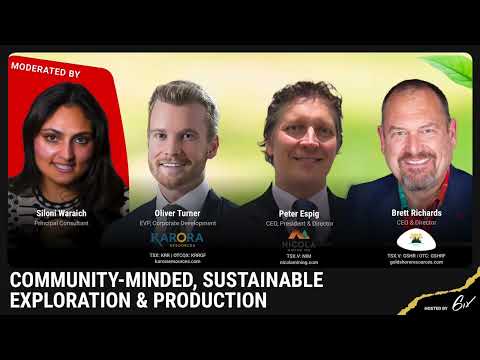
0:08 Good afternoon or morning for some. Thank you for joining us here today to talk about community minded sustainable exploration and production. My name is Selanie Rarach. I'm a risk management professional that works on a lot of interesting things, including sustainability, governance, strategic communications, especially within our sector. It's a particularly exciting time to be talking about ESG within our mining sector. Very recently, the Responsible Mining Foundation just released a new report that most mining companies make no effort to shed a light on ESG risks.
0:54 We know that investors are increasingly focused on environmental, social and governance factors. And of course, Larry, think of BlackRock in his most recent annual letter stated, every company and every industry will be transformed by the transition to a net 0 world. The question is, will you lead or will you be led? And joining us here today are 3 mining leaders that are well-known to many of you, Peter Esbig of Nikola Mining, Brett Richards of Goldshore Resources and Oliver Turner of Karora Resources.
1:40 And we're going to kick off our panel with what is always top of mind in our sector. There's always public attention on our sector related to environmental concerns. So let's kick off our ESG panel today with the E in ESG. And here, Tell us a little bit about your company's unique vision. We'll start with Peter. Would love to hear about your dust and reclamation program. Yeah, thank you, first of all, for having us on this panel. I'd just like to start and kind of make the statement I think that mining companies in general have become increasingly environmentally conscientious.
2:26 So we've gone a long ways from back in the 80s, 70s and 80s And mining companies have put a great deal of effort into this. I think what they haven't done well is done a good job at telling the story of what they're doing. So I think there's a lot of policies that have mining companies become focused on the environment, but they just haven't properly explained that to investors.
2:55 And Nikola Mining is a great example where we took over a company, the historic Craigmont mine site that had, that operated from 1962 to 1982. And we inherited a large dust issue that we had and in that issue, So we acquired 900 acres of land. We're unique in that we're one of the few mining companies that owns the land where the mill is freehold. And so what we do is we recognize that, you know,
3:27 dust, whether the dust is a health issue or whether it's not a health issue, it's still a nuisance to have dust because nobody likes dusty clothes, dusty cars. And so we recognized early on that that was an issue. So what we do is we work with First Nations, we work with the local community, we came up with a seed mix that we were told would grow well in the region. And so we also went for, We became a partner with the Trans Mountain Pipeline. And so the Trans Mountain Pipeline is there as they dig between, let's say, Coquihalla to Merritt on the Coquihalla Highway. There's a lot of good soil that is basically agricultural grade material.
4:15 We accept that material, bring it to our site, cover the historic tailings and then seed it. And so as we're doing our exploration, as we're doing our milling and our gold silver processing, at the same time, we're providing a cover and a cap to mitigate dust originating from our site. Great.
4:37 Thank you very much, Peter. I'm going to turn to you now, Oliver. You know, Karora recently announced becoming the world's first carbon neutral junior gold miner. Tell us a little bit about what that means and what potential investors should know about Karora's overall ESG vision.
4:59 Yeah, thank you very much. And thanks everyone for joining me on the panel. I'd like to echo Peter sentiment to me. One of the most important parts of all of this is telling your story and and your proper environmental practice has been ingrained in some areas of the world for mining companies for a long time. So it's now time for us to tell our story. So with respect to the carbon neutrality initiative we launched last year, we partnered with a group called the Net 0 Company. We started work on this initiative just about a year ago and understanding not only the importance from a climate change perspective, We've all read the IPCC reports and they get more alarming with each one that's passed. But mining is certainly a part of the solution to all of this. And while we are the solution when it comes to materials, we can be part of the solution as well as obviously part of the problem with respect to emitting. So we launched this work with the Net 0 Company last year, announced our engagement mid-year, and then by the fall we announced the phase 1 of this program. And it's very important that this is recognized as a multifaceted approach. The most important part of all this is a long-term emissions reduction strategy which we're working on right now. And that's evaluating everything from alternate power sources to fuel switching, to fleet replacement. We're undergoing that right now with a group, but we also invested in a series of projects in Australia on an indigenous land, particularly called the Mount Sandy project, which is focused on afforestation of
6:29 an area that was hit very, very hard by the bushfires that we all remember in 2019, which dramatically impacted the entire nation. So we're proud to launch that initiative and achieve carbon neutrality, but as part of a dual track approach for us, emissions reductions hand in hand with these investments in order to tackle our greenhouse gas footprint. And look, we are a company that self generates power via diesel generation
6:56 on site. We are and we recognize that And we want to be part of the solution and one of the leaders in the space with respect to both emissions reduction and investment in these products. WG is Corora, which of course rebranded R&C Minerals previously. We are about to release our inaugural ESG report, which will come out here at the end of the first quarter, which will elaborate a lot on our carbon neutrality objectives, but as well, you know, the other remaining aspects to ESG right across the board. So it's been a big piece of work with us for us over the last year. And we're very excited to get that out to investors. Thanks, Oliver. That's great to hear that you're going to be publishing your first ever ESG report as well at the end of this quarter. I know we'll be looking out for it.
7:47 And now over to you, Brett. You know, you have been front and centre, a great spokesperson for the great things happening with Gold Shore, and we've heard about your Moss Lake project and the excitement around that over the last few months, it would be great to hear actually about the environmental challenges that you maybe have experienced there and the risk management approach as you build out the project into a Tier 1 asset. Yeah, for sure, Saloni. And thanks for having me on the panel today. It's a pleasure to be here. And I think after listening to Oliver and Peter, it's pretty clear to me that those 2 guys will not be led. These guys are going to lead the way. I think Moss Lake, specifically Goldshore Resources,
8:43 we're a pretty early story. We haven't really been around for a full year as far as a listed entity goes. We've been around for over a year, just over a year from a transaction standpoint. But very early on, probably around this time last year, we started to lay out the framework as to how we want to conduct business. And this is the same thing that we all go through or most of us go through when you start a business. And I can,
9:12 you know, a very key part of our story, I can, you know, the correlation between ESG, between what we do, what we say and how we behave in ESG, right back to our kind of our mission and our vision and our values. And those are very, very strong statements that we have about how we drive ourselves. We're looking for policies, and we've implemented policies that will create this 0 net discharge, this sustainable working environment as we go through our drilling program, you know, water and emissions are, we're very sensitive to. So we try and do this on a 0 net discharge basis. So those early kind of framework of policies that we put together.
10:02 We actually worked with our host communities and our First Nations Indigenous representatives and with the ministry and the EDM in order to kind of be on a collaborative basis, making sure that we were doing everything we should be doing. And then we can set our policy at the highest level because we too want to lead. So that was the focus early on in the year. We've started our campaign, we've started our program, and we're well down the road on a lot of our ESG objectives
10:37 and initiatives that we've been working on. And it really does come back to, you know, it really does come back to our values, how we work, how we behave and how we behave in the community. And I think having a long-standing career in major mining companies to see how
10:58 big companies do this, and some of them do it very right. And my VP of exploration at SITE, Pete Flindell, he is kind of a longstanding guy as well, who we kind of have watched over the years and we have participated as to how these things get done and how they get done properly. And I think I have to give a big shout out to, you know, our people too, and our host communities, because they're very, very well integrated. Our people believe and drive these values as much as we do. And our stakeholders like our consulting firm who assist us with 180 Consulting in Vancouver. And our contractors. So it is actually systemic. It goes right through our organization about how we behave relative to our values, which align to our ESG objectives.
11:55 That's great, Brett. Thank you for sharing that and for reinforcing that, you know, though you're in different stages of operation, that setting the tone for your sustainability vision and framework has to be done from the get-go and not an afterthought. And you've actually provided a great segue by already touching on it to the big S in ESG, the social. And we would love to hear more about your extensive consultation work with the local indigenous communities that you embarked on in 2021? Yeah, I'd be more than happy to. I think, again, when we signed the transaction to acquire the Moss Lake project from West Dome on January 26, 2021.
12:50 And I think before the end of January, I think Pete and I were already contacting the EDM to talk about, you know,
13:01 the framework and who are our host community, First Nations Indigenous representatives work. Who were they? How do we get in touch with them? How do we start collaborating with them? And our obligation as an early stage exploration company is to consult and engage with them. It really ends there. And we just didn't think that was acceptable. So we have 5 different host communities, 1 main 1 and 4 others. We've reached out to all of them. We've engaged with all of them. And with the exception of 1, 1 simply just doesn't want to engage and they have moved on and they're quite a ways away, several hundred kilometers away. And they just, they don't have any interest in participating and that's fair.
13:47 But those who do have an interest in participating, we wanna have discussions with them and we did, and we continue to monthly. And we have a very transparent approach as to what we're doing on site, how we're doing it, all the programs we have with 0 discharge, et cetera. So that relationship has manifested itself to the point where we're now participating in programs with them. We're starting to lay the framework out for those programs. And I think this eventually becomes, you know, an exploration agreement where we define the parameters of how we're going to work together, but how we're going to, how we're both going to benefit from what we're doing, because this is, after spending kind of almost 20 years in Africa and going through various CSR programs and ESG programs in Africa in about 9 different countries, you really understand and learn that it's not for us to determine what it is other people want or need. It is us for us to sit there and listen, not to speak. And for us to sit there and ask them, you know,
14:55 how are we going to impact you by coming in here? And how can what can we do to mitigate that? And how can we work with you to grow you both economically, educationally, and in other parts of the world. We've gone in certain areas with medical advancements and putting in clinics and etc. But in this case, this is really about them controlling their own destiny and us providing that economic assistance to be able to do that in collaboration with
15:27 giving them preference to employment and giving them preference to when commercial and when competitive and when they have the capacity to do it with affiliated consultants and contractors. And we've gone well beyond our obligation and not because we think anything more than A, it's the right thing to do, but B, we wanna be collaborative, we wanna be inclusive, and we want our First Nations to be a part of this project at the end of the day, because they have some longstanding historical rights here, and we respect that. Thanks, Brett. It certainly sounds like you're raising the bar on how early stage explorers should be engaging with their host communities.
16:16 Peter, it would be great to hear about Nicola's approach to stakeholder engagement. Yeah, I'll echo kind of Brett's philosophy on the importance of communicating with the local communities. But I'll also say this, that if you look at the environmental side, so the E and the ESG, you can't really do a good job on the E if you don't have a good S and you need to have that local communication because
16:51 it's it without that transparency or the communication with the local community you don't really understand what is important for them and what environmental impacts or concerns they have. And so the way you address local environmental concerns is by having a strong communication
17:12 platform with the local community. And that isn't only First Nations, that is the local community, whether it's First Nations or non-First Nations. And so when we look at Nicola mining, and a good example is that, A, we have a mill that operates, We're the only mill in British Columbia that is fully permanent to accept third-party material from out the province. And, but our employees are local. So it's not like we're coming into their territory. They're, we're working with the local community. They have jobs and they provide, they speak with the local community and they provide us with direct communication or feedback from that community, what we're doing right and what we're doing wrong. And the other thing is that, I'll give you an example where, and I've mentioned it in the environmental discussion, where we, when we did the seeding of what type of seeding we did, so we received a mixture, the Ministry of Environment at the time came to us and said, OK, here's the mixture of seeds that we recommend you to plant and
18:21 at your site when you're doing your reclamation. And we reached out to the local community and it was the local community who said, no, we don't like that seed mix. We want this seed mix. And they gave us reasons why. And so we then went back to the Ministry of Environment and said, no, we're not willing to take this. And it was the same thing with one of the, our original permit actually had a clause in there that recommended that we take bio, like biomass,
18:50 which in British Columbia and in the Merritt region was a huge issue where people didn't want to receive biomass for what they view as sewage from the lower mainland. And we fought because the local community said, we prefer you not take it. So we fought to take that out of our permit. And that was all because of the communication that we had with the local community, understanding their concerns, and then being able to address those concerns. And without that communication, that wouldn't happen. Thanks, Peter. Oliver,
19:27 what are the highlights of CORA's vision around the social aspect and stakeholder engagement.
19:38 And what would you like to share with investors around that approach? Yeah, absolutely. So We're in a bit of a different situation, I guess, or more so, like, very much in an established mine camp, obviously, in Kalgoorlie in Western Australia, surrounded by significant mining activity. And we have 1,971 square kilometers of land, and 100% of that land is owned by Indigenous peoples. And that's very, very important and something that ties into every single decision we make. So right at the beginning of any new activities
20:15 we are going to undertake, we consult the local Indigenous people. 97% of our land is the Naju tribe, so most of our conversations are with the Naju tribe and most of our work is on their land. So early engagement, consultation on activities, consultation on any potential disturbances, Consultation, and this is very important in Western Australia, is heritage reviews and heritage management planning, making sure that the land is properly surveyed for any
20:42 significant sites that may be important from a heritage perspective. So maintaining that regular dialogue is something that is very, very important to us. And to that effect, we actually have a quarterly implementation committee where irrespective of whether or not we're starting a new disturbance area or not, we engage with the Anishinaabe tribe and people and also with other indigenous people and just to keep them up to speed in terms of what we're doing. And that often translates into new opportunities for employee engagement. We are a large employer in the region. We also partner with a lot of traditional landowner companies. In fact, you know, again, just due to the fact that we are an operating company, in $2,144 million went into the local community and a large portion of that was into the Indigenous Peoples companies in terms of our partnership with them and various efforts. So we do have a significant impact. We are very, very meaningful presence in the region. We're also surrounded by very large mining companies that have a significant impact as well. So we take that very seriously. Outside of operating on Indigenous land, we do have several mining communities around us. Kambalda is 1, so we've launched several initiatives there.
21:55 Interestingly, as we've grown and as we've scaled, we've had additional need for accommodation. And at one point in 2020, we were looking at expanding our onsite accommodation. Instead, we pivoted to reestablishing the Cumbalda Hotel, as it's known, which is a local eatery and hotel and reinvigorated a business that had been dormant for a fairly long period of time before that. So
22:19 again, if we have the ability to allow our economic impact to benefit local communities, we try to ensure that that is prioritized first. We've also sort of restarted or re-established the Kumbalda Co-op Airport, which is now leading to, especially now that Western Australia is open again, leading to increased tourism and it allows the local population to use the airport as well. We are a significant revenue generator and we try to make sure as many of those dollars go back into the local communities and allow them to have an impact on the decisions that we make via regular engagement. So That's our strategy. Thanks, Oliver. Another aspect, crucial aspect for any mining company is their shareholders when it comes to engagement.
23:16 It's been quite written up about that pandemic has brought on more shareholder activism and all the more reason that we should be having more open discussions, transparency.
23:33 Have each of you seen an increase in shareholder activism specific to your companies? If so, how have you responded and adjusted? And Oliver, I'm going to put you back in the hot seat for this one. I think Oliver is...
24:03 Momentarily. So Brett, I'll turn it over to you to take it back. No, we lost him. Yeah, we haven't, again, early stage company. We haven't seen a lot of, we haven't seen any shareholder activism, but I think over the past 10 years, we've started to see it more and more where you've got significant private equity companies
24:27 with, you know, very, very high standards of governance requirements. And I think we've seen that kind of crescendo. We see it in our space all the time and I'm not gonna name names, but there's been a lot of headlines even this year where activist shareholders have got involved, CEOs have left or management teams have left or chairmen and boards have been disassembled as a result of it. And the spirit of governance in my view is for providing a framework whereby there is authority and accountability
25:04 to management and the board, but there are checks and balances. And again, I go right back to our vision and our mission and our values, primarily our values as to how we behave and how we conduct ourselves. And I've been very fortunate because I put together a board and an advisory board of some of the most senior people in our industry, primarily in Vancouver and Toronto, but they have a significant degree of experience. Majority of them, CEOs in their own right and or senior executives and we're very fortunate to have one of West Dome's people, their chief governance officer as our lead in our governance and nominations committee.
25:53 So we have developed that framework and very early on we've developed the policies that guide us, we've developed the ability to shape all of that, to provide that transparency and that participation.
26:09 And so the behaviors are well-known. So I think that's the framework that we work in. And when you have that framework, I think you, you, I'm not going to say satisfy, but I think you, you avert and mitigate those who may question your governance standards, like activists, shareholders, etc.
26:30 Thanks Bret, and thanks for framing the spirit of governance in your own words. That was very helpful. Now, Oliver, great to have you back. And I'm going to try to put you in the hot seat again regarding the shareholder activism trend. Yeah, so we have sort of similar along the breadth slides, you know, haven't seen any activist in terms of driving our interternal strategy. But what we have done is engage with our major shareholders and bring them up to speed on what we are planning. So there are several strategies we have implemented at Cora, right across the governance structure, increasing board diversity,
27:14 increasing disclosure. Obviously, the ESG, our inaugural ESG report is going to be a massive part of that, of which we're very proud. And that's been 18 months of hard work to get that together. But one of the things that we have seen as a result of some of our work, especially the net 0 announcement, is increased engagement by shareholders that were previously unavailable. Let's just say that the capital pools were unavailable for investment unless we met certain ESG criteria. And by addressing those criteria, you then basically appear on their investment radar. You quoted Larry Fink at the beginning of this, his small investment firm has become an investor in
27:53 ours and they've been increasing their ownership over the course of the last 6 months as a direct result of some of the work that we've been doing. So it is translating into investment dollars, which is great for shareholder return. But I think that's one of the most important things that's happening in the entire investment community over the past couple of years is that we're now driving change with investment dollars. And just to bring it back again to this net 0 concept, there's a very important alliance called the Net 0 Asset Managers Alliance. It's now over $57 trillion of active capital under management. That's over half the world's active AUM. So those investment funds are driving change right across the board. And, you know, mining, again, we are we are the solution. We can also be part of the solution. So that kind of marries hand in hand to make sure that you're you're addressing the needs of those kind of capital pools. So it's worked out very well for us.
28:47 Great. Thank you, Oliver and Peter. How's Nicola prepared for any potential shareholder activism? Have you seen any in the last couple of years? And have you had to adjust to your strategy accordingly?
29:06 Well, I would say this, that, you know, I began my career on Wall Street and worked for a Wall Street firm and was an investment banker and also in private equity. And when I think back of the definition of shareholder activism back even 10 years ago, basically shareholder activism was more like green mailers or funds that would go in and they would take significant stakes in companies and then they would try and dictate what management needed to do. If they didn't listen, they would change the board and that. And I think that shareholder activism has gone through a very incredible metamorphosis where it doesn't necessarily mean that anymore. Shareholder activism means choice. And so you have shareholders or you have pools of capital or you have investors that want to invest in companies that they believe are doing good.
30:01 And just a very simple definition. And whether that is socially good, governance good or environmentally good. And,
30:08 and mining originally was one of the, was, was a sector where these, these investors who had the choice would say, well, we don't want to invest in mining because mining is bad. It's digging holes in the ground. And then you saw the shareholder activism movement or the ESG focused funds at first kind of turn away mining and then start to understand, well, you know, I mean, there are green metals, copper is a green metal. You can't have green energy without copper. And then they went through a period of learning about mining companies. And then I think where we are right now is we're in a stage where there's differentiation, where some companies do a much better job in their ESG obligations than others.
30:58 And I think that we've had
31:02 The biggest thing that I would say has happened over the past 2-years for Nickel mining is it's not so much, I think we've always had that ingrained and it's part of our corporate credo. It's part of our philosophy. We've always valued the environment and we've always listened to the local community what we need to do. I think what we've really focused more on or highlighted more is it doesn't matter how many ounces of gold or how many ounces of silver you produce. You need to also let the market know that you're doing a good job. You're conscientious. You care about the environment. You care about social issues. You care about governance. And that's where you become more of a well-rounded company. And that has become more and more important.
31:50 Even 4 years ago, we wouldn't have investors ask us specifically about social issues or governance issues or environmental issues. And you are seeing an increasing number of shareholders ask those questions. So I think it's a great opportunity for companies such as ourself that value those issues to kind of highlight that we're progressive in an industry that is thousands of years old. Thanks, Peter, especially for highlighting the essential transparency and disclosure aspect, which is a great segue into something that Brett also already touched on, is the increasingly high standards of governance requirements.
32:45 Are expressing concerns about greenwashing. There is a lack of consistent standards. Some call it the alphabet soup of acronyms. We have ISSB, we have UNSDGs, we have SASB. And The tone for transparency and disclosure starts at the top, like you said, Peter. What are your boards and management teams doing to ensure that your companies are addressing these concerns with a more data evidence-based approach? And Peter, I'm going to bring it back to you. As Nicola has publicly stated that measuring, monitoring and reducing our impact on the environment is a team effort and is core to Nicholas philosophy?
33:35 Yeah, I'll do a very short answer. So I think that if you look at, if you look at management's obligation for a company, management's obligation for a mining company or a manufacturing company or any company is to maximize shareholder value. It's one of our obligations. And then if you think of it, though, if you think of maximizing, protecting the environment and focusing on social issues and governing issues, they're not necessarily aligned. And so, and that's a balance. So I think that in order to, for Nicola, what we did is, in order to govern ourselves, right, The best way to govern yourself is to have external people govern you. And so we brought in a consultant who's, she heads up our social and our ESG committee. Her name is Vesta Filipchuk. And Vesta has a long track record and long history in the mining industry of communication with indigenous communities, with social issues.
34:42 And so essentially we listen to her because that allows you to hear almost from third party that's not inside and then you can kind of incorporate that into your daily because it is a learning process. I'll be honest, it's easy for me to sit here and say, yeah, we, you know, we value this and here's our credo and here's our corporate logo. You know, this is these are things that are really important to us. But it's also very important to have external people tell you what you need to do, to listen to the local community, and then implement it that way, because otherwise, it makes it more difficult.
35:30 Thanks, Peter. Oliver, what is Karora's approach? I know you have the first ever ESG report coming out, but when it comes to the standards, the disclosure, the continuous monitoring piece, What is Karora's approach to that? Yeah, no, absolutely. So it certainly is a myriad of acronyms out there. The good news is that these entities seem to be combining into a fewer number of acronyms. So at least we're consolidating the standards, which we all need to adhere to. But same approach that Peter and his group have. We've hired ESG Global Advisors, who is an outstanding group of people who are very far up the curve on this entire space to not only help us with our ESG report, but also to help us keep up to speed on what the latest requirements are and to anticipate changes in disclosures as we move forward. So that's included everything from an extensive list of filings, That's very, part of this, again, could have come back to the beginning of our conversation is telling your story. So all of that is available on our website.
36:39 The ESG report is the single biggest document we've ever prepared on this. When you start talking about data-driven disclosure, there will be a massive amount of data in that report and measurements that we've been taking over the last 2 years, which has been fantastic. We'll also have enhanced ESG disclosure in our AIF, which is coming out shortly, as well as stated objectives. So a lot of management's, you know, and I think this is important to tie management compensation to ESG related objectives too. So we've done that as well at Core to make sure that we are aligned from the top, right down through their organization, and we're all trying to move towards the same thing. So it's working with experts in the field and sorry, and experts in the space. And as you produce this work, making sure that there's full disclosure and it's available for all investors to access on our website and in our documentation. So that's that's our approach.
37:34 Thanks, Oliver. And Brett, once again, you're in the early stage exploration phase. And but it sounds like you really are trying to raise the bar and set the tone from the onset. So what should investors and what should your peers be thinking about when looking at early stage exploration companies like yourself in terms of setting the tone for disclosure and reporting? Yeah, I think, and to mirror a little bit about what Oliver has just said, you know, I agree with their approach and I absolutely agree with kind of where they are and they're leading through this. Given the fact that we are a little early stage, we just have to create and embed those behaviors, stakeholder wide at a very, very early state. And we have, and we've penalized contractors for not working within those parameters and working within that policy.
38:39 And they have been punitive. Just as a management, myself and Pete, a large percentage of our KPI scorecard for our remuneration is driven around these things. Now, there's also other performance mechanisms, you know, we have to perform, We have to get through our program. We have to raise capital. We have to do a number of things. But where at one time ESG and, you know, it was called CSR for a little while, but they tacked on the governance model onto it as well. But it was very token and it wasn't really taken seriously. It wasn't a facet of an organization that is part of their fabric. It has to be part of your fabric and all these things that are related to environmental, social and governance, I'll say criteria, they have to be part of your fabric.
39:39 And if we're going to go to the next level, and I'm not gonna try and jump the shark onto your next question here, But if we're going to go into a green transformation, every company in this world has to start thinking like this. And it has to start with mining companies because without mining companies, we won't have a green transformation. Thanks, Brett. And you're not jumping the shark just yet. We do have some great questions that have come in from our attendees. But before I get to a couple of those, timing is everything. And this week, we all celebrated International Women's Day. I don't need to mince words. Our sector has made strides, but we're still heavily male dominated.
40:29 What is your organization doing to enhance its EDI practices and increase diversity representation at your decision-making level? Brett, we'll start with you. Sure. Again, going back to kind of those values And I can put my hand on my heart and say, not only do I completely agree with the types of values we have, of which inclusion and participation, and certainly trying to promote outside of the box. And we went to our host community, our Indigenous community, our First Nations host, and asked them for assistance with both male and female graduates.
41:20 We got a lot of female graduates. We have, we've employed 5. We don't have a big team. I would say 30%, 35% of our workforce is female. And we do have a percentage of those who are First Nations, Indigenous. So it's just something we're very fortunate in our field in geology that coming up through the ranks of post-secondary school education globally, there is as many, I think there's almost as many women coming through programs that support us than there are men. And I get it, this has been heavily male-oriented for a long, long time, but we're starting to see that demographic shift a bit, and we're benefiting from it.
42:06 And in geology, and I don't wanna take much time here, but in geology, we need that dynamic, and you need that diversity, and you need that diverse brain thinking, you need that three-dimensional left brain oriented thinking or right brain oriented thinking, because when you go to the next level and you start talking to mining engineers, the metallurgists, they're more left brain oriented. So they think two-dimensionally and they think planar, whereas the geologist thinks spatially and three-dimensionally. And women bring that dynamic to the geology standard, I think very, very well, because they think differently than men. So, you know, I have one of the best ambassadors for these types of programs to promote women in Pete Flindell.
42:55 Pete has been completely inclusive. We've been together now for almost 15 years on our last 10 projects. And whether it's been in Africa, Indonesia, other parts of Southeast Asia or North America, he's always put that first and foremost. And when we go out recruiting, first and foremost, he wants to give an opportunity to a woman. That's great. Thank you, Brett. Peter, we'd love to hear about Nicola's philosophy around increasing diversity of perspective. Yeah, that's a very difficult question. Hopefully I can answer it somewhat acceptably. But I think that I may have a different viewpoint than Brett in that I think, so first of all, our ESG initiatives and our community relations are both led by females, by women, and they do a very good job. But that said, okay, well, what about the mine engineers? And what about the geologists? And we've had male and female geologists. So we don't put a priority on male or female. We really look at the specific of what that person can bring to the team and what the team and that being management can bring to that person individual and to see how that works.
44:21 I think we do, we certainly do put a priority on indigenous employees in bringing, and that is a priority that we continue to have is to increase the amount of or the number of Indigenous people working at our mill site. I think though that where we really prioritize and so we just actually put an offer with the, through the local First Nations, through their community. And we basically, and I spoke with the chief and I said, well, you know, what we would like to do is we would like to engage and we'd like to hire young people from the community.
45:06 But we don't want to brand. We don't want to say, OK, well, here is what the here's what the opportunity is and hire people for that opportunity. We've actually gone beyond that because we value the Nicola and myself and our management team. We really value education So what we did is we said we went to the local college and we went to the local high school and said, okay If you were to work for Nicola mining, what job would you like? And if they don't have that skill set to provide them the education to get those skills. And that way, because when we look back in our lives and when I was 18 or 19 years old, I really didn't know what I wanted to do. And so it's difficult when somebody who's 22 years old, they may have completed their post-secondary education, but they still really haven't found out what they want to do. So we have an associate program where we bring these individuals on. And if they want to go back and do a geology degree or an engineering degree that Nicola will help fund that and promote their education. Because ultimately we want to have employees who love what they're doing.
46:15 And there you have a happy employee and it's also good for the company as well. So we kind of start at the education level where we're willing to fund or willing to pay for or provide for those educational skills to allow them to enter into the company in any type of job position, regardless of what they're interested in. Thank you, Peter. I especially applaud you for bringing up the education theme. That is core to moving our sector forward and bringing more talent in and more diversity, absolutely. And Oliver, tell us a little bit about Karora's approach. Yeah, absolutely. And I echo the education part of it. And I promise as a mining engineer, I'm not insulted. I don't think you can have a mining panel without a geologist mining engineer joke. But coming back to that, looking back at my graduating class at Queen's Mining Engineering, I think we were less than 10% female.
47:17 And to hear that there's more and more graduates, female graduates coming through the system is absolutely the start of the solution to this problem that we have. You need to attract a more diverse set of thinking into the education system so they can be well equipped with the proper skills as Peter said, so they're able to do the job whether that's via education later on or right at the beginning of it all, so that we have the right cross-section of people involved in this industry able to contribute in meaningful ways. So very encouraged to see that and hopefully that's a trend that will continue. At CORE, I mean, we are, again, a large organization, we're close to 700 people. And in our approach, along with some similar notes that the other 2 gentlemen outlined is to set targets. We set targets, we achieve those targets and then we set more aggressive targets. So we set a target to reach 20% female employment by the end of the year, right across the organization.
48:19 We're well on our way there. We're getting quite close, and that is well above the regional average in Western Australia. It is a fly in, fly out camp area, and that is well above the average. So we're quite proud of that. Right all the way up to the ultimate decision makers, whether it's management level or all the way up to the board. We have a stated 30% target. So we have 2 of our 7 directors are female. Recently, we had Shirley Infeld join us, actually, and for her breadth of experience across the mining sector, but also her expertise in the ESG aspect of our sector. So great to have her on board. So it's about setting explicit targets, communicating those transparently, and then delivering on those targets. But to bring it all back to the root, if we don't have a woman and a good cross-section of people coming through the educational system, it'll be very hard to source the right people for these roles. So it all starts there. So I am very encouraged, even if minorly insulted, but very encouraged.
49:22 Thanks Oliver. Amy has asked a great question that combines a bunch of themes that are integral to this topic. And that's ESG governance. Does the board have proper oversight? And she asks, how is ESG being led from the top? Does your board have the competencies to understand the importance of ESG and ensure it lives on as new CEOs and executives come and go? Thanks for that great question, Amy. Oliver, we'll start with you. Yeah, yeah, absolutely. It's a great question, well-timed and extremely relevant. So right at the board level, we have ongoing ESG education of your advisors and other educational institutions that flows right down to management in terms of, this is a rapidly evolving space. So making sure that we are well apprised of changes in the sector so that educational aspect happens at the board level.
50:22 Our entire ESG mandate also falls under board oversight. So our ESG report, which again will be coming out at the end of the quarter, is a direct product of the drive of our board, ensuring that we deliver something of the highest quality. So that starts immediately from the top and flows right through the executives and down into the organization. With respect to ensuring that it lives on beyond current executive management, These are policies that are in place at the company level. They're not attached to individuals. They don't live and breathe with a single individual. They're right through the organization. And these are policies that are passed by the board. And irrespective of who the management team will be, those same standards will be in place. And then of course, as things evolve, we'll roll out new standards and enhance our targets and our objectives.
51:10 So, very good question, Amy. Thank you. Thanks, Oliver. Peter, How about your board? Yeah, I think what, so what we do to assure that, that we're adhering to our, I guess, our proclamation or what we're stating that we do is to actually encode it in writing. So we have, so at the corporate level and then at the board level and at the management and the employee level, we have a code of ethics. We have a environmental policy. We have a First Nation policy. And there, the rules are clearly laid out as to what the expectations are and what the replications are of not adhering to the policies are.
51:58 And so that way, you have, everybody knows what is, what the expectations are. Because if you don't implement that, if you don't have it written out and you don't have a rule book, it's pretty hard. You can't have a football game without having rules. And So we have these rules implemented and it, whether, you know, whether I were to leave or somebody else on the board were to leave the next board member and everybody has to sign it. So everybody in the company has to sign these policies, and that gets documented, and then, and everybody understands that they're, what the rules are and the expectations are. Thanks, Peter. And Brett, how is your board, how are you ensuring that at the board level, there's a thorough understanding of the ESG principles in order to have proper oversight?
52:50 Yeah, I think not dissimilar to Oliver and Peter's structure, our board is structured with not only the board itself and a lead director, independent director, but we also have a governance denominations committee and we have a technical and sustainability committee. And ESG is quasi broken up from the standpoint that environmental and social objectives are measured under sustainability in our tech and sustainability committee. Yes, we deal with some governance issues, but the platform of governance is really mandated to the governance committee and governance and nominations committee. So we actually have charters for each of the committees. We have company policies that You can see all this stuff on our website, whereby we have a core group of corporate policies.
53:52 Much like Peter, we have a code of ethics, whistleblower policy, environmental policy, health, safety, and social policy. And all of these things are what again, which drive the framework for our mission and our vision and our values and our inner company behavior. So I think, and the fact that we have, I haven't actually looked at it, but between our board and our advisory board, probably in the order of magnitude of something like 400 or 500 years of experience, we've got a very, very diverse and very senior group of people. We have 2 women on our board, 1 from West Dome, who is the chairman of the nominations, governance and nominations committee.
54:38 And also we have another woman who is chairman of our audit committee. So I think just our relative kind of collective experience and knowing how large companies work and knowing how these frameworks are very important to the success of an organization, all the way through to investor relations and stakeholder relations, but all the way through to your financial performance, let's face it. If you behave properly and your company behaves in such a way that is all guided by your values and guided by your policies and guided by all this, you will know, I'll say better financial performance. Thanks, Brett.
55:24 And some of what you've said is really speaking to the governance nerd in me. Some of the reviews that I've done with boards, best practices are that having effective subcommittees, standalone committees that have oversight over these vital issues make for a more effective board and decision-making process, that's for sure. We're coming up against time. This has been a great discussion. We do have more questions that have come in. For those of you that are still with us, rest assured that we'll be sharing those questions with Peter, Brett, and Oliver, and that you will get a response after today's panel discussion. And I always like to end on a high note.
56:11 So each of you, a quick rapid round, 30 seconds. If you want everyone to walk away with 1 feel good, memorable thought about your company. Brett, starting with you. How is Goldshore Resources making the world a better place? Well, I think that, I would like to think it's because of how we perform and how we act as a company and as a people in our organization. But Ultimately, whether it's our business being in the Gold business or other business being in EV-related businesses, the mining sector has to lead towards the green transformation.
56:56 And there's no 2 ways about it. Without us, this world will not receive the minerals required to turn green. And secondly, it's why we have to lead so that eventually, you know, yes, companies like ours and big companies like the majors can also be, you know, carbon neutral or close to carbon neutral in a reasonable period of time. But without us, this world can't go EV. This world cannot go, you know, emission, 0 emissions. And I think we play an integral part of that irrespective of our commodities. I think we all play an integral part of that. So we should be leading by example. Thanks, Brett. And Peter, how is Nikola Mining making the world a better place?
57:42 Yeah, I think that, you know, first and foremost, we are a company that has a milling facility that processes Gold and Silver. We are also located on the historic Craigmont Copper mine. We also have a fully permitted Silver mine. Going back 5-years ago where you had the anti-miners, there are people who are dead against mining and that's fine. But remember that you can't drive a vehicle, you can't listen to the, you know, watch the TV, you can't talk on a phone, you can't wear clothes, you can't do anything without mining.
58:28 And I think what we are working very hard at and we take a lot of pride in is staying to our core competencies of being a mining company, but our moral obligation of doing a good job for society, for people, for the environment. And I think it's that balance of doing that, and then also allowing the communities and investors and the world to know that mining is not bad. Mining is good. And to reach out to the new generation or the younger generation, because a lot of the investors between 20 to 30 years old, they don't have that understanding. The investors who are 45 and older, they get it. They understand the importance of mining, but the younger there's, so we would, we really want to reach out to the investors or to individuals who are between 20 to 30 years old and say, you know what, mining is a green industry and learn more about us and then judge us after, judge us on our behavior.
59:35 Thanks, Peter. And last but not least, Oliver, how is Karora Resources making the world a better place? Yeah, and there's a lot of good points made there, but I think it ultimately comes down to actions speak louder than words. So, you know, taking control of your narrative and telling the right story, but, you know, actually engaging in practice and launching initiatives that, you know, maybe 5 years ago would have seen, you know, outside of the realm of a normal miner in our changing environment today. And particularly when talking to younger investors and people of that generation, I'm one of them. If we want to have a future world here, we need to mine responsibly. We need these materials, but we can also do it in a really, really green way. And I think launching initiatives such as this decarbonization platform we're working on, and then communicating that to people and showing them the good work that we are doing will help to engage and will help to attract more people from other sectors to this industry. So we're talking about job creation, but we're also talking about solving some of the problems that we're creating.
1:00:42 So leading by example, actions speak louder than words and following through on what you say you're going to do, being accountable. Thank you so much, Oliver. And thank you once again to everyone for attending today, for tuning in. And most of all, thank you to Peter, Oliver and Brett for being leaders within the mining sector and being so open and transparent about being community minded, sustainable visions and practices through your company's work. And dare I say, maybe a year from now, we all get together again in the spirit of continuous improvement, measuring progress, and talk about where each of your companies and projects have reached since today. Thank you once again everyone and have a great day.