Kiran Morzaria
CEO at CADENCE MINERALS PLC
Replay available
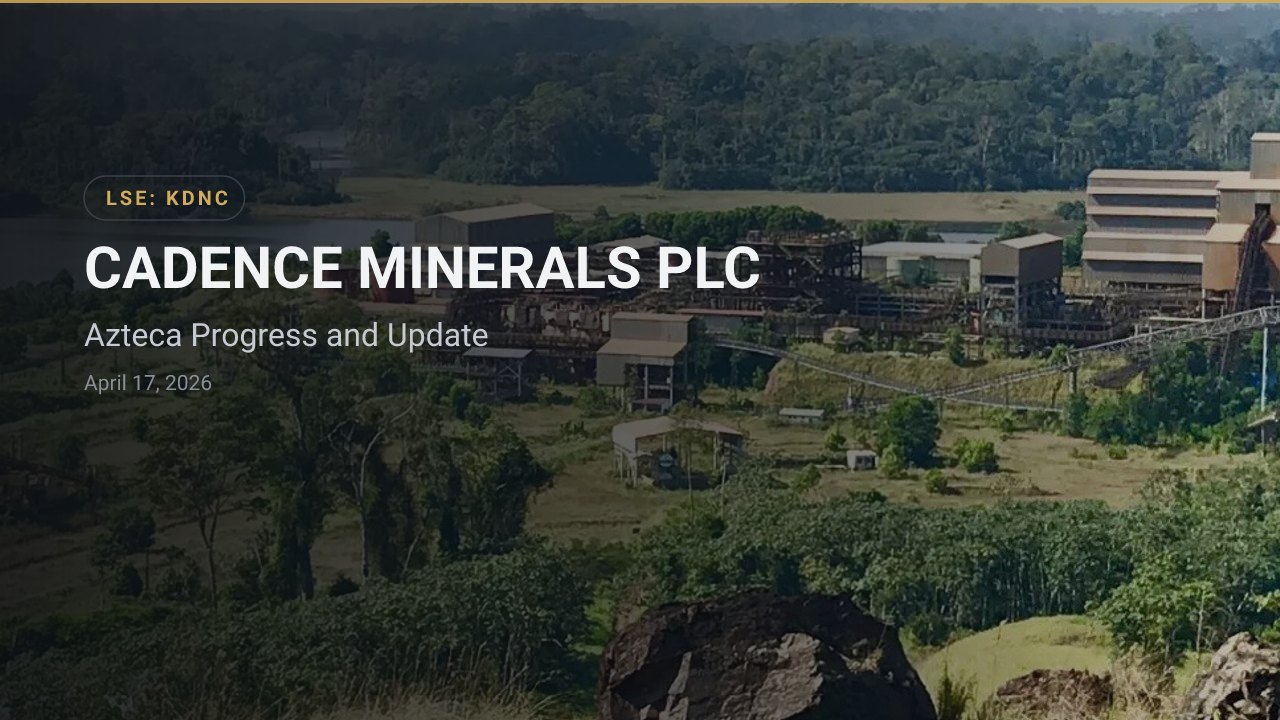
Azteca Progress and Update hosted by Cadence Minerals (LSE:KDNC) on Investor Meet Company, held 2026-04-17.
On 6ix: 6ix.com/event/cadence-minerals-plc-kdnc-azteca-progress-and-update
Automated transcript · Written by software from the replay's audio. It can mishear names and figures; the replay is the record.
0:00 Good morning, and welcome to the CADENCE MINERALS PLC investor presentation presentation. Throughout this recorded presentation, investors will be in listen only mode. Questions are encouraged and could be submitted at any time via the q and a tab situated on the right hand corner of your screen. Simply type in your questions and press send. Company may not be in a position to answer every question it receives during the meeting itself. However, the company can review all questions submitted today and publish responses where it's appropriate to do so. Before we begin, I'd like to submit the following poll. I'd now like to hand you over to Kieran Mazaria, CEO. Good morning, sir.
0:30 Good morning, and thanks for those attending. Thanks for joining me on a Friday morning. And, also, what I'm gonna do with this presentation is that, obviously, lots of people are aware of the company, and I've made this presentation before. So I'm gonna keep the investor presentation down to around five minutes and really focus my time and efforts on answering as many, if not all, the questions that are being put so far and anyone's that will come up as a result of the presentation. So, really, you know, KDENCE, as as many of you will know, is a staged iron ore and lithium developer with one simple story. We're moving from what we believe is a is a fraction of the NAV valuation into near term cash flow on a path to a world class 1,970,000,000 NPV iron ore project in Brazil.
1:29 And since January, we continue to derisk and we believe materially derisk that project. And we as you've seen with the permitting progress of MAPPA and more recently with the funding of the Mexico lithium claim. So when we take those, we'd wanna look at, you know, what is our investment case. And so for us, the three numbers frame the opportunity. We reckon we've got a 139,000,000 net asset value, and KDNC currently trades at a fraction of that. The post and post tax NPV of the Amapa project sits at 1,970,000,000 on a full scale 5,500,000 tons per annum project with a 56% IRR and a low one of the lowest quartile operating cost cost.
2:25 And lastly, we've got a small CapEx start for for the for the Azteca project, so which is fully funded, and that bridges us the cash flow in a matter of months, not years. So this is a rerating story, and the rerating catalyst catalyst are now dated, funded, and visible. When we look at the MAPPA project, which is our flagship ship flagship asset, we hold a stake with around 16,100,000 invested today alongside our partners. We're what we're buying into is a fully integrated, permitted in relation getting through the l I and previously operated vintage asset.
3:15 A mine, a 198 kilometer rail line, a port in Santana that we own the freehold, which has shipped iron ore before, and we're commissioning the start of that infrastructure. We're doing the building that Azteca plant once we get through the licensing, and we're not building it from scratch. And on a resource base, well, it's a 276,000,000 tons, 38% FE At the mine site, we've got a maiden reserve that we declared at 39% FE, which is about a 196,000,000 ton tons, and fifteen year mine life. So the PFS that we updated at the end of twenty four, we managed to produce a 67.5% Fe concentrate, which is a Doctor grade. And that is, you know, one of the scarcest products in the seaborne market at the moment and is important as steel decarbonizes.
4:08 And for us, in addition to that, when we look at the regional side, and I'll get to that slide in a second it's actually not there. Apologies. The regional price is much bigger. You know, we've also highlighted to shareholders through a previous presentation that there's a potential 1,500,000,000 tons plus within the thirty fifty kilometer radius of our rail.
4:33 And some of that we already control through our through our licensing, through our JVs, and others, you know, are not part of our of our of of our total asset. But, critically, the rail is the most important. The rail import of the most important parts of that infrastructure. And with iron ore, it's not just your resource that that represents the most important part. Actually, one of the most important parts are the rail and the port because it is otherwise, you end up with stranded assets. And and that's why you I know what you've seen from the economics that we previously put out that the rail and port is only 5 or $6 a ton, while if you take it by take it by transport, it's around 20 by road transport's around $24 a ton. So that's why in the longer term, having control of that rail and port, you know, other producers will start to can utilize our our rail and port once constructed.
5:30 But, obviously, that's really talking about the larger asset, what we, you know, what we've been really focused on and what we've seen actually shareholders being interested and price move move has been the Astecca plant. So the bridge to cash flow is the Astecca plant restart restart. We all know it's the restart's fully funded through a binding 4,600,000 prepayment off tech off tech signed in December. So there is no further equity from CADENCE that's required to bring Astaka into production. It's gonna target 308,000 tons per annum, a 65 Fe concentrate from existing from an existing pile of partly processed material.
6:15 And, obviously, when we did the r and s, the economics was around a 126,000,000 turnover. I don't think that's going to change. Iron ore has been relatively stable. 37,000,000 of net profit over three years and 32,000,000 of free cash flow to equity over three years. So that's a pro rata IRR of around 70%. And the reason we've got that for Cadence is because we've actually put our money into that, which has already been fully put in now, is the if we put it in as a off take prepayment, so we're getting the same times as the off taker. I'd add that sort of the free cash flow and equity, we haven't updated that as yet. We're waiting to see how, basically, how shipping rates changed changed over the next two or three months.
7:05 Basically, it's highly linked to the straight of formulas issue and bunker price bunker price and and fuel oil. So once we get closer to production, you know, within one month of production, we'll update those figures to reflect the status of fuel oil and bunker oil and pricing and, of course, shipping pricing, which would be the two variables in in that cost. And on permitting, the the the most important since date since January is that we've, obviously, we received the preliminary environmental license since January 6. On the April 2, Ifan has confirmed that no additional archaeological field studies are required in those previously impacted areas, basically, where the last tech of plant is and what and and its impact.
7:57 The remaining work streams are finalizing the tack, which is in process, which is part of the fan process, and that's a narrower and low risk pass in installation license. And the water abstraction and the tailings disposal licenses, both of those were similar. I I think there's, like, several questions on that, so I'll go into more detail of that in the questions. So at the moment, we still believe end of June remains achievable for commissioning, and then that means production in July. And we are already started the as we've said beforehand, the procurements, the early planning works, and some early works are underway on-site. So we're trying to preempt that work so that we get a bit of a head start before the licensing is complete.
8:48 So for us, the path to license is now clearer. It's narrower, and it's lower risk than before before I did this presentation on the I think it's the sixth well, in January when I did this presentation. The last point is the lithium opportunity, which I think that's one of the most important things that happened so far apart outside of Azteca. As you know, this is a genuinely new new since we last last did a presentation. So we have the JV 30% JV interest in part of the small lithium project with Gangfeng. Gangfeng is the third largest world producer, and this is a very large tonnage project with 8,800,000 tons of LCE and about 1,500,000 tons attributable to CADENCE.
9:43 Now following Mexican's naturalization of its lithium sector and the cancellation of the concessions, we have pursued a claim under The UK, Mexico bilateral investment treaty. And then on the March 21, we announced that we had received an LCM funding. LCM had issued a funding notice, a funding confirmation notice after it's completed its due diligence. In plain English, our arbitration now is fully funded on a nonrecourse basis. LCM pays the legal fees and the disbursements. If we lose, KDNC owes nothing. If we win, shareholders capture some of the upside. It's a free optional optionality on a large claim, and it preserves our balance sheet for a mapper.
10:31 So given that, you know, in pretty well in a a pretty easy summary is where does that leave investors or new investors today? Well, it's undervalued. You we've got an out NAV of 139,000,000 against the market cap of somewhere in the region of 20,000,000. So it's a fraction of that. We've got near term revenue. Astecca is still targeting commissioning by the end of June twenty six with production in July. We've got potential workhouse growth with iron ore asset of 1,970,000,000, 5,500,000 tons per annum of production of Doctor grade material, and it's derisked.
11:18 It's we've got our preliminary environmental license. If our scope has been narrowed, and we're progressing with that well, And we're now focusing on the we got the pre prepayment offtake funded, and we've also got the the water license, and the tailings disposal license is progressing well. And lastly, which is free optionality, we've got this nonrecourse funded Mexico BIT claim against the backdrop of Mexico's lithium metallization. So we've got near term cash flow, a world class iron asset asset behind it, and a funded claim on the side. That's the cadence pitch. That's basically a, I believe, a really strong position, and we've continued to move forward across all our assets in this first quarter of this year.
12:12 So I think that that's all of it. I really thank you for taking the time, and I now will move on to the questions. That's great. Thank you very much for your presentation. Ladies and gentlemen, please do continue to submit your questions just by using the q and a tab situated on the right hand corner of your screen. Just while the company take a few moments to review those questions submitted today, I'd like to remind you that recording of this presentation along with a copy of the slides and the published q and a can be accessed via investor dashboard. As you can see, we have received a number of questions throughout today's presentation. Can I please ask you to read out the questions and give responses where appropriate to do so? And I'll pick up from you at the end. Okay. Thank you. Thanks for the questions. Think I've got around at twelve at the moment. We'll we'll we'll try and go through all of those. And I think, again, just reinforcing the key message for our investors is straightforward.
13:04 As tech is important because it turns them up from a long dated permitting story into a near term operating and cash flow story. That means that
13:17 that matters not only because of the direct economics of the plant, because the successful delivery at a stack a stack of material derisk the bigger map of redevelopment and strengthens KDNC's position with strategic partners, off takers, the market more broadly. So the questions, I'll start with the first one is off taker identity. The first question here. Question is the identity of our off takers still remain a mystery. Has the situation changed from when you last answered a similar question? The situation is unchanged. The off taker remains confidential for commercial reasons as I've highlighted beforehand. But the key point is that they have already committed the capital via via binding prepayment.
14:03 They've paid the cap all the capital required on the under the agreement so far, and that that prepayment is to restart Astecca. That tells you a sophisticated buyer has done his homework on a mapper, likes the high grade product, and is prepared to fund the restart restart upfront rather than the sort of vague commitments. So it's a you know, I I know we keep on asking, but I don't I think the most important part here is that they've done the work, and they're funding it, and we're moving forward. The next question is, what is your opinion or the reason for the continued suppressed share price given that Astecca strategy has derisked the larger project? Look. Since we put the Astecca strategy on the table last year, KDNC's share price has moved, albeit, from a very low base from about 1.5p to roughly 5p today.
14:59 So the market has clearly started to recognize the progress we've made. And, certainly, I think the decision to go with the Azteca plant was much better than, you know, trying to seek funding for the DFS into the public markets. So, you know, that that approach, that tactical approach has worked. That says, we still not believe the current price fully reflects a funded once we get the licenses, restart our restart of the plant plus a 5,500,000 ton, 1,970,000,000 NPV expansive case behind it. So I think right now, the market is still valuing KDENCE more as a permitting and study story than as a business on the cusp of near term cash flow from.
15:50 And I think as we get those licenses cleared and we start construction, I think the market all being well, pre assuming that everyone appreciates getting to cash flow, we'll see that price move up. And our job is to close that gap and close that valuation. As I said, you know, we need to secure the remaining approvals, restart the plant, and letting production and cash generate generation drive the next leg of the rerate where we will do the next leg of the rerate, where we do the DFS and move that project for for the Astecca larger as a MAPPA project forward. Okay. So the next question is on licensing. I think there's two of these, so I'll I'll might answer both of them, and this one will just answer separately.
16:41 Following the April update confirming if it requires no field studies, what is the expected administrative turnaround for signing the TAC, and is the LI for ASTECA linked to that? So for obviously, we have our preliminary license granted. Now we need the installation license. There are three main strands, and I've obviously talked about this beforehand. The water abstraction tailings disposal license, which comes from a organization within the environmental organization in The States, but basically part of SEMA. They're already with SEMA. We're pushing them on a daily basis to go through their final administrative review, and, hopefully, that should be coming fairly soon.
17:28 On Ifan, we've actually made really quick progress on the TAC. As I said, they confirmed that no field work is needed on the previous impacted areas, and now we have to finalize the TAC. But we understand and broadly agree with the proposed measures that Ifan has put together for the TAC, and so we are progressing that as quickly as we can feasibly do so so that we can get the clearance. But the point is those three things are required for to get the LI issued. And so, yes, the if an or that's if an is a a federal organization rather than a state one. So once if an provides a clearance, then saying that the attack is signed and agreed, and they and they have no objections to semi issuing LI, semi should effectively issue the NI.
18:25 I think the important thing is, although we're pushing this and we're getting back as quickly as possible, turnarounds are very quick, and that's been just come back from Brazil, you know, consistently doing meetings, planning, and liaising with the authorities on a daily basis, we are giving our best efforts to get this done as quick as possible. But it's the authorities, not the company that set this timetable. But with no further studies requested, those three stands now converging, we see it as an administrative finish line rather than a technical one. That's why we continue to say subject to permitings and commissioning
19:10 Sorry. In execution, we still believe that by the end of June twenty twenty six, we'll be able to commission the Azteca plant. K. The next question is on tailings. Regarding the Astaka plant refurbishment, has A and M provide the necessary stability certification for existing tailing facilities to support the June 2026 production target? And are there any additional decharacterization requirements that could impact commissioning? So decharacterization for those that don't know, that is effectively in Brazil. Two things. The the first thing is, do we need to change our tailings design?
19:56 Because there was a Burmandino deposit, and that had what they call an upstream tailings design, and there's been a push to get to dry dry stack tailings, downstream tailings design rather than upstream. All apart from one dike of of a project, a tailings die dams or dikes are downstream. The other one that isn't is what they call a middle middling design, which is fine, and a and m has reviewed that. So in terms of that, a and m have no required no decaracterization. And then the last thing in terms of decaracterization is what do you do at the end? What is part of what is your dewatering plan once you've closed the mine down? How does your tailing dam react to water?
20:44 And, you know, obviously, we're in the Amazon Rainforest Amazon Rainforest, and and that was designed as part of the PFS. So at the moment, there is no decharacterized further decharacterization requirements. So the main work stream is now completing a revised dam break study and tailings disposal plan, which has already started. It's ongoing, and that will then support what they call the DSA stability sign off under Brazil's strengthened down safety regulations. We expect to facility the production to sit in the medium risk category because in essence, we're not putting that many tons into back into the tailings storage plant. You know, we're not gonna be at 5,500,000 tons production per annum. So we're talking about, you know, 300,000 per annum on on tons per annum that will be in the tail going into the tailings.
21:37 And that already aligns with the planned emergency action plan. The as I said, the dam has already been characterized when we're operating with routine inspections and monitoring place. So in practical terms, it's about updating formalizing the documentation to current start standards rather than fixing any, which they weren't, any legacy stability problems. And that is works progressing in parallel with the s stacker commissioning. That's what will happen, is so that will align at the moment. We believe that's going to align perfectly with our June timeline. I hope that's answered that question. Strategic interest from major with the MMAT MAPPA project now reaching execution richness in the high grade market in deficit, have you seen a measurable increase in unsolicited approaches from tier one miners or steel majors for offtakes or JV in 5,500,000.
22:39 Look. You're right. A fully studied execution ready Doctor grade projects with an integrated rail and port plus funded starter plant is exactly the profile that attracts strategic interests from groups seeking to secure high grade supply. But while we cannot comment on individual names, we are sort of seeing the same inbound interest and diligence you expect to this change. And every step we take on permitting and as tech has strengthens our hands in those conversations. K. I hope that answered that one. Funding okay. Is the current funding structure via Indocide trade sufficient to cover the full refurbishment period for Astecca, or do you anticipate needing a secondary project finance facility alongside the LI?
23:32 So the Astecca restart is funded through the $4,600,000 prepayment offtake structure, and the company has made it clear that no further equity is required to bring the Astecca plant to production. That's important because it means that shareholders have an exposure to the restart without dilution. Any additional capital we might look for in the future will be about optimizing and accelerating the broader map of project, a map of development project rather than plugging a gap in this Astecca reto restart budget. So, you know, as as it is, we've actually we're actually under budget in terms of the capital we spent in the development of Astecca. So that's good. We have some spare capital there. And and, certainly, because one of the things is, obviously, we one of the things that we had originally budgeted for is in the dam and tailings, we thought we might be in the high risk category.
24:28 And I think we will be in that category once we get to the full Amapra project. But for the Astecca, we don't believe so because it's a very small amount of material going in, and that required has some additional capital required to we we don't believe that we'll need that capital. It's mainly to do with sirens. We don't we won't need that capital. So that has actually reduced our requirement for the Astecca project. In terms of broader map of development, obviously, the idea here is that the Astecca project funds the DFS for its free cash flow. Obviously, that the the DFS then will align with the available cash flow. So if you wanted to accelerate that cat accelerated that DFS, yeah, you would maybe look at additional capital for that. But at the moment, our plan is not to do that. It's very clear we're utilizing the free cash flow from the Astecca project to fund the DFS on the map development.
25:30 Greatest risk. What is the greatest risk moving forward? I think the the the risk here is is the times of approvals. Assuming that we stay where we think we are and we don't, like, slip another month or something like that, then that that is the that's for me is represents the greatest risk. Okay. So where are we? Yeah. So yeah. So that's why we have kept us in execution ready mode with procurement, running on-site permitting, and some of the early works. So when the ally grant is that ally is granted, we can move immediately.
26:17 The next one was, is it the board's intention if the offer is right to sell a mapper before it's in production? Well, I think you've talked about maybe a mapper as as as a whole rather than Astecca. Don't think we're gonna be selling this project with this market cap before Astecca gets into production. But in broadest terms, the board's responsibility is to maximize value for shareholders. So, you know, as I've said beforehand, not to commit pre commit to one end state because by committing to one end state, that actually that actually reduces your commercial ability to negotiate.
27:03 So if a credible offer emerges that it it fairly reflects the value of a MAPPA and a stacker, it would have to be considered. At the same same time, the best way to improve any strategic outcome, whether build, partner, or sell is to keep derisking the asset asset, get Astecca into production, fund the DFS. Having those strengths not being having to rely on internal external equity for funding the DFS is really important and derisking the asset, as I've said beforehand. If you show you can operate and you get your LI, which, by the way, the l the LI does will cover the whole Amapa aspect. The LO, which comes at the end, will just cover the ASTECA. Getting the LI in place, showing that you can operate, showing that you've gone through the environmental approvals, both for strategic investors and in and for the state, actually is a really important part of the derisking. So the derisking is one of the most critical parts of getting this project going, and that's why its tech is really important.
28:10 Assuming license approval, what is the expected timeline? Next sorry. Next question. Assuming license approval, what is the expected timeline for approval to refurbishment, commissioning for production post production test as tech? I think at this point in time, we still believe that we'll be able to achieve the end of June timeline for commissioning. That will be in production in July. You know, as we've we've been driving that point of obviously, done all our engineering studies or completed detailed engineering studies are all completed. We've start we preordered all the long lead items. They're on the way. They're coming directly to site, and and we started some preliminary work at site, which is allowed under our current preliminary license.
29:04 So we're doing as much as we can. And with that occurring, building in the Slack that we have into the timeline and critical paths, we we believe that end of June is still viable. Obviously, once if if the license extend, let's say, by another six weeks or a month, then we'll have to move that expectation out a bit. But at this point in time, we still believe June's achievable. I I I I look. Astecca's production profile and cash flow. How should investors think about the potential production profile, operating costs, and cash generation from Asteca once operational?
29:50 So I I think we stated before, Asteca's expected to provide production of around 380,000 tons per annum of 65% FE. It you know, it's a much smaller plant, and it's a it's a concentrate from some previously processed material that had gone through all the grinding circuits, just hadn't gone through the float. So, you know, as we've shown that it's actually a very high grade input. You know, our presentation shows a 126,000,000 turnover. I don't think, I said before, that will change. Iron ore has stayed pretty stable, improved slightly. The 37,000,000 impact over the first three years, and I think the $35,000,000 free cash flow to equity.
30:42 Look. I I think that could change. I'm not gonna update it just yet. As I said beforehand, external political issues, the Strait Of Hummus is impacting bunker bunker fuel oil prices and therefore shipping. So once we get a very clear situation of where that is, and we'll probably update it update that those cash flows once we get closer to production. So one month before production, we can update those cash flows because then we'll have a real idea of of the pricing of, basically, shipping, which is the biggest impact and biggest delta that will occur to our our profits. But suffice to say that even with current shipping prices, it's profitable.
31:35 Question 11. This is can you again, a license question. Can you confirm whether all technical requirements for installation have now been satisfied and that they and that the remaining steps are administrative? If so, what are the final milestones? Yeah. I I I think I said beforehand, the heavy technical lifting for has been done, submitted. The regulators have no have not requested any additional field studies for if I'm on previously impacted areas for CEMA and the and the water authorities. They've required nothing. At this stage, the Allot LI comes down to three linked items, water extraction, tailings disposal, and clearance. Water and tailings are with SEMA for final review. We bug them daily.
32:23 If and but with we've broadly agreed with the terms of the tech, we're finalizing that. And once the tech is done, if and we'll clear the product to SEMA, and then assuming that we've got at the same before then, the water extraction and tailings disposal license that SEMA will issue the LI. So, yes, we regard the remaining steps administrative rather than technical while timing ultimately remains with the regulators. In parallel, we are maintaining the execution readiness so that we can move straight into refurbishment and commissioning as soon as the license is granted. Railway fuel costs. So this is a question about railway.
33:09 Look. With increased fuel costs, have there been any further attempts to fast track the railway upgrade or access access grants rather arrangements to accelerate it? So the the railway you're right. And I think I illustrated earlier on the difference between taking the railway of, like, $5 a ton, and, obviously, we'd have to refurbish the port as well. Otherwise, you're going to basically taking the railway to two kilometers away from the current port and then spending $10 loading it. So it becomes a $15 cost rather than a $24 cost, which sits at the moment if we just track track track transport. So I think the point, remember, is is the railway is we still have to do the definitive feasibility study on it.
33:59 You know, there is an overall cost of the railway over to get up to production of 5,500,000 tons of around $50,000,000. There are a on on top of that, there are communities near and on the railway. So that requires a very structured approach in terms to the resettlement of those communities going forward. So that is if if you know, realistically, that's not going to be done as part of Astecca. It only gets done as part of the larger redevelopment of the port and the rail port and railway and the plant, particularly because actually, yes, it's it's it's not the difference between if you look at our DFS, it shows that $5 loaded onto onto a ship.
34:54 And people think the delta is between $5 and 24, but, actually, the port is also a really important part of that development. And as I just said earlier on, the development of just the railway, you still then have to move the material to to the public port, which then becomes another $10. And, of course, if you're not using the railway to its full capacity, you still have a large fixed cost in terms of maintenance. So that delta is going to be smaller than maybe $10. It might only be $6 or $5 or $8 in terms of the the savings that you make. But it's still all you know, it's a 198 kilometers of railway. That's still gonna take two years to develop. So for us, the most important thing is get the to deliver first. Get the cash flow from that, fund the DFS, fund all the social community programs, fund the engagement with the community in terms of getting that railway as part of the longer term value with the 5,500,000 ton as a map a map a plan.
36:03 I would add that, yes, there are not grants, but what certainly we have been discussing I've had discussed historically with the minister of integration in Brazil. The minister integration is about the development of especially poorer areas of Brazil, which the North Of Brazil, particularly poor. And there are very well known state owned banks or private banks which have state owned funding within it that can provide soft loans for the development of this infrastructure. And we've had verbally confirmed that, in fact, the port and the railway in Amapa is strategically important for the state because it provides not only access to the iron ore in in in the Amapa project, but it also allows the railway to be used for other sustainable long term sustainable development in the state, whether that be agriculture, other mining opportunities, which the railway can reduce the cost when it's integrated with the port, reduce the transportation cost substantially.
37:07 So, yeah, we believe that there are funding opportunities, soft loans for the railway, for the port, but that only really comes after we have completed the DFS, and we're going through the funding process of the larger amount of project. Okay. Let me just see if I've gone through all the questions here. I was I had I think that is it, or have I got some more? I can't I'm sorry. I've lost lost it now. Hello? Sorry? Hi, Kieran. Can you see a blue chat button at the bottom of your screen that says chat? Okay. Yeah. Yeah. Sorry. Sorry. Perfect.
37:54 Alright. So where are we? Okay. So with the resignation of going things arbitration have any impact on the ice, no. We are pursuing a different a different claim, obviously, on the same same claim in terms of what we're claiming for, but, ultimately, it's a separate process. Hi. Could you help us on the buildup of a So the 139% NAV, I can provide that in a in a separate probably in the next presentation. The NAV would have been based on effectively utilizing a market comparable in terms of what value of an asset of this value at this stage and our 36% stage 3036% stake should be valued at. Obviously, we're investing it at the moment at about a $100,000,000 valuing the the amount of stock about a $100,000,000, which would probably our market cap is would nearly reflecting that at the moment going up from 1 p to 5p.
39:15 Do honest tech, what are the remaining hard gating items to first shipment? Hard I I I'm assuming me what are the what are the gates the main gates left, and I think I've just the main gates to get to production and therefore shipment. We at the moment, on the critical path, those gates are the licensing. The rest, all the equipments is available, people are available. It's not a complex plant to develop. So we believe that it's those are the two main gating items. And and yeah. So that's the two gating items. What other plan the plan of license approvals are approved in the next few weeks. How does that change the June time frame?
40:02 The the the plan I mean, I I think as I said, it's an administrative process. There's no technical issues in relation to this. It's just pushing people to go through papers, sign papers, get it through the various compliance in terms of who needs to sign off when, and we're really pushing that. So how does that change the June time frame? I said, look. If if it if it moves past sort of a month, that will move the timeline, we'll inform the market how much that would delay. But, I don't know, if if we're a further month, I expect that there might be a three week delay or something like that. So right now, I'm losing count here. So how confident you are about receiving license within your time frame?
40:52 I think, certainly, with the water, look, we've really made really good progress. I think within the next two to three weeks, hopefully, we should see those licenses coming through, that allows us to keep our June time frame. So with the water abstraction, with the tailings storage license, that's very clear. What needs to be done. It's just getting us some signatures. And with the if an as I said, we have you know, they put put together what they expect from the TAC. We broadly agree with the TAC, what they're asking from us. And so, you know, I I think as as long as no one moves their position in terms of what that TAC is, I think that's a very rapid thing in terms of a pre in principle agreement will be very quick, and then it'll be a legal one that just needs to be drafted up. So we've already got the legal document drafted. They've drafted and sent it to us. We are, you know, we're broadly in agreement with that.
41:54 We've got some minor changes, so that gets signed, gets executed, and so that's why I expect in in in that timeline to be able to achieve all. Right. That's a I do. You expect any delay in your own stack of date July? At the moment, no. As I I think do you expect any any date of July? I don't expect any delay at this point in time for the July timeline, I. Commissioning at the end June commissioning at the end of June and production in July. What's the worst case? You know, I don't think there's much real issue talking about the worst case at this moment in time.
42:43 As I said, if it is, it'll be two or three weeks with that close to getting stuff done. The nerve quater would convert about 26 p. Why do you consider that the market doesn't believe you're nav? I I think it's I think overall, when people have talked about the valuation of the project, and you've seen analyst reports talking about higher prices, etcetera. The NAV I I I think this is a problem with a lot of junior mining companies when they hit the prefeasibility study. They hit the prefeasibility study. People know and the market knows that you've got to raise capital to do the DFS, which is often quite expensive. So we certainly expect that, you know, expect the DFS to be around depending on how much drilling we need to do for the large sampling required for the design DFS level design of the plant between 6 and maybe $10,000,000 in total for the DFS.
43:45 So once you once you alert small market cap, even if you're in a 100%, that's gonna be hard to raise. But as you've seen, as we move through this project, I think the value we get more value accretive in terms of going from where we were at 1.5 to five p, moving up towards that now as we get through to as I've talked about the value accretion about getting to as tech into production, funding the DFS, and moving that forward. That's where I can see we get the value moving forward. And, of course, that NAV will improve as we get once we get the DFS completed. What commercials have been agreed with LCM regarding potential? As you can understand, that's sensitive both across the board and for both LCM and any negotiation strategy that we would have with the Mexican government.
44:46 So I'm not going to disclose those. For the BIT claim, can you confirm the historical spend on the project? It's it's not a huge amount. It's in a couple $100,000 that we spent on it so far. So, you know, if you're talking about any studies you're talking about, can you highlight any studies to value the project that could be referenced? I think that probably the best way that you can do it is the the the definitive feasibility study produced by or lithium at the time, which shows valuation, I think, of about $1,000,000,000 at a much at a lower lithium carbonate price.
45:35 So you'd have to update that for the current lithium carbonate price, and then it actually has in there the the staging of when we get our cash flow because our cash flow doesn't come in the snorlithium project in the first one or two years. It starts from year six or seven. So that impacts our NPV. So you can utilize that and and back calculate some valuations. Any can you also provide an so, yes, so the BI took a historical. Can you how how many studies done that? Can you also give an overview of prior litigation on the issue by yourself? So that the only litigation in relation to the IT client is the one that we're pursuing, And, obviously, gangfang are pursuing similar piece of litigation, basically, on the same idea.
46:24 We'll be on the same ideas that that that, you know, the these licenses have been taken away with us with with no court. You know, there's no reason for these licenses to be removed when everything's been complied with. So next one, could you elaborate on the critical licenses and permissions pending on issuing to the mining operation? I I I think I've done that. So just for clarity, there are three permits before we get the installation license. The installation light so those three permits are the water abstraction license, the tailings disposal license, and the IFAM, which is the archaeological study clearance.
47:11 I've talked about the timelines where we think we're gonna get those. That then gives you the installation license. Once you've with once you've done and completed your installation, so you complete you then as long as you've complied with the various parts of the installation license, which is environmental control program, your operating health and safety, There's an inspection. They grant the operation license, and then you can start producing. And, you know, the if we're talking about risk approach, the largest risk was getting the initial preliminary environmental license. Installation license is lower. Operating license, as long as you've complied, it it it's it's a basic administrative staff. It's a bit like getting your you know, you put your planning permission in your house As long as you've constructed the house to the specifications and it's compliant with legislation, you then arrive to live in that house and it's, you know, it's it gets approved.
48:12 How long might the DFS take to complete? DFS, look, typically, they are around one year in terms of timeline. And and, again, I think bit talked a bit about whether or not we would be required to do the drilling. I I think we will to get a sufficient sample, I 20 10 to 20 tons of drilling. So we'll be required to do drilling to get tonnages to then utilize in a pilot plant for our 67.5% material tons per annum. So that that will probably that will probably then mean that we've sorry. That will be that will be the one year timeline.
49:01 Let's see. I've answered some of these questions already. After the MAPPA DFS, what are the steps to get a MAPPA up and running? So DFS is effectively for those who don't know, DFS is done to a bankable level. So that means that you can secure bank financing. So you we will be engaging with financiers or have started engaging some with financiers before the DFS is complete. You build building that relationship certainly on the equity side, but but up to six months, eight months before the DFS is complete.
49:48 And then once the DFS is complete, the idea is and usually within six months, you then have your financing package together, equity debt. So we would intend to put that equity at project level if it's all possible or, you know, at PBA, our joint venture, and then the debt at project at at project level as well. So then there is a you know, the timeline at PFS was around a two year timeline for construction, and that means a construction rehabilitation of everything. And importantly, that's the railway port and plant. And with that complete, then you would enter into commissioning and construct and production. So in simplistic terms, it's obviously much more complex to that than that. But in very simplistic terms, that is the sort of the the timeline and the process of getting to production of 5,500,000 tons. Remembering that 5,500,000 tons, you know, is is is sort of a NPV. Well, not forget the NPV. There's a free cash flow about $300,000,000 a year from that production. So it's a order of magnitude in size, order of magnitude in in engineering, much more complex.
51:04 Yes. DecaPlant is relatively simple. Importantly, we will already have the installation license for the whole of the project with the grant of of this no. Sorry. The whole of the mine and mine and processing plant. This LI gives us that give us that that LI. So, theoretically, if we have the money to construct the a MAPPA project, the whole of it, we could. But, you know, what we're going for is the a a stacker project at the moment, and we'll get that going and funded for that. What do you think will be your biggest first customer if China if China would appear that they're on good terms around? This might help with shipping.
51:56 Shipping well, first thing, shipping's an international business a bit like oil. You know, whether you produce oil locally, it's a $100 a barrel. It you know, so shipping is a global market. We don't pass through the Australian farmers. There's nothing to do with it. It it effectively, the route is from a MAPPA, goes around South Africa through Singapore and to China. But you're right. China is the largest customer. It's certainly for the 65% product as it is the largest producer of steel. Longer term with the with the Doctor grade, you know, that depending on how Doctor grade develops in Europe and America, that could also be a target market, reducing the shipping cost, of course. So, yeah, so China is the largest customer.
52:47 Whether it was be China or America or The UK, shipping rates are the same pretty well across the board. It's ultimately defined the defined by the availability of ships and bunker oil or bunker diesel price. Right. I think the last one is how do you see the interest of all your JV partners on the MAPPA product? So I think we're talking about Indocyno here. Indosyno is they've been with us all along, and I think they've been a really critical part of this project. Remembering that so how did they get involved with it? Well, ultimately, they were one of the creditors, and they had a have a $50,000,000 loan into the project, which is now into our JV. So that that was effectively their conversion of debt to equity into our JV.
53:42 So that is they can they that JV now owns $50,000,000 debt into the project, which we therefore have a 36% of. Their contribution has been vital because as much as we can put expertise and people involved, they're when we came to this asset in 2018 and 2019, effectively going to a chapter 11 with no data, no information. Yes. We have the physical assets, but to build up all the historical drill core, all the historical engineering work, to bring that to the fore, we needed people at Indosynos. So one guy there that's involved was engaged. He's previously opt was previously involved with the amount of project, and that's what we've been utilizing. And those contacts and that knowledge base has been really vital for us. So, you know, we work on the basis that we work together. Our alignment today has been the same.
54:40 And yeah. So we're moving I think, you know, there's been been no arguments or discussions about the development strategy. We've always agreed on what we need to do, how we're going to develop it. We're aligned. We've both got very large equity positions in the project, so the alignment is clear. Is the bank consortium still on board with the settlement agreements? Yes. So the bank consulting, this is the bank liability historic liability. We entered into a settlement agreement a while ago. What we are doing with them is actually trying to negotiate that position down further, and we'll update the market once we have that position negotiated or the final the final negotiated positions will be announced. But it's it's possibly ultimately, there's two ways to settle the banks.
55:38 One is a payment upfront through some sort of long term financing off take agreement with them not with with a third party to fund them, which will be a one time payment. We would anticipate that's being one one time payment. That will be substantially cheaper than settling with them at the point in time when we get to fund funding the DFS. It's not sorry. Not funding the DFS. Funding the construction of the project because those banks would be have to be taken out. Okay. Look. Thanks so much for those questions. I hope that I've answered those as fully as I can. So, yeah, I I think the main thing to take from that and take from what Cadence is about and our investment in a mapper is that, you know, in simple in simple terms, The investment case today is is very similar to the investment case that we we talked about early in April, but it's it's a clear undervaluation of the assets.
56:52 We've got a defined near term route to cash flow through Astecca backed up by a larger long life Doctor project behind it. And fourth, additionally, an optionality through the regional iron ore expansion, which is a possibility, and our lithium exposure and arbitration in on the Sonora project. Okay. Thank you. That's great. Thank you for updating investors today. Can I please ask investors not to close the session as you'll now be automatically redirected to provide your feedback in order that the management team can better understand your views and expectations? This may take a few moments to complete, and I'm sure it'll be greatly valued by the company. On behalf of the management team, we'd like to thank you for attending today's presentation, and good morning to you all.
Follow Cadence Minerals PLC into a list and get an email when it puts out news.
CEO at CADENCE MINERALS PLC