Kiran Morzaria
CEO at CADENCE MINERALS PLC
Replay available
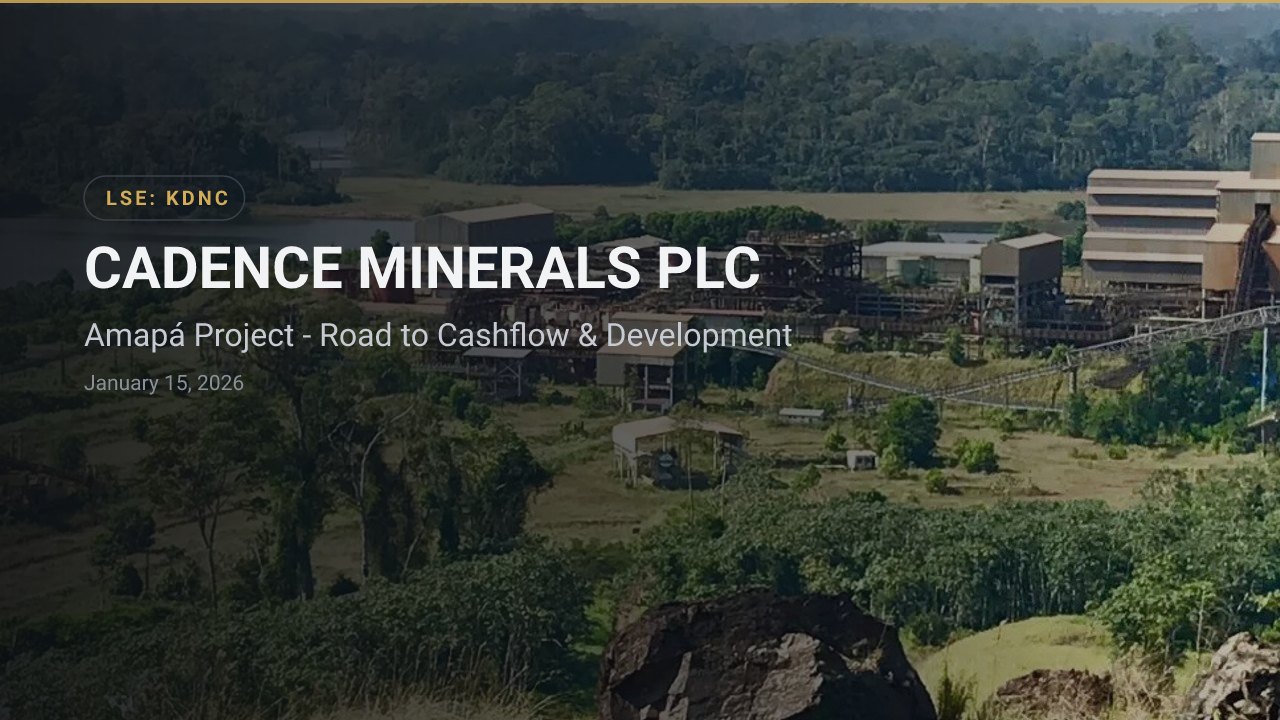
Amapá Project - Road to Cashflow & Development hosted by Cadence Minerals (LSE:KDNC) on Investor Meet Company, held 2026-01-15.
On 6ix: 6ix.com/event/cadence-minerals-plc-kdnc-amapa-project-road-to-cashflow-and-development
Automated transcript · Written by software from the replay's audio. It can mishear names and figures; the replay is the record.
0:01 Good morning, and welcome to the CADENCE MINERALS PLC Investor Presentation. Throughout this recorded presentation, investors will be in listen only mode. Questions are encouraged and they can be submitted at any time using the Q and A tab situated on the right hand corner of your screen. Simply type in your questions and press send. Company may not be in a position to answer every question received during the meeting itself. However, the company can review your questions submitted today and publish responses what is appropriate to do so. Before we begin, I would like to submit the following poll. And I would now like to hand you over to CEO, Kieran Mozaria. Good morning to you. Good morning, and good morning, everyone, and thanks for attending and joining us on this presentation. The presentation is one that we've obviously have on our website, and I think you guys will be very okay with what is in it.
0:51 But what I want to take you through is where is KDENCE today, what has already been delivered, and why the next phase of the company is funding fundamentally different. This is about progress, momentum, and execution. Before we begin, there is a standard cautionary statement on the screen. You can read it probably after the fact. We don't want to dwell too long on that. So let's with that said, let's turn to the substance of the project and cadence. So what is Cadence? Well, Cadence is an AIM listed company. And as you can see from there, what our strategy is about, what where our flagship asset is, and, of course, the key derisking that we've achieved so far.
1:44 What sets KDNC apart, we believe, is how we build value. We're not relying on a single asset. We're not lying on relying on binary outcomes. We have really focused on progressing in stages. First, the activity, then the cash flow, and then scale. And our flagship asset sorry. The percentage there is slightly wrong, is our interest in the Mapa iron ore project Brazil, a fully integrated mine railway import system. And that integration is absolutely key because it dramatically relies our risk and is pretty unique for an iron ore company or an iron ore asset and for a junior company. But what people often ask is, you know, why invest in case okay. And some retail investors ask, why now?
2:37 Well, the answer for me is timing. For a long time, KDNC was viewed as an early exploration, early development story, a recovery story, or an asset with potential, but large capital expenditure and still proving itself. But based on the strategy that we really adopted in 2025, we're now moving into phase where the funding is in place, activity is occurring, and milestones are being delivered. So now we're going from a tran that transition from a potential to execution. It's typical, and then that's typically when investors' attention starts to shift from and therefore, hopefully, as we deliver value being accreted to the project and to CADENCE.
3:30 So the project. That's the foundation of value at the moment and is found and is really a key part of the CADENCE story. Key, it's not a small exploration asset. It's a large scale iron ore system with its existing infrastructure. A mine, a rail, a port, all working symbiotically to deliver low cost, low CapEx, and they're all connected. That immediately places a map in a very different category to most junior mining projects. And, you know, it's not like we're reinventing the wheel, you know, at its peak. And you can see from this history with which had huge investment. You can see that it's made profit.
4:19 It produced and exceeded over 6,000,000 tons per annum. The exports were moving through the port, and the operation was profitable. Operations were stopped due to a combination of the price of iron ore and the port failure, Not because it might it has technical difficulties in processing, not because it didn't have the license, not because it didn't have the social license to operate. That distinction is important. We're not trying to invent something new. We're bringing an existing system back into production production, albeit we are changing the product specs specifications to bring it to higher grade, I. E, the 67% Doctor grade. But in essence, we're using roughly the same volumes, the same processing plant, the same tailings storage facility, and the same port.
5:11 So it really is important to understand that it's considerably de risked on a technical basis based on its previous operation. And when we describe it as a world class asset, some might say, well, that's a bit bullish. But when we look at it, it's scale. It's got a good resource, a reserve that's proven, a fifteen year mine established mine plan plan. We are upgrading it to a Doctor grade at 55,500,000 tons to 67 FE, which considerably increases the revenue. It got a fully integrated infrastructure, as we mentioned beforehand. And on top of that, that infrastructure, particularly in the railway, goes through a really large part of additional potential additional resources.
6:02 So that resource upside, both on our joint ventures and generally in the region, is a future growth plan that we can build on and what all is already there rather than starting from scratch scratch and having to drilling it out. And when we talk about the logistics and infrastructure, control is really important, and I think it's one of the most important slides on the deck. Many mine projects, especially iron ore projects, fail because they're isolated. Their infrastructure is missing, delayed, or too expensive. Because the railway exists, because the port exists, and we either own it or have long term leases or effectively concessions on railway, we can reduce our operating costs so that our operating costs are forecast to be in the lower quartile in terms of iron ore. And our capital intensity is also reduced because, of course, this project is partly developed.
6:59 That removes a major barrier to development and significantly reduces the capital intensity. Infrastructure control might not be exciting, but it's really incredibly valuable when we're talking about the development of an iron ore deposit or bulk commodity deposit. But all that being well, what we really have to focus on, and that's what's changed fundamentally in the last year, is the near term focus, and that is the Astecca plant. And that's where we believe the momentum is really starting to build. As the Astecca restart is our near term focus and really represents a clear step forward.
7:44 We've got a binding prepayment offtake, which has been executed and funding has commenced. We critically, there's no additional equity that is required to bring Astecca into production. And for investors, that matters. It means we progress to production without further dilution. And when we look at that timeline, it's in a matter of months and not years, and the it's a relatively short pathway. Obviously, now I've put some beforehand, I just had quarters. Now we can put some dates around this because we have got the offtake finance in place and which was in December last year. And we can see that we're gonna go through the mining licensing, the TSF licensing. We've already achieved part of that mining licensing, the preliminary license earlier this year.
8:33 And then we can start doing the capital investment basically starting in February, but majority of it will be in March as the partner refurbishment occurs with then the operating license coming at the end, you know, at the end of June and starting production in that point and then production and shipping. I mean, as always, these mining timelines really depict depend on execution permitting, but the plan is grounded, and we've got when you can see with the progress. We're we are making progress ahead of schedule, but we're being conservative about where we believe it is going to end up, and that is that is our time line at this point in that's our time line that we we're putting out there. So that being the case, we already, you know, talked about the amount of full economics, and I think everyone's seen this slide.
9:28 But I think the important points there is for us and for potential JV partners, potential investors, the cost metrics in terms of the lower OpEx per ton, FOB, the type of product we're going to produce, obviously, and the capital intensity. So the studies basically show long mine life, strong margins, and strong free a substantial free cash flow at scale. You know, these are study outcomes. They're not guarantees, but they demonstrate why a MAPA is considered such a significant asset. And we will be obviously updating this as we progress through definitive feasibility study. I think this sort of shows the operating and capital expenditure. It's a slide that we've been there beforehand. It shows where we line up, you know, how how low the capital intensity is and how low our operating expenses are.
10:33 Now and I think it's an important part. Beyond the current mine plan, there are multiple additional targets close to our infrastructure. And when we look at that as a whole, you can see within our near mine potential, there is a sort of 400,500,000,000 tons of potential resource within concession and JVs that we are. Now those, of course, need to be drilled out. They need to be explored, but it does show past the twelve years, there's a potential to expand this asset further and have a much longer mine life and and and hopefully producing over that over that fifteen year pit past that fifteen year period. Also, areas that are not in our control is the Villa Nova trend and Dartigua, broader region. These are broad iron ore drift districts and banded iron formations that exist in the Mapa area.
11:28 And with the development, assuming we have with the control of that infrastructure, we ultimately then can detect the development and gain commercial benefits from shipping that material should it be developed. And, ultimately, many of the other assets, particularly some in the Villa Nova trend, are on hold because the railway is not operating. And previously, that area in Villa Nova, the one of the assets there used to ship about, I think it was about 700,000 tons a year on top of the 6,000,000 it was basically paying for the infrastructure. So there is potential revenue streams outside of even the a MAPPA project because there is, of course, control of the infrastructure.
12:17 I think we can see here this is just the slide momentum in 2025 and what has happened since we've owned it. You can see that we've updated the technical studies, improved the NPV, reduced the cost, and re resolve legacy issues in terms of municipality and secure the restart funding. And more importantly, I'm critically showing that progress. We are able to we've got the preliminary license. And this is not a story of just standing still. We've always been active, and it's a story of steady prediction and movement forward going towards production at Astecca and, obviously, the ongoing development of the larger AMAPA project. Environmental and social, I I think, obviously, with the latest updates, getting the preliminary license, and there are some questions around that, which I'll answer in in in a second.
13:14 But it shows that PMIC permitting ESG, particularly matter in Brazil. A map has a long operating history, and it has the it had previously had those operating licenses across the board. And in January 26, the project received its premium license environmental license, which is a critical point showing that the project is environmentally viable and to mitigate there's a mitigation plan to mitigate the impact. Look. We continue with the regulatory framework, and we engage with the stakeholders as activity progresses. I think it's important to show that we're also going to be a relatively low carbon emitter in terms of our c o two because of, one, the type of iron ore project product product we're producing. And two, ultimately, we're in a fortunate position that Brazil, 80% of its power is hydroelectric.
14:08 So we do get that advantage there. And the impact and that's another important point when we look to invest in the state. The impact of when this mine is operating, it contributes to 3.5% of the GDP of the state. That is and becomes the largest employer private employer in the state. So that is an important impact on the state. It would probably over the state and larger impact something like 4,000 jobs in terms of first half jobs within the mine and then secondary and tertiary impacts. So the other part is our diversification in the lithium projects. You guys will know about Sonora. Lithium prices have improved of late, which is really good to see.
14:55 We see still see the electric vehicle market as ever expanding despite some changes in legislation. Ultimately, this is through going through an arbitration process. And as we get updates on that, you can understand that I can't discuss too much around that. We will update the market. I think you know the management team. Don't need to go into that. Capital structure, obviously, with we are predominantly a retail held. Directors have invested substantially either through placings or through buying in the market. We've probably invested in the region of about £800,000. We're heavily aligned with shareholders in that regard.
15:44 And I think the final part, trying to keep getting on to the questions, which I think most people want to do, is to summarize what KDNC's about. We've got a clear stage strategy in the development of DEXCA. You know? And that leads us to cash flow. That leads us to the ability to fund the ongoing development of the Amaca project, which is a large integrated iron ore asset, and that provides a longer term upside. And, also, by going through this production cycle that we're going to go through, it prove it proves to both shareholders and it proves to low communicate that we can operate in that environment. And we believe that the delivery over the coming period, how we perform to that, will be key to how the company is viewed and the valuation.
16:38 So, yeah, thanks for your time, and I'm very happy. There's quite there's actually 14 questions or thereabouts to go through at the moment. So I'm very happy to take questions. And as I go through these questions, if I have time, I will answer the other questions. Perfect. Fantastic, Karen. Thank you very much indeed for your presentation. Ladies and gentlemen, please do continue to submit your questions using the q and a tab situated on the top right corner of your screen. While the company take a few moments to view those questions submitted today, I would like to remind you that recording of this presentation along with a copy of the slides and the published Q and A can be accessed by our investor dashboard. And Kieran, as you have said, you have received a number of questions. If I may hand back to you to take us through the Q and A session, and I'll pick up from you at the end. Thank you.
17:26 Yep. Thank you. Yeah. I'm just having a look through these questions. Give me a second. I'll just get the chat thing above. Alright. And forgive me because there have been several of them, and I don't want to duplicate the work in terms of some of these questions actually duplicate themselves. And I just wanna make sure that I answer them effect correctly and effectively. So so first question is the identity of the off take counterparty and the associate remains undisclosed. Why is this being kept confidential?
18:12 And when do you expect to disclose it? I'm sort of mixing two questions here. And how should shareholders stay comfort around counterparty risk and funding in certainty of the absent public disclosure? Look. It's a fair question. Most important point for shareholders, what matters here is certainty of funding execution, not the name of the contract. I mean, we have entered into buying off trade for 4,600,000 fully committed. Funding has already commenced, and no further action is required to to bring the Astecca plant to production. The key is derisking is is the key is this is a derisking milestone. Confidential state state is is normal for preproduction off take structures involving prepayment.
18:57 Cat and counterparty risk is managed through structure rather than disclosure. I mean, if we look at the confidentiality in this regard, it can have commercial sensitivity for the off taker. And as such, they've decided that at this point in time, they don't wanna disclose it, and we want to, you know, can we want to abide by that disclosure where will occur. We anticipate it to go when it's commercially additive, not because, you know, shareholders just want it. So the most important thing is that the counterparty risk is managed through the structure rather than disclosure, including delivery link protections, market based pricing mechanisms, and alignment to incentives. And, of course, CADENCE is also involved in this and have gone contributing, and we're aligned with the off taker as well. So I wear two hats in this regard.
19:52 Are there any intentions or possibility to increase KDNC's current ownership interest in the AMAPA project to 49%? Yeah. This refers to our ability to increase it to 49%. Look. Our increasing ownership is not our near term priority. Look. We've got a current structure gives us meaningful exposure to cash flow and the upside while keeping capital requirements and risk risk tightly controlled. That balance of having that capital funded and including us putting our our money into the off take and getting a return for that, I believe, is a better use of our money than just taking equity position, especially when we're looking at that balance of what it costs us to put in on our market capitalization.
20:41 So while we retain that opportunity, we would only reconsider increasing it if it's value accretive and not dilutive. So right now, the most effective way to build value in CADENCE share price and in the and its VAT and its investment is through per tap through the commissioning of the Azteca plant, what the licensing, commissioning of Azteca plant production, cash flow, and DFS delivery, not increasing our equity stake. Okay. The next question is what price would KDNC accept to sell a MAPPA in its current state? How might that change over twelve months of mark if milestones delivered, and how risk it to sale in the future?
21:30 So this is a bit of a mug's game. Look. We're deliberately not gonna state an exit value. That's very much in shareholders' interest. Publicly stating a value anchors expectations and effectively sets the price, whether it be now or looking at the future. It can therefore affect commercial discussions, not for potential acquirers, for financiers, for contractors, counterparties. That weakens our negotiation leverage rather than strengthening it. I appreciate the shareholders would like to know that, but, ultimately, that's about it's in it's in shareholders' interest that we don't start setting price targets because that could also inadvertently cap the price. So we're not going to discuss an exit value. As I said, we want to be able to have that ability to negotiate and not set the price to the broader market.
22:21 And the valuation in the twelve months, that's a dynamic proposal. Look. The value of MAPPA changes materially as the milestones delivered. Production, cash flow, DFS, completion, financing. Any single number today quick could quickly become outdated and potentially misleading. You know, in strategic discussion, as often as in strategic discussion, the stated valuation almost becomes a ceiling rather than a starting point. So I think what we mean when we look at a mapper, we can look at, obviously, its NPV, which we have there at 1,000,000,000 oh, sorry, 2,000,000,000. We have looked to the NAV, looked through NAV, which basically takes that value, takes our portion, and applies typical prefeasibility disc discounts. So the current mac market capitalization doesn't even reflect that value, it's, you know, being discounted on a execution risk, not asset quality.
23:27 And as execution risk reduces through delivery, that gap should narrow. Our focus is really not declaring a price. It's delivering on milestones that make valuation increasingly difficult to ignore. Okay. So the next question. Excellent progress has been made on approvals. Are the remaining license effectively a formality, or is this still a risk that may not be granted even after the additional studies and documentation approved? So that's that's a good question. And the right way to think about this is Brazil is in Brazil is not in terms of guarantee, but in terms of process and execution. Brazil operates a clear three stage environmental licensing system.
24:17 The preliminary license, which we've got, the installation license, and then the operating license. The most important step, if you look at any other project in Brazil, is the preliminary license because that is where the regulatory regulator, in this case, CEMA, confirms the project is environmentally viable in principle, and we have secured that. In granting preliminary license, the authority has accepted the mine plan, the processing route, the tailing concept, water abstraction approach, road based road based logistic strategy for so that that 12 club you know, when we expanded, there's a 12 kilometer road based logistic strike strategy. We already have a transport license, and these are all subject to defined conditions. That's a major derisking milestone. Critically, this is not a greenfield project. The Mappa mine operated for many years under valid licenses using the same mining method, using railway, using the same tailings, and at production levels materially higher than even planned for Astepka and even higher than were were planned when we get into full production.
25:21 We're not proposing any fundamental change in footprint or process. In essence, the difference in process is some magnetic separators. I mean, this is the larger plant and a additional ball mill. So what remains now, and that was stated in environmental, the preliminary license, what we need to deliver are specific executional conditions, not a reapproval where the project should exist. For example, the archaeological work, which was being completed completed and submitted to Ifan. Ifan is the federal life that they deal with archaeological and and cultural history. So that's been submitted, and we already did the survey. We know that there's nothing that impacts our area.
26:08 They just asked for an expansion on that survey, more detail, which we provided for and delivered in December, and is now with Ifan waiting on their review and approval. The weight remaining work streams of warm brown water extraction, tailings overflow management are underway, and the rest is very much tick boxing exercises. But those are the two things. They're on target. They're going forward. So I think because the operate project has operated before and because the result does not materially change its environmental profile, we do not see any a structural obstacle to the remaining licenses. As I said beforehand in in that presentation, the installation license, we anticipate by the end of March. After which, we refurbish our stacker and then move to the operating license, which is issued once, you know, basically, we've we've constructed it as we said we would, and they're verified on-site. I sometimes compare it to effectively planning permission that last stage.
27:10 You know, you build your house, you then basically get the to get the right to live in it and become you will basically get an inspection. So as long as we abide by our PCA, RCA, and we build we construct as we've said, the operation license will be given. I mean and that's exactly how Brownfield restarts across Brazil and handled. The project is past conceptual permitting risk. What remains is a managed procedural pathway, and we're executing against it. What is the current state of the previous well, sorry. But what is the current status of the previously stockpiled iron ore that was expected to be exported, and is this still part of the strategy?
27:55 Okay. For those that don't know and just to give some clarity, there are two actually historic stockpiles, and this came out of basically when the mine was operating when there was a port failure. It had over it was basically still producing 6,000,000 tons, and it had several stockpiles around the area, but they're basically divided into two stockpiles in terms of ownership. So following the judicial recover recovery, there's one stockpile owned by a historic creditor that provided some off debt financing in 2015. That part that's that was that some of that stock the overall some of the stockpiles was used to settle that historic liability, and we've actually been managing and shipping this material for them, I. Taking it to port. And we've probably shipped around 14 cargos of that material.
28:45 We get some small management fees from that. And in fact, over the last month, that's what we've been moving. We've actually been moving material of the stockpile from the mine to the public port as they restart that shipping. The second stockpile, I believe that's what this question reversed sort of refers to is approximately 1,100,000 tons of 58% material belongs to dev and the project, but remains subject to historic bank liens. And if you guys remember, there have been settlement agreements and subsequently pricing moves, and we're now continuing discussions with the banks. And any shipment of that material would be linked directly to paying those banks, and it's not gonna generate cash for or free cash to the project. It's really you have to assume that that 1,100,000 tons, if we're moving it, is in relation to settlements of the bank's debt, whatever that is, and rather than any free cash flow to the project.
29:49 I mean, the key point here is that although these are you know, that it's important to, you know, settle with the banks because, of course, what does that mean? All the securities and liens are removed off a project, makes project financing easier, and the other stockpile is a mild there's no small revenue for us. The key point from shareholders is that Astecca does not depend on the stockpile exports. As I've said, the restart is fully funding, and the DSF funding comes from these operating cash flows from Astecca. Another question, what are your expectations on a cadence once the Astecca plant is operation? Sorry. What are your expectations for the value of cadence once the Astecca plant is operating and generating cash flow? I think I that's asked and answered beforehand, but, you know, we're not gonna provide valuation targets.
30:41 As I said, that can, you know, limit the upside as as it were. But we've got reference points, as I said. We have the Astecca. We have a look through, a look through NAV, which is basically taking our pro rata portion and 8080% discount to the NPV, gets a NAV of around 140,000,000. And, of course, once in production finance, the NPV of the project is of 2,000,000,000. I mean, ultimately, rerating follows delivery. Production and cash flow are the strongest valuation stock statements that we can make in this year. Next question. It's been a long time since heavy vehicles operated between the mine and port.
31:26 Is the road infrastructure fit for purpose, and are there environmental concerns with with restarting traffic? So this is the obviously, when we're producing Azteca, we will be transporting it by road because we won't have to redevelop the railway. So we'll be transporting that by road to port, which is about a 198 kilometers in terms of distance. So a portion of that, around 70 kilometers, is is a Durham dirt road, and the rest is tarmac all the way to the port. So the best way to answer is in evidence. First of all, that that road network is continuously used for other commodities. There's magnetite. There's chromite, and there are other some other small iron ore when opportunity opportunity presents moves there.
32:15 And more importantly, over the last month, we have been moving if you remember that stockpile we talked about long to that creditor, we've been removing that material on a regular basis enough for around one shipment without any issue. But we do actively maintain the roads where we need to, the bridges where we need to, and we're actually currently renovating the the major bridge between the stockpile area and Pedobanca Del Marfadi, which is ongoing. Now the environmental impacts on the transport license already have what they call PCA and RCA, which is a plant control ambiental, which is an environmental control plan, and it's well understood and mitigation measures are built into that operating plan, whether that be timing the trucking so that it's not disrupting communities, whether it also be dust suppression where required.
33:14 That's all built into that and built into our cost. I mean, so this is not greenfield. It's a proven logistics corridor for many assets, including ours. So the next question, what discussions have taken place regarding people settled near Ray near transport corridors? And this this does this pose a risk to operations? So I'm trying to work out. If if you're talking about the transport licenses, again so if you're talking about the Astecca plant, I thought I've asked and answered in the previous quest in the previous previous question and answer.
34:01 In essence, that's what our discussion around PBA was. We wanted to ensure that that both the municipality settlement got result resolved, but also the understanding of how we would operate in that environment, avoiding that local community if possible. Again, water suppression dust suppression if required. And then along the roads, they've largely unpopulated bar a couple of big towns. And as I said beforehand, the community is basically used to that to to traffic, whether it be the commodities that bulk commodities I've just talked about. Also, Saja, Soya, sorry, and wood chip also go through this this infrastructure, and we abide by the legislation, and there's a environmental control plan.
34:50 Of course, if you're talking about the longer term as a mapper plant. Basically, that's the last 20 kilometers does have a community on the railway, and that had gets addressed as part of our railway license by environmental permit or preliminary license. These are addressed through a structured dialogue, a lawful process involving the state and ourselves. And then, well, it's well understood, but that railway issue does not impact what Astecca's gonna do, and that's the restart. Okay. Next question is how much production time is required for Astecca cash flow to fund the definitive speed feasibility study?
35:39 Look, was specifically designed to self fund the DFS and also show that we can produce, show that we can operate, reduce risk, etcetera. So all being well and assume the margin stay the same, particularly on the revenue side and we can't control the cost of can't control iron. In the initial period, we probably repay the offtake prepayment and the associated financing costs. We'll take that will take around nine months During and that, obviously, that money comes back to us as well from our portion. During this period, there'll be some free cash flow, which will fund the start of the DFS work. After that period of nine months, then that cash flow, because we're not repaying the 4,250,000, increases substantially, and we believe that will allow the DFS to be completed within twelve to fifteen months of the first shipment. Obviously, that depends on contract availability, etcetera, etcetera, but we're already starting to plan that.
36:42 And we can come with definitive timelines once once we can see cash flow coming from the project the project. Okay. Can you provide next question is, can you provide an insight into the intention of shareholding approximately 67,000,000 shares? Look. I can't do that because I can't comment on a third party's intentions of individuals, shareholders, retail, institution, high net worth, or otherwise. But, you know, we can now have got to register a mix of longs to you know, long term institutionals, high net worth individuals, retail shareholders, and as we shared beforehand, the material the directors materially invested alongside the shareholders.
37:30 Share can you okay. This is a longer question, so I'm gonna try and answer this in stages. Can you provide further clarity on the rationale of the offtake counterparty associated with the ESTEKA restart elect restart electing to remain undisclosed at this stage? In addition, can you outline the circumstances and project milestones at which the company expects to be in a position to disclose the identity of the partner so that shareholders can properly assess the strategic value they bring, their financial capacity, and their long term commitment to the project. From a risk management perspective, how should shareholders take comfort at this stage regarding counterparty risk, funding certainty, alignment of incense in the absence of public disclosure of the counterparty's identity.
38:16 Right. I think I've disclosed talked about that beforehand, but let's go through it nonetheless. So the rationale for nondisclosure, that's the counterparty's decision and what they wanted, and it remains under scope for commercial confidential reasons, not because of any weakness, capability, finan incapability, financial standing, or commitment. I mean, it's been the the the offtake has been around for over a hundred years in trading and in shipping. So they've been around. We've done our due diligence. It's preproduction offtake offers involves prepayment and confidentially standard practice, particularly when the the counterparty manages downstream customer relationships and pricing strategies across multiple supply chains in terms of delivery of products.
39:07 So it's typical, and that's why we haven't disclosed it, and they're asking for it not to be disclosed. But I think what matters and what shareholders should really focus on is there's a certainty of funding of execution. They've already started the payments in December and January, not the name on the contract. I mean, CADENCE is executed to what? Sorry. The project has executed a binding prepayment offtake, and it involves 4,560,000,000 of committed funding with funds already funding funds already flowing and no further equity to bring Astecca into production. That materially dewrest the start. And so the next part of it was, I believe, county counterparty risk and alignment of incentives.
39:54 So the counterparty risk, which I'm assuming is the ability to then make payment. Look. We've done our due diligence. They've been trading for over a hundred years in the shipping and trading industries, and they are a good counterparty risk. So it's not you know, the counterparty risk is not gonna be mitigated through structure through disclosure. It's gonna be through structure. The prepayment secured against secure concentrate deliveries. The pricing is fully based on market reference, and the counterparty only recovers capital through successful production and shipment. This creates a strong alignment both from both parties benefit directly from timing restart and stable production.
40:39 So, ultimately, we believe that we've done our due diligence. They've been trading for a long period of time. They are and in fact, they have dealt with some of the material beforehand. So we know them, and and we have very strong belief that they're gonna deliver, and they have the capital. It's all it's all secured. Timing potential. So I suppose disclosure is gonna be about whether the counterparty wants to disclose. And for us, it's when it's commercially additive. Until then, execution and cash flow are the most important relevant indicate indicators to value and credibility of the counterparty and so far, and they have been delivered and may be supportive all the way through this process.
41:33 Okay. Next question, another long one. Assuming the successful and timely delivery of the company's stated milestones and catalysts, including the receipt of all key licenses, commencement of production at the Basteca plant, generating a meaningful operating cash flow, and securing appropriate funding for the broader map of project, what valuation framework do you consider realistic and reasonable for CADENCE over the next twelve months, three years, and five years? And why do you believe the market does not fully reflect the scale and quality of the MAPPA opportunities by progress report to date? Finally, what action specific actions or forthcoming milestones do you believe are most likely to drive improved market understanding, credibility, and rerating the company's shares? Again, that valuation I've gone through that, know, it's not appropriate for us to re or reasonable, really, for management to price specific share price market capitalization.
42:29 Again, providing valuation guidance, risk anchoring expectation, and as I said before, can to a point that it can actually inadvertently cap upside. So we're not we're not going to do that. There are valuation pointers. There are analyst reports. And and, you know, shareholders can utilize those as guidance with all with all their caveats that go with it. So market disconnect. Look. I think the market has not really woken up to where we are, and I think the current value reflects some execution risk and timing and not asset quality. And I think until those production and cash flows are visible, the market's going to apply a discount. And as we get closer to that, you will see the value inflection moving. So it's important that we deliver against what we've said. And if we continue to deliver those things, we can see the rerating going forward.
43:34 And I I think it would I would why the opportunity is not fully reflected? Look. A map is a large long it's a large, long life asset, and it does have a complex history. And for many investment, for many investors, given that long history, given that it went into JRP, not because of the asset itself, because of a because of a port failure and and iron ore prices, we have to earn that credibility through deliver through the delivery of the Azteca plant initially, and that discount is only gonna narrow once prediction production shipments and cash flow are demonstrated. And so the next question was the next part of it was rerating catalyst.
44:22 I think I'm gonna bang on about this. Rerating will be driven by delivery and not commentary. The finalization of remaining licenses, the recommissioning and restart of our stacker plant, first shipment and concentrate operating cap shipments and operating cash flow, and divot the the DFS in the long term, DFS delivery, and then funding clarity for the project. Those are those milestones that really going to push this up the up the up the value curve. And as this project, a mapper, transitions from a development profile to a cash generating business, valuation frameworks then naturally shift from fundamentals and peer comparison.
45:07 And the market has not fully reflected the scale and opportunity because until recently, it was really this project was probably really perceived as being an execution risk phase. How are gonna get the capital? How are you gonna get the money for the DFS given your market capitalization? And large scale brown for re restarts are typically in fully re fully recognized once production and cash flow demonstrated, and that's what we are doing. We're getting Astecca back into production. And studies and plans reduce risk, but operating evidence removes it. I think that's a key point. And what has changed here is, again, Astecca is fully firm and funded. We're going down the permit defined permitting route, preliminary license, and we're on a defined restart timeline.
45:56 Each operational milestone removes a layer of discount. And those and as those are delivered, the investment question shifts from, but can this be done to how fast can it scale? What is what I believe is when the tip it's typically when the broader market and market recognition will follow. Okay. I hope that's answered that. Take so this is questions, and it probably does covers things like takeover risk and opportunities offer. Again, a longer question. Given current KDNC's current market capitalization and the discount to the underlying value of the amount project, do you consider the company a potential acquisition target? If so, can you outline how you would assess any approach to ensure shareholders receive their fair value, particularly in period of market dislocation, including the valuation benchmarks you would rely on?
46:49 Can you confirm that you would be prepared to reject opportunistic low premium offers even if they present a premium to current share price? Were were such offers to not to reflect the strategic value in the medium term upside of the company's asset? Okay. So getting a question with, you know, sort of things that I can and cannot answer, but I'm gonna do my best here. So, look, high quality assets that MAPRA is with long, you know, medium to long term life assets, potential expansion, existing infrastructure, and a clear pathway to production that we've got are always gonna attract interest at various points in the cycle. That does not mean the company's being managed for a near term sale.
47:34 In fact, that can be dangerous in itself because then you don't operate and progress the rest of the the rest of the project. And then when it looks for a sale later on, said, well, how long why have you taken so long? So it's important to focus really primarily on delivering what we talked about, and any approach can then be assessed if it's along the way. And, basically, we will assess any approach against asset level fundamentals, including project economics, infrastructure replacement value, state of developments and comparable sector transactions, and a simple premium to share price, particularly as you pointed out during market dissipation, would not be at an adequate value measure of value. I mean, the fully the board is fully aligned with shareholders and would be prepared to reject an opportunistic or undervaluing offers that do not reflect as you've just pointed out the strategic value of the medium term upside and short and medium well, medium term and long term upsides created through staged execution.
48:40 Okay. The last question is really covering execution risk and mitigation. So what do you consider to be the principal execution risk that could be impact delivery the delivery time take last decade restart and the broader map development, including but not limited to remaining environmental installation permitting, infrastructure rehabilitation, and operational readiness, execution of the definitive feasibility study, cash flow constraints during ramp up, the availability of nondilutive project financing, the local regulatory approvals, including potential community injections. In this context, can you, like, outline specific mitigation strategy contingency? Right? So if I went through all of that, I think we would definitively be here for the next half an hour going through each individual mitigation strategy.
49:28 So let's go through some of the ones that we would view as some of the higher risks. So for me, when we look at operating projects and the development of assets, the risks really fall into two areas overall. There are external risks, and those are things like, as you write, point permitting, community engagement, and financing. And then, of course, price of iron ore, commodity prices, etcetera, and internal risk, which are effectively operation readiness, DFS funding. And some of those interact because, of course, if you're in our case, let's say the iron ore price goes down, there's less cash flow for DFS for DFS funding. So they do interact, but let's deal with them. Look. I I think the permitting risks, they've been tier being reduced. Part you know, partly as we've just seen with the preliminary license, which is for the mine the mine, the processing route, the tailings storage facility. So that's a really important part that that's been done.
50:39 That confirms confirms environmental viability in principle. And I've gone through that process in permitting for Astecca. So I I don't think for Astecca, there is any material risk there. As I said, it's a process that we need to do and we need to get in embark on and we've embarked on and are delivering to that. So what remains on that on the mining one is a is a procedural and execution based approvals rather than any conceptual risks of sort of we have to do a fauna and flora survey. The railway that we've again we've submitted the studies that we previously previously said for a full get the installation license. We might probably go we might end up getting preliminary license and installation license.
51:26 There will be a consultation process in there, particularly around the the the the last 20 kilometers and where there is communities close to the railway, and that will involve typical process. Is that going to represent a risk that wouldn't get done? I think no. But because there is a process in Brazil in relation to how you deal with any encroachment of people near the railways, and that's and we're liaising with the government on how to approach that going forward should there be any objections. So that would be more of a timing issue rather than actually a permitting issue. The port the main thing is that that really has no impact on the local communities as it is yes. It's next to it, but it's well known. There is it's a well known we've got the naval authorities.
52:25 It is a well known area where shipping's passed, so it's not exactly going to be a problem there. So I think the perm proteins are substantially reduced. And I think on top of that, you've gotta remember that this asset had its permits beforehand and operated beforehand. And in living memory, it was operating, you know, ten year in in 2015, just under ten years ago. So 2014, just over ten years ago. So there is a living memory in the community and understanding of how things operate. So that's really I I think the permitting, which is not an issue. The infrastructure infrastructure and operation readiness operation readiness for us is I think it's really important. We're actively recruiting people for us, people on board to execute that plan, especially now we've got the preliminary license.
53:14 And I think we're we're well on the way to be operating ready for that. And then teams change as you go forward, and they're very well known set up plans to get that. And there is enough expertise in Brazil for that operation readiness side. Infrastructure, look, I think we just basically talked about it. We've got a PFS and a DFS. We'll define that further. There was an element that is mitigated because of the brownfield nature of the project and, obviously, well developed area. The map is quite well developed in terms of electricity, power, and other infrastructure. DFS execution is well mitigated by stage funding from the cash flow, redoubt and it reduces the reliance on equity and and and preserves some optionality.
54:02 I would say that, look, if pricing changes, there are two choices. The pricing changes, there's still enough buffer to fund the DFS of the you know, we talked about the free cash flow that's gonna come from there. There is definitely enough buffer there for the DFS. It's just that it might take timing. The timing might be extended. So, therefore, we then have to make decisions of how we fund if there is that decision. Do we borrow some money so it's non dilutive and pay that from the free cash flow macro longer term, which would probably be an easier solution to that. But, yes, there are options. But once you have free cash flow, once you're operating, those options become easier. The intent is not to raise equity from the market to fund the DFS because it's built into the MAPPA project, into the Astecca project.
54:51 Cash flow and funding, I think we dealt with that with the deal with Astecca project. So yeah. So I think, you know, I've sort of deal dealt with trying to deal with some of those community and regulatory engagement. You know, that's a structured process well known, well established through but but both the legislation in Brazil, the IFS principles, which we're sticking to in terms of our engagement, in terms of environmental planning, in terms of what we should buy by. That's really important because that becomes about banking that becomes on to finance and and carrying out that properly, doing a proper DFS, doing a proper I have sorry, IFC rules, engagement in terms of environmental impact, in terms of community engagement.
55:40 Those actually then reduce and mitigate. Those are systems and process that meet mitigate the aspect of funding, which is the funding for the DFS. I think I've outlined before about non way of non dilutive funding. So that funding for the DFS, we were we're we are in discussions with various financing providers for not for the funding for the DFS, for the funding post DFS. It's going to be a mix of something like probably a a royalty, an offtake agreement, equity in the project, so there will be some dilution at the project level and then debt. And I think, you know, once we show that production, once we've got the DFS, once we show them compliance with with IFC rules in terms of in terms of the development, those are those are keys key pillars that allow us to go on to funding.
56:40 And that was one of the really interesting things about the visit from state representatives in December. We were able to show the state how that would be funded through various avenues and meeting both institutional investments, both private equity providers, and some of the largest debt funders in mining finance around. So by showing that to the state, it also provide confidence that we would be able to do it going forward as we develop that project. I'd also add that the state and the federal government and the state government, they have their own banks in relation to funding infrastructure. So we certainly believe and certainly hope that we would be able to get the debt funding for the railway and the port through local state funding or local regional funding through Sudirmi.
57:35 There are various sort of public private banks that you're allowed to get soft loans on with with long term repayment and low interest rates. Okay. So, hopefully, I've answered those written questions that have come up. Let me see if there have been anything so right. I'm gonna go right to the front. So I don't okay. So there's there's some other shareholder questions. Why do you feel that the share price has not moved north of IP taking into account all the positive news recently come company's potential? Yep. I've just I think I've gone through that, gone through those the the rationale and how we intend to change that.
58:28 I've been a next question. I've been a shareholder since July 2014, then REM. I would like to know if you're if you're intending to keep a macro long term or sell soon when development's near completion as as in other projects. I think, again, we're not aiming for to go for a quick sale or anything like that. We have to look at development, and we'll assess any bids or offers or JV structures as we move forward. Please, can you be me more specific on time scales? So sorry. So I I think we've been specific on time scales in relation to the I think we've shown here the time scale on that, but that's, I think, as specific as I get to cash flow. The time scales after that, as I've said in the q and a sessions, is about the DFS timing.
59:26 And if we're funding it from us, you know, we've talked about a twelve to fifteen month time timeline to get to to get that to go through the DFS. I can get those timelines when we get to Astecca into production. And as we're being funded from Astecca, funded from that cash flow, it all depends on those margins and how quickly it's going to take. So I don't wanna give definitive time sales on the DFS, but that's a reasonable estimate right now. And in terms of the terms of reconstruction and commissioning of a larger plant, I think I've always pretty well stick to the timing and the the the PFS timing was around the two year mark to get the mine fully commissioned with the rail and the port.
1:00:22 What are the medium, long term fundamentals for iron ore? Yes. So when we look at the media the the iron ore price, I mean, it has been very steady for the last, well, about six, seven months and at a good price, I would say. In terms of demand supply and and and to give you a bit of our understanding, in terms of iron ore, around four times of iron ore trading is done in paper. So let's say there's 1,000,000 tons of iron ore shipped, there'll be a four x value in paper being traded. So there is a lot of of pricing is on on paper trading rather than physicals. But when we look at the fundamentals, we see that the center of demand is no longer still gonna be China largely, but China's growth is not going to be large as other parts of the world, whether that be India is probably the largest growth sector, and then other places like Indonesia, The Philippines, etcetera, where you'll see that that development.
1:01:30 And, of course, when we start to look at, we then marry that's a traditional view. Then if you marry that with the let larger build out of infrastructure for the electric electrification of the EVs, there's gonna be further demand in the West as well. But China and and is still the largest consumer of it. But overall, it's going to shift more to places like India as we go to longer term as China's development development curve is goes more into services rather than massive infrastructure development. Well, I currently have a retail base on the register. Are you actually looking for We are always discussing with potential institution potential institutions.
1:02:20 I would say that they they they they they want to take part in placing. So at the point in time that we don't want to do a placing, we're we're reticent to do so. And I think our market capitalization does also represent an issue for institutions to come on board. I think you really do have to have a, you know, market capitalization of above 50,000,000 before institutions want to take a look because they're not interested in investing, you know you know, it's very easy to get 3% for this company or 4% of this company becoming a large institution and being locked ineffectively because your buying or selling will impact the market. They want to see large liquidity. They want to see larger market capitalization, and that's what we're driving to. So it'll be off us to deliver that market capitalization and attract institutions through market cap and through shareholder volume of shares traded. So but, you know, the fundamentals are there to deliver deliver that, and we are talking to shareholders, institutional, high net worth individuals because we are getting through that crisis and see if there's opportunity for people to start staking stakes in that.
1:03:36 Right. Letter of any update on letter of intent with the Hesperian around December 24. Yeah. I I I I think we put that in our annual accounts. We didn't, and it's not we we didn't proceed with that at all based on not on the fundamentals of the project, by the way. It was the ownership structure. We weren't happy. So the fundamentals are good on that, but, ultimately, we were not happy with the ownership structure and the risks it posed to our investments, so we decided not to embark on that. Next question. With EU carbon border adjustment mechanism entering its definitive months, I'm interested sorry. With the EU carbon border adjustment mechanism entering its definitive phase this month, I'm interested in how the could impact the premium for KD specific product. Does management view a mattress production of concentrate rather than pellets as a strategic advantage?
1:04:35 In your discussion potential European off takers or JV partners low carbon is a low carbon in Brazilian group becoming a material factor in their pricing or demand or calculations Doctor feed. So right. Yeah. So we're producing a pellet feed or the longer term idea is to produce a pellet feed Doctor grade. At the moment, pricing is still there's not being given a premium because of its low carbon intensity. It's not being given a premium over and above the iron ore content at at this point in time. The longer term view, and you can see some pricing mechanisms from Champion, etcetera. Longer term view is there will be a premium associated with it, not necessarily Europe.
1:05:24 But, you know, Europe has a high cost base. So often, what happens is they'll start to ask for a discount. So what we've put in our pricing is a pricing of, you know, in essence, the market forecast of what we think about the the pricing of the upgrade is gonna be. So the the carbon intensity is important, but it's not important as the commerciality. I'll put it that way at this point in time. But going forward, it will be. Now whether there'll be a premium for it is a different matter, but I think they may be then if they can get the upgrade, obviously, their cost will reduce as well because the energy intensity reduces. Is there any intention to increase cadence investment into MAPPA from the current '37 thirty five point seven?
1:06:15 I I think I've asked and answered that question. Obviously, you cannot be propriet so that that's answered asked and answered. Obviously, you cannot be precise, but to the best of your knowledge and belief, do you anticipate commencing a map of commencing production? So I think you're talking about the larger map of project here. I think I've sort of highlighted a rough ideas of where we see that production getting to, assuming that financing is placed is completion of DFS, and then two years after that to get into production. Will the rail be reintroduced at all? Not for us, Tekka. There is you know, the rail is a $30,000,000 project in terms of re re reintroducing it.
1:07:07 And for 500,000 well, for 380 to 400 to 500,000 tons, it's probably not worth it. That's but it will be absolutely critical, and it's part of the development of the broader MAPPA project. That said, if there was someone that's wanting to invest with us on the rail, we're always open to it because if we could get the rail going for the Astecca project, that would reduce the project capital sorry, would reduce the operating cost substantially. But for Astecca, no. It's probably not worth it. You probably need to be in the 3,000,000 ton mark to make that investment worth it because it's $30,000,000 CapEx initially and then an ongoing $20,000,000 on top of that to get up to 5,500,000 tons.
1:08:02 You meant previously mentioned a port failure. What was that, and what has been done to ensure no further repetition and reduce and reduce impact of future shipments when frequency will no doubt increase significantly? So what I was talking about was the port failure in relation to our private port. The public port has had no port failure that it operates consistently and operates two or three shipments a month in various commodities. So that's fine. And that's where Astecca will go from, not from our private port. The private port failure occurred in 2000 and well, in 2013, 02/2013. And in essence, what occurred there was effectively a combination of what has been assessed as probably overloading of the area, the front area very close to the river and seasonal changes in high tide and, obviously, a lot a lot of rain.
1:09:06 So what is being done to mitigate that? Well, actually, luckily, and part of this, when the port was being rehabilitated because it's bought from Anglo and some you know, there was a a large chunk of money raised, about a $156,000,000 were raised from secured bank creditors and other and other creditors, etcetera. And that money largely was to rehabilitate the port because it everything else was working. And so 80% of that port rehabilitation was done, which is effectively putting in around a 100 meter, 20 to 30 10 to 20 meter wide, 10 to 15 meter deep, 50 meter concrete anchors, concrete, basically, wall retaining wall around that area that had failed.
1:10:05 So that's that's been largely been done. And in our PFS, we have included the completion of that. But, also, what we are doing to mitigate that is to mitigate any further loading near that for sure is changing the orientation and the layout of the conveyors so that once we get into full production, that load is taken away, and that's including moving the railway loop a 100 meters away from the current location. So it comes further back, so reducing that load. So not only are there designs that were approved to mitigate that and would has partly been constructed, we're gonna further mitigate that by look to mitigate that by moving the infrastructure further away, any load load any massive loads further away from the shoreline.
1:11:00 Okay. That's So I think that I think that If I may just jump back in there. Yeah. You have managed to address all the questions from investors today, so thank you for that. And, of course, the company can review all questions submitted today, and we'll publish those responses on the investment company platform. But, Karen, before I redirect investors to provide you with their feedback, which you know is particularly important to the company, could I please just ask you for a few closing comments? Yeah. So, again, there there's a load of questions there, and thanks for those questions. I hope that I've answered them as transparently and properly as possible. They've been really thoughtful, very much focused on execution, how we can deliver value, and where the company is exactly today.
1:11:46 So I wanna to close, I just wanna bring away a few key simple takeaways. So what Cadence is no longer talking about is what it might do. What we're focused on is we've got are funded for our near term activity. We have a clear stage development plan, and we have a very large vested stake and partly control integrated iron asset that has operated before and can operate again. The Astecas restart is an important step not because of its scale, but because it markets transition from preparation, from early, you know, from development into delivery.
1:12:32 And then that delivery supports the next stage of derisking for the growth of a map hub, whether it be the licenses, whether we show that we can operate in the community, whether it shows to our shareholders that we can also operate. And I think what investors and we hope that investors are really looking for in the sectors is that it's backed by structure, and that's what we are focused on building. Measure progress, clear milestones, and a regular communication to the market. And we recognize that the value is ultimately reflected in over time, and it's gonna be through delivery, not words, and our priority is to continue to executing and updating shareholders as milestones are achieved. So thanks again for taking the time to join us and for your continued support and interest in Cadence. And we look forward to keeping all of you informed as the company moves through its next phases.
1:13:22 Fantastic, Kieran. Thank you once again for updating investors today. Could I please ask investors not to close this session as you will now be automatically redirected to provide your feedback in order that the board can better understand your views and expectations. This will only take a few moments to complete, and I'm sure will be greatly valued by the company. On behalf of the management team of CADENCE MINERALS PLC, we'd like to thank you for attending today's presentation, and good morning to you all.
Follow Cadence Minerals PLC into a list and get an email when it puts out news.
CEO at CADENCE MINERALS PLC