Transcript
Automated transcript · Written by software from the replay's audio. It can mishear names and figures; the replay is the record.
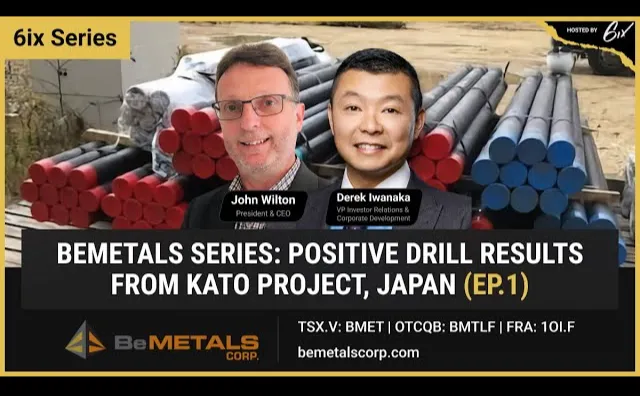
0:08 Hello everyone, welcome to the first episode of B Metals new monthly series hosted by 6. I'm pleased to introduce our speakers for today, John Wilton, President and CEO at B Metals, as well as Derek Iwanaka, Vice President of Investor Relations and Corporate Development. Derek and John are going to walk us through a company presentation and after we're going to be taking questions live in a Q&A session. You can submit your questions using the Q&A tab found on the right hand side of your screen. And further to the right on your screen is the handouts tab. Today's presentation is available for download. As always this event is being recorded and
0:39 is going to be available on six.com in the coming days and because this is the first episode of BMEL's new monthly series with your registration and attendance today you'll automatically be notified of episode 2 when we figure out a date for that but gentlemen I'd like to kick things over you to get started. Great thanks very much Cam, appreciate that and I appreciate people for logging on to to get ready an update from us on where we are at the moment with B-Metals and our exploration projects, specifically today focusing on the results we put out yesterday from the Kato project over here in Japan. So I think without further ado, we'll start to move through our slide decks.
1:27 And just to give you, many of You will be familiar with this slide, but it really gives an overview of where our projects are across the world, including our Pangeni copper project in Zambia, where in fact we have, as of this week, completed another phase of shallow air core drilling, testing for extensions to the mineralization we've already discovered underneath the thin Kalahari sand cover. And actually just yesterday I was having a meeting here in Tokyo with Jogmech, the Japanese state agency, our joint venture partners and co-funding partners on that project.
2:14 And We're encouraged by the results we're starting to see coming out of that Air Corps program and very shortly in the next week or 2 we'll be starting a phase of follow-up core drilling. We also have our South Mountain project in Idaho in the USA which is related to the exploration of a very high grade zinc silver gold copper polymetallic deposit what we geologically call a carbonate replacement deposits. That start of mineralisation is known to deliver significant mineralisation and on that project at this time we're in the middle of completing a grand fixed loop EM survey to further map that high grade mineralisation at depth and along strike and we'll be assessing the results of that survey in the coming months.
3:13 And now obviously to focus on the On the main topic for this webinar today is our Kazan Gold property over here in Japan, where we are currently drilling on the Kato project, 1 of 5 projects that we have over here, highly prospective for gold exploration. The reason for the spread of our projects is that we're really driven by the geology, prospectivity and opportunity that we see in our portfolio and in new opportunities that come our way. We have to go where the correct geology can deliver large-scale, ideally low-cost or high-grade metallic deposits.
4:02 Prospectivity, very important. How easy is it to explore in the terrains that you've selected with that potential and obviously you need the opportunity the business opportunity and ability to close deals to unlock those prospective terrains.
4:26 So we'll be looking now at our Kaz and Gold project, specifically at Kato, where about a year ago we brought in a larger drill rig to be able to deal with the large clay related alteration systems that we see around this epithermal mineralization. We've also for the first time here in Japan, brought in that green unit that you see just behind the drill rig, which is a centrifuge. And we use that to clean the drilling muds as we're drilling these holes. That I think has improved our ability to drill in this area with the insertion of a large diameter casing.
5:16 Environmentally also very useful things to have on site. It means we don't have the need to dig large sumps, as we would have done in the past into the ground. And we can use generally a system of tanks and that mud cleaning unit which I think are going to become sort of a globally required piece of equipment for future exploration drilling. So just zooming in a little bit now to where we are over here in Japan. As I mentioned, we have 5 projects, 3 up on Hokkaido and 2 down on Kyushu. We've been active in the last 6 months really on all our properties.
6:05 And in fact, right now we have a geological team down at Toshiro looking for outcropping information, discussing potential access agreements with landowners on the Tachiro project. That's ahead of a planned drone high-resolution aeromagnetic survey that we hope to complete in the next 6 weeks or so. Also the Hokusatsu license which is about 12 kilometers to the northeast of the Hishikari gold mine. As you'll have heard from us before and from other companies working in this area, Hishikari being commonly referred to as the highest great gold mine in the world, hosted being an epigenetic deposit, hosted in similar rocks to what we're exploring throughout Japan.
7:04 And then up on Hokkaido we have our Kato, Konamai and Todoroki project. You would have seen some results coming out some months ago from channel sampling, surface sampling across cropping mineralised veins that were previously mined at Todoroki. At Konamai we expect to start a soil sampling program in the next few weeks, But the focus has been, or the more advanced focus, has been our drilling operations up at Kato in Hokkaido. So this
7:48 is a plan map of the simplified geology within the Kato project itself. What I'm going to step you through on the next slides, Initially is the section line A to B, and then we'll look at another section line C to D. So these are slices down into the earth, and we're going to look end in to the northwest into those section lines, and walk you through the recent drilling results, specifically from the whole KT22 slash 12. I think what's also important to look at on this base plan is that we do have significant distance, more than 1400 metres to the south-east, you know, high-grade surface sampling results, mainly from the Seto River in gold.
8:48 So the broad essence here, what we're trying to do with our mineralisation that we've now identified in 2 veins, the Seto vein being the lighter pink colour and the Kamitake vein in darker purple. We're looking to extend that mineralisation further to the southeast to get us to a scale potential that development at Kato might become economically attractive. Based on the results we have to date, including yesterday's KTEA-2212 results, we've decided to expand our program, drill more holes in this phase, this first phase of drilling for B metals at the property.
9:36 And we've now extended the set of vein approximately 160 meters on strike. And at the significant widths and grades that we're seeing, that's really
9:48 a positive impact for the project. Also we've identified a new vein zone called Kamitake, which we think has also the potential to expand further to the south east as we continue our step out drilling in the next weeks. So let's look now at a section line, a slice through line, the blue line there, A to B and these are the results we disclosed into the market yesterday which certainly appeared to have got a favourable reaction in the market that we would have expected. Really what we're seeing here is a continuation and continuity of the setter vein which is the red area to the right of the drilling results.
10:43 As we approach the setter vein we see what we're calling the setter stopper zone. So it's a relatively low grade area in the halo of the main quartz epithermal veins themselves.
11:00 And then we intersected some really nice mineralised zones that include 26 metres at over 3 grams per tonne. And within that we have 10 and 5 metre zones running between 4.8 and 5.76 grams per tonne respectively. Also, what's encouraging here is this is following the model that we revised from work with Dr. Salitto on a previous visit here to look at the historical core from the Kato project and what we've identified is that a lot of the historically drilled mineralization both of Kazan and formerly MMAJ, the Japanese State Agency, was probably focused too shallow in the geological sequence at Kato and up in what we call the steam heated zone which is really an overprint on the epithermal mineralization, the main veins themselves.
12:13 But nonetheless that sort of relatively low grade broad intersection does give us an indication of potentially higher grade and more continuous mineralization at depth as we move down the sequence. As I mentioned what was encouraging from the results of KT2212 was that on our way to drilling the setter vein target we also intersected a second vein now named the Kamitake vein which we've intersected in the upper portion of that mineralization
12:57 and we'll look at our future drilling targets to explore the down dip grade continuity and extent on the Kamitakee vein and also step that out along strike. Nonetheless, already we're seeing some interesting grades coming from 4 and 2 metre type width intersections at about 0.84 grams per ton and 0.81 grams per ton and that could also be an indication that the Kamitake vein is sitting at a slightly different elevation compared to the Seto vein. We will need more drilling information to be able to understand the Kamitake vein in parallel with the Seto vein, which is only some 40 metres away on cross-section.
13:55 Again, this slide sort of emphasises the blue lines that were drilled
14:03 in earlier phases of exploration by Kazan on the property, and the difficulties that they had in penetrating through the clay alteration, often associated with the steam heated zone of the epithermal mineralization. So in the next slide, we will now take a step back to the results that we previously issued in KTE 2211. So this slice through the Kato geology is approximately 100 meters further
14:42 to the Northwest. And there you see that the encouraging part is we've also intersected the Seta vein, slightly higher grades than what we've seen in K2-2212. But we're still building up a picture of the distribution of the gold mineralization. So as we bring in more and more intersections we will better understand where the high-grade parts of this system are developed and be able to trace them along plunge of the setter structure. The reason we think that this hole did not intersect the newly identified Kamitake vein is because it probably drilled past the northwestern edge of that newly identified mineralized zone.
15:37 In the bottom right-hand corner there, we're seeing some pictures of the core before it was sampled from the set of vein zone in hole number 11. And geologically, what we see there are the typical textures of quartz and other mineralogical features typically associated as hallmarks of large epithermal gold systems. So really what we're seeing is geologically an encouraging picture of great continuity and extension at Seto to date. And currently we're drilling hole 13 and 14, another 100 metres step out to the southeast of hole number 12.
16:32 So really testing the full
16:36 scale potential along strike. And in subsequent holes, we will also be drilling deeper in the system to see what happens to grade continuity at depth. So this slide really summarizes the results, the highlights if you want to call them that, from the Kato exploration. The drilling In the early 1990s, completed by the then Japanese state agency, these were the sort of intersections that made the team interested in this project. In this project. We've been able, they were followed up by Kazan in the in 2018-2019 where they drilled relatively shallow holes but still significant intersections of relatively low tenor gold mineralization and now we've been able with improved larger scale equipment to drill deeper into the cut-off system.
17:51 And we're starting to see a general increase in the gold grades, but importantly seeing that continuity on the setter vein, which is the wider vein zone that we've intersected to date but also discover other mineralized veins and I think that trend will continue as we step along strike and down dip on the Kato system. There's a picture of me at the drill rig earlier this week where the our field team in Kazan working closely together with the drilling team of Energold are also starting to improve the drilling technique and the design of the holes to speed up the production of drilling at Kato.
18:47 Derek that's sort of a technical overview there. I'll hand over to you to describe some of the recent trends in the general market and where we are with B Metals. Thanks, John. This is a really simple slide that just illustrates the market cap comparison between ourselves, B Metals on the far left side, and then we really only have 2 peers or competitors, I guess you could say, in Japan operating today, both of which have market caps well in excess of $50 million, in Irving's case close to $60 million. So nearly triple the market capitalization of B Metals. And I can't speak for the companies technically, but we've really entered into the country this year, has started drilling, coming out with some good results.
19:43 And as John pointed out today, I'm just looking at the ticker, we're up 30% today and I can only think that that's attributed to yesterday's results. So hopefully we're going to catch up to these folks but I just want to illustrate that we're highly undervalued at the moment compared to our peers. And hopefully as we get more results out, that we'll close that gap. And then just looking at an overview where we are in terms of where our share ownership is, not much change here in the last year but suffice to say that B2 Gold is still one of our largest shareholders at 19%. As John pointed out, we also received a loan from B2 Gold this past month. So that was 5 million US which translates into just close to 7 million dollars Canadian. So that gives us a decent cash position to work with.
20:40 We're sitting at about 9 billion dollars. That should give us a good runway for getting all the drilling done in Japan, Zambia, and hopefully some work done in Idaho as well. Something that we're working on is increasing that institutional ownership, so that yellow piece of the pie. We have a few institutions that are involved, but really I think that if we do come up with more results like this, that number is only going to increase. And look at our traded volume, our average traded volume, it is very small. And of course the markets are tough in general, but on a day like today we're up 30% on trading just under 100,000 shares. Just goes to show you that if you do get some good news, the stock can get a good reaction of it. Of course that can go both ways, but for us, I think there's not a lot of sellers left at these price levels. And so it's a good opportunity to take a look at the stock.
21:42 Thanks Derek. Okay. So I think in summary, many of these points we've gone on before, so we won't labour them. The important thing is we do have the backing, as Derek just mentioned, of an excellent technical and financially very strong partner in B2Gold, who like the results that they're seeing, certainly out of our Cato project. Also very encouraged by the relatively early stage, but the fact that we have discovered copper mineralization at our Pangeni project in Zambia where we know companies like Barrick Gold for example operate and are exploring systems around the Lumwana project and mine in Zambia, part of the same system that we're exploring known as the Zambian Copper Belt.
22:43 And we're currently finishing our grand electromagnetic survey at Idaho, where we're looking to generate targets to be able to expand the size of that very high grade zinc silver mineralization at South Mountain to get it to the critical point of potentially being an advanced and a development project for us. On top of that, we continue to look at extensive deal flow. One of the flip sides of the current general market conditions and conditions in the junior market is that there are potentially opportunities coming up for a company that has the technical acumen and backing of a strong strategic partner as we do with our relationship to B2Gold.
23:46 So I think in summary, we'll leave it with our golden opportunity in Japan slide and pass back to Derek and Cam to wrap us up. Absolutely. Thanks, John. Great presentation, guys. I'd like to remind everyone in the audience that you can ask questions using the Q&A tab found on the right hand side of your screen. We already have a question come in from Paul. Given 3 projects across the globe already, why spread yourself even thinner with additional projects that require more money and attention? Money and attention? Yep, I can answer that one. We're looking for a specific type of new opportunity to bring into B Metals, a really advanced project, something that we could in a short timeline bring into production, establish us in a cash-flowing situation which is obviously good for investors in that we wouldn't have the requirement to return to the markets on such a regular basis to fund our exploration activities.
24:57 Right, okay. Another question, based on your experience of what you've seen to date, What's the potential for growing the Catto project into a significant deposit? And how could it possibly be mined in the future? It looks at this point that the potential to grow the Catto project is really very large. We really like what we're seeing in terms of the geology and I think that will continue to to to manifest itself in encouraging drilling results. Ultimately what we would our first sort of target at Kato would be for a high-grade underground type operation at the property and that would be our first prize there but there may be other potential development projects that area of Japan we've got strong local support from surface rights owners in the area, and certainly from the nearby population centers, a lot of interest and support to potentially bring a project into that area of Japan which would stimulate economy and keep younger generations interested and potentially move to that area of relatively low population density in Japan.
26:22 Okay, great. This question is just to both of you, but why do you think B Metals is so undervalued versus its peers in Japan? I don't mind answering that one. So I mean, I think that we were kind of I guess from a public perspective we were a little bit late to the game. Irving Resources and Japan Gold in particular have been exploring there for some time as was the private company that we acquired last year but that was a private company. They weren't putting out results like those other 2. So those companies I think had a bit of a head start in terms of reaching the market. Japan Gold we know are great marketers and they've certainly traveled around the world. John and I have also traveled around the world doing some marketing and almost everywhere we go it seems their people are familiar with Japan Gold. So They've obviously done a lot of marketing, so they have, I think, reached out to a number of different investors, so that has probably given them a bit of an advantage over us.
27:26 And quite frankly, we've kind of been under the radar. We've only really put out 2 sets of results so far. It looks like we're building confidence and hopefully the market is reflecting that now and so hopefully that really gives us I think a lot of runway to catch up to our peers there. Yeah I agree Derek. I think you know we've got a good technical background here in Japan. In our team, we have people like Tom Garrigan, who's really a world expert in exploring and developing these type of gold systems. And we're really getting to grips with that geology as we get new data coming out from the ongoing drilling. So I think over time, we will really start to put ourselves on the on the map and here locally even in Tokyo we're starting to get interest from a number of different groups reaching out to us about our results coming out of Japan.
28:33 Great, speaking of results, the next question is when do you expect to see the next set of results from your Kato or for that matter other projects? I think we'll certainly start to see more results flowing out of Japan in the next 4 to 6 weeks. We have been able to gradually increase the pace of the drilling. We have we've now cemented a good a good line to get samples out of Japan to accredited laboratory which is working really well with our friends from intertech laboratories in in the Philippines and you know we'll start to see I think continued and increasing news flow out of Japan.
29:23 And I think shortly as well, we'll be putting out information on the commencement of our core drilling follow-up program at our copper exploration in Zambia, in the Zambian copper belt. Awesome, great. Well, gentlemen, that's all the questions we have for today. So I wanna thank you again for coming on as well as everyone who's attended, especially those who've asked questions. Derek, John, I want to pass things back to you just for some closing remarks before we wrap up for the day, though. Great. Thanks very much, Cam. And thanks again for the 6 Platform hosting this event. And we appreciate that opportunity. And as you know, we'll be doing these regular updates for our investors and potential new investors and hope they can see through the fog of the current markets and see this as really a golden opportunity here to realise some value with some very shrewd investing at current levels.
30:30 You