Automated transcript · Written by software from the replay's audio. It can mishear names and figures; the replay is the record.
0:07 It's definitely one of our favorite locations in the world. Central African Copper Belt produces, it's one of the most prolific copper producing areas in the globe. We're really excited to be down here because we have a really terrific property. For those who don't really know the Central African Copper Belt or Zambia in general, a lot of the western side of the belt is covered by what could be fairly significantly deep Kalahari sand cover. It's basically covering all the bedrock geology. If you're walking in, say, the Canadian Shield, you're walking along and you stumble across this crop of gold or copper, boom, you might've found yourself a deposit.
0:59 That doesn't work in this area of the world because it is just basically covered by this, that sand cover, which can be, well, it could be like inches, but it also could be hundreds of meters deep. So when you're dealing with this sand cover, you don't have those kind of serendipitous or easier low-hanging fruit, I guess, so to speak, where you can just stumble across it. You literally have to drill underneath the Kalahari sand and that's how you really discover these things. And So the Western side of the belt has been relatively underexplored. If you look to the Eastern side of the belt, there are some massive deposits. First Quantum has their Sentinel deposit over there that's producing. The Kansanshi mine is producing also on the belt. And so you have these huge deposits.
1:48 If you look kind of the Northern part of the belt, you get to Ivanhoe's Kamokakula deposit, which is huge. So it really has some massive potential. We are really quite fortunate in that the property that we've acquired or optioning has quite thin cover. So we're looking at between some of it could be as almost right to the surface, but it also is probably averaging about 25 metres of thickness, which is pretty favourable to be operating in this area where even just a little bit to the west of us, it could be 100 meters thick. So we have much more favorable conditions to operate in. We're working in an area that is, like I said, is super prolific for copper mining.
2:34 And yeah, we're excited to be drilling here. I mean, it's kind of elephant country for copper.
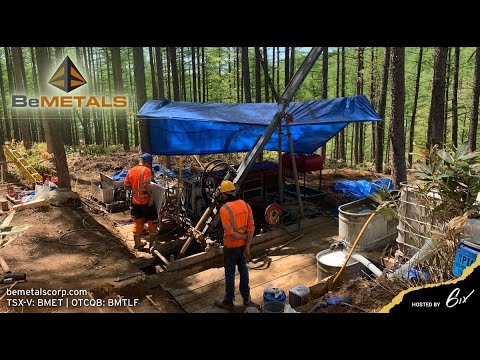
2:45 So In 2018, we optioned the property and we did a full, actually we did 2 air core phases of drilling. Air core is the technique that you use to test the bedrock geology. Typically, if you're again, to look back at the Canadian Shield as an example, you might be walking along the surface and you pick up some rocks to sample back at the laboratory. That is very difficult out in this area. So what you'd have to do to get under that sound cover is you have to use air core drilling. So air core drilling is just a cheaper way of getting underneath the ground and picking up the soil samples. And so we've done 2 phases of that in 2018.
3:34 2019, we did our first actual core drilling program, which came up with some really interesting anomalies. And then 2020, we did another round of core and air core drilling, which interesting enough, we've, we had an anomaly that extended about 850 meters to the North East of the first one. And it's too early to say whether that's going to turn into a deposit, but if you have 850m of strike length and it seems to be open both going to the North East and to the South West, there's really good indications that it could be something. We are going to be doing some ill-filled drilling between that, or those 2 holes, and then step out drilling out to the northeast and to the southwest. So really intriguing results.
4:25 What is probably more intriguing to us is that we're seeing the same kind of minerals, kyanite and chalcopyrite, which is the same minerals that you're going to see at the Sentinel Mine for 1st quantum. So you're seeing the same kind of minerals, which are kind of indicator minerals for us. We're also seeing very similar grades. So we've hit intersections of about 4m of about half a percent or just under half a percent, which is very similar to the grades that you're going to see at Sentinel. So we're really encouraged and we're just planning for the 2021 drill program now. 2021 drill program now. So we basically just collected all the data from the 2020 program.
5:13 You know, with COVID going on, everything has been delayed, but we finally got the results out in April and very encouraging, like I said. The next phase here is to take all that data and take a look at where we exactly need to drill. We're coming up with a program which should be outlined shortly. I think what's going to happen here is we're going to have to drill to the Northeast and infill drill between those 2 holes where we're intersecting about half a meter of about 0.4, 0.5% copper. So really interesting geology and prospectivity here. We also have another target that's seeing kind of the same thing.
6:01 We had about a 600m distance between 2 intersections and so we're going to be following up on both of those holes as well as a couple of new targets that we defined during the 2020 AirCore and Core Drilling Program. What are the biggest cash positions you've had in the past? So yeah, we actually have probably the largest, well, we definitely have the largest cash position that the company's ever had. We're sitting at close to about $11 million in the treasury. So we have a really strong bank account to deploy for exploring these properties. We've always been working on a pretty tight shoestring budget on these projects. And now we have a bit more money that we can expand the programs.
6:49 In addition to that, just in March, actually, we brought on a new joint venture partner for the Pengeni property that the company is called Jogbeck, or Japan Oil, Gas and Metals National Corporation. So that company is going to be funding a good chunk of the exploration program for this year. They're putting in about 1 million and a half dollars US. So that takes up most of the expenditures for this year and going into next year. So we have a pretty significant budget for exploring on Pangani this year. We're looking at probably about 1.5 million US for this year. And we're really looking forward to finally expanding this property to really discover the true potential here.
7:44 So for 2021, we are going to be doing that infill and step out drilling. If we do happen to hit in between, that could be pretty substantial because if you've now defined say 850 or the other Southwest target, a 600 meter strike length, then all of a sudden, this could be something that has actually some scale to it. And as you know, I mean, in the Central African Copper Belt, if you find something, it tends to be quite large. And so we're looking at very pretty significant step outs. You know, if you were, again, taking the analogy of the shield, you might be looking at like a 25 meter or a 50 meter step out. In our cases, you're looking at like more like 250 meters or 500 meters because you want to find something big here.
8:39 You're not looking for a tiny high grade deposit. You're looking for a massive, which, you know, if it's at 0.5, 0.4% Copper, but it's very near surface, that's going to be highly economic. That's the type of targets that we're looking for here. We'll hopefully get the drill program here started by about May. And then based on those results, hard to say exactly, but you know, it'd be nice if we could start putting together a series of holes and then getting a resource together. And, you know, with Jogmech involved, they are going to be paying for their pro rata share of the expenditures. So now we have a little bit better leverage for expanding or accelerating the programs here.
10:37 Sure yeah I mean to put it into context, if you look at, say, the you know, the old gold rush days, either in the Klondike or the in San Francisco, You know, back in the days, you know, those old prospectors might have been walking along with their donkey and tripped over a rock that has some shiny metal in there. And you'd be able to potentially make a, like, find a discovery there. And you just, you know, draw down, stick some ground and start digging away. That just doesn't work in this area. It's all pretty much covered by sand. And that's why the majors are here because they have the deep pockets that they can drill under there or can afford to drill under the sand. For us, because the sand cover is not as extensive, you can really just drill under there much easier, much cheaper than almost anywhere else.
11:32 And it's a really cool area because it's not like you can just find these deposits on the surface, you have to drill. And if you have to drill, obviously much better position to be in if it's thin cover.