Replay available
AvenuesAI (NSE:CCAVENUE) Q2 2027 Earnings Call
AvenuesAI (NSE:CCAVENUE) Q2 2027 earnings call, held 2026-11-06. Watch the replay and read the transcript on 6ix.
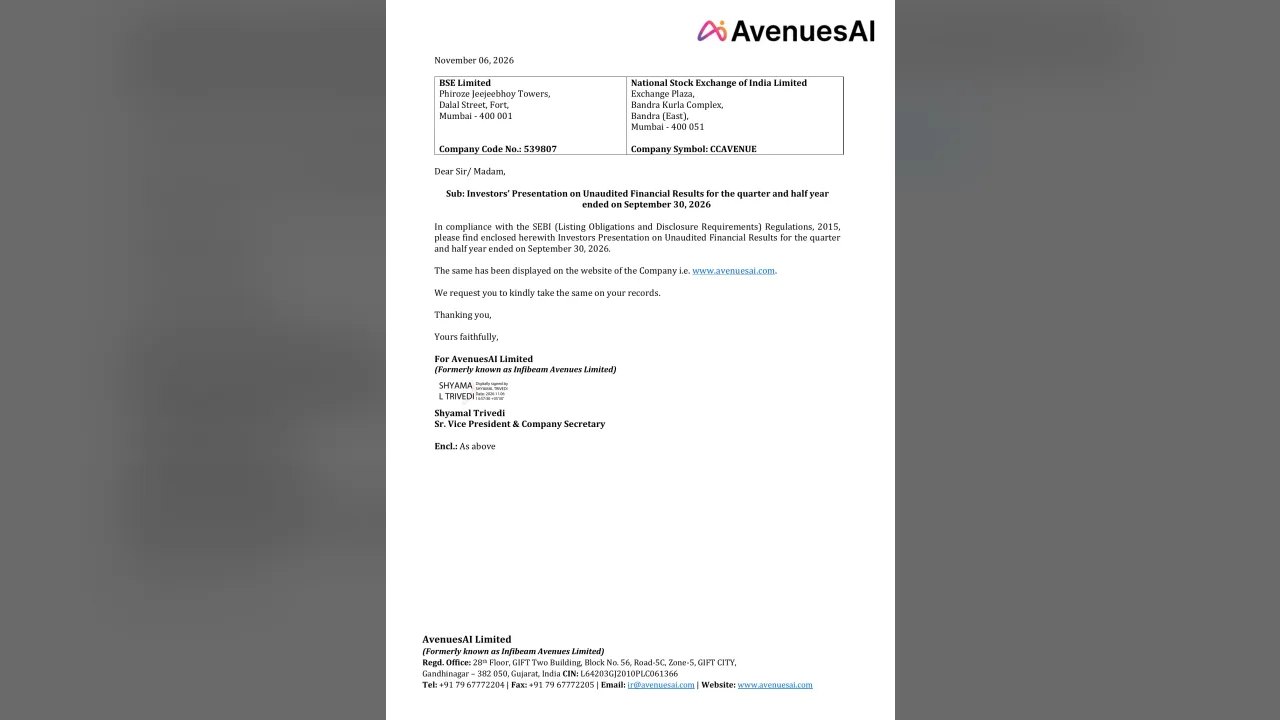
- Company
- AvenuesAI Ltd (NSE:CCAVENUE)
- Period
- Q2 2027 earnings call
- Date
- Fri, Nov 6, 2026, 7:39 AM ET
- Replay
- Watch the replay on this page · 1 h 2 min
On 6ix: 6ix.com/event/avenuesai-limited-ccavenue-q2-2027-earnings-call
Replay
Transcript
Automated transcript · Written by software from the replay's audio. It can mishear names and figures; the replay is the record.
0:00 Ladies and gentlemen, good day, and welcome to AvenuesAI Limited Q2 FY 'twenty seven Earnings Conference Call hosted by Go India Advisors. As a reminder, all participant lines will be in the listen only mode, and there will be an opportunity for you to ask questions after the presentation concludes. By pressing 0 on your touch tone phone. Please note that this conference is being recorded. I now hand the conference over to mister Rajat Gupta from Go India Advisors. Thank you, and over to you, sir. Yeah. Thank you, Huda. Good evening, everyone, and welcome to AvenuesAI Limited earnings call to discuss the q two FY twenty seven results.
0:52 We have on the call with us today mister Vishal Mehta, chairman and managing director Mr. Vishwas Patel, Managing Director and Chief Executive Officer Mr. Sunil Bhagat, Chief Financial Officer and Mr. B. Ravi, who's advising AvenuesAI on corporate and financial strategy as an independent consultant. We must remind you that the discussion on today's call may include certain forward looking statements and must be, therefore, viewed in conjunction with the rest that the company faces. I now request Mr. Vishal Mehta to take us through the company's business outlook and financial highlights, subsequent to which we'll open the floor for Q and A. Thank you, and over to you, sir. Thank you, Rajat, and a very good afternoon to everyone. Happy Danteras. Thank you for joining us in the AvenuesAI second quarter and first half FY 'twenty seven earnings call.
1:42 I'm pleased to share our performance and more importantly, our perspectives on how the next phase of AvenuesAI's growth is expected to unfold. Let me start with a thought. Over the years, we have built infrastructure to process payments. Our next opportunity is to create significantly greater value from the millions of digital interactions that happen on a weekly basis that this infrastructure enables. This is the transformation underway at AvenuesAI. We are evolving from a payments technology company into an AI first fintech infrastructure company, which combines payments, enterprise digital platforms, and transaction intelligence. Our first half results provide a very strong foundation for this journey.
2:29 I will now invite Vishwas Patel, our Managing Director and CEO, to take us through the business performance and key developments, followed by Sunil Bhagat, our CFO, who will present the financial highlights. Vishwas, over to you. Thank you, Vishal. For the first half of FY twenty twenty seven, our consolidated revenue from operations increased 71% year on year to INR 5,560 crores. Our operating EBITDA, excluding other income, increased 19% to INR 199 crores. Our consolidated profit after tax grew 24% to INR156 crores. In the second quarter, revenue grew 47% year on year to INR2879 crores, while profit after tax increased 6% to INR 72 crores.
3:27 These results demonstrate the growing scale of our business and our ability to generate profits while continue to invest in our future. But I want to emphasize something important. Our ambition is not simply to process more transactions. It is to generate greater value from every merchant relationship, every enterprise relationship, and every technology capability that we have built. That is where we see the next phase of opportunity. Let me turn on to our payments business. During the second quarter, our total payments processing volume increased 19% sequentially to INR1.77 lakh crores. This is an important development demonstrating continued growth in transactions throughput across our payment infrastructure.
4:19 Our net take rate during the quarter was 5.06 basis points, reflecting a competitive pricing strategy. We recognize that investors closely monitor take rates and margins. Our approach is deliberate. We are prioritizing transaction scale, merchant relationships and long term competitiveness while continuing to evaluate the economics of the business. An equally important part of our merchant strategy is settlement efficiency. We have been focusing on accelerating settlement cycles so that the merchants can receive their funds faster. This strengthens the merchant experience and can improve their working capital efficiency. Faster settlements can also create timing related working capital requirements for our business.
5:07 We believe that a combination of competitive pricing, reliable infrastructure, and efficient settlements can help us build stronger and more enduring relationships. However, scale alone is not sufficient. The opportunity ahead is to use our established merchant relationships to introduce additional services and improve the value we generate from our infrastructure. Today, we primarily monetize the processing of payments. Tomorrow, we want to build additional revenue opportunities around the enterprise technology, merchant intelligence, digital services, AI enabled financial workflows. We believe the payments business is not the end of the opportunity. It is a foundation on which we can build several additional businesses.
5:54 Let us now discuss Rediff, which is one of our most important strategic priorities. We believe Rediff has the potential to become more much more than a traditional Internet and communications business. Our vision is to develop a connected digital ecosystem, bringing together enterprise communications, commerce, payments, and other technology services. ReliftOne provides an opportunity to deepen our relationship with enterprises to digital communications and commerce solutions, while Rediff Pay is intended to expand our participation in consumer payments and create additional digital engagement opportunities. CCAVENUE in turn provides established payment infrastructure that can support this broader ecosystem.
6:45 The strategic advantage is that there are complementary capabilities. An enterprise using communication services may also require commerce and payment solutions. A merchant using payment infrastructure may also require business software, customer engagement tools, and intelligent services. By bringing these capabilities together, we believe we can create opportunities to serve the customers across a broader range of requirements. This is how we intend to unlock value from Radiff. Our immediate focus is on commercial execution, integration and building sustainable revenue streams. We are not assuming that value creation will happen automatically.
7:32 It will require disciplined execution and measurable progress. But the opportunity is compelling. It will give us a platform to participate in a much broader digital economy than payments alone. Our second strategic growth priority is our international expansion. Over the years, CCAVENUE has developed payment technology and operating capabilities that we believe can support growth beyond the domestic market. We already have an international presence across The UAE, Saudi Arabia and Oman. Our next objective is to develop opportunities to expand our payment infrastructure into additional markets with The United States remaining an important priority.
8:19 International expansion provides the potential to diversify our revenues, deepen relationships with global merchants and develop additional payment processing opportunities. Of course, each market has its own regulatory requirements, competitive dynamics and commercial considerations. We intend to pursue opportunities selectively with a clear focus on disciplined investment, measurable returns. Our ambition is to build CCAVENUE into a more significant international payments infrastructure franchise over time. We have developed the technology and experience in payments. Opportunity now is to extend its capabilities into markets where they can create commercial value.
9:06 Let me now turn to what we have could become what could become one of the most differentiated aspects of AvenuesAI's future. That is artificial intelligence. We believe the convergence of payments infrastructure, enterprise technology and AI creates an important opportunity for our company. Every day digital transact commerce generates information about transaction patterns, merchant activity, and financial behavior. With appropriate permissions, governance and regulatory safeguards, such information can help businesses and finance institutions make better decisions. This is the opportunity we are pursuing through TESSCO, a transaction intelligence initiative.
9:55 Our objective is to develop AI enabled capabilities for applications such as merchant intelligence, risk management, fraud prevention, and financial services workflows. Let me explain why this matters. Additionally, government infrastructure companies generate revenue by enabling transactions. Transaction intelligence introduced the possibility of generating additional value by helping customers understand and act on permitted transaction related information. For example, financing institutions need better tools to assess market activity at risk. Businesses needs better intelligence to understand operations and transaction behavior, and the broader financial ecosystem increasingly requires technology that can improve efficiency and decision making.
10:51 We believe AvenuesAI is well positioned to explore these opportunities because of its existing technology infrastructure and experience serving merchants and financial institutions over the last two decades. Cisco is still being conceptualized, developed and we will approach commercialization responsibly. But our longer term ambition is clear. We want AvenuesAI to evolve from a company that processes transactions into one that also helps businesses and finance institutions make better decisions. That is the opportunity we see in Applied Artificial Intelligence. We recognize that our growth strategy must ultimately translate into substantial earnings and cash generation.
11:40 Our first half operating cash flow was negative INR192 crores. This reflects significant working capital movements, while management attributes primarily to faster settlements with merchants. Accelerating settlements is part of our effort to improve merchant experience, support merchant liquidity and strengthen our competitive position. At the same time, we remain focused on optimizing working capital, maintaining adequate liquidity and improving cash conversion as the business scales. We continue evaluating our investments and initiatives against their commercial potential, capital requirements and expected returns.
12:27 Our objective is not growth at any cost. Our objective is to build a larger, more diversified and sustainably profitable technology business. Looking ahead, we have previously communicated FY twenty twenty seven consolidated revenue guidance of INR 11,000 crores to INR 13,000 crores. We have delivered revenue of INR5560 crores in the first half. Our focus on the remainder of the year is to continue to expand transaction scale, strengthening merchant experience, advancing Redux integration and commercialization, developing disco and pursue selective international opportunities.
13:16 I want to conclude with three thoughts. First, we have scale. CCAVENUE is an established payment infrastructure business with substantial transactions throughput and long standing merchant relationships. Second, we have multiple growth opportunities. Relieve international payments and AI led transaction intelligence provide potential new avenues for revenues and value creation. Third, we have a very clear strategic direction. We are building towards a more integrated fintech infrastructure model where payments, enterprise technology, and intelligence can reinforce among another.
14:04 The opportunity is not simply to grow our existing business. It is to expand the role AvenuesAI plays in the digital and financial ecosystem. We recognize that investors will judge us by execution, profitability, cash generation and the commercial progress of our initiatives. This is exactly where our focus will remain. We believe the infrastructure we have built over the years provide a strong foundation. The next phase is about converting the foundation into a broader commercial opportunities and enduring shareholder value. We are excited about the journey ahead. Thank you for your continued trust and support.
14:51 I will now invite our CFO, Mr. Sunil Bhagat, to take you through the financial performance in greater detail. Thank you. Thank you, Viswasser. Good afternoon, everyone. Let me take you through the key financial highlights for quarter two and half year FY 'twenty seven. For the second quarter, our consolidated revenue from operations stood at 2,879 crore. That is an increase of 47% compared with INR $19.65 crore in the corresponding quarter last year. Our operating EBITDA excluding other income stood at crore compared with INR96.2 crore a year earlier.
15:40 Our consolidated profit after tax for the quarter was 71.70 crore compared with INR 67.6 crore in quarter two FY twenty twenty six. For the first half, revenue from operations increased 71% to INR 5,560 crore. Our operating EBITDA, excluding other income increased 19% to INR 199 crore, while consolidated profit after tax increased 24% to 156 crore. In our payments business, quarter two TPV increased 19% sequentially to INR 1.77 lakh crore with a net take rate of 5.06 basis points.
16:29 Our consolidated balance sheet reported total equity of INR 5,145 crore as of 09/30/2026, while cash and cash equivalents stood at INR 5 and 46.5 crore. Our first half operating cash flow was negative INR 192 crore, reflecting significant working capital movements. Management attributes this primarily to our initiative to accelerate merchant settlements. Faster settlements help merchants access their funds sooner, improve their liquidity and enhance their performance on our platform. While this can result in timing related working capital outflows, we view settlement efficiency as an important competitive differentiator.
17:17 We continue to focus on balancing faster merchant settlements with prudent liquidity management and efficient cash conversion. We remain focused on transaction growth, operating efficiency, disciplined investment and sustainable profitability. With that, we can open the floor for questions. Thank you. Thank you very much. We will now begin the question and answer session. Anyone who wishes to ask a question may press star and one on their touch tone telephone. If you wish to remove yourself from the question queue, you may press star and 2. Participants are requested to use handset while asking a question. Ladies and gentlemen, we will wait for a moment while the question queue assembles.
18:06 The first question is from the line of from My Invest Buddy. Why has the growth reduced like this thing in this quarter? Is it because of the seasonality? So the question is around revenues this quarter. And revenues revenues are are growth. Profit growth, yes. So what we've done is we have prioritized growth as an objective. Growth gives us a lot more data in the world of AI, but we think data is the mode. And so in other words, in the medium and long term, we should try to get transaction and volumes going.
18:55 For that, if you look at our net take rate, that's reduced sequentially quarter over quarter by about 4%. So it's at 5.06 bps. Yes, we wanted to capture volumes for the upcoming festival, plus we have decided that we should continue focusing on scale. So it's a conscious decision and that scale will potentially open up more opportunities to give services to our merchants and customers. Got it. I have two more questions. Yeah. So, like, one is regarding, like, the profit guidance for the entire year. And second is regarding Redis IPO.
19:41 Like, when can we expect, like, it to come to fruit? So if given EPS guidance, you're right. The EPS guidance that we had given was around close to INR 8.75 to 9.5 per share. So if you look at Slide 11 of our presentation, earnings per share, we've given a guidance of INR 8.75 to 9.5. And if you look at our numbers as of now, for the first half of the year, we've reached about INR 4.5 per share. So we think that we are staying by our guidance, our guidance range as far as earnings per share is concerned.
20:34 I mean as far as the Rediff IPO is concerned, it's, of course, a Board decision of Rediff Board. What is out there in the open is that there has been a confidential filing, which has been approved. But we believe that as and when we get to know more information that we'll immediately let shareholders know. Got it. And like just one more question. We is there like any promoter selling which is going to happen in the future or like there is no more of that? No, there's no promoter selling.
21:22 Other words, you know, in AvenuesAI, promoter has been continuously at the same level. So Okay. Understood. Primary, we've invested. Promoters have invested in primary doing the right offer. Got it. Congratulations on a good set of numbers. Thank you. Thank you. The next question is from the line of from FB Capital. Please proceed. Yeah. Hi, everyone. So my first question is regarding to the refund business. So what about the revenues, EBITDA, and cash fund contribution so far? And what are the timelines we're looking forward to monetize it?
22:15 Rediff Fund is part of Rediff ecosystem. If you look at annualized revenues in Rediff on a run rate basis, it's upwards of INR200 crores. It's much more than INR200 crores, but that much I can tell you. And in terms of profitability, Redefill generate about INR 100 crores worth of profit a year. These are the ballpark numbers that I've shared with you. In terms of the synergies to play out, which is what we discussed in terms of how the synergies, we are working on that. So it may take a few quarters to actually start playing out in synergies, but or maybe sooner. But I think, of course, it would be difficult to make any forward looking statements on that.
23:10 But Rediff is profitable Rediff Fund is the largest driver of that profitability. Okay. Got it. And one is regarding the ReadyPay launch UPI system. So is it subject to NPC market cap or TPAP constant? Vishwas is the head of chair board, but what I could tell you is that we got the permission from NPCVENUE. We were in CUG. We got onboarding permissions, spending all the security and compliances as of last month, mid of last month. I think, you know, now, you know, of course, given the festival season, so on and so forth that, you know, UPS transactions are in the upswing.
24:02 So you'll hear more from us in terms of the progress. Okay. So I have two more questions regarding the commerce AI and CCAVENUE SOON. So what are the pricing model and the revenue expectation for the next two financial years, like financial year '27 '28? DC Avenue transaction, mean, of course, there are two things. One is there's a UPI mandate, which is out there, which is still not implemented yet. But if you think about all the other payment types and so on and so forth, we've been very competitive. It varies by customer scale, the kind of business that they're in, so on and so forth. And, you know, payments as a business is a fairly competitive business.
24:49 So the net take rate, if you look into it, will give you some indications in terms of, you know, in order to scale that, you know, what is the impact to, you know, the take rates. But that too is a very conscious decision in the part of the company saying, we want to make it profitable, but eventually, not today, tomorrow, day after tomorrow, data will be the mode. And if you have more transactions, more intelligence in the system, that's when we can actually be able to monetize in the future. So that's one. I think... What's the second question? I'm sorry. So what are the revenue expectations for the next two financial years? Yes. So we've given you revenue projections for this year. We typically end up giving projections for the first quarter in the financial year in terms of guidance. So if you look at Slide 11, you will pretty much have an indication in terms of our FY 'twenty seven guidance that we've given.
25:50 I think we have a lot going on as far as AI is concerned. And so... And I think, you know, the playbook is out there for a lot to digest. But we think that we will continue investing in that opportunity to build up, you know, our own differentiation. And we think, you know, data is the most important differentiator if we had to think about it, given the n number of frontier models and other models which are out there. But in terms of the ecosystem that we breed, we think that that becomes a differentiator. Okay. So I will have this last question. So how are you going to measure the AI driven margin expansion given that the net revenue per TPV is currently falling right now?
26:42 It helps us build the AIs actually got two things. One is it gives us productivity benefits. So that's one. But second is that a lot of that benefits are being passed on to consumers and merchants at the moment. And so what we are doing is we want scale, we want magnitude, it allows us to do a lot more given the the opportunity that we sit on top of. Having said that, I think, you know, I mean, we are also learning a lot in terms of what it means to our ecosystem. So a lot of things like contextual engineering, how do we actually work at the specification level of building software, not just prompting it. Things like, you know, how do we build out, you know, the kind of more than scale that we we think are important.
27:34 There's some experimentations also that we need to do to be able to see how that works. How do we reimagine the ecosystem and many pieces of our framework, which are somewhat more AI first. So while a lot of work is being done in the back end, which is not visible, because in in this world, we need to change a lot compared to, you know, what we were before and how we need to look. So there's significant work going on in the back end, which is not visible. But... Yeah. So a lot of cost is somewhat front loaded in this business. But, you know, in terms of... We look at it in two ways, monetization and survival, both are equally important. And we think that not us, most of the businesses need to think of it this way. So we think that... Well, let's keep on building out a robust framework.
28:26 And then we also see a lot of green shoots in terms of how we could monetize. So the discourse score that we talk about, which is the transaction intelligence score, You know, it's not easy to build such things, so we think the probability is against us to make it successful or it for it to become successful. But if we if we are able to make it successful, the returns are at least a few thousand x. So I think those are the bets... Bold bets that we need to take up. They're calculated bets. They're one worth making because it changes the ecosystem. But like I said, the odds are always against us to take on such probability. And I think with more and more data, the probability increases.
29:14 The probability of success increases. Let me put it this way. And if that probability of success increases, the returns are a factor of magnitude more. So those are some bold bets that we have taken, but they're calculated, and we'll be monitoring and tracking them. Okay. Thank you so much. That's it from my end, and all the best for the future growth. Thank you. Thank you. The next question is from the line of Rahul from Dollar Capital. Please proceed. Hello. Thanks for the opportunity. Wanted to understand how the landscape changes for us in terms of competition given that there is an MDR opportunity on the UPI side.
30:04 So are we shifting any gears in terms of merchant acquisition side? And also on the payment gateway side, how the opportunity is shaping up given the current landscape that you see? Rahul, this was here. So a UPI and the other good monetization strategy that will be helpful to not only other than the ecosystem. Today, almost 38 to 40% now of our transactions that we are processing for free for UPI. Right? Almost three percent of those UPI will be chargeable under the MDR regime. So we're looking forward once and then it gets implemented.
30:49 So it will add good revenue boost to the existing ecosystem. And overall also, UPI continues to grow on the debit mechanism because all the has been kind of like. So it's good monetization that happens probably when we implemented with no no, I mean, this January or earlier, we'll wait for indication from NPI. Overall, business continues to grow because if you see on the offline state today, Brazil Brazil and China, they have their POS infrastructure reached almost 90% of their population, of the merchant population.
31:37 While we in India are still at 30%. Right? So there's a there's a lot of potential going forward in increasing the scale. And as you know, payments payments is like any product or services sold, then payment has to come in in any businesses, in any any line, even a teacher getting payment from the students. That is an opportunity for us to get in. So that scope is vast. It will keep growing, and we are very confident of the landscape when going faster. Sure. Vishwas, if you could attribute some of the innovative product that we launched during this GFF, I think we did a lot of partnerships.
32:23 So how are some of these partnerships taking share... Shape? And which of these could, you know, become a meaningful contributor to our net take rate basis? So everything helps in getting newer merchants as well as deepening the relationship with our existing merchants. So, see, we went live... We we went live with Apple Pay, and we launched it with employee hotels group. Right? So that itself where you know all Indian and international customers can quickly pay for Apple Pay and other increases the other efficiencies, like Indian customers. If Apple Pay is there, which is more easier pay than than UPI. Right? So then people ship that and that...
33:10 And the recently, earnings has always been better on credit cards. Right? So those things will definitely help. There were a lot of launches on Forms AI, which, you know, flows through a few coupons. You can create that as a a Dynaform and Use it to fees on your club or this thing or any alumni need or a pilot's association want to connect. Just a few rules, just creating a form or with the pre integrated CCAVENUE payment gateway is created within seconds now. So that itself opens up a lot of new businesses with a lot of in stream WhatsApp, in stream payments that we launched. The whole indirect side of the... What's the ecosystem.
33:56 So some set of payments and a link within WhatsApp. The entire payment journey is concluded within WhatsApp. That's because of a deep partnership with Meta on the WhatsApp platform where we... CCAVENUE now is available. So that also opens up for a a lot of negotiated sales in the business ecosystem where, you know, transactions which is connected and then sent within a WhatsApp chat. Similarly, we launched with SIP Rocket to faster checkout where we now have access to the name and the building name and address preloaded when a customer comes in and puts their mobile number. So automatically all his delivery addresses and everything is preloaded so that, you know, the transactions are finished off in just two or three clicks.
34:45 So a lot of partnerships helps in boosting existing business, getting new businesses, and newer business models evolve based on the functionality that is available. We launched commerce AI, which is 2.2, which is built on Google's a QA platform. So payments can be done without without even a manual intervention end to end. So that's the... For AI agents to conduct a pleadage. So those platforms are also ready. We also did the tap to own device where, you know, if you're going on an app, say, you are on a CV. So at the end, you always get a credit card, debit card, net banking as a payment option. Why not tap your own card to your own phone and complete the payment? So you don't have to insert any card number or save any card number with anybody else. You just... At the checkout, take out a card and just just tap it at the back of your own phone and the car... And the transaction is complete.
35:44 So tap to own device. Right? Those are world first that's one of the things that we have launched after our we have a a recent... Just during... Before GFF, the global fintech press. So many products we launch, which are quite pathbreaking, and these all solutions have increased business. So that's where the innovation and the scale that I was just talking up earlier. Right? And then when more transactions comes in the art disco engine, the transaction intelligence initiative that we are pertaining with AI capabilities will help with more data to complete more transactions and further. Rahul, just add to what Vishwat said, I think, we look at it as incremental TPV.
36:29 I think we should be able to get to at least INR 50,000 to INR 1 lakh crore of incremental TPV in the next twenty four months by all the partnerships, and that's our internal estimate. And, of course, the upside in the earnings comes because of transaction conversions. All the distribution led growth with what Vishwas described on Shiprocket and all of that and some higher margin incomes that come because of all the forms and reconciliations and integrations and tools. And that's what we'll track and demonstrate going forward. That sounds pretty interesting, both, Ushwas and Vishal. Just last bit, if I may. We also used to have this solution for hospitality where we were doing the reservation system.
37:24 So are some of these consumer partnership and our ability to provide integration with the reservation system? Are some of these things can become a very integrated play for players like us who are into the SaaS application as well as consumer innovation side? So, Rahul, you are right on that. So our revenue solution, RDS, AVR, revenue is working today across more than 3,000 plus orders. So it's just not a payment gateway with some services. This is a full end to end vertical specific hospitality solutions with deep integrations. Like, we are the... One of the only Oracle, Micro, Spidelio, property management system certified where, you know, a reservation comes and it's then further distributed through our channel manager, which is connected to almost one fifty websites including booking.com, Hotels, Expedia, MakeMyTrip, ZipRec.
38:26 So all those ecosystem where our hoteliers to connect the inventories visible across all these ecosystems. And we said that almost within almost 1,200,000 home nights in the last ninety days on through our management system and payments becomes the last integrated part. Right? So when the reservations comes and someone pays to a payment link, I'd say, CCA in the ninth year in India, through the connect on the PMS, it gets automated, updated without any physical manual intervention. This money has come in, someone has to update It's an entire automated system. So hospitality, they're very gung ho because it's a it's a it's a very dynamic address to mark those inventories perishable.
39:16 They have to put the work on the beds, fill up the occupancy, plus the margins are good. Today also, they have a mindset of paying 10%, 15% commissions to agents to get the room bookings. So actually, it is much more open and for our better sales on by giving this value added services. So yes, there's revenue also And to add to what Vishwat said, I think the way we look into this is also in the world of AI, it is a distribution layer. So in the future, we think that there's an AI assistant which will actually access the distribution later... Layer for hotel inventory booking confirmations where CCAVENUE becomes a payment infra.
40:06 So so we think that, you know, I mean, today, maybe we will go directly to a booking or a make my trip or whatever. Tomorrow that... We think that the biggest opportunity is this AI agents booking directly with hotels. And so we think that that is perhaps where it needs to go. And if we are able to build out in some ways for the hotels, what price to charge, what customers to target, how to maximize their occupancy, which channels to prioritize, how to increase their profitability. Those are all the services that you need to layer in, which becomes an opportunity for us, Avenue. So I think it's just more much more than what it is today, which becomes an opportunity for us going forward.
40:55 Great. Great. Thanks for the color. That's it from my side. Thank you. The next question is from the line of Dinesh Kumar from Fees Preventure. Please proceed. Hello. You able to hear me now? Sir, can you please speak loudly? Okay. Yeah. Okay. So I'm... Yeah. This is. He said, sir, I'm sure I am able to... Sir, you're able to hear me. Sir, my... Have a couple of questions here. So firstly, on the 700 crore right issue, major part was deployed on Quantum AGI's sovereign data center. Can you just highlight on what kind of investment it was?
41:44 Status. You can just highlight on the status of the investment. And, also, in line with the same question, electronic AI monetization has also happened. Can you just highlight on the status of this also? Yes. So the issue proceeds and the use is part of our publication. And if you look into this, you're right. What we have done was we have said that about INR294 odd crores were in investments that essentially enable us to build out advanced technology solutions in AI software. We have not deployed that capital yet as much. We have a lot of things changing. In fact, every day there are two or three breakthroughs.
42:33 I mean, the pace at which it's moving is very quick. We ourselves are rather than being a spectator, we are involved in terms of figuring out what to do and how to build up. And we are assessing how we need to think through the deployment of that capital. But if you look into the deployment of that capital as part of rights, we have not deployed that capital as much. And what we need to think about is that going forward, what are some of the things that we spend on, like pretty much the agent frameworks, the Cisco solutions. In current quarter, we'll see a lot of that going forward.
43:18 So we'll keep you updated. Okay. Sure. Thank you, sir. And next one is regarding our international businesses and geopolitical risk. We have recently got licenses from Saudi and RPI also. What kind of margins are we seeing going ahead in this? Because internationally and domestically, what kind of the arbitrage we are seeing both of them? Can you just highlight on that? See, international margins are much better than India. We think that given the macroeconomics that you highlighted, of course, we see that we don't see as much of a dip, but we definitely would have grown more.
44:05 We definitely see a slowdown, but we think that the margins are still very robust there. And primarily because those geographies, have a lot more card solutions, lot more travel, entertainment, certain categories that are very valuable. And for that ecosystem, there are more travelers than incumbents. So I think, of course, there is geopolitical instability and that geopolitical instability will cause those disruptions. But to us, they have been slightly minor compared to the greater ecosystem.
44:52 We think that's when we said that we also need to prioritize growing up in The U. S. Middle East is good for us. The next important geography that we'd like to target is The United States. But we don't see too much of an impact yet. Okay, sir. So the next one is in line with embedded credit analysis and the future outlook, open OPM and organization, What is the actual loan origination volume process for CCAVENUE and plus online PSB loans and during the quarter 02/5527? What is the net margin on the transaction?
45:38 And did AI recognize AI revenues AI recognized on these credit lines in rupees and percentage? See, OPL and Ratnaf in our investments, we don't record any of those transactions and values as part of our P and L and balance sheet. These days investments, we do have an aspiration to open up our merchant ecosystem to such companies where we are strategically invested in. And that becomes an opportunity for us to monetize. The disco score that we are working towards conceptualizing and developing will also be valuable where such investments add tremendous value in terms of the build out.
46:28 So the loan origination does not start with CCAVENUE. We do have EMIs and others that are offered to consumers, but we don't segment them and provide that detail. Yes, sir. Sir, on this line, regarding the same question, how much have we earned in this quarter regarding our investments in investment in the organization, right? And how much margin also have been extracted? And what kind of cash flows have we seen from these kind of transactions? No, we don't see cash flows from such transactions. We have made investments. So these are investments that have been made. Cash flows will come when we actually open up our ecosystem in the medium to long term. Currently, these are strategic investments. They said in our books as investments, both online PSB loans as well as these are long term investments.
47:22 They are not short term investments. So these are strategic investments that we have made in OPL is, of course, the backbone for many of the PSU banks that utilize the framework for loan origination processing. Similarly, NBFCs like are the ones where they provide such loans to merchants, and they have to deal with the work with us within our own ecosystem as well as for us to build out such intelligence scoring frameworks. So these are long term strategic investments. They don't contribute to cash flow into the company. Sir. Then for FY 'twenty seven guidance, does the quarter two profit before tax compression alter your full year 'twenty seven consolidated tax expectations, which we had given?
48:17 And do you maintain yes, sir. We've given EPS guidance. If you look at Slide 11, we've given EPS guidance. 8.75 to INR 9.5. Think if you look at the first half, we're at almost INR 4.5 a share. So we don't want to alter the guidance. We'll be we're staying with the guidance that we've given. Can I have one more question on the same line? Are are they... Are the stabilizing, sir? Do we see, mister, one is quite falling? Are we seeing it to stabilize or floor or something that's not providing a guidance? Or can you highlight on this?
49:02 What kind of status do we have on our debt margin? Yes. I mean, the take rates have, of course, sequentially been slightly under pressure. So you will look at the take rates have sequentially reduced by 4% quarter over quarter. And that reflects in the margins. I think with this scale, we are there, there will be some things that help us increase the margins like take rate on UPI and others that potentially come up. But we are forward investing. We think that there are a few things that will help us in terms of improvement. And second is the kind of services we put on top of our existing transactions and our ecosystem will help us in terms of margin expansion. So I think there's you're right, there's going be some compression, and then they'll we'll work on those expansion opportunities because at scale, when you work on those and if it works, then they become large by themselves.
50:06 There is one probably a last one, the second last question. If MDR comes into the picture, what kind of impact are we seeing in the remaining period of this FY 'twenty seven? Vishwas will tell more, but one thing we know is that up to 40 basis points was the earlier conversation. So whatever comes in, and then it's again a competitive world, which means that there are many providers and depending upon who wants to sub and to what. So there is no ceiling or a floor by the regulator. What that means is that there's going to be, of course, but we think that whatever it is will always be a positive.
50:53 And so it will help increase the margins. Did no much Well, change and the implementing plus is yet to be done. We'll do it when we have to change. But the actual revenue operation once the MD is in effect, we will come... Most probably we'd like to know by next quarter how much has that incrementally increased the volume revenue on our on our system. Sir, is there any expansion and new revenues are we looking forward to which we are expecting it to come in the near term? I think we've already out what we are aiming for in my speech earlier.
51:46 We clearly said that we are looking at more increase of business here for multiple avenues that we already have in place. Additional services and other things that we are looking at as an expansion. UAE is delivering very well. Saudi is growing. Oman also the top four or five banks are using our entire systems looking at The United in the next quarter. So that also is a very interesting market. And looking because of our excellent technology and features, I think it's a very good market to tap. Of course, the world's biggest economy and market. So even a small good push can really scale things here.
52:38 So is there any news or any margin expansion in the data center expense setups? We're appropriately conservative. So we'd, of course, invest in certain processing that you would you would expect if we wanted to actually scale up our AI opportunities. But, you know, we are tracking what is going on in the ecosystem. And we we we are probably conservative given that there's a lot of changes happening on a daily basis, forget the weekly basis. We need to actually get a tunnel vision and then don't make those specific calls. But you can expect that to happen in the next I mean, the current quarter and the next quarter.
53:28 And last question. Regarding the IPO, can you just because we are not clear on the time lines of the IPO. So is there any expectation in the near term or the... Because they already filed the draft during prospectus. So long back long back last... Last... Okay. Long back, we have filed the latest IPO prospectus. So what kind of timelines are we looking at for the IPO launch and what valuations are we seeing on the? See, yes, whatever is there in the public is what we can discuss. We had filed a confidential DRHB.
54:16 And subsequent to that, there were observations that were provided. Final time line of the IPO and filing would be a Board decision of Rediff based on the markets and the market timings and the valuations will be determined by the bankers as and when that would happen. But that's all I can share. What we can tell you is that as soon as we have more information that we'll be able to share that with the shareholders. Okay. So what kind of you're not able to Sir sir, one last question I have. So what... In this quarter... Or you can take this for a year also. What are the good points? So what were the expectations which we have met, which we had earlier?
55:03 And what are the expectations we were not able to meet? So it is just highlight on the status of our expectations from the financial year and the quarter as well? Sure. I think we had given indications on the beginning of the quarter in terms of how the quarter would look like. So I think if you look at Slide 11 again, we then point back to that. I think we are tracking that. Strong So payment growth volume, positivity in profits. We fell a little short on the net revenue growth, take rate. The operating earnings momentum, I think that's where those are the if you ask us the not met, but the met was strong payment volume and positive profitability.
56:00 That's the way we see it. If you look at TPVs up, we grew our volumes quite a bit. And despite all the competitive pricing and pressures, were able to manage profitability. So those are the things where take rate of course is compressed. So I think that demonstrates that we have lower yields and by lower pricing is deliberate, the economic benefits we'll have to demonstrate going forward. Earnings growth were modest. They're in line with expectations, but there's always this market more. So that's the way we see it.
56:46 Okay, sir. Okay. Okay. That's all from my side, sir, and congratulations on the results as well. Thank you. Thank you. Thank you. The next question is from the line of James from ARC Consulting. Please proceed. Yeah. Are you able to hear me? Yes, sir. Okay. So the first question will be that I observed two years, there was no dividend payment. Is there any plan to pay dividend to the investor? And the second question would be regarding the Rediff IPO when it comes to a part of the business from AvenuesAI will be transferred to Rediff. So how it is going to affect the AvenuesAI shareholders?
57:31 Because the top three decisions were not being helpful to the retailers, be it reverse merger or rigmar for the rights issue? So that's my concern. Yes. So I'll answer the second question on Rediff. Rediff is, anyways, the business that was transferred last year in FY 'twenty six. So currently, AvenuesAI owns about 82 odd percentage in DDEF and it gets consolidated as part of our P and L and balance sheet. So that transaction is true, which means that whatever quarterly numbers that you're looking at is all consolidated and that thing has been completed.
58:19 So there's no impact additional impact that you see as a result of this business transfer between AvenuesAI and Rediff. Regarding Rediff as a company, we think it's a strong brand. It resonates a lot with users. And there's a lot more, you know, potential to actually build out that brand going forward. And so I encourage you to try out some of the real estate applications. If you go to the Google Store or Apple Store and you're able to download the application, you'd be able to experience it. Regarding your first point on dividends, I mean, we understand that shareholders look forward to that and we appreciate that expectation also.
59:06 But the Stage Board believes that retained earnings and reinvesting in our growth will create greater longer term value for shareholders, at least in the last two years, that's the thought process that we had. And with CCAVEN expanding payment volumes, redefining the next phase of growth, our own investments in AI international markets, we see opportunities to deploy capital productively. So the objective is not just to grow the business, we want to translate that into earnings and returns. So obviously, the Board will continue reviewing the priorities on dividend policy as the business evolves. And the key is to balance that growth investments with distributions. I hope that answers your question.
59:53 Okay. Thank you. All the best to the team for the hard work they are putting in. Thank you. Thank you. The next question is from the line of from My InvestBuddy. Please go ahead. Hi. So, like, in Bavion, like we had like a CAD 29,300,000 like profit from sale of investment. So can you give more color on this? On '24 Yes, that was nothing else, but the we had explained that there was an entity that was created with the BAVENUE owned an entity, and there was an entity created in Abu Dhabi, which then also in consolidation, it cancels itself out.
1:00:44 So it was restructuring where you created an entity in Abu Dhabi, which owned the asset that owns CCAVENUE. So if you look at the consolidated results, it cancels each other out. It doesn't reflect in the consolidation. Got it, sir. Thank you. Thank you. Ladies and gentlemen, due to time constraints, that was the last question for today. I now hand the conference over to the management for closing comments. Thank you all for joining our second quarter earnings call, and happy and having... And happy Diwali to all you and your families, and we look forward to keeping in touch. Thank you very much. On behalf of Go India advisers, that concludes this conference. Thank you for joining us, and you may now disconnect your lines. Thank you.
Follow AvenuesAI Ltd into a list and get an email when it puts out news.
Latest news releases
- NSE:CCAVENUE — Press Release Jan 30 2026 · Fri, Jan 30, 2026
- NSE:CCAVENUE — Press Release Dec 29 2025 · Mon, Dec 29, 2025