Transcript
Automated transcript · Written by software from the replay's audio. It can mishear names and figures; the replay is the record.
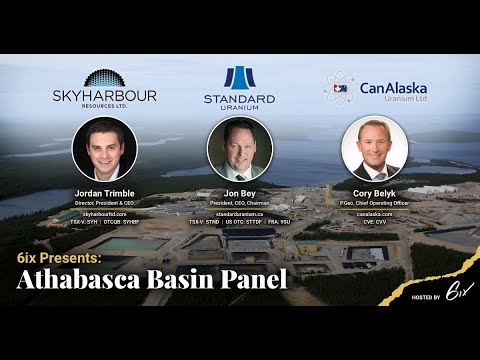
0:12 All right, well, hello everyone and welcome to the Athabasca Basin panel hosted by 6. We are joined today with the leaders of 3 mining companies with projects based around the Athabasca Basin. Please introduce our panelists today. We have President and CEO of Standard Uranium, John Bay, Corey Bielik, CEO of CanAlaska, and Jordan Trimbles, President and CEO of Sky Harbor Resources. In this panel, we will be discussing the importance of the geology in the region and the opportunities that these 3 mining companies are presented with. As a reminder, you can submit your own questions on the Q&A panel on the right-hand side of the screen at any point during the presentation and we'll open the floor up to live Q&A after the panel discussion.
1:00 And as always, the session is being recorded and will be available on six.com afterwards.
1:05 So welcome, everybody. To kick things off, John, if you can just please introduce yourself and your company. Sure. Thank you, Dasha. And Thank you for inviting us today and the 6 for hosting this event. It's quite an honor to be on the stage here with Jordan and Corey, 2 guys that I also admire and share the honor of working in the Athabasca Basin with. So first of all, as you mentioned, I am John Bay, CEO of Standard Uranium. We are a junior exploration company focused in the Athabasca Basin. We have 5 projects, our flagship being the Davidson River project in the southwest corner. We are searching for high-grade basement-hosted Uranium. And right now we're in the middle of our drill program at our Davidson River program. That's phase 2, and we should be wrapping that up in the near future so watch for news coming up in the immediate future.
1:52 Thank you. All right thank you. Welcome John. Corey?
1:58 Thank you Dasha and thank you to 6 Capital for the invitation and the opportunity to talk with John and Jordan. Always a pleasure. I haven't seen them face to face very often this year, so it's good to be on screen. Myself, I'm a geologist by trade. I've been in the Uranium business in the Basin primarily for the last 30 years, but also on the international stage with Cameco. And more recently joined CanAlaska to help move their really prospective portfolio forward in the Eastern Athabasca Basin. We're proud of ourselves for CanAlaska on being a project generator. We believe we have the expertise. We've got everything, all the tools necessary to generate new projects, advance those projects through to discovery.
2:43 We got stopped in 2011 around Fukushima, of course, and we're just getting back to it now with the increase in attention in the market. Our portfolio is a vast array of projects in the Uranium space spanning from basement targets through to MacArthur River type targets, all mostly in the East. We've also got Nickel and Copper assets. If you think about it, energy production, energy storage and energy transfer are important for the green future and we believe we've got the portfolio that fits that. A few years ago we coined the phrase Saudi Arabia of Uranium. That's the Athabasca Basin. These deposits here are 10 to 100 times the size of anywhere else on the planet. So we're in the right space and we believe we're on the right target.
3:28 Most importantly, our West MacArthur project is 13km from the MacArthur River mine and there we're drilling 8% Uranium at the Unconformity in the classic target. So we're really excited about the future and excited to be here today. So thank you.
3:42 Great. Thank you. And Jordan? Great. Well, thanks everyone for tuning in and good to see you guys as well. As Gauri, as you said, it's been a little while, so great to connect again. Sky Harbor Resources, as the other 2 companies are, is focused in the Athabasca Basin, high-grade uranium in the Athabasca Basin. We've accumulated 6 projects over the last 8 years. At Attractive Valuations, we have a variety of projects scattered throughout the Athabasca Basin at various stages of exploration. The 2 main projects, Moore Lake, our flagship project, and South Falcon Point, both host deposits and high-grade uranium mineralization. We're actively exploring our Moor Lake project. In fact, we just announced last week that we're getting back to work there with a drill program and some geophysics. So just starting our next wave of news flow from that project.
4:33 But unique to Sky Harbor, we have a dual-pronged strategy. So we are focused on high-grade discovery and exploration of our flagship Moore project. But we also act as a prospect generator. We have over 500,000 acres of ground. 3 partner companies, including Arano, which is an industry leader based in France, France's largest nuclear fuel cycle company and uranium mining company. And more recently, we just signed a deal with an ASX listed company, Ballard Resources at our North Falcon Point project. So 3 partner companies that are actively exploring our other projects and focus on our flagship More Lake project on the east side of the Athabasca Basin.
5:09 Great, thank you. So for those of you who don't know, can you just each of you describe the Athabasca Basin and what makes it an ideal or unique location for Uranium mining? Well, I think Corey touched on it already by saying that it's the Saudi Arabia of the Uranium space. What we're finding in Canada, in the Athabasca Basin specifically, is high-grade Uranium, higher than anywhere else in the world by huge multiples. What we're looking for there is a project that we're going to find that's going to be economical to build into mines. Athabasca Basin has got projects all over the basin. Originally, they were all thought to be on the eastern side. In the past 10-years, we're finding projects in the southwest corner where our flagship project is. I believe we're still scratching the surface of what is going to be found in this region over many years to come. I'll pass that on to these more senior gentlemen who've been there for much longer.
6:00 Corey, anything to add?
6:02 Yes, the Athamaska Basin, Saskatchewan itself is number 3 in the Fraser Institute, I believe, for mining investment. It is the place to be. More importantly, the infrastructure around the production of Uranium from the Athabasca Basin is already well established. You've got a number of mills, you've got road access, you've got support from the political side, the community side for the most part. It's really a friendly place to explore for any metal, let alone Uranium. And the Athabasca Basin itself, it's unique in the sense of geologically, it stands out. It's 10 to 100 times the grade of anywhere else in the world in terms of average.
6:50 It's got all the right elements that allow for these large deposits to occur. And that just doesn't occur anywhere around the world in the same fashion. So It truly is the place to be. Saudi Arabia, if you want to think of it that way, this is a very Uranium-rich district with a long history of production, safe production, and it's a great place to invest. It's fantastic.
7:15 I feel like you've covered it, but Jordan, anything to add? Yeah, I think we've covered all the talking points there. I mean, look, geologically, it's very unique, right? I'm not a geocorer, Cory is, and he can attest to this, but you've had a very unique set of geological factors and events that have happened to create the environment for the deposition of these kinds of deposits. One of the other things I can add on top of great geology, high grade, and a great socio-political place to work is the fact that the exploration and now the development and mining of these deposits has come a long way in the last 20-years. Corey, back in the Cameco days, looking for these deposits, finding MacArthur River and Cigar, the discovery process has changed drastically. And, you know, John talks about these basement hosted targets.
8:08 That's what we're looking for at our flagship project as well. A lot of the historical exploration was carried out looking for sandstone around conformity hosted deposits and had the recent discoveries made by NextGen and Fission and various others in the basin that are now in these underlying basement rocks. We now have a lot more tools at our disposal to actually go in and find these proverbial needles in a haystack. And you've seen that with a number of notable successes, discovery successes in the last 10 to 15 years. Despite a really tough Uranium market generally over the last 10 years, you've had major wealth creation through these discovery stories. So it's pretty remarkable. I don't think there's any other commodity or metal out there or any other jurisdiction where despite a really difficult
8:57 price environment and commodity price environment, you've seen the kind of returns generated by these exploration companies. So that's what's exciting for our companies. And I'll note there's not many companies that are active. We're starting to see that pick up a little bit, but investors really can only look at a few companies. And so I think there's been a consolidation of good projects and teams within these companies. So, you know, bottom line is the basin's really the only place you want to be looking for uranium right now until you have 70 or $80 uranium. You know, you want to stay focused on making new discoveries in the basin. Great. Thank you. Yeah. So I thought I actually want to take a deeper dive into each of your respective companies. What would you say your company's strong points are?
9:45 John? Sure. I'll start off again. Thanks, Dasha. So our strong point, once again, I'll point to our flagship project, that's where we're doing most of our work right now, our Davidson River. So when you think about the Athabasca Basin as this wonderful place to find Uranium, we think more about, you know, it's great, but we're also in the southwest corner where Davidson River project is. Now the southwest corner is where Fission and NextGen both made their huge discoveries in the past 10 years. So we were in that same neighborhood, but we're not just an area play. Both those discoveries were made on the Patterson Lake Conductor, which runs Northeast to Southwest and then turns at the Clearwater Domain and goes opposite up to the Northwest. And that's where our Davidson River project lies. So we believe we have that same conductor going right through our project, which is great. Now On top of that, besides having exciting projects to look at, you want to have people who actually know what they're looking for. If you look at how we built Standard Uranium, we built it around people who've made discovery success in this region. When I started this company, I added Neil McCallum as our VP of Exploration. He's worked in this region for 15 plus years for multiple juniors. And then we added Garrett Ainsworth. Garrett Ainsworth is a noted geologist who made the radioactive Boulder discovery, which led to Fission's RRR project. He worked with them for a bit before moving over and being the VP of exploration with NextGen, where he helped progress the aero deposit for many years as the VP of Exploration. The day he left NextGen, he joined us. Now on top of Garrett, we've added Galen McNamara, who was working with Garrett at NextGen, who was one of our advisory team. And then last summer we added Sean Hilliker. Now Sean has spent the last
11:17 5-years doing his master's degree on the Arrow deposit. So if there's anybody that knows that rock and what we're looking for, it's Sean. So as we're looking at the drill core coming in on our exploration program right now, to have Sean and Gerard and Neil and Gail, what we're seeing and why that's important and how that left line is up for our next drill program. It's remarkable. We've got the project, we've got the people, we're in the right region and we believe we're at the start of a great Uranium bull market. It's a fantastic time for investors to look at what we're doing and come along for the ride.
11:48 Absolutely. Thank you. Corey, what about with CanAlaska? It's similar to John. It starts with people and ideas and surrounding yourself with people that know what they're looking for. And then it leads into projects and then there's corporate structure. So if you think of people for Canalaska, the CEO, Peter Dazzler, has built and run mines before overseas. Very, very good business type approach to everything that he does. Then you've got Dr. Carl Schieman, who at the time of Scar's discovery was leading that team. He led that team toward discovery of one of the tier 1 assets in the basin back in the 1980s and led their exploration for a number of years past that. Now he's obviously project generating for us and coming up with ideas and searching for all sorts of new opportunities for CanAlaskan shareholders.
12:47 And then recently, just in the last number of weeks here, we've brought on a senior geologist, Nancy Normore, who has a long history in the basement as well, most recently with UX and discovery at their Christie Lake project near MacArthur. She knows what she's looking for and she's bringing that strength to our team now as we lead into this Uranium bull market. And then hopefully myself with my both global experience overseas looking at all the different types of models for Uranium around the planet for Cameco at the time, and then also working as chief geologist at the Eagle Point mine for about 5-years. So I understand that basement model intimately, not just in a 2D sense of the drill core, but the 3D sense of the deposit itself really intimately.
13:36 We like to think that we have the right elements in place to make a discovery anywhere in the basement for the classic unconforming model.
13:44 Our project array really reflects that. I have a map behind me on this side. I just want to show you how close our best project is to MacArthur over on the right-hand side. So That is 12km from the world's richest, highest grade Uranium deposit. And that's where we've been drilling 8% Uranium at the Unconformity, right close to that infrastructure. The Eastern Athabasca has a need for feed. Cigar lake has maybe 7-years of mine life left. You've got some MacArthur River when it restarts, maybe 15-years of mine life left. There isn't much else out there that will feed those mills. So there's opportunity, real strategic opportunity around this infrastructure in the east, which our portfolio follows of projects,
14:34 providing that real strategic opportunity for Canal Askin and shareholders. And we do have a wealth of projects ranging from basement models, which have become increasingly important with the discovery of Arrow or even historically with Eagle Point, but also down to around and close to MacArthur River where you get that classic unconforming model type. So we believe we've got the team in place. We believe we've got the array of projects to cover all scenarios of that style of deposit in the Athabasca Basin. And also, our company is well-structured. We have 78M shares outstanding and we've got a little over 7M in the bank today. So we're well-financed, we're well-structured and there's lots of opportunity for investors to do very well with discovery. Great, thank you. And thank you for bringing the maps. Very helpful. Geologist.
15:23 Exactly. Off to you, Jordan, with Sky Harbour Resources. Yeah, I think just, you know, a couple of highlight points there. I'd say, first and foremost, as Corey highlighted, an array of projects, a diversity of projects. We have a dominant land package. One of the things, as I pointed out earlier, is we do have this dual-prong strategy. So our focus right now is at our 100% owned Moor Lake project. And I'll note we've had drill intercepts returning 21% U308 over 1.5m, 6% over 6m. More recently with some of the exploratory drilling we've been doing into the basement rocks. We intersected our longest continuous zone of uranium mineralization, 17.5m of 0.72% within that 10m of 1%. So we are intersecting high-grade uranium mineralization, making new discoveries at our flagship project. But We also have multiple irons in the fire with other companies.
16:20 We have a partnership with Orano over on the west side at our Preston project, as in Cord Energy. They just completed a drill program. They have future plans for further drilling this summer. So results pending from that. And then just more recently with the ASX listed Valor resources, we signed a deal. It's a $4M deal, cash and exploration expenditures and we own about 8% of the company. It's about $1.8M worth of stock. They've just announced that they're going to be carrying out a multi-phase exploration program, including a drill program later this year. You'll have several programs, drill programs,
16:57 underway over the coming next 6 to 12 months. Lots of news flow, lots of potential for discovery and as I mentioned, high-grade mineralization at our flagship project. I'd say that that's one thing for Sky Harbor. Another thing, as the other 2 gentlemen highlighted, is the people. I'd like to point out that we have a good mix of technical and geological experience with Rick Kaczmarski, my head geologist in Saskatoon. Rick was the exploration manager at Cameco. He then left, built and sold his own company, Uranium company called JNR, which he sold to Denison. Denison is one of our largest shareholders. They're a strategic partner of ours. David Cates, who's the President and CEO of Denison and UPC is on our board. We have a very close working relationship with Denison Mines as a much larger strategic partner.
17:47 Rick sold his company to Denison and that's when Rick and I started Sky Harbor about 8-8.5-years ago. Dave Biggard, who's worked with Rick for many decades, and Christine McKechnie, our head field geologist
18:00 overseeing all the work programs. They've made lots of discoveries in the basin. They know how to find these deposits, very focused expertise, geological expertise, uranium exploration in the basin. But we also have good capital markets and management experience as well. I've run the company for 8, 8.5 years. As I mentioned, I was a corporate development manager for a gold company called Bayfield, which we sold to New Gold back in 2013 and 2014. And then more recently, we brought in a gentleman named Joe Gallucci, who's the head of mining investment banking at Laurentian Bank. And so Joe's brought some more capital markets experience to the board and management team as well. So a good mix and a focused expertise in the Athabasca Basin.
18:45 Great, Thank you so much, Jordan. So I wanted to go a little bit deeper into uranium itself. Why should potential investors be interested in uranium mining? And what does the future hold for uranium? Sure. Let me jump in again, Dasha. So I think what's really important for everyone to, I think all our investors and everyone watching is understanding that there's a real push now for clean energy and nuclear energy, and it's all being considered part of the new ESG. We're starting to see environmental groups get on board and really understand that the benefits far away some of the negative things that are out there. The World Health Organization is talking about moving towards clean energy away from the energy by 2050 and China following along in 2060. Now for that to happen, there has to be a massive switch in clean energy and how it's produced. Currently we've got nuclear, we've got wind and solar and hydro, but reality, you know, wind and solar are 5% of that energy mix globally. Nuclear is 10%.
19:42 We look at comparing how nuclear stands up against wind and solar. And in my opinion, it's not even close. Wind and solar are great when it's sunny
19:51 and when it's windy, but they produce a small amount of energy. And we don't have the energy storage capabilities yet to store that energy. When that changes, we'll see wind and solar playing a bigger part. But thinking about how we're going to not only create the pump of the energy to meet the current demands of what we're seeing globally, but where we're going to be in 20, 30, 40 years from now, the amount of energy that's going to be needed is going to be phenomenal. And nuclear, it fits that perfectly. We can create a huge amount of energy with a small amount of nuclear. And there is lots of uranium around the world to be found, but we have to build mines. And that's going to be a much higher spot where they send along contracts for that to happen. And that leads into your future questions, but I won't go down that path yet. So I'll pass it over to Cory and Jordan to finish off here.
20:37 Thank you, John. Just to build on that, the whole nuclear space, energy production for nuclear is steady. Really important through COVID. It's been steady. It's provided that baseload energy for cooling, for heating, no matter where you are on the planet for the last 12-months during what is a global crisis in many ways. That's continued to be steady. On top of that, you've continued with nuclear builds, So it's growing. New technologies like SMRs or small modular reactors are becoming more and more talked about as options. Think of things as not being new, but actually being 40 to 50-year-old technology. This is what has been powering
21:19 these aircraft carriers or submarines in the US and Naples for decades. They don't have to refuel them except every 25 years. So this is the type of technology that's becoming available that will open up new spaces for perhaps population densities are lower, all these sorts of considerations. And again, it's low emission to 0 emission energy production. And if we're truly going to electrify the planet over the next 20, 30 years, which is where this is going, you have to be able to produce energy that is renewable. Solar, wind are a portion of that. Nuclear need to be an increasing portion of that. I believe that's going to start to drive the positive sentiment. We're going to move into that world fairly quickly. You've seen pictures from around the world in these big cities, the before and afters, the pandemic, when they just shut down the driving, the air cleared.
22:16 So imagine what we can do if we get away from fossil fuels and nuclear is a big part of that. And again, electrification, you have to generate the electricity, you have to move it, Copper, you have to store it, Nickel. And that's where Canalasco's portfolio becomes very strong, because we have all 3 of those quantities as part of this green mix. We're really focused on the nuclear side, on the Uranium discovery side, but we've also got additives during the down market, in particular the Nickel space in Manitoba.
22:44 It's a bright future for Uranium and a bright future for Green Metals in particular. Great. Thank you so much. Jordan? Yes. There's not a lot to add there, but I'll just note by some estimates, nuclear saved over 3M lives that would have been lost prematurely to deadly air pollution from energy alternatives. I think what you saw in the last, in particular, call it 6 months, 5, 6 months, is you finally saw, as guys like us have been talking about for what seems like an eternity, the rest of the world or at least a part of the rest of the world waking up to a simple reality that if we want to
23:24 go carbon neutral or getting anywhere close to that with our electricity grids, nuclear is the only option, full stop. And so, you know, it's the only base load emissions for your low emission source electricity that's reliable, it's safe, affordable, we have no choice, right?
23:46 And then you saw, you know, with the election last year, and it seemed seemingly at the same time, a number of countries like China and the US and other big economic powerhouses announcing their objectives or goals of going carbon neutral. It just seemed like the sentiment turned, did a complete 180 and people finally woke up to this simple fact, or at least some people I think it's still, there's still a lot more interest that can be generated in nuclear. And, you know, as Corey pointed out as well, some of these advanced nuclear technologies are really starting to get traction. We've seen with the SMRs, we've seen the rollout and the development of SMRs in several Western countries and some notable business leaders like Bill Gates and others that have been avid proponents of these new advanced nuclear technologies and SMRs.
24:41 I think that that's where the growth is going to be in the Western world. But if you look at the build out of reactors globally right now, You have places like
24:49 China and India and other parts of the developing world that are leading the charge and the demand side is going to continue to grow. The supply side for Uranium is what's been the big question mark and there's been a major supply side response over the last 4-5 years that's been exacerbated by the pandemic. We're seeing very similar to what we saw in the mid-2000s. We're setting up for a major bull market in this commodity. And as we all know, with this metal, when there is a bull market, there really isn't anything else like it. It's pretty incredible. So, yeah, it's an exciting time to be in the space.
25:32 Great. Thank you. Jordan, I'm going to actually throw it back to you for this and mix up the order a little bit. But how do you see the price of Uranium changing in the coming year? And what are some major factors you foresee affecting its rise or fall? Yeah, so I mean, I'm a bull, so I see it rising. We'll start with that. I mean, look, it's 30 dollars a pound. It's still well below the average all in global cost of production. It's well below the price needed to incentivize any real new meaningful production to come online. We're going to need a lot more arrows discovered over the coming 20 years to meet the growing demand.
26:13 If you look at it historically, over the last call it 20 years, the early 2000s, we had a low uranium price. We then had the big uranium bull market in the mid 2000s where we saw the price jump up to 135, $140 a pound. Even in the financial crisis in 2009, it only got down to about $40 a pound before moving back up to 70. And then we all know what happened in 2011 in Fukushima and the price steadily declined until about late 2016, when in inflation adjusted terms, it was trading near its all time lows at just under $18 a pound. So we've seen that trend reverse. We've seen obviously a move higher. It's been volatile. There's been fits and starts. But, you know, at $30 a pound, It's just it's it's simply not going to work. And if you look at the long term forecast price for most analysts that cover the space, you know, they're estimating 50 to 70 dollars a pound. Usually what happens and I think this is an important point is usually it overshoots and undershoots drastically.
27:16 So I could very much see in the next run up. I don't know if we get back to where we were in 2006-2007, but I could see
27:24 the equilibrium price at $60 a pound. I could easily see it overshooting that by a significant margin. There are lots of fundamental reasons for that. You get these long drawn out bear markets, underinvestment, lack of supply. Like look at the supply, primary mine supplies decreased from 165 million pounds. We got down to less than 120 million pounds last year and that's in the backdrop
27:47 of 180 to 190 million pounds of demand. And so we're having to chew through a lot of inventories. And again, we were in this position right now. There's a big structural primary mine supply deficit. There isn't a lot of near-term supply, new supply that can come online. Even with the restarts of some of these operations that have shut down from COVID, you still have a pretty significant supply deficit. So again, I just see this, I see the price continuing to move higher, but I see it accelerating in the next few years. A new contract cycle. We're seeing more recently developers and producers buying physical Uranium and I can see it overshooting what would be a fair price for the commodity ultimately. Great. Thank you. Corey, do you have anything to add or what are your thoughts?
28:37 Well, it's a pretty good summary, Jordan. I think our perspective is that the Uranium price is gonna increase just by how much. And if you look at the charts today of Uranium and of the chart, stepping back 14, 15 years ago, they look pretty identical. We're approaching that real big spike potential And all the catalysts are coming into play around the market, supply, demand, changes in technology. You're also seeing depletion of the assets that were front and foremost 15-years ago, like Cigar and MacArthur, now coming into play. Imagine a world where the Eastern Athabasca, one of the premier districts on the planet to produce Uranium and supply Uranium, now doesn't have mill feed 15-years from now, from any of the mills, the 3 mills sitting there.
29:29 So I think that's starting to wake up out there and
29:32 people are realising that there is a shortage and that investment is going to flow in. So for me, long-term contracting is the key. The spot price will move, but the long-term contracting, they really have to be up around US$50 a pound, plus or minus, to incentivize MacArthur and Sagar to continue to produce Uranium profitably. And that will automatically reset that spot price, probably north of that long-term price. So you're probably talking about US$60. Now, it'll probably settle out somewhere in that range, at least initially. The big spike is probably going to be short-lived if it occurs again, but the next tier of deposit around the planet sits in that sort of 65 range as tier 2 outside of the Athabasca and say Kazakhstan, and then you've got a tier 3 up around 100. So, for us in the Athabasca, it's a great opportunity if it just sits at 60, 65, it kind of holds some of the global, let's call it global geological environments for Uranium down a little bit, which is great from an exploration perspective for those that are active in the basin. And again, electrification of the
30:35 planet, you simply can't do it off of wind and solar. There has to be base fluid energy. And the best thing we have at our fingertips as a society is nuclear. We can control the waste. That's the key. Thank you. John?
30:51 Yes. I too am very bullish on the spot price and the long-term pricing for Uranium. We see US$30 as the bottom, where it is right now, as Jordan and Corey both mentioned. For those long-term contracts to come in, they need to see those long-term contracts being signed into fifties. And that's for the tier 1 projects, as has been mentioned. The tier 2 ones need to be somewhere above $65, $70. So I see that happening over the next 2 to 3 years. And even, I'm pretty sure there's contract negotiations going on right now. So watch for those long-term contracts that start being announced in maybe Q2, Q3, as one of our guests has already asked that question. One thing that hasn't been mentioned yet is, in the past, these utilities have been going to the spot market to buy some of the Uranium. And now what we're seeing is that spot market being cleaned up. We've seen 3 Uranium companies step up in the past few weeks to make cash raises to go and buy spots.
31:45 David Cates from Dennison was the first guy to jump in and then UBC came in right the next day. And now I heard that BOE
31:52 last night. So we are starting to see that. We have the next trigger. So watch for that to have an impact on when utilities want to go to the spot market and buy is not going to be there. And not to mention Cameco has to go into the spot market and buy their Uranium which they've already, you know, they've got contracts to sell out and they're not producing so they have to go to the spot market to buy that. So those are all going to be triggers which are going to force long-term contracts and the spot price up in the near future. And when will that be? Well, out of us, it's the Uranium market. So we don't know when that's going to happen, but we know it has to happen. All right, great. Yeah. So just the last question here before we open the floor to and get to our attendee questions, but what is the big takeaway you want to leave with investors coming out of this discussion? So I'll continue the order with Jordan.
32:39 Yeah, look, I mean, I'll start with, you know, Sky Harbor specific points, you know, As we highlighted, we have a variety of projects, big land package, advanced stage exploration projects where we're drilling, actively drilling into high-grade mineralization, continuing to make discoveries. We have pounds in the ground, so we aren't just earlier stage projects. We have partner companies that are funding exploration at some of these other projects and 2 strategic partners in Denison and Orano. A lot of upcoming catalysts and news flow over the next 6 to 12 months. One of the great things with the prospect generator business too, is working with these other partner companies, you get to leverage their geological expertise and knowledge and it really does help in the discovery process.
33:30 We're very pleased to work with the 3 existing partners that we're looking to add to that as well. And, you know, as as more of a macro standpoint, we're you know, I think we're really in the first few innings here of the next Uranium bull market. And, you know, one of the things that is exciting about this space is there, as I mentioned earlier, there aren't many companies. It's not a crowded sector. I think the combined market capitalization, even with the recent move in equity prices, is still less than 20, 25 billion dollars. So that's not a lot. When you have a couple of generalist funds that come into the sector and want to deploy capital. That's going to move all of these companies very, very quickly. There aren't a whole bunch of ETFs. You really can't buy physical. Yes, there's been in recent weeks, there's been developers that have and physical holding companies that have raised hundreds of millions to buy physical uranium, which I think is great. But the average investor doesn't have the ability to go in and buy a bar of uranium like they would with gold or silver. So every dollar that comes into the sector is real direct upward buying pressure for the mining companies typically speaking. And so that sets the stage for a rapid move higher. And so all of the companies in the sector, but especially the ones that have been around for a while that have battled through a real tough market, taking advantage of a depressed uranium price, built a great asset base, great team, they're
35:01 gonna benefit enormously from that. You will see, I think at some point in the next few years, the 50 or 60 active Uranium companies that will double or triple. There are over 500 back in 2006 and 2007. I don't know if we'll get there again, but the ones that were the original companies that took advantage were contrarian mentality, they will be the ones that benefit the most. All right, thank you. Corey? Well, well said Jordan, to close out contrarian. So, you know, it's been a tough 10 years for Kishima, for Canalaska and all of us in this game, but the tides are turning. The signposts are there and the companies that are going to reap the benefits are the ones that have the right array of projects in their portfolio.
35:49 The ones that give multiple opportunities for discovery of these tier 1 assets like an Arrow, like an Eagle Point, like a Cigar MacArthur, it's not just restricted to 1, it's restricted to the spectrum or array of those deposit types within the Athabasca Basin in particular, because those are, every time you discover an Athabasca tier 1 deposit, it sort of resets that bar globally. It displaces these other things that are out there. So That's where we're trying to achieve with CanAlaska and our portfolio. We think we've got the right portfolio of projects. We've got a bunch of news flow coming on projects that are testing for basement type deposits like Arrow, right through to MacArthur River, our West MacArthur project, where you're talking 600Mlbs deposits. Those come with scale. We've got scale. The alteration system, I believe, is very important in leading us to something that can be very exciting. And we've already drilled 8% Uranium there in the last couple of years. We're looking to follow that up with some new exploration space on our work in the last 6-months.
36:50 Right now, we're drilling at Waterbury project, which is kilometres from Cigar Lake. Same model, same target. We should be wrapping that program up in a couple of weeks. We'll have news flow out of that. We've also got, coming up in the summer, we're going to get back to our West MacArthur project. We're ready to go. We're going to follow up that mineralization, just 10km or 12km from MacArthur River. So we've got a lot happening and that's just Uranium space. We're also trying to put into play our Nickel assets in Manitoba. We did a deal with Fiordland last year. Fiordland is 30% owned by Mr. Robert Freeland, one of the best mining financiers and builders in the world, discoverers in the world. So he's backed that project really through Fjordland and we're really excited about getting on the ground there and drilling what are Thompson type size targets, multiple targets that look like the Thompson Nickel belt deposits. So these are tier 1 Nickel assets.
37:48 We've got partners that know what they're looking for and understand it, coupled with our Uranium assets, the expertise that we bring to the table and the portfolio projects that we believe we can make that discovery in the next cycle here, which provides a lot of value for our shareholders. The value really is contained in discovery. We think we've got the project portfolio in place and the right structure to the company. We've only got 78M shares out there. It moves quick when it moves and discovery will no doubt have importance to us and our shareholders. We're excited for the near term here. We're excited for the opportunity that lies in front of us in another Uranium cycle that looks to be coming. And we're really excited about it. And we want everyone to come along for the ride with us and work to that discovery. Absolutely. Thank you. All right. And John with Standard Uranium.
38:38 Thanks Dasha. So I think the first 2 gentlemen did a great job of summarizing their projects and globally where we're headed. We're all very bullish on where the Uranium space is going. And I think we're still in the early stages, innings 1 or 2, as you use a baseball reference. We talk about where we think Standard Uranium is going, and that will be making money for our shareholders through discovery. We've talked about our flagship project in the Davidson River, the southwest corner, but we also have our Sun Dog project in the North by Uranium City. And we have 3 projects over in the Eastern Basin side, which we haven't put any drills into yet. So that's coming in 2022. Outside of having those drill targets ready to go, it's important to realize that, as Jordan mentioned, there were 500 companies here back in the last cycle. Right now, there's only 30 or so in this region, and we anticipate there's going to be a lot of companies turning themselves into Uranium companies and trying to jump into this space. So, as Jordan mentioned, be aware of who those companies are. Have they ever set foot in Saskatchewan? Do they know what they're looking for? Align yourself with proper teams who've done it. They've made discoveries.
39:37 They understand this region and they've got relationships, relationships with the First Nations groups. I caution investors to look at what's going to be happening in this region in the near future. There are things going on behind the scenes that you need to be very aware of. So, look for companies that have strong relationships with their First Nations partners. They're getting their permits on time. They're moving things forward. They're getting advanced and they're doing drill programs. That is going to be key going forward. Now, one thing I haven't mentioned is our capital structure, as Corey mentioned, is very important. We've got 93M shares out as well, which is quite tight. A lot of that's held by insiders and strategic investors. Some of the top Uranium funds globally who have invested with us right from the start when we started this company back in 2018 and 2019. And we continue to drive this company forward with modest and sensible capital raises and managing our drill programs and being set to go. We're closing off our drill program with the flagship Davidson River, but we'll be back this summer.
40:31 And I'm not going to jump ahead and spoil the news release coming out next week, but we're going to be going hard in Saskatchewan, further drilling and really following up on those projects, which we believe are going to be a world class down the road. So thank you, Dasha, for hosting this today. Yeah, of course. Thank you. And so now I think it's actually a great time to jump into the Q&A from the audience, because there's quite a lot of questions here. So if we can just jump right in. Terry's first question is, can you comment on the recent shift in relationships with First Nation groups, with uranium companies in the Athabasca Basin, and will it impact your objectives in the future? It's for whoever wants to take it, so. I can jump in there if you want, Corey. I'm happy to jump in. So first of all, there are multiple First Nations groups in the region right now. Our flagship is in the southwest corner and that is working, we work closely with the Clearwater River Dene Nation. So we have a strong relationship we've developed over the last several years with Chief Clark.
41:32 If you watch any of our social media channels, you'll see an interview that Chief Clark and I did talking about how much we support each other. And we stay at Big Bear Camp and supply work opportunities for people of the Walash area, the camp, working with our drill programs. And we both see this being a success for both companies to move forward. Now, up in the Northern region near Uranium City, we've got our Sun Dog project and we've just started negotiations with the Yap and Iny. We have already been fully permitted up there, but we haven't started doing it yet. We want to make sure that the center is full and that we've got great negotiations and great opportunities to work together in that region. And I think that's happening all across the basin now. So it's very important. It's crucial to have not only the government's permission to go ahead and do your work, but also to have consent from First Nations. And we've seen some things can go sideways if you're not on top of that.
42:24 Great, thank you. Anything to add? Yeah, I agree. Sorry, I agree 100% with John. It's part of the present, it's part of the future, and it's really about respect and opportunities and finding where it works for both the companies and local stakeholders. And that is a great thing. One of the strengths that CanAlaska has is one of our board members is from the Fawn Black area, Mr. Victor Fern. And he provides a lot of assistance to us and insights and discussion around how we can do better and what the sort of the tune to the environment in terms of how to go about our work and our activity, and ultimately making that discovery that hopefully brings benefits to everyone.
43:12 It's a big part of the present and the future and you need to pay attention to it. And I think it was touched on before, look for companies that are doing this, look for companies that are having a track record of successfully executing in this region and working with stakeholders to achieve the goals for everybody. It's an important piece of the business and it must be paid attention to. I'll just add a quick note to that. Mining has a long history in Saskatchewan and in particular in northern Saskatchewan. It's important that all stakeholders for any project are involved. That's going to be of most importance and significance going forward and the duty to consult and I think going forward, there's going to be more attention paid to this, there should be. And so I think it's important that, you know, the companies that are in there right now and in particular, you know, new companies that are going to be coming into the basin pay a lot of attention to this.
44:21 And again, when you're exploring, advancing, developing and mining these projects, there's a lot that goes into it. There's a lot of people involved and you have to take everyone into consideration when you're carrying out, whether it's a small exploration program or whether it's a larger development or mining operation, you need to be aware of everything that's going on there. Right. Absolutely. Our next question is for Corey. Bruce is asking, Corey, with your varied asset base, can you elaborate on your prime goals for CanAlaska over the next few years? Well the first goal is to make money for our shareholders. That's what we're doing. Discovery does that. Our focus, our love, our passion from both technical and the business equation, the belief in the model for the future is nuclear. It is Uranium.
45:18 But during the low period for the last 10 years, when nobody wanted to talk about Uranium post Fukushima, how do you build value for your shareholders on an ongoing basis? Well, we looked at opportunities in neighbouring province Manitoba And that's Nickel. And if you think about it, Nickel is required for batteries. It's the sulphide Nickel. It's not the dirty Nickel from other places around the world, but the clean Nickel. And one of the most underexplored Tier 1 Nickel belts on the planet is in Manitoba, the Thompson Nickel belt. And it has not seen current exploration for a number of decades. And the opportunity came up to stake land there and provide opportunity, hopefully for shareholders through discovery of a Nickel asset. So we're a Uranium company, but we have a Nickel add-on, if you want to think of it that way, that provides additional opportunity in an ever increasingly important space in the clean energy world, that being batteries and EVs, the EV revolution.
46:19 This Nickel has to come from someplace and there needs to be new Nickel discoveries. And the Thompson Belt provides that opportunity for CanAlaska and the shareholders. So Uranium focused Nickel as a nice tack on. Right. There's actually a follow-up question about Nickel, so I might as well just ask it now. But what grade and size do we need in Nickel to be profitable in the Athabasca Basin? Well, to be clear, the Nickel assets aren't in the Athabasca. These are in the neighboring province of Manitoba. It's in my backyard, being from Saskatoon. It's a similar jurisdiction as Saskatchewan. We understand it. But what we're looking for, or trying to look for, at Thompson Belt is another Thompson type deposit at one of our projects with Fiordland. The Thompson deposit itself is 150Mt of 2% Nickel.
47:08 It's tier 1 in the world. We have the right targets in our portfolio that we're working with on Fiordland that it looks similar. There's other aspects of the belt that are geologically unique and interesting that provide a slightly different twist in that you could have high-grade Nickel deposits in a smaller target that can still make money. So it really comes down to deposit style, economics of the day. And we believe Nickel has a bright future and we're positioning ourselves in that space, build value for our shareholders to make them money if we can. It's a tack on to our Uranium assets, which are our core focus. Right. Well, thank you so much. Bruce has a 3 part question here. So bear with me. When does the supply and demand imbalance for global uranium needs become critical?
47:57 And do you expect some type of buying panic, especially now that the public companies are raising cash and buying physical in the spot market directly in front of the utility needs? And lastly, why are the utilities dragging their feet to lock up supply? I can take a stab at that initially and there's a lot to unpack there. I think we're getting very close to that critical point. If you look at the inventories in the US and Europe, US nuclear utility inventories are well below 2 years, well below what they usually are. Same with Europe. The numbers are a little less clear in other parts of the world, but suffice to say, given that we've gone through almost half a decade now of drawdowns and in particular with certain utilities that do report, You can see they are near lows and there have been ways for them to acquire Uranium over the last several years, the carry trade and other ways of getting material. But a lot of these other avenues and channels are getting less and less attractive and becoming less available.
49:05 And so I think with the recent buying that you've seen, a part of that and the rationale for it is to force the hand of utilities, right? To further clean up the market. We've seen the market tighten up with no question and we've seen other parts of the fuel cycle tighten up and I think you know no different than what we have seen in the past. Typically when the utilities come back in a new contract, long-term contracting cycle or procurement cycle, they typically come in a herd mentality. This is one of the reasons you can see a price spike. I think we're setting up for a similar situation. One of the other things that people need to remember is that the operating cost or the overall cost of a reactor, the fuel cost is relatively insignificant.
49:58 So when push comes to shove, utilities and the purchasing managers aren't always that price sensitive. And so you get this price inelasticity where you can see the price shoot up very quickly because all the utilities and the purchasing managers really need is secure long-term supply and they will be willing to pay up for it. I think that that tipping point is coming. I think it could even be this year. And I think the recent moves by producers and some developers and physical holding companies are going to help facilitate that. All right, thank you so much, Jordan. Does anyone have anything to add? I'll just add one final thing here. I mean, recently we've heard Tim Gibson from Cameco say that these long-term contracts, when they come into play, Cameco is not going to be signing them for anything less than something that starts with a 5. So that is important to know. And when you come from the utility side, it's not just a simple discussion, they have them aboard in 1 day and sign a contract. These are long-term discussions that go on in negotiations before these contracts are signed. And the other thing that Mike Alca, Stajan Koval, always brings up is, these utilities are not incentivized to be the first guy to sign the contract.
51:08 They're not getting bonuses for signing the first contract at a good price, but they might get fired if they sign too early and all their peers get better prices. So, For them to wait and then come in and join the party and sign when the contracts are already happening, that's fine for them. Watch for that. When it starts happening, it's going to all start happening. That is why we see these big jumps in price. Just to build a little bit on that, the utilities generally hold multi-years of fuel in inventory and it might be up to about 7-years of supply for the reactor. That's been drawn down over the last decade or so to 1, 1.5 years. So they're getting into that critical stage where they need to secure some fuel. And you know, the reactors, you don't just turn them on and off, you know, like a gas plant where you just shut it down, go get some gas, turn it back on.
52:02 You need to have that forward look in your inventory that you have stability of supply and probably forward selling into these long-term contracts. Correct? So, you know, that's for me, again, that's the key. Start seeing the long-term contracting come because when that does, everything's going to shift with it. And these utilities, if they go back to their sort of pre-Fukushima levels, you're talking about 1 billion pounds of Uranium that has to go back into the system. That's 4 cigar lakes. That's 3 Arrows. That's the scale we're talking about that has to replenish the system. And that just doesn't happen overnight. When it shifts, it's going to shift hard. I think my panellists would agree. It's going to turn hard. We'll see how sustainable it is, but it's probably going to have some legs.
52:55 That's another great reason why shareholders today who have understood and figured out the Uranium space are getting positioned early. They're going to be the ones that are going to benefit the greatest. Pick out your variety of companies you want to invest with to make your investments now instead of coming to the party after that jump has already started. Great advice. So we have lots of questions here and I'm calling some time, but we have a question for you, John. When do you anticipate needing your next capital raise? Good question. So right now we've got $3M in the bank, fully funded for this year and through our summer program. Should we choose to expand how much drilling we're doing, we'll go back to the market when the timing is right. We don't need to do it right now, but when we feel the timing is right and the share price is appropriate and we want to expand what we're doing, then we'll go back for our next raise.
53:45 Great. Thank you. Barry is asking, what is the current status of the world surplus supply of Uranium? Great, great question. Yeah, I mean, it's look, it's it's It's hard to get definitive numbers on it, right? You know, it really almost depends where you look, but we do know this much that, you know, there's been major drawdowns for the last several years. And, you know, as Corey was pointing out, most utilities and governments mandate that there is some bare minimum amount that they hold in inventories and stockpiles. And what's important to look at, too, is mobile inventories, what's available for sale. We know that that has decreased significantly.
54:33 And really, that's what's going to be, I think, the price driver, right? There can be lots of inventory out there. But if it's not available for sale, it doesn't matter. It's not coming into the market. So we do know that mobile inventories have decreased significantly and are quite low right now. Great, thank you. Yeah, there's lots of questions here and I'm sorry I can't get to all of them today. I just wanna finish off with a forward looking, What are your catalysts that you are working towards in the coming year, briefly, for each of your respective companies? And then we'll close out. Sure. I'll jump in first and I'll let the other 2 guys finish off for the day. We are discovery-driven, so our catalysts are continuing to drive forward with drill programs and make a high-grade basement host discovery. We're focused right now on our flags of Davidson River. We're going to be moving up to our Sun Dog in 2022 and also to our Eastern Basin projects in 2022 and 2023.
55:28 So watch for us continuing to drill and make discoveries in the future. Thank you. We're currently drilling at our Waterbury project, just a few kilometres from the Cigar Lake mine. It's got all kinds of potential. Look for news out of that in the coming weeks as we wrap that program up. For the summer, we're really looking at advancing the West MacArthur project. We've got a refinance for a drill program there. We drilled 8% Uranium. We've opened up 3km of exploration space to the southwest through our work late last year in terms of revisiting the core and thinking about the geology in a slightly different way. So we're really excited about that opportunity because I always equate these things when you get a high-grade intersection, it's the tiger by the tail. You've got to go find the body and you need space to do that. And I believe we've probably got the tiger by the tail and I'm really excited about the space that we've created with our work last summer. And also our Nickel projects in Manitoba in the summer. We want to try and get those going. We could have a drill or 2 on the ground there based out of Thompson.
56:35 And more importantly, we're always looking at project generates. We're picking up tidbits of ground, whether it's Uranium or Nickel space, adding to our portfolio. And it's not to dilute what we're trying to do, but it's to really pick out the cherries, the best geological environments for a basement or unconformity type deposit to occur. We believe we've got the ground to have a successful near term, and we're certainly financed for it. And we should have lots of news flow coming out of our core assets in the coming months. We're excited about 2021. I like that expression, tiger who grabbed the tiger by the tail. First and foremost, our flagship project, as we just mentioned, we are starting back up there. I just announced that last week. We have plans for about a 3,000m drill program coming up, some geophysical work we're doing right now. And again, I'll highlight that we are hitting high-grade mineralization at this project. We are expanding and advancing a deposit there. We're working towards a resource estimate later this year. I really do think we've just scratched the surface with the basement potential, as I mentioned, 10m at 1% in our most recent drill program. I think there's a lot more we can find at higher grade and larger deposits in the basement rock, so keep an eye out for that. And then our partner companies, as in court, we have, they have results pending from this program that they just finished.
57:58 They have plans for a summer program. So news flow from that project will benefit us as a minority interest holder in the project and large shareholder. And then our more recent partner, Valor Resources, just starting some work at our North Falcon Point project. There's a 68% U-8 surface showing that they're going to be doing work on, they're going to be ultimately drilling it later this year. So again, we'll benefit from news flow there. And keep an eye out as well for additional option and joint venture partners. We're looking to bring in other partner companies. As Corey mentioned, we continue, much like CanAlaska, to acquire ground, build a portfolio. We see a new wave of companies coming in and we want to be one of the land barons, if you will, but also offer that upside exposure to a 100% owned discovery and exploration success at our flagship MOAR project.
58:51 All right, great. Well, thank you so much, John, Corey and Jordan, for your great insight and discussion today. And thank you, everyone who joined us and submitted questions. If I didn't get a chance to get If you didn't get a chance to get your questions answered, we'll be sending out a brief survey and you'll be able to leave your contact details and we can put you in touch with any of these companies to get those answers. So thank you again for joining us and have a great rest of your day. Thank you. Thank you.