Kurt Muffelman
CFO
Replay available
Archtis (ASX:AR9) Q4 2026 earnings call, held 2026-07-31. Watch the replay and read the transcript on 6ix.
On 6ix: 6ix.com/event/archtis-limited-ar9-q4-2026-earnings-call
Automated transcript · Written by software from the replay's audio. It can mishear names and figures; the replay is the record.
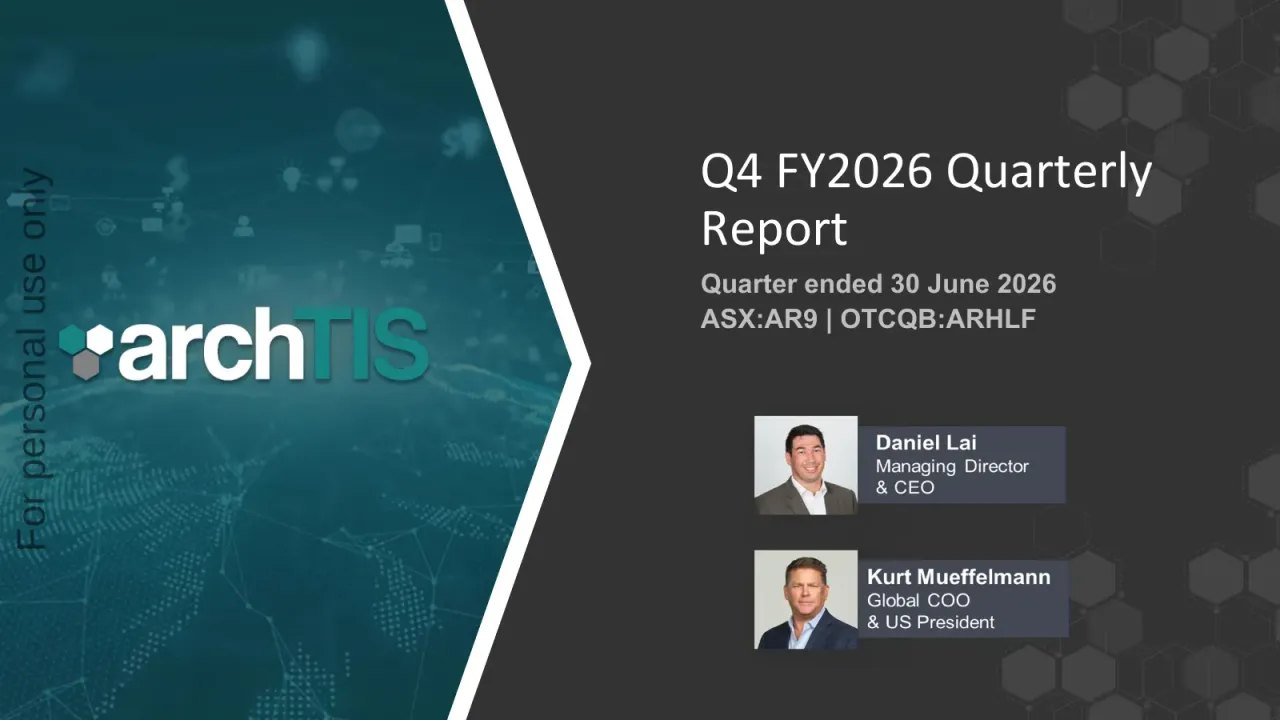
0:01 Good morning everybody and thank you for joining us. I'm Curt Moffelman and I'm joined by our CEO Daniel Lai. Today we'll be reviewing ARCA's fourth quarter FY twenty twenty six results. We really have two themes defined for this period. The Spearon acquisition has continued to fundamentally transform not only the shape but the scale of our business and the defense momentum that's continuing to build on both sides of The Pacific with the US Department of Defense and the Australian Department of Defense each taking significant steps forward with our technology and as we move forward the way that we can scale and continue to drive shareholder value moving the business forward. So let's push it over to Dan for some opening comments.
0:39 Dan? Thanks very much, Kurt, and welcome everybody to the fourth quarter report for 2026. Before we begin, I I wanna address a couple of questions directly from shareholders, particularly around these four areas. On the share price, we know it hasn't reflected the business' progress, and it's just as frustrating for the board, the executive, and as well as institutional and retail base of shareholders. The small cap liquidity and uncertainty around the timing of the USDOD outcome have weighed heavily on the company and the expectations in the market. But the catalyst for changing that are clear.
1:25 Obviously, we need to convert the DOD negotiations into a single dependent award. The other component of that is making sure that we guide the company towards a sustained cash neutrality and, obviously, ultimately to breakeven. Those two components, we believe, are the catalyst for that change. And we are very confident with the DoD awards that we are going to get there. So I wanted to address that first and foremost. Business, as you have said in the opening remarks there, Kurt, has been transformed and we are a very different business to where we were twelve months ago. And I think people need to I think we need to explain that a little bit better to the shareholder market and what that opportunities now are in front of us.
2:15 On our growth, our biggest opportunities run on government procurement timelines, not ours. That is the nature of government and defense, particularly when you're dealing with a defense organization that's preoccupied globally around the world. However, we are moving closer and closer to the outcome that we are seeking, and we are no longer dependent upon just a single award. We now have with the CN acquisition 225 customers, and twelve months ago, we had 60. That upsell revenue opportunity and cross sell and partner channels that that we're engaging throughout our twelve months of hard work this year are gonna pay those dividends that we are seeking. Yes. There's been some churn in the student base, which was expected, but that's also indicative of a competitive growing market that is now seeing not only the customers turning to data centric security solutions, zero trust, as well as the defense industry.
3:18 But it's been acknowledged by the cyber vendors themselves, and that's what's created this competition. So we we are seeing that upsurge of that market driving towards us. On performance, you know, we are not where we need to be relative to our revenue, and we understand that. You know, we've continued to cut operating expenses two quarters running, you know, and we expect that to continue. We're still looking for that opportunity to remove waste and create synergies in the business. The bridge breakeven in receivables and converting that cash deferred revenue flowing through and holding our cost discipline, they're all critical to us achieving that. You know, a year ago, the US team consisted of three people all playing global role.
4:03 Today, with the Sphere and acquisition and turning that into an archTIS entry point into a go to market strategy, we have 30 people covering sales, presales, customer success management, and product engineering. In December, post the acquisition of Spheron, we identified 4,500,000 in annualized savings. And since then, we have identified another 2,500,000 which we've executed. We will continue to look for those savings, but albeit albeit with a clear understanding that you cannot cut your way to growth, and we'll continue to walk that line. And finally, on dilution. You know, we understand that there's a time pressure on the perception of time pressure in the marketplace cash.
4:55 However, we made a very deliberate decision back in December that we wanted to make sure that we didn't want to dilute shareholders post that through an acquisition and that that strategy was to use debt financing, which we believed was an economic way of making sure we didn't dilute while we acquired time to make sure that we could close the deal with the US Department of Defense. Now we will continue to look at those that financing and those opportunities, and we have recently announced that the CVA has extended that loan. And obviously, they have done their due diligence on the company as well. So any capital decision will be weighed against the alternatives and strengths that we need to look at from continuing to this this success of the company.
5:41 But these are the real challenges of the company, and we acknowledge them. And we and we wanted to make sure that you understood that we are doing positive things about it. But why am I saying all of this? I'm saying it from a position of confidence because we, on the inside of the company, are seeing the progress that we gives us confidence that we will execute what we need to execute. So moving on to the results of q four.
6:13 So I'm not sure if that's rendered right, but we'll see. So annual recurring revenue closed at 14,800,000. That's up 208% on the the previous comparative period. Year to date, gross margins are still strong at 74%, a little lower than than last this time last year, but obviously on a bigger sales revenue pool. We've got under annual contracted. We've got 16,600,000, and we did 4,100,000 total in sales across the period of the year, sorry. And 40% deferred revenue growth still on the books, which will support us going into this year, strengthening our revenue baseline. As I mentioned about cost management, we have reduced our OpEx by 11% and that's the second consecutive quarter that we have reduced our cost base based on that identification of that $4,400,000 annualized savings and the 2,400,000 that we're now introducing, which will continue to see us reduce that cost base.
7:18 And finally, we've got momentum now in the defence industry baseline. Obviously we have had the win within The US and European alliance, but also the announcement with the Australian Department of Defense and finally the announcement of that we've got 100% or 60 out of 60 use cases, which we prosecuted with the USDOD, which has now led us past that point of technical evaluation into that commercial conversation and negotiations. And with that, I'm going to hand over to Kurt to get more detail in the numbers. I think Dan made a couple of good points in the overall summary, they are reflected, right? If we take some of the cash issues outside of where we are from a finance standpoint, it's looking pretty strong as where we look at comparative to prior periods. So for the quarter ARR or our annual recurring revenue stabilized at 14,800,000 that's up 208% on the prior comparative period of 4.8.
8:15 So almost $10,000,000 of ARR growth, albeit through Spirion, but over year over year. Total revenue for the quarter was $3,500,000 and that's a 92 percent increase over the period. And that's in line with the same from last fiscal period. Gross margins really were strong at 74% and that actually was 74% across the entire year. So very strong and at the top realm of where SaaS and software companies generally should be from a gross margin standpoint. So we're managing where our cost of goods are as it relates to costs. This reflects really our continued transition away from lower margin services, equipment and that third party and really looking at towards the proprietary software across the products that we have today in NC Protect, Spirion, Cogency and TDI.
9:05 Total operating expenses were $5,300,000 and that's almost $1,000,000 or 11% lower than the March quarter. That's the second quarter as Dan talked
9:16 reflecting the full and continued effect of cost actions implemented following the Sperion acquisition. We continue to drive that forward and look to decline in the coming quarters to better align ARR with the overall revenue and have it directly tied to how we look at cash and how we drive that towards cash flow neutrality. I think some of the other aspects is when you look at cash, we had a couple of things at month end that really were impactful. If you look at combined cash term deposits, which we received since the beginning of the quarter, and trade receivables, they were actually 5.8, almost 6,000,000 So pretty close to what our net operating expenses would be over a two quarter period. So that was actually $2,000,000 higher than the prior year.
10:02 I think the other things to start to look at is some of the strength of the balance sheet that you'll see at the end of August with the release of our audit. But deferred revenue grew by 40% to almost $9,000,000 So that will actually be revenue that we'll be able to convert in 2027 without doing anything. It's just the actual ticking of the clock for annual recurring revenue. The other thing you'll see on the balance sheet is that our net assets increased to 15.6 from 5.4 over the prior period. So again, that's all following the capital of Experian acquisition and the actual capital raising. I think some of the other things that really start to come into play as you start to look at what we do is not only are we looking at diversifying where our revenue is coming from, but diversifying customer base itself. So FY 'twenty six delivered record contract revenue of $14,100,000 That was up 65% from last year. And if you include Spirion for the entire full year inclusion, it was $16,600,000 So that's really a strong growth period. That's almost 100% increase year over year. And as
11:10 we indicated, one of the things we really push is that up sell and cross sell. And that's emerged as really a genuine growth opportunity. Just last year alone, particularly in the second half of the year, that contributed $2,700,000 across 12 separate transactions. That's essentially across zero from two years ago. So you see where we've gained $2,700,000 towards our annual recurring revenue just through cross sell and upsell. And that's coming in and selling additional services or additional product to the existing customer base that we have today. And really what I think is also strong is we went from roughly 60 defense heavy customers to two twenty five across a dozen verticals with a top 10 concentration halving to 32%. So we're also losing our real strength or our real inability in the way that account concentration drives.
12:01 And that's really looking at where, particularly for Australian defence has gone, where that's down to 17% from a total revenue standpoint. So at one point that was as high as sixty five percent two years ago. So now that's less retention or less, I'm sorry, less resilience on one account and spreading that risk and spreading that shifting of right of procurement over across all sorts of different accounts that are out there today. Yes, we remain focused on US and Australian defense as well as NATO and coalition forces. But again, this diversification of the customer base and the de risking of it really helps where our strategy goes going forward. So it becomes much more predictable and allows us to better operate in how we match against operating expenses that materially impacts cash flow requirements as we move forward.
12:46 So as we talked about, one of the exciting things is also the Department of Defense and where we are today. So Dan, why don't we talk a little bit about some of the strategic milestones that we hit during the quarter? Yeah, look, I think this is the critical one, which was that we finally got the report out of the US DOD, which confirmed that we had met all the criteria technically, security wise, and all the rest of it. I know that there are some questions already pouring in about the USDOD one of them is do they still have NC Protect production environment or has it ceased? No. It's still in there. They're still working with us on that. We already did completed the services to more tightly integrate the product in, which was a component of that testing. And of course, that testing was done with Central Command, which is the operational area which is dealing with the war in Iran at the moment. Not only did they believe that it was critical to do the test and prioritise resources while they had other priorities, they completed that testing.
13:47 So you know that's a really important indicator of the importance of this to the USDOD. And where does that take us? Well that really takes us into that contract negotiation process. But as I said, are working towards the USDOD timetable not ours unfortunately and that's where that frustration creeps in. So there's no technical barriers remaining. There is an operational urgency as I just mentioned. They have recognized this. It has been mandated by the USD CIO that they will implement Zero Trust. We are the only product being filed and tested for the Microsoft DOD three sixty five environments, and that's been completed. And, of course, we're in negotiations now, and we continue to have those negotiations. In fact, I'm over to The US next week just checking on the progress of those negotiations, and I'll be catching up with Kurt on that tool.
14:40 In fact, we're also introducing new products to the sponsors of that with the US DOD. So we continue to have momentum in Australia and the allied environments. We've spoken a little bit about that. And what is this doing? This is all building up that story that we are carving out a niche for archTIS that has defensible boundaries from from competitors while we build this up and get this long sticky, yes, the deals are long. Once you're in there and you acquire that revenue, that revenue is a long period of revenue too. It becomes very sticky. And a good example of that is the Australian Department of Defense with cogency.
15:19 We know what their plans are for expansion. Not only have they increased their got quotes for increasing their licenses and revenues, but they also have put in 2,200,000 in services annually across a budget of three years. So 2.2 annual, but a three year term of investment for expansion of in the Australian Department of Defense in those highly classified areas. That's the sort of stickiness and the growth that we expect to see. That validates what we're doing in
15:51 terms of the strategy. The U US and EU military alliance, another one. You you know, cracking these things from an Australian company is major. And it does take investment, and it does take time. But referenceability of that for growth is critical. Kurt, did you want to add to that? Yeah, think what it also does is it provides that cross sell, up sell and it actually leads to what we talked about and we'll continue to talk about a little bit later in the presentation is about that partnership traction. Because we're talking to this alliance over in Europe and you start to talk about how we're in with NC Protect within the SharePoint environment, SharePoint on prem. But one of the interesting things that's happened in the quarter also is Microsoft's completely restructured their go to market lines of business. They've created this company called Microsoft Frontier.
16:42 They've taken all their defense and intelligence leads and have actually put them into Microsoft Frontier. Our main lead for our main contact within defense and intelligence is now heading that up within the D and I team globally for Microsoft. So we're carrying additional contacts across. We're going, as Dan said, DC. We're going to be briefing them and a number of the Microsoft defense and intelligence teams and Frontier team members on not only what we do with Microsoft, but what we do with some of the other different partner opportunities that are
17:12 out there today. And I think that ties back in, Dan, into one of the big announcements that we made that actually saw a big bump in the share price over the quarter, earlier in the quarter, was the Mattermost technical partner agreement. They are very strong into coalition forces, into other defense ministries and NATO allies and coalition partners. And Dan will take you through a little bit of the technology in a moment, but we're looking to increasingly scale through the business through partners. We're not looking to bring on 15 account executives at $200,000 $250,000 We think that we can really scale the business through these technology partner agreements with the likes of Mattermost and others where we can incorporate our product lines into them. So it's a sell to sell through. They are the trusted advisor. They already have existing customer bases. You don't need to spend significant amounts of money on marketing. We can really look at what that partnership drives as we extend our channel into the different NATO, defense ministries and coalition forces that are out there today. So we're really happy about where that direction is going and I know just from what we have in meetings next week, we're meeting with six different Mattermost organizations or companies that have Mattermost currently.
18:25 And again, they already have this product and they're looking for how to provide the secure collaboration in real time against the products that they have out in shipment today. So it's external validation of not only what we do as a company, but it's also validating the technology, the product, the use cases that we bring to the market.
18:45 Thanks, Kurt. I mean, just to add to answer one of the questions that's popped up here as well. MetaMost is not a competitor to Microsoft. What they do is they apply the ability to do chat, in offline circumstances where Microsoft's major capability is in the cloud. So it's that offline chat for connected, disconnected, deployed states that they use it for. So when we send an operation out into the field that needs to do chat amongst themselves, they'll get it on the Atomos technology platform for doing all of that chat. Pexip, which is another group, will do the video, which gives them that Teams like functionality when they're off the grid. And that's really important. We apply the ABAC or and policy enforcement to that, which enables them to, you know, classify and compartmentalize that information between Five Eyes and other such organizations.
19:39 And it's that ability to be able to be effectively a policy enforcement layer across so many different aspects of collaboration and information management that we received the recognition again from the Defense Industry Awards as the 2026 cyber business of the year. This is the third time that we have won it, and what I'm really proud about with this recognition is an award is that it's done by your industry peers as well as defense.
20:11 They the the judgment judging panels form a combination of the two, and it's highly contested and coveted. So for us, it's fantastic recognition. And I'll say this, the mood in the awards night was interesting because defense has been extremely tight in its budget. You know, the the Labor government didn't win it on national security. They won it on, you know, a whole range of other aspects of social welfare and benefits and health. There hasn't been a lot of cash injection
20:43 into the Australian Department of Defense over the last three years. And although what have been injected has been forward loaded and also into the submarines, what we have seen in the last six months is them opening the door and coming back for more budgets. That's what's been you know, we think there's been a pivot there now, and and we're having direct talks, obviously, in multiple opportunities in the Australian Department of Defense, not just the Cogency one. So this recognition is critical and important to us. Next. So I wanted to talk a little bit about why people are getting excited in in and around the defense organizations. In February I think it was in February 25 we acquired Directive, and what we did was we enabled that platform which we added our AVAC policy enforcement which through the NC Protect capabilities that we had, and we combined it and created a trusted data integration platform. This is what's quite unique in the in the in the market. What that does is it takes information which is being clearly identified, whether that's from Microsoft Purview or other things, and I know this is getting a little bit technical or matter most, and it adds consistent policies to any data source, to any application, provides that information to any, security management information tool, and takes any identity source, which means it becomes like a a fabric. So some people out
22:15 there might hear about data fabrics. This is now the policy fabric. And what we're seeing in the marketplace is a real excitement about this particular product because what it solves is allied interoperability and joint force interoperability. It also then goes into manufacturing interoperability. And this is where we're consolidating what we have acquired with Spurion, CyberPoint, and other products and building out a platform to enter the market and consolidate it, which is why we took the opportunity to grab Sperion and build enter that US market. The cost of doing that is time, and we have to be very careful about how we manage our capital expenditure, but the opportunity is enormous. And in fact, we've just received out of New Zealand a tender which specifically asked for that and we're seeing Gartner and Forrester also talking about this is the missing
23:12 gap in the marketplace. So we're excited by the validation in the marketplace with our existing customers. Kurt? Yeah, when we look at that technology, it really validates where we're taking the market across the policy orchestration. You see a massive investment into data security posture management right now. That's actually identifying what information is out there and managing it. So that's what Spirion really does. There's some massive companies out there, SIERA, BIG ID, multi billion
23:48 dollar revenue as well as multi billion dollar investments. They're up at anywhere from 50 to 100 times ARR from a valuation standpoint. So we're looking to sit on top of that, and so we feel really good about where we are with the technology. That actually leads into what some of our 2027 go forward priorities are around creating that one platform, one story. So again, why don't we go through some of those go forward tech priorities?
24:13 Yeah, obviously, of the pops and we opened with this was really obviously at this point with where the shareholder price is. The way that we can turn that around is by announcing wins. So for us, it's concentration on closing business and particularly converting strategic momentum in The U. S. With closing that USDOD deal.
24:32 Again, that's the basis of my whole trip to go to The U. S. Next week. Achieve sustainable cash flow is the second component of that. They are the two catalysts that we outlined at the beginning. That's what we continue to be focused on. And of course, converging our product portfolio into a single platform. Best of breed products, as this market consolidates and matures, will not be able to be competitive. We need to make sure that we move towards a platform, a single platform that can do data discovery, labeling, enforcement and governance, which is what we have spoken about previously. We're well on our
25:04 way to that. We're ahead of schedule in terms of product development and we have validated that that's what the customers are seeking. What that means is we can take that platform and then integrate into all of those larger cybersecurity companies and not treat them as competitors, but treat them as a value add and into the market that way, with referenceability from large customers such as defense organizations. And then all of this is about
25:32 scaling through strategic alliances. You know, we want to use SIERAs and BIG ID's customer bases as an entry point for ours because we can integrate with them, not compete with them. And and that is the same with Microsoft as others, which I think answers one of the questions out there is, are we locked into the Microsoft ecosystem or expanding beyond it? We are definitely expanding beyond it. But we wish to leverage all of them as a customer access entry point.
26:02 I think it's all about a disciplined approach. Think we have mentioned earlier, Dan, that we feel like we're in a better position today than we were twelve months ago. And I think we were better positioned even twelve months earlier than that. So it really is an underpinning of every initiative needs to be disciplined around what our capital allocation is. We need to improve our operating efficiencies. We need to return and maximize return on invested capital, particularly around the invested technologies that we acquired. So you see that with
26:32 Spirion, you see that with TDI, with the directive. We need to minimize that shareholder dilution as we go forward and ensure that every investor every investment that we have contributes to long term enterprise and shareholder value as we move forward. So again, we understand where we are from a cash position. We understand where we are with the US DoD. Those are the main things we hear day in and day out. Among two or three investor calls with potential US investors on a weekly basis. They like the core foundation that we have today. There's some things that we need to pretty up a little bit. But again, when you look at where some of our competitors are from a multiple standpoint, we're at 1.6 of ARR market cap right now. We're at, say, dollars 15,000,000 of ARR and a $25,000,000 market cap. So we feel like we're in a pretty decent position.
27:28 We just need DOD to fall, which we again, Dan and I are going to meet with them later on next week as well as look at ways that we can extend other components of the roadmap into them. So they're already looking beyond this initial NC Protect purchase. So we feel really good about where we are with that and looking at that cross sell, up sell just within DoD itself. So again, we understand the frustration, we understand the challenges that are out there. We feel it ourselves as two of the top five shareholders within the business. We feel it every day and not a day that Dan and I don't go by and look at it and just say we've got to do something, we've got to drive hard, we've to keep this thing moving in where we go. So I think there's a good foundation there. We just need to get DoD closed and move on to making sure that we provide that capital allocation and disciplined approach going forward.
28:19 I think to some extent there, that's also distracting from what we have achieved. I mean twelve months ago, we had $8,600,000 in sales, we're now at 14,100,000 We had an IRR of 4,800,000 We're now sitting at 14,800,000 Gross margins are strong, as you said, 60 customers to $225,000,000 in terms of diversification. We're starting to see that cross sell, upsell engine you know, hitting the function. We, you know, it does take time to turn and we've got a major acquisition launchpad in The US, which is the largest market for this product, these type of products and the fastest adopting market for these types of products in the world. So, you know, we have substantially transformed the company, and they're all good things.
29:05 But, again, we can get caught up in the the short term execution things that we have to do, but we we still have to take care of those things. So over to some questions, think, Kurt. And we've got Why don't we get those if want to pick it? And we do wanna get through all of them for everybody. You know, is man the first question was from JT, Manimo's partnership. Is there a competitor Microsoft? I think I answered that question a little bit earlier. It's not. And in fact, Microsoft and Matamos are co market co exhibit. Ed Anderson has asked, does The US DOW still have NC Protect in production? I think I've answered that question. They still have licenses for it and with the system integrator and it's still in their environment.
29:59 Greg has asked how is the upsell going with the Spirit acquisition and their customers and where is it on the balance sheet? Think you talked about that in terms of starting to see some up sell cross sell revenue 2.7 there. And of course, when you acquire a company in The US, you have to retrain them into your product sets. They haven't seen our products. They haven't don't haven't known how to position it. They're learning all of that, and that takes a little bit of time. And I think we're now in a position where we are enabling that sales force to execute those things more more diligently and more effectively. Here's one probably for you, Kurt. Our IRR is 14Point8. Cash receipts were only 7.8.
30:46 Can you explain some of the difference there in terms of Yeah. A lot of it's timing, right? And so when you look at where The US markets are, The US markets has a twelvethirty one close date. We only brought Spirion in for nine months of that. And if you look at that on financial statements, the cash, we did not bring cash across. We did not acquire cash in the transaction because it was an asset purchase. So Experian does have a heavy Q1 of our fiscal year. So July to October, July to September. So a lot of that cash already came in. So you're going to see that difference where it sits. You'll also see some cash that came in July as well as receivables that were high. So if you can balance that out, you'll get to work pretty close to where your cash cash requirements are as you go forward.
31:39 Okay. Tim O'Keefe. Tim has asked, please explain the impact of AI on product development and the risk to archTIS of AI infiltration. I might take that one, Kurt. We've obviously rolled out and invested in AI in our product development, in our testing, in our harness testings, all of that sort of thing. And we've seen a good increase in terms of productivity. And what that's enabled us to do is obviously squeeze some of those costs and look at different ways of preserving the cash base as we increase our productivity and particularly as we consolidate best of breed into, obviously, the process of creating that platform, which we discussed earlier. AI infiltration?
32:24 No. One of the things that, you know, we are heavily focused on in the defense industry, which gives us competitive advantage, is the management of AI and making sure that they can be controlled and governed effectively. AI gives you implicit trust. It doesn't give you explicit trust. That difference is critically important to organizations in national security and defense. What we do with our TDI product is put guardrails around that and make sure that the sources of data that it accesses, that what people can questions can be responded to, what services AI integrates into can be controlled. And that's something that we think has got potential growing market that we can look at.
33:10 We also have added AI into the product base itself to make sure it can be deployed ease more easily. Policies that are right are in plain English, etcetera, etcetera. So, yes, we're very heavily investing in AI in the business as well. We're not concerned about being taken out by or losing competitive advantage by AI at this point. Neville. Neville Drake has asked, does the product roadmap include a move outside Microsoft environment leveraging directive acquisitions to increase potential customer base? I think we've answered that one. I saw that Virtru do the policy enforcement for This is from Ryan. Ryan Sindle. Ryan, no. Virtru do not do policy enforcement for Matamost. What they do is encryption enforcement.
33:58 So once a policy says, take this piece of data and please, you know, encrypt it with Virtru, that's what it does. What we are is the policy engine that tells it which thing happens to be needs to be done and encrypted by Virtu. The other aspect of that is if I'm Daniel Lane, I wanna search a whole range of blobs of data in a database that are all encrypted by Virtu, We have a policy which says decrypt this set suite of data so that I can see it, as opposed to not being able to see it or not being able to search it. So we we align and add value to Virtu. We don't directly compete with Virtru. It's probably a little bit messy in the marketing language out there, but, you know, we're pretty confident, and we're working inside the Australian Department of Defense to solve exactly those sorts of problems.
34:51 Greg Boyd again. He says, we see domestic losses of data like Origin Energy. Why aren't we seeing any direct approaches with product domestically, And and is there an opportunity there to do more of this? Look. I'll start. I think Kurt's got an opinion on this, but I'll I'll kick it off. The worst time in the world to approach an organization and try and flog them some product is when they're in the middle of a a media crisis and an incident management response. That's the worst time to approach them. But, you know, that does not mean we haven't directed our teams to have a crack at at all the other energy companies and and ask them whether or not they feel that they've got their cybersecurity postures right. But most importantly, you know, investing in different sectors and verticals in the marketplace costs a lot of money to get right.
35:46 You can be opportunistic. Yes. Absolutely. But to get it right, you have to make an investment. And right now, we are very highly focused on where our best option should be, where we've got the biggest competitive advantage and the most defensible market. Kurt, would you like to add to that? Yeah. No. I think I think it's all about focus, is We that, look at, you know, the different areas we talk about, the different verticals that Spirion has brought us into. We're not out there actively marketing towards that. We just can't handle that. Again as a micro cap company right now where we are, we need to focus on where our knitting is. We need to focus on defense, we need to focus areas within intelligence and those tangential markets. If it touches things such as energy, natural resources, what have you, we'll opportunistically jump on those.
36:36 But again, it's really about focusing where our core investments need to go. We're not going out again to bring on a ton of different resources to go into new markets until we make sure that we have these fixed, ready to go. The other thing is also those types of breaches are outside of our core opportunities from a technology standpoint. Those are really affecting a lot of the data breaches of consumer data and what is being exposed. Yes, we can identify where that information sits within an organization through Spirion, But we are not really in the market of having the ability to stop those breaches from coming in, having people come in and scan. That's really more of the network side and making sure that people can't get into the system itself. So we really want to stay, again, tight to where our focus is right now, making sure that we're operationally focused on where the market and where our technology fits.
37:33 We don't want to be chasing deals when we know that we don't have a chance of really winning. Yeah. And just to to round that off, yes, we are looking at expanding into other verticals. But, obviously, there's trigger points in terms of get having the right amount of cash, getting success where we are, cash, flow neutrality. There's a whole range of other factors in there before we really attack those markets. But is it are they on the road map? Yes. They are. Can TDI validate by user biometrics? We can validate any identity source, anything that we can do. We if you if there's an identity source or a second factor authentication mechanism, yes, we can integrate into it using TDI. It's just up to the client to let us know.
38:23 Can you speak to the impact of USDOT suspension of the CMMC phase two compliance and what that means for ARCTIS? Probably the last one, Kurt. But over to you. Yeah. You know, it really doesn't affect us. You still have the first component that people need to abide by and that's really where we come into play. We also focus very hard and very tightly on CUI, controlled unclassified information and how that's presented. That's not going away. That's not part of the second component. So we really don't have any material impact on the loss of that CMMC component by any stretch. And generally word out on the street is that a new CIO came in, they want to put their stamp on CMMC, they pulled back because it does cost organizations a fair amount to have that second layer, But for the most part, they do see some sort of component coming back in in the near future. But again, it doesn't have a material impact on us. We do what we need to do within CUI, and really that's where our strength is within CMMC itself.
39:32 Yeah, I might also add to that. It's not actually why we are seeing people buying our technology. They they're actually buying it because they recognize that they have to protect their data, that they wish to protect that data in a way that it can be enabled and used proactively, I. E, shared or collaborated on or compartmentalized for various other compliance reasons adjusting CMMC. And and that's really it's really more being driven by zero trust enablement. And we're seeing this coming, as I said, these requirements now coming out in RFTs and tenders from multiple organizations. This is this is something that we see as the real driver of it, not just a a CUI or a CMMC industry push.
40:22 It's people recognizing that there's other aspects of data than just the labeling. All right, great. Well, that's I think the last question I see on the board there, Dan. As always, please feel free to reach out to us. Have investors at archTIS dot com is always out there. You can reach Dan and I out personally. I know we're pretty proactive in getting back to people in a timely manner. And, Dan, any closing comments? No. Again, you know, sometimes, you know, you've so focused what's in front of you, you can't see how far you've come, and I think we've got to balance that. Then I think we're in a better position at the end of this year than we were last year. And and as I said, I think people what I I what I'm happy about is our infiltration to that US market and getting ourselves set up to really try and grow that opportunity in in the world's largest cybersecurity market, particularly for for data centric security products.
41:25 To me, that's the headline act of this year's achievements. Yes. We need to be focused on cash flow. Yes. We need to look at a shareholder value story, but that comes through getting wins out, chalking them up from the board and ticking them off. And we have those re rate opportunities in front of us. We It's down to execution, that's what we're focused on, execution within strategy. Great. Well, thank you very much for everyone's time today. We appreciate it. And thank you for being valued investors and look forward to moving forward with closing of the USDOD deal and trying to drive valuation forward. Thank you very much. Have a good rest of the morning, and enjoy the weekend. Thank you. Oh, one last thing. A very happy birthday to Kurt Musselman for tomorrow.
42:11 Great. Have a great time. Yeah. As the oldest employee, I feel honored. Thank you. Alright. Take care. Thank you. Okay. Bye bye.
Follow Archtis Ltd. into a list and get an email when it puts out news.
CFO
CEO