Replay available
Archtis (ASX:AR9) Q3 2026 Earnings Call
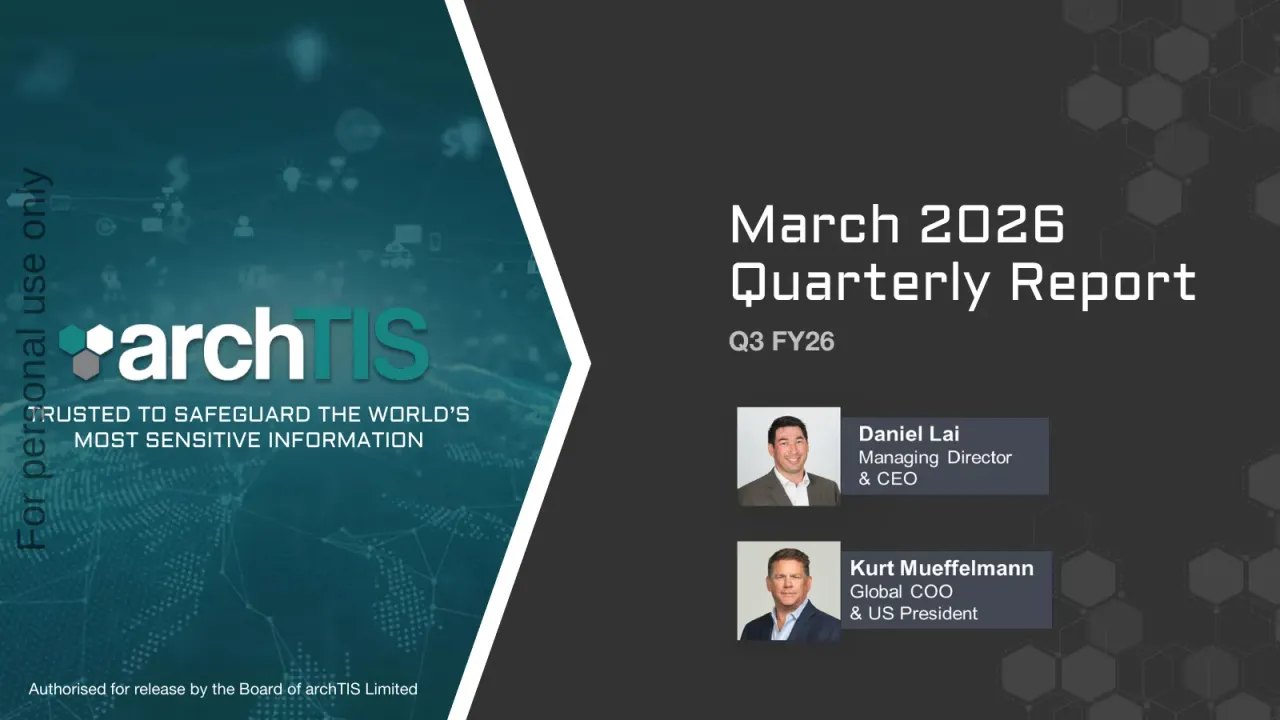
Archtis (ASX:AR9) Q3 2026 earnings call, held 2026-04-30. Watch the replay and read the transcript on 6ix.
- Company
- Archtis Ltd. (ASX:AR9)
- Period
- Q3 2026 earnings call
- Date
- Wed, Apr 29, 2026, 9:00 PM ET
- Replay
- Watch the replay on this page · 34 min
On 6ix: 6ix.com/event/archtis-limited-ar9-q3-2026-earnings-call
Replay
Transcript
Automated transcript · Written by software from the replay's audio. It can mishear names and figures; the replay is the record.
0:01 All right, why don't we get going? So welcome everybody. Welcome to the ARCHIS Q3 FY 'twenty six quarterly update for the period ending March 2026. I'm Kurt Muckelman, and I'm joined by our CEO, Daniel Lay. During today's session, we'll provide you an update on the quarterly performance, provide an in-depth financial review, update on the U. S. DoD opportunity, Experian integration and further discuss the go forward strategy around the market focus and growth. So first, let me kick it over to Dan and he'll get things going today as I sit here in black with a broken camera. Yes. So apologies everyone for the camera. You're going to have to stare at me and preferably the slides for most of the presentation, but welcome everybody to the quarterly update. So let's jump into the highlights.
0:47 So accelerated experience sales. So the integration is going well. We talk a little bit about this sales further down the track in the slide deck that essentially we've closed the global IT provider sale. That was a sixty day sales cycle. It was for $150,000 but we're starting to see that cross sell, upsell engagement starting to come through that pipeline, which we've been working very hard over the last six months. USDOD, custom development fully delivered and production ready for the DoD three sixty five. That is excellent news for that DOD opportunity and as it says, it's been completely delivered, validated for integration into that environment and is production ready. ARR 15,100,000 up two thirty one on the previous comparative period.
1:39 Revenue of 3,500,000 and revenue up 143%. Available funds released this morning at $8,000,000.71 percent gross margin still hovering around that 74% annually and an allied defense win which we announced earlier in the quarter with military alliance between Europe and The US. Can all guess who that is. That is at $1,200,000 with additional options on those years. So that's very exciting for us and we're commencing that deployment shortly. So they're the big news points for the quarter. Kurt? Yes. So I'll take us through the financials. So again, apologies. I got in from Australia about ninety minutes ago from a thirty two hour door to door and unfortunately, my laptop did not reset properly for the camera. So again, apologies. So our Q3 FY twenty twenty six financials, I think we reflected a continued step change in growth and scale of the business.
2:36 ARR grew 231% year on year to 15,100,000 and we sequentially strengthened that month over month. So we saw less churn at the beginning of the month than we did at the we saw less churn at the end of the quarter than we did at the beginning, which is really strong because, again, when we acquired Spirion, we understood the churn coming we kind of forecasted it during the second half of FY twenty twenty six. So that's coming to fruition the way we thought it would come through. Quarterly revenue rose by 143% to $3,500,000 driven almost entirely as you can see by licensing revenue of $3,400,000 Gross margins remained really strong at 71% and our year to date stayed at 74%. So we're broadly in line with the prior periods. The area that we've been working pretty hard on is operating expenses. We were $4,900,000 last quarter, excluding $1,000,000 of one off costs associated with experience synergies and line of credit fees that we previously mentioned in prior quarters.
3:34 This is $1,000,000 improvement over the prior quarter, reflecting our commitment of capital efficiency, while balancing investments to support our expanded pipeline. Operating cash flow was $3,700,000 and we closed the quarter with $8,000,000 in cash and equivalents, a solid foundation for the phase of growth that we're looking at. I think one of the interesting things we saw though is the current market cap sits below 2x in recurring revenue when I was talking with Dan and the Board last week. I mean, let's be honest, we're a bit impatiently bullish. And I think all shareholders are at this time around the financials that we're really waiting on where is the U. S. DoD and we understand that that share price is tied to it. And so what we want to do is really focus on that as we go through. So Dan, why don't we take us through where we currently stand with the US DoD and some of the other momentum opportunities?
4:23 Yeah, look, let's go through that now. The USDOD as we mentioned, we've completed that software development. It's been validated by the US Department of Defense and it's ready to be, it's production ready to be deployed. They Obviously, had that additional 1,000 licenses which we deployed with them. The tenure of that is almost up so that we know that they're coming to an end of that process. And I guess the other aspects of that is of course, there's been a lot of activity in The Middle East. Where those licenses were deployed is in central commanders. Obviously, command plays a significant role in the war currently with Iran. So there has been some unfortunate delays with that. However, I I think it's really important to understand that with that deal, there has been constant activity on a weekly basis.
5:14 And that gives us great confidence that this is going to go forward and obviously there is a significant up grade in licenses to be done in the deal with the USDOT. Things that I would say to that is if that wasn't the case and we knew something about that, we obviously would have to inform the market. And We're very confident that that's going forward. And the weekly activity and all the engagement suggests that it's going to happen in the near future. So we are making progress into the extent of agreeing and aligning the product future roadmap with the USDOD. So that's all good positive news moving forward, which gives us confidence in that deal. Technical validation advancing as we talked about. There's obviously that heightened military activity that I've mentioned. But the last one there is something that I was very proud of for the company, which was that European military alliance.
6:09 It's currently going to be deployed across two and a half thousand users, and that act opens up access to a major ecosystem in Europe. That's a significant opportunity, and it's obviously got a two year extensions with one year options on that. For the next two years, they've got a one year option on that license, and we're currently in negotiations with getting our people cleared to go and do that deployment. So that those are significant wins. What do they all say? They all say that the opportunity there for archTIS to become the number one provider of policy enforced data centric security to The The US and their allied partners is significant. So moving on, what else have we now been up to? Well, the new cross product development, currently, NC Protect has now been integrated with Mindbreeze, which is an AI enabled product doing reports and such. So we are still moving forward with the product and the future roadmap for that and development.
7:11 Mindbreathing is deployed across a whole range of global manufacturers. This one just happened to be with an existing customer that wanted us to extend that protection and visibility into their security domains. The new customer win with Speron, that's really important. It was with an IT provider. The really good news of that was it was a sixty day process from where to go to close that deal, which we're very happy about. And of course, the UK division for global aerospace, which we announced last year, that deployment has gone well and they've extended that for another two years and also that we are able then to be introduced and start to have significant conversations in different geographic domains, which has commenced. So they're all good news signatures, evidence of us executing our strategy, and they're all extremely positive signs.
8:03 Market validation. Why now is the right time? Well, Microsoft just defined the gap. So at the RSA conference recently, and I'll get Curtis speak speak more deeply about his experience over at RSA. Microsoft launched Zero Trust for AI. Now when they explained their future of their, and you can go and check the blogs that this information is out there. When they discuss what that vision looked like, there was a very particular gap which has been identified. And that is extremely complementary to what ARCTIS is building and the future of of the ARCTIS company. And that, of course, was attribute based access and policy enforcement for the data layer and how to extend that across a hybrid environment.
8:50 And when we talk had talked previously talked about the road map for our products, selling best of breed, developing the platform, and extending that platform to AI, we're in a significantly sound position for that to happen. Furthermore to that, data security posture management, it was recognized as the fastest growing security category. And again, when we look at all of our major competitors out there, major providers, I should say, because they're not actually competitors because that space is still open to us. What we're seeing there is people are now starting to take the responsibility for cybersecurity investing into that cybersecurity market and particularly around CMMC and zero trust much more significantly.
9:39 We're starting to see those investments come through and we're extremely well placed to look at that. Where are they spending their money? Platforms. And again, this ties into the strategy of us and our positions of directive, NC Protect, and and, of course, Codency, but most importantly, Spirion and where we head. We now have ability to identify, label, enforce, and govern that. And as we significantly build that into a platform over the coming months, that's gonna put us in a very strong position to be a value add to all of those current DSPM providers and capabilities that the customers are missing. And we're uniquely placed to do that specifically in the Microsoft environment, particularly after the work that we've been doing for the US DOD and NATO and others.
10:29 Kurt, over to you for RSA. Yeah. I think what was interesting. So RSA was earlier in March in San Francisco with 50,000 cybersecurity professionals, the largest show. And sitting down with the CrowdStrike, the Palo Altos, the Microsoft, the number of bankers that were out there, we really saw where the strategy that we're bringing to market really holds true. Again, Dan talked about Zero Trust for AI. We're really looking at those guardrails of where you go. So when you look at CrowdStrike, Palo Alto, Netskope and all these others, they're looking at the security aspect of it, but they really aren't looking at it from policy. And policy is a thing that transcends all the different businesses out there and the way that you orchestrate across it. And one of the bankers that we worked with, William Blair, really talked about it, and I thought one of their quotes during their session was really pertinent to where we are, where orchestration is the layer in the new center of gravity. So that's really what's making the decisions about AI, is the actual orchestration layer of the policy itself.
11:32 And so it's a new category that's forming, it's following within this data centric policy orchestration that we're at the forefront with, and it's really piggybacking across the tailwinds of data security posture management, which Dan said is the fastest growing and some significant investments into the businesses and into the markets themselves. So we feel that when we start to put our strategy together, the tailwinds are right, but lining them up against the different horizons that we have across the next twelve to eighteen months really will make an impact. I know we showed this slide last time, but I think it's worth going through again, because you can really see where we talk about some of the wins that we've had, some of the cross sell in The U. S. DoD and Horizon one how those carry across the way we're looking at it from a market perspective. Yes, look, defend and extend the base. These three horizons are obviously based on McKinsey three horizons for growth framework for those people that are aware of it. What it means is you you how are gonna continue to make sure that you've got growth in your business going forward? And what are you planning and what are you working on simultaneously or in parallel to make sure that that growth happens? For us, defend it and extend the base.
12:41 Stabilize that customer base who have already invested in data centric security, cross sell, upsell, and win new logos with the products that we already have. Make sure those products are supported to do what they need to do, but then combine those products into a platform for Horizon two to add additional value to those customers to make sure that they've got a single and a use and control plan for putting policies into and making sure that user experience is of high value to them to help reduce the complexity in an ever increasing complex ICT world, particularly with the introduction of AI. And that's horizon is really, for us, about six months away. So we're actively working on these two horizons currently. And you can see the sorts of deal sizes that equate to that. The USDOD, which we forecasted somewhere around about 6,000,000 ARR and possibly 2,000,000 in services around that contract is one of those deals. NATO was another one of those deals for NC Protect. The Microsoft co sell and the Sphere and cross sell, which we've just announced that other deal.
13:53 For us, then Horizon two, that's really about what we call trusted data integration, which is that orchestration layer and platform. And really what that means is that expansion of what we've done, and we've done a number of trials which are now going into procurement, and NEC was one of those trials that we did. UK MOD, which we've got having conversations with them, the deep supply chain regulated industries, Australian DOD. We've they're all looking for an answer here with this capability. And that's really critical for zero trust frameworks and how you embed zero trust into your environment. And we're seeing great opportunities pop up with that. Then the future, and this is all about AI. Now I think that with the advent adoption of AI, something like 13% of organizations have already seen data spills from AI, which they didn't know were coming because they don't know what it is in terms of a black box functionality and what data is aggregating and taking from you and searching for. And, of course, out of that, 97% of, companies that have an AI breach according to IBM have been because they haven't put proper access controls in place.
15:08 Now that says that there's a real opportunity for us to play in securing AI and integrating all of those other cybersecurity controls, for early visibility, reaction, and so forth. And I think that that is really, really important. So we're executing on those three horizons currently and in parallel. And I think that, you know, you mentioned Microsoft had a big play at RSA. And when you talked about those three horizons, they continue to validate the AI market and where we're taking it. And I know we're spending a pretty significant time on this webinar around AI. But when you look at where we're going, when you look at where the market's going, this is where we need to be. This is where we're going to get our multiplier from a shareholder valuation perspective. So, Dan, you wanna talk a little bit about kind of the Microsoft effect in that?
15:55 Yeah. Look, I I I think it's really about everyone's the early adoption there, one. Microsoft from a marketing perspective always sets the marketplace. They're they're a marketing machine. They're up there. You know, obviously, you got Google and you've got the other hyperscalers as well and the big open AI providers. But but really what that they still control the majority of the market and incumbent in the majority of enterprises, and therefore, their validation is important. The gap that they've left us is a really strong gap for us to play in, and I that and that's just constantly validating back to us that the strategy that we've set is an extremely strong play for growth. And I don't mean, you know, 30% or anything like that. I mean, if we can get this right and execute this and expand into that US off the back of the USDOD deal, this the growth of this company is you know, it's got great potential.
16:52 So I'm gonna simplify this for those people out there in the audience that are not technical. And and what does it what does this look like? Well, it's really quite simple, and I tried to get this slide to to simply give you a concept of what the opportunity is. ARCIS must provide the policy enforcement layer for the zero trust data. That means becoming enforcement and proactive about what we do because things like, called mythos and others are are are now being able to map vulnerabilities so quickly and then be able to be tasked to execute against those vulnerabilities is is really accelerating this space. And therefore, protecting the data layer is becoming absolutely critical. It's now mandated as we have said on numerous occasions, and organizations are slow to move to get that on, but we're starting to see that real significant growth. So turning data into discovery, classification and real time enforceable access policy decisions.
17:50 We have multiple vendors across identity, devices, networks, application, and workspaces in that zero trust framework. We have very, very few in data. And if you go down that stack about what clues that framework together, visibility and analytics, automation and orchestration and governance, that's the space that ARCTIS can is already leading in and can really own. And that's really where we go from TDI integrating with NC Protect and Sperion, and also then being able to extend that as a DSPO tool, which then integrates into all the products in identity devices and and complements them and doesn't necessarily compete against them. And that gives us a very clear product road map, and it gives us that even if it doesn't contribute to that, we don't build it, and that's all we sell.
18:39 So that's where we see ourselves in the marketplace. Cross platform control plane, what does that look like? Well, TDI integrated with NC Protective Sphere, and as I mentioned, can connect to and extend Microsoft Azure, in CAS, all of those different capabilities, I can it can be multi cloud. It can send it into AWS, GCP, whether it's on premise. It can take those DSP vendors and IAM vendors, integrate all of that, and then control from a unified policy across all platforms, real time access control, governance compliant, and continuous audit and observability. And, again, we're now seeing people talking about this. It's not just us marketing it. We're seeing all of the big providers starting to market this way, that they're behind the ball.
19:28 And we know we're in a position of strength, and we think we can springboard off a couple of big deals and really charge into that market for high growth return. So over to you, Kurt, on the revenue, making that Yes. So we talk about theory and we talk about where we want to take the business, but we really want to look at where the revenue is sitting and where it's going to sit. And we break it out our revenue streams into three different components. So we look at the SPO across platforms. So whether it's across working with Five Eyes, ARCAUS, what have you, they're large, very recurring, sticky, where they're using multiple customer clouds, doing a hybrid environment, what have you. Microsoft will never be in this area and has stepped back from it. So we're trying to be that middle layer of the combination of information across the policy for all aspects of it.
20:19 The second one is across AVAC to AI agents and governance guardrails, which Dan talked about, where we are today, tying back into some of the Microsoft components, looking at what we're doing with MindBreeze, looking at the conversations we've had with the CrowdStrike, the Palo Altos and the others that are out there today. Big market, a lot of competition, but we feel that ABAC with those guardrails is the right place to be that can help differentiate us. And then lastly, again, we're all waiting on where the US DoD is. There are other aspects of that out there because that's not the only one that we're tracking. And so when we look at where these areas go, we have active immediate pipeline opportunity across all three revenue spreads that we're looking at and how to drive that back into the vision that Dan's bringing in to the business, the strategy behind the product development and the way that we can scale across integrations and components with large technology vendors that actually will bring us into more of a valued situation as we go forward.
21:16 So that's where we see the revenue, but it really comes down to where going to execute across the next thirty days. So Dan, if you can bring that home, and then we'll turn it over to questions. Yeah, absolutely. Obviously, all the focus right now is on converting that USDOD engagement. Obviously, there's an expectation in the market. And again, I reiterate our level of confidence in executing that. But it's something once we have done that, I think you're going to see a significant change, not only in the perspective of the company, but the share price and other things. For us, that gives us the reference ability in The US to really drive into that market place. We obviously had it's not the only deal we are highly focused on, and we have some significant deals in the pipeline to close over the next sixty to ninety days. And I think that's only good news for investors.
22:09 We need to drive to continue those cost efficiencies. Yes, we are critically aware of the cost structure and expenditure and we monitor that on monthly basis. We've already reduced down significant synergies with the acquisition of Spirion and we understand that there has been some churn in their customer base. But obviously, we are managing and monitoring that as well, and we believe that we have stabilized that churn and starting to turn that around. And that's not unexpected. That's something that happens when you acquire companies. Until you get the company and can go through all the closets and pull out all the skeletons, you don't really know that from a due diligence process. Yes, you do the best you can with the due diligence process, but some things happen after the fact of the acquisition and we are certainly working very hard on that. I'm not worried about it.
23:00 As I said, it is expected and some of it was forecasted. And it's not the only reason we acquired Sperion. Let's be clear. I want to make sure that everyone understands we did not just buy for Sperion ARR and growth. We bought it to launch into The US marketplace. And the quality of some of the people in that company is exemplary. They're very good. But we have got an eye on cost. Expand US operational focus, obviously, that's where we need to be. The high growth market in the globe at the moment is The US. We need to grow in that US market. Advanced delivery of core product capabilities and functions, it's a very dynamic market at the moment. Do we have a play with AI, or are we threatened by AI? No. We have an opportunity with AI.
23:46 And, you know, we have an opportunity also to enhance our productivity inside the company and also drive cost efficiencies by adopting AI into the company. We are using it. Our coders are using it. We are evaluating product code against it. We are embedding it into our products. They're the focus over the next sixty days. But and I don't think there's anything there that would be unexpected to the shareholders. So let's get to the questions because I'm quite sure that although we've covered a lot of them in strategy and where we're heading, I think that a lot of shareholders out there have questions how we're going in terms of cost and concerns about runway and all sorts of other things. So let's jump on to answer those questions, Kurt. Yeah, Dan. I think, know, first thing is I, again, apologize for the audio and video of this. I know I understand some people they're getting echoes through that, that's coming through my computer. So again, apologies, I'm not sure why that's taking place. So I'll be a little bit quieter and let Dan drive this forward.
24:45 First one is, can you quantify what dollar amount of cost efficiencies can be attained? You're coming off of $4,900,000 of operating costs this quarter. What do you expect going forward? And how can that be positioned to tie Sobe with ARR? Look, again, this is a real balance of the company waiting for some, I guess, opportunities to drop that are going to be significantly transformative for the company and balancing that growth with that cost. So we are we are constantly monitoring that. Obviously, we're also had now the sphere integration, and we've had a really good look at those people and and what they're contributing and how we restructure the company moving forward. So I look, I think that there's another probably couple of million in terms of synergies that that could be looked at in terms of the company.
25:38 But it needs to make sure that we we are surgical about those cuts and not, you know, completely blunt about it the way that we do that because we have to be in a position for what we are expecting is growth. Yes. I think we have to continue to look at where the ARR goes as well, right? We have to balance where ARR is today, where we see it going in the future. We want to make sure that we are in a positive cash flow sooner than later, which we've always said. We knew it was going to take a couple of quarters to flush through the synergies from Spirion, which we're doing. And I think we're coming back towards that by the end of the fiscal year, which is June 30. So I think we'll be in a better place there for that. I think, Kurt, as you highlighted, there's some one off costs there that have now been flushed through the system as well.
26:25 Yes, exactly. So that will improve our operating as we get there. Can you talk about there's been obviously some drop in ARR generally considered from the Spirion line. Can you talk about why that drop of ARR is taking place? Yes, I can. So the Sphere product out was out in the market. It was a leading product, best of breed product. When I what do I mean by that? It was doing 98.5% accuracy for which is deterministic, not probabilistic, which is what AI does in in terms of those things. So for its customer base, it's an outlier. It does hybrid. You get the vendors coming in saying, we can do this such as Microsoft, you know, we we've got Purview. We can do the discovery. Can do the like. And as we have said previously, when economics get tight, people wanna consolidate those costs and look at a vendor to do everything. And if they can say they can do everything, they'll go through a process of discovering that they can't. But that means that you'll you'll probably move on from that that smaller best of breed, which is it's much harder to defend.
27:31 Now that is part of the reason that we are moving to a platforms because we can then offer many more services combined in one product rather than the best of breed product. Now I I I would suggest that most of those churn customers, have happened over the last the previous two quarters, were specifically already preparing to disengage with the company as we were going through that procurement, which is why we knew they were at risk. We didn't know exactly where they were. We had some conversations with the company about those, and that was actually priced into the the company cost. As I said, you know, you don't buy a company at point nine of its IRR.
28:16 It for if there isn't some going to be some churn in that company. However, point nine still to acquire that ARR that we have is still a very good buy. And again, it's not the only reason that we acquired that company. And I think that the potential value of that company isn't just in the product, It's actually more in our ability now to execute and enter The US market with our products. That probably goes to another question there about, well, how is your cross sell and upsell going? Well, it takes a little bit of time to make to get all the products into the right place and particularly the sales team, the the marketing material, and we have done that. And the news of of that first beer and sale on new logo is an example of us executing against that strategy. It was never going to happen overnight.
29:07 It was never going to be a month. It was never going to be three months. It's something that takes a lot of work to get the teams to understand how all the products fit together and take that to market. We've done a lot of NC Protect demonstrations to the existing customer base, and we are expect the results to come through. Kurt? Alright. Let me see. On the product side, think you addressed it, but maybe you just wanna touch on it a little more. Have you considered merging all products into one brand or one platform? Was that question done by the chair or who who who asked that question? Because it can't me. Yes. Yeah. Of course, we have, and the answer is absolutely we will. Again, you know, the merger for the acquisition of Spirion, we're going through that process, the rebranding strategy has been already determined and we will move into restructuring all the branding as we move forward in in the company.
30:03 So you can expect further news on that. Great question. Yes. We have. Yes. We are. And and we're active on it currently. Must be a new shareholder here. What percentage do management own of the outstanding shares? And I would still say that from day one, Dan and I are both top five shareholders within the organization. So our long term shareholder value is tied directly to where the company goes. We need to make sure that we drive this forward for shareholder value and make sure that we drive every component out of the business we can to see that in shareholder value. I believe to date, am speaking for myself, but I have never sold a share of the company. And so what I brought in through acquisition, what we brought in through parts of components of our compensation, as well as participating in the various capital raises that are out there, I don't believe Dan or I have sold any shares. Dan, do you just want to confirm that? Yeah.
31:06 I haven't sold a single share. So I want I'm as eager as everybody else for return. Great. So last question we'll hit about moving towards The US. Will you ever move the head office of AR9 to The US? I hope that our success forces us to. How's that for a hand, sir? Look, obviously, we we we obviously wanna crack that market. That's what we're investing in. We didn't do this lightly. We we we considered all the different angles and the risk. But if you're going to go and play with the big boys, you've gotta be where the big boys are and where that growth market is. And a good example of that is just the SME market in The US is staggering compared to the market here in Australia.
31:51 So we have opportunities there. There's a couple other questions I might just answer, Kurt, while we've got the time and space. And I know we're on the half an hour, but there was someone mentioned the 8,000,000 loan facilities mature within the next nine months. Any commentary and comfort around that? Obviously, we took the decision that where the share price was and we did have an institution move some shares and sell out. That did put downward pressure on the market, on the share price. We believe that they've been exited now, so we're thinking that we'll get a little bit of a bump back there, that's the market. But, obviously, when we took out that debt facility, we won't we are confident and we still are confident that that that this deal will execute within the time frame that we and we are comfortable.
32:38 So I wanted to answer that question directly, and I think that's about it, mate, unless there's any other screening questions from you. No. I think that is it. I had a lot of couple of questions that were duplicated. So alright. Great. Why don't you give a give a quick summary, and then we'll wrap it up. Yeah. No. Look, that's it for me. Like I said, the keynote there, we are progressing not as fast as we would like and probably not as fast as you would like. The outlook is good. We are confident. We are seeing the right activity and the right conversations are occurring and we still believe that the company is going to return significant shareholder value and we will be very excited to make those announcements as they come through. Alright. Great. We will end on that. Thank you very much, and we will be putting this up as a recording in the coming days through our Clearinghouse Atomic. Thank you, and have a good weekend coming up. Thank you.
33:33 Thank you, everyone.
Follow Archtis Ltd. into a list and get an email when it puts out news.
Latest news releases
- ASX:AR9 — Quarterly Activities/Appendix 4C Cash Flow Report · Tue, Oct 27, 2026
- ASX:AR9 — Quarterly Activities/Appendix 4C Cash Flow Report · Tue, Oct 27, 2026
Companies on this call
Speakers
Daniel Lay
CEO