Transcript
Automated transcript · Written by software from the replay's audio. It can mishear names and figures; the replay is the record.
0:08 Well, hello, everyone, and welcome to Goldshore Resources live investment summit today, hosted by 6. We are joined today by CEO and director Brett Richards. Brett will walk us through a company presentation and then we will be accepting questions live. So remember you can submit your questions at any time on the Q&A panel on the right-hand side of your screen. And as always, the summit is being recorded and will be available to watch afterwards on Six.com.
0:33 So without further ado, I'll hand it over to you, Brett. Thank you, Dasha. And thank you, everyone, for dialing in today. I'm going to walk through the GoldShore story. It's a new emerging gold development story in Canada. And I look forward to some interaction at the end, possibly some Q&A. First of all, as usual, we like to qualify forward-looking statements and our disclaimers and sources and these can be taken off our website from the presentation or you can download a copy of the presentation from today. Gold Shore Resources, we have started an early stage gold development company and we are in a low risk jurisdiction being in Northern Ontario. And I'll talk about the deal and what we have, the asset and the transaction as we move forward.
1:36 But this is a emerging company. We haven't started trading yet. We will be trading on the Toronto Stock Exchange in about 4 weeks time. We're going through the approval process. But after working in many jurisdictions around the world over the past 25 years, getting back to Ontario and getting back to Canada was quite refreshing. So we are in a low-risk jurisdiction being in Ontario, And one of the keys for me and why I got so interested in this project from the very early beginnings was we quickly assembled a really top quality management team and board to help guide and lead this project through, through the development process.
2:23 Secondly, the next point you know we have a resource code, which is the Moss Lake project and Thunder Bay and I'll talk about the transaction we did with West Dome to acquire that project, but it is a significant exploration package with a historic 4 million ounce resource. And we're looking to do great things with the existing historical resource and going forward. So we have quickly moved to, you know, putting together the phased approach of 100,000 meter drilling program. That will commence later on in the spring early summer. In 2021 and 2020 and go on into 2022. But we are doing a number of things on the ground today. I'll talk about in a little more detail in order to prepare for that.
3:15 And there is a historic PEA from 2013. And if you look at what was used as historic metal prices and various exchange FX assumptions back in 2013, This project, as it stood back then, was quite economic. This is a high volume, high tonnage, low grade Gold deposition. And we're not calling it anything else but that. This is just over a gram per ton project and the size and scale and scope of making these projects economic tends to be quite large. And if you look at the PEA from 2013, you'll quickly see that the project had CapEx north of $700-$800 million and had an NPV of around $300 million at $1,600 Canadian gold price back then, which was around $1,250 US gold price which they used for this.
4:20 If you look at just the sheer economics of the PEA from 2013 and extrapolate those numbers using today's gold prices, you get an NPV closer to $700 million today, and you get a CapEx that's probably going to be north of a billion dollars. And we'll talk a little bit more about that, about this being kind of into our strategy going forward into updating this. I mentioned about the top quality management we have. Our VP of Exploration, Pete Flindell, Pete and I have been together for almost 20 years now on several projects in Southeast Asia and in Africa. And we have, you know, we've worked together kind of hand in hand for some time, dating back to companies such as Avocet Mining, Roxgold, Midnight Sun Mining, Banro Corporation.
5:19 And today, he is gonna be living in Thunder Bay and leading the groundworks of the project from Thunder Bay. Gavin Cooper's our CFO based in Vancouver. And then we have Doug Ramshaw and Victor Cantor, who, you know, these are very senior guys with a significant amount of experience both in the mid-tier and junior sector and also at M&A Capital Markets in Canada. Galen McNamara, who is going to emerge as our chairman, he is, Galen is the CEO of Summa Silver, and has a significant amount of experience kind of in our space, and he's on the board of Angold as well. Brandon McDonald is the CEO of Fireweed Zinc, also a PhD geologist, and he's a director on our board.
6:16 Sean Coon-Coon, who is the CEO of Dolly Varden. Again, young guys, diverse and complementary skill sets. And then we have our 2 West Dome appointees, Mike Michaud and Heather Laxton. Mike is the VP of Exploration for West Dome and Heather is in charge of corporate affairs and governance for the company. And It's a very, very complimentary board and a very, very complimentary group of skill sets. And we moved to our advisory board. David Garofalo really needs no introduction. He was the CEO of GoldCorp through the emergence of it and through its transaction to exit.
7:05 Craig Perry, Brian Slusaruk, Leo Hathaway, Daniel Coons and Adrian Rothwell, all form our strategic advisory board. And all of these guys have extensive capital markets experience, junior mining experience, senior mining experience, and are well positioned as a group for us to lead and take Gold Shore forward. Just a quick look at the project and I will come back to the transaction but we have a large land package northwest of Thunder Bay And our focus is going to be about taking what we've acquired from West Dome, taking this project and advancing it in through the development pipeline.
7:57 And I use the metaphor quite often. I say, you know, we're not taking this from A to Z. It's already gone through the first part of the alphabet. And we're going to take this from about H, and we're going to take this to about O. And we are going to add value and we are going to do a number of things to prove that this is a real project. Pete and I have worked for majors and we know whether it's been in deal sourcing or deal M&A acquisitions and deal transactions, we know what it's going to take at the end of the day to get the ire and the interest of major and mid-tier mining companies. We know we have to do our work to a quality and to a standard that is not only acceptable to mid-tiers and majors, but meets or exceeds their quality and meets or exceeds their expectations.
8:48 That is the way that we are, one of the ways that we are going to add significant value. So when we're looking at Moss Lake, you know, we have a, as I said, we have a very large land package and we have the opportunity to not only take an existing resource and prove it up to be a world-class resource, but also to take the resource stepped out from where we have our historical resource and bring on, I'll say, nuances through step-out and scout drilling into areas that are identified as mineralized but don't have any drill holes in them yet. So we've got some quite exciting upside and some quite exciting work to do within the existing resource.
9:37 But this is exactly the process that some of our peers have taken. Detour and Kirkland Lake and New Gold at the Rainy River Project and I am Gold and Sumitomo's Kote Lake. So these are very, very similar. They are high volume, low grade depositions that tend to have big capex, but also are very sensitive to the gold price. And the NPV, looking at Moss Lake, and I use their historical 2013 PEA as an example, the PEA that was conducted, Actually, even in 2013 numbers, for every $100 move in the gold price, the PENPV goes up about $180 million.
10:25 And I would assume that is the same on today's numbers. And actually, it'll be actually a little bit bigger. So these are quite exciting type economics that we're looking at. But again, we need to start, we need to walk, and we need to walk before we jog, and we need to jog before we run. What we have to do is a lot of work on the ground to not only prove up the historical resource, but also add to it. As I said, we have 4 and a half, just, or sorry, 4 million ounces of historical resource. There's about a million and a half in indicated and about 2 and a half million ounces in inferred. And our focus will be initially to do some twinning, to do some verification drilling on the existing resource, which won't be very many holes. And then we will look to both infill the existing resource, to bring it up to a higher quality of M&I and bring some of the inferred into M&I, but also to add some inferred.
11:26 And if you look at the Moss Lake deposit, we will be looking at adding inferred resources at depth to understand the extensions at depth and also along strike and out to the Northwest and to the South Southeast. And we will be looking to add potential mine life, potential resources along strike and on those extensions. But it's very important for us to demonstrate that the key project at Moss Lake is a real project and that this is gonna be attractive to someone down the road. We have other mines. There is the East Cold Stream deposit where there was a historical copper mine run by Xtrata for several years. So there are a number of kind of permutations to where this is going to go and how this can go, but we're going to be focused on the Moss Lake deposit initially and work from there.
12:22 It shows you a little bit of the, I'll say the regional footprint where our land package is, just under highway 11, and it almost touches it. And we are in that, in the Birchell Lake, Moss Lake, Rainbow Lake area with the existing resource. But you can see where we have historically, where there's historic drilling, we will be kind of infilling in and around this area. And I'm just going to highlight it. We're going to be infilling in and around this area in here where the actual resources and then, and stepping out to this direction, stepping out to down towards Hamlin and in this direction, as far as our extensions go. So that's the strategy on the ground. But if you look at some of the drill holes, if I just look at like Moss Lake here, there's some very interesting things going on.
13:24 We have certain holes that are low grade in the midst of a gram, just over a gram per ton, over long intercepts of 100 to 160 meters here. But we also have some very high grade holes, 11 grams over 70 meters, just over 2 and a half grams at 70 meters as well. So these are the things geologically that Pete will be working on with his team. They'll be trying to understand the geology in this area, as well as, you know, if we do some work in the Cold Stream area, we'll be looking at Cold Stream and Hamelin as well in due time, but our focus is going to be on Moss Lake at this time. And the map's turned a bit here. You can see north is down towards the lower right. We've just done this for convenience, But this shows you the red area where the actual deposit is in this area. And again, we will be drilling to the southeast down here towards Hamlin and be looking at scout drilling up towards this area here, where there have been some holes and they've been significantly mineralized over long intercepts, and Iris is a good example of that, but this is a 20-kilometer extension to the Northwest that is virtually under drilled, undrilled.
14:51 And we'll be looking at, you know, this as a possible size and scale scope extension to the initial kind of Moss Lake deposit. In this area as well, we have a not only a 20 kilometer plus trend of this extension, we also have an 8 kilometer zone of IP expression, which again is going to be the focus of some of our data compilation where we will try and focus on getting really good quality drill targets. This is more of a 3D model of showing you where the indicated and where the inferred resources at Moss Lake.
15:38 And I think this is important from a number of standpoints. If you look on the left, if you look on the left here, you'll see the existing kind of drill profile and drill pattern. It goes down around 200m, 250m. There's a few holes that are 280m, but it doesn't really go much deeper than that. So from an at-depth standpoint, this has actually been fairly under-drilled. And we're thinking that not only is this gonna be a focus for infill drilling, you can see a large quantity of holes to the Southwest here, but also at depth, there's very little information and data at depth. So this will be one of our focuses. We will be putting some deeper holes into this area. But if we just look at this just as drill data, we've had several owners over the last 50 years. We've had Westdome as the current and former owner.
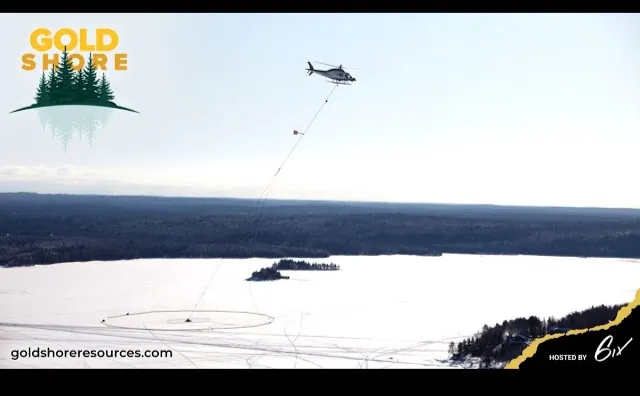
16:39 And quite frankly, there is a lot of information. So we're taking, and I go back to my first principles statement earlier about this is a company, this is a project that really needs to have all the data compiled and compressed. And that's one of the first exercises that we've embarked on. We're doing this with a company in Toronto called Orcs, and they are working on doing a digitization of anything that's not digitized, but they're working on compiling all of our data. And on top of that, we have our data sets from all the drilling that has been done historically. And those 2 things layered on top of each other will actually give us a good profile, good indication of where our quality drill targets will lie. But even beyond that, the first thing that we're doing on this property is we're conducting a Helleborn geophysical survey, a V10 survey, an electromagnetic survey that's going to be flown over the entire property.
17:46 Again, another piece of large information, a large piece of data that when put with the data sets, that when put with all of the other work that has gone on, the geochem work, the geophysical work on the ground, other information, you put all this layered together and we will have a substantial amount of high quality drill targets that will lead us through this 100,000 meter program. So we've just taken a back to basics approach here, whereby we just wanna make sure we do this all right to a quality and a standard that is not only acceptable, but will exceed the expectations of mid-tiers and majors, and then start building on that and do it in a proper way. And that is, yes, taking the time to pull all this data together. And that costs money, we get that, but we think that's also very good value.
18:38 To take a look at the historical drilling that has been done and potentially embarking on a re-logging exercise. Pete is in the process of pulling together a team of guys who are going to be our first to senior geo geologist Max Q and Jose Garcia are going to be joining us next week, and we're going to start working with Geotext to start, you know, doing a re logging exercise of existing core. We've been out to Cold Stream, we've been out to Moss Lake multiple times now, and we have visualized the core, we've seen the core. So we're gonna start looking at re-logging the core. Again, the data that was collected 20 years ago, 16 years ago, even 5 years ago, doesn't tell the whole story. And we need to kind of go through a re-logging exercise
19:28 to understand the stratigraphy and lithology a little better than was once understood. So that's another exercise. So all of this data is going to be, generally can just be a constant machine of information and results that are gonna come forward to the point in time where we can demonstrate we have a real project. And we feel we do because of the head start we've been given. And this project will emerge very quickly on, within 6 or 8 months, we'll start to really understand the size and scale of what we have before us. And with upside to understand what the size and scale of the step out and step down drilling will provide for us. As I said, there's an extensive historical exploration that dates back to kind of even the late 1800s all the way up to 1950.
20:19 And in the 70s, Falcon Bridge did quite a bit of work in and around the area and on Snodgrass Lake. In the early 80s, mid 80s, there were some other work done by Tandon and Stormin. And then in the 90s, Moss Lake Gold Mines did some drilling as well and into the 2000s. And then in 2010 through 2013, West Dome took ownership of it in 2013
20:51 and ran a small program in 16 and 17. So there's all of these ownerships that we need and data points, and you can imagine some of this is manual, some of this is electronic, some of it's in boxes, some of it's not, some of it's on hard drives and pulling it all together in one place really does make proper sense for this project.
21:16 So going forward, we are planning on this data compilation process that we're going through while we have our drill permit in. It's going to take a couple of months to get our permit from the ministry approved. And in that time and in that process we have engaged with 3 of our host community First Nations. We have engaged with Lakhdil-a-Malak First Nations. We've engaged with Fort William First Nations and Red Sky Metis First nations and we're having very proactive discussions about how we can work with the groups and work with their partners and work together for some symbiotic relationship building, capacity building in and around the area. So we have started off on a good step.
22:04 And then as we get our permit, and as we get some of this information compiled, and as we get through our VTEM survey, we will start kind of an infill program and a step out program. And it's probably going to take another month or 2. It's going to certainly take another month or 2 before we get listed. It will take another probably a month or 2 before we get permitted. And I would expect that we should be able to have drills running sometime in June. It may well be the 1st of July, but again, this is a process that we can't compress. This is where we are at the regulatory body. We're at their discretion and we need to satisfy not only the exchange on our listing application and our filing statement, we also have to satisfy the ministry on our drilling application. So there's a number of things that have to go in sequence and in series and can't be run in parallel.
23:00 But when we're able to get moving and when we're ready to start the first 20,000 meters and we will get moving on it. There will come a point in time when we feel that we have enough data that we can start the process of updating the mineral resource estimation.
23:19 And I suspect we're probably looking at that around this time next year. Again, it's gonna be result dependent, it's going to be drill data dependent so that we can certainly get started on mineral resource estimation, but also on rethinking and redoing a PEA, which may take the form of a pre-feasibility study. Again, all these things we need to prepare for and wrestle with, but this is all part of our development program. And I used the metaphor earlier about starting at H and taking this to O, I would expect by sometime in 2022, we'll be kind of somewhere in that NOPQ part of the alphabet.
24:05 And the latter part of the alphabet we'll use for someone else to make project financing decisions, construction decisions, and then ultimately building this and putting it into production later on in the alphabet. Our job is to demonstrate this is a project. Our job is to do it to a quality and a standard that is acceptable for an exit. And our job is to add as much value as we can. And I look at the historical PEA that's gonna come out, sorry, the historical PEA that's been done that has a multi-hundred million dollar NPV. At today's gold, almost $700 million NPV on that PEA.
24:54 And when we emerge as a listed company and we're approved for trading, we're going to open the market at a $65 million market cap. So if you look at our market cap, where we're gonna start listing at and where the potential size and scale of the economic valuation of this company could go, there is a lot of room to move. And that's even before we start to add value with our drilling and with the other programs we're going to do that will demonstrate that value. So if I look at, we have reserved the ticker GSHR for trading. And if I just look at the kind of the transaction a little bit.
25:42 So we acquired the Moss Lake Gold Mines project from West Dome. It had initial consideration of $12.5 million cash and a greater of 30% of our outstanding shares or $19.5 million of shares upon trading. So as soon as this transaction is approved, we will transfer the funds, we will transfer the shares. And when we exit
26:14 and we are ready for trading, we'll have 100 million outstanding shares in the market. Westdome will hold 30 of them. And, and the subscription receipts we've we have just raised $25 million worth will have 36 million shares. So we'll emerge at a $65 million market cap company when we're approved for trading. We currently have a few million dollars of cash in the bank and we've got quite a bit of cash, $25 million in escrow waiting for the transaction to close. So West Dome, why West Dome and why do they want to take such a position in all this at the end of the day? I think if you look at West Dome from a strategic standpoint, they have Eagle, they have Kiana, they're very high-grade gold mine, underground gold mines. Eagle is probably
27:08 the third highest grade underground gold mine in the world. They are, again, low volume, high grade underground operations. Moss Lake is a high tonnage, low grade open pit operations. So when you start to look strategically, did Moss Lake ever fit with West Dome? The answer was great pipeline project to have, size and scale, great to have in the portfolio, but eventually, you need to realize the exposure to that project or the exposure to the gold price. And that's why this transaction works so well for them and for us. They're going to now have a 30% exposure
27:54 to GoldShore as a 30% shareholder. They're going to get a bit of cash And they are also going to have exposure with this project to a possible run in the gold price. We took the view originally and why we centred in on West Dome and the Moss Lake project, We were looking for projects that are going to be economic at higher gold prices than historic PEAs, historic feasibility studies have been run. We went through the band where $1,200 was used as the kind of pro forma consensus type project gold price. We went through even up in 2011, 2010 and leading up to 2011, where projects got funded and financed at $1,500 gold assumptions.
28:43 We're now taking a view that We're going to the next step. And we're of the view, I'm of the view, that gold will trade between a range of $1,800 to $2,200 for the next 4 or 5 years. Just given the macroeconomic situation this world is in, The pandemic and the cost of that pandemic to this world, to Canada, to the US, to the European markets, you know, this has caused significant havoc. It has caused central banks to print money, weaken their currency, and hence the natural fallback to inflation will always be gold. However, we've seen some bumps along the way with competing offsets and that is in crypto and Bitcoin.
29:30 And so we've seen a less volatile gold price movement based on so much money has kind of come out of this non-security backed cryptocurrency asset class that we're not sure where it's going to go. We're not going to We're not sure whether it's going to stick around. We're not sure whether it'll actually be around in 5 years' time. But we do know one thing, gold is not going anywhere. And our view is that it is going to trade up. So let's find some projects that fit within that band. And let's find some projects that fit within that band. And let's find some projects that fit within that band that are not only highly economic, but are highly sensitive to the gold price. Now you talk about volume, you talk about big size and big scale and Moss Lake ticks all of those boxes.
30:18 So that is why I think this transaction is so good for both Goldshore and Goldshore shareholders, but also Westdome and Westdome shareholders, because now they have exposure to something that was sitting on the back shelf for some time. The total consideration of this deal was $52 million, and we do have an option to buy out the 1% NSR that goes with this project to West Dome. We can buy it out in $5 million in shares. So the headline number that we acquired this project for was $57 million, of which 12 and a half is in cash. The balance of it is in shares, some on transaction approval and the balance on milestones over the next 24 months.
31:08 I think I've gone through a lot of the kind of key terms of the deal and of the transaction. Again, we issued the sub receipts. We raised $25 million back on February. We closed on February 26th. That money's held in escrow until we have this deal approved. And we did some flow through shares of $15 million and $10 million, both flow through sub receipts and sub receipts. So we will release those funds. We will make the payment to West Dome upon approval of the transaction and the monies will come out of escrow. This is probably a summary of what I've just said in regards to the $12.5 million of cash that will go to West Dome on closing and the balance and shares and some share payments over a period of time, and then the 1% NSR granted to them with some buyback provisions over 4 years.
32:16 But again, I go back to kind of our thesis and our mantra, and that is we wanted to have a gold project in a decent jurisdiction, and there aren't very many better than Ontario as far as jurisdictions go. We wanna do this correct. We wanna be inclusive and engaging with our host First Nations communities. We wanna do the technical work, the technical, the compilation and creation of new data, we wanna do it to a standard that is, you know, at a very, very high level. And so we are quickly positioning the company to accelerate on all of those things, both on the people side, both on the technical side, on the social side.
33:10 And again, I receive excellent support from my board. It's a strong board, a strong technical team and strong advisory group. And quite frankly, this is a stock that is going to be very tightly held for a long period of time. I think only 36 million shares will be free trading as we start. Those are the ones that have just been raised through the sub receipts. All the Westdome shares are tied up in escrow for 12 months with some milestone releases, as are the Goldshore shareholders tied up for, I believe it's 36 months with milestone releases. So this opportunity is I think, one of the emerging exciting sized opportunities. This is not a million dollar, 2 million dollar junior gold mining company entering the market, raising a bit of money and waving arms.
34:03 This is a proper development company. We've just made that step jump from junior explorer to junior developer. And we are quickly gonna demonstrate the quality of this project with the, I'll say the quality of funding and management behind it. So anyway that's the Goldshore story and I'd look to to update everybody you know as we get closer to as we get closer to trading approval and trading listing. And I have the lovely team at 6 to assist me with all of our investor relations and our social media platforms so that everyone that we can engage with out there is updated real time on what it is we're doing.
34:49 All right, absolutely. Well, thank you so much, Brett, for the update on GoldShore. You did a really great job of introducing your team and board. I was wondering if you could speak to a bit more about yourself and your background. Yeah, sure. I'm kind of a mining and metals person I've been in the mining and metals space for almost 35 years now. I have run listed companies in the mining space both in gold and copper. I have been on startup teams. I have built mines in Africa and other jurisdictions in the world. And for the past 10 years, I've worked for private equity clients. So all the people I hope I'm talking to today, they're investors or they're potential investors or they're stakeholders.
35:40 And I just don't see this, my job is not a lifestyle CEO. I'm not doing this for any other reason that I wanna advance this project, I wanna make my shareholders money. And working for private equity for the last 10 years, you very quickly get aligned to what drives projects. And Driving projects and making your shareholders money is all great, but the drive can't be just waving your arms and flashes and pans. It has to be of substance, has to be a quality, and it has to be done to a degree of integrity that is built into our values at the end of the day. So we're not just doing this for the fun of doing it and trying to raise money. We're doing this with substance behind it. And I have really run all of my companies like that. I've been involved with companies such as Banrel, Midnight Sun, African Thunder Platinum, Avocet Mining, Roxgold, who announced today, they were just merged, and Katanga Mining. I was one of the founders of Katanga mining where I lived in the DRC for 4 years as we built that project and took that to first construction.
36:54 So I understand what it takes to build mines. I understand the development phase of what it understands to, is there really a mine here? So, and Pete does as well. Pete has worked for Newmont, he worked for Avocet and a lot of the companies I mentioned, but he has probably 10 million ounces of discoveries under his belt in his lifetime and his career. And he's excited about what he sees here. He's excited about this region. And we've got a number of things that we have to execute on over the next 12 and 18 months in order to deliver on what it is we say we want to do. Great, thank you. Yeah, very impressive background. Can you speak to the transaction with Westim to acquire Moss Lake and why were they interested in partnering with Goldshore Resources?
37:46 Well, we weren't the only group at the table, that's for sure. And this dates back to kind of September, October when we were in discussions and putting it into a private vehicle and then vending that vehicle into a Sierra Madre group. They liked, I think they liked Gold Shore for 3 things. First of all, the project gives them exposure to the gold price and if the gold price runs, they will have exposure to that. And company exposure based on the fact that somebody else will hold this, be listed in, and they will hold shares in that company. So the first thing was really their exposure, they're going to benefit from it and the West Elm shareholders will benefit from it.
38:34 And in addition to the consideration that we're going to give in cash. The second piece I think is really about our vision and our vision was we want to build a mid-tier development company that has a pipeline of these types of projects that we take from L to O, and we take the next one from L to O, and we take the next one from L to O. Again, I am not wedded to these projects. My job is to add value and look to exit. And that's the reality. This is gonna be a well over a billion dollar CapEx project. And although I'd love to raise the financing and put this project together, the reality is we're not set up for and we're not planning on being set up for being able to build a project this magnitude. And that's where partnerships come in and that's where we will have those discussions a couple of years from now. So I think they saw this as a like mindset.
39:32 And the last one was the quality of the people that were involved. You look at our advisory group, you look at our board, you know, they were, I'm gonna say, it probably was the box that was ticked that allowed us to be able to transact with them. And they had a lot of people interested in this asset. All right, thank you. So you recently closed your 25 million financing. Can you let us know what you plan to do from here with the proceeds? Yeah, so 12 and a half of that goes right out the door to West Dome and as part of the transaction consideration and the balance of that we will, as I said, some of it will go towards our geophysical work that we're doing with Geotech on the airborne survey. Some of it will be done on the ground, building infrastructure and building capacity in this area.
40:28 Somebody has to build capacity. We need that capacity, so it's going to be us. And I'm talking about simple capacity. I'm talking about being able to run multi-rig programs and have the location, the capacity to lay down that amount of core and have the people to re-log it or to log it in the first place and people to assemble the data, interpret the data. So there will be a bit of capacity building that we'll ramp up over kind of the next 6 to 8 months as our drilling program ramps up in that period. And I guess the last thing is, like I say, everything we do, and yes, a lot of the proceeds will go to our drill program, but we're trying to keep our overheads down.
41:17 There's just Pete and I as employees right now, everyone else is gonna be hired as a consultant. We technically work from our homes and we don't have a lot of your traditional development company overheads. We don't have an office in Toronto. We have a space where we call our office in Vancouver, a registered office, but it really is part of our corporate services company called Sentinel that provides some back room for us, that provides some financial back room, they provide administrative back room, but for the most part, it's 2 guys on the ground getting their boots dirty and making this happen. Great. Tim is asking how many kilometers are you from Thunder Bay?
42:05 So if you drive northwest of Thunder Bay on Highway 11, we're about 130 kilometers. We're just past Shibandawan Lake in a little town called Kashibawe is where our camp is gonna be. And to the south of there, as our property comes very close to the highway, we're about 20 kilometers into Moss Lake from Highway 11. So it's about an hour and a half drive to get out there. If you just did it as a straight drive, it's about an hour and a half. Great, thank you. Mike is asking, he said that you spoke of potentially re-logging historical core. Can you tell us roughly how much historical core is there in meters? Ideally?
42:51 Well, there's over 100,000 meters, I would say, looking at it probably well north of that. There's some, a lot of the core has been preserved quite well. There is some core that didn't make the 20 year weathering, but again, it's not, I don't think it's vital to the program. I think what we'll do is what can be salvaged, what can be re-logged, we'll re-log. If we have a hit ratio on some of it at 30 or 40%, I think that's all we would do anyway. We're not going to re-log at all, but we're going to try and re-log in such a way that we make the most use, the best use of that information. So, yeah, there is quite a bit of core. It's probably 120 to 150,000 meters of historical core.
43:39 All right. Matt is asking, is there any intention or appetite to take on additional projects? And if so, what would that timeline look like? Yeah great question yeah I see I see I'm gonna start and look at new projects you know now I mean we're always looking at new projects you know When something ticks the boxes and seems to fit the bill, then you do a deeper dive, and then you do a deeper dive again. And that does take some time. And I suspect that we'll be in a position sometime this year to seriously take a look at a second project because it would be ideal to replicate what we're doing.
44:30 So, if we did a transaction this year, that would be fine. If it wasn't until the first part of next year, that would be fine too. But there are a lot of projects like this out there. And both in Northern Ontario, Northern Quebec, I think that's our sweet spot. That's where I'm gonna look initially. We're obviously gonna look in and around our area. There are a lot of small juniors in and around our area. And yes, it might make some sense to do some consolidation down the road, but the time is gonna have to tell and our results are gonna have to tell that story as well. But if we had to go outside of Canada and maybe into the US. I think, you know, I wouldn't be adverse to looking in Nevada or other parts of the US as a, as again, a fallback, you know, we're not gonna hang our hat that our next project has to be in Northern Ontario or has to be in Canada.
45:32 But I think for synergies and for keeping the risk profile similar, I think we would wanna keep a jurisdiction of Canada and the US for now as our kind of prime focus. Got it. Well, Jordan is asking based on your African experience, is there a plan to include reverse circulation for infill drilling at Moss Lake? Good question. The answer is possibly. It's possible, but I'll leave that to Pete to make that determination. I think he's got a pretty well laid out program for the next 6 to 12 months.
46:21 I don't think it involves any RC drilling, but 1 never knows. When you're starting to look for targets or you're starting to do other work that verification and you need to quickly tell yourself something about lithology. It is a possibility we can do some RC, but again, I see this as being primarily diamond drilling. Got it. Well, Bob is wondering if you could mention who are some of your other larger shareholders aside from Weston and how much stock was subscribed for management. Yeah, so Weston will hold 30% of the stock. I don't think there is another shareholder who holds, aside from Sprott, who I believe are in for $4 million of the 100, So probably around 6 million shares, 5, 5.5 million shares.
47:23 Aside from that, it's majority of it's all retail. And we raised $4 million pre-money, pre-transaction through GoldShore. So management and historical Sierra Madre and historical shareholders of Sierra Madre, they hold, you know, 60, just over 60 million shares. I think if I go back, you can see the cap structure where it was 63 million shares. And 30 million shares of those are West Elm. So about a third of the company was Sierra Madre and Goldshore.
48:10 Thank you. So once you have taken Moss Lake as far as a junior developer can take it, can you replicate this model again? And will you? Yeah, I think that's again, that just goes back to our mantra of looking for projects that are historically been a bit unloved, because the gold price wouldn't allow them to be, you know, seriously looked at. And nobody wanted to put money into a project that didn't appear to be economic at a gram. But now I think we can start and look at those types of projects and many have. If you look at Rainier River and Coté Lake and Detour, there are many projects that fit the same bill. And I can, there's a list of 10 others that are like that. Those are the ones that I think that we can replicate.
49:01 We can put another project into the portfolio that looks and feels just like that. Will we look at stuff outside of that bandwidth? Will we look at five-gram projects, six-gram projects underground? We'll certainly look at them, but that wasn't the purpose of this. This vehicle was a development vehicle to add value, gain a ton of accretion in order to deliver this to mid-tiers or majors who have the project financing capacity and the management and skillset capacity to be able to develop them into production. And that's our role as kind of not the beginning explorer, not the final constructor, the developer in the middle.
49:51 All right. Well, thank you so much. That is all the time we have for today. I'd like to thank Brett for taking us through your company presentation and the live Q&A. I'd also like to thank everyone who joined us today and submitted these great questions. If you do think of a question after the summit, we will be sending out a short survey and the GoldShore team will be happy to follow up with you directly. You can also find more information at their website, goldshoreresources.com. And also a copy of the presentation is available for download under the handouts tab on the right hand side so please download it now before we close out and I'll hand it back to you Brad just for the final word. Yeah thanks Tasha yeah I'd just like to thank 6 for organizing all this. They've done a great job for us so far. And as well, thank you for everyone for being on today.