US Oil Sands — Uintah County "Fueling Utah's Economy" Energy Summit 2011
26 slides from US Oil Sands's conference presentation, October 2011
Slide 1: Developing the USA's Largest Oil Sand Resource
Developing the USA’s Largest Oil Sand Resource Cameron Todd CEO US Oil Sands Inc. A presentation to Uintah County “Fueling Utah’s Economy” Energy Summit October, 2011
Slide 2: Forward Looking Statements
Forward Looking Statements This presentation and the Company’s website referenced in this presentation contain forward-looking statements including expectations of future production and components of cash flow and earnings. Investors are cautioned that assumptions used in the preparation of such inf
Slide 3: Outline
Developing the USA’s Largest Oil Resource Outline • Utah’s Extensive Oil Sands Resources • USO’s Extraction Process Breakthrough – PR Spring Bitumen Mining Project – Environmental Leadership – Fueling the Economy • Utah’s Energy Future 3
Slide 4: Why Develop Oil Sands in Utah?
Why Develop Oil Sands in Utah? • Good business environment • Sound regulatory framework • Proximity to markets, low transportation cost • Low cost operation – Access to infrastructure, services, mining expertise • Higher quality bitumen – Low sulfur, lighter than Athabasca crude • With good technolo
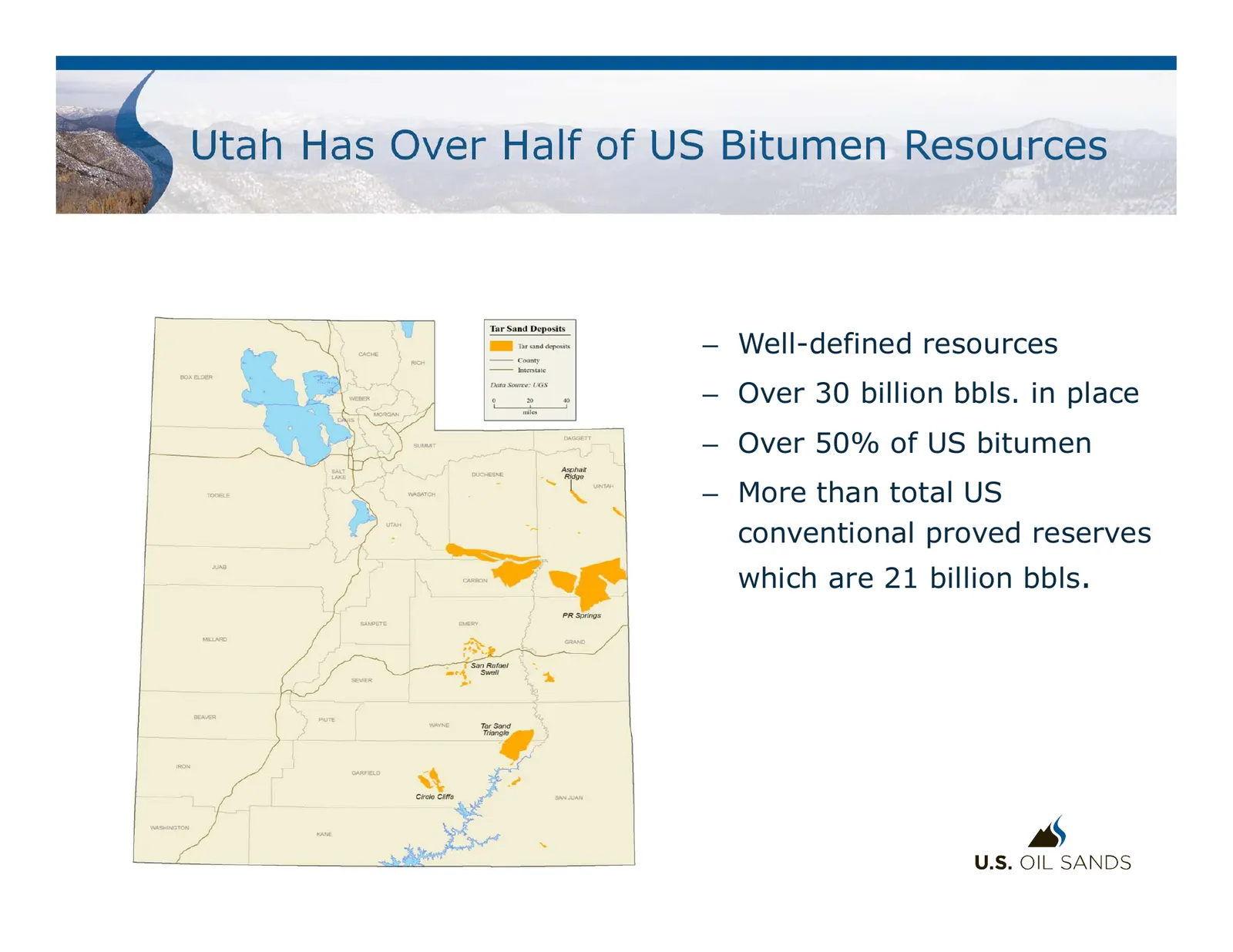
Slide 5: Utah Has Over Half of US Bitumen Resources
Utah Has Over Half of US Bitumen Resources – Well-defined resources – Over 30 billion bbls. in place – Over 50% of US bitumen – More than total US conventional proved reserves which are 21 billion bbls. 5
Slide 6: Introduction to US Oil Sands
Introduction to US Oil Sands • Calgary based oil sands mining company (TSXV: USO) • Public company listed on Toronto Venture Stock Exchange • Proprietary extraction process enables clean bitumen extraction • An “overnight sensation” 10 years in the making – 8 years as a private company prior to goin
Slide 7: US Oil Sands - A Resource Development Company
US Oil Sands - A Resource Development Company • US Oil Sands is focused on developing its Utah bitumen resources – Largest commercial oil sand land position in U.S. – 32,005 acres 100% owned Utah mining leases • Company expects to develop 50,000 BPD over next 10 years – PR Spring Project on stream i
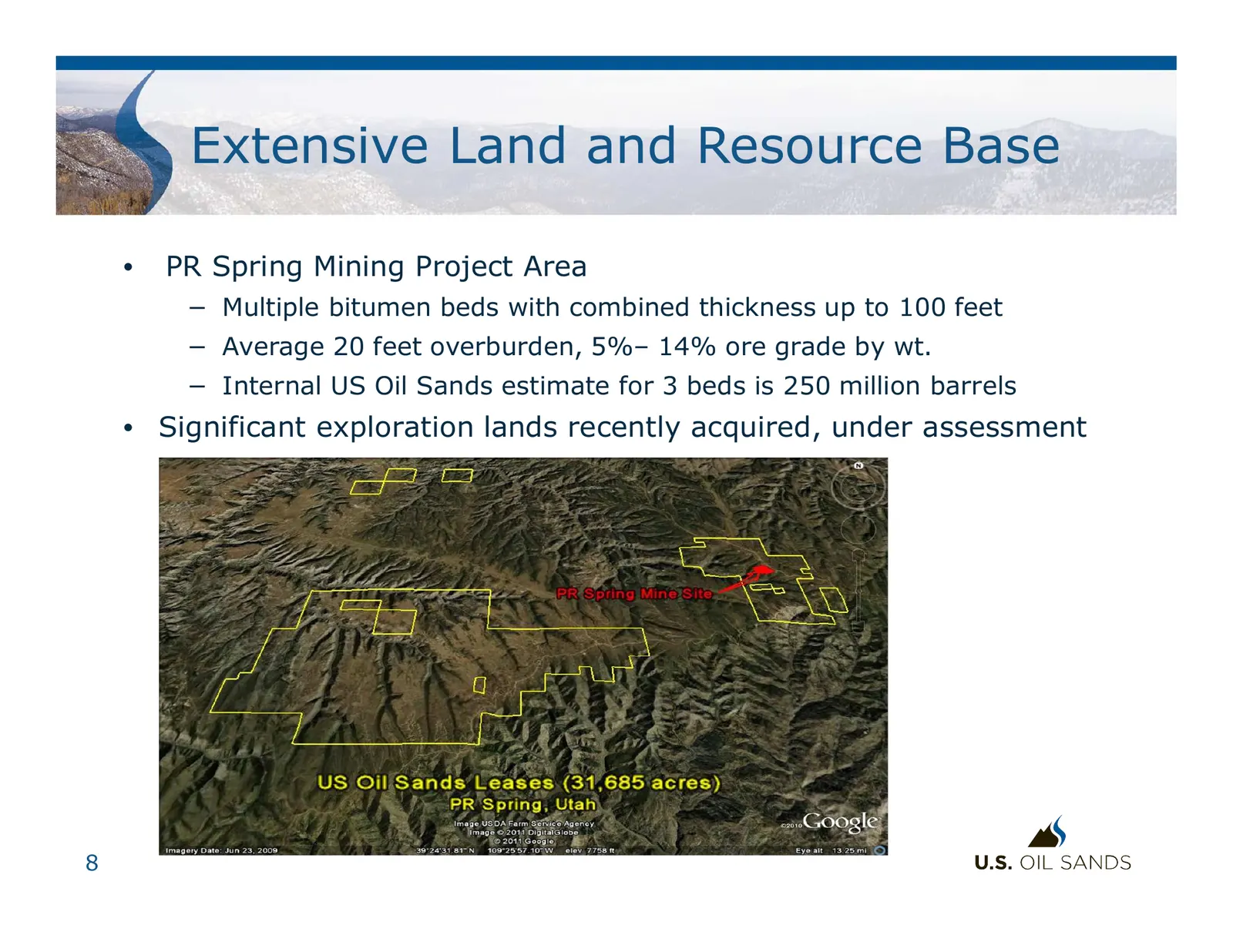
Slide 8: Extensive Land and Resource Base
Extensive Land and Resource Base • PR Spring Mining Project Area − Multiple bitumen beds with combined thickness up to 100 feet − Average 20 feet overburden, 5%– 14% ore grade by wt. − Internal US Oil Sands estimate for 3 beds is 250 million barrels • Significant exploration lands recently acquired,
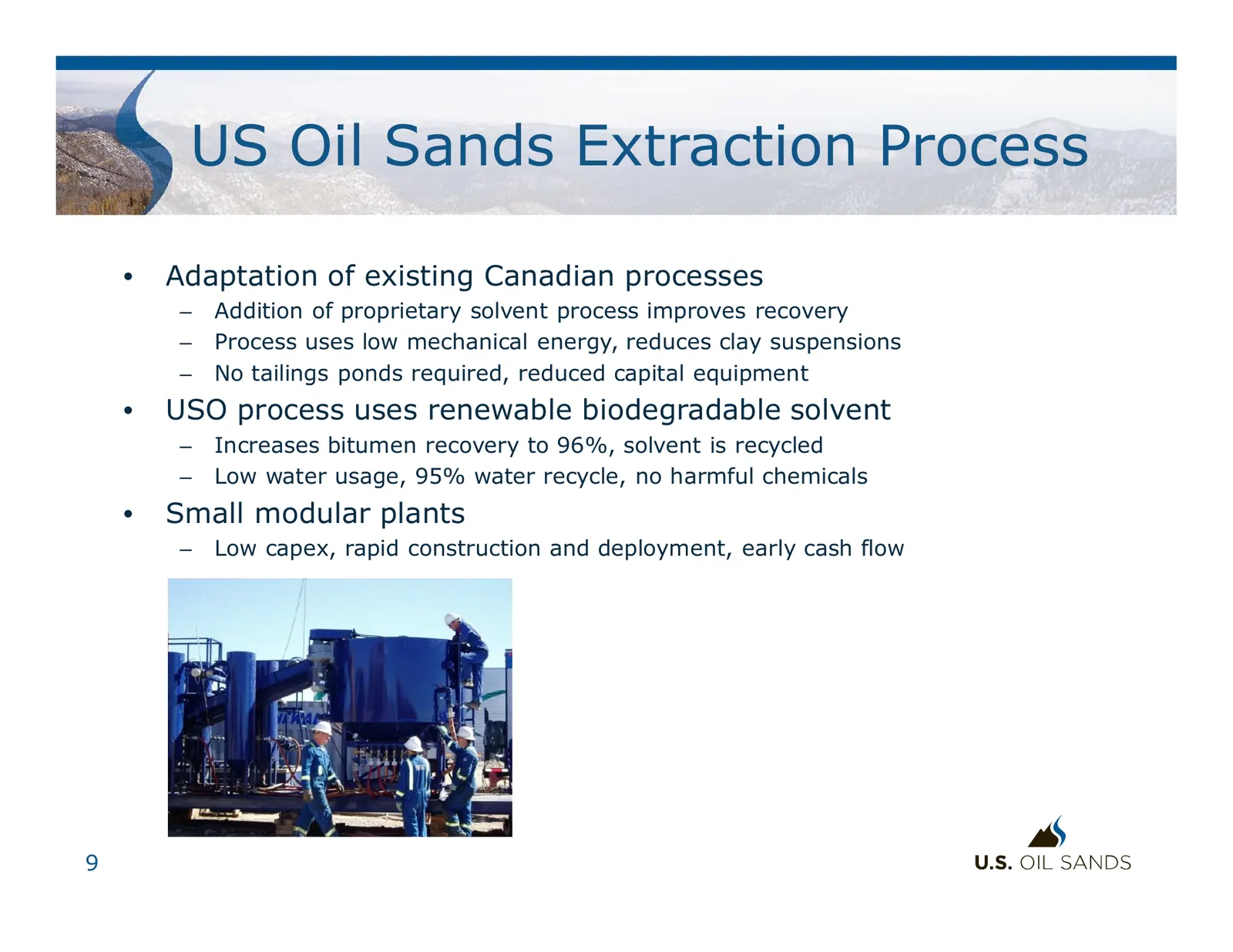
Slide 9: US Oil Sands Extraction Process
US Oil Sands Extraction Process • Adaptation of existing Canadian processes – Addition of proprietary solvent process improves recovery – Process uses low mechanical energy, reduces clay suspensions – No tailings ponds required, reduced capital equipment • USO process uses renewable biodegradable so
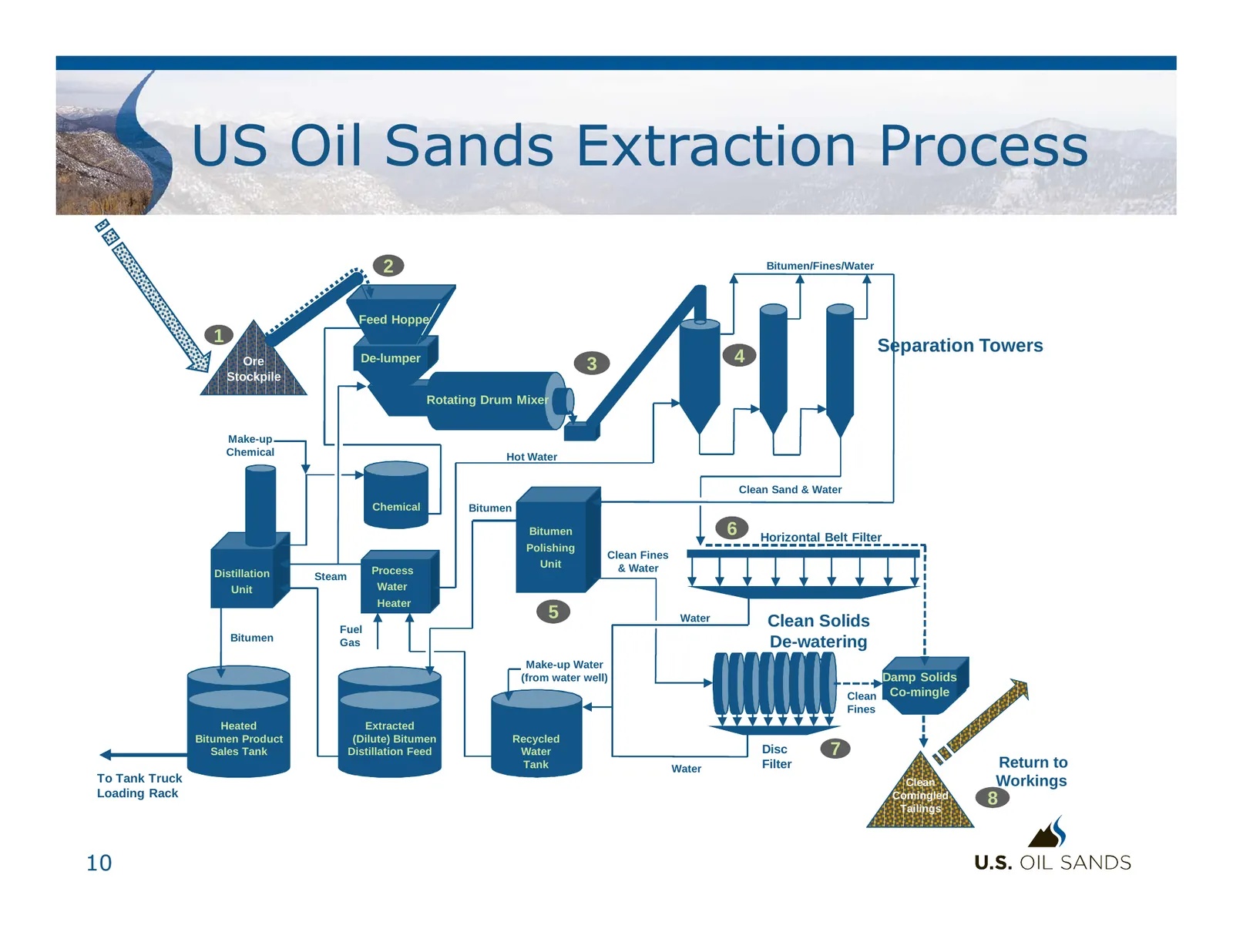
Slide 10: US Oil Sands Extraction Process
US Oil Sands Extraction Process 2 Bitumen/Fines/Water Feed Hopper 1 Separation Towers Ore De-lumper 3 4 Stockpile Rotating Drum Mixer Make-up Chemical Hot Water Extraction Clean Sand & Water Chemical Bitumen Bitumen 6 Horizontal Belt Filter Polishing Clean Fines Unit & Water Distillation Process Ste
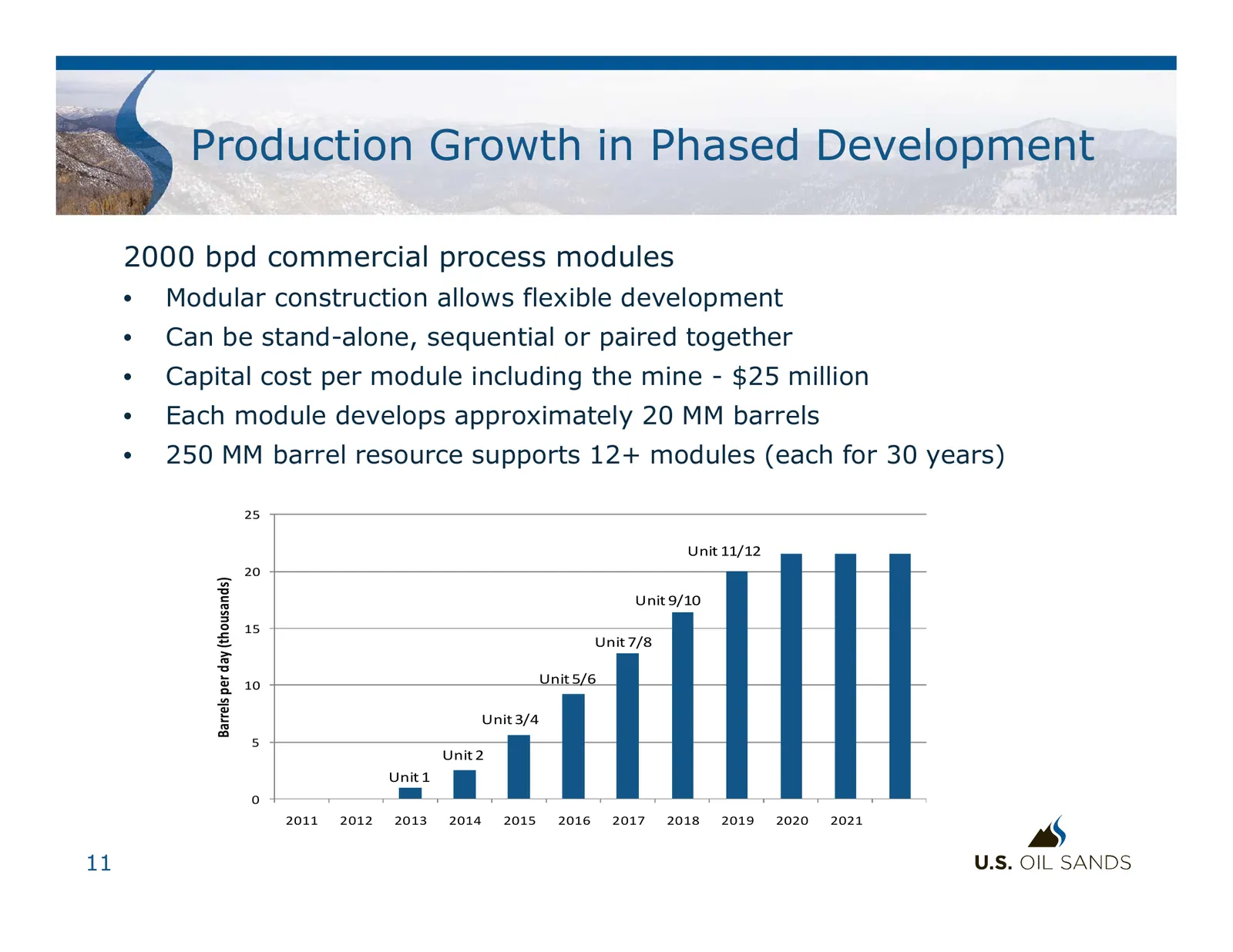
Slide 11: Production Growth in Phased Development
Production Growth in Phased Development 2000 bpd commercial process modules • Modular construction allows flexible development • Can be stand-alone, sequential or paired together • Capital cost per module including the mine - $25 million • Each module develops approximately 20 MM barrels • 250 MM ba
Slide 12: Best-in-Class Environmental Performance
Best-in-Class Environmental Performance Environmental Report Card • Air quality: Best-in-Class • Land footprint: Best-in-Class • Water Impact: Best-in-Class • Energy Usage: Best-in-Class • GHG Emissions: Best-in-Class 12
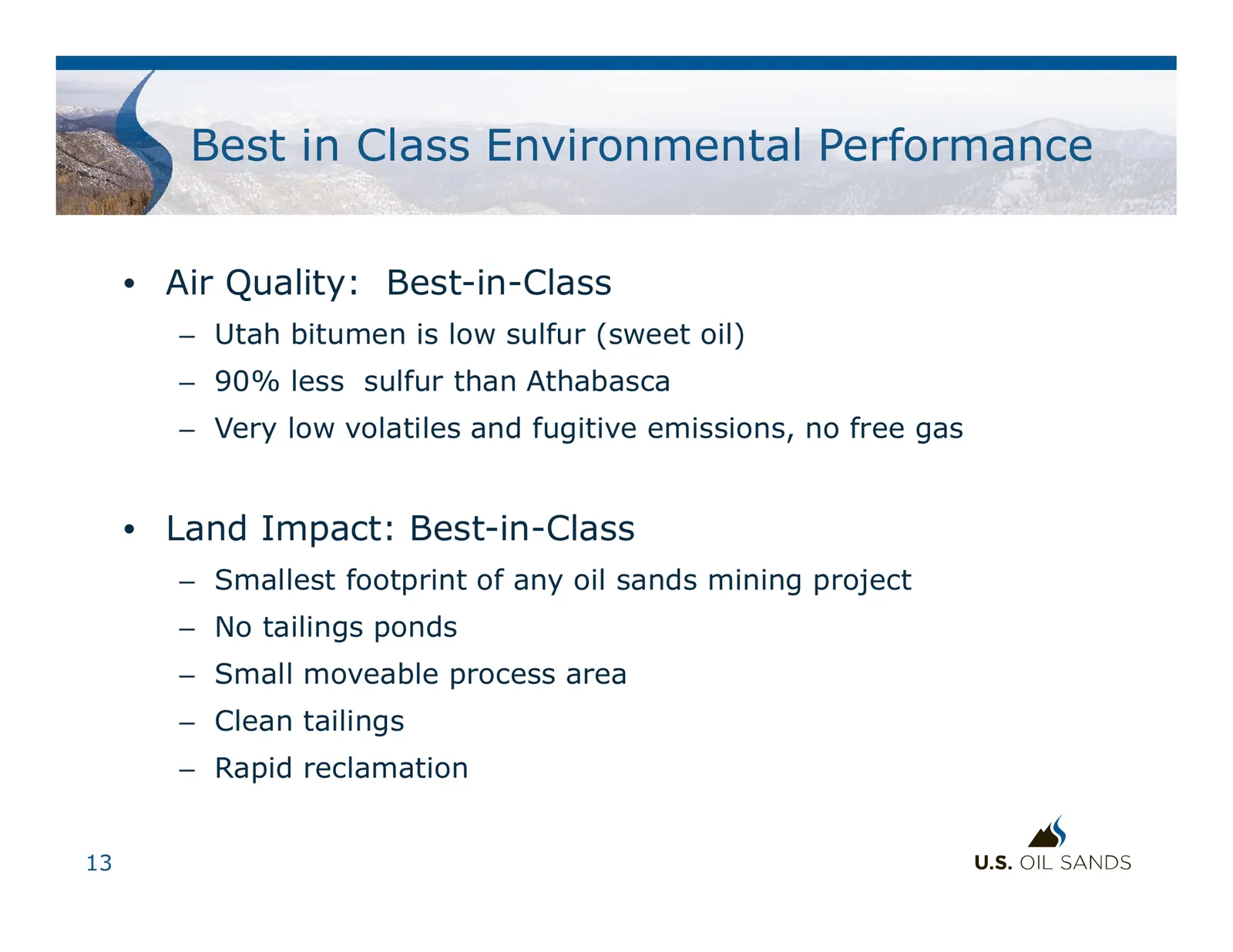
Slide 13: Best in Class Environmental Performance
Best in Class Environmental Performance • Air Quality: Best-in-Class – Utah bitumen is low sulfur (sweet oil) – 90% less sulfur than Athabasca – Very low volatiles and fugitive emissions, no free gas • Land Impact: Best-in-Class – Smallest footprint of any oil sands mining project – No tailings pond
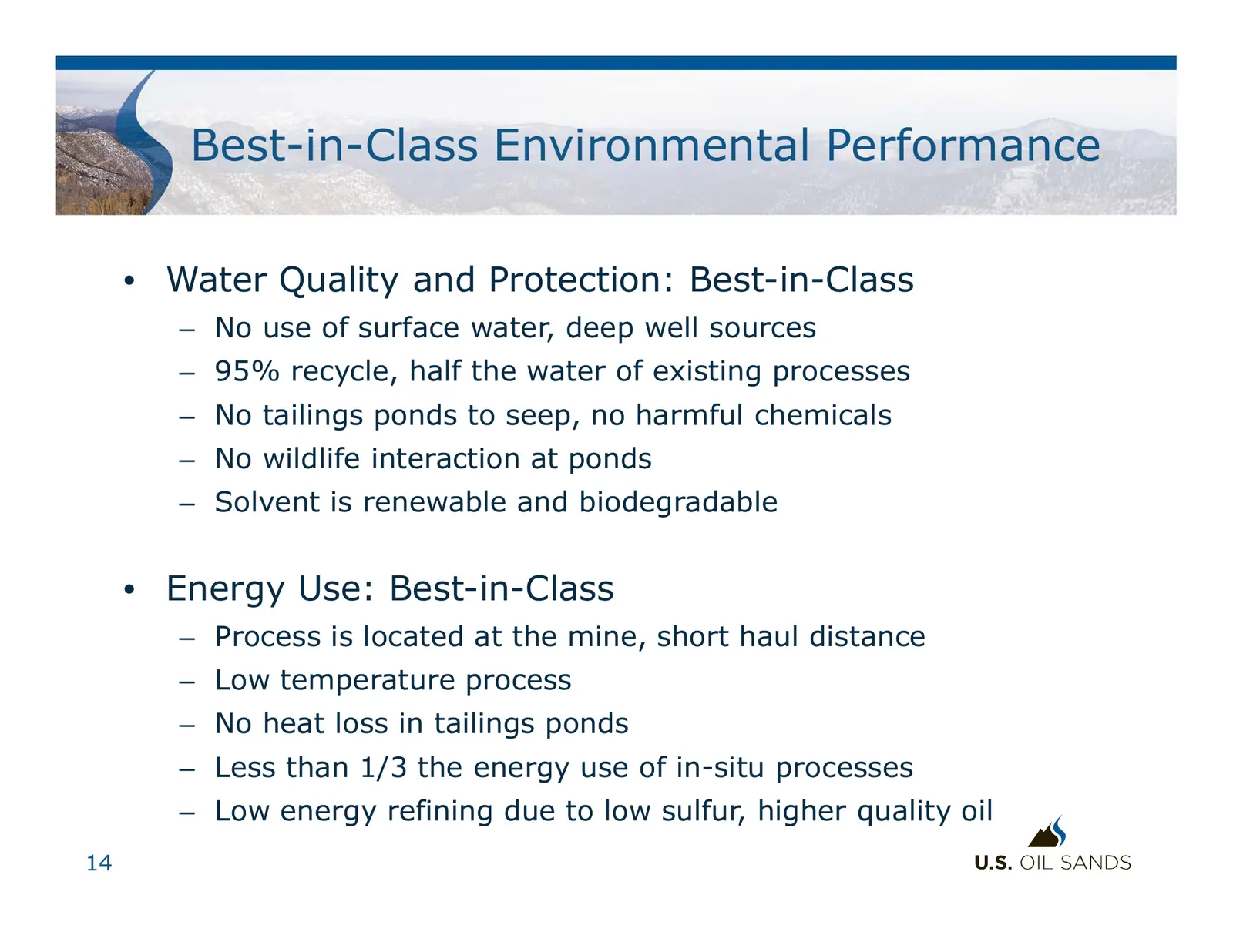
Slide 14: Best-in-Class Environmental Performance
Best-in-Class Environmental Performance • Water Quality and Protection: Best-in-Class – No use of surface water, deep well sources – 95% recycle, half the water of existing processes – No tailings ponds to seep, no harmful chemicals – No wildlife interaction at ponds – Solvent is renewable and biode
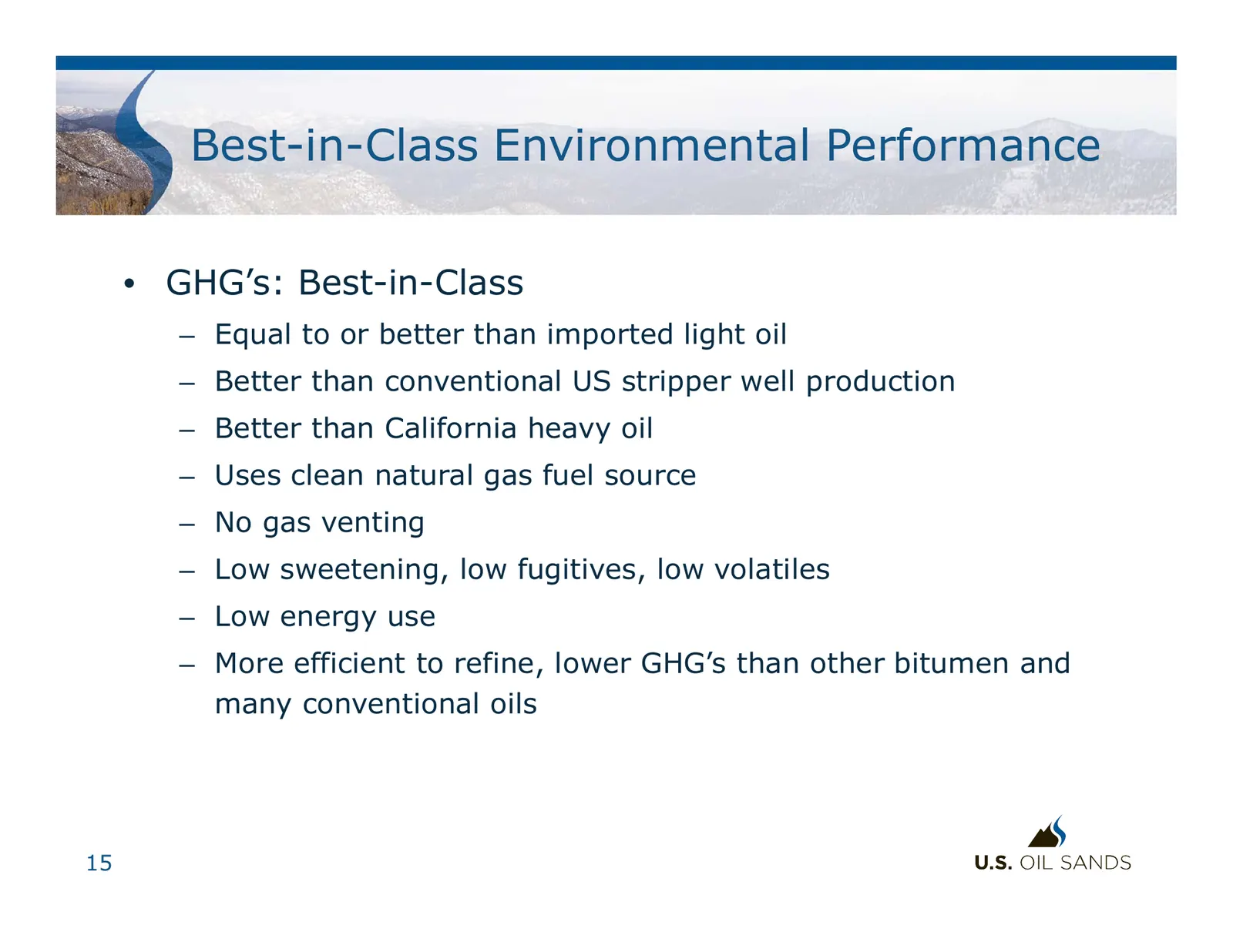
Slide 15: Best-in-Class Environmental Performance
Best-in-Class Environmental Performance • GHG’s: Best-in-Class – Equal to or better than imported light oil – Better than conventional US stripper well production – Better than California heavy oil – Uses clean natural gas fuel source – No gas venting – Low sweetening, low fugitives, low volatiles –
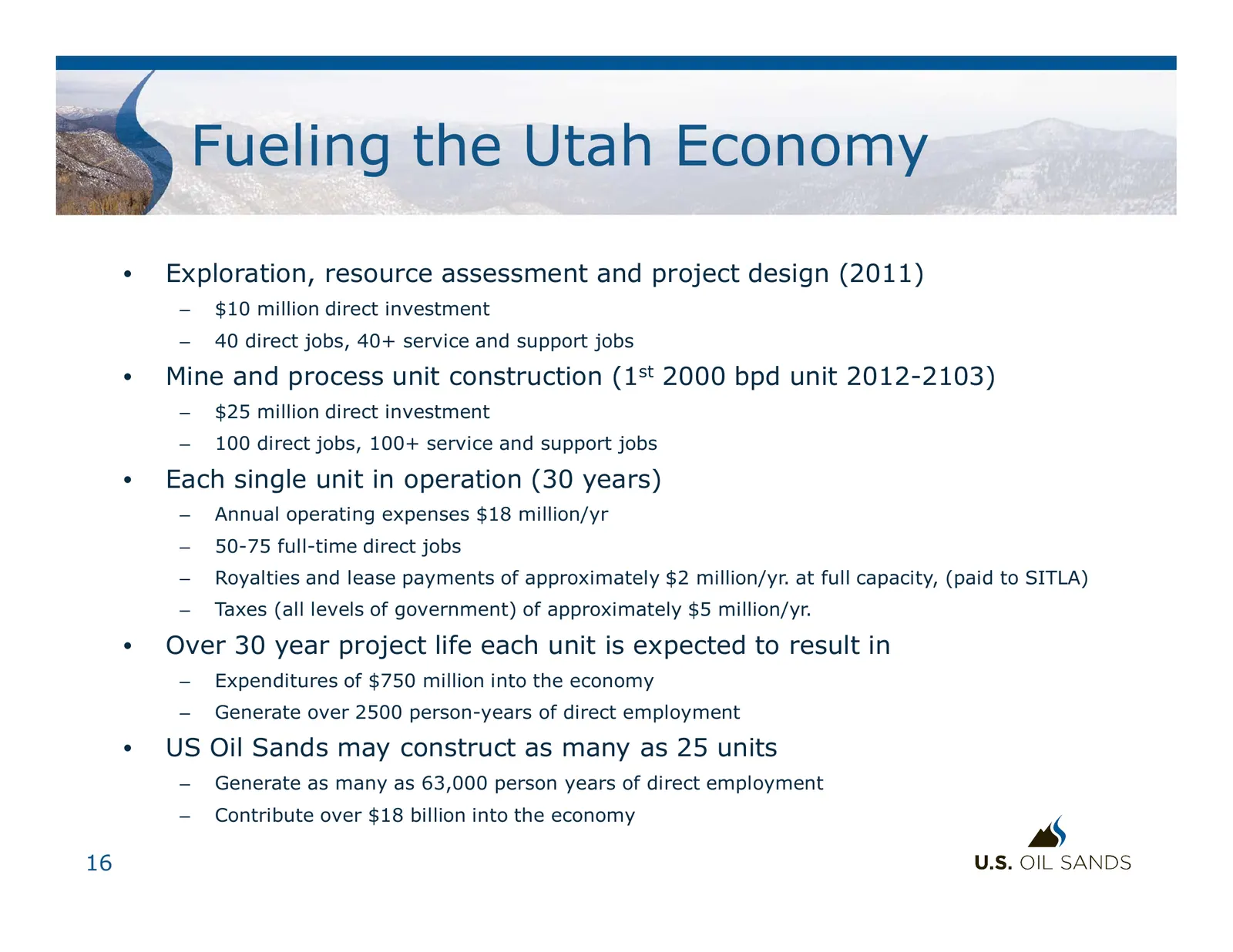
Slide 16: Fueling the Utah Economy
Fueling the Utah Economy • Exploration, resource assessment and project design (2011) – $10 million direct investment – 40 direct jobs, 40+ service and support jobs • Mine and process unit construction (1st 2000 bpd unit 2012-2103) – $25 million direct investment – 100 direct jobs, 100+ service and
Slide 17: Utah's Energy Future
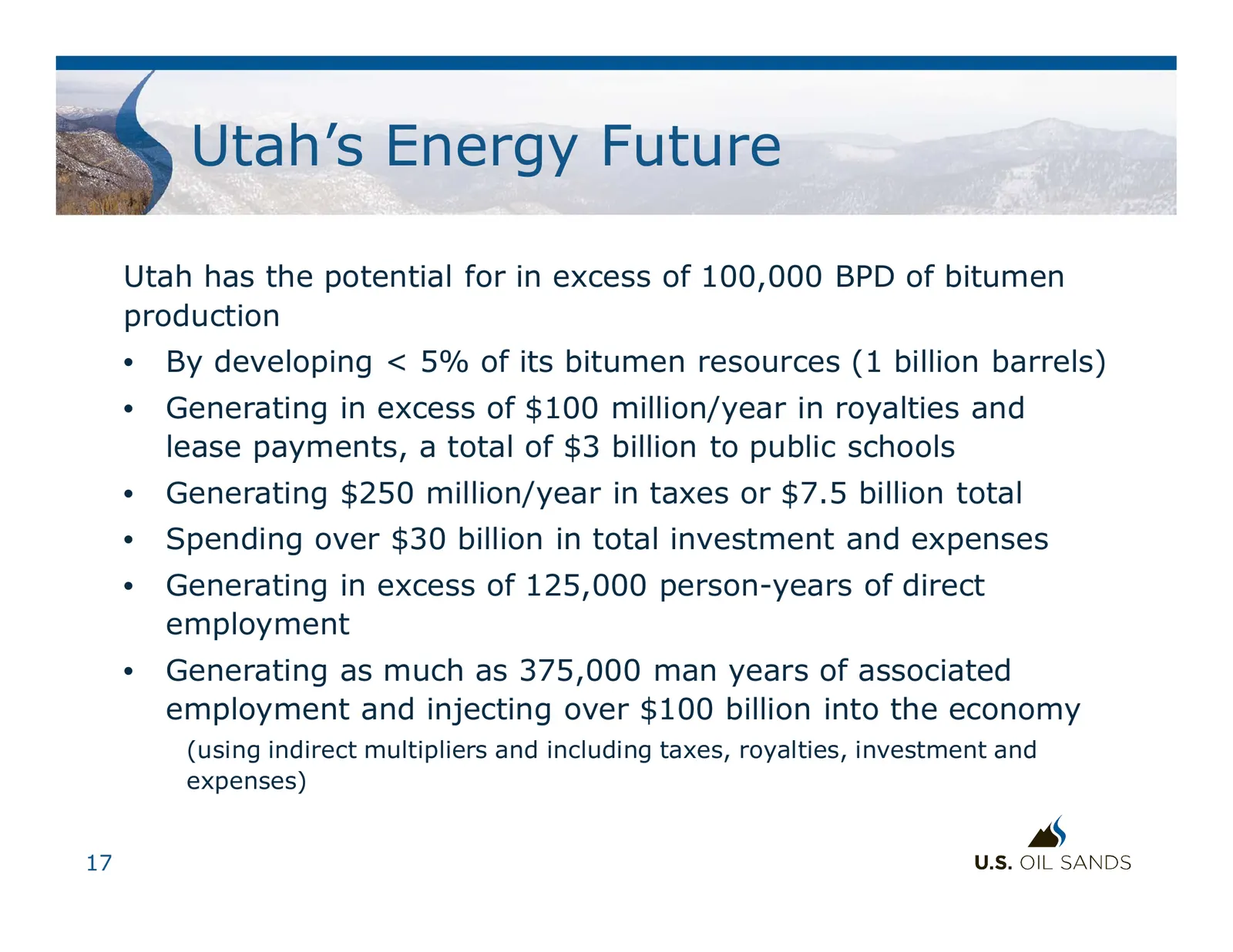
Utah’s Energy Future Utah has the potential for in excess of 100,000 BPD of bitumen production • By developing < 5% of its bitumen resources (1 billion barrels) • Generating in excess of $100 million/year in royalties and lease payments, a total of $3 billion to public schools • Generating $250 mill
Slide 18: How Do We Make It Happen?
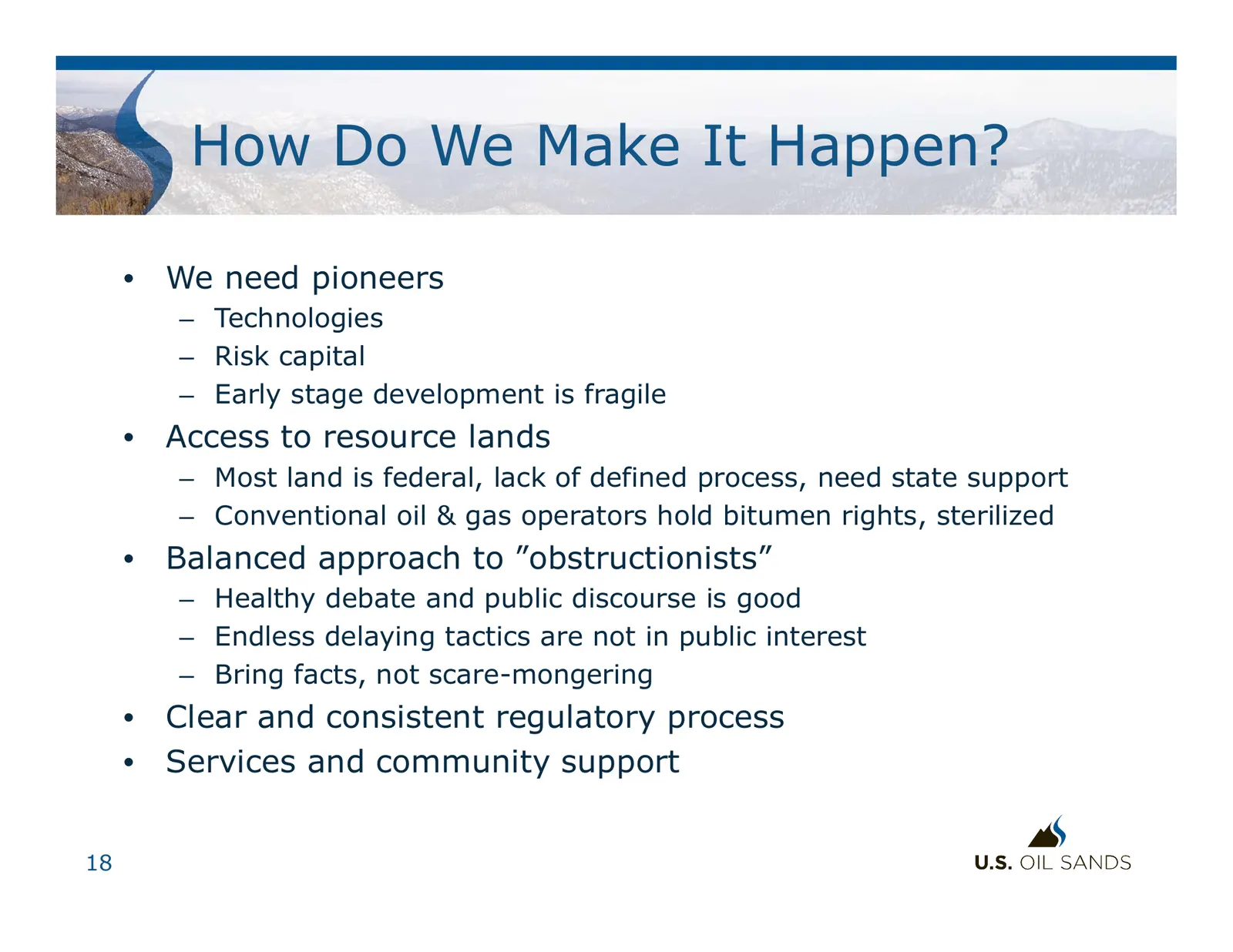
How Do We Make It Happen? • We need pioneers – Technologies – Risk capital – Early stage development is fragile • Access to resource lands – Most land is federal, lack of defined process, need state support – Conventional oil & gas operators hold bitumen rights, sterilized • Balanced approach to ”ob
Slide 19: Appendices
Appendices U.S. OIL SANDS
Slide 20: Planned 2013 Development Area
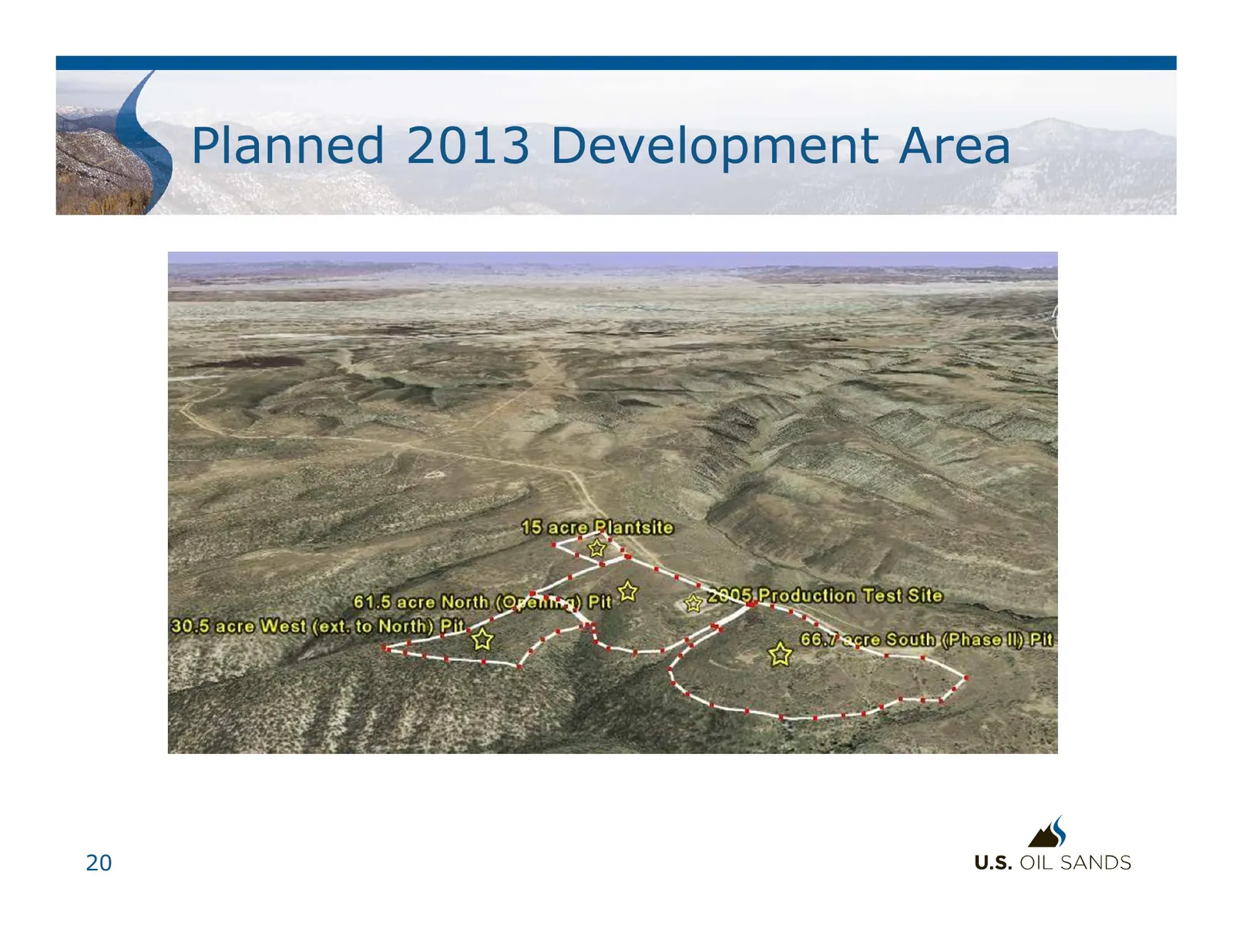
Planned 2013 Development Area 20
Slide 21: US Oil Sands Working in Harmony With the Environment
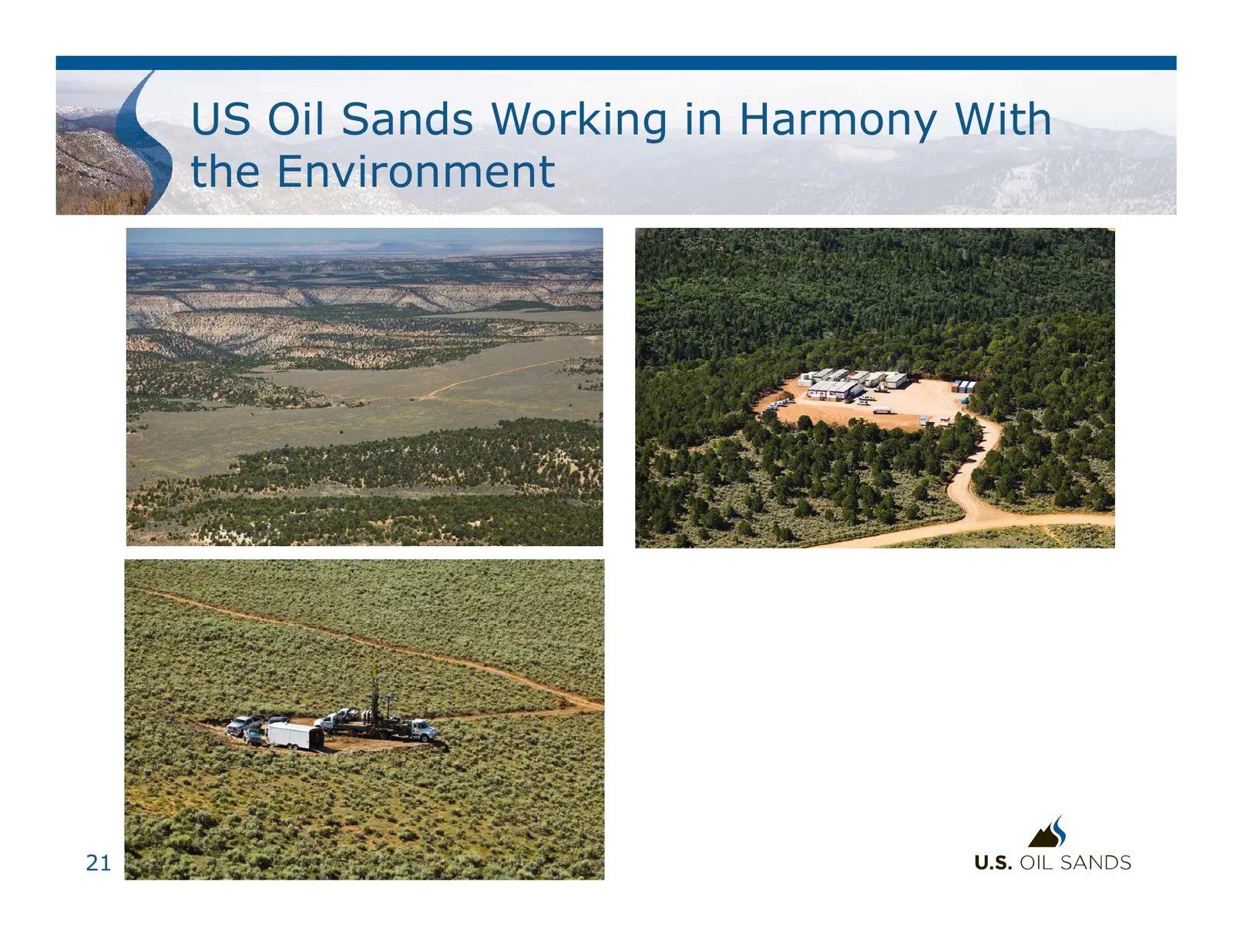
US Oil Sands Working in Harmony With the Environment 21
Slide 22: Mining Equipment – Wirtgen Surface Miner
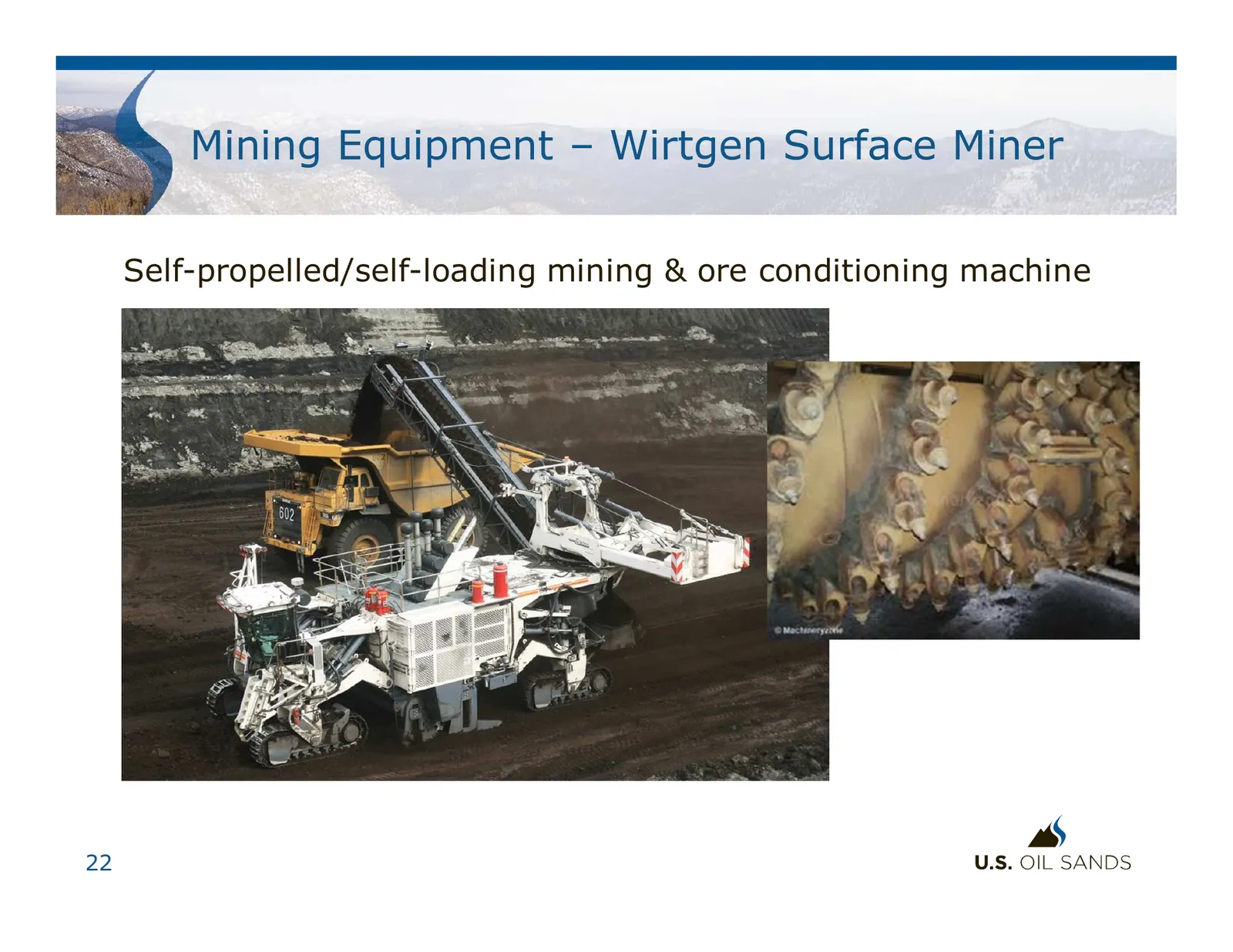
Mining Equipment – Wirtgen Surface Miner Self-propelled/self-loading mining & ore conditioning machine 22
Slide 23: An Adaptation for Oil Wet Reservoir Rock
An Adaptation for Oil Wet Reservoir Rock • Athabasca oil sands of Canada are “water wet” – Water sticks to the sand grains, bitumen and clay are in between – Clark process uses hot water to remove the oil – Hard to break oil-water-clay emulsions created in extraction process • Most oil sands in the
Slide 24: Process is Tested and Scalable
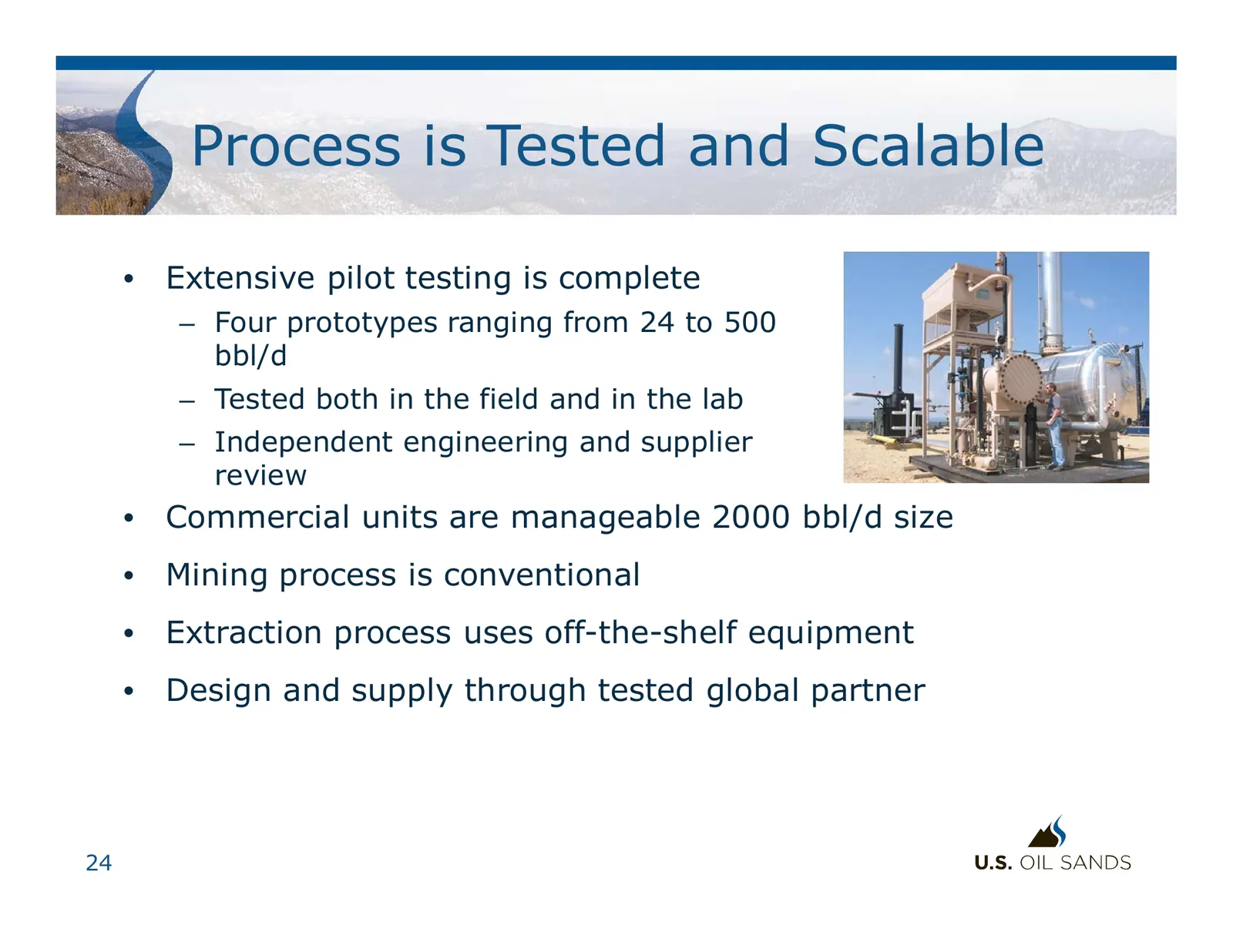
Process is Tested and Scalable • Extensive pilot testing is complete – Four prototypes ranging from 24 to 500 bbl/d – Tested both in the field and in the lab – Independent engineering and supplier review • Commercial units are manageable 2000 bbl/d size • Mining process is conventional • Extraction
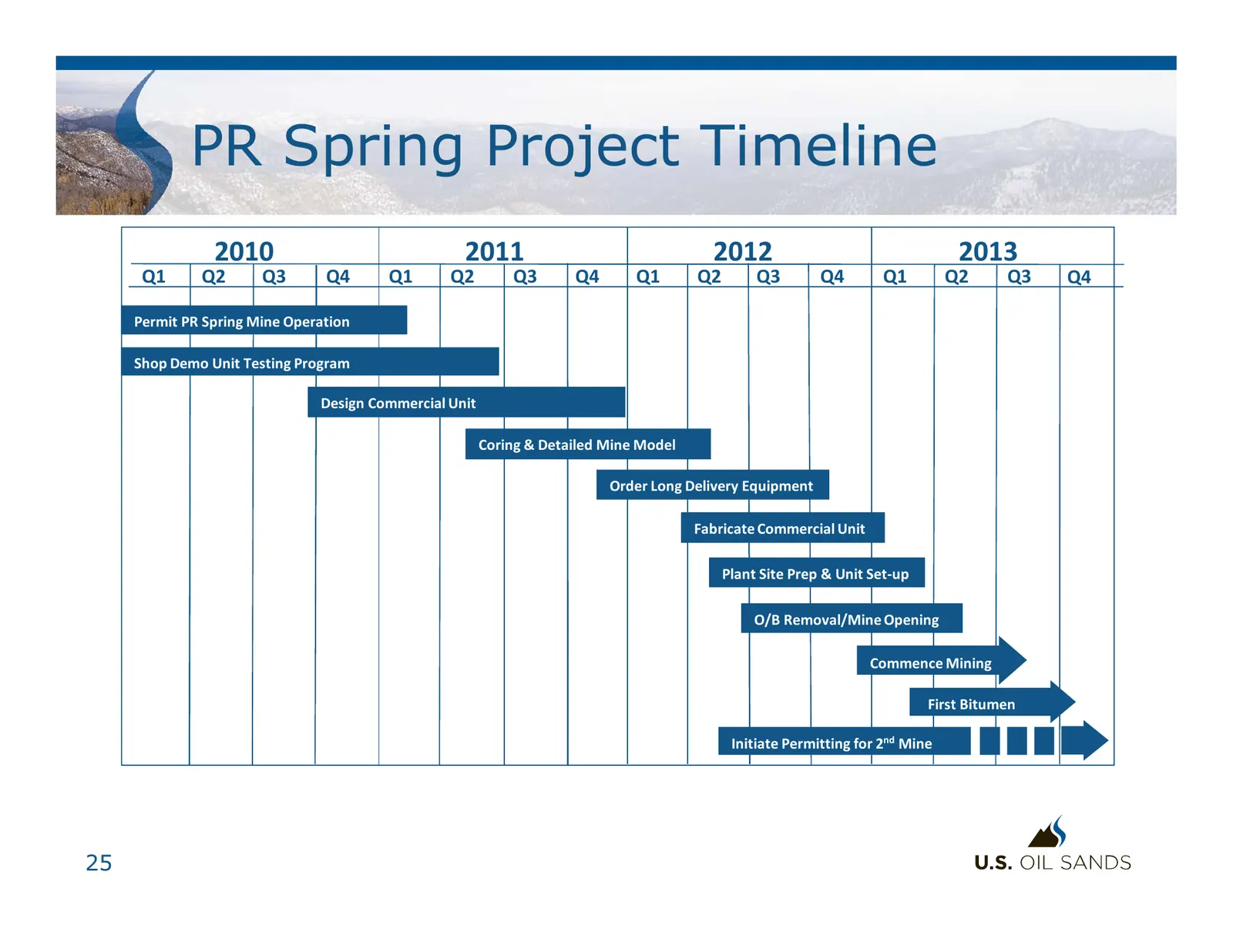
Slide 25: PR Spring Project Timeline
PR Spring Project Timeline 2010 2011 2012 2013 Q1 Q2 Q3 Q4 Q1 Q2 Q3 Q4 Q1 Q2 Q3 Q4 Q1 Q2 Q3 Q4 Permit PR Spring Mine Operation Shop Demo Unit Testing Program Design Commercial Unit Coring & Detailed Mine Model Order Long Delivery Equipment Fabricate Commercial Unit Plant Site Prep & Unit Set-up O/B
Slide 26: TSXV: USO
Cameron M. Todd Chief Executive Officer cameron.todd@usoilsandsinc.com D. Glen Snarr President & CFO glen.snarr@usoilsandsinc.com (403) 233-9366 www.usoilsandsinc.com TSXV: USO
Source: Internet Archive copy of usoilsandsinc.com
More decks from US Oil Sands Inc.
 Investor Presentation (September 2016)33 slides · September 2016
 Investor Presentation (December 2015)35 slides · December 2015
 Investor Presentation (July 2015)35 slides · July 2015
 Investor Presentation (September 2014)30 slides · September 2014
 Investor Presentation (September 2013)26 slides · September 2013
 Shareholder Meeting (May 2013)22 slides · May 15, 2013