
All figures and tables referred to in this announcement can be viewed via the following link: http://www.rns-pdf.londonstockexchange.com/rns/8542H_1-2022-11-29.pdf


29 November 2022
AIM: AAU
SIGNIFICANT INCREASE IN TAVSAN RESOURCE
Ariana Resources plc ("Ariana" or the "Company"), the AIM-listed mineral exploration and development company with gold mining interests in Europe, is pleased to announce an update to its JORC Resource Estimate for the Tavsan Mine. The mine is currently in construction and being operated by Zenit Madencilik San. ve Tic. A.S. ("Zenit") in partnership with Proccea Construction Co. and Ozaltin Holding A.S. and is 23.5% owned by Ariana.
Highlights:
· Global Resource increased by 22% over the previous Mineral Resource Estimate ("MRE") to 6.6 Mt at 1.44 g/t Au and 5.26 g/t Ag for 307,000 oz Au and 1.1 million oz Ag (all categories)*.
· High-grade domain of 1.1 Mt at 2.74 g/t Au and 4.89 g/t Ag for 96,000 oz Au and 171,000 oz Ag (all categories)* is defined for the first time.
· Significant additional potential of 1.7Mt of below cut-off grade material occurs in the 0.5 to 0.7 g/t Au range for c.34,000 oz Au (not currently classified as Resources)*.
· Resource is further de-risked with 83% now classified in the Measured & Indicated JORC Resource categories.
· Exploration targets previously defined in the East and South zones are being assessed and up to 4,600m of drilling is currently underway to test resource extensions; resource is not closed-off in several areas.
*All Mineral Resource figures in the announcement are quoted gross with respect to Zenit of which Ariana owns 23.5%.
Dr. Kerim Sener, Managing Director, commented:
"This MRE represents a tremendous enhancement for Tavsan, as construction continues on site. Not only has the total resource grown to c.7 Mt but about 1 Mt of this is now attributed to a newly defined high-grade domain containing sufficient resources to potentially satisfy up to three years of gold output in its own right. This is all the more impressive considering that the 2016 Scoping Study had only considered a total mine life of four years from the entire resource. Current planning is consequently focusing on a mine life of eight years.
"When we acquired the project in 2008, we did so with the expectation that the resource could grow to this scale. Now that we have achieved this significant milestone, and after having completed additional work, we see that there is further room for growing the resource. This is already apparent when considering the potential impact of a lower cut-off grade of 0.5 g/t, which could add a further 34,000 oz of gold to the resource currently, which could aid the further extension of mine life.
"This resource estimate will be updated again in 2023 following the conclusion of a new drilling programme which commenced a couple of weeks ago and is continuing to test for further resource extensions. The current resource estimate will now be used to update our financial models and mine optimisations, which we are aiming to complete and announce as our Definitive Feasibility Study in due course.
"Tavsan represents our most significantly de-risked project after Kiziltepe, which contains resources now larger than those remaining at our operating mine. As a result, Tavsan is expected to become a more significant operation than Kiziltepe in the coming years."
The information contained within this announcement is deemed by the Company to constitute inside information as stipulated under the Market Abuse Regulations (EU) No. 596/2014 as it forms part of UK Domestic Law by virtue of the European Union (Withdrawal) Act 2018 ("UK MAR").
Introduction
Between late 2021 and early 2022, the Ariana and Zenit teams undertook a significant new drilling programme across the Tavsan Sector for 4,355m (Figure 1) comprising 112 diamond drillholes (including twelve geotechnical drill holes for 374.6m), following which a revised Mineral Resource Estimate ("MRE") was completed. This phase of estimation has involved integrating the latest drilling data (see RNS 16 June 2022), which has, in addition to increasing the global resource, enhanced confidence in resource classification within the MRE. Updates to the Tavsan MRE have been reviewed by the Ariana and Zenit geological teams in detail.
This announcement summarises the modelling and resource estimation methods. The classified resources are as detailed in the JORC Table 1.
Tavsan Resource Estimate
The new Tavsan JORC 2012 compliant MRE is prepared in accordance with JORC 2012 and based on 159 diamond drill holes (6,205m), 128 RC drill holes (4,119m) and 156 rock-saw channels (1,169m) representing a total of 11,493m of drilling. The mineralised zones represent the most current geological data and understanding.
This data was collectively reviewed and modelled to create representative three-dimensional mineralisation domains for the Tavsan deposit. Estimation of grade and tonnage were attributed to the mineralisation models based on internal and external laboratory assay data and drill core density studies (where available). A three-dimensional block model was constructed from the mineralisation model based on optimal block size parameters of 10x10x5m as defined by the Zenit mining team.
The mineralisation model and associated block model will be subjected to a new open-pit optimisation study to be completed internally by the Zenit mining team under revised economic input parameters according to the latest economic and processing factors.
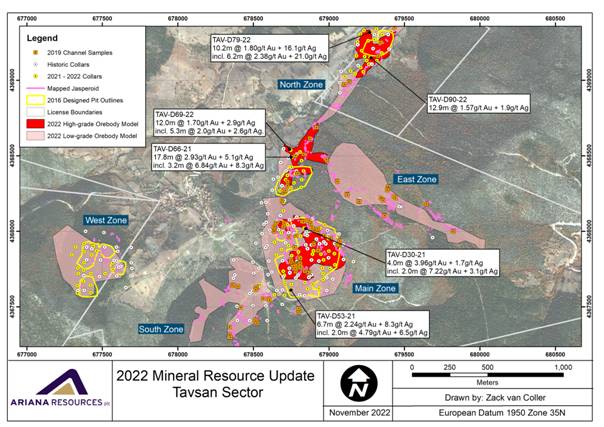
Figure 1: Plan view of the Tavsan area, showing all recent drill collar positions, rock-saw channel samples, mapped jasperoid outcrops, and the surface projection of the 2022 Tavsan high-grade and low-grade MRE domains.
Geological Modelling
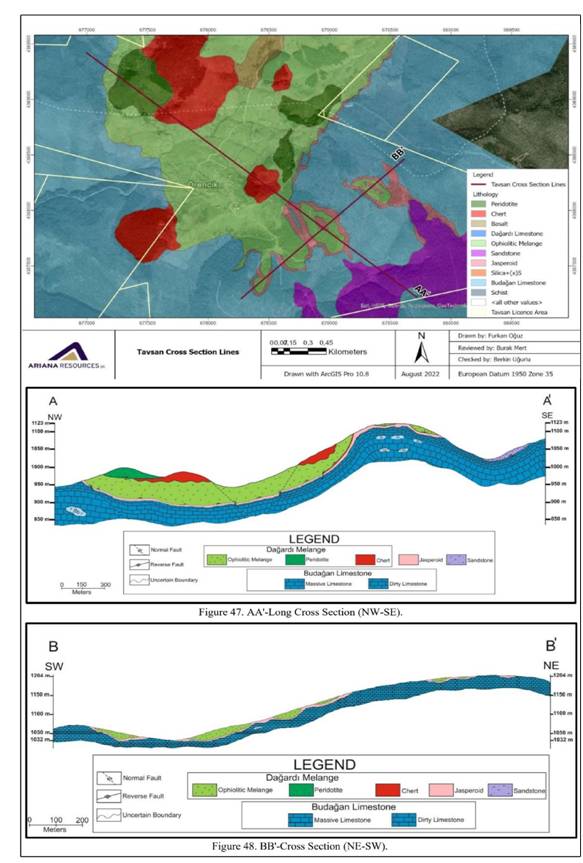
Gold mineralisation at Tavsan is epithermal in style, with associated silver and antimony, broadly located along the thrust contact between Jurassic-Cretaceous massively bedded limestone and an overlying Upper Cretaceous multi-lithic ophiolite sequence. In addition, a karstic network within the limestone and fractures within the ophiolitic rocks potentially acted as conduits for the development of jasperoidal and generally silicified rocks, several tens of metres, below and above the thrust fault contact, respectively.
The mineralised jasperoid developed along the thrust contact is irregular in form on a ten meter-scale but broadly follows the gentle topography on a hundred meter-scale and is largely exposed at surface (Figure 2). In the vicinity of a NE-SW trending fault zone, the thrust is steeper than the topographic gradient, resulting in a more steeply dipping zone of mineralisation. The greatest thickness of gold-bearing jasperoid is observed in the vicinity of the NE-SW fault zone. However, gold concentration appears to have a dominant NW-SE control within the jasperoid as a whole, suggesting the potential for steeply dipping conduit structures cross-cutting the limestone units in the footwall.
This mineralisation is modelled using assay data, geological logging and three-dimensional interpolation modelling methods. This was completed within Leapfrog Geo 6.0.5, using the "vein" tool to define mineralisation domains based on manually isolated economic drill composites. Economic composites with up to one metre of internal dilution were defined using a nominal 0.5 g/t Au modelling cut-off for lower grade or peripheral intercepts whilst a 1.5 g/t Au modelling cut-off was applied to define the high-grade domains. The continuity of the various structures is reflected in the Mineral Resource classification. Exploration target areas on the periphery of the system are defined by surface mapping, soil pXRF, rock-chip and rocksaw-channel sampling assay results and drilling where available.
Estimation Methodology
Tonnage and grade estimation of the defined mineralisation domains was completed using Leapfrog EDGE. A 10 g/t Au top-cut was applied to the assay data (where required). It was determined that silver did not require a top-cut.
Compositing of assay data was completed within Leapfrog EDGE, using a 1m best fit routine within the domain boundaries. Hard domain boundaries were applied to all domains, which forced all samples to be included in one of the composites by adjusting the composite length while keeping it as close as possible to the selected intervals of 1m.
Specific density averages were applied to the mineralisation domains based on a total of 896 density measurements acquired from diamond drill core during the 2021/2022 programme. Accordingly, the Tavsan mineralisation has been determined to range from 2.60 g/cm3 to 2.64 g/cm3, depending on the intensity of brecciation and/or silicification. Density values have been determined for each zone based on this data.
The block model used is a non-rotated conventional model with no sub-blocking applied (Figure 3). The block model was constructed using a 10m E by 10m N by 5m RL parent block size, which is deemed suitable by the Zenit mining team. Isotropic search ellipses and ranges were used. The variable orientation function (dynamic anisotropy) was used in Leapfrog EDGE to better represent the grade distribution. Estimation was carried out using Inverse Distance Weighting Squared (IDWS) at the parent block scale using a three-pass estimation using all available composites within the hard boundary. The IDWS method was selected as the most suitable method of interpolation for this deposit.
The estimates were completed separately for High-grade and Low-grade domains. Domaining the High-grade zones separately minimised cross-boundary extrapolation of grades from the High-grade zone to the Low-grade zone and vice versa. Low-grade domains have been modelled above a 0.5 g/t Au cut-off and reported above a 0.7 g/t Au cut-off grade, whilst High-grade domains have been modelled and reported above a 1.5 g/t Au cut-off grade. Cut-off grade is based on assumptions concerning mining and processing cost, metallurgical recovery and metals prices, as defined by the Zenit mining team.
The effect of a lower cut-off of 0.5 g/t Au was also assessed, and it was determined that a further 1.7 Mt at 0.61 g/t Au (for 34,000 oz Au) of below cut-off grade material exists within the 0.5-0.7 g/t Au grade range. This will be assessed further in the coming studies, as this represents a considerable tonnage of currently sub-economic but otherwise significant mineralisation.
During the review of the Tavsan MRE, a visual validation between drillhole data, composite data and block model data were carried out. No mining factors (i.e. dilution, ore loss, recoverable resources at selective mining block size) have been applied to the Resource Estimate. Likewise, no metallurgical factors have been applied. It is assumed that the ore will be mined via open-pit operations with Heap Leach used for gold and silver extraction.
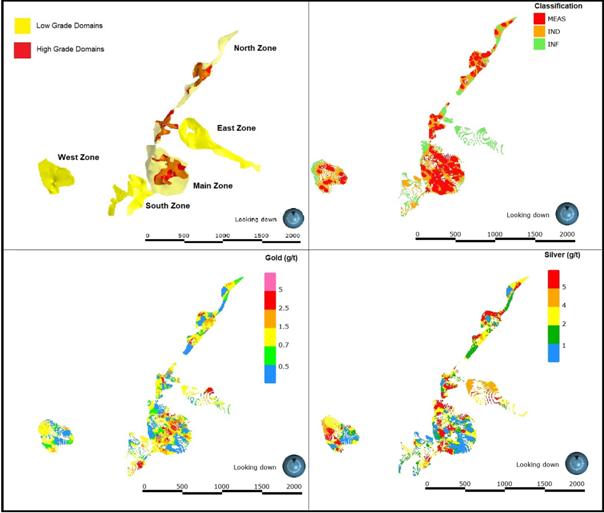
Figure 3: Top left: Tavsan mineralisation domains, showing High-grade domains modelled at 1.5 g/t Au in red, and Low-grade domains modelled at 0.5 g/t Au in yellow. Top right: Tavsan 2022 block model colour coded according to defined classification in accordance with JORC 2012. Bottom: Tavsan 2022 block model coded according to mineralisation grades for both gold (left) and silver (right).
Tavsan Sector Exploration Upside
During 2021 and 2022, the Ariana team continued to develop drilling targets within the Tavsan Sector. This work is critical for generating future sources of potential ore for production. These areas include a series of underexplored outcropping or sub-cropping mineralised units at the periphery of more well-defined parts of the Tavsan mineralisation. The drilling targets are defined by surface geological mapping (1:2,000 to 1:5,000 scale), surface soil, rock-chip and channel sample assay results and any available drilling. Recent mapping and sampling have confirmed the potential of some of these areas, notably in the East and South zones.
Tavsan Resource Classification
The Mineral Resource is classified and reported in accordance with the 2012 JORC Code (JORC Table 1) as Measured, Indicated and Inferred (Table 1). The classification is determined based on search pass spacing, with confidence increasing with proximity to drill holes. Importantly, 50% of the Resource sits within the Measured category, with 33% in Indicated and 17% in Inferred categories.
Table 1: Summary of 2022 Tavsan Sector MRE classified and reported in accordance with JORC 2012 (see associated JORC Table 1 for details). Reporting is based on cut-off grades as noted in the table. All figures are quoted gross with respect to Zenit. Figures in the table may not sum precisely due to rounding.
TAVSAN | Average Value | Material Content | ||||||
Classification | Volume | Density | Mass | Au | Ag | Au | Ag | |
m³ | g/cm³ | t | g/t | g/t | t. oz | t. oz | ||
High-grade Domain | MEASURED | 241,500 | 2.62 | 632,700 | 3.00 | 4.76 | 60,980 | 96,800 |
INDICATED | 135,000 | 2.62 | 353,000 | 2.55 | 4.55 | 28,950 | 51,660 | |
INFERRED | 39,000 | 2.60 | 101,400 | 1.75 | 6.87 | 5,720 | 22,400 | |
Sub-total | 415,500 | 2.62 | 1,087,200 | 2.74 | 4.89 | 95,650 | 170,860 | |
Low-grade Domain | MEASUSRED | 935,000 | 2.62 | 2,447,400 | 1.19 | 5.15 | 93,300 | 405,080 |
INDICATED | 728,500 | 2.61 | 1,902,000 | 1.19 | 5.64 | 73,000 | 344,790 | |
INFERRED | 457,500 | 2.61 | 1,196,100 | 1.19 | 5.24 | 45,660 | 201,320 | |
Sub-total | 2,121,000 | 2.61 | 5,545,500 | 1.19 | 5.33 | 211,960 | 951,190 | |
TOTAL | MEASURED | 1,176,500 | 2.62 | 3,080,100 | 1.56 | 5.07 | 154,280 | 501,880 |
INDICATED | 863,500 | 2.61 | 2,255,100 | 1.41 | 5.47 | 101,950 | 396,450 | |
INFERRED | 496,500 | 2.61 | 1,297,500 | 1.23 | 5.36 | 51,380 | 223,710 | |
Total | 2,536,500 | 2.61 | 6,632,700 | 1.44 | 5.26 | 307,610 | 1,122,040 | |
Sampling and Assaying Procedures
All diamond drill core is being processed at the Kiziltepe mine site and analysed at the Kiziltepe Mine Laboratory. Results are assessed systematically and are grouped according to individual mineralised zones at the Tavsan Sector.
HQ size drill-core samples from the drilling programme at the Tavsan deposit were cut in half by a diamond saw and sent for analysis in batches in line with the Company's quality control procedures. A total of 3,997 samples (including 631 QA/QC samples) were submitted to the Kiziltepe Mine Laboratory. A total of 2,347 samples (including 301 QA/QC samples) were submitted to ALS Global, Izmir as an external laboratory check to add confidence to the Kiziltepe Mine Laboratory results, particularly during laboratory expansion works.
QA/QC sample insertion rates vary depending on the batch size accepted by the laboratory. Ariana sampling protocol requires insertion of 4 QA/QC samples per batch to include 1 blank, 1 CRM, 1 field duplicate and 1 pulp duplicate to assess the accuracy and precision of all stages of the sampling and analysis. During the 2021-2022 drilling, Zenit QA/QC protocol required 1 blank, 1 CRM and 1 field duplicate and over 10% samples analysed at external laboratory. The Zenit QA/QC protocol is under review by both Ariana and Zenit teams following the laboratory upgrade.
Core recovery for all drilling conducted at Tavsan during the 2021/2022 campaign was 88%, for a total of 2,854 measurements. 95% of this latest phase of drilling had over 70% recovery.
Between 2020 and 2021, the Kiziltepe Mine Laboratory has undergone an extensive expansion to meet the significant demands for sample assaying, from both the mining and exploration teams. This expansion is complete with the onsite laboratory now housing seven furnaces, two ICPOES instruments, two Atomic Absorption spectrometers (AAS), three drying ovens, three crushers and three pulverisers. The laboratory upgrades now allow the Zenit team to increase their sampling throughput by 48% (70 samples per day to 135). The two major upgrades for 2021 included with the above mentioned is the addition of 1) a multi-element ICP-OES (PerkinElmer Avio 550) analyser, and 2) an Elementrac CS-i sulphur-carbon analyser. The ICP-OES provides the team with a full suite of elements on selected samples (as opposed to just gold and silver). However, new operating procedures are currently being internally reviewed and calibrations of the new instruments are being assessed. As part of this, the laboratory team are sending in excess of 10% of their crushed rejects from selected drill core samples to ALS Global in Izmir for check assays, with 59% of the Tavsan samples also analysed at ALS. Zenit's internal QA/QC data and sample duplicates have been reviewed and are considered satisfactory for Ariana's reporting purposes. In addition, since October 2022 the Kiziltepe Mine Laboratory has been accredited by the Turkish Accreditation Agency (TÜRKAK) with "TS EN ISO/IEC 17025:2017 General Requirements for the Competence of Experimental and Calibration Laboratories".
All samples were assayed for gold using a 30g fire assay. Reviews of the assay results have determined that all Quality Control and Quality Assurance samples (blanks, standards and duplicates) passed the required quality control checks established by the company, with duplicate samples showing excellent correlation. Laboratory sample preparation, assaying procedures and chain of custody are appropriately controlled. The Company maintains an archive of half core samples and a photographic record of all cores for future reference.
Contacts:
Ariana Resources plc | Tel: +44 (0) 20 7407 3616 |
Michael de Villiers, Chairman | |
Kerim Sener, Managing Director | |
Beaumont Cornish Limited | Tel: +44 (0) 20 7628 3396 |
Roland Cornish / Felicity Geidt | |
Panmure Gordon (UK) Limited | Tel: +44 (0) 20 7886 2500 |
John Prior / Hugh Rich / Atholl Tweedie | |
Yellow Jersey PR Limited | Tel: +44 (0) 7951 402 336 |
Dom Barretto / Henry Wilkinson |
Editors' Note:
The Mineral Resource estimate was prepared by Zack van Coller BSc (Hons), Special Projects Geologist, Ariana Resources plc. Mr. van Coller is a Competent Person as defined by the JORC Code, 2012 Edition. The estimate was reviewed internally by Ruth Bektas BSc (Hons) CGeol EurGeol, Projects Analyst, Ariana Resources plc. Ms Bektas is a Competent Person as defined by the JORC Code, 2012 Edition. The results are reported in accordance with the JORC Code, under the direction of Dr. Kerim Sener BSc (Hons), MSc, PhD, Managing Director of Ariana Resources plc, and a Competent Person as defined by the JORC Code. Mr. van Coller and Dr. Sener have reviewed the technical and scientific information in this press release relating to the Mineral Resource Estimates and approve the use of the information contained herein.
The information in this announcement that relates to exploration results is based on information compiled by Dr. Kerim Sener BSc (Hons), MSc, PhD, Managing Director of Ariana Resources plc. Dr. Sener is a Fellow of The Geological Society of London and a Member of The Institute of Materials, Minerals and Mining and has sufficient experience relevant to the styles of mineralisation and type of deposit under consideration and to the activity that has been undertaken to qualify as a Competent Person as defined by the 2012 edition of the Australasian Code for the Reporting of Exploration Results, Mineral Resources and Ore Reserves (JORC Code) and under the AIM Rules - Note for Mining and Oil & Gas Companies. Dr. Sener consents to the inclusion in the report of the matters based on his information in the form and context in which it appears.
About Ariana Resources:
Ariana is an AIM-listed mineral exploration and development company with an exceptional track-record of creating value for its shareholders through its interests in active mining projects and investments in exploration companies. Its current interests include gold production in Turkey and copper-gold exploration and development projects in Cyprus and Kosovo.
The Company holds 23.5% interest in Zenit Madencilik San. ve Tic. A.S. a joint venture with Ozaltin Holding A.S. and Proccea Construction Co. in Turkey which contains a depleted total of c. 2.1 million ounces of gold and other metals (as at February 2022). The joint venture comprises the Kiziltepe Mine and the Tavsan and Salinbas projects.
The Kiziltepe Gold-Silver Mine is located in western Turkey and contains a depleted JORC Measured, Indicated and Inferred Resource of 222,000 ounces gold and 3.8 million ounces silver (as at February 2022). The mine has been in profitable production since 2017 and is expected to produce at a rate of c.20,000 ounces of gold per annum to at least the mid-2020s. A Net Smelter Return ("NSR") royalty of 2.5% on production is being paid to Franco-Nevada Corporation.
The Tavsan Gold Mine is located in western Turkey and contains an undepleted JORC Measured, Indicated and Inferred Resource of 307,000 ounces gold and 1.1 million ounces silver (as at November 2022). Following the approval of its Environmental Impact Assessment and associated permitting, Tavsan is being developed as the second gold mining operation in Turkey. A NSR royalty of up to 2% on future production is payable to Sandstorm Gold.
The Salinbas Gold Project is located in north-eastern Turkey and contains a JORC Measured, Indicated and Inferred Resource of 1.5 million ounces of gold (as at July 2020). It is located within the multi-million-ounce Artvin Goldfield, which contains the "Hot Gold Corridor" comprising several significant gold-copper projects including the 4-million-ounce Hot Maden project, which lies 16km to the south of Salinbas. A NSR royalty of up to 2% on future production is payable to Eldorado Gold Corporation.
Ariana owns 100% of Australia-registered Asgard Metals Fund ("Asgard"), as part of the Company's proprietary Project Catalyst Strategy. The Fund is focused on investments in high-value potential, discovery-stage mineral exploration companies located across the Eastern Hemisphere and within easy reach of Ariana's operational hubs in Australia, Turkey and the UK.
Ariana owns 75% of UK-registered Western Tethyan Resources Ltd ("WTR"), which operates across south-eastern Europe and is based in Pristina, Republic of Kosovo. The company is targeting its exploration on major copper-gold deposits across the porphyry-epithermal transition. WTR is being funded through a five-year Alliance Agreement with Newmont Corporation ( www.newmont.com ).
Ariana owns 50% of UK-registered Venus Minerals Ltd ("Venus") which is focused on the exploration and development of copper-gold assets in Cyprus, containing a combined JORC Indicated and Inferred Resource of 17Mt @ 0.45% to 1.10% copper (excluding additional gold, silver and zinc), in addition to pursuing an option on a 50:50 JV with Hellenic Apliki Mines, which owns an SX-EW processing plant and the 17Mt @ 0.26% to 0.69% Cu Apliki mine development project.
Panmure Gordon (UK) Limited is broker to the Company and Beaumont Cornish Limited is the Company's Nominated Adviser and Broker.
For further information on Ariana you are invited to visit the Company's website at www.arianaresources.com
Glossary of Technical Terms:
"Ag" chemical symbol for silver;
"Au" chemical symbol for gold;
"cut-off grade" the lowest grade, or quality, of mineralised material that qualifies as economically mineable and available in a given deposit. May be defined on the basis of economic evaluation, or on physical or chemical attributes that define an acceptable product specification;
"g/t" grams per tonne;
"Indicated Resource" a part of a mineral resource for which tonnage, densities, shape, physical characteristics, grade and mineral content can be estimated with a reasonable level of confidence. It is based on exploration, sampling and testing information gathered through appropriate techniques from locations such as outcrops, trenches, pits, workings and drill holes. The locations are too widely or inappropriately spaced to confirm geological and/or grade continuity but are spaced closely enough for continuity to be assumed;
"Inferred resource" a part of a mineral resource for which tonnage, grade and mineral content can be estimated with a low level of confidence. It is inferred from geological evidence and has assumed, but not verified, geological and/or grade continuity. It is based on information gathered through appropriate techniques from locations such as outcrops, trenches, pits, workings and drill holes that may be limited or of uncertain quality and reliability;
"Inverse Distance Weighted Squared" or "IDWS" or "ID2" a conventional mathematical method used to calculate the attributes of mineral resources. Near sample points provide a greater weighting than samples further away for any given resource block;
"JORC" the Joint Ore Reserves Committee;
"JORC 2012" is the current edition of the JORC Code, which was published in 2012. After a transition period, the 2012 Edition came into mandatory operation in Australasia from 1 December 2013;
"m" Metres;
"Measured Resource" a part of a Mineral Resource for which tonnage, densities, shape, physical characteristics, grade and mineral content can be estimated with a high level of confidence. It is based on detailed and reliable exploration, sampling and testing information gathered through appropriate techniques from locations such as outcrops, trenches, pits, workings and drillholes. The locations are spaced closely enough to confirm geological and grade continuity;
"MRE" Mineral Resource Estimate.
"Mt" million tonnes;
"oz" Troy ounces;
Ends.
Tavsan, Western Turkey (data to end October 2022, MRE reported November 2022)
Section 1 Sampling Techniques and Data
(Criteria in this section apply to all succeeding sections.)
Criteria | JORC Code explanation | Commentary |
Sampling techniques | · Nature and quality of sampling (eg cut channels, random chips, or specific specialised industry standard measurement tools appropriate to the minerals under investigation, such as down hole gamma sondes, or handheld XRF instruments, etc). These examples should not be taken as limiting the broad meaning of sampling. · Include reference to measures taken to ensure sample representivity and the appropriate calibration of any measurement tools or systems used. · Aspects of the determination of mineralisation that are Material to the Public Report. · In cases where 'industry standard' work has been done this would be relatively simple (eg 'reverse circulation drilling was used to obtain 1 m samples from which 3 kg was pulverised to produce a 30 g charge for fire assay'). In other cases more explanation may be required, such as where there is coarse gold that has inherent sampling problems. Unusual commodities or mineralisation types (eg submarine nodules) may warrant disclosure of detailed information. | · Reverse circulation (RC) chips were collected at 1 m intervals and in some cases over 0.5 m intervals over the mineralised zone. The chips were collected into plastic sample bags from a cyclone to ensure maximum recovery. The samples were split using a standard riffle-splitter to around 0.25 to 0.5 kg per sample. · Diamond drillcore is cut using a diamond rock saw, and half-core samples are taken in lithologically appropriate intervals, ranging from 0.5 m to 3 m in length, with additional sampling extending before and after mineralisation. Diamond core void of mineralisation was not a priority for the company and therefore not all core has been sampled once mineralisation controls were established. Core recovery is recorded into the database. For diamond core duplicate sample analysis, half core samples were cut into two quarter core samples, one as the primary sample and the other for duplicate analysis. · Samples were sent to an ISO accredited ALS Chemex in Vancouver, British Columbia for Au and Ag analysis by fire assay and latterly to a similar ALS laboratory in Izmir, which is still used as an external laboratory for QA/QC purposes. · Samples are now prepared and analysed at Zenit's laboratory at Kiziltepe Mine, for Au (fire assay), Ag (AAS), and 4-acid digest for several other elements. · Under normal Company operational procedures, sampling undertaken during early-stage exploration or reconnaissance is submitted to the laboratory for 30g fire assay analysis. However, sampling undertaken on more advanced or resource stage projects are submitted for 50 g fire assay analysis, where it is expected that the larger sample mass will provide marginally more representative results. · Through 2021, the Kiziltepe Mine Laboratory, while undergoing various enhancements, was able to analyse samples at a 30 g fire assay sample shot capacity. Therefore, check samples sent to ALS in Izmir for external review have been, and will continue to be sent as a mixture of both 30 g and 50 g assay shot capacities, so that the various teams involved can appropriately reconcile the minor variation in the compared datasets. · As of January 2022, the Kiziltepe Mine Laboratory houses two ICP-OES (PerkinElmer Avio 550 and PerkinElmer Optima 8000) instruments, two Atomic Absorption Spectrometers (PerkinElmer's PinAAcle 900F), three drying ovens, three crushers, three pulverisers and seven furnaces. In addition, since October 2022 the Kiziltepe Mine Laboratory has been accredited by the Turkish Accreditation Agency (TÜRKAK) with "TS EN ISO/IEC 17025:2017 General Requirements for the Competence of Experimental and Calibration Laboratories". · Portable X-ray Fluorescence (pXRF) analysis is typically used on 1m intervals on all drill core not sampled for assaying. This is primarily for geological modelling purposes. · Pulp rejects from all assayed samples are also analysed using pXRF analysis. This data is not used for mineral resource estimation purposes, but rather for internal evaluations conducted by the exploration team. pXRF certified reference standards are used on a regular basis in line with company procedures. · Rock-saw channel sampling was completed in early 2020 over 60 outcrops of mapped mineralised jasperoid to support the resource. A petrol powered dual bladed diamond saw was used to cut 35 millimetre (mm) thick channels to represent halved HQ core. · Historic drilling and sampling procedures (pre-2000) were not available, but work undertaken was completed by reputable exploration companies. This data amounts to 25% of the drilling database to date. In 2008 Ariana Resources successfully completed check assaying of 42 coarse reject material samples to test historical drilling to provide additional confidence to historical Quality Assurance and Quality Control (QA/QC) procedures.  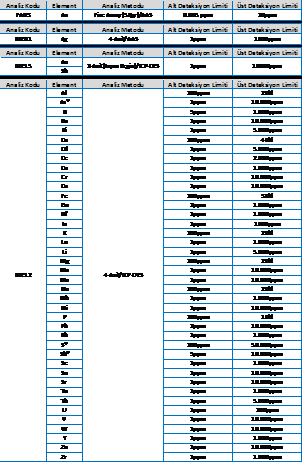 |
Drilling techniques | · Drill type (eg core, reverse circulation, open-hole hammer, rotary air blast, auger, Bangka, sonic, etc) and details (eg core diameter, triple or standard tube, depth of diamond tails, face-sampling bit or other type, whether core is oriented and if so, by what method, etc). | · In total 10,324.3 m of drilling across 287 drill holes has been completed across the Tavsan deposit. Additionally 1,169 m has been completed across 156 rocksaw channels. · Diamond drillholes comprise a combination of PQ and HQ diameter (standard tube). Drilling on the project can be summarised as follows: o 2022 - 41 DD holes for 2,181.1 m o 2021 - 71 DD holes for 2,173.7 m o 2019 - 4 DD holes for 90.5 m (Tavsan Far North) o 2006 - 87 RC (13.3 centimetre) holes for 1,611 m o 2004 - 35 PQ DD holes for 1,419 m o 1997 - 8 DD holes for 341m, 7 RC holes for 543 m o 1988 - 34 RC holes for 1,965 m · All historic holes were drilled by Ranger (1988), Teck Cominco (1997) and, Pusula Madencilik (Odyssey's 100% Turkish subsidiary) and their various contractors prior to the acquisition of the project by Ariana Resources plc and latterly Zenit Madencilik San. ve. Tic. A.Ş. |
Drill sample recovery | · Method of recording and assessing core and chip sample recoveries and results assessed. · Measures taken to maximise sample recovery and ensure representative nature of the samples. · Whether a relationship exists between sample recovery and grade and whether sample bias may have occurred due to preferential loss/gain of fine/coarse material. | · Diamond drillcore recoveries were monitored and recorded into the sampling database. No recovery was calculated for RC drilling conducted at Tavsan. · Select historic drill holes were examined for core recovery at the site, which was deemed to be satisfactory. · Overall core recovery for 2021/2022 diamond drilling is 88% for 2,854 measurements, with 95% of drilling showing over 70% recovery. · There is no bias between sample recovery and grade. |
Logging | · Whether core and chip samples have been geologically and geotechnically logged to a level of detail to support appropriate Mineral Resource estimation, mining studies and metallurgical studies. · Whether logging is qualitative or quantitative in nature. Core (or costean, channel, etc) photography. · The total length and percentage of the relevant intersections logged. | · Core was logged geologically by company geologists using a company standard logging protocol. Logging intervals are based on lithologies. All logging used a coded logging system for rock type, grain size, colour, alteration and any other relevant observations. All drilled metres were logged regardless of presence of mineralisation. · The core was photographed before logging to provide a permanent record of all DD core. · Mineralised zones were identified from the observation of mineralogy and lithological characteristics. Portable XRF (pXRF) analysis was conducted post-drilling, to provide supporting geochemical data for non-sampled regions. Areas identified as geochemically anomalous by pXRF were further sampled. The pXRF was checked by use of certified referenced standards to ensure good quality data was produced. · Logging of RC samples was carried out on washed samples with geological characteristics recorded into a database. |
Sub-sampling techniques and sample preparation | · If core, whether cut or sawn and whether quarter, half or all core taken. · If non-core, whether riffled, tube sampled, rotary split, etc and whether sampled wet or dry. · For all sample types, the nature, quality and appropriateness of the sample preparation technique. · Quality control procedures adopted for all sub-sampling stages to maximise representivity of samples. · Measures taken to ensure that the sampling is representative of the in situ material collected, including for instance results for field duplicate/second-half sampling. · Whether sample sizes are appropriate to the grain size of the material being sampled. | · Core samples were cut using an electric circular diamond saw with water supply for dust suppression. Half core remains in the core tray for reference. · RC sampling: Samples were collected at 1 m intervals and split using a two-stage riffle splitter, running each sample through the splitter twice. Wet intervals were sub-sampled with scoop or spear. Samples were oven-dried at the laboratory if necessary. Although every metre was sampled from top to bottom of each hole, metres which were clearly unmineralised were not assayed. · Sample preparation technique is appropriate to the mineralisation style. · Splitting and sample preparation conducted on samples at the Kiziltepe Mine Laboratory: o Drying at 105OC o Crushing whole sample to ≤2 mm o Splitting of crushed sample to analyse o Pulverising sub-sample to 80% passing ≤75 μm 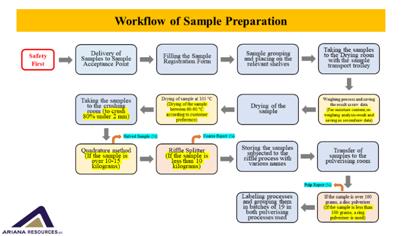 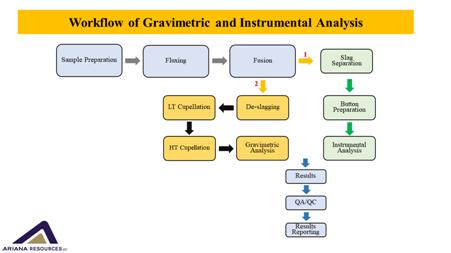 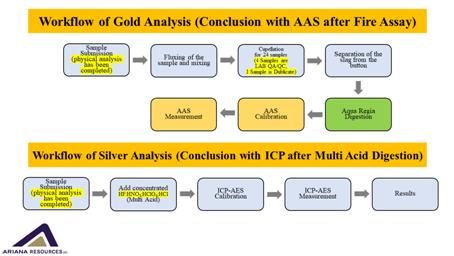 · Splitting and sample preparation conducted on samples at the ALS laboratory: 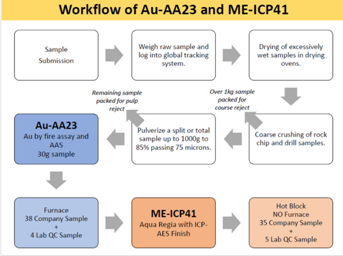 |
Quality of assay data and laboratory tests | · The nature, quality and appropriateness of the assaying and laboratory procedures used and whether the technique is considered partial or total. · For geophysical tools, spectrometers, handheld XRF instruments, etc, the parameters used in determining the analysis including instrument make and model, reading times, calibrations factors applied and their derivation, etc. · Nature of quality control procedures adopted (eg standards, blanks, duplicates, external laboratory checks) and whether acceptable levels of accuracy (ie lack of bias) and precision have been established. | · During Odyssey's drilling campaigns, a quality control (QC) programme was instituted at the beginning of the drill programmes, which consisted of inserting a field duplicate and uncertified/certified reference material samples into the sample stream. No field blanks were inserted. Uncertified standards were typically inserted (1:16 to 1:20 samples). These were determined to not be reliable enough to measure accuracy at the laboratory. Odyssey's own QA/QC programme has significant shortcomings, but the lab performance is adequate to support a mineral resource estimation. Standard and duplicate samples for QA/QC were taken by ALS Izmir and performance was noted as good. Reporting of ALS's internal QA/QC samples have found the results to fall within the 95% confidence interval assigned to them, as per the lab's internal monitoring standards. · All suitable measures were taken to ensure that samples were suitably representative. · QC procedures employed in all drill programmes prior to 2019 included the insertion of certified reference standards (1:22), blank samples (1:22), pulp and crush duplicates (2:22) to monitor the accuracy and precision of laboratory data when samples were submitted to ALS Global, Izmir. Insertion rate of 18%. · In drill programmes since 2019, samples have been submitted in batches of 35 to ALS Global, Izmir, to include 1 blank, 1 CRM, 1 field duplicate and 1 pulp duplicate. Insertion rate of 11%. 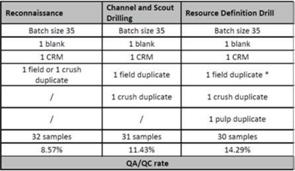 · In the 2021/2022 drilling programme, samples submitted to Kiziltepe Mine Laboratory are in batches of 20 to include 1 field blank, 1 CRM, 1 field duplicate. The Kiziltepe Mine Laboratory adds an additional duplicate sample which is a split of the 19th sample of each batch. Further to this the laboratory adds 4 internal standards for their own instrumental QA/QC checks. · In addition to routine QA/QC procedures, 59% of all Tavsan drill samples from the 2021/2022 programme were duplicated to submit to ALS Global, Izmir, as check samples at an external laboratory to confirm internal Kiziltepe Mine Laboratory results, whilst the laboratory expansion was taking place and while laboratory procedures and instrumentation was being checked internally. · The overall quality of QA/QC procedures is considered adequate to ensure the validity of the data used for resource estimation purposes. · The handheld XRF is an Olympus Vanta. A series of 10 blank and certified reference material samples are used to check the quality of the pXRF data. These are scanned at a rate of 1 blank and 1 CRM for every 100 samples. The device does not require further calibration. |
Verification of sampling and assaying | · The verification of significant intersections by either independent or alternative company personnel. · The use of twinned holes. · Documentation of primary data, data entry procedures, data verification, data storage (physical and electronic) protocols. · Discuss any adjustment to assay data. | · Significant intercepts were inspected by Mr. Joe Hirst (Tetra Tech Competent Person) during the site inspection in 2018. Data input has been completed in accordance with company procedures, which have been reviewed by Tetra Tech during their MRE in 2018 and 2020. · Data verification was also independently completed in 2006 by Mr. Antoine Yassa of P & E Mining Consultants Inc. during an earlier phase of exploration. 12 check samples were taken. Results were deemed satisfactory and demonstrated that the grade of gold is very similar in most instances, to what was originally reported by Odyssey. · Prior to resource estimation, below detection limit assay results have been replaced with values of zero. · Primary data, data entry procedures, data verification and data storage protocols are in line with industry best-practice. · All samples (30 g or 50 g) are analysed using fire assay with AAS (Au-AA23) and aqua regia with ICP-AES (ME-ICP41). · All samples before 2019 were submitted to the internationally accredited laboratory of ALS Global in Izmir, Turkey (ISO 9001:2008 accredited). · Samples taken in 2019, 2020 and 2021 have been submitted to Kiziltepe Mine Laboratory (TS EN ISO/IEC 17025:2017 accredited since October 2022), with at least 10% also selected for check assays at ALS Global in Izmir throughout the sampling programme. Samples are chosen from areas suspected to be mineralised. During the Kiziltepe Mine Laboratory expansion, 59% of Tavsan samples from the 2021/2022 programme were checked at ALS. · Since early 2021 the Kiziltepe Mine Laboratory has been undergoing expansion to deal with substantially increased sample analysis requirements. Initial verification of assay results from newly installed laboratory instruments is still undergoing internal review. To date, 1,663 samples were assayed at both Kiziltepe Mine Laboratory and the external laboratory (ALS Izmir). Results have been received and reviewed. Initial checks have demonstrated that received assay data and associated QA/QC samples fall within expected levels. Evaluations of incoming check data for the Zenit and ALS laboratories will continue to be assessed through 2022 until results conclusively prove that all new instruments are appropriately calibrated and operating as intended. |
Location of data points | · Accuracy and quality of surveys used to locate drill holes (collar and down-hole surveys), trenches, mine workings and other locations used in Mineral Resource estimation. · Specification of the grid system used. · Quality and adequacy of topographic control. | · All collar positions were located initially by hand-held GPS (Garmin Etrex 10 and 30) and later surveyed by a professional surveyor using DGPS equipment. All coordinates are recorded in UTM ED50 35N. · Down hole surveys were not completed at Tavsan as holes were typically drilled vertically. However, drill holes were surveyed, where possible, by open hole methods at 20 m intervals from surface, during a project review in 2015; using a Flexit down hole multi-shot survey device. · All holes were surveyed in the 2021/2022 drilling programme using a standard Electronic Multi-shot Magnetic survey deviation tool (Devico PeeWee). · Topographic data is collected by DGPS. Additionally, 5 m and 25 m contours were generated from ortho-rectified WorldView satellite imagery. |
Data spacing and distribution | · Data spacing for reporting of Exploration Results. · Whether the data spacing and distribution is sufficient to establish the degree of geological and grade continuity appropriate for the Mineral Resource and Ore Reserve estimation procedure(s) and classifications applied. · Whether sample compositing has been applied. | · The Resource area has been drilled as access allows, resulting in an irregular data spacing, typically between 25 m and 100 m between collars (average collar spacing between all zones is 45 m). · Samples were composited to 1 m prior to estimation. · 159 diamond drill holes (6,205.3 m), 128 RC drill holes (4,119 m) and 156 rock-saw channels (1,169 m) were used to model the mineralisation. · Sample compositing has not been applied at the sampling stage. · Sample spacing and distribution is sufficient to establish the geological and grade continuity required for modelling and resource estimation. |
Orientation of data in relation to geological structure | · Whether the orientation of sampling achieves unbiased sampling of possible structures and the extent to which this is known, considering the deposit type. · If the relationship between the drilling orientation and the orientation of key mineralised structures is considered to have introduced a sampling bias, this should be assessed and reported if material. | · The mineralisation is primarily outcropping at surface and has been drilled primarily vertically, with full intersections. Some inclined holes have been drilled between -80 and -40 degrees of dip, primarily stepped off from the mineralisation to delineate the edges of the mineralisation at depth. · No sampling bias is observed from the orientation of drilling with regards to the mineralised structures. True thickness with respect to apparent thickness is well understood as most intersections are normal to the mineralisation. · No biases are expected from the drilling direction. |
Sample security | · The measures taken to ensure sample security. | · Samples are stored in a secure location (Balikoy Depot) in a clean area free of any contamination. Full chain of custody documentation is used when transferring the samples to the laboratory and has been overseen by the responsible company geologist. · In drilling programmes pre-2019 the measures taken to ensure sample security for samples used for analysis and QA/QC include the following: o Chain of Custody is demonstrated by both Company and ALS Global or Kiziltepe Mine Laboratory in the delivery and receipt of sample materials. o Upon receipt of samples, ALS Global delivers by email to the Company's designated QC Manager, confirmation that each batch of samples has arrived, with its tamper-proof seal intact, at the allocated sample preparation facility. o Any damage to or loss of samples within each batch (e.g., total loss, spillage or obvious contamination), must also be reported to the Company in the form of a list of samples affected and detailing the nature of the problem(s). · In all drilling programmes since 2020, the majority of samples have been analysed by the Kiziltepe Mine Laboratory. Samples are delivered securely from the drill site to the laboratory by the exploration team and are securely held at the laboratory in the fenced off and guarded mine site, with no unauthorised access. |
Audits or reviews | · The results of any audits or reviews of sampling techniques and data. | · In 2020 Tetra Tech reviewed the protocols and procedures adopted and found the various aspects sufficient to support mineral resource estimation. Tetra Tech completed an independent analysis of the QA/QC data completed by Odyssey, and whilst there are shortcomings, the ALS lab QA/QC programme was robust. The data is deemed appropriate for resource estimation. · Ariana has implemented QA/QC programmes covering all aspects of sample location and collection that meets or exceeds the currently accepted industry standards. · Ariana implemented a QA/QC programme based on international best practice during the initial exploration work and subsequent drilling programmes. The company has continued to review and refine the QA/QC programme as these exploration campaigns have progressed. |
Section 2 Reporting of Exploration Results
(Criteria listed in the preceding section also apply to this section.)
Criteria | JORC Code explanation | Commentary |
Mineral tenement and land tenure status | · Type, reference name/number, location and ownership including agreements or material issues with third parties such as joint ventures, partnerships, overriding royalties, native title interests, historical sites, wilderness or national park and environmental settings. · The security of the tenure held at the time of reporting along with any known impediments to obtaining a licence to operate in the area. | · The Tavsan Property consists of four operating licenses owned by Zenit Madencilik San. ve Tic. A.S. ("Zenit") Joint Venture ("JV") with Proccea Construction Co. and Ozaltin Holding A.S. (23.5% owned by Ariana). Licence numbers: o Örencik license no: 12743, due date of 11.06.2029. o Kavaklı license no: 59770, due date of 11.06.2029. o Dağardı license no: 70484, due date of 10.01.2030. o Evciler license no: 72400, due date of 26.01.2025. · In 2008, Ariana acquired the Project for US $500,000 in cash and 3 million shares in the Company at 5 pence per share from Odyssey Resources Limited and a retained royalty of up to 2% on future gold production payable to Teck Resources Limited. This royalty has since been transferred to Sandstorm Gold Ltd. · There are no known impediments to current operations. |
Exploration done by other parties | · Acknowledgment and appraisal of exploration by other parties. | A summary of exploration activities at Tavsan: · 1980s - Initially discovered by Australian company Ranger. · 1988 - Ranger drilled 34 RC holes totalling 1960.5 m in the primary mineralisation zone. Ranger completed no further work. · 1995 - The MTA (Turkish government exploration agency) sampled the primary ore zone. · 1996 - Cominco acquired the property and conducted several systematic surface sampling programmes yielding an average grade 2.3 g/t Au at surface. · 1997 - Cominco initiated a 341 m DD programme for 8 holes. 265 samples were sent for Inductively Coupled Plasma (ICP) and fire assay using a 30-gram aliquot. A RC programme totalling 543 m for 7 holes was run concurrently with the DD programme. 362 RC chip samples were analysed for gold using fire assay on a 30-gram aliquot. · 2003 - Pusula Madencilik, Odyssey's 100% owned subsidiary company in Turkey acquired the Tavsan property from Cominco. · 2004 - Odyssey completed the first of a 3-phase drilling programme. Phase 1 totalled 1,067.7 m and consisted of 20 DD holes (OD1 - OD20). Phase 2 consisted of 15 DD holes (OD21 - OD35), totalling 350 m. · 2005 - Odyssey undertook a surface sampling programme on 11 surface-exposed gold mineralised jasperoid zones. · 2006 - Odyssey completed Phase 3 of drilling with the addition of 87 RC holes (ODX36-ODX131) totalling 1,611 m. · 2008 - Ariana Resources acquired the Tavsan project. |
Geology | · Deposit type, geological setting and style of mineralisation. | · The property is located in the Izmir-Ankara suture zone in north-western Anatolia. The formations present span from Jurassic to Tertiary and typically comprise metamorphosed sedimentary sequences, displaying intense compressional tectonic features. · The Property includes an upper thrust plate of Late Cretaceous ophiolitic rocks (Dagardi Melange), jasperoid gold-bearing silicification along the thrust surface and a footwall of Jurassic-Cretaceous Budagan Formation massive, a massive micritic limestone. · Through the summer of 2022, the Ariana team completed remapping of the Tavsan license area to 1:2,000 and 1:5,000 scale. 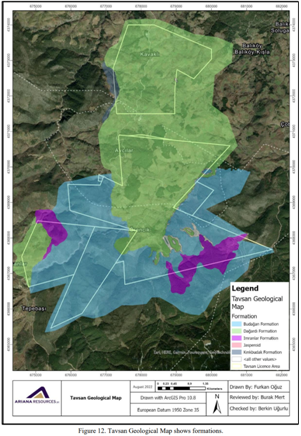 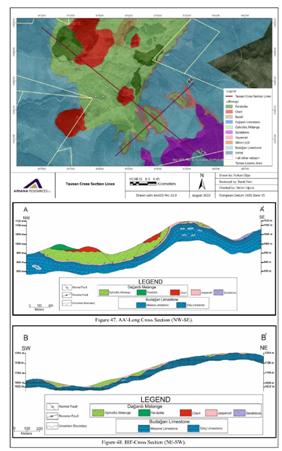 |
Drill hole Information | · A summary of all information material to the understanding of the exploration results including a tabulation of the following information for all Material drill holes: o easting and northing of the drill hole collar o elevation or RL (Reduced Level - elevation above sea level in metres) of the drill hole collar o dip and azimuth of the hole o down hole length and interception depth o hole length. · If the exclusion of this information is justified on the basis that the information is not Material and this exclusion does not detract from the understanding of the report, the Competent Person should clearly explain why this is the case. | · No new exploration data is included in this report. All relevant data has been reported in press releases. · The purpose of the 2019 to 2020 rock-saw channel sampling programme was to provide a further increase in the confidence of the resource classification, and to reduce planned infill drilling meters for future resource development work. The sampling included areas that are were classified as part of the JORC Exploration Target and Inferred Resource, with a view to improving confidence in the resource estimate and an improvement in the resource classification. A total of 751 samples (including 118 QA/QC samples), averaging a length of 1.8 m were extracted during the sampling activities. Of these samples, 676 were sent to the Kiziltepe Mine Laboratory for gold and silver fire assay only. A further 76 samples were sent to ALS in Izmir for gold and silver fire assay and multi-element ICP analysis. The channel sampling makes up only 10% of the drilling database. · Infill resource drilling and exploration drilling was completed in 2021/2022. Details of this latest drilling programme are given below. 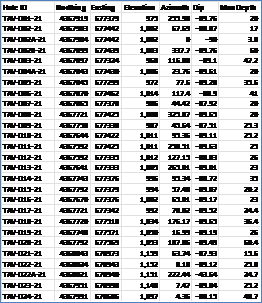 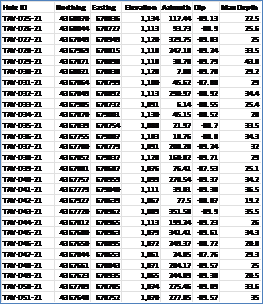 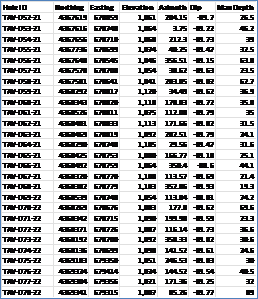 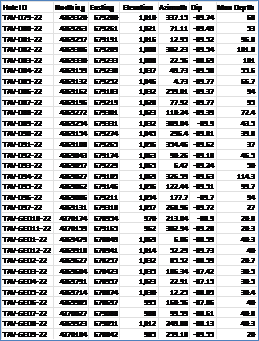 |
Data aggregation methods | · In reporting Exploration Results, weighting averaging techniques, maximum and/or minimum grade truncations (eg cutting of high grades) and cut-off grades are usually Material and should be stated. · Where aggregate intercepts incorporate short lengths of high grade results and longer lengths of low grade results, the procedure used for such aggregation should be stated and some typical examples of such aggregations should be shown in detail. · The assumptions used for any reporting of metal equivalent values should be clearly stated. | · Metal equivalents have not been used in this estimate. · No aggregation has been applied beyond the standard 1 m sampling interval honouring lithological changes down to 30 cm. · Significant down-hole intercepts calculated for the Tavsan 2021/2022 drilling programme, using a 1.0 g/t Au minimum cut-off and allowing for 0.5 m internal dilution: 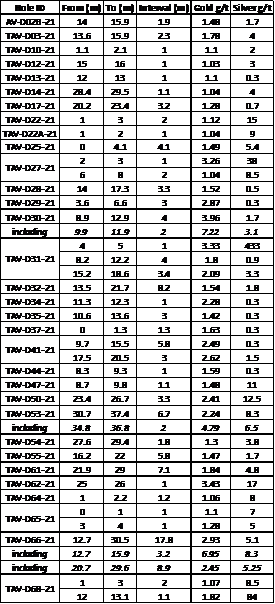 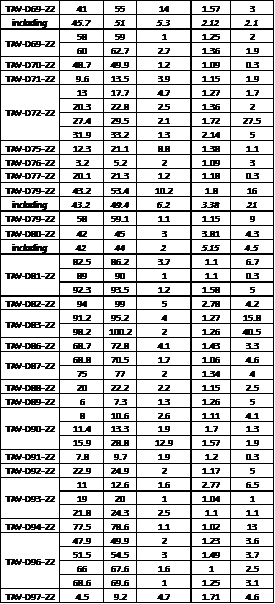 |
Relationship between mineralisation widths and intercept lengths | · These relationships are particularly important in the reporting of Exploration Results. · If the geometry of the mineralisation with respect to the drill hole angle is known, its nature should be reported. · If it is not known and only the down hole lengths are reported, there should be a clear statement to this effect (eg 'down hole length, true width not known'). | · The majority of the drillholes were advanced vertically. Some holes were advanced at between -80 and -40 degrees from horizontal to intersect dipping structures, or to delineate at depth. The mineralised horizons are commonly flat-lying to gently dipping. As such, the true width is generally represented by the intersection length. However, recorded intercept widths are down hole length and should not be regarded as true widths. · Three-dimensional wireframe models have been generated for sample selection to constrain the resource estimate. This process eliminates any bias imparted by oblique intercepts. |
Diagrams | · Appropriate maps and sections (with scales) and tabulations of intercepts should be included for any significant discovery being reported These should include, but not be limited to a plan view of drill hole collar locations and appropriate sectional views. | Tavsan Overview 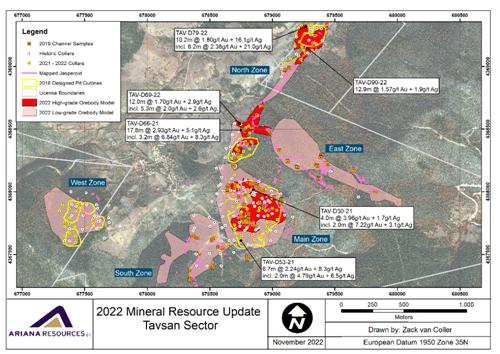 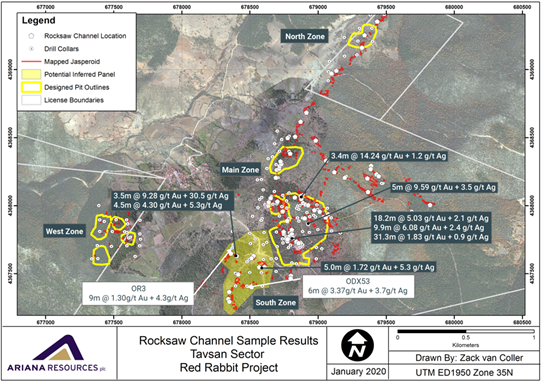 |
Balanced reporting | · Where comprehensive reporting of all Exploration Results is not practicable, representative reporting of both low and high grades and/or widths should be practiced to avoid misleading reporting of Exploration Results. | · Full balanced reporting of exploration results has been undertaken and is disclosed within the technical report and press releases. · Intercepts depths stated in the drill hole information but not stated in the data aggregation methods section are lower grade intersections. Widths of intercepts are stated. |
Other substantive exploration data | · Other exploration data, if meaningful and material, should be reported including (but not limited to): geological observations; geophysical survey results; geochemical survey results; bulk samples - size and method of treatment; metallurgical test results; bulk density, groundwater, geotechnical and rock characteristics; potential deleterious or contaminating substances. | · In 2022 Ariana completed a 41km2 geological mapping project across the Tavsan licenses. This work included pXRF analysis of lithological units, petrography analysis, thin section and magnetic susceptibility studies. · In 2017 Ariana completed an extensive high-resolution (25 m by 25 m) portable X-ray Fluorescence (pXRF) soil survey. This work was completed in order to better define and characterise targets for a second phase of resource-development and to improve confidence in targeting for further resource drilling. · Sixteen target areas were highlighted by the 8,265 soil samples collected, covering an area of approximately 5 square kilometres (km2). 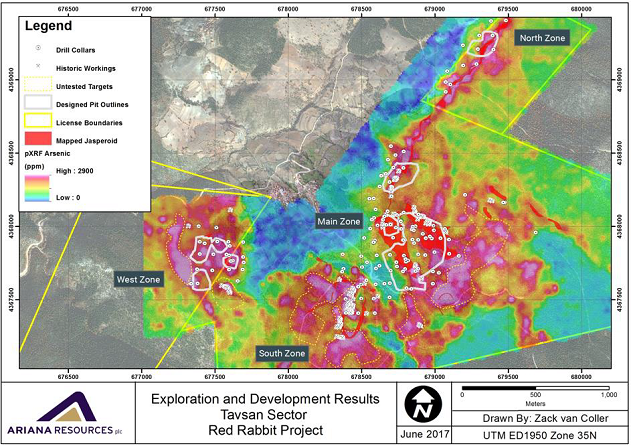 |
Further work | · The nature and scale of planned further work (eg tests for lateral extensions or depth extensions or large-scale step-out drilling). · Diagrams clearly highlighting the areas of possible extensions, including the main geological interpretations and future drilling areas, provided this information is not commercially sensitive. | Zenit have planned the following drilling for the Tavsan Main, North, South and West Zones, scheduled for 2023-2024: · 3,610 metres for resource infill · 5,915 meters for resource step-out · 5,200 metres for exploration · Further surface sampling and drilling work will also be scheduled for Tavsan East Zone. 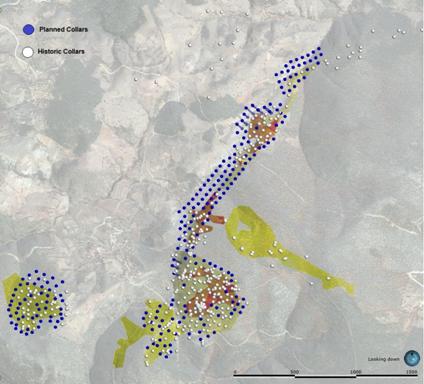 |
Section 3 Estimation and Reporting of Mineral Resources
(Criteria listed in section 1, and where relevant in section 2, also apply to this section.)
Criteria | JORC Code explanation | Commentary |
Database integrity | · Measures taken to ensure that data has not been corrupted by, for example, transcription or keying errors, between its initial collection and its use for Mineral Resource estimation purposes. · Data validation procedures used. | · The Tavsan resource data was stored in a MS Access database and managed using MS Access and Excel software. Data has now been transferred to MX Deposit, the database management system used by the company, which started in Q3 2021. · Data was logged onto field sheets which were then entered into the data system by data capture technicians. · Data was validated on entry into the database, or on upload from the earlier MS Access databases, by a variety of means including the enforcement of coding standards, constraints and triggers. These are features built into the data model that ensure data meets essential standards of validity and consistency. · Laboratory data has been received in digital format and uploaded directly to the database. · Original data sheets and files have been retained and are used to validate the contents of the database against the original logging. · Zenit Madencilik and independent consultants such as Tetra Tech and Odessa Resources Pty Ltd performed a visual validation by reviewing drill holes on section and by subjecting drill hole data to data auditing processes in specialised mining software (e.g. checks for sample overlaps etc.). · Independent consultants Tetra Tech performed a visual validation by reviewing drill holes on section in Datamine Studio RM mining software. · Archived reports have been used to evaluate potential errors and liability of historical data. · Ariana Resources performed validation checks in Leapfrog GEO and EDGE v. 6.0.5. |
Site visits | · Comment on any site visits undertaken by the Competent Person and the outcome of those visits. · If no site visits have been undertaken indicate why this is the case. | · Ariana staff have visited the site on numerous occasions, and supervised all drilling, sampling and other operations at all times in order to introduce appropriate logging, sampling and drilling protocols. · Zack van Coller (BSc) of Ariana Resources has been involved in all work on the project since 2010. Mr van Coller last visited the project in July 2022. · Ruth Bektas (BSc, CGeol, EurGeol) of Ariana Resources is acting as the Competent Person for this study, and has been on site during exploration programmes. Ms Bektas is a Resource Geologist and Competent Person as defined by the JORC code. Ms Bektas last visited the project in June 2018 and has verified aspects of the data collection and handling for the project. · Ariana Resources (Galata Madencilik) and Zenit Madencilik field staff are permanently on site. |
Geological interpretation | · Confidence in (or conversely, the uncertainty of ) the geological interpretation of the mineral deposit. · Nature of the data used and of any assumptions made. · The effect, if any, of alternative interpretations on Mineral Resource estimation. · The use of geology in guiding and controlling Mineral Resource estimation. · The factors affecting continuity both of grade and geology. | · Geological interpretation used a combination of surface mapping data, geophysics and geological and geochemical boundaries from the drill holes across the Tavsan deposit. Interpretations of geological surfaces are derived from 3D modelling of drill hole data in Leapfrog GEO and EDGE v. 6.0.5. · Geological Domains were interpreted for the deposit according to geology, grade and geotechnical structures. Five main mineralised lodes have been identified, two of which have been subdivided into higher grade and lower grade domains. · The mineralisation is well understood, typically defined as a single identifiable unit, and geologically constrained. · Grade continuity analysis within the interpreted mineralised zones is robust. · The confidence in geological interpretation is appropriately reflected in the classification of the Resources. · Interpolation and wireframe modelling of the mineralised zones in Leapfrog EDGE was completed using a 0.5 g/t and 1.5 g/t Au modelling cut-off grade (CoG) for low grade and high grade domains, respectively. Where continuity was not established between sections, the strike extrapolation was limited both manually (wireframes) and statistically (interpolations). |
Dimensions | · The extent and variability of the Mineral Resource expressed as length (along strike or otherwise), plan width, and depth below surface to the upper and lower limits of the Mineral Resource. | · The mineralisation follows a SW-NE trend where outcrop occurs along the jasperoid unit contact. The mineralisation is generally present at surface. The mineralised zone is approximately 4.5 km long across the SW-NE trend, and covers an area of approximately 2 km2. · The mineralisation has an approximate true thickness of 4.5 m, ranging between 1 m and 30 m thick. |
Estimation and modelling techniques | · The nature and appropriateness of the estimation technique(s) applied and key assumptions, including treatment of extreme grade values, domaining, interpolation parameters and maximum distance of extrapolation from data points. If a computer assisted estimation method was chosen include a description of computer software and parameters used. · The availability of check estimates, previous estimates and/or mine production records and whether the Mineral Resource estimate takes appropriate account of such data. · The assumptions made regarding recovery of by-products. · Estimation of deleterious elements or other non-grade variables of economic significance (eg sulphur for acid mine drainage characterisation). · In the case of block model interpolation, the block size in relation to the average sample spacing and the search employed. · Any assumptions behind modelling of selective mining units. · Any assumptions about correlation between variables. · Description of how the geological interpretation was used to control the resource estimates. · Discussion of basis for using or not using grade cutting or capping. · The process of validation, the checking process used, the comparison of model data to drill hole data, and use of reconciliation data if available. | · Drill hole sample data was constrained within: o 3D mineralisation models based on manually isolated economic drill intercepts, where all the Tavsan mineralisation was modelled using Seequent's "vein" model tool to define grade driven domains. Economic intercepts were defined by nominal 0.5 g/t Au and 1.5 g/t Au modelling cut offs. · Compositing was completed in Leapfrog EDGE using a 1 m best fit routine. Hard domain boundaries were applied to both deposit models, which forced all samples to be included in one of the composites by adjusting the composite length, while keeping it as close as possible to the selected intervals of 1m. · Top cuts were applied to the assay results at 10 g/t Au. Silver did not require a top cut. · Isotropic search ellipses and ranges were used. The variable orientation function (Dynamic anisotropy) was used in Leapfrog to better represent the grade distribution. · The block models were constructed using a 10 mE by 10 mN by 5 mRL parent block size. · The block model is a non-rotated conventional block model with no sub-blocking used. · Estimation was carried out using inverse distance weighted squared (IDWS) at the parent block scale using a three-pass estimation using all available composites within the hard boundary. The Inverse Distance Weighted Squared (IDWS) method was selected as the most suitable method of interpolation in this deposit, as there is not sufficient nugget affect to warrant an IDWC method. Ordinary Kriging was not used as satisfactory variograms were not obtainable. 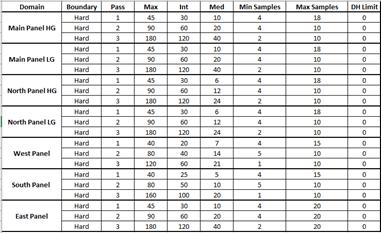 · Check estimates were carried out and the final estimate was compared to previous estimates. · Gold and silver have been estimated as mining products. No by-products or deleterious elements have been modelled. In general, gold and silver show a positive correlation with each other. · Density was assigned to each zone based on the values in the density database.  · A visual validation between drillhole data, composite data and block model data is carried out. |
Moisture | · Whether the tonnages are estimated on a dry basis or with natural moisture, and the method of determination of the moisture content. | · Tonnage is estimated on a dry basis in accordance with the specific gravity determination. |
Cut-off parameters | · The basis of the adopted cut-off grade(s) or quality parameters applied. | · Low grade domains have been modelled above a 0.5 g/t Au cut-off grade and reported above a 0.7 g/t Au cut-off grade. High grade domains were modelled and reported above a 1.5 g/t Au cut-off grade. · Cut-off grade calculated from assumptions on mining and processing cost, metallurgical recovery and metals prices. |
Mining factors or assumptions | · Assumptions made regarding possible mining methods, minimum mining dimensions and internal (or, if applicable, external) mining dilution. It is always necessary as part of the process of determining reasonable prospects for eventual economic extraction to consider potential mining methods, but the assumptions made regarding mining methods and parameters when estimating Mineral Resources may not always be rigorous. Where this is the case, this should be reported with an explanation of the basis of the mining assumptions made. | · No mining factors (i.e., dilution, ore loss, recoverable resources at selective mining block size) have been applied to the original resource. · The deposit is expected to be mined as an open pit heap-leach operation. · Bench face angle 65° · Largest operating bench width 40 meters (Main Zone) · Bench width changes due to mineralization shape in general o Bench width = 8 meters if bench height = 10 meters o Bench width = 5 meters if bench height = 5 meters |
Metallurgical factors or assumptions | · The basis for assumptions or predictions regarding metallurgical amenability. It is always necessary as part of the process of determining reasonable prospects for eventual economic extraction to consider potential metallurgical methods, but the assumptions regarding metallurgical treatment processes and parameters made when reporting Mineral Resources may not always be rigorous. Where this is the case, this should be reported with an explanation of the basis of the metallurgical assumptions made. | · No metallurgical assumptions have been built into the resources. · Basic metallurgical assumptions were made with regards to expected processing methods, recoveries from test work and expected throughputs. · In April 2005, 42 samples of coarse reject material from drill core and 47 pulp samples (mostly from the same drill core samples as the coarse rejects) were sent to ALS Chemex in Vancouver, Canada for cyanide soluble testing. The purpose of this test was to substantiate Cominco's 1997 cyanide soluble tests attesting to the fact that cyanide leach is an appropriate beneficiation method for extraction of gold. · Results of the tests indicated that the average gold recovery after one hour for the coarse reject material was 55.6%, and for the pulp samples was 91.6%, which indicate that cyanide remains a potentially viable method for the recovery of gold at Tavsan. · In 2019, a series of metallurgical test works were conducted at Zenit's Kiziltepe Mine Laboratory to obtain and optimise the basic parameters for leaching such as sodium cyanide (NaCN) consumption, particle size, flux (application) rate, agglomeration, and lime consumption rates. Bottle roll and mixing in two litres flask tests showed higher recoveries hence increasing the exposed surface area of the ore with the solution. · The optimum recovery conditions, which resulted 76% Au recovery in column tests were: o Particle size: P100:12.5 mm. o Flux rate: 10-12 litres per hour per square metre (L/hr/m2). o Sodium Cyanide: 1.3 - 1.5 kg/ton dry ore. o Lime: 2 kg/ton dry ore. o Leach cycle: 45 - 60 days. |
Environmental factors or assumptions | · Assumptions made regarding possible waste and process residue disposal options. It is always necessary as part of the process of determining reasonable prospects for eventual economic extraction to consider the potential environmental impacts of the mining and processing operation. While at this stage the determination of potential environmental impacts, particularly for a greenfields project, may not always be well advanced, the status of early consideration of these potential environmental impacts should be reported. Where these aspects have not been considered this should be reported with an explanation of the environmental assumptions made. | · The Competent Person (CP or QP) is not aware of any known environmental or permitting issues on the projects. · Statutory forestry permits have been approved by the Prime Ministry and issued by the Department of Forestry for the Tavsan Sector. · Zenit has carried out a comprehensive Environmental Impact Assessment. Under this; a Flora and Fauna study has been completed and reported by Balıkesir University. · Acid Rock Drainage and Hydrogeological studies have also been completed. |
Bulk density | · Whether assumed or determined. If assumed, the basis for the assumptions. If determined, the method used, whether wet or dry, the frequency of the measurements, the nature, size and representativeness of the samples. · The bulk density for bulk material must have been measured by methods that adequately account for void spaces (vugs, porosity, etc), moisture and differences between rock and alteration zones within the deposit. · Discuss assumptions for bulk density estimates used in the evaluation process of the different materials. | · Density modelling at Tavsan was evaluated from 896 drill core measurements taken from diamond drilling in 2021/2022. The data was domained according to the various model volumes. Statistical averages within each domain were used as a representative value of density. Further work is needed to code the density to each model to better show density variations to depth and along strike, rather than applying statistical averages. · For modelling purposes, average specific gravity values ranging from 2.60 to 2.64 g/cm3 were used based on specific gravity measurements on core samples.  |
Classification | · The basis for the classification of the Mineral Resources into varying confidence categories. · Whether appropriate account has been taken of all relevant factors (ie relative confidence in tonnage/grade estimations, reliability of input data, confidence in continuity of geology and metal values, quality, quantity and distribution of the data). · Whether the result appropriately reflects the Competent Person's view of the deposit. | · The Mineral Resource is classified and reported in accordance with the 2012 JORC code as Measured, Indicated and Inferred. The classification is determined based on search pass spacing, with increasing confidence with proximity to drill holes. These are given in more detail under section "Estimation and modelling techniques". · Measured Mineral Resources have been defined by Pass 1 (up to 45 m x 30 m x 10 m) depending on the mineralisation characteristics and drill hole spacing. · Indicated Mineral Resources have been defined by Pass 2 (up to 90 m x 60 m x 20 m) depending on the mineralisation characteristics and drill hole spacing. · Inferred Mineral Resources have been defined in areas beyond the Indicated search radius to the limits of the resource wireframes in Pass 3 (up to 180 m x 120 m x 40 m). |
Audits or reviews | · The results of any audits or reviews of Mineral Resource estimates. | · The Inverse Distance Weighting Squared (IDWS) model was validated against the input drill hole composites for each vein model by visual comparisons carried out against the composited drill hole samples and against the modelled block grade. · The Zenit Mining team conducted their own internal MRE estimation of Tavsan, using both their own and Ariana's input parameters and domain models, but using different software (Datamine Studio RM). Results between the Ariana and Zenit estimations were peer-reviewed and discussed until a level of agreement was met between both parties in terms of correct data interpretations. |
Discussion of relative accuracy/ confidence | · Where appropriate a statement of the relative accuracy and confidence level in the Mineral Resource estimate using an approach or procedure deemed appropriate by the Competent Person. For example, the application of statistical or geostatistical procedures to quantify the relative accuracy of the resource within stated confidence limits, or, if such an approach is not deemed appropriate, a qualitative discussion of the factors that could affect the relative accuracy and confidence of the estimate. · The statement should specify whether it relates to global or local estimates, and, if local, state the relevant tonnages, which should be relevant to technical and economic evaluation. Documentation should include assumptions made and the procedures used. · These statements of relative accuracy and confidence of the estimate should be compared with production data, where available. | · The Mineral Resource estimate at the global level for the Measured and Indicated Resources based on the estimation technique and data quality and distribution is considered to be adequate for the classification. Inferred Resources have a lower level of confidence outside of this range, and the Exploration Target is categorised separately from Mineral Resources. · The composition of the mineralisation, and the grade of the block model accurately reflects bulk samples taken at the property for test work. |
NOTE: Sections 4 and 5 are not relevant to this work as Reserves aren't being reported and there is no estimation or reporting of diamonds or other gemstones in this project.