Replay available
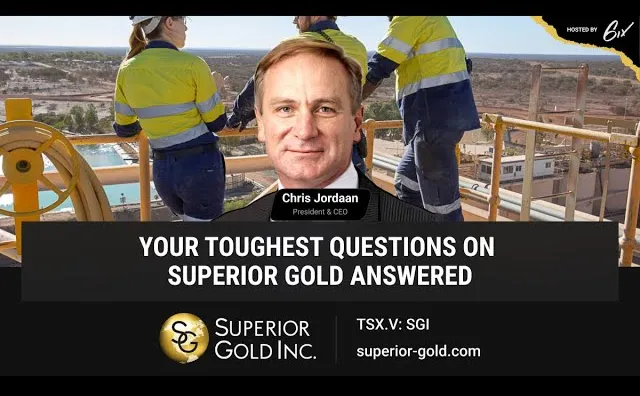
Your Toughest Questions on Superior Gold Answered
Join us for a great event!
- Company
- Superior Gold
- Date
- Mon, Oct 24, 2022, 5:00 PM ET
- Replay
- Watch the replay on this page · 26 min
On 6ix: 6ix.com/event/your-toughest-questions-on-superior-gold-answered
Replay
Transcript
Automated transcript · Written by software from the replay's audio. It can mishear names and figures; the replay is the record.
0:08 Can you explain in detail what went wrong in the open pit? What are the issues you're dealing with, which caused the poor performance and ultimately the decision to suspend mining operations. So talking about the open, but they were basically 2 main issues that we had to deal with. Firstly, the total material moved or TMM, as we call it, was below expectation. And that was due to a number of challenges that we had. 2 contributing factors, the one being availability of labor and so forth, given that the mine was started or the mine produced was started during the height of COVID, unfortunately, which spilled over at least 2 months of that startup period. So that held us back quite significantly.
0:58 And then also in addition to that, we were challenged in providing an effective solution to mine around the voids. Now, understanding that the open pit, the deep end of the open pit, intersected with some of the underground workings. So working around those voids were absolutely critical and that caused 2 things. Firstly, reduced rate of mining, but also dilution of the higher grade ore. Now, the benefit of this is that the gold is still there. What we're saying going forward is we are going to provide a technical solution that will give us access more effectively and more efficiently of that gold that's still in the ore. You state that the gold is still there. So when do you expect to be able to mine it?
1:46 Yeah, I think that's a very good question. So what we have in plan going forward, as you know, Mainpet deeps was an early entry option into the Mainpet pushback. This has not impacted on the Mainpet pushback project in any way. It's certainly a project that we still have in our pipeline and we will develop going forward. I think what the Mainpet pushback will provide us, which we believe will typically be seen of our operation in the next 36 months, 1 would expect to be able to access that ore, which is currently in Mainford Deeps, much more effectively and cost-efficiently in so far as the size of the entry into that area. The other important thing is that it's going to be a mining operation that's going to run over a much longer period.
2:39 So we're talking about 6-years. So we'll be able to attract really well set up operationally to be able to go after that gold. And once again, as I said, the gold hasn't gone. All we're saying is that the main pit pushback will give us an opportunity to more effectively and efficiently extract that ore from the main pit. What's the timeline for that main pit pushback? Yeah, so the main pit pushback forms part of our life of business plan that was recently finished in draft form. Now it's considered to be somewhere between 30 and 36 months away at this stage. Now, as with all life of business plans or life of minds, like some companies call it, it changes or could potentially change from year on year as new information becomes available, projects are developed and there might be options that are even more lucrative than others that has been in your, in a previous plan. So we will consider it continuously, however, we'll be continuing setting ourselves up for the main pit pushback. And just to remind everyone, the main pit pushback is currently on PEA level. So it's very early in its stages of development.
3:50 The project it is. In addition, that talks to about 360,000oz at about 60,000oz per year. It is a long-life project. In conjunction with the new resource and reserve, which is currently standing at 630,000oz, the lion's share of those reserves that we have there has not taken into consideration the reserve within the main pit pushback. I think we've, in the reserve, we only had about 20,000 ounces of the main pit pushback in our reserves. So it still reports under the resource at this stage. Were you required to pay a demobilization fee for the open pit contractor?
4:38 Yeah, so the way it works is we had to give a 30 day notice as per contract. In this case, it was the month of October. Now during this time, we have accessed and is nearing the completion of all exposed ore of the workings previously that ended in September. And we expect to complete this before the end of October, which means, once again, all exposed ore would have been extracted and we were leaving the main pet deeps in a good state that it's safe And it's properly defined. Turning to the underground and the lower grade, you state in the press release that it was due to being behind on development. What actions are underway to catch up on development?
5:26 Yeah, we're very excited about it. I mean, there's a very clear lack of development that basically followed on. As soon as COVID hit the business really hard in May, June and so forth, a lot of our labor was reallocated to keep on pushing forward and extracting oil from the underground. And during that period, we fell behind in our development. We've pulled together a 3 pronged strategy to address it. About 2 months ago, we replaced one of our old jumbos with a new one, a brand new Sandvik unit. In addition to that, we modified the drifter length from 4.2 meters to 4.9 meters, which now allow us for every cut that we take, instead of only having a 4.2 drill advance, we can now do it with a 4.9 metre drill advance. So it certainly gives us much better productivity from that perspective, and we're very happy with the performance of that unit.
6:31 The second part is executing on a performance improvement plan to increase the utilization efficiency and also to improve the deployment of the jumbo's, of which we have 3, to minimize tramming and to ultimately increase our development rate towards ore. We're also accelerating the development of the area plans, so-called consumables, for the underground based on the new block model to open up new areas for mining going forward. There's a short-term focus to increase development towards specific stokes and stop barriers. We want to see that development rate increase from typically 500 to 520 metres up to 750 metres.
7:19 So that gives you about 250 meters per unit and then increase that up into next year as we open up further capacity in the current units we have. We would expect in future to also include additional jumbos into especially the capital development piece of the business of which, sorry, of the underground of which we're much more now confident where we need to go based on the on the new block model. What is the number of jumbos being used now? And do you anticipate adding more? Yeah, so currently we're using 3 jumbos. 2 of the units are operating on 3.0, sorry, 4.2 meter steels or lengths of drill bits. And then we've got the new one, which is a 4.9m unit.
8:08 The expectation is to increase that to or the rate at which we advance with every jumbo to an average of 750m per month for the 3 jumbos. We are planning to bring on additional jumbo's, an additional one at least to be able to take us up to that 952,000 metre development right into the future. Now that will enable us to get ahead of our development, which will ultimately give us optionality to access both high grade and lower grade stuff so we can balance it to get our average grade from stoping up to 3 grams per ton. How many months of development is ideal to be completed before extraction of that area begins? So in the short term, our target is 150,000 tons for the overall mine.
8:57 In the medium term, we'd like to increase that to north of 200 towards 400,000 tons of developed stocks. With the debt financing in place, do you expect to stop the cash bleed and return to profitability in Q4? So I think I need to be very clear. The debt financing we put in place was to strengthen our balance sheet. And then also, since we've suspended the open pit operations, we have reduced our cash costs significantly. Now, if gold prices hold and there's no further operational issues, we're going to have a significantly better outcome in Q4 because we basically, you know, alleviated the cash burn that we've incurred because of the lower than expected performance of the open pit. Looking ahead to the focus on the underground, what is different that encourages you to aim for 1Mt per annum next year?
9:51 The first and foremost thing here is the block model. Now, to put that into perspective, in the first 5 years of Superior Gold owning and operating plutonic, we typically mine between 8% and 12% out of the reserve. That has increased over the last 9 months to between 75% and 80%. So what that really means is we have a block model now, which as you know has been redeveloped over the last 18 months. We have a block model now that is significantly more accurate at predicting the special position or spatial position of the ore in the underground. So therefore our development success is gonna be significantly better than it was in the past. In addition to that, I've already spoken to that, we have a three-pronged strategy to improve development. So that is really, now that we have the plan and the block models is how do we access that all? That is an execution, and we're really seeing improved performance. In fact, this month, we're seeing an increase of typically 520 metres. We're in fact targeting 620 to 640 metres this month.
10:59 We're also suspending new capital development until we achieve at least 2 months developed inventory. So that talks to the 150,000 tonnes target. And that is about the capital that we need to spend in opening new areas into the future. In that time, we are completing also the engineering for that capital development and that really refers to the so-called area plans. And we're planning to be, towards the middle of next year, to be 18 months ahead of engineered capital development. And then it's just purely a question of deploying the rigs and making sure that we stick to that capital development plan. We expect that plan to run over a number of years, given our current reserve, which is at 630,000oz.
11:53 And it's interesting if you look back, we started off with 200,000oz when the asset was acquired. We expect to have elevated requirement for development for the next 3 years. And then 1 with based on the current modeling would see that Peter off as we then would have access to all the appropriate areas for mining into the future. And that gives us the confidence that we will, are targeting and we'll be able to move up to that 1 million tons per annum in the near term. Given that the underground is the only mill feed source, what do you target as the stow upgrade to the mill? Yeah, so our target is 3 grams per tonne and people might say then, you know, but why aren't you achieving it? It's very simple. Given the position that we were in, in Zofaras, that we fell behind on development, we basically had to mind what we had in front. If we have enough development fronts and optionality, we can then balance the combination of stoves in such a way whereby we can keep the average grade at above 3 grams per ton. Now, understanding that we have a range of grades in stoves. And it's very important for us to make sure that whatever we mine, we do that in a way that it's cost-effective and profitable.
13:12 So the 3 grams per ton is an overall target. Some of the stoves in a specific month, if we had our development areas in front of us will be way beyond 3. Some will be slightly lower, but on average we're targeting 3 grams per ton. Now that the mill is running well and at capacity, will you have enough ore feed to run it continuously or will you move to a campaign of ore program? And if campaigning, what percentage of time in a month will the mill run? Well, I think at this stage, we're considering all our options. Our primary goal is to focus on the underground only going into the future. And you know, as soon as we've made that final call, we'll inform the market appropriately as to how we're exactly gonna take that forward. I think the key element is also to take into consideration the stock that we have left from our open put endeavors.
13:58 So that will be taken, or is currently being taken into consideration to determine exactly what the best setup would be for the mill. But you're absolutely right. The mill is running well. We've done major shutdowns throughout the year and it's well set up for future operation. From an exploration drilling perspective, where are you focused? We have 3 rigs currently underground and all of them are dedicated on diamond drilling for grade control. And the key reason why we're doing that is because we're purely focusing on production or development at the moment, grade control drilling is a critical piece in that puzzle to ensure that the stokes to which we're developing are in fact stacking up, given the results from the great control drilling.
14:50 Work is also underway to better explain the geological features of Timor. This is the most prolific section of the mine that features a discontinuity that may host the opportunity of dislocated Gold. Now this process entails dating the samples. Now we have several different lithologies or levels at which the ore has been deposited over a very long period. It's expected that this will provide more confidence as to the potential layer of the gold that might feature. And that specifically refers to the dating of the gold. Now imagine that the deposit of the gold in these different layers happen at different time periods and in long gone history.
15:36 The question is now to define it and which layer it is. We know where those layers are and that will put us in a position to more accurately determine where we need to go for the drilling to try and find that gold. Now, once again, as I said, Timor has been and still is one of the most prolific sections in the underground mine. Something worthwhile noting as well, Timor is only 30 meters wide. So you can imagine if you do exploration drilling at a 100 by 100 or 150 by 150 meter distance from each other, you can very easily miss it. So it's very important for us to ensure that we give it the best or put forward the best understanding of where that potentially could be so we can orientate and also guide the draw to have the best chance of finding this gold. What's the biggest inflation cost challenge for the company? Is it finding and paying more qualified employees or are your input costs increasing?
16:40 I think it's a combination of a number of things, I think, in analysing our costs, there's certainly been an increase in labor costs. And it's in specific, I think, speciality fields. We've seen specifically costs in underground operators, for instance, Jamba operators, we've seen labor costs increasing there. There's been quite a significant movement of production engineers, so we're seeing, you know, increase in salaries there as well. Another part of course, because our mobile fleet runs on on diesel, fuel costs has increased from that perspective. And then of course, consumables like cyanide, et cetera. The benefit we have from our perspective, our biggest fuel bill is basically the gas that we use to run our power generation units.
17:30 And when you look at our power generation, we have locked in those prices and supply for a number of years. I think it's about 2 and a half years left on that contract. So that at least has given us some buffer against inflation. Will management and board be buying shares to show your belief in the company and its potential? So we're currently in a blackout and as required by the TSX compliance from the end of the quarter until after we release our financial results towards the end of November. Towards the end of November. If we're not a blackout manage has in the past bought stock and I would expect them to plan to continue to do so. I mean, if you look at our current stock price, it's certainly a very good investment and a cheap buy.
18:16 What is different this time from the last time the company ran into problems? I think there's 3 things. The first thing is we have, from what we've seen over the last month, a proven block model, which has resulted in approximately 75% of our reserves mined to plant versus a previous of 8% to 12% in the previous 5 years of the company's operation. So we're much better organized in understanding the spatial positioning of the ore in the underground, which directly impacts on the effectiveness of our development strategy. The second part, or the execution of our development strategy. The second part is we've got this three-pronged improvement plan, and that's well advanced. It's really showing results. We're following an accelerated rate of improvement.
19:05 So we're certainly not falling into a position of analysis paralysis. We've engaged right down to team level. We had jumbo operators, nippers, etc. In rooms, asking them what are the major challenges that they're dealing with, and to make sure that we remove all barriers for these teams to deliver what they have to. And as I said in the past, we've achieved these levels. We have been operating at 750 meters per month with 3 jumbos, lot of confidence we're gonna get there, but it's about breaking down those barriers that's holding the guys back. And that's the team, sorry, that's the plan that we pulled together that will deliver on it. And we've got 6 priority areas, we've already identified 3 of them, or opportunities will be assessed and implemented if they're successful within October, and then we'll start with the next 3.
20:02 And then Lastly, the mill shutdowns were completed and more than capable to efficiently and effectively process the ore that we have available. To give you an idea, some of the bearings that were replaced are in fact the original bearings that were in the mill. They were way beyond their operating life expectancy. That risk has been completely removed, which was a real risk in the past. Once again, just quickly, we have a proper block model that's shown its mettle in the last 9-months. We have a very detailed and advanced 3-pronged improvement strategy. We're rolling out to improve our rate of development, which will open up opportunities and flexibility in the underground mine to go after higher grade stoves and get a good balance of stoves into the feed into the mill. And then of course, you know, having the assurance that the mill can take whatever we throw at it. What are the key reasons why an investor should stay in the stock or purchase stock?
21:07 Yeah, I think there's a number of considerations here. Firstly, we strengthen the balance sheet with a loan that require a payment of 220 ounces per month from January onwards for over 18 months. The second thing is the operating model has been aligned to reduce cash costs and we're all focusing at the moment on the underground mine. So we absolutely laser focused on getting the best out of the underground mine that we can. The underground improvement plan is an execution and it's expected to deliver enough ounces to the mill to generate cash and accelerating development to align the underground mine with the longer term life of business plan. I think another key consideration is that the drilling completed in the first 24 months has no doubt provided appropriate reserve for an extended life of mine.
22:00 We started off at 200,000 ounces that clipped up to about 380 in 2019 and we're now on 630,000oz. That augmented by a measure indicated in FERD of close to 6Moz in resource gives us a good pipeline or optionality into the future to take more ounces into reserve and ultimately go out there and mine it. It's got a long life ahead of it. We have a clear life of business plan that has optimised the extraction sequence for the life of the reserve and areas we have high levels of confidence that will convert from resource into reserve in the future. Now, this prioritises our ore zones by profitability and helps guide our mine exploration activities.
22:48 And I think lastly, in addition, we have a clear pipeline of development opportunities, which we have ranked by value and preserved as options for the future after the appropriate study work is performed. So in essence, what we're saying is we're taking a very measured approach in pulling these projects together to ensure that our success in delivering them is assured. What else would you tell investors and stakeholders before we wrap up for the day? I think, you know, as with other companies in the area, we've been impacted by COVID. In our case, specifically in the region we were operating earlier the year, we were impacted by weather conditions. This is by no means a reason for us to sit back and hope for better days. I think we're going after it really hard.
23:42 We've reconfigured our business to make sure that we take it back to cash generation. We know that we were operating previously in this operating model. And of course, now we have many options that are in consideration as we set up the mine for its long life. So I think fundamentally, the gold is available. It's a question of what is the most appropriate way of extracting it. We've enabled ourselves to take away any potential other barriers there are to process gold. So our process plant has received in critical areas of birthday. So That puts us in a very good position from an operational perspective. In addition to that, there's no doubt that this property, with all its combination of all its tenements have huge areas that has been significantly underexplored.
24:38 In addition to that, there are clear areas of interest that we can go and explore further. I think the important thing in the near term is to get the underground development ahead and everybody's focused on that and that'll create the opportunity to go and look further afield on our own property. We are working, as I said, we are working on dating specific finds in the underground to better understand where potential dislocated gold is potentially present in the ore body. Now that's work that's currently underway and if that turns out to be positive, it can certainly be a game changer. I think that provides a framework within which our investors have invested. On the one hand, having a business that takes along and generates cash and we're going to get back there.
25:38 We have a solid plan to deliver on that. And the second piece is about that potential next big find on the platonic operations.
Follow Superior Gold into a list and get an email when it puts out news.
Companies on this call
More from Superior Gold
- Nov 30, 2022 Superior Golds Q3 Financial Results Recap & Outlook to Finish 2022 Stronger
- Oct 24, 2022 Your Toughest Questions on Superior Gold Answered
- Aug 18, 2022 Second Quarter Financial Results Recap and H2 Outlook
- Jul 21, 2022 Superior Golds Q2 Production Results and H2 2022 Outlook
- May 30, 2022 Insight into Superior Golds Q1 Results and Updated Reserve & Resource Results
- Mar 17, 2022 6ix Virtual Spring Conference: Breakout Room 4