Transcript
Automated transcript · Written by software from the replay's audio. It can mishear names and figures; the replay is the record.
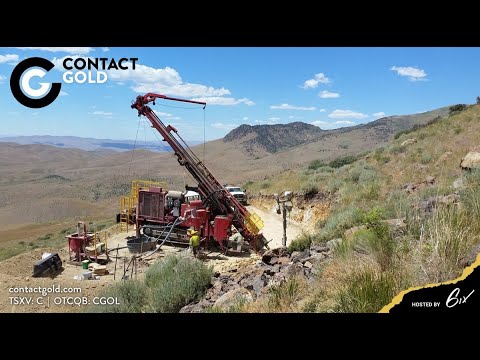
0:09 All right. Hey there, everybody. It's Matt Lennox-King, President and CEO at Contact Gold. Today we're going to take you through a virtual site tour of our Green Springs project. Certainly need to do things a bit differently in this environment, but I think with the 6 platform and Verify working in the background, we're going to be able to give you guys a really good impression of Green Springs and how things are panning out at the project level. So we'll switch now to Verify, which we have here. So here we're looking at a regional satellite image of Northeastern Nevada. You can see our 2 key projects here. The first being Pony Creek, which sits on the southern extension of the Carlin Trend, roughly 30 kilometers to the northeast of Kinross' Bald Mountain Mine. But then we're gonna come down and look at Green Springs, which will be obviously the focus of today's site tour. So that sits on a Cortez trend, parallel trend to the Carlin trend, also major gold producing area. In this case, we're very close to Fiore Gold and their Pan Mine, their Gold Rock development project and Waterstones Mount Hamilton deposit.
1:32 Coming into Greensprings itself, We're looking at a relatively large property position at about 18 Square kilometers. You can see here more roughly. Or exactly 10 kilometers from Gold Rock, which is a feasibility stage project. We're again about 5 kilometers south of Mount Hamilton, another feasibility stage project. So Green Springs does fall in the middle of a very active district here in northeastern Nevada.
2:04 We'll start off with a panorama looking east through Greensprings. So here we can see the old Greensprings mine. We're looking at what's called the Charlie Pit. And here we can see the rusty, well-oxidized unit in that pit. That's called the Chainman Shale, and as you'd recall, hopefully, that is the main host unit through the mine trend, which measures about 2.5 kilometers, and extends from Charlie down through the Delta Pit through the Echo Zone, which is the high-grade oxide zone here at Green Springs, down to our recent Zulu discovery. It extends north through the Charlie North Pit and then terminates when we get to the Bravo and Alpha zones. So these are hosted within what's called the pilot shale. That's a really important host rock at the Pan Mine and at Bald Mountain.
3:08 Here we have thick zones of well-oxidized Gold mineralization at Alpha and Bravo in the North and also outcropping mineralization at our large-scale Tango target that we will be drilling in the coming months. We'll do a little bit more geology here on the mine trend. As I said before, this is the Chainman Shale. That's the key host rock at the old Greensprings mine. Beneath that we have a unit called the Joanna Limestone. It's about 50m thick on average. It is not a good host to Gold mineralization here at Green Springs. But beneath that, we see that same pilot shale unit that we have up at Bravo, Alpha and Tango.
3:55 And that is one of our key exploration targets here along the mine trend, but also at Gulf that we see off to the east and also up at the Bravo, Alpha and Tango zones where the mineralization is definitively hosted within that pilot shale. So yesterday being Tuesday, we released results from 2 holes at the Charlie Pit. Now, these are very important because these are tests of that pilot shale beneath the mine trend. Prior to our involvement, there were some widely scattered holes, perhaps didn't follow the best targeting. But we got these holes down and we have oxidized Gold Intercept at that pilot shale. So recall, we have first off the Chainman hosted mineralization in the near surface.
4:50 We then have the Joanna hosted and then beneath that we're targeting that pilot shale. Here in the wall of the Charlie pit you can see one of the key faults that we're focused on. So these are roughly east-west focus faults that cut the mine trend. And that's where we believe we'll have great success targeting that pile of shale. All right, we're gonna look at a bit of 3D imagery here. So here we're looking due east into the mine trend. We can see if we rotate it down a little bit, we can see the mine trend proper extending here. We have the Zulu discovery that opens everything up down to that southern property boundary. We can see our northeastern trend here which is pilot hosted and then we are going to just take a look in the subsurface and focus in on those intercepts at the pilot shale, which you see here.
5:50 So this is Chainman, this is Joanna, and this down here is the pilot shale. So still quite shallow at 150 meters or less. And here, we're gonna focus on this intercept just here between the yellow and the royal blue. That's the pilot shale. That's what some of our exploration focus has been. All right, we're back to our panorama here. Again, looking from Charlie, Gulf, Delta, Echo and Zulu. These are all zones that we have drilled this year or in 2020, results pending so far this year. And what that looks like, we've had some great results thus far at Zulu, making that new discovery at almost 26 meters of over 1 gram per ton oxide opens up everything down to the southern boundary. We've had some very strong results including yesterday at Echo with 35 meters at 2.2 grams, 17 meters at 1.5, both well oxidized with 3 3 dribble holes still with results pending.
7:02 We have 3 results from Delta, 5 more holes from Charlie, and I think what could be very interesting is we have 5 results from Gulf, which sits 1.2 kilometers to the east of the mine trend. We're now looking at nearly due north up the mine trend. I just sketched this on before we overlay the labels. This would represent our mine trend here. Rig targeting Zulu. This is Mount Hamilton up in the north. And here we go. So we have the Zulu discovery. We have Echo. We have Delta, Charlie. And this is really where we start to pick up some of these key east-west faults. You can see them in the topography coming through here, here as well.
7:50 And the light brown to orange, this would be the Jasperoid or strongly altered chainment in the near surface or at surface in this case. Overlaying some of the recent results, we have the Zulu discovery at nearly 26 meters at a gram. We have the Echo Zone, and these are results both from last fall and
8:19 in December 2021, extending that oxidized discovery. Okay, we're gonna overlay. First, we'll look at results from our October 2019 drilling. Again, near surface, broad intervals on the southern end of the echo zone. We'll zoom in a little bit more and then we're going to overlay the first results from this year's echo drilling. So 40 metres at 0.3, 28 metres at 2.1, 29 metres at 0.4. You can see how we're starting to both improve the confidence, but also extend that mineralization to the south, which we'll now look at looking due to the west and you can see specifically the impact that hole 3 had as we move things to the south towards Zulu down here.
9:14 All right and again looking down from the surface we can see those 20 drill results on the southern end. So this year at Green Springs, it's really the first time any company in over 600 drill holes dating back to the mid-1980s has done any core drilling. It's all been reverse circulation at this point in time, which gives you rock type, it gives you assay results, gives you some alteration information, but you don't really get a good picture of how things sit in the subsurface as far as structure, degree of strain and the like. So here we're looking at core from the echo zone. We can see in the upper image, the strongly sheared and oxidized chainman limestone, really one of the key hosts to high-grade oxidized gold mineralization here at Green Springs. And in the lower box, we can see intensely silicified chainman limestone.
10:16 We go so far as to call this jasperoid. And that's also another key element in the hybrid mineralization here at Green Springs. All right, now we're going to look to the east out to the Gulf target. So again, we have our mine trend, roughly north-south, roughly 2.5 kilometer strike length. On that, golf sits roughly 1.2 kilometers to the east. Geologically, it's quite similar in that you have a chainman shale in the near surface and that's underlain by Joanna Limestone. One of our key goals out here was to test for the pilot shale at depth which had not been done before And just before we dive into some of the orientation of the drill holes, you can see some of that jasper development here in the chainmanshale at surface. Certainly key and does help us pick up some of those major east-west structures.
11:17 So looking at drilling here, we have results pending for 5 holes, as I said, we can see the location of 4 of them here. These are designed both to follow up on this historic result, but 6 meters at a gram of oxide in the near surface or effectively at surface. But then also to look for that deeper pilot shale hosted mineralization beneath Gulf. All right, So we're back to our overview of the mine trend. Again, looking at Charlie, again, to reinforce that major East-West fault that we see replicated throughout the various zones here at Green Springs. We're going to step from the mine trend to the north.
12:04 So this is in the area of Bravo and Alpha. These are both hosted within the pilot shale, so our target beneath the mine trend. These are both effectively at surface, strongly oxidized, and appear to sit or are interpreted to sit on a strong northeast oriented structural zone. So here we're looking effectively at the Bravo zone, Where we have results pending in the immediate Bravo area for 5 holes. Following up in part on this great result from the 2019 drilling 22 M at a gram. We can see the connector road. We can see the excavator working on additional drill sites.
12:52 Now we're going to come up to Alpha. As you can see here we've stepped 450 meters to the northeast. One of the key intercepts from 2019 drilling is 1.68 grams per ton over 35 meters oxide as well. Here we're looking at the connector target with the view that we can connect these 2 zones of oxidized gold mineralization along this major structure. So there's 1 hole pending from the connector zone itself and then 5 pending from the alpha zone proper. From alpha. We're going to step back up the hillside. So this is alpha down here. And we're now at the tango target, which is a large zone of strongly altered pilot shale and limestone at surface, we have a lot of jasperoid development, We have high grades of Gold in rock samples at up to 1.5 to 2 grams, as well as a very large Gold in soil anomaly at about 250 by 500 meters. This is a brand new target, has never been drilled, and we intend to be out here drilling in Q1 of 2021.
14:06 Great opportunity for a new discovery. We'll now look at a bit of a slice of geology stepping back down to the mine trend itself. So here where this photo was taken we're looking at Gilnet limestone so that underlies the pilot shale when your stratigraphy is right side up. So over that we have the pilot shale. Typically we see the Joanna limestone on top of the pile of shale as we discussed before. Normally on top of that you would have the Chamond shale. In this case we have some Diamond Peak conglomerate on top and then we have a thrust where we pick up that Gilmet limestone again. You can see here in the upper left, the gill net typically is a big cliff former, so I think most places in this part of Nevada you'll either have gill net or devil's gate, which is essentially the same unit forming big cliffs, and then we come into our normal stratigraphic sequence again as we approach the mine trend of Gilmat, Pilot, Joanna Limestone and then Chainman Shale just around the corner.
15:13 Here we can start to pick up some of the claims from Fiore's Gold Rock deposit which again is just across the Flat Valley. We can see the reclaimed mine dumps at Charlie here as well. So I hope that was a good overview for you and you really got a sense of how things sit on the ground at Green Springs, how both the 2019 results and the first results that we've had from our 2020 program fit into the big picture at Green Springs and what the opportunities are. Of course, you can always follow us on all the regular channels and methods, the website, the info account, and certainly we're on Twitter, LinkedIn, and all the rest.
16:03 All right, so there we go. Again, Matt Lennox-King, President and CEO of Contact Gold. Hope you enjoyed the site visit to Green Springs, and we do hope to have the opportunity to host you to site in the future as things approach normal. Thank you very much and all the best for 2021.