Ian McLaughlin
CEO at VANQUIS BANKING GROUP PLC
Replay available
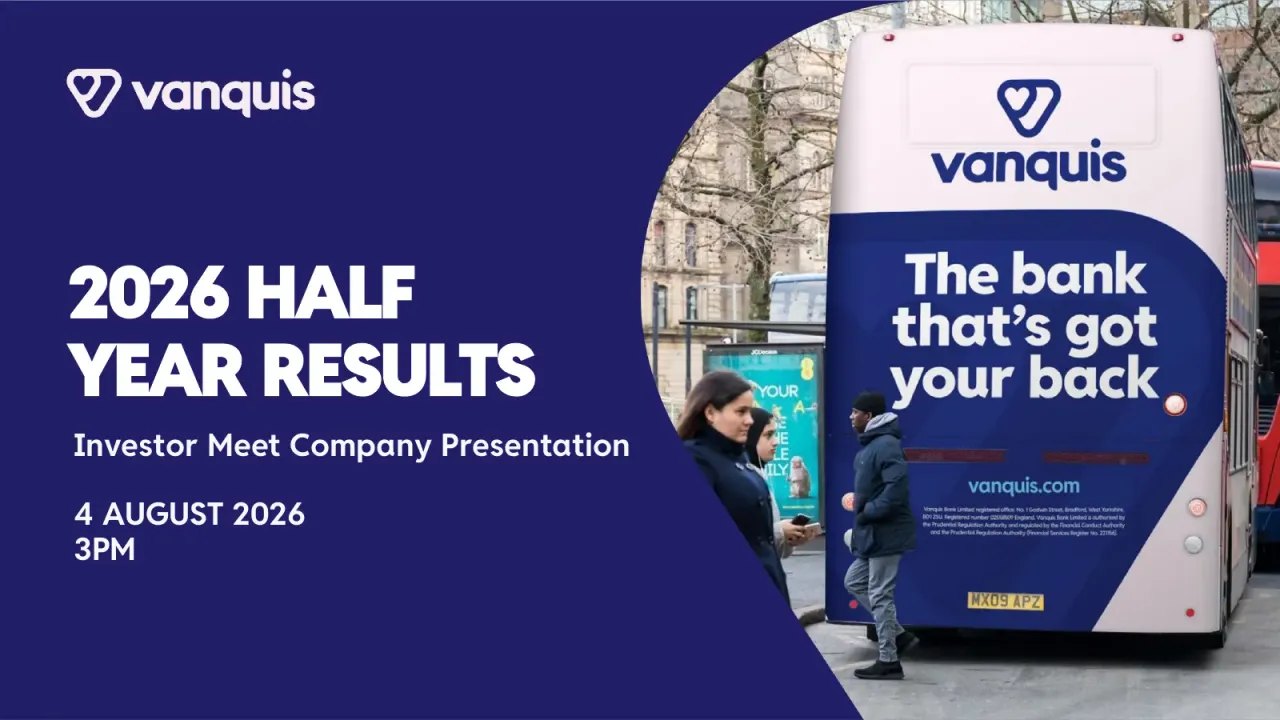
Interim Results hosted by Vanquis Banking Group (LSE:VANQ) on Investor Meet Company, held 2026-08-04.
On 6ix: 6ix.com/event/vanquis-banking-group-plc-vanq-interim-results
Automated transcript · Written by software from the replay's audio. It can mishear names and figures; the replay is the record.
0:01 Good afternoon, and welcome to the VANQUIS BANKING GROUP PLC Half Year Results Investor Presentation. Throughout this recorded presentation, investors will be in listen only mode. Questions are encouraged, and they can be submitted at any time using the Q and A tab situated on the right hand corner of your screen. Simply type in your questions and press send. Before we begin, I would like to submit the following poll. And I would now like to hand you over to CEO, Ian McLaughlin. Good afternoon to you, sir. Afternoon, Alex, and welcome, everybody. If we just go to our sort of intro slides, look. It's I really appreciate you joining this afternoon. It's a bit of a frustrating update from VANQUIS. I'm sure it is for you, for your investors. It certainly is for us as a management team. We are making really strong underlying progress, and I'll go through a little bit of that, in a second because I think it's important to talk about how we're doing with what we committed to do.
0:52 But then probably the the the meat of today's presentation is what has happened towards the end of the first half that has caused us to change our guidance. So I'll I'll take you through that. I'll then hand over to Dave Watts, our CFO. You can see on the screen, I've got James r Cranston, our head of investor relations with me, and Dave as well. And then we'll go to your questions, which which are always the bit where we get great value from. So look forward to that. Please do post your questions as we go. So so, look, as I said, a bit of a frustrating first half for us. Really good underlying progress, particularly on transformation, but two headwinds and one particular tailwind, and and that's what I wanna unpack. So if we just go to, the next slide, if I'm summarizing where are we on the, in our overall performance, it's it's it's sort of strange this in that you don't often get to say things like profit before tax is up 44%.
1:45 We made more profit in the first half of this year than we did in all of the previous year. As you can see on the slide, our balances are up 24%. Income's up 8%. Credit quality's stable. Cost discipline, our cost income ratio's down 9.4%, so heading in the right direction. Dave will talk a bit about capital, but real improvements there. And at the very bottom of the slide, you can see as well, we got some very, pleasing external recognition from Euromoney who you'll know are one of the the premier, awards, and an external recognition where we were recognized as, the best bank transformation in Europe and the best for consumer lending in The UK. So look. What that's all that's all good. Right? And it is. We're very pleased with that. I'll I'll just turn to the next slide and pull out a couple of the things that we've delivered that underpin those numbers, and I'll not talk to all of these. But you'll see the the biggest one is top right under scale profitably.
2:44 Our our strategy remains the three pillars that we've talked about before, serve more, serve responsibly, and scale profitably. And and probably the most important part of our gateway tech transformation that is the proof point of the quality of the build we're putting in to underpin the future sustainability and and profitability of this business is around our mobile app. It's very rare. In fact, I can't remember in my entire career, a mobile app transformation going quite as well as this one. 100% of our existing 1,000,000 plus cards customers voluntarily downloaded, and set up our new mobile app. Now that that was for some good reason. I'll talk about some of the things we've been doing, to to make that worth their while and to stimulate that in our existing customers. But that was a fantastic success. It was driven by our Snoop engineering team.
3:38 They built that within a couple of months, and it was deployed for, as I said, to all our customers between February and June this year. So a really big milestone for us. You'll see bottom right of that column if I stay under scale profitably. We also deployed our first customer facing agent. That's a big milestone for us as well and something that is incredibly important as we build through the rest of this year and into next year in terms of our cost to serve our customers. If I go to the left hand side, you'll see a couple of things about, installment lending and a prime upgrade. These are the things that I talked about if you heard the q and a's from our actual presentation on last Thursday morning that we're not developing new brand new product streams that cost quite a lot of money to do.
4:28 We're we'll get to that in due course, but for now, we're concentrating on optimizing and deepening the number of customers that we can reach in our total addressable market, which as you will remember is vast at about 24,000,000. So how can we do more in our cards, in our vehicle finance, and in our second charge mortgage main asset products? And, certainly, those two things, for cards, both in a an insta installment lending, which we know with buy now pay later regulation coming in, then there's real demand for that. And the prime upgrade one may sound a bit curious. Like, why would a bank like VANQUIS be doing a prime proposition? And the simple answer is because we're getting better and better at helping our customers learn to manage their money better using the tools that we give them. And, therefore, we've got a couple of 100,000 of them now in our book who have become prime.
5:17 And that's in some ways, that's a really nice thing because it shows that the way we're working with our customers is is really benefiting them. But there's a risk associated with that because as they become prime, even though they've got loyalty to us because we've helped them the whole way through, there is a danger that they can transfer their balances away to a prime, card, supplier. And, therefore, what they're saying to us is we would like to stay with you, but we would like a product charged appropriate to our financial resilience and our credit score as it is today, not as it was maybe five years ago or three years ago when they when they came to us in the first place. So I think that's a really important one as well. And in the middle, I'll just call out the top two, really. These these are just, again, proof points on the underlying progress we're making.
6:04 Our customer satisfaction index again increased and has increased above the industry benchmark. So we are serving our customers better than our peers. That is really good. And for the first time ever, we got a service mark accreditation from Institute of Customer Services. VANQUIS has never had that before. If any of you have been through it in any other businesses, it's quite an achievement and real recognition that we're just making the underpinnings that support the future success of this business stronger and stronger as we go through each week, month, quarter, half year, and year, and you should expect us to continue to do that. Those getting those foundations right is absolutely our number one priority. But, of course, we have to perform in the in the time that, we're reporting on as well. So let me let me turn to the next page and talk about the two headwinds that we discussed last week. And both of these emerged pretty late in the quarter, and both of them are a drag on our performance, which we could frankly do without, but there's no point bleating about it. These things happen. Everyone sets a strategy, and sometimes things go in your favor, and sometimes things go against you. We've had these two go against us. We are therefore doing what you'd expect us to do as a relatively mature management team, at least in years.
7:22 We are absorbing them, understanding what's causing them, and reacting and and planning, you know, as a result so that we still get to the goal that we've set, albeit it will take us a a little bit longer. So what are the two headwinds? Well, you can see on the slide, we've called out the, the first one and the most the one that worries me most is lower utilization than we had planned for with our existing credit card customers. And I'll come back to that. The second one was a more mechanical model adjustment, and we can pick this up in q and a's if you wanna drill into it. But unemployment forecast in The UK from the start of the quarter to the end the start of the half year to the end of quarter two has increased. So it was 5.1. It's moved to 5.7.
8:10 That takes 8,500,000 of a hit to our model straight out of our of our bottom line. So, you know, it is one of those things. It's mechanical. Every bank has its own version of it. It's supplied by an external provider. You can't pick and choose which forecast you want. It's all covered by our auditors, Deloitte. So it sort of is what it is. The obvious question is if that gets worse. So if unemployment forecast goes up, could we take further hits? The answer simply is yes. Currently, it's it's forecast to trend back down through 2027, but we can't bake that in yet. So we are assuming that stays at its current level with that level of drain through the model adjustment on onto our p and l. So we can talk a bit more about that, as I said, as we get into q and a's. But I'd I'd almost park that one because it sort of is what it is.
9:00 It's a mechanical model adjustment. There's nothing we can do to influence it. So but it but it's frustrating because we made 8,900,000 of a profit this year, and that would have been another 8,500,000 on top. But there you go. The first one that I mentioned is the one that I wanted to spend a bit more time on, and and we've got a couple of charts coming up on our particular products. I'll I'll spend most of my time on credit cards, but I do wanna touch on vehicle finance and, on second charge mortgages as well. But in very simple terms, the best way to illustrate this is our active cards customers. So customers that are with VANQUIS that are have gone outside a promotional onboarding period are spending more with us, so that is good. Their actual spend is up 10% in the first half.
9:51 We know our competitors' equivalent number is minus one in the first half. Now that's not every competitor. That's a cut of those that are most like us in terms of the type of customers we serve. So So we've got a delta of plus 11, to the market. Well, what's wrong with that, you may say? The the simple answer is as we forecast the recovery of this business and all the work that we've been doing to stimulate our existing customers to use our card, we had a planning assumption north of 15% on that. So 10 plus 10 is good. Plus 10 versus peers at minus one is relatively plus 11, so that is very good. But if you've got a planning assumption of plus 15, that's a 7,000,000 delta. And and that is this you know, that's the headwind that probably you should pay more attention to because we have put a lot of good, well thought through previously proven stimulation activities into this this card's customer base, which is where the 10% uplift has come from. So things like we've done prize draws with our customers where they could win a trip to Florida. We've done cash back. We've done rewards. We've done, love to shop vouchers.
11:04 We've currently got an FX free for the summer initiative, out with our customers where the clue is in the title, but, you know, their foreign exchange spend on the card is free. So there's a range of things that we haven't really done before as a business that are making a difference and are improving that spend, just not by as much as we had assumed. So, you know, you could say, well, you know, you you over assumed that. Yes. Of course, with hindsight, it's always your best strategic planner, so we have 15. 10 is not 15. So, you know, that's that's very obvious. But, actually, the those underlying activities will continue, and we're assuming that 10% continues. But when we talk to our customers, what they're telling us is it's the link to that unemployment first, you know, the other headwind that is making them more cautious about their bigger spends. And and that's more worrying because, you know, for our customers, we would never want to overstimulate their spend. We don't want them taking on credit that they can't afford. That just flows through to our impairment line at some stage and is awful for the customers. So we're trying to hit a very delicate balance here about making them aware that there are good things available to them now through VANQUIS that they probably haven't been used to before, but not overdoing that. And it is that consumer confidence, and you can see it in lots of surveys. You know, the Bank of England put out an appetite for credit report last week.
12:30 There's a GFK consumer confidence report that that all says versions of the same thing that particularly for this sector of customers, their appetite to take on credit links to their confidence, and their confidence is down. Now will that stay like that? We don't know. We've got a, you know, a new prime minister. You know, we'll we'll see what happens with the talking up The UK maybe rather than talking it down. That can help. We'll see what happens with unemployment, but, you know, that is what is behind that second headwind. So I wanted to spend a bit of time on that. I always think when you look at any business, asking a management team, if something has happened that you weren't expecting, do you at least understand it? The answer to this is yes. We do. These are the two headwinds that hit us. And are you then clear about what you can do about it? And that's what I'll come on to talk about now.
13:18 And, yes, we are. So we have a very clear plan, but it will take us a little bit longer. So if I just go to the next slide and if I stay on credit cards, we've shared this probably for the first time at this level of detail, but it's part of answering that question about, are you clear on the problem and on what you can do about the problem? And we there's a couple of very important facts on this slide. So first of all, we have two main types of credit cards when customers come to us new. We have the traditional credit builder card where someone comes in, they wanna build a credit score, they tend to get a very low balance with us. And then over time, we increase that balance assuming that they are performing and paying. That's the, the chart on the left, the credit builder chart that you can see. The other proportion of our new business is for balance transfers in where customers have built up a credit card balance elsewhere. They bring it to us for a promotional period, which is usually nought percent at something between six and eighteen months for us. There's a whole range of different cohorts, but they they move to profitability with around two years.
14:22 The credit builder card, as you can see on the slide, takes longer because it's building the credit. So, you know, that that's how long it takes our cards to become profitable. Once they get past that line that you can see on the axis and into profitability, they're very profitable. And they then become the existing customers, which is who I was talking about on the previous slide, who have spent 10% up, but not 15 up. So we wanna get our customers to that stage, and that is working well for us. And if you look at the bar chart below, let me just illustrate, you can see circled in the middle at plus 19%. We increased our cards volume at last year in 2025 by 19%. That is a very good performance by any standards. I I talked to you about that back in February when we did the last one of these.
15:12 That, though, will take on average two, two and a half years to reach maturity. So that starts paying back and hitting that, that line at you know, during 2027. So 2027 is well underpinned by that bigger influx of new business in 2025. The challenge is the year before where we actually were down 10%. You can see it in the red in 2024 in our cards balances. As we got to grips with what we'd inherited in the business, sorted that out, and and reset the business to go again in 2025. And the issue there is that, therefore, the volume of new business that we wrote in '24 that comes it through into profitability in '26 as it hits that two year, point, that is not as much volume as we would like, which is why we were working on stimulating more spend for our from our existing customers.
16:08 '25 onwards, though, is good. So 2027 onwards is good. So what are we doing about the challenge of that 15% spend assumption versus 10% actual? The simple answer is we're gonna write more business, new business through the rest of this year and into 2027. So we're filling the hopper up again that then pays back two years down the line as as those customers stay with us and and reach maturity. And that's all fine, but it's a lag because your existing customer spending today becomes an interest bearing balance today, and that's the 10 to 15 that I've talked about. A new customer coming in and bringing you a balance and then starting to spend pays off two years down the line. And if there you wanted the simple explanation about why have we pushed our guidance out a year, it's because we're having to fill our hopper with more new business, which then has that payback period lag, and that's what means that our our rooty ambitions have have gone out a year. So, look, happy to touch on any or all of that as we get into questions, but, hopefully, that slide has been helpful. We've been going around our existing investors over the last couple of days, and and we've spent a lot of time with them on this. And the feedback is that it is at least giving clarity on not what's changed, but why has it changed and what are we doing about it, and how does that then underpin our performance going forward.
17:32 So I'll pause on cards there. Let me just flick to vehicle finance, if I may. So if we move to the next slide and we've basically shown the same thing as we've just shown for cards, but for vehicle finance, and then I'll come to second charge mortgages. Now this one's a pretty simple one. You can see it pays back quicker than cards. It's at a slightly lower return on tangible equity absolute, but this is good business for us. So why are we not increasing our volumes? You can see in the blue bar charts that our volumes are staying broadly flat. And we talked about this back in February. We have a very inefficient inefficient legacy platform that underpins both the onboarding of new customers and the servicing of existing customers in our vehicle finance business, our money barn business.
18:21 The last bit of our tech transformation that we're working on right now is to give us a new onboarding and servicing platform for vehicle finance. Currently well, in fact, I go back a year, our cost income ratio for this product was in the seventies, so high. It's come down to just under 60%, so it is getting better. But we want to get that down into the forties to be in line with our cost income ratio of the other asset products. So that means that scaling this business up, writing lots of new business is expensive for us in the short term, and we are there for holding the volumes. We're writing enough new business to make up for the business that gets to the end of its five year term. It's often a little bit less than that just from behavior of customers, but we're we're writing enough to stand still. We're looking at that again very closely to see if we can do any more through the rest of this year and into '27 as we get that new platform deployed, but you'll understand why we're being cautious because it's it's just not an efficient business.
19:18 But there's really good demand there, and the feedback from customers as to how we serve them again is very positive. So it is a business we really like. We want to get going on. You'll see we've moved margins up a little bit in the meantime because there is decent demand. So we're passing on some of our increased cost of funds into into this. So this business will broadly stay enough new coming in to make up for what's getting to the end of its term and then move into growth as as we get the new platform, or maybe we can do a little more in the second half. We'll come back to you on that. So that's vehicle finance. Bit simpler than cards. If I turn to the next slide, which is second charge mortgages, again, the same way of presenting the story, but a very different business here. This is obviously secured lending, all all secured on the main residence, an average loan to value of about 70%, just slightly north of that, so very much in our sweet spot.
20:14 And as you can see, our volumes here have been a roaring success. So we launched this business, sort of mid twenty twenty four. We're it's now our second biggest book after cards. It's bigger than vehicle finance now from almost a standing start in a couple of years. So you can see the sort of group figures. We're over 800,000,000 of a book now. But it is lower margin because it's secured, but it's also lower risk. So the the hurdle of all three asset products that I've just talked about, including this one, is all mid teens or above. So if we keep writing new business at a mid teens, eventually, overall business mathematically gets to the mid teens RoTE that is our guidance. It's just that change in cards of the mix from existing customer spend to writing more new business that makes the difference and has pushed the guidance out. So, hopefully, that makes sense.
21:06 Again, you know, I'm very happy to, to take questions on that as we get to it. So, look, if I just summarize what I've said so far on the next slide, and then I'm gonna hand to Dave. Basically, you know, what is going on with VANQUIS? I think, as I said at the very beginning, we are very confident that we are doing all of the right things that will get this business to where it needs to get to in terms of a mid teens RoTE. The headwinds that I've described have slowed us up a bit. The market hasn't reacted well to that. Completely understand that. That doesn't take away our determination to keep doing the right things and and find a bet you know, a different path to the same destination. So one of the broker notes that you may or may not have seen, summarized us as delayed, not derailed, And I think that's as good a summary as as as I could give.
21:56 But we concentrate on keeping doing the right things. The worst thing we can do as a as a leadership team is get distracted, start, you know, making up new knee jerk reaction answers. It stick to the plan that we know and react to what's gone against us and and find a a different path to get to the same destination. But that destination will still be underpinned by our new technology. And as you can see on point two here, we've actually found some further benefits from that as we get into 2028. Our liquidity and funding is good. Our capital actually has improved as of a couple of weeks ago, so Dave will talk to that in a second. And we're very clear that this business is serving customers well. You've seen the customer satisfaction scores that I've just talked about, and you've also seen that the board has confirmed that it is looking to reinstate a dividend at the end of this year subject to no other major changes.
22:52 I think that is just a sign of how well underpinned the plan we believe now is. So has it been a a fun first half for us? Not really. We have had to absorb things that we hadn't planned for, so we'll learn from that. But we're not packing our toys up and going home. This is a time for resilience and determination, and that's exactly what we're doing as a management team. So, look, hopefully, that gives you at least an overview of the story, what's changed, what we're doing about it, and where does that then get us to as we look forward. I will pause there and pass over to Dave to take you through some more details on the financials. Dave, over to you. Thank you, Ian, and good afternoon, everyone, and thanks so much for joining the call. I I will go into more detail about the financial guidance on three slides before covering a capital requirement under the new Basel 3.1 regime, which comes into effect on 01/01/2027.
23:44 So if you look on this slide here, this gives you updated that you're going to '26 and 2027 from what we published back in February of this year. This guide assumes the impact of the consumer confidence that Ian has spoken about from uncertain macroeconomic environment continues through this next eighteen months. As a consequence of that, balanced growth can be expected to be driven by new customer acquisition, and this is going to moderate our returns in the short term. In the first line, you'll see the gross customer interest earning balances, and we're not changing the guidance there. It's going we expect to get to a greater 3,300,000,000 of of balance by the end of this year and 3,700,000,000 by the end of twenty twenty seven. You'll see on net interest margin and risk adjusted margin that the those numbers have decreased over that period of time. This is exactly as we said previously as we had more of our business going through the second charge mortgage business, which has a lower margin but also lower risk product, that was going to decrease. There's no change there. The absolute amounts have come down because of the new business being written in in the newer customer acquisition, which has the outset a lower yield on that.
24:53 Cost income ratio, we've nudged that down to low 50s and 26 at the mid to high 40s. This is a factor of the lower income that is going to come through. Then on statutory growth, you'll see a 2.5% dividend first half this year. We now move that out to low single digits this year, followed by low double digits in 2027, then ultimately get into mid teens ROUP PLC expected in 2028. Look, Ian's talked about this. He's given the confidence that we need to come out of the business and assuming no deterioration in The UK company, the the board intends to reestablish a modest dividend at full year '27 '20 full year '26 from there. I will come back to c t one ratio in a couple of slides timing. James. So this slide just gives a little bit more detail, and I think you've seen some of this before. On the left hand side, it just shows you in graphical terms the pies on the left hand side. You'll see on the old balances and old products are gonna grow over the next eighteen months. That's not changing.
25:55 You'll see that the share of second charge mortgages in the gray bit or silver bit is going to increase. You'll see the NIM trends and the RAM trends, which is just margin trends, just coming down a little bit as a concept I talked about earlier. And to note on the cost income ratio, this is gonna change and get better over time, not just from a growth in income, but also reduction in costs. What we've got is a change in guidance on a cost takeout of previously highlighted transformation sales of 23,000,000 to £28,000,000 over the period twenty six to twenty seven, increased up to GBP 30,000,000 to 35,000,000 over the period up to 2028. What is really what we laid out previously is that the cost of GBP 26,000,000 will be lower than the cost in GBP 25,000,000, and the cost in GBP 27,000,000 will be lower than the cost in GBP 26,000,000. We have a downward trajectory on costs.
26:45 On the next slide, it's an illustrative RoTE guidance walk. And what you see on the left hand side is the bit from the full year '25 to full year '26. And we've shown this to you before, but the bits and the hashed out bits show what's changed. First, we'll go to the bit in the third bar across. It says increased IFRS nine macroeconomic provision. That has a 2.4% RoTE impact in 2026. On the left hand side, you will see the low income due to lower expected credit card utilization from the high yielding existing customers. That brings out a big drop down of income, which we expect to come through in '26 is no longer gonna occur, and you get some credit against an underlying impairment because you're not writing so much business. On the right hand side, it just shows you how to go from full year '26 position to full year '27.
27:33 Yeah. You can see the growth coming through our risk adjusted income from the income from the new customer credit card business that you tend to do, because you grow the second charge mortgages, and importantly, 27, a growth of vehicle finance portfolio. All other aspects in terms of these these these walks in terms of complaints coming down, transmission cost savings, underlying cost movements, etcetera, have not changed in our thinking at all. Right. The last slide is probably the most important one. This is our tailwind. We do get some tailwinds every once in a while. So as you as you all be aware, the retake requirement of capital is changing here in The UK for the 01/01/2027. In early on this year, in January 27, the PRA issued its guidance on what happened to that where we call a pillar one RWAs and the Basel 3.1.
28:23 And you'll see on the left hand side, our RWAs would go up by 15%. That's only one half of the equation. It shows you why the left hand side on the second charge mortgages where it's going up, credit cards, and operational risk. What's important and what's happened in the last month is we've got we've got confirmation in writing from our regulator. What is gonna be actual capital requirements or what they call the the pillar two requirements? The net result of that, if you look on the right hand side, is we've had to reduce our our our guidance to the market on a CET1 ratio from 14.5% for 2026, bringing it down to 12% under the new regime. It's not directly the same. What is important to understand is the surplus capital above the guidance is increasing from £23,000,000 to £38,000,000.
29:13 So as a consequence of that, all things being equal, we have 15,000,000 additional CET1 capital to support our growth for the business going further forwards. So this capital, supported by strong liquidity position and a strong funding position, gives us a rock solid platform to continue to grow this business going forwards. With that, I shall hand you back to Ian for a wrap up. Thank you. And, look, there's some great questions in already, so we'll get to those pretty quickly. I I sort of said this at the start, but if if I just put the summary slide up, you know, this is a business that is now profitable. It's it's not massively profitable, but it was massively unprofitable back in 2024. So that in itself is a is a very positive move. Our balances are growing. Our NIM and RAM are staying where we'd expect them to be for the mix, particularly of the secured business coming through. And our credit quality remains stable. We're making continued progress on costs, as Dave said. You know, twenty five's costs were lower than '24. '26 is lower than '25. '27 will be lower. So we're continuing to work on that because that's within our direct control.
30:15 And we're good on liquidity funding and capital, and the board is feeling confident enough to signal dividend for the first time certainly in our tenure here. So so there's a lot to like here, but I'm not shying away or sugarcoating for the fact that, you know, we have delayed our guidance. That is for the reasons that we've described. We are reacting to those reasons and bringing the best plan back that we can get access to without going crazy on on actions that add extra risk in because no one's gonna thank us for that. So you should expect us to continue to do that. We are determined. We are resilient as a management team. Many of us have faced other things that probably, you know, felt at the time even more challenging than this in terms of global financial crisis and COVID and so on. But this is really annoying, and, you know, there's no you can be as emotional as you like, and I'm not overly emotional. But it is frustrating, but we are absolutely determined to get to where we've said we're gonna get to. We had a few of our investors say, slightly tongue in cheek, I think. Thank you for creating another buying opportunity for us. So we a few others that are already invested say slightly different things. But depending on what stage you're at, this this may or may not be that sort of opportunity.
31:25 Our job as a management team is to stick to what we know is working, keep the focus on that, And probably most importantly, as in any business, keep our teams motivated, engaged, and focused on doing the right things, and that's exactly what you will see us do. So a challenging set of first half messages, but we continue to do the right things to get us to the right destination. I will stop there, and we can go to questions. Great. Thank you, Ian. Thank you, Dave. So we have a few questions in the in the queue. So let me go through those, and I'll try and group them in together in themes as much as possible. But I think let's start on this one. And I know, Ian, you covered a lot of this in your in your comments earlier, but maybe just give a little bit more color around the timing.
32:12 Essentially, question is what has dramatically changed since early May when we gave our q one trading update to the market that's caused us to to revise our our our guidance? Yeah. Look. Very, very fair question. As you said, I've sort of covered some of this, but let me just quickly recap. We saw the, unemployment forecast through, that we have to take into our model. We got that in the June 22. Right? So it's a quarterly thing. It's right at the end of each quarter. So, that that was the one that affected the first half most. So I think that's that's that's a dramatic change to to use the language in the question. On the other headwind of sort of consumer confidence and spend, in particular, spend, we had a brilliant December. We had a really good March.
33:00 We we saw April and May tail off compared to our assumptions that I've I've already described. So it's really the impact of that coming through and and the fact that we're not gonna blithely assume that that magically gets better. Okay? So we are assuming that those two headwinds stay at those levels, and that's therefore in our forecasts going forward. But both of them bit more towards the end of the second quarter, the end of the first half. So that's that's really I mean, we did there's some wording in in our update that you can read back in in May that does allude to us watching this very closely, but it really bit particularly around you know, post the start of the Iran war, which you'll remember was, I think, February 28. We saw that build through March and then through q two in in terms of just consumer confidence, uncertainty, cost of living, you know, fuel, all of that stuff.
33:54 So that probably is the best answer to that. Dave, unless you want to add anything? No. I think you've covered it, Robin. K. Great. Thank you. Next question, the investor calls out the, I suppose, reducing asset yield in credit cards, the the reducing NIM in our guidance. And obviously, you've explained the reasons for that. Question is how much of the margin compression do you think is permanently structural due to competitive dynamics? So that's probably one question. And then the second question is what specific cost takeout could you put in place if the existing customer spending that you've already talked about remains depressed Yeah. Into 2027? Yeah. Do you wanna take the first one on NIM, Dave, and then I'll talk about the cost aspect?
34:43 Yeah. Okay. So on on NIM, on on actually the slide 13, we did call out on the credit card. Once we've got to a degree of growth that's maturing on credit cards, we expect the NIM should stabilize post 2027. So the number we put up there for '27 was a 13% NIM. As I said earlier, we always knew it was going to come down because of the proportion of second charge mortgages coming through, which is low risk and low margin. But once it's it's maturing our balances through post '27, we expect to hold the 13% level. Yeah. And and look at it. I think there's a there's a factor here in terms of our NIM overall will change in relation to that mix. As I said, we're over 800,000,000 of second charge mortgages. Now if you go back two years, we were zero. So, you know, that just has a mechanical effect. It's a very different product.
35:36 I think the other thing to just be aware of that I mentioned is that prime proposition in cards that will bring our cards NIM down as well. But far better to be getting some revenue from a customer staying with you on a lower rate than a 100% of a higher APR, and they've left. So you're getting nothing. You know? It's a really simple one, but it will change the NIM as we mature our book. And and, look, I'm I'm very confident that that is a good thing. We want our customers to use the tools that we give them to help them manage their money better. That's what makes them loyal to us. That's where we add real value to them in their lives. But we don't want them to go through a period of getting you know, repairing their credit with us and then leave. And they don't want to either. They are loyal, and they wanna stay. So even though NIM will look like it is the compression coming through in cards as that builds, if that retains a couple of 100,000 customers that otherwise might go to one of our prime competitors, I am absolutely fine with that. That is the right thing to do.
36:37 To the second part of the question on costs, look, we we are looking again at costs as as you'd expect us to. I mean, as as I said in my remarks, it's the one thing that we are in direct control of as a business. You've seen we've had a very good history of setting cost challenges to ourselves and beating them. We did that in 2024. We were over the 25,000,000 that we set. We did the same in 2025. We are looking again. We have, you know, a range of initiatives that are everything from, you know, the bits and pieces of travel and accommodation and entertaining and all of that stuff through to how much we're spending on marketing, but some of that is good spend. You don't wanna go too far. But, you know, how do we balance that? We're looking at all of our sort of big contracts that you know, with suppliers and seeing if we can do anything else than that. So there are a range of other things that you would expect us to pull levers on to continue to improve that, and that is what we're doing, which is why that cost balance year on year will continue to go down.
37:36 And I think, you know, that is absolutely right. You know, that is that is the the correct thing for us to do. And we'll you know, it helps with that jaws that I talked about before. If we're getting our revenue going up and the margin right and we're getting our cost going down, the bid in between is impairments and profit. And impairments, as as I said, stay stable. Though in a business like this, you know, we're very vigilant over that, but so far, so good. So you should expect us to see do see us do more on cost as we go forward. James, back to you. Great. Ian, there's a lot of things I just wanna add to that point there. As a business will continue to invest in the business, and that's crucial to go further forwards. Because if we don't do that, we'll be in the same sort of sticky position we perhaps inherited two or three years ago where there's been under investment in the business. So expect the investment to to still occur. It's a transformation cost savings which you're paying for that in as well as inflation.
38:28 And and, you know, that's a fair point. There are there are good costs in a business. So things like developing your tech and getting fit for purpose in that and investing in the right people, We'll continue to do that, and we are, but we need to be very mindful of every penny we spend if it's not in that good cost bucket. And you've seen I mentioned it earlier, but, you know, we had a 23 to 28,000,000 cost saving forecast for '26 and '27 from our gateway initiatives. So putting better tech out there and getting a more efficient business as a result. That's now a 30 to 35,000,000, you know, cost goal for us, albeit some of that's in 2028 as the business orientates around the better tech and gets more efficient. So Agendika is a good example. So, yeah, great question, and we will continue to manage margin very carefully, but to serve our customers where the demand is.
39:21 And we will continue to manage our costs very carefully as well, but keep the focus, as Dave says, on investing in the business. That's that's a healthy thing to do. Great. Thank you, Ian. Thank you, Dave. The next question I think we'll turn to is sort of linked to the first part of the previous question, and it's around the competitive environment across our products. So basically, has there been any discernible change in the competitive landscape that the investor calls out cards and VICRFINENCE in particular, but I think we should also touch on the competitive landscape in second charge mortgages. Yeah. And look. We have we haven't talked about liabilities or deposits either. You know, it equally has its own competitive position, but it's going very well. We're sitting at 3,200,000,000. So I'll not say any more on that, but other other than Dave might wanna comment on interest rates aren't quite going the way that everyone six, eight months ago thought they might go.
40:12 If I take the three asset products, though so what's happening with competitors? Nothing dramatically different to what we've seen over the last couple of years. We do have people come in and go out in each of those product lines. We we track it weekly. We do an impact assessment on our forecast volumes. They're pretty accurate, so we haven't seen anything dramatic. I think in vehicle finance, we saw, you know, one provider go bust last week or do a shrink wrapped liquidation. So we're keeping a very close eye on that. We saw Secure Trust Bank with v twelve pull out of the market over a year ago now. We haven't really seen the FCA scheme bite yet because it's obviously not deployed yet, but we're watching that very carefully. But remember, for us in vehicle finance, we're serving a very targeted and specific niche of customers whose demand is growing. So I I think I said before that our average vehicle is a nine year old Ford Focus with seventy, seven zero thousand miles on the clock, and we're financing that for up to five years.
41:18 So this is not, you know, like, discretionary track day play things for, you know, the the the the mad male egos or female egos amongst us that might like those things. This is essentials for families to get their kids to school and get themselves to their jobs that earns their income. And we we see real demand there, so we like that. And as as I mentioned earlier, we've seen our margins go up a little bit in vehicle finance. Commensurately in second charge mortgages, which we also like and, as I said, is going really well, we've seen margins compress a little bit. We have seen some other providers come in. There's flurries of pricing activity, and then it tends to ease off, and then someone comes someone else comes in and and and we get the same. Overall, it's down a little, but it still hurdles our mid teens roaches, so we still like that product.
42:04 Again, guys, anything you either of you want to add? Nope. No. It's coming. Okay. Okay. So the next one I think we turn to is and again, the investors acknowledging the fact that the RoTE guidance for this year has been pushed or has been has reduced to low single digits. The CET1 ratio has reduced to 15.6% relative to our 14.5 guidance. And they also call out in our disclosures the severe macro scenario in that NOI IFRS nine disclosures where if you're a 100% risk weight or a 100% weight that scenario, you get a sort of impact of 14,200,000. So basically, a downside sort of a severe downside scenario.
42:52 I suppose the question really is what's the absolute floor for your CET one ratio before your plans to reestablish the dividend with full year results are canceled? Well, let let me take that briefly and then pass to Dave because this is Dave's sort of specialist subject. But as Dave just described in this in the slides that he presented earlier, we've we've seen our capital increase actually over the well, we got that two weeks ago in terms of confirmation. So very recently, that is a good thing. That's the tailwind that we talked about. Our capital plans and thresholds support our new business forecast even with the increased new cards business that we're now talking about in the con continuation of second charge mortgages. So we believe we are well underpinned in terms of capital, and that includes that's what the board were looking at when they decided to make that comment about dividend at the end of the year. And, Dave, do wanna add to that? Yeah. Just a couple of things to add from there.
43:48 At the we've always said we're gonna deploy capital for growth, and that's exactly what we're doing. So 16.5% down to 15.6% is 90% reduction. 80 basis points of that increase was basic through an increase in credit risk weighted assets for the business, and that is gonna drive the returns of the future by investing today, as we've covered earlier on. At half year, at the end of June, £93,000,000 surplus and regulatory requirements. It's quite a big buff to regulatory requirements to go into. And as Ian said, look, when we get to the January 1 next year, we're gonna have an extra number £15,000,000 of surplus capital above our of our desired level of 12% in the new c t one regime from there. So we're quite comfortable there. Look, we do know the 14.2, and I think, you know, you can see that against regulated capital plan to 93,000,000 gap now. We're we're we're comfortably okay on capital. Yep. And, look, I'll maybe just pick up Ken B's question, which is there as well about is the is the dividend intended to enable a larger institutional investment base? I think the announcement's intended to do two things.
44:55 Yes. Of course, there are certain funds that can't or won't invest unless you are generating a dividend, so that helps open the the potential pool for us. So that that would be a good thing subject to this is only an intention on dividend. It's not it's not for the first half. It's it'll be a full year discussion. But, yes, of course, that helps. But I think it's more the board signaling its confidence in how well underpinned this plan is. Think I that's the way you would you should read it is, you know, you can imagine how intense a couple of weeks this has been as we've had to replan as we saw those two headwinds really bite towards the end of of of q two. The board have been through this with a fine tooth comb, and that's why they were were keen to support the the point on dividend for year end.
45:41 Yep. Thank you, Ian. That that was the question I was going to go to next, so you beat me to it. The next one, think, a quick one, but worthwhile just giving an update even though we may not be able to say a lot given the legal status. But just the status of the legal action against the claims management company that we're have Yeah. Look. It's a it's a very fair question. I always love these. Could you tell us about a a legal case that is ongoing? I mean, the obvious answer is no, because it's a legal case that's ongoing, and you don't wanna, you know, prejudice it in any way by saying anything untoward. What I will say is that we are you you can see even in the press over the last couple of days, the advertising standards authority and the information commissioner's office raiding offices of claims management companies and looking very closely at the, you know, the millions, like, tens of millions of techs have been sent out to to see whether their practices were appropriate.
46:40 I think we called this out earlier than that. You know, we we we were pointing at some practices a couple of years ago that we really thought were inappropriate and unfair on customers, and we have, as the question, suggests, one case that is ongoing. We are in negotiations still, and we will update when we're able to update. But I I think that broader view, you've even heard Nicola Rathi at the FCA, the CEO there saying about practices of of these companies. I think the market has caught on to what was going on there that is inappropriate. It's not every claims management company. I should caveat that a bit, but there are some that were the very high volume, low supervision that, you know, were just, you know, not behaving in the interest of customers would be our supposition. So we will update on our particular case the minute we are able to, rest assured.
47:29 Great. Thank you, Ian. We have two more questions in the queue, and I think they're they're good ones to end on, and I think they're very closely related. So I'll couple them together. So the first one is from a potential investor saying, are you able to give me some reasons to invest in the potential but and the potential of the business over the next three to five years? And the other question, which is linked is, are you more or less optimistic about the future of bankers bankers That's a great one. Here today. So I think it's let's cover them both. Yeah. Dave, do you wanna say anything on those from your perspective? Steal your funding. No. No. That's alright. Me have a go at this one here. Said, look, The potential for this business is the same as it it was when I came into the organization nearly two and a half years, three years ago now. From there, look, whatever measure you you wanna put in place is is about 24,000,000 people. We just turn turn underserved to go and serve a VANQUIS to meet their financial needs.
48:29 When I look at the business now, the quality of the people in the operation is excellent, and it's definitely improved over a period of time. Our understanding of the business is much better. The systems technology is much better. We're not this this where we are now in the guidance, nothing to be done covering issues in the balance sheets, you know, in in the past. There's nothing to do with CMC complaints spiking up. We couldn't afford to pay from there. That's got a way. This is about what's happening for the for the future. Liquidity funding and capital is so much stronger than it was previously, and we've got clarity about capital issue going further forward. So I'm definitely more optimistic for the business today than I was twelve months or twenty four months ago. Yep. Very well said. And, look, I would echo that completely. I think, as I mentioned earlier, our task now as a leadership team is to keep the confidence and the focus of our people so that we continue on the path that we are delivering. You know, it's it's it's rare to see a a share price reaction like we've had, to, you know, a 44%, you know, improvement in in in PBT and and doing more in the first half than you did in all of that last year.
49:36 But I understand that, you know, those headwinds obviously mean we pushed our guidance out, and that is frustrating. It's it's it's frustrating mostly to us, but it's frustrating to everybody involved. Whether that's an opportunity, that's up to you to do your own research. But I I remain, as Dave has very clearly summarized, you know, the quality we have built into this business over the last couple of years in everything from scorecard underwriting, collections and recoveries, customer service. You can see the stats, you know, winning best bank transformation in Europe. You know, there's just a whole range of things that are positive factors when you look at the where VANQUIS is now compared to where it was when we took it on a couple of years ago. All of those are good, and they will pay off. The question is, you know, it's back to that very simple math. If all our new business hurdles a mid teens, eventually, business gets to a mid teens. I mean, it's it's almost inevitable.
50:33 The question only becomes how long does it take, and that's the bit that we've we've described in terms of that payback period for cards in particular. But we remain confident. We remain focused. We are absolutely determined. We're not the sort of people that take a punch and then go home and cry. We're the sort of people that take a punch and then work out how to come back and fight better. So that's exactly what you're seeing us do. And then if I can add just a couple of things as well. So as you can see on the slide on this page, this is essentially a summary articulation of our investment case. And, you know, as as we point out in those four bullets, we got a large underserved addressable market in The UK. In the past, we talked about the 24,000,000 underserved customers. So, you know, we have 1.7, 1,800,000 customers today. So there's a lot of customers to to play for, you know, has a real social purpose in terms of building customers financial resilience and taking them on that journey.
51:30 We've got the cost efficient funding model, and we're obviously building a efficient scalable tech platform through the gateway proposition. So there's a lot to lot to play for and and there's a lot to to be confident about in terms of the the opportunity for the business. And and look, you know, just to to close, you've heard from two of my leadership team here. Their view, I think if you asked any member of our executive committee, any member of our senior management team, you know, they would say the same thing. We are really focused on we're delivering lending to customers that otherwise may not be able to access it. That is a very noble purpose. Our job is to get all the stuff that underpins us doing that safely and well in place, and we're making good progress on that. Yes. We've had two headwinds that we need to absorb. That's frustrating, but it doesn't change the mission. So that that's that's how it end. We will get on with getting on.
52:28 Great. Thank you, everybody. Alex, are we handing back to you to close? That's great. Yes. Thank you very much indeed for addressing all those questions. But, Ian, if you just wanted to say a few closing comments to wrap up? Well, I think I just have, Alex. But so, yeah, look. Watch watch this space. We will get on with doing everything we've described and building on the successes that we've put in place so far. We will absorb whatever comes at us and come back stronger. That really is my summary. Amazing. Ian, Dave, James, thank you very much indeed for updating investors today. Could I please ask investors not to close this session as you now be automatically redirected to provide your feedback, which will help the company better understand your views and expectations. On behalf of the management team, we would like to thank you for attending today's presentation, and good afternoon to you all. Thanks, Alex.
53:16 Thanks, everybody, for join
Follow Vanquis Banking Group PLC into a list and get an email when it puts out news.
CEO at VANQUIS BANKING GROUP PLC
CFO at VANQUIS BANKING GROUP PLC
Head of Investor Relations at VANQUIS BANKING GROUP PLC