Alex Nichiporchik
CEO at TINYBUILD INC.
Replay available
H1 Results hosted by Tinybuild (LSE:TBLD) on Investor Meet Company, held 2024-09-30.
Automated transcript · Written by software from the replay's audio. It can mishear names and figures; the replay is the record.
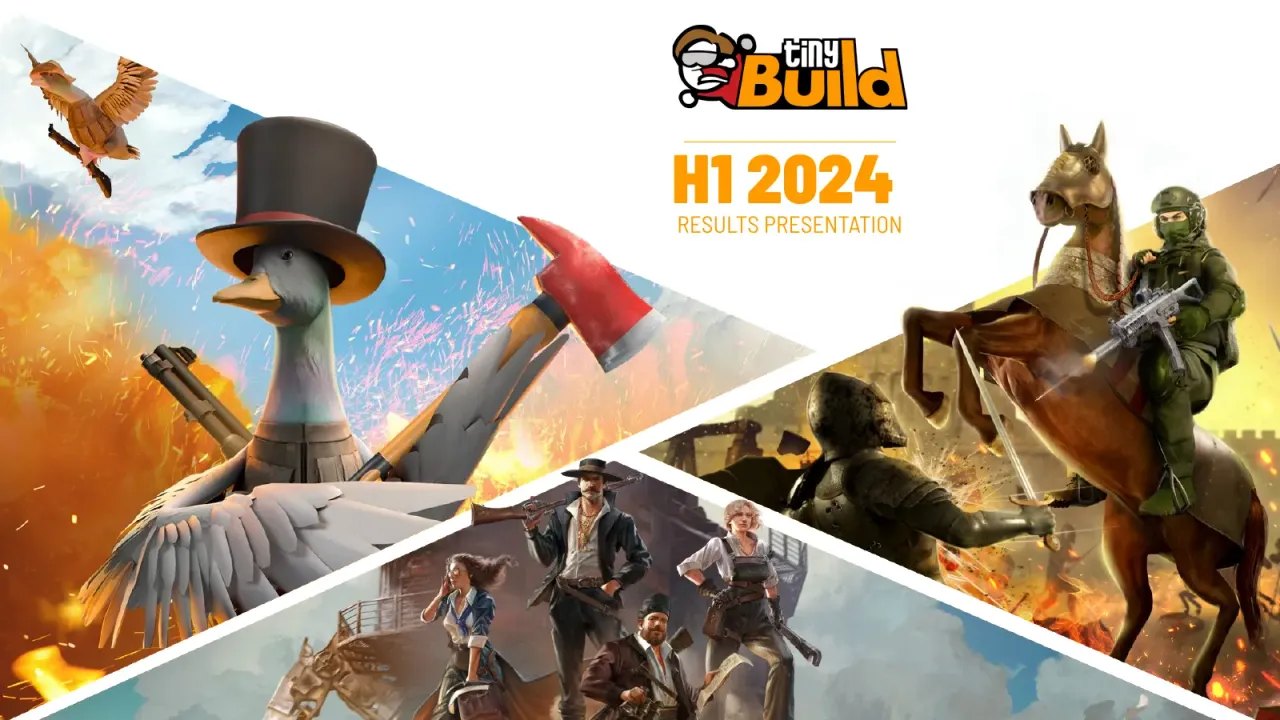
0:01 Good afternoon, and welcome to the TINYBUILD INC. Investor presentation. Throughout this recorded meeting, investors will be in listen only mode. Questions are encouraged and can be submitted at any time by the Q and A tab situated in the right hand corner of your screen. Just click Q and A, type your question and press send. The company may not be in a position to answer every question received during the meeting itself. Have the company review your questions submitted today and publish responses where where it's appropriate to do so. Before we begin, I'd like to submit the following poll. I'd now like to hand you over to Alex Nicopocik, CEO. Good afternoon, sir. Good afternoon, and thank you everyone for joining the h one twenty twenty four presentation for TINYBUILD. If you hear barking in the background on my microphone, I do apologize. My dog just recovered from back surgery, so he's able to walk again finally.
0:48 And he's just really excited about scaring off the neighbors and just really excited in general. That said, let's go ahead and turn over to the disclaimer that I'm sure everyone has read. And presenting today, it will be myself. I'm the CEO and cofounder of TINYBUILD and was joined by Jazone Jaz Salati, who will run us through the financial part of this presentation. So today, we'll do an operational review, then the financial review, and I will give a brief strategic update. And I'm also excited about answering questions today because this has really been a transformative year for TINYBUILD. So we will go through the presentation and then dive straight into the q and a. So the operational review, as many of you know, in the beginning of this year in January, we have done a capital raise supported by myself and Atari.
1:40 This is in light of continued revenue compression in h one twenty twenty four led mostly by platform deals. So think licensing out content to subscription platforms and also by the launches of noncore titles. And what I mean by noncore is the ones that do not fit into our one thousand hour game strategy. By one thousand hour games, I mean literally that. If you look at the reviews of our titles like, Spice of Frog or Speedrunners or Secret Neighbor, you go to their Steam pages, you scroll all the way down, and then you check the time played on some of those reviews. It will be thousands of hours. This means that we are really excited about investing into titles that are highly replayable, that are systems driven, where we create content that can be consumed multiple, multiple times instead of focusing on things like cut scenes that the player sees once, cost us a lot of money, and then never sees again.
2:44 And this is really heavily underpinned by our portfolio where the best performing titles over the years are the ones where players indeed can spend thousands of hours. Now if we go to the overview slide, I think the most interesting parts here, which we will discuss more in detail, is the share of revenue coming from our own intellectual property, which does come with higher margins with a higher degree of control. So it means that those contracts don't expire like a typical publishing agreement where the publisher does not own the intellectual property. And, also, what's really important to note here is 89% of sales coming from our back catalog. This is what I mean by one thousand hour games.
3:30 Within our back catalog, we have a few titles that are evergreen that when launched had a good launch year and then going forward in year two, three, four, five, six, seven even generate very meaningful revenues. This really underpins our business as a whole and creates a solid base for us to continue growing. Now if we look at the IP portfolio, last year, we had a higher share of revenues from third party IP, and that was mostly strategic with SQLs to legacy titles that we had. And we're now back to 78% of revenues coming from our own intellectual property. And this will be more important more evidently important later on. And if you look at the chart on the left side of the slide, we continue to diversify our revenues.
4:21 So we're not dependent on a single tile or anything like that. This is a testament to the work that we do on our portfolio, and we continue to invest into it, creating a safety cushion for the business. If we look at the back catalog, I just want to highlight a few games here that you should check out. They're on the slide here. It's Streets of Rogue. It's Secret Neighbor. It's Deathspot's game. It's Deathsight, etcetera. So in general, our back catalog is very healthy and continues to generate meaningful revenues for the business. And with that, I will hand it over to the financial review before taking it over on the strategy side. Jazz? Hello.
5:09 First half of twenty twenty four saw net game revenues, excluding events, fall 20% as we still suffer from lower platform deals, which peaked in 2022. In terms of adjusted EBITDA, we reported €1,900,000 loss in the first half of twenty twenty four, with a positive underlying trend month on month from the beginning of the year that leaves us confident in achieving consensus around breakeven for adjusted EBITDA for the full year. And to close, in terms of net cash from operations, on the right hand side, a drop to 2,000,000 in the first half of the year as we supported some as we went through some one off charges, which are not necessarily disclosed separately, including restructuring charges and still exceptional costs for the war in Ukraine.
6:09 Diving a little deeper in the profit and loss, breaking down revenues. Revenues from direct sales of gains were down only 4%, showing how resilient the business is in underlying terms. Development Services, which include platform deals, was actually down 31%, and that's really what's moving the needle in the first half of the year. You can see on cost of sales and the G and A, the stronger impact of our cost saving plan put in action at the end of last year and beginning of this year, a drop of 1628%, respectively. These are now cut back in line with our expectations, and we are ready for a more balanced second half. I also want to call out a €3,000,000 impairment of development costs, which relates to Broken Roads, one of the last games released by Versus Evil, which delivered below expectations.
7:11 In this chart, we look a little bit more in-depth at platform deals, a very large peak in 2022, a very sharp drop in 2023 and a further drop in H1 twenty twenty four. Year on year, there is still a decline, which means that the second half of the year, we're just going to have slightly easier comps, at least in terms of platform deals. Moving to cash flow. Net cash flow from operations, as I said, 1 920,000 positive. That has some changes in net working capital, which are mostly related to seasonality and timing. We have typically a strong Q4 in terms of P and L with cash received in the part of the year.
7:59 But what I really want to call out in this slide is the software development charge, which moved from €16,000,000 €17,000,000 to €8,700,000 in the first half of twenty twenty four, witnessing our strong commitment to cost cutting and to align investments with revenues. This chart shows more clearly the effort we took in terms of development software. Software development costs peaked in the second half of twenty twenty two and came down sharply from 21.5% to only 8.7% in the first half of the year. On the right hand side, we combine software development and M and A, and you can see small disposals happen in the first part of the year in 2024, two small IPs that are not consistent with our strategy of one thousand hour gain and allowed us to strengthen our financial position.
8:56 In terms of balance sheet, what I really want to call out is the cash at the end of the year, 9,200,000 at of the June, dollars 9,200,000 cash at the end of June. And in this slide, you see positive cash generation, the positive impact of the share issuance in January, the net working capital and software development cost, M and A positive, as I said, disposals to add up to €9,200,000 at the end of this at the end of the year half. We're going to continue to use cash in the second half of the year as we near the release of some high potential games and larger budget games we are we have been investing. Over back over to you, Alex.
9:47 Thank you so much, Jas. Now if we look at the games launch so far in 2024, we've actually had quite a busy first half and more recently a very busy summer. I will want to point out that the first four are legacy tiles and are not necessarily part of our core strategy. That said, we did have a pleasant surprise with Little Guardsman, which is a very, very wonderful game that had a lot of positive reception and will have a strong long tail going into the end of this year and into next year. Now the games that I do want to mention fall into our one thousand hour game strategy. Many acute investors have noticed the launch of Level Zero Extraction earlier in August, which is a tactical extraction horror game where we have aliens and mercenaries fighting it out. Now the game had a really great launch and then has seen some of its player numbers go down.
10:51 And we are working on fixing that because we have very clear feedback from players, and we understand exactly what to do. This game is in early access, and this is to be expected. Some of our most popular games have had similar launch situations where at launch, we get a lot of players. And then we do a lot of modifications, rebalancing, adding features, and then they go back up. That said, I will want to focus this slide on the two bottom ones, Duckside and Drillcore. So Drillcore launched a few weeks ago. It is from our own internal studio that previously launched the game called Black Skylands to a lot of fan reception. And Drillcore is a game, the next game by that studio that focuses on very systems driven gameplay, infinite replayability, etcetera. And we're seeing that in the player numbers. If you look at the CCU or concurrent users chart of the game, you will see that within the first week of its launch, it gained more peak players than the day before.
11:59 And this is exactly what we want to see with these thousand hour games. Because the more time players spend in the game, the more users the game will actually attract because we know the users are enjoying the game. They already commit this to other players, and that makes our marketing efforts so much easier. Please take a look at the SteamDB stats for Drillcore to understand what I mean. And more recently, we have had a very first in the company's history with the launch of Duckside last Wednesday. So for acute investors, you will know that we bought a company called Bad Pixel responsible for a game called Deathsight, which is a survival PVP shooter. And what we did is for our studio in Riga, Latvia, Saudi built Riga, we took the technology of Deathsight and allowed the studio in Riga to reiterate on it because the technology is very unique. It allows over 50 players to be on the same map, build a lot of constructions, build their own bases, and be able to compete with each other for resources.
13:10 This is extremely difficult to do. And within ten months of starting development on Duckside, we were able to launch it last Wednesday. And between Wednesday and yesterday, Sunday, we were getting more and more concurrent players at their peak. This is a testament to technology being shared between our studios and really an example of when a studio that we have internally ships a game, which is very important to be able to ship a game. They have shipped Hello Engineer, which was a Hello Neighbor spin off game for the Google Stadia. And in the record time, we were able to ship another game with that studio that is now getting a lot of fanfare. I'm happy to answer questions about that one.
13:56 But this shows how using a lot of data driven decisions, data driven marketing, we're able to, in record time, set the precedent for a game launching that essentially a multi a massive multiplayer game with Ducks that was announced on April 1 to take the market by store. So I'm really excited about that one, and please send us questions about that one. That said, going towards the pipeline. We have a very exciting pipeline that is announced. We have more games, obviously, in the works. I just want to highlight a couple of games here. The one that does have a launch date is Streets of Rogue two, which is set to the end of October, which is the highly anticipated sequel to the original.
14:44 Please consider going Jess, do you mind meeting yourself, please? Please consider going to the Streets of Rogue Steam page and scroll all the way down to the reviews there and see the amount of hours that players have spent in the original. So we have been working on the sequel for a few years, and that's coming at the end of October. Another obvious one that I'm sure, many people have submitted questions about is Kingmakers. Kingmakers is a unique example of when you have, technology into works for years under the hood that gave players something that they were not expecting, yet they know they want it. So the premise of Kingmakers is that you have a time traveling van of all things, kinda like Back to the Future, and you travel back in time to medieval battles in England with modern weapons. And you're able to mow down thousands upon thousands of enemies on screen.
15:43 It sounds like something a five year old me would come up with. And, yes, it is true. Yet no one was able to make a game like that. And the announcement, the reception has been absolutely phenomenal. There's a lot of expectations for this game, and we're going to be sharing the release plans for that relatively soon. Another tile that is in the portfolio that is making a lot of traction is sand, created by the studio behind one of our most most played games, I would say, secret neighbor, which is a Hello Neighbor spin off. Sand takes you to a planet of Sophie where players compete for resources in giant walking mechs that are also their bases. So for context, in games like Duck Sight and Death Sight, players build bases to store their loot, and those remain in a single location on the map. Here, you have a walking base, so you have a lot of risk and also a lot of reward because you can steal other players' loot while competing on this phenomenal world that the team has designed.
16:52 Now just a reminder on our five year plan. We're still on track this year. We are launching more big titles, and, we have actually recently gone into live action media with a brief announcement from Story Kitchen on an upcoming Kingmaker's film. That said, we are really excited by live action media and also animation because animation has been at the core of our business for the past few years with Hello Neighbor franchise, and they will talk about that in-depth. But the idea is that while platform deals right now on the gaming side are a little bit deflated. What we're seeing is that Hollywood is actually very hungry for great intellectual property. And if you watch the fallout TV series, you don't need to be a fan of the games to really enjoy that series.
17:43 And this shows how in video games, can create an IP from essentially scratch and then overnight become a worldwide phenomenon. And this is where I believe the businesses will converge in the next couple of years where we will have cross media originating from video games and then transitioning to theaters, to streaming services, etcetera. So this is a really exciting time, and I'm going to talk a little bit more in-depth about the Hello Neighbor anime series. Welcome to Raven Brooks. We have launched season one, just over a year ago. And so far, it has generated over 275,000,000 watched. Now, for some, million minutes watched is a weird term. This is what the Nielsen rating uses.
18:33 To contextualize this, the most expensive show in the world, Rings of Power, based on Lord of the Rings by Amazon, has generated about a billion minutes watched in its first week. Now I understand that this is not apples to apples, but this is just context. We are releasing season two this Halloween, and season three is currently in production. And what we have seen is a direct correlation between an uplift in sales and traction for the animated series. And with really lore rich franchises such as Hello Neighbor, we're seeing that putting that lore into a linear media format that is easily consumable actually expands the audience. And fans are calling this the best prod product within the franchise.
19:26 And that's outside of millions of books sold, millions of game downloads across all platforms, etcetera. So we are really excited about the future of doing this cross media strategy and fueling our core business, which is video games. To close off, just to remind everyone about our core strategy, we are a global developer publisher. We invest into intellectual property with the ultimate goal to bring that IP to multiple media formats, to expand it, and to unlock its full potential over the years. And, you may not know this, but, typically, a video game intellectual property unlocks its full potential over the course of a decade or even more. We have seen this with major publishers like Capcom with their Resident Evil series and countless others. So we're really excited to continue following the strategy because we strongly believe in it.
20:27 And the board does remain confident that we have adopted the right strategy, and we are on track to deliver within expectations. And with that, let's dive into q and a. I see we have a lot of questions. Thank you very much indeed, Alex. Yes, thanks indeed for the presentation. Ladies and gentlemen, do please continue to submit your questions just using the Q and A tab situated in the right hand corner of your screen. Just while the team take a few moments to review those questions submitted today, I'd like to remind you the recording of the presentation, along with a copy of the slides and the published Q and A, can be accessed via your investor dashboard. As you can see, as you just said, Alex, we have received a number of questions throughout today's presentation, and thank you very much for those. Jas, if I may just hand back to you and just click on that Q and A tab, where appropriate to do so, read out the question, I'll pick up from you at the end.
21:15 Certainly. I've tried to regroup the questions already received in in different sections. So starting with games. The first sec the first question is on Hello Neighbor two. What changes have you made or can be made to improve Hello Neighbor two? Would you consider improving the existing game to align it to the a thousand hour strategy? For example, adding multiplayer, make a map more open world, or what else? With Call of Neighbour two, it has been quite an interesting challenge in terms of development because we have always anticipated the game to be more open world. That said, in the public domain, there have been some developments within the Hollow Neighbor franchise that I cannot disclose the insights of.
22:05 But if you search for RBO on Steam, you will get an idea of what we're cooking, and it does involve multiplayer. And I can neither confirm or deny if it's part of the Hollow Neighbor franchise. Second question on level zero extraction. Actually, a few questions on LZE. Can you discuss the performance of LZE to date? Why has the momentum faded into launch compared to the beta and the demos? Yeah. So the launch has actually been quite the momentum. There was a lot of traction behind it. And the challenge with these kind of games is we really wanted to make an asymmetrical game. So you have two classes of players within any match. You have the aliens and the mercenaries. The aliens are fighting the mercenaries, and the mercenaries are also fighting each other.
23:00 And the challenge was that kind of game design is balance of how do you make it inflated playable. Because if you look at the reviews, whenever we do a patch and we do a what's it's called a buff. So, essentially, making one side stronger than the other, then the side that is not made stronger is really upset. And we have a clear plan over the next few months of how to use data driven decisions to turn that around. It is definitely a challenge, and it's also an exciting one. What is the strategy to get players back again on LZ? The strategy is updates that revolve around major changes to spice up the gameplay. And what about the impact of cheaters in the game?
23:50 Oh, right. So if you've done your homework, and I see the person that asked this question has done it, what we did on launch day is we had a press event where, because of some technicalities, the anti cheat system was not implemented for the first about six hours of the launch day, and that is when we got a lot of comments about cheers. That issue has been fixed. Let me just caveat that. You can never fully fix a cheater problem in an online player versus player game. But right now, it is much smaller than what was on launch. Moving on to Ramen. How has Ramen actually done in terms of revenues, and do you regret going for free to play? I still believe that the strategy of going free to play on the Epic Games Store was the right one.
24:38 The question is if we can turn the stats around and make sure that users continuously, well, continue playing. That is an ongoing project that we are still committed to, And I'm I'm excited about Epic's marks and capability, which has not been fully realized yet for when we turn the the stats around for that tile. Moving on to dockside. Is there any any cannibalization with Deadside in terms of players? And how did you determine the price for Duckside? Right. So Duckside, as I mentioned, shares the game engine of Deadside. And we're actually not seeing cannibalization at all because even though they're in the same genre, the Deadside target audience is much more hardcore, and they come from military style shooters.
25:36 And while Duckside actually fixes a few issues that casual players have with hardcore survival shooters. And there are two main issues with that. One is the amount of running because in an open world, if you get taken out by other players and you don't have respawn points around, there is a lot of running and idle time. And some players do enjoy that, and that is a lot of the Deadside audience. While in Duckside, you fly. That that was the thing that we wanted to fix. We wanted to make the character controller really fluid and mobile. The second issue that players have in these style of games is it is called roof camping. When you build a large base, you sit on your roof, you're untouchable, and you just take off players and, well, essentially, laugh at them.
26:26 Again, in Duck Sight, since you're able to fly, there is no such thing as roof camping. So the crossover is it is there, but it's also quite minimal in terms of the more hardcore versus the more casual. And players will hate me for calling them casual because the game is still very difficult, but it's more accessible, I would say. The price point for Duckside, we had a lot of discussions about because what we believe is that a lot of players don't know that they will love this kind of genre. A lot of players in Duckside have been playing what's called PvE survival games, so player versus environment, where there is no player versus player interaction. So there is no risk of dying to another player.
27:12 And we determined that a $15 price point would be a really accessible way for players to experience that, which we're seeing with the concurrent player numbers. And, also, we launched with a launch discount that was at just below $10, which gives the game a lot more visibility, which I do believe is paying off right now. One to close on that side. Is the is the engine the game engine possibly usable for other games like SAND or else? So Sand does use a different game engine because of its mechanics where you have giant walking bases. But one would be smart to assume that reusing existing technology might be fruitful.
28:01 Moving on to Streets of Rogue. Does Tani build the only IP? Did we ever disclose that? Well, it is an internal studio, so yes. Moving on to Kingmakers. It has become one of the most anticipated titles since reveal. Can you give more color on the upside of the game? So the game is one of those rare lightning in the bowel situations where everything went right with the reveal and with the upcoming marks and beats. We are knee deep, well, probably neck deep at this point, in the game design to make sure that we deliver something that players, on one hand, expect and on the other hand, will be really pleased by.
28:50 So there is a lot of pressure on us with Kingmakers, and I'm personally committed to making sure that the game launches in its best shape and form. Is this an internal studio for Kingmakers or external? And do do we own the IP? I will revert the second question to you because I'm not sure if we have ever revealed that. That said, it is an external studio that we have a great relationship with that had previously launched a hit game called Road Redemption. Yeah. We haven't disclosed the IP ownership. Moving on to more questions on games, more general questions. How do you ensure you attract the casual, less committed players to a thousand hour games? That is a phenomenal question.
29:41 I think what makes a more casual game great is when it becomes a habit. And what I mean by that is when every night you sit down in front of your PC or maybe your portable device, and that is your go to game to relax. And I think the best example we have so far is the one of the most recent ones is a drill core. We see players coming back every night and spending two, three, four, five hours of just, like, one more match. And while the game visually appears maybe a little bit more hardcore, through the Steam recommendations engine, we were able to attract an audience that just continues playing it and never actually knew that they would enjoy it so much. So for anyone who hasn't trial tried Drillcore, if you are a remote lay gamer, if you like games like the classic Minesweeper or one of my all time favorites, Kingdom Rush, or any tower defense game, please try it. You will love it.
30:47 Okay. Next question. Beyond your announced your announced pipeline of games, are there any other major title under development? We are always developing titles and doing a lot of them in stealth mode before revealing them. So we have a lot of games in development. Shifting your strategy from building games game franchises to building a thousand hour games seems risky because the success is less predictable. Why have you chosen this focus for new games? It's not a shift in strategy. It's the same strategy. We are building franchises out of games that players spend a lot of time in. Therefore, if a player enjoys the game and continues playing it, it increases our chances of building a franchise.
31:38 On the other hand, just for context, building a franchise out of a really expensive game that might win all of the game of the year awards that players play, let's say, for ten or twenty hours is much more difficult because the expectations set by that original that players do love, they will finish it, between getting another tile that players really enjoy within that franchise is just too much of a risk. So this is the less risky move to focus on systems driven gameplay that players spend a lot of time in. Moving on to multimedia. Can you disclose what is TINYBUILD spending on the the Kingmaker's movie? We cannot disclose that. But what I will say is that we are not interested in funding expensive ventures ourselves.
32:33 Can you discuss the economics of welcome to Ravenbrooks season two and possibly also of Kingmakers? I cannot discuss Kingmakers. What I can say is that the anime series for Hello Neighbor, welcome to Ravenbrooks, has had a very positive effect on our core game sales. So that one is a very strategic investment that we have done that we're seeing is contributing to the franchise as a whole in a very positive way. How significant is the contribution to adjusted EBITDA generated from multimedia? That would be a question to you, Jas. I don't think we've ever disclosed it. Yes. So the multimedia bit is complicated for what Alex just said in terms of cross cross pollination to to games.
33:26 So every time we start a multimedia project, we make sure that the multimedia project pays for itself, which means limiting the budget on one side and making sure that we have that positive impact on game sales. We are expanding our channels for Welcome to Raven Brooks. We added, for example, Amazon, giving us more visibility. And we we're looking forward to the launch of season two of Welcome to Robin Brooks. The trailers for season two have been very well received. We now have a a good installed base of of followers. We're looking forward to that to to see a more more direct contribution to adjusted EBITDA. Yeah. Just for context on that, if you go to our YouTube, youtube.com/tinybuildgames, and go to the community tab, you'll see the amount of engagement that we get whenever we post any screenshot or GIF or a trailer for the season two of the anime series.
34:26 Moving on to more financial questions, starting with a couple of questions on compensation. Why there is not an executive share based compensation scheme? And maybe I can take that one. We're always working on improving compensation schemes for executive and not. There have been complications very, very plainly, in particular, due to the conflict in Ukraine. We have we think we we we're close to finding a solution, and there might be an announce announcement soon. What we have been trying to do internally is to make sure that everybody has regular conversation to with with with their reporting manager and making sure that compensation is adequate and and revised frequently.
35:19 Another question on compensation is why not change executive performance based payout to be linked to per share data? We have considered that, and that's still under consideration. There are drawbacks in moving to per share data, like there are drawbacks in focusing only on revenues or only on profitability or only on cash. The the best performance plan, the best targets are the ones that are fully embraced by by everybody, management and the whole company. And for that, again, with the messaging internally and the the the teamwork internally needs to be needs to be the focus more than the actual measure per se. Moving on to financials.
36:06 What is the outlook for the Precision and Amortization in the coming years given the level of capitalized software development in recent years? Is 2024 a peak year for D and A? Or that could increase in 2025? So we have spoken very openly about the launch of new high potential games. High potential games also means higher budgets, slightly higher budget or higher budget altogether. So there will be an increase in amortization of dev costs in 2025 as new games new higher potential games launch. When can we expect a return to positive free cash flow generation? Another question. Consensus for this year is looking at around breakeven at adjusted EBITDA level. It's going to take a little longer to get to positive free cash flow generation.
37:02 We will have to go through the launch of these games. Bear in mind that towards the last phase of development of a game, you incur higher cost, that being localization or QA or the same marketing. So just before launching a bigger game, you're gonna have a bigger cash need, which will then be offset by the the coming revenues. Next question. How much in software development cost has, on average, been spent on each of the major titles to be released in 2024 and 2025? And how confident are you in achieving good returns on investment? We haven't given out an average number. We have broken out software development cost in past slides, and we might do that in future if there is interest, showing that we were investing in over 30 titles.
37:56 And that is a good metric to bear in mind. Next question. Where should we expect the gross and operating margins to trend in 2025 given the level of own IP games being released? We are focusing on own IP. We're focusing on improving gross margins and as a result, operating margins. The primary driver of margins at this point is going to be revenue growth. So we need to work on the titles on the high potential titles we have very carefully and make sure that the launch is successful. Another question. Following discuss the opportunities to unlock value from other assets in the company?
38:47 For context, we have sold the two IPs in the first half of the year, Surgeons Simulation and TRDS, Total Arrival Delivery Services. We're always looking at our portfolio. There is nothing I can say, of course, about discussions in the future. But if an IPO or else doesn't belong, doesn't get the right valuation inside the portfolio, a disposal is possible. At this point, I can't make any any further comments. Next question. How much has the increased discounting of game prices pulled forward sales from future years across the back catalog? Maybe this one is for you, Alex.
39:33 The increased discounting of game prices and if that pulled forward sales from future years. Yeah. That that's a very interesting one. Because whenever there is a deep discount on a game, what happens is two things. There are existing players who have wishlisted the game and might finally pull the trigger on actually getting it. And then we usually do featured sales for specific titles, so they will show up on promotion on the Steam front page or on the console front pages. And more people will actually wishlist them for a later date. So the discounting is I understand that the sentiment might be that when you do deep discount, you kinda, like, pull forward sales. We're not seeing that. We're seeing that games after discount when they perform well and players actually like them, we see their sales at full price actually slightly go higher.
40:27 And this is normal amongst the other publishers that I talk to when you do a deep discount. Another question on back catalog. How quickly could revenue from existing back catalog sales deteriorate in 2025 and 2026? That's a wild hypothetical. We are seeing that games that players continuously play, that they spent a lot of time in, that they do not have a very significant rate of deterioration in terms of sales. I will caveat that that you see that with more linear tiles. So games that you can beat in a few hours, enjoy yourself, and that's about it. The thing about those style of games is that when you can watch a full walkthrough of a game on YouTube, for example, or watch a stream, many players feel like they've experienced it by proxy, watching it.
41:28 Whereas with systems driven games where you make your own decisions and your gameplay session is actually your own, it feels very unique to you. It doesn't matter that people have watched the walkthrough or a stream. People will still want to experience those emotions for themselves. I guess that's the core difference between linear games and highly replayable titles. What proportion of revenues does merchandising make up? I'm not sure if we ever disclosed that, Jas. Do you want to disclose it? It is minor. It is very small percentage. Will you consider putting our annual multiyear guidance for key financial statements line items?
42:19 We would consider that if there was a clear advantage. The the dilemma we are facing internally is setting any target that being revenues, adjusted EBITDA, cash, or else could actually force the strategy into the right direction or the wrong direction for the long term. So for that, what we what we are focusing is value creation for the long term. The fact that Alex is majority shareholder is is the most the ultimate guarantee that that is that is the ultimate focus of the company. Company. Another question. Are there any games that have significantly outsold on Nintendo's platform versus other distribution platforms?
43:05 Yes. That's about as much as I can say. Can you comment on which one are they? No. That will be commercially sensitive, and there are games that sell very well on Switch compared to other platforms. What cash position would you like to return the business to and remain above over the next few years? That's a great question. What we're trying to achieve in terms of cash position is a balance of revenues and investments. We have, as we sit now, a bunch of new investment opportunities, very interesting, that we have not pulled the trigger on yet because we want to maintain a very strong financial position. The the exact there is no exact number.
43:51 It will depend on the time to to ship the game for every single projects, on the current trend of revenues, on the current trend of the industry. Right now, we feel like we have reestablished a financial a strong financial position. As I mentioned, we will still use cash in the second half of the year, so we go a little lower. The consensus is at low single digit for the full year cash for cash at the end of December twenty twenty four. But we want to maintain a few millions buffer and more over the long term. Next question. In terms of the amount of development CapEx invested, what does your game pipeline look like for 2025 in comparison to the game released planned for 2024?
44:45 I can take this one. Please. We yep. In terms of development CapEx, we continue to invest to create a smooth flow of of games. So we we are also investing now in games which have not been announced and in games that will will release far in the future, possibly even after 2025. We haven't disclosed exactly how much. There is a balance. And as I said, games that are near launch consume more cash because there are more things to do, including porting, localization, QA and marketing. How many projects do you currently have in development? And what's the average budget per project?
45:31 Similar question. We have launched so far in the year 10 games. So you will look at us looking for a similar number of projects to add to the portfolio to maintain a nice flow of games in the future. There will be different budgets, low or high. When we say for clarity, when we say higher potential games or higher budget games, we mention we refer to games with a budget over 1,000,000. We will continue to have lower budget games because they represent a very interesting option, and they typically have an interesting an interesting vibe that that resonates with a with a lot of our audience.
46:21 Another question. Do you see budget for future new IP titles coming down in relation to your recent and upcoming releases? Not necessarily. I don't think, Alex, we can see a a direction up or down in terms of the average budget. We will again choose game by game, situation by situation. Yeah. I would say that the industry had a very sobering slap on its face in terms of overinvestment during the past few years, especially during the pandemic. But that said, there is no, like, rule of thumb on the budgets. I'm moving to questions, sir, which have just come out during the call. So apologies if we will be jumping left and right.
47:08 Could you please explain how the $946,000,000 bad debt occurred in H1? The technicalities of that is revenues, we were expecting, we realized we will not be able to collect anymore. Which item in the cash flow statement contains the EUR 2,000,000 payment for the legal settlement with Steve Escalante? I'll take that offline. Your Chairman said in the last annual report in the next twelve to thirty six months, there will be more space for TINYBUILD games. Was it in reference to the start of 2024 or publication date of the report? Are you in a good position to profit for the next two or three years when you halved investments in new games compared to H1 twenty twenty three?
48:00 Okay. I will take a part of that question. I think the major thing that has changed for us in terms of company structure is that we are not going in the blind in terms of spending a lot of time in developing game and then revealing it. If you go to tinybuild.com, there is a blog section where I talk about our tiny build direct, how we announced a whole bunch of games during it in May, and how we, I won't say, dominate, but we are really, really visible during this team's summer next festival. And it will give you an idea how we approach investments and how we test things as early as possible.
48:45 And for those things that work, we will continue to invest and maybe invest more. And for things that don't don't work, we change direction. Another question from Jack. Could you please elaborate on the one off charges in the cash flow in the cash from operations not separately listed in the earnings release? In the at the end of last year, at the beginning of this year, we had some one off charges relating, for example, to a reorganization, the construction plan. We have decided that the maturity of them and the situation did not grant that status of exceptional charges. We have listed them as simply recurring charges.
49:31 Another question coming from Shahin. Considering the success you had with Drillscore and Duckside while less than six months passed between announcement and release, are you planning to take a similar approach with new games? Alex? We are taking a similar approach with some of the new tiles. Keep in mind that these two games are exceptional because their development cycle was also very short. Duckside, because of reusing existing technology from that side, has taken about ten months from inception to launch. And a slightly longer timeline, still very short, was Drill Core. So here, these were just unique situations that we have been building towards facilitating with our internal studios. When we see a great idea, we see a great prototype, and we can immediately jump on rapid development of it knowing all of the variables and then double verifying or double checking that they click with the audience during early playtests.
50:33 The what I will tell you is that we do love playtesting as early as possible, and we do it a lot publicly, and we also do it a lot privately. That is where a lot of our decision making comes from. Question from Shaheen. As someone who doesn't play Savage games, can you explain what makes that side different from games like Rust? Right. So games like Rust are very chaotic, and I love them because you meet a lot of other players and you have a lot of interaction with them, not all so positive. That is what makes it fun. In games like Deadside, it is for a slightly older audience that like their simulation, their military style genre.
51:18 And this is what we've been working on a lot with the community is to figure out what upcoming features we focus on. And, if you read through the, Steam posts on that side or join the Discord, you will get what I mean. We had a lot of discourse and a lot of communication with that community, which is very particular. And, if you don't play survival games, that are player versus player, if you download any game like Deathsight or Rust or Ark Survival Evolved, etcetera, I highly recommend you join, what is called PVE servers where other players cannot kill you. That is a great way to learn the game. Because, otherwise, if you're trying to understand the genre and you go to a traditional player versus player server, you may not have a good time, but players really love it, especially those that grew up playing games like this.
52:15 What are the plans for Pigeon Simulator? We, right now, do not disclose the plans for that specific IP. Would you still oops. Would you still sign new games where you don't control the IP? For strategic reasons, that is quite possible, and we are doing that. And strategic reasons means that we may want to get into a new genre or we may want to continue working with a developer or something along those lines where we know that the long term risk of not owning the IP is justified for a really good game launch. Can you please advise your commitment to remaining a listed entity, or do you think we're finally seeing the light at the end of the tunnel?
53:10 I have invested $10,000,000 of my own funds to remain listed earlier this year, so I'm pretty committed. What is the strategy to get the stock price on track? To launch really good games, to communicate with investors really transparently, and to regain the trust in the markets as the industry rebounds. What is the strategy? What is the reasoning behind the reasoning? Welcome to Ravenbrooks season two late so late around Halloween, and why not release it as soon as possible? Releasing it as soon as possible would be an option.
53:57 However, the thematic of releasing it around Halloween or starting to release episodes around Halloween makes more sense in the spirit of the season. And, also, the later we go into the year, in most places, the weather gets worse. So fans are much more likely to tune into our show. What is your medium term, I one or two year target for sales revenue levels and EBITDA margins or other applicable metrics. So we look at 2024 as the year of reset, where we have, if you want, seen the trough in Platform deals.
54:46 We have, as I said, seen the underlying revenues from actual game sales pretty much flat in the first half. So this is, for us, a starting point. We are working we we have the best pipeline we've ever had. If you look at the number of followers or Alex Post on the 3,000,000 wish list that we we we added in in June, it gives you a very strong idea of how strong, how big is the potential of the current pipeline. So with that should come revenue increase, and with that should come margin expansion. EBITDA breakeven for this year and an improvement for next year is what we're targeting. What is behind your focus on PC first when you launch games?
55:40 Oh, right. So a lot of our games that we launched this year, especially the strategic ones, are in early access, which means that we can rapidly develop it and get patches out. The reason to launch on PC first is because there is a little bit less overhead in terms of it's called certification for consoles when you need to well, first, need to optimize the technology behind the game to make sure that it runs on consoles. And second, you need to have that technology meet certain certification requirements for the consoles. So doing PC first is more rapid iteration. And going forward, the idea is that we want our games to be available on every platform possible, and we're just being very strategic with allocating resources to where it makes sense.
56:31 Okay. And a final question on a on a lighter tone. What game have you what game from TINYBUILD have you most enjoyed player in the last few months? So full disclosure, I'm sitting in a brace right here. Like, my leg is covered in you know, had some knee surgery that was long overdue. Not an emergency, but what I've been playing the crap out of part of my French is drill core. If you have a Steam Deck or if any of your kids have a Steam Deck, try it. Have someone explain well, that's true. Was actually pretty good, so you will get the hang of it. I've been playing Drill Core like crazy. And when I can sit in front of my PC, I've been playing Duckside. Both of those styles, I I don't remember the last time I've spent hundreds of hours in our own games, probably outside of Deadside. So please check those out if you're gamers and you're listening to us. Once you get it, once you understand what I mean by the one thousand hour game and you're like, you know, tomorrow night or on the weekend, you're going like, oh, I'm going to play one more round of Drillcore.
57:40 And then you've had seven rounds, and it's 1AM. You will know exactly what I mean. This is a really exciting time for the company because we finally figured out what the recipe is, what is the the idea of creating long term sustainable franchises with thousands of hours spent by players in them. It is real. It is here, and I'm really excited about and also fully committed. That was the last question. Paul? Okay. Well, we can also say some anecdotes while we wait in silence here. But that said, I think the the core of this year has been a real reset for us. I'm just gonna do a closing statement while we wait up for Paul.
58:32 It's it's been extremely difficult with the whole industry being in turmoil. And I do believe that we've actually gone past it. I do believe that the bottom of the games industry has been around April, May when we've seen a lot of game delays. We've seen a lot of overinvestment into the industry not pay off. Fortunately, for us going through the extremely difficult period of the beginning of the year, we were able to get ahead of it and refocus on things that work and use very data driven decisions for investments where we allocate those investments. So I'm really excited about the industry, and I am committed to shipping some really, really good games.
59:24 Fantastic, Jaz. Alex, thanks indeed for updating investors today. Ladies and gentlemen, please do continue to stay on just while we redirect you to provide your feedback in order the management team can better understand your views and expectations. It's only going take a few moments to complete. I know it's greatly appreciated by the company. On behalf of TINYBUILD and Jaz and Alex, many thanks indeed for attending today's presentation. Thanks, everyone. Thank you.
Follow Tinybuild Inc. into a list and get an email when it puts out news.
CEO at TINYBUILD INC.
CFO at TINYBUILD INC.