Nicole Galloway Warland
Managing Director at THOR ENERGY PLC
Replay available
Investor Presentation hosted by Thor Energy (LSE:THR) on Investor Meet Company, held 2022-05-17.
On 6ix: 6ix.com/event/thor-energy-plc-thr-investor-presentation
Automated transcript · Written by software from the replay's audio. It can mishear names and figures; the replay is the record.
0:01 Good morning, and welcome to the THOR Mining PLC Investor Presentation. Throughout this recorded presentation, investors will be in listen only mode. Questions are encouraged and can be submitted at any time by the Q and A tab situated on the right hand corner of your screen. Just simply type in your questions and press send. The company may not be in a position to answer every question received during the meeting itself. However, the company will review all questions submitted today and publish responses where it is appropriate to do so. Before we begin, I'd like to submit the following poll. I'd now like to hand you over to Nicole Galloway Wallard, managing director. Good morning to you.
0:33 Good morning, Alexandra. Good morning, everyone, and welcome to our investor meet company presentation. I haven't given an investor meet company presentation for over six months, so I thought it was a good opportunity to give you an update on THOR, our projects, and most importantly, give you an overview of upcoming exploration activities. We've had a busy six months. We've been drilling at our Alfred East Copper Project, Molly Hill Project, and at our Rabbit Range Project in the Pilbara. We're excited to have the WA border back open, and be boots on the ground, undertaking exploration activities at Ragged Range. We currently have a team over there doing some on ground exploration and mapping for our lithium targets in the North.
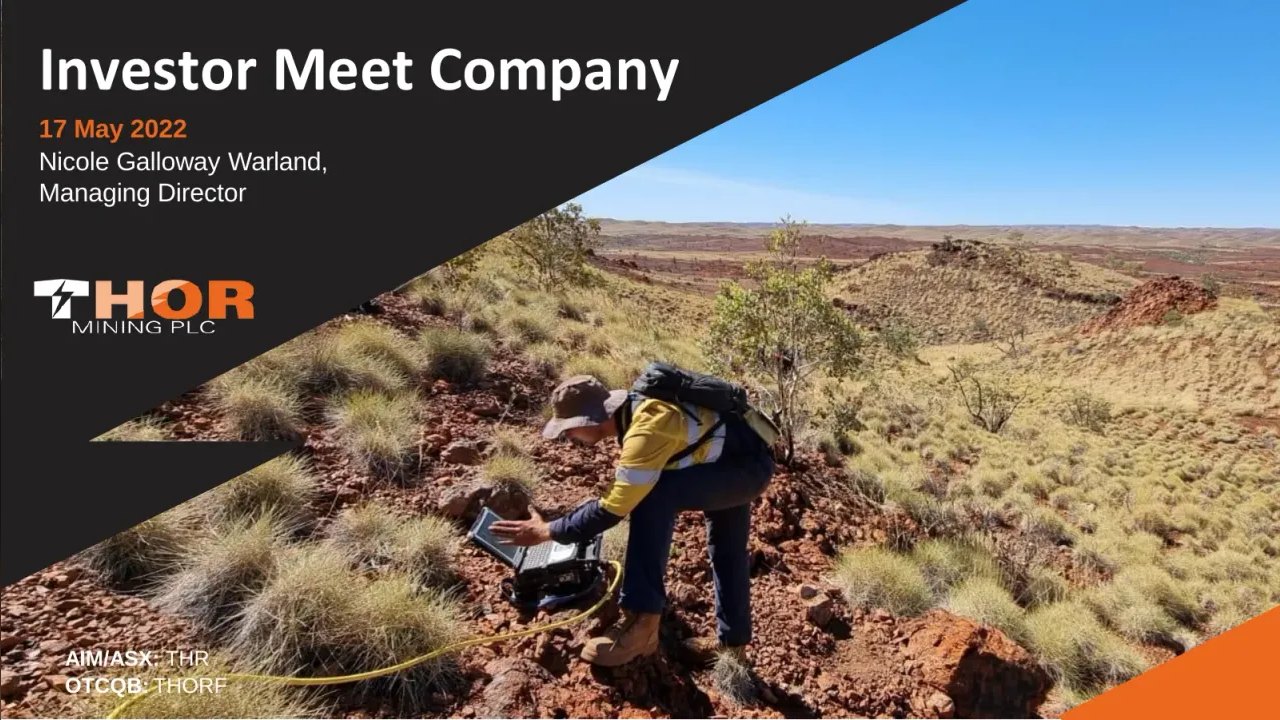
1:24 And as you can see from this photo, this is our geophysics crew who are currently on the ground doing a high powered electromagnetic survey over the Corona prospect, which is essentially over our nickel. So we're certainly boots on the ground undertaking a lot of exploration activities as we speak. For the presentation, I'm gonna be switching my camera off so that you can have a bigger screen, and then I'll be switching it back on at the end for q and a.
2:01 So standard disclaimer. So THOR miners exploring for high value commodities in global demand, so uranium, lithium, nickel, copper, and gold. I like to think of these as commodities for the future. As the world transitions into low carbon emissions, so renewables, green energy, electrification, these commodities are certainly in high demand, with a increase in supply, and I don't see this changing in the near or midterm future. So THOR is certainly leveraged for success. We have an exciting diverse portfolio of projects with opportunities for shareholder value through discoveries as well as development of our projects.
2:50 At our Ragged Range project over in WA, we certainly leverage for discovery success with a diversity of commodity. We've got highly prospective lithium targets. We've got a 30 kilometer gold corridor of robust, geochem targets. We've got a nickel Gosson as well as copper gold in the Northwest. We have three copper projects in South Australia. These are advanced projects with resources of over 400,000 tons of contained copper, and we're assessing and moving these forward with the intention of in situ recovery. In the Northern Territory, we have our tungsten molybdenum project, and this is poised for development or, as I like to say, shovel ready.
3:39 And then over in The US, we have three projects in Utah and Colorado, and we hope to be on the ground in US summer drilling those projects.
3:54 So just from an investment case, we are poised for significant growth through discoveries as well as project development. We're focused on mineral discoveries for the future, as I said, so battery and critical metals. Our projects are all in portfolio project portfolio is all in proven mining jurisdictions, so there's no sovereign risk. These are, you know, ranked very highly on the Fraser Institute, and there's no foreseeable risk or issues with the jurisdictions we're working in. In particular, with our ragged range, this is an underexplored area, but highly prospective, for the lithium, nickel, uranium, gold, and copper.
4:39 And then over in the Northern Territory with our tungsten plate, this is ready for development. We're well funded to advance our projects. And most importantly, we have a very experienced board and management team with a success track record. And this is really critical to move the projects forward.
5:02 So just as a corporate snapshot, we're dual listed on the AIM as well as the ASX. Market cap sits at around £14,000,000. We have just under £2,000,000 in the bank. No debt. And so we're in a strong corporate position, with a focus on advancing our projects towards discovery and development success, so really creating shareholder value. So who is the board and management team? I'm the managing director with over thirty years industry experience, working from exploration through to mining, in Australia, Eastern Europe, and South America. With a technical background, we also have Mark McGough who is based here in Australia, an extensive level of experience in both industry and government.
5:52 And then in The UK with a finance and corporate background, we have our chairman, Mark Potter, and also a nonexecutive director, Alastair Clayton. So we have a really good balance of technical expertise as well as corporate and finance to drive the projects forward.
6:11 So current activities over in the Pilbara, our Ragged Range project, as mentioned, we currently have a crew on the ground doing a high powered fixed loop electromagnetic survey. We're doing our final preparations for our upcoming RC program at Sterling Prospect. And concurrent to this, we're on the ground doing some mapping and G chem sampling for lithium as well as copper gold in the Northeastern portion of the tenure. Over in The US in our uranium, vanadium projects, we're focused on the Colorado side, and we're in the final stages of drilling preparations for Wedding Bell. I'll be heading over later next week to finalize the drilling logistics.
6:58 And then in the copper projects in South Australia, we have our Alpha to East project where we're currently doing some hydro metallurgical work, and we hope to be back on the ground in the second half of this year drilling. And at Kapunta, we're in the midst of doing a push pull test. We've just completed the tracer component, and we'll be moving into the side of things in the coming weeks and moving towards a site environmental test later this year. So really driving those resources forward. And Molly Hill, as mentioned, this project is poised for development. So moving through the projects now. So Ragged Range. This is the one I think that has the the best value of creating being a company maker for THOR with a lot of exploration discovery opportunities to be made.
7:56 The project's located in the East Pilbara granite greenstone terrain. We're in close proximity to very large scale gold deposits. We've got Calladus' project to the North, the Warrawuna project, 1,200,000 ounces. They've just done their first gold pour. And then we have the Grays project in the Northwest, the Hemi project with over 9,000,000 ounces of gold. So we're in very favorable large scale gold jurisdiction, and we have very similar geological settings and structurally favorable geology. For lithium, we have two of the world's largest hard rock spodumene deposits located in the Pilbara, Wodgina and Pilgangora. So, again, we're in the right jurisdiction for lithium prospectivity, so targeting lithium, cesium, tantalum, pegmatites.
8:49 So if we just go down onto the tenements the tenements, we've got five tenements covering over just under a thousand square kilometers. On the eastern side sorry, the western side, we have our 13 kilometer structurally controlled corridor or sterling prospect. This sits on a thrust faulted contact between the ultramafix and the mafix. And through stream sediment and soil sampling, we've defined this 13 kilometer corridor with up to 2.2 grams per ton gold. Just to the south of that, we have a nickel Gossen or the corona prospect, and this is where we're undertaking our current high powered fixed loop electromagnetic survey. In the northern portion of the tenure, we have our lithium targets.
9:38 And then in the Northeast, we have some historic high grade copper and gold deposits, which will be following up in due course. So we have a 100% control of the Kelly Greenstone Belt.
9:56 So just looking at the lithium prospectivity, it's a very busy map, but I just wanted to highlight that the two world class lithium deposits and also the other lithium deposits in the Pilbara are associated with the Split Rock Super Suite, which is essentially the red blobs of granites. And if you look at our rated range area, we also have one of these red blobs, and it's never been explored for lithium prospectivity. So excited to be on the ground now testing that. So it's not so much the split rock super suite. It's actually the radius, the five to 10 kilometer halo around that. And this is commonly referred to as Goldilocks Zone, and this is where the enriched pegmatites sort of, expand out of the granite body.
10:43 And this is where we're currently on the ground mapping and sampling. We have three other areas of interest. In the center, we've got some mapped pegmatites. So, again, we're on the ground testing this to see if they're enriched lithium pegmatites. And then two other areas which we feel are favorable for lithium. So currently on the ground following these up. As mentioned, we're on the ground at our Corona prospect doing a fixed loop EM survey over the nickel Gossam. This Gossen was identified by the geological survey. And back in 2020, we were on the ground mapping the Gossen and identified that it extends well over a kilometer, a 100 meters wide with elevated nickel and chrome.
11:33 The other interesting thing is it also sits on the basal contact of the Dalton Suite, so above the fells deep volcanics of the Wyman Formation. This is quite important from a nickel sulfide geological model. The fixed loop survey should take approximately another week, and then with processing, we hope to have some news flow out in the next few weeks. The objective of the survey is to identify conductive bodies at depth, which have the potential for being massive nickel sulfide mineralization. And from there, it'll identify drill ready targets, which we can follow-up with our RC drilling program in June this year.
12:20 At our starting prospect, we did a maiden RC drilling program towards the end of last year. We unfortunately didn't complete that program, so we're aiming to be back on the ground in June to complete that program, but also build on the knowledge we learned. We certainly identified some very interesting serocyte pyrite, folk site alteration along the contact. So we'll be following that up in June this year. So I'll have more information out to the market on that drilling program as we finalize that in the coming weeks. So over in The US, we have our uranium vanadium projects. With the current geopolitical situation as well as green energy, it's good to have a strong asset in The US as we see the domestic demand increase for uranium.
13:16 The senate is potentially going to sanction its import of uranium from Russia, which is over 18% of their supply. And The US also about 30% nuclear. So as they wanna increase their supply for the over 100 nuclear reactors, again, they need that domestic supply for uranium. So we have three projects in The US on the border of Utah and Colorado. So Wedding Bell, Radium Mountain, and Vanadium King. This is a very well known, province for uranium, the Uruvan Mineral Belt, and was extensively mined, during the twentieth century producing over 660,000,000 pounds of vanadium and 85,000,000 pounds of uranium.
14:07 Has good infrastructure, and I think significantly, we're very close to the White Mesa energy fuels processing plant, which has the potential to toll treat, which is something that we would consider moving forward. Our initial project is very much focus is very much on the Wedding Bell Radium Mountain or Colorado site. So this style of mineralization is referred to a salt wash style, and it's essentially sandstone filled paleo channels which host the uranium and vanadium. It basically, it's named after the geological unit in which the uranium and vanadium is hosted in. It's quite, unusual to see the uranium and vanadium form, but we do have a South sorry, a Northern Territory analogy with a Bigelie deposit.
14:58 This style of mineralization is very high grade, and our field sampling identified, grades up to 1.25 uranium and up to 3.5% vanadium. A lot of the current uranium, mines are operating at a hedge grade of point zero two to point 05% uranium. So these grades here at our Colorado project are exceptionally high grade. The soil of mineralization is stacked tabular ore bodies, and these can be traced along strike and laterally over meters to kilometers. The uranium and vanadium form together, and the vanadium usually forms a much larger halo, so about a five to one sort of ratio.
15:47 And the uranium forms in uranonite and kaufenite with the vanadium predominantly montrocyte and vanadium rich aluminosilicates. And on the surface, you get a lot of carnitite. And the images here, you can see there's a photo of carnitite carrying about 1% uranium, 1.2 vanadium. And the series of photos, you can see the stacked sequence of the uranium mineralization, the center zone is the enriched uranium and vanadium and then showing the wider vanadium halo. So this is taken at our Rim Rock prospect.
16:28 So we have three areas that we are aiming to drill test, Rimrock, Groundhog, and Section 23. Rimrock and Groundhog a long strike of historic workings where we can easily trace the favorable stratigraphy along strike. Section 23 is an area that has never been tested, and we're the first company to have access into this area. So excited about really getting on the ground there and fairly optimistic about the potential of intercepting high grade uranium and mineralization. The targets themselves are very shallow. They're 50 to a 100 meters deep. So the drilling program itself is, you know, very shallow holes, a fence line across the three projects.
17:22 So moving on to our copper projects. As mentioned, we have interest in three copper projects. THOR itself is earning 80% equity in Alfred East. And then through our 30% equity in Enviro copper, we have Kapunda and Alfred West project. We're exploring for shallow oxide copper mineralization with the objective of developing and mining them using in situ recovery. And this is a low cost, production of copper and gold with a low environmental impact. The projects themselves are very close to Adelaide within one to two hours drive and very good infrastructure.
18:09 In situ recovery is an alternative to traditional open cut and underground mining. It's low cost and, as mentioned, low environmental footprint. There's no large volume of dirt being moved, which really not only has the environmental benefits, but also has a reduced cost from an operating as well as a CapEx. EnviroCopper as well as THOR have both received funding to advance these projects. EnviroCopper is not sorry. In situ recovery is not new to South Australia. We have two current ISR projects in uranium space, and they've been mining for over fifteen years. So we certainly have the local expertise in the area as well as the regulatory system in place.
18:55 ISR copper is also being developed in Arizona in The US with the Florence project, Van Dyke as well as the Gunnison project. In situ copper is really just a transition taking it from the heat bleach phase to fully in situ.
19:14 At our Alfred East project, we have identified shallow copper oxide mineralization. The map here shows the historic drilling. It was drilled for primary IOCG mineralization, and companies in the past ignored the copper oxide mineralization as they were drilling to test, you know, for primary mineralization. From that information, we generated a mineral resource of over a 177,000 tons of copper and 71,000 ounces of gold. We feel based on that initial our initial drilling and moving forward that we can significantly increase this resource. And I'll talk about our recent drilling program in the next slide, but I wanted to highlight that initial hydrogeological work has showed the mineralization is saturated.
20:10 The groundwater is hypersaline, so it precludes agriculture or potable use. So it can only be used for industrial use. And our initial pump testing showed favorable results for in situ recovery.
20:24 From the hydrometallurgical work, we've just done some initial glycine licksilian trials. So this is the solution that you would put into the ore zone to dissolve the copper. And this has shown favorable positive copper and gold recovery. And we'll be continuing to work on the hydrometallurgical side as we move forward. Just looking at some of the results from our initial drilling, we just tested one area in the northern portion of the mineralized domains. The colors are just for us as far as describing the domains. They don't have any context as far as changing grade, tonnage, etcetera. So initial, drilling, we identified in Hole 5 up to 73 meters at 1% copper, 20 meters at 2% copper. And this is from almost the surface, so from six meters.
21:20 These are exceptionally high grade copper results and would be ideal for any style of mining, whether it be open cut or in situ recovery. The broad zones, though, within the oxide are very favorable for in situ recovery. We'll be continuing to drill further to the North and to the South in our next phase of drilling. And we've identified that there's some key structural controls on the mineralization, which are increasing the grades associated with these structures. So we'll be following that up in the second half of this year. So the one of the biggest benefits with in situ recovery is the time frame from taking a project from exploration through to development and production.
22:08 I've just got a rough time frame here showing the Kapunda project as well as Alfred East. At Kapunda, as I mentioned, we're in the midst of doing our push pull testing. So we're about to move into the lixivian phase of the push pull test, and then from there move to the site environmental lixivian test. From that test work, we actually start producing copper, and we can then scale up, with the economics, and add, other well fields to move forward into copper commercial production. So the aim is, to be moving into that phase in 2023 to 2024. At AlphaDees, we're a little bit behind on that, and we hope to be doing some of the in ground hydrometallurgical test work later this year and moving into the site environmental excipient test next year.
23:05 The ISR system has a much lower CapEx and operating expense, and one of the benefits from that is also the fact that you can have an upscale or flexibility with your production. So as mentioned, with our testing of our initial well field, we can then add well fields onto that to upscale the production. And, you know, a conventional open cut or underground copper mine would probably take ten to twenty years to get into production as opposed to ISR, which can be into production within three to five years. So exciting days ahead on this. So our Mollie Hill project, this is our most advanced project and is essentially shovel ready.
23:54 The project's located in the Northern Territory about three to four hours drive from Alice Springs. And what we are excited about is the government has kindly sealed the Plenty Highway. So we have a sealed road up to 20 kilometers from the project. The geology itself consists of two magnetite skarn bodies with the mineralization in shear light, molybdenite and chalcopyrite. Historically, a feasibility study was completed in 2018, which demonstrated profitable production with a low operating cost and early payback. In late two thousand and eighteen, the commodity price sort of fell, but we're now back up to beyond the 2018 prices. Molybdenum itself is double what it was in 2018, and certainly tungsten is trending higher than what it was in 2018.
24:48 And we certainly know the tungsten itself is a critical metal, and The US is certainly wanting geopolitically safe supply of tungsten. The project itself is fully funded to move forward, and it has major project status with the Northern Territory government. So it's poised for development. And as THOR move to assess the development phase, we've been doing some on ground exploration activities. Because the deposit itself is in a magnetite scan, we've modeled the magnetics and identified a magnetic body to the south of the deposit, and we put some drill holes into that at the end of last year.
25:35 We've also highlighted the image on your right is some other magnetic targets, which we'll be following up in due course, hopefully, later this year. The results from that initial phase of drilling, unfortunately, have been delayed. We had some QAQC issues with the drill core, and we've had to resonate core for sampling. So there has been some delays.
26:00 We already have a backlog in Australia with our assaying with the labs, but, unfortunately, this has exacerbated those delays. So I do hope to have some results to the market in the coming weeks.
26:15 So next steps, just in summary, we're exploring for high value commodities, so commodities for the future. These are improving mining jurisdictions. We're well funded to move the projects forward, and we have a strong pipeline of targets. We have year round news flow. So while we're working on one area, we can be waiting for results in another area. And a very experienced board and management team to take these projects forward. So key work streams and upcoming news flow. As mentioned, we're on the ground doing our ground EM survey, so I hope to have some updates on the nickel prospectivity in the next few weeks. We are on the ground with our lithium exploration, so, again, hope to have some news out on some of those results in the coming weeks.
27:06 And we'll be on the ground in late June with our sterling follow-up RC drilling program. Over in The US, we'll be focusing on our RC shallow drilling program at our Wedding Bell and Canadian King project in Colorado. As mentioned, I'll be heading over there late next week to finalize the logistics of the drilling with drilling scheduled for The US summer. So certainly a lot of on ground activities. And they'll also be news flow from our Molly Hill as well as our Alfred East copper project. So in summary, that's thank you very much from the webinar point of view. I'll switch the camera back on now, and I can move into the q and a side of things.
27:54 Nicole, thank you very much for your presentation. Ladies and gentlemen, please do continue to submit your questions using the q and a tab situated in the top right hand corner of your screen. But just while Nicole takes a few minutes to review those questions submitted today, I'd like to remind you that recording of this presentation along with your copy of the slides and the published q and a can be accessed via your investor dashboard. Nicole, we received a number of pre submitted questions from investors, I want to start off the q and a session with these. The first one is as follows. Will we be applying to get government funding as King Island Tungsten Mine did for Mollie Hill development? Also, have we had contact with USA regarding sourcing tungsten from Mollie Hill? The answer is yes. We have been in discussions with the Northern Territory government as well as the Australian government for funding to move that project forward. And we certainly know that The US is looking to source and support existing tungsten projects. So not exploration, but certainly to move projects forward. So we'll be closely monitoring that as we move forward.
28:58 Thanks very much. Do you have permits in place for all three uranium vanadium assets yet? I only saw that two had been attained so far. Yes. So we do have county permits in place for Rimrock, Groundhog, and Section 23. All three projects, these are on the Colorado side or on BLM ground, but we did need to get San Miguel County permits for two of those projects. So we're now finalizing our BLM bonds and permits, so should have those in the coming weeks. Thank you very much. The next question reads as follows. In December 2021, you indicated that the company would be receiving assay results back for the Mollie Hill project.
29:44 There's been no update to this date on this project. Why not? Look. I touched on it briefly. We did complete our drilling in December 2021. And then with dual core cutting and processing, etcetera, it did take a little there were a few delays getting it to the lab. And we have had some QAQC issues with the dual core, so we have had to resubmit some samples and do some reassaying on the core. Obviously, with tungsten molybdenum and charcoal pyrite, they slight they each need different analytical techniques. So there has been some delays on those samples, and I hope to have some news flow to the market shortly. Thanks very much. The next question reads as follows. The company has advanced projects in Mollie Hill and Alfred East. Why is the company now focusing on new targets at Ragged Ranch with nickel and lithium?
30:37 Do you think that as a small cap company generating no revenue, shareholder value is better spent concentrating on advanced projects? Look. We are advancing all of our projects. To take the Mollie Hill project forward will require a large capital. So the feasibility study suggested about 45,000,000 to take it through development. So that's a big decision to progress that project, particularly for a small cap. For me, the Ragged Range project has the most or or greatest opportunity for shareholder value through discovery. We've got some great perspective targets for lithium, nickel, gold, as well as copper gold, and I think that has the opportunity to be a company maker through discovery.
31:25 We will be progressing, obviously, the Alfred East project with the hydrometallurgical work and hope to be back on the ground later in the year. So we certainly are progressing those projects, but I think the WA border is open, so we're back on the ground in WA. And I I'm certainly very excited and optimistic about our Ragged Range project and moving that to discovery success. Thank you very much. And the final presubmitted question, reads as follows. Hi, Nicole. As you know, the deadline for the Colorado state to grant the wedding bell permits is Thursday, 06/02/2022, which is exactly seventeen days. Will you get the Colorado permits in time? As you know, there is no extension allowed even if the Colorado state want to grant you the wedding bail permits after the 06/02/2022.
32:12 By law, the state cannot. I assume you know that full mining has had nearly one full year to get the permits. And if you don't get the permits by Thursday, June 2, THOR share price will fall. Look. I'm very optimistic that we will have the BLM permits in place, which includes the Colorado permit within that time frame. It has taken over twelve months. The project themselves are on BLM ground, which is federal ground. So we were working closely with Colorado and the BLM to progress that. We were 99.9% complete when we realized that San Miguel County had a requirement for permits as well.
32:58 So the the federal and the state permitting was put on hold while we progressed the San Miguel County permitting. And this has taken some time, but it had to be done in a very logical systematic process. And certain steps needed to be taken, and we had to wait, obviously, the required time to be allocated time slots at the various approval meetings. So it wasn't something that we could shortcut. We had to work with the San Miguel County and progress the permitting through that manner, and we're very happy and with the successful outcome. So, yes, I'm very optimistic that we'll have all our permits in place in the time frame and be on the ground drilling this summer.
33:46 Nicole, that's great. And that actually concludes the pre submitted questions. But as you can see, we've received a number of questions throughout today's presentation, and thank you to all the investors for submitting those. Could I just ask you to read out those questions and give response where it's appropriate to do so, and then I'll pick up from you at the end. Okay. So the first question is, are there still plans to IPO EnviroCopper? In short, look. We will we are looking at either IPO ing or getting a joint venture partner in to progress that project. So, yes, at this stage, there are plans to IPO the project. Next question. Which commodities are THOR Mining going to prioritize as the market enters into a commodity bull run? Look. As I mentioned, we have a diverse portfolio of projects and focused on commodities of the future.
34:37 Our uranium asset in The US will be progressing as well as Ragged Range, our gold, nickel, and lithium. So, I feel if anything, we're leveraged for the success as the commodities move forward. Within situ recovery projects, what is your expected copper recovery rate with the right? Question mark, 50%. Look. No. I'd like to see it up higher around the 70 percent. Like any project, it has to have commercial economic benefits. So we need to get that copper recovery up around at least 70, if not higher percentage of recovery. With a share price at a fifty two week low, thanks for reminding me, and so many projects, how are you looking to prioritize the field program?
35:29 So at the moment, the priority is at our Ragged Range project, and this is where we're currently on the ground with our EM survey and our lithium mapping. In June, we'll be hitting the the ground with our RC drilling program. Over in The US, we're obviously using consultants, that project will be run sequentially or concurrent. And then at our Alfred East project following on sort of mid year, we'll be moving into our second phase of drilling. So, you know, it's a matter of, you know, our priority really is around our uranium project and our rugged range project at this stage. So that's the final question. Nicole, thank you very much. I think you've addressed all those questions you can from investors, and, of course, the company will review all questions submitted today, and we'll publish those responses on the investor meet company platform.
36:26 But just before redirecting investors to provide you with that feedback Sorry, Alastair. Alessandra, there were one or two questions right at the very beginning that I missed. If I could just I'm happy to address those. A strong board and no debt will access to further funding help accelerate your work on ground and achieve your drilling your target sooner. Look. Yes. Of course. More funds, you know, means more money can be spent on the ground, but we are not looking to do a capital raise in the short term. Next question is THOR has ownership of Molly Hill for some time now. How realistic is a joint venture farming, sale, or asset moving forward?
37:13 Look. I think at the moment, if anything, Molly Hill, with the the critical middle space, is a project, that has, you know, good potential to get a a joint venture partner in or to drive that forward ourselves. Next question is which project excites you most and which offers the greatest near term potential? To me, it's Ragged Range. I think this has the greatest exploration discovery opportunities, and this has the, you know, potential to be a company maker. Over in The US, likewise, this is a very exciting project. I don't have any doubt that we will intercept high grade uranium and vanadium.
37:59 The question will be the thicknesses and the economics of those intercepts. But, again, very excited about those two projects. Can you please provide estimated timelines of when THOR's main projects will go into production. I sort of touched on the AlphaDees project and where we're at and looking at certainly driving that project forward towards development in 2024 with Kapunda being bit closer in time frame to move into commercial production. Next question is with all these potential high value resources, isn't THOR greatly undervalued and therefore vulnerable for a takeover. Look.
38:45 I fully agree. We're completely undervalued. I think we have an exciting, very diverse portfolio of projects and some great opportunities moving forward. Takeover. Look. I can't really answer that question, but I'm very bullish, about moving these projects forward, and delivering shareholder value through discovery success and development of our projects. So, yes, that's the last question. So thank you very much, Alessandro. Nicole, thank you very much for that. And before redirecting investors to provide you with their feedback, which I know is particularly important to yourself and the company, could I just ask you for a few closing comments? Look. I'd like to thank you all for joining me for this webinar and to stay tuned.
39:32 Obviously, with COVID, there have been some delays with borders, etcetera, but we are on the ground. We have a very systematic, process to advance our projects, for discovery success as well as development potential. So stay tuned. Thank you very much. Nicole, thank you very much for updating investors today. Could I please ask investors not to close the session as you'll now be automatically redirected to provide your feedback in order that the management team can better understand your views and expectations. This will only take a few moments to complete, and I'm sure will be greatly valued by the company. On behalf of the management team of Pool Mining PLC, we'd like to thank you for attending today's presentation, and good morning to you all. Thanks.
Follow Thor Energy PLC into a list and get an email when it puts out news.
Managing Director at THOR ENERGY PLC