Nicole Galloway Warland
Managing Director at THOR ENERGY PLC
Replay available
Corporate Update hosted by Thor Energy (LSE:THR) on Investor Meet Company, held 2023-11-02.
Automated transcript · Written by software from the replay's audio. It can mishear names and figures; the replay is the record.
0:01 Good morning, ladies and gentlemen, and welcome to the THOR ENERGY PLC investor presentation. Throughout this recorded presentation, investors will be in listen only mode. Questions are encouraged. They can be submitted at any time via the Q and A tab that's just situated on the right hand corner of your screen. Please just simply type in your questions and press send. The company may not be in a position to answer every question it receives during the meeting itself. However, the company will review all questions submitted today and publish responses where it's appropriate to do so, and these will be available via your investor meet company dashboard. Before we begin, I would like to submit the following poll. And if you could give that your kind attention, I'm sure the company would be most grateful. And I would now like to hand you over to managing director, Nicole Galloway Walland. Nicole, good morning. Good morning. Thanks, Jake.
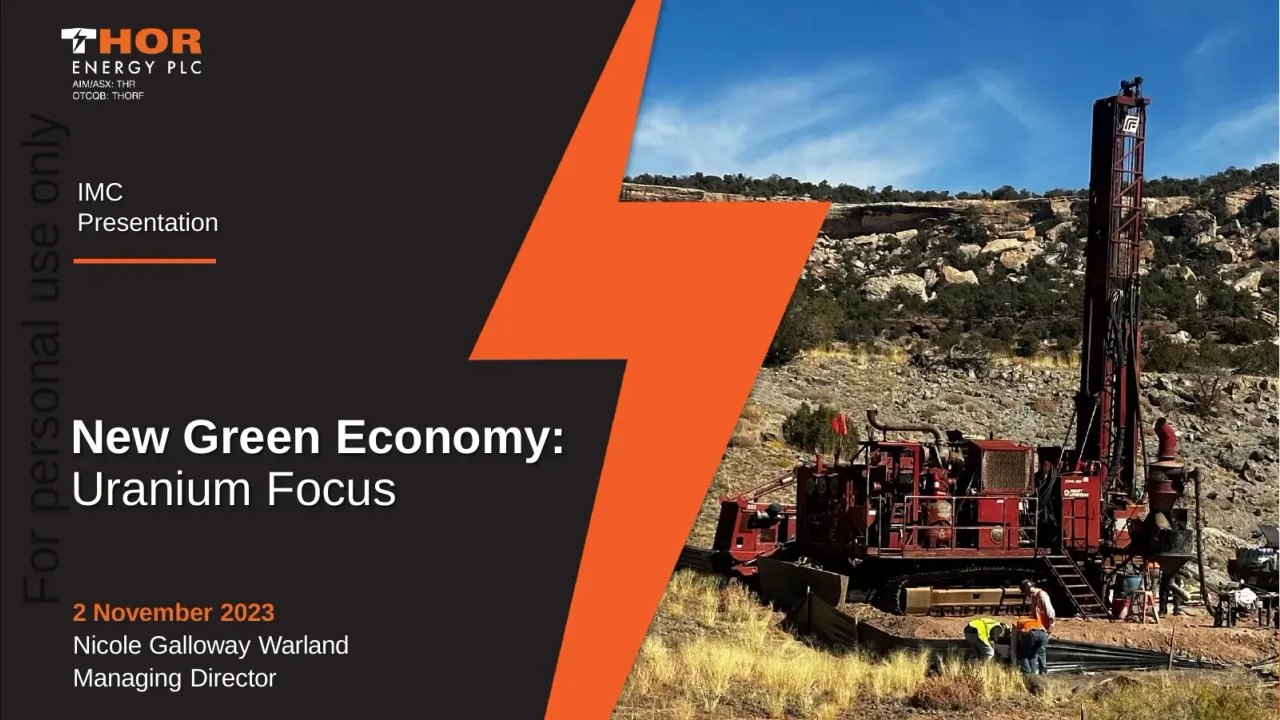
0:47 Good morning, everyone, and thank you very much for joining me today. My name is Nicole Galloway Walland, and I'm managing director of THOR ENERGY. THOR ENERGY has been very busy on the ground exploring over the last few months, including our current ongoing RC drilling program over in The US where we're drilling our at our Wedding Bell and Radian Mountain uranium projects. We also have made a few corporate changes, so I thought this was a very good opportune time to give you a brief update. During the presentation, I'm going to be switching off my camera so you can see the the slides a little bit more clearly, and I'll switch it back on at the end when I address the the questions.
1:32 As I mentioned, we've made some strategic changes. One of those you will have noticed earlier in the year, and that's when we changed from THOR mining to THOR ENERGY. And this is really around the strategic focus on uranium and energy metals. We've also made some divestments and looking at monetizing some other assets. Few reasons, this is obviously to focus on the uranium, but also it's an opportunity to generate income, alternate to just going to the market, for capital raising. It also allows for any opportunities that may arise to acquire any new uranium projects. So our uranium assets, we have three projects all located in The US, so in Utah and Colorado.
2:20 These are all a 100% owned, and they're in proven mining jurisdictions, so there's no sovereign risk. As mentioned, we are currently undertaking drilling at our Wedding Bell and Radian Mountain projects. So just a little bit of background about uranium because it's a little bit different to some of the other commodities. So the uranium, spot price is sitting at about 74.5 US per pound. This is based on, yesterday. And we've seen about a 54% rise in that spot price over, since the start of the year, and this is a twelve year high. For those familiar with uranium, when it runs, it runs very fast and hard, and we look to be, at that pivotal point now.
3:09 So what are some of the key drivers with uranium and nuclear energy? I think the key one is environment. People want that net zero carbon emissions, electrification, energy security, and domestic supply. We know, the world is in conflict at the moment, so geopolitical risk is a big factor. Russia invading the Ukraine. We have the coup in Nigeria. The rise in small nuclear reactors as well as, the major reactors. And I think the other one is the current stockpiles and inventories are depleting. So this is, creating a demand for uranium.
3:56 So I mentioned, green energy. Uranium is now considered green energy. And if we want to have our net zero carbon emissions by 2050, we need to triple the amount of nuclear energy capacity that we currently have. So where is that energy? Where is that uranium going to come from? So, this is probably one of the key factors. It's a baseload power source. Although renewables are fantastic, they're not baseloads. The other one is China. China is, the third largest producer of nuclear power followed, with you sorry, The US and France one and two. With China, they have currently have about 53 reactors in operation looking at constructing 23 and then another further 70 plants.
4:49 So although they have a small resource of uranium, they really need to increase that. So where are they going to import that uranium? So, again, there's going to be a strong continuous supply demand for uranium, and, this is one of the places it will be coming from. If we move the shift now over to THOR and our US uranium exposure, So The US want national security, geopolitical reasons predominantly. They are the largest producer of nuclear power, about 30%, yet currently only have 3% domestic supply. So they wanna increase this domestic supply. Our projects are improving mining jurisdictions, so Utah and Colorado, so no sovereign risk.
5:37 They're high grade. They're very shallow. They're about 50 to 60 meters below the surface and within the Uruguay Mineral Belt, so an area that has been historically, mined. So we feel that there's a lot of exploration growth and opportunities through drilling initially and then building resource reserves. We also have a very experienced, board and management team with uranium backgrounds and uranium success track records. So if we move on to that board, we have Alastair Clayton, our chair. He's a geologist. However, these days, he's more in the business and finance side of things. And he had a, uranium background involved in some of the African assets, etcetera.
6:25 Myself, a geologist with thirty years industry experience, worked globally, from exploration through to mining. And from 2004 to 2011, I worked in the uranium sector and was fortunate to be involved in the discovery of the Sandfire uranium deposit located in South Australia, which is now being developed into an ISR operation. Our nonexecutive director, Mark McGough, has extensive experience both in industry and in government and, again, has, a strong background in uranium and was involved with THRW and the discovery of the Theseus uranium deposit. So a strong, board and management team with uranium experience.
7:11 Quick corporate snapshot. So our share price in The UK, is sitting at about 1.6 p. In Australia, because we are dual listed on the ASX and the AIM, it's sitting at about point three sorry, 3¢. Cash in bank is about £1,200,000, and our market cap sits at about £4,000,000. So certainly a lot of opportunity, to increase all that. So if we move over to our projects, as mentioned, we have three projects in The US. So Wedding Bell, Radium Mountain, and Vanadium King located in Utah and Colorado. These are a 100% owned. And if you look at the map, the Eurovam Belt is really just a geographical location, of deposits that sit on the border of Utah and Colorado.
8:08 You can see where our seats, and what I'd like to point out is the location of the White Mesa Energy Fuels Mill. This is the only licensed facility to process uranium and vanadium in The US. And this is toll this is trucking, distance, from our projects, which is certainly a huge benefit, once the project, gets to that stage. So good infrastructure around our projects.
8:38 ESG, obviously, community and stakeholder engagement is critical to the success of any project. And this is something we've endeavored to build very early on. So engaging the community, involving them, making sure that they're aware of the activities we are undertaking, and allowing them to collaborate with us, where they can. So we've, sponsored local events. We employ locally. We have a local geology team. The photo on our right is some of the government officials that came out to sites two weeks ago to see the start of our drilling program, and they're all very supportive of our project, which is great to have that, local favorable attitude with any project, but particularly in a foreign country such as US Fast.
9:33 These styles of deposits, I won't go too much into the geology, but they're referred to as salt wash sandstone deposits. Basically, the uranium and the vanadium have formed in extensive paleochannel systems. And that's a unique feature is these deposits are relatively thin. However, they extend over kilometers. So in some cases, up to 17 to 20 kilometers. So very laterally continuous. They're high grade, and they tend to sit on the oxidation redox boundary, and are traditionally mined by open cut room and pillars sorry, room and pillar.
10:15 Last year, we completed our maiden, drilling program testing rim rock and groundhogs, so a long strike of historic workings, but also Section 23, which is a relatively new area. There's no evidence of historic workings. So we, did a major drilling program there to test the lateral extent of, uranium through the salt wash formation. We got favorable results, using the downhole gamma and then comparing that to assays. You can see on the chart over on the right where we've got the gamma results correlating nicely with the assay results. All three regions intercepted uranium mineralization and also a vanadium halo.
11:05 Results are up to point 5% uranium. This is quite encouraging. We would be happy to see anything over that 500 PPM or point 05% uranium, but certainly around the point 1% uranium or above would be fantastic. So from there, we then flew, some regional helicopter radiometric and magnetic surveys over the area. This is the first time high resolution geophysics has been flown. Regional work had been done in the sixties, but no high res work. From this image, you can see the red anomalies, and these uranium anomalies. Some of them are around Rimrock and Groundhog where we're currently drilling.
11:54 But you can see there is some lateral extent, and we'll be following that up. The other area that's encouraging is Section 23 where there's also anomaly. So we'll be again extending our drill pattern to test some of these anomalies. So as I mentioned, we're currently drilling over at our Wedding Bell and Radian Mountain projects. We've started the 4,000 meter drilling program at Section 23, and then we'll be moving to Groundhog and Rimrock. We are using Bort Longyear to do the drilling, and then we have Jet West, for the Downhole Gamma. The program itself will take about six to eight weeks, and we started that about a week or so ago. What's fortunate, with uranium drilling is we will be able to do downhole gamma throughout the program. So we will have news flow throughout this program. We'll probably do downhole logging after the completion of section 23 and then again, after groundhog and Rimrock.
13:00 And we will be able to, announce these gamma results to the market throughout the program. At the end of the program, assays will be sent to ALS laboratories in Reno as well as over to ALS in Vancouver, and they will give us uranium as well as vanadium assays. So we'll have news throughout the program, and then at completion with the assay results. Over at Vanadium King, this area is a little bit more greenfield. It's adjacent to the historic Yellow CAT uranium area. And in this case, the the rocks are undercover, but we know we've got two petroleum holes in the north, where they intercepted uranium.
13:45 So we'll be following that up at the end of this drilling program current drilling program. So looking forward to get on the ground here at Vanadium King and test this area. So just looking at next steps and news flow. So as I mentioned, we're currently on the ground drilling at our uranium projects. We then hope to move to our Vanadium King project. And as mentioned, we'll have downhole gamma results throughout the program with follow-up assays on uranium and vanadium. So quite a little a lot of news flow coming prior to Christmas. So just looking at, the timeline or the growth, obviously, we have permits and licensing in place. We feel with exploration, we've got a lot of drill growth opportunities, and then we'll be working towards job compliant mineral resource estimates, particularly at the Rimrock and Groundhog areas.
14:43 And then we know with section 23, this is an underexplored resource potential area. We'll also be looking at project generation and monetizing of our assets. So I'll keep the market updated on that progress. So just from, a recap on the investment opportunity of THOR ENERGY, uranium focus, very favorable fundamentals from the supply demand. And this is not just short term, but very much long term fundamentals. We're exploring in mining friendly jurisdictions, so there's no sovereign risk.
15:20 We have a good pipeline of drill targets to test. We have a modest market cap, so potential to rerate the share price, and that market capitalization based on exploration results. And most importantly, we have an experienced, board and management team who are very passionate about what they do. So thank you very much for that brief presentation, and I'll now hand you over to Jake to put my camera back on, and I will start working through some of the q and a. Nicole, that's great. And thank you very much indeed for your presentation this morning. Ladies and gentlemen, please do continue to submit your questions just by using the Q and A tab that's situated on the right hand corner of your screen. But just while the team take a few moments to review those questions that were submitted already, I would like to remind you that a recording of this presentation along with a copy of the slides and the published q and a can be accessed via your investor dashboard.
16:19 Nicole, we obviously received a number of presubmitted questions ahead of today's event. And as you can see there in the q and a tab, we've also received a number of questions throughout your presentation this morning as well. So firstly, thank you to all of those on the call for taking the time to submit their questions. And, Nicole, if I could just ask you just to make your way through those questions, if I could just ask you to read them out and give your responses where it's appropriate to do so, and then I'll pick up from you at the end. Thank you. Okay. So I'm just going to to run through the questions just in the order they've come in. So the first question was about the divestment of Ragged Range project, which some of you may have seen in the quarterly, And why is this the case? We've made a corporate, an exploration strategic decision to focus on uranium and energy metals, and we feel that this is not a core asset to us, so hence the opportunity to divest the project, and hence monetize that asset.
17:19 The next question, is about the equity raise we did a month ago intended for green energy metal projects. Are you intending to do a fundraise for Australian assets, or are you planning to use the cash resources to help, fund these projects? So the capital raise we did a month ago, so that was, strategically a small raise of 1,000,000 Australian at a price of 4.2¢ was just to accelerate uranium drilling over in The US. It allows us to keep the momentum going, drill any additional holes, and increase assay amounts, etcetera. So we still have, cash in the bank, to cover our existing Australian, projects. But as mentioned, we are looking at monetizing some of our assets.
18:11 At Alfred East, we have Fleet Space Technologies, collaborating on equity interest. So they'll be undertaking the geophysics that they're doing at the moment, as well as modern monitoring, modeling that data so there'll be no cost involved to us on that project. Next question. Why did you partner with Fleet Space Technologies at Alpha to East? What will be the benefits, and will they be able to assist assist with the development of the anti surveys? Does this take a stake effect on the company long term? So, I sort of touched on this briefly. So Fleet Space Technologies have taken an equity interest in THOR, and this is in collaboration with the Alfred East project.
19:00 So they will be undertaking the ambient noise or ANT surveys, and then modeling the data in conjunction with THOR's, existing three d model and then using AI as well as machine learning to extrapolate the Alfred Copper Belt. We feel that this is a very positive move. It brings their, technology and combines it with our exploration expertise. So it's a fantastic collaboration. And, yes, we do see this as a long term partnership. It's a vote of confidence to THOR by having them on board, so really welcome fleets based technology. Next question. What are your expectations of the recent drilling program at Radian Mountain Weddingvale?
19:51 So I'm obviously very optimistic about the drilling program. We'll have that rat downhole gamma results out for each of the prospects as they come through and then assays at the end. So certainly a lot of news flow as we lead up to Christmas on that project. And then moving over to our Vanadium King project. Why did you move to Green Energy Metals, given the difficulties of operating as a junior? Surely, would make sense to focus on the Australian assets. So, look, I think in summary, based on the expertise of the the THOR team, we felt that the focus on uranium and energy metals was the best way to move the company forward. We had a very broad, diverse portfolio of projects. And as the junior, we felt that we were spread too thin, both staffing as well as financially, and so we made that strategic, decision to focus in on uranium assets.
20:56 The US, is a very easy jurisdiction to work in. It's a very favorable mining friendly area to be in, and there's no sulfur and risk associated with it. So, we don't see any difficulty in working in that jurisdiction. Do you feel you can fully, function to help the share price with your flagship projects based in The US? And how can you reassure stakeholders that you're able to operate efficiently, in the different time zones. We have over in The US, we have a very experienced local team. The time zone, although, you know, sure, it does create some challenges, but it's very easy to have morning meetings, with The US.
21:45 It's their afternoon. It's our morning. So I don't see any, limitations in that team. I also get over there very, frequently to, obviously, coordinate things with the team as well as speak to some of the key stakeholders, government as well as compute community wise. So, again, yes, there's some small challenges, but nothing, major to impact our exploration over there. Are you able to explain in more detail about the in situ recovery process, and does it actually help the environment as it's claimed to do so? I think the best I can certainly talk about ISR, but we have a very good, video on our website, so I certainly recommend having a look at that video.
22:33 In situ recovery is, environmentally friendly and certainly a lower cost alternative to traditional open cut and underground mining. It essentially uses a a pattern of, wells or water bores to inject a solution into the mineralized zone where the copper is extracted, by a series of extraction wells, and then that copper is stripped off, and that solution gets recycled back through the system. In the case of Alfred East, the water is hypersaline, so it cannot be used, for drinking water or for agricultural use. We are looking at using a benign Loxiviant. So this is, an amino acid which is used as preservatives in food.
23:24 So it, has no impact to, animals or human consumption. I think the thing is it doesn't actually help the environment, but it doesn't have any impact on the environment. The other thing to point out with ISR is there's no open cut. There's no major, waste dumps, hence no dust, etcetera. So very minimal impact to the surface. There'll be a series of wells. The farmer can still, have livestock wander around. And then once those wells are removed at the end of the program, it can return to agricultural land use. So next question is about Alfred East and our rare earth announcements.
24:12 We're still, doing some metallurgical work on, the rare earth. So we're doing some mini column tests on the copper recovery as well as the rare earth, recoveries and looking at whether we can use the same to recover, you know, all of the metals or whether we have to use potentially two flushes,
24:34 to get optimal recoveries. So as soon as we have some results on that, we will share that with the markets. Next question, are there plans to eventually, go into production, or will you look to sell off operations? We are an exploration company, so, our objective is to add value through exploration, so drilling growth and build resource reserves. So, obviously, in that case, we are looking for joint venture partners or to divest projects and hence monetize our assets as we move forward. For a junior company to transition into mining, although I do have a mining background, you do need a different skill set, and it would have to be a different, you know, board of and management team to take it to that mining phase.
25:26 So we really feel our strength is in the exploration space. You spoke recently about the Eurovan Mineral Belt and its five to one vanadium to uranium ratio. However, the company tends to focus on the uranium. Why is this the case? That is correct. The Uruguay Mineral Belt is unique in that it has a vanadium associated with the uranium. Essentially, you have, a uranium core, if you like, and then a vanadium enriched halo around that. The main product we are exploring for is the uranium, but we do get, the vanadium, byproduct. We know that White Mesa Energy Processing Facility, can extract both the uranium and vanadium.
26:15 So we will obviously, be looking at making money from both, elements, but the focus really is on the uranium. With the vanadium redox batteries, we do see, a strong market moving forward for the vanadium. What future funding do you think this needs in the short term? We've obviously just done a capital raise. We have that 2,200,000 in the bank. This will allow us to, keep the momentum going over in The US with our exploration and drilling programs and, obviously, allow us to keep momentum up going at alpha to east. And then, hopefully, through monetizing of assets, we can supplement, the cash in the bank.
27:03 The uranium spot price is at a twelve year high. How much of a priority is advancing your US assets over the others? That is our priority. So our priority is very much focused on the uranium assets in The US, and, you know, progressing those as quickly and efficiently as we can. We know that the spot price, is obviously at a 52, percent high, for this year, but we feel that that's going to continue to run, both short term and long term based on the key fundamentals. So getting that project up and potentially looking for other, uranium assets is our objective. And I think we've almost come to the last question. Can you give more detail on selling of your assets to raise funds?
27:54 So as I mentioned, we wanna focus on our uranium assets. And so that, does, basically come to Ragged Range being a noncore asset, so looking to divest that project. Over the last, probably eighteen months, we did divest Pilot Mountain tungsten projects, and we have, farmed out our project. And this has obviously generated cash for the company. So looking at other alternatives to monetize projects and bring in funds other than just going back to the market to do capital raises. So, thank you all very much for those questions that you've submitted. Nicole, thank you very much indeed for being so generous of your time then addressing all of those questions that came in from investors this morning. And, of course, if there are any further questions that do come through, we'll make these available to you immediately after the presentation has ended just for to review to then add any additional responses, of course, where it's appropriate to do so. And we'll publish all those responses out on the Investor Meet company platform.
28:59 But, Nicole, perhaps before really just looking to redirect those on the call to provide you with their feedback, which I know is particularly important to yourself and the company, if I could please just ask you for a few closing comments just to wrap up with, that'd be great. Well, thank you all for joining me today. As Jake's mentioned, this will be on our website. But just in closing, I'd just like to highlight that we have strong exploration momentum. We've got a strategic plan focused on uranium and energy metals. We have cash in the bank, and we have a very enthusiastic, experienced board and management team that really wanna drive these projects forward. So thank you very much. Nicole, that's great. And thank you once again for updating investors this morning. Could I please ask investors not to close this session as you'll now be automatically redirected for the opportunity to provide your feedback in order that the management team can really better understand your views and expectations.
29:53 This will only take a few moments to complete, but I'm sure will be greatly valued by the company. On behalf of the management team of THOR ENERGY PLC, we would like to thank you for attending today's presentation. That now concludes today's session. So good morning to you all.
Follow Thor Energy PLC into a list and get an email when it puts out news.
Managing Director at THOR ENERGY PLC
IR at THOR ENERGY PLC
at THOR ENERGY PLC