Replay available
The Geology Behind the PC Silver Project
Join Andrew Jedemann, VP of Exploration at Honey Badger Silver as he discusses the geology behind the PC Silver Project. Following the presentation he will be available for questions.
- Company
- Honey Badger Silver Inc. (TSXV:TUF)
- Date
- Thu, Jun 25, 2026, 2:00 PM ET
- Replay
- Watch the replay on this page · 45 min
On 6ix: 6ix.com/event/the-geology-behind-the-pc-silver-project
Replay
Transcript
Automated transcript · Written by software from the replay's audio. It can mishear names and figures; the replay is the record.
0:04 Hello everyone and thank you for tuning in for this live event with Andrew Jediman, VP of Exploration at Honey Badger Silver. Today we'll be doing a deep dive on the geology behind the PC Silver project. First we will have Andrew provide a presentation and then we can open the room to any questions. Today we also have CEO Chad Williams on the call for the Q&A session. So If you do have any questions at all for the Honey Badger team, please feel free to submit them at any time using
0:35 the chat box, which can be found in the bottom corner of your screen. As always, this event is being recorded and will be available shortly after we conclude. With that, Andrew, welcome. The floor is yours. Awesome. Thanks, Kyle. Yeah, really excited to be here. So for those who don't know me, I'm Andrew Jettiman. I'm the vice president of exploration for Honeybadger Silver. I'm a professional geologist with a decade of experience in the mineral exploration industry across North America with a primary focus in Canada. I've been involved in several early to advanced stage exploration projects including overseeing programs in the remote Ring of fire, but also on the development side of things and spending several years at the Bear Chemical Gold Mine as well.
1:24 I completed both my undergrad and master's theses, both at Lakehead University here in Thunder Bay, and focused on exploration techniques and mineral deposit characterization. It's honestly been a privilege to work with the Honeybadger team so far. And I can honestly say that as a true exploration geologist, The quality of the projects that Chad and the board have put together over the last few years is outstanding. And yeah, I'm really excited to talk to you about the high-grade PC Silver project that we've recently acquired. We'll dive right into it. Standard disclosure. All right. I'm going to put my IR cap on for a second here and give everybody 3 reasons why they should own Honey Badger Silver now.
2:16 And so Number 1 is our flagship PC Silver mine, which I'm here to talk to you about. That's located in the Northwest Territories, shown on the map there. This really is a large, high-grade resource, 407Moz Silver equivalent at about 800g per ton. As I'll get into, there's a ton of existing infrastructure already in place here. We have important government and First Nations support. And yeah, I'll touch more on the infrastructure and all that moving forward. But number 2, we are materially undervalued and we are trading at a major discount relative to our peers. And we believe that there's a big re-rating potential here for us, you know, 10 times based on the quality of the assets that we currently have.
3:04 And number 3 would be insider ownership and experience. So management currently owns around 17% of the company. This is always a very good sign that everybody here believes in what we're doing. We truly believe in the projects that we have and the team is itself incredible. And here they are quickly here. Everyone here brings such a wealth of knowledge and technical expertise to the company. And I really believe that this is the team that will move the PC Silver project and our other projects forward in the future. So Some important background on the deposits on the PC Silver mine. It's located, as I mentioned, in Northwest Territories, Canada. It is a fully permitted mine, which means we're fully permitted for the mining activity.
3:58 Our deposit type, so the PC Silver project, It's special. We have traditional high-grade quartz veins, stockwort quartz veining, but we also have more of what we call our strata-bound massive sulfide. This is more of a traditional sedimentary hosted mineralization. I'll get into these more. Our products, we have a Zinc concentrate and a Silver-rich Lead concentrate. You'll hear more about that in the future. The project itself, there's so much infrastructure already in place here. There's an established history. The mine was built in the early 1980s by the Hunt brothers. And we estimate that there's several hundred millions of dollars already spent on the project, which is obviously a massive value add for us and gives us a 1 up and a leg up on getting this thing into production sooner than later.
4:52 And that includes assets like 1000 ton per day mill, a fully functioning airstrip, a network of roads, power and 5 kilometers of underground development, which is a huge advantage for us moving forward here. We have important benefits agreements signed with the local First Nation groups and strong government support. And as mentioned, this is a large, high quality, high grade resource. Our metering indicated is about 240Moz of Silver equivalent at 766g per tonne and an inferred at 167Moz Silver equivalent at 813g per tonne. And important to note that we are working towards an updated MRE and PEA, which you'll hear from in the future here.
5:41 So now we're gonna dive into the geology a little bit more. What I've got up for you here is a regional geology map of Western Canada. Importantly to note is the location of the Prairie Creek project, right in the center of the map in that box. You'll note that it's right on the margin of the Selwyn Basin, which is an important sedimentary basin in Western Canada. Also hosts some large lead-zinc deposits like Howard's Pass and Fireweeds-McMillan Pass. And the point here is that we're in the right rocks. There's lots of other important deposits in very similar stratigraphy here. And it's formed in a big basically carbonate and sedimentary sequence of rocks. Zooming in a little bit, this is more of a local geology map.
6:28 And the important takeaway here, you can see on the lower part of the map, this is basically linear trend. It's outlined in that blue line, kind of goes like this. And what that represents is basically a big fold in the project area. It's folded carbonate rocks. And what we see is the Prairie Creek mine site in the blue star here. And a long trend of that is about a dozen exploration zones with known Silver, Lead, Zinc and Mineralization all on the property. And they form this nice North-South linear trend. And that's because of this fold in the project area that basically controls the structure. And so that's why we get this sequence of mineralized occurrences in the deposit itself along trend here.
7:15 And so what I'm going to do now is take you through some slides of the deposit and everything, project area. And I'm going to use, it's from Verify, which is basically like an interactive 3D platform that I'm able to spin around a little bit for everybody and hopefully it gives a little more context to things. And so what I'm starting out here with is our land tenure. And we have basically the project is made up of 12 mineral leases from 3 blocks you see here. And this works out to about just shy of 7,500 hectares. And with the most important block being the south one here, which hosts the deposit itself and a lot of the other exploration zones. And zooming in here, this should give everybody a little bit of context for the site infrastructure.
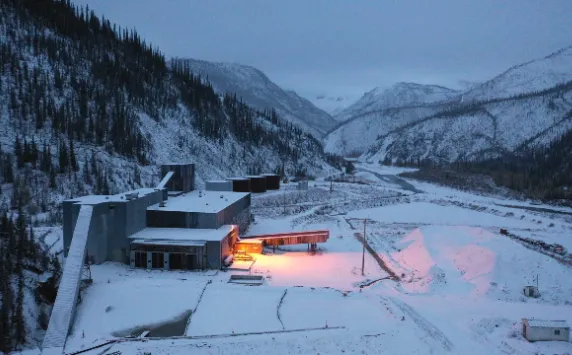
8:05 So what we see here is the mine site itself. This includes the mill, electrical buildings, all the infrastructure. Just around the corner here is our fully functioning airstrip. I flew in here myself 2 weeks ago and part of what struck me again was just this existing trail and road network that allows us to utilize the area without us having to do any of it ourselves. This is already in place. We can get around, we can access the 870 level portal, the 930 level portal, and the 970 level portal, all from site. So it's really easy to get around and get to where you need to go here. And zooming back out, and now what I'm showing you is all of the drilling that's been done on the project. So all the collars are represented by the yellow dots there.
8:58 And so you can see that this works out to about 80,000m of drilling that's already been done here from about just shy of 300 drill holes. Again, this is an advanced asset. There's been an immense amount of work already done here. 80,000m of drilling is no small feat. You can see that a lot of drilling has been around the main deposit area here, but it's also been done on some of the exploration zones to the south. In success, they've outlined mineralization in the drilling to the south. So there's proven mineralization, but lots of room to grow there as well. And what does this look like at depth? So what I've got for you now here is the actual drill traces underground and more importantly the underground infrastructure that's already here.
9:48 This works out to about 5 kilometers of underground development between 3 different levels. And you can see here, importantly, that in the past, they actually utilized these levels for resource drilling, which, you know, added to the measured and indicated resource blocks that make up the model today. And as mentioned, I can't stress enough the importance of already having this underground infrastructure in place. We plan on utilizing this ourselves and I'll get into that a little bit moving forward here. So what I've got up for you now is silver grates in all the drilling. And so anything in orange is over 50 grams per ton, anything in red is over 150 grams per ton and anything in pink is over 500 grams per ton.
10:36 And the big takeaway here for me is when you look at this, I see a lot of orange, red and pink and I think my message here is that this is in fact a high grade silver deposit. There's lots of nice wide intercepts of several hundred grams per tonne silver and no doubt that we have room to grow it as well. But like I said, lots of really nice wide intercepts of high-grade silver. Now I'm showing you zinc. So anything in pink is over 8% zinc. And similar to this being a high-grade silver project, This is also a very high-grade Zinc project and you can see there's some really nice, wide, very high-grade intervals of Zinc here that complement the Silver.
11:26 Same thing with Lead. Anything in pink is over 5% Lead. So this just goes to show, again, the quality of the asset. We have high-grade Silver, Zinc and Lead throughout the deposit. And what I'm showing you here is something that's been ignored in the past and that's Copper. And it's important to highlight to people that this is actually a Copper project as well, a Copper mine. You can see anything in red is over 0.5%, anything in pink is over 1%. And so it's very clear to me that in addition to the Silver, Lead and Zinc. We have a high quality Copper project here as well. We have lots of nice wide intervals of over a percent Copper. And so this is something that we're currently evaluating.
12:13 How can we add value to deposit the mine in the future utilizing copper as well. There was a copper circuit built in the middle initially, but it's really kind of been ignored in the last decade or so. And so we're looking at how we can add value with this. And so when you put all those together, we end up with a nice geologic model shown here. So we see 3 main, you know, kind of mineralization models. And this is our main quartz vein, which is in red. This is our massive quartz vein, hosts the bulk of the deposit. We have our stockwork zone in yellow here, our SDK zone, similar to the massive quartz vein. And then we also have our SMS or strata bound massive sulfide zone, which is in the blue here.
13:02 And I'll touch on these a little bit more moving forward.
13:07 And so if I was to take a nice slice right through the middle of the deposit, this is kind of what it would look like. And so this would be looking north and we can see here like what I was talking about, where we have folded carbonate sequence. So we have these folded layers of different carbonate rocks. And we get our massive quartz vein, which basically cuts right through the middle of this carbonate sequence, this folded carbonate sequence. And it's essentially north-south trending. And what we can also notice here is this stratagound mass of sulfide zone, or SMS zone. And what's different about this zone is instead of cutting through the stratigraphy like the quartz vein does, it actually is formed specifically within some of the stratigraphy and parallel to those layers. It particularly likes a couple of these layers in the Whitaker Formation.
13:58 And so rather than cutting through, it's actually parallel. And as I'll get into, this is important for us for germanium, this zone here. So if we think of that cross section, but actual in real life, we're looking North here. And what's really cool is that, you know, from zone 6, you can actually see this layer in this folded carbonate sequence right at the deposit scale. And we have our vein projection on surface. We have our SMS zone projection on surface. But essentially, this is exactly what that carbonate sequence in the cross section looks like in real life. And here's our nice 870 level portal sitting kind of right at the mouth of it here.
14:41 So what I've got up for you now is that cross section, but also with the individual geologic models of the mineralization. And so this is our massive quartz vein. Like I mentioned, this is basically, you know, this is the meat and potatoes of the deposit. It's a very large, high-grade quartz vein, quartz carbonate vein. Basically it runs north-south, you know, This is looking North, so it runs North-South. And it's got a bit of a plunge to the North, which means it's kind of dipping to the North. And it ebbs and flows. It blows out in certain places, but it's very predictable. That's important because for future drilling, we know where this vein is going to occur. We have the same trend of the vein 10km to the south of the deposit.
15:28 That's really important. This isn't a cryptic system where we don't know where the mineralization is. It's a very traceable vein. And so we know this extends a depth. We know this extends to the south. And that's an important takeaway. So here's our stockwork zone. And so you can see here that it's just kind of right at the tail end of the underground infrastructure. And you can think of the stock work zone as basically a point within the main quartz vein where you had some structural displacement. It allowed for some space to open up. And so rather than 1 kind of continuous vein, it forms several veins, but over wide widths. And so the nice part about the stock work zone is that we get nice wide high grade intercepts in here.
16:13 And we feel like this is a very important zone for future work, which I'll get into soon here. And last but not least is our strata bound massive sulfide zone or SMS. And again, like mentioned, you can see that it's got a different orientation than the massive quartz vein in Stratabound or Stockwork Zone. It forms within this layer and so you know it tends to form near or around where the quartz vein is. Important to note that in the past this wasn't really a targeted zone. They kind of intersected this coincidentally while trying to find the massive quartz vein. And so there's lots of potential, I believe, for us to find additional SMS material that wasn't really ever focused on.
17:00 If we look at it from this angle here, you can see that because of the plunge of the ore bodies going to the north, that the projection of this zone is actually coming towards surface to the south of the deposit. And we know that's true because we've actually in the past, they've intersected in shallow drilling SMS material in zones 5 and 6, several kilometers to the south of the deposit. So I believe that there's a really strong potential for us to find additional SMS mineralization close to surface in the future. And so what I've got for you now is some really nice pictures of some of these zones. We'll start out with the main quartz vein. You can see this great picture here, nice 3 to 4 meter wide, high grade lens exposed in the 930 level.
17:49 You can see all the goss in, the massive Galenas, Phalarite. And here's some nice drill core again with similar massive Galenas, Phalarite or silver mixed in there. This stuff is striking. It's stunning mineralization. It's impossible to miss. You know you're in the zone. And this is actually what our stockwork zone looks like. And like mentioned, it's not necessarily 1 main vein. It's actually several veins spread out over distance, but still very high grade. But now we're getting into, you know, some considerable widths in this thing as well. Nice picture here, same deal, massive sphalerite and galena.
18:31 This is our strata bound massive sulfides. This is what this rock looks like. Quite a bit of a different flavor, different texture than the main quartz vein and stockwork zone. It's quite a bit of a different flavor. Like I said, it's a replacement of the host rock rather than a vein. And importantly, this is what is host or what we understand to be hosting the high-grade germanium. I can't say too much about the germanium right now because the research team from U of T and the Northwest Territories Geological Survey are currently publishing some of the work that they've been doing on this. But what I can say is that if you haven't seen or heard, we put out a press release not too long ago highlighting the potential for Germanium at the PC Silver mine.
19:21 And there was grades, whole rock grades of up to 316g per tonne or ppm Germanium within the SMS zone. And we don't believe this to just be an isolated occurrence. I'm very encouraged. It looks like the SMS zone consistently hosts Germanium and there's a close association between the Germanium and the Sphalerite or Zinc content. We know the SMS is zinc rich. And so I'm personally very encouraged by the early work that's been done here. I think that the germanium is going to be a really nice value add to the deposit. And I'm looking forward to, you know, continuing to work on this and give some updates in the future on this, not too far from now.
20:09 So taking a little bit of a peek under the hood here at what's in store for PC. So We are planning on doing some drilling this year and that's highlighted in the pink drill holes here. We are planning on fully taking advantage of the advanced nature of this deposit and the underground infrastructure that's already in place.
20:30 What this program is aiming to do is target the main quartz vein and the SDK zone or the stock work zone, utilizing the end of this 930 level drift. And this allows us to really efficiently target this zone, rather than having to drill from surface. We can do multiple short holes where you get into the mineralization almost off the start of drilling. It's important to show everybody here, Like I said, you get a really nice in the stock work zone, a big blowout in the widths, but still maintaining nice high-grade Silver, Lead and Zinc. And I think if you notice here, there's kind of a cutout or a gap.
21:16 And I don't think this reflects that there's no mineralization here. It's rather to me, there's been no drilling here. And I believe that we can add a lot of value with a small 3000 meter ish program that aims to target this zone. And I want people to note these 2 holes, which I've highlighted here, that are kind of in the guts of this zone. And so there was some drilling done in 2015. And one of those holes, which is PCU 1572, hit some phenomenal grades over wide intervals. And this was actually the last hole of that program and really never got followed up on. And cumulatively here, we've got about 37m of high-grade material, true width.
22:06 We're talking an interval here of 7.5m at just shy of 250g per tonne Silver and 50% combined Lead-Zinc. 24.5m, true thickness, right within the heart of that stockwork zone at 116 grams per ton, silver 12% zinc, 7% lead, and then back into our main quartz fin. So we're talking really nice widths here with also really high grade material. And this interval particular also included about 16.5m of 0.24% tungsten oxide. And so tungsten is also a critical mineral that we're looking at, potentially trying to add value to the deposit. And so we'll certainly be assaying for Tungsten in this plan drilling.
22:55 And again, just one more example from this zone, PCU 1569, just shy of 13m true thickness at combined 50% lead and zinc and 452g per tonne silver. That's a world-class interval, truly. And this is where we're planning to do this drilling right around to follow up on these hits.
23:18 And again, I just I believe really believe that there's a value adds, you know, we can we can add new ounces to the deposit in this area and also at the same time, you know, upgrade some of the inferred blocks that are around in the area. And so if we just look at our current mineral resource right now we can see that it outlines about 2.3 kilometers strike length and our red here is our measure, our green is our indicated and our blue is our inferred. And what is a big takeaway from this image is the fact that we have this historic drill hole way down at the bottom of our inferred zone. And we got 6.3 meters at 240 grams per tonne Silver, 9% Zinc and 19% Lead.
24:04 To me, I don't see this as a deposit pinching out at depth. That's a significant interval with high-grade material that's basically sitting at the bottom of our inferred zone. And so to me, there's no doubt that we can add, you know, meaningful ounces to the deposit by following this thing down strike and or down plunge along strike. And I think that's a big takeaway as well from the deposit itself is that not only can we add some ounces that are planned drilling, but you know there's there's an absolute path to add ounces in the future as well in the immediate deposit area. And again just showing you know the the amount of work that's been done, our current underground infrastructure in the blue here, and what's been planned for the future in the green.
24:57 And so perhaps my my favorite slide out of this whole deck, which is the kind of overall exploration potential for the deposit in the project.
25:06 And what I've got for you here is grab samples from the 2012 rock sampling program on surface. And anything in green is over 50 grams per ton, orange 200 grams per ton, red 500 grams per ton, and pink 1,000 grams per ton. And so we see very high-grade samples all the way to the South, 50g plus all the way at the very end. And here's our deposit. And so I think this gives, this should give people some context for the scale potential of this property. The deposit here, that's 2.3km long as discussed. And we have all this high-grade material on surface here, plus known intersects or intervals from drilling. You know, zone 8 down here is 10m at 6% Zinc, 9% Lead and over 100g per tonne Silver.
25:58 Zone 6, similar thing, very high-grade Silver, you know, proven in the vein through the drilling. And all the way up to the Rico showing at the North, which has had trenching results, a metre at 18% Zinc, 35% Lead and 240g per tonne Silver. And so if you chalk all this up, we're talking 16 kilometers strike length of known high-grade silver mineralization plus zinc, plus lead. And I think that's a really meaningful thing for people to take away from here is that this isn't just a one-trick pony. We don't just have this deposit. We have substantial room to add to the resource down the line as well.
26:40 And if you don't believe me, here's some pictures of the quartz vein cropping out right on surface, way to the south of the deposit, which for us means shallow drilling, easy test targets. And like I said, it's already been proven that we have nice wide high-grade intercepts here. And so this is really encouraging for me. I'm planning on visiting some of these this summer and doing some, you know, a bit of exploration work along trend to, to highlight some, some zones as well. And as I previously mentioned, you know, there's lots of potential to find additional SMS mineralization, which would have implications for the Germanium at the deposit, in addition to just more Silver, Lead and Zinc. We know that the SMS zone has been hit in historic drilling in zones 5 and 6, a few kilometres to the south of the main deposit. There's already been geophysics work done here that highlights some, you know, high priority targets without drilling.
27:38 And again, really encouraging from an exploration point of view, you know, that looks like we can target this stuff in the future. And lastly I would be remiss if I did not remind people that this is just 1 out of 8 projects that the company owns. As a geologist I could make the case hands-down to explore any one of our projects. And I mean that, you know, these are all really high quality silver projects, silver and polymetallic projects that all, you know, have significant potential. And again, we're just highlighting one of them right now. So lots of value add. And I'll leave it with that. Thank you.
28:24 Perfect. Thank you, Andrew. Before you stop your screen share and before we bring Chad into the discussion, There's a couple of questions here and it might be worth keeping the slide deck up for John's question here So where is the 94 meter intercept that ended in mineralization? Not sure if that's in the deck or not. I Don't know I'd have to know the name of the hole. I suspect it might've been, if I can go back here. So PC 1572, this was just 1, this was 1 lens within that hole. There was additional mineralization in this hole.
29:10 I don't know if this is what the viewer was talking about specifically, but It may have been in the stock work zone here, but I'm not sure if there's a specific hole name or anything like that. No worries. We'll give John an opportunity to elaborate here. He had a follow-up question. Is it true that PC has copper intercepts up to 10%? Yeah, absolutely. And that's, I mean, I'll try to zip back here quick. Yeah, so like I've shown here, The pink is anything over a percent. So there are intercepts in here, 10% plus copper. I wouldn't say it's all over the place, but there's certainly high grade copper values up to 10% within the deposit itself.
29:58 And like I said, there's wide intercepts where you're getting percent plus for several meters. So yeah, that is certainly true. Thank you. Peter Epstein joined the call here. When by-product credits are considered for viability to be exploited, recovery rates are obviously key. What approximate minimum recovery rate might be needed to make tungsten and or geranium potentially feasible with those metals require separate or special processing above and beyond the needed for silver, zinc and lead? Yeah, yeah, yeah, yeah, sure, yeah. So, I mean, I'll let Chad add on to anything. But I would just say that it's, you know, of course, it's early days, We're still evaluating what we actually have.
30:49 And I think it really just depends on the deposit and what the Germanium is hosted in. As I said, it looks encouraging for us here early days. I'll leave it at that. I don't know if, Chad, you have anything else to add? Yes, quickly. It's a great question. We don't have an answer right now. The reality is that when we acquired the project, we were focused only on Silver, Zinc and Lead. And then late in the acquisition process, we were made aware that the possibility of Germanium being important was revealed to us. So that was a positive surprise.
31:36 And to Andrew's 0.1 long time ago, they looked at producing a copper concentrate. And with copper prices being so high, all of a sudden the copper values in this project become important. And then, you know, there's all kinds of other metals like tungsten and antimony. We just don't know. And there are 2 factors. It's not just a recovery at the mill or at the mine, if you will, or at the mine site, but it's also what's payable by the smelters. And so let's say we can recover, just to pick out a number, 80% of the copper. What percentage of the Copper will be payable by the smelters? Will they take another 5% or 10% deduction?
32:25 We just don't know. Those numbers are, you know, there are chemical aspects of it. Those are the mine site recovery rates, but the payable metal components, that's a negotiation with the smelters. And we've talked to probably close to a dozen smelters, off takers, folks that are experts in concentrate treatment, and I alluded to this on other presentations, but the terms presented to producers or future producers like us are the most beneficial to mine owners than they've ever been. And there are reasons for that. The Red Dog mine in Alaska is gradually shutting down. So that's a major source of zinc concentrate.
33:16 That's seeing its throughput decrease. Plus there's a brand new smelter being built in Tennessee by Korea Zinc. And so you've got new demand for zinc concentrate and less supply. And There have been no new zinc mines built for many, many years. And so we are in a very, very enviable position. And time will tell. Again, it's a negotiated process. But time will tell what the terms are that we will benefit from in terms of the recovery of all these secondary, tertiary and quaternary, if you will, metals. It's going to be very interesting. I'm very optimistic about the significant by-product credits we're going to get when we start producing metal from this mine.
34:07 Thanks for joining the discussion, Chad. A good thread to pull on leading up with that commentary is from David here. With a likely M&A wave coming, are there any majors in the area that might be interested in Honeybadger?
34:22 There are no majors in the area. In the Northwest Territories, Of note, there are 2 world-class diamond mines that are shutting down, Ekati and Dyavik, but obviously they're not polymetallic mines like ours. We will benefit from those mines shutting down in terms of labor and so forth. But in terms of major companies active in our area, there are none. There are obviously many silver mining companies that are generally active in North America and elsewhere that will probably find this project very attractive, but nothing in the near, like let's call it nothing in the neighbourhood.
35:07 Right. So upon registration, an individual asked a question, if you could take us through a detailed roadmap to production then, including any risks and mitigation strategies? Can you anticipate when additional funding will be required and options that the company would consider to raise capital? Sure. I mean, it's a long question, but we don't have a detailed roadmap because we have just commissioned a PEA. That PEA is due in the third quarter, so soon. And these are experts, these are metallurgical experts, you know, mine reserve calculation experts, mine building experts, and they will tell us what they think. We're gonna have to rely on them in terms of a timeline. But what I can tell you, and this is very, very important and Andrew alluded to it many times, this is not a project.
35:58 This is a mine restart. Mine was 95% built in 1982. So it's like finding a 1982 Porsche in a barn that's never been run, okay? It's got great bones. What we need to do is restore that Porsche to get it running in our neighborhood and then get it running on the highway and eventually we're gonna run it on a racetrack. But these things will take time, but we are blessed. Like Andrew mentioned the 80 kilometers of drilling, that's $80 million plus 3 years. If I said, I want Andrew, I want 80,000m of drilling, he's going to say, okay, find me $80M in 3-years. We have it now.
36:43 The 5km of tunnels, we call them drifts, you know, that's another 20 million easy and probably another 3 years. The point I'm trying to make is that we are blessed with advanced mine that we are restarting. And so we are actively working as we speak. We've got people on site trying to figure out how to restart the mill. And I'm sure, you know, 1 day we're going to get a really positive surprise. You know, this motor is amazing and we can restart it. The next day, we're gonna get a negative surprise that this motor is not usable or we have to rip out some cables. Like any restoration, there will be pluses and some minuses, but that mill, you've seen pictures of it. You don't have to bring anything in, really. All the pieces are there, essentially.
37:38 And so it's, you know, I've said this many times publicly. My goal, and it's a bold goal, and there's no guarantee on this, but my goal, and the team has embraced this goal, is to produce concentrate within a year from now. Now, this will not be commercial levels of production, but it will be some zinc concentrate, some lead concentrate, maybe some copper concentrate, I don't know. We'll have to see what we can do. But then what we can do is start shipping some of that high quality concentrate by plane and generating some revenue. Maybe next year we build a winter road in anticipation of an all season road the year after.
38:26 And so I want the listeners, the investors to know that this is full speed ahead. The questions we don't know is how much it's going to cost. And we're trying to figure that out. That's why we've hired a consultant, an expert, in these kinds of things. My gut tells me it's going to be a lot less than people think. It's going to be a lot quicker than people think. But I could be wrong, too. I've been wrong before. And it's a restoration project, and time will tell. But this is by far the most high quality, most advanced polymetallic deposit anywhere on the planet. It's rare. It's not even rare. It's unique. There is no other one, certainly no other one in North America. There's no parallel.
39:15 And time will tell on how valuable this is. Sounds like you might have Peter in your corner here. He's saying, what might the replacement cost of the mill complex be? It would take 5 plus years to permit and build a new one. Yeah, I mean, the permitting alone has taken decades, you know, and we can benefit from that. The IBAs with the Indigenous governments has taken many, many years. They're in place right now. So the mill, and we want to have as many people up there. I've mentioned this on other calls. We're going to have a tour up there in August and everybody's invited. I don't know how many people we can fit on the planes and so forth, but we want to have as many people up there so they can see it in person. Everybody who goes up there, including myself, is blown away by how advanced this is.
40:03 The mill itself, how much would it cost? I'm going to say, for what we have today, probably $200 million in 3 years. Forget the permitting, to Peter's point. And I'm just guessing. It's amazing. This thing was never run. I mean, some of the filtration presses are still in the original wrap. The flotation tanks, the thickeners never run. Now, maybe they're seized up And like I said, maybe the motors don't work, but we'll see. But let's hope they do work. Looks like we have one last question here and answer it if you're able to. Can you speculate on the life of this find site? Well, the it's easily 20 years easily with what we know today, And I'm glad Andrew actually has this slide up. If you could put the silver one up, the equivalent of this slide, but the silver one up.
41:03 So one of the things that, first of all, you can see the silver is very pervasive throughout. It's very homogenous. Sometimes you get deposits where the silver is in just 1 zone. Here, it's all over the place. But I also look at some of the high grades of silver at the bottom of the holes. Now, there may be a geologic reason that the silver doesn't go deeper. But I find it kind of odd that There's good intercepts, not just in silver, but lead and zinc at the bottom of the holes. I've visited probably 300, maybe, I don't know, more mines in my career. I used to be a mining analyst. And every time I saw this, I went, there's a lot of depth potential here because if we extended some of these holes, I would bet we would find more mineralization.
41:55 Can we double the size of this deposit? I think so. And that would add another 20 years. This is currently a sizable, substantial, high-quality deposit. One could argue it's not world-class because 20 years, you know, that's good. But if it's 40 or 50 years, that becomes a world-class company-making asset. And we know some companies, and very large ones, have already indicated to us that they also share that belief, OK, because of the geology. But this is mere speculation on our part time luck and a little bit of Money will will basically, you know, tell us whether that thesis is true or not or false and in terms of funding Just what what real quick on the funding side, there are 15, 1, 5 different Canadian government agencies that can provide funding to us, sometimes in the form of grants, which we already have some, sometimes it's the form of loan guarantees, sometimes it's cooperation with the indigenous governments.
43:11 But the point being is that Canadian government funding is, there's a new program, it seems every day. So there's that, there's US government funding because the germanium and other metals are of strategic importance, especially if this concentrate goes to Tennessee for the Korea zinc smelter, okay? They're gonna want this metal. So we might be able to access US government funding. Debt is available. There are streams on the non-precious metals. There are streams on other metals, maybe a zinc stream or a Copper Stream, that kind of a thing. We're a precious metal company, so the last thing we'll do, I'd rather sell my house than do a Silver Stream. But the point is, we have many different options, equity being one of the last options.
43:57 In my opinion, we've already got enough shares outstanding. Our job is to limit our share count as much as we possibly can. Great, thank you Chad. Thank you Andrew for the presentation and taking time out of your day. For people that joined the call late, This is being recorded. The replay will be available shortly after we wrap up here. You also get a meet and request button when we close off. Feel free to request a meeting if you have further questions for the Honey Badger management team. But thank you. Thank you for the thorough presentation. Look forward to more to come. Thanks, Kyle. And just before we sign off, obviously, thank you, Andrew. That was an amazing presentation. You've seen Claudine, now Andrew. We've got lots of highly talented people on our team and you'll see that and that should give investors a lot of confidence about us advancing this project.
44:52 Andrew, will these slides and thank you 6 of course for hosting it very professional as usual. Andrew, will these slides be on our website? Yeah, we can certainly put this presentation up there. Okay, good stuff. Thank you, Andrew. Thank you, Kyle. And thank you, 6.
Follow Honey Badger Silver Inc. into a list and get an email when it puts out news.
Latest news releases
- TSXV:TUF — Precious Metals & Critical Minerals Virtual Investor Conference Presentations Now Available for On-Demand Viewing · Fri, Oct 16, 2026
- TSXV:TUF — Honey Badger Silver Samples up to 279 g/t Silver, 5.82% Copper, & 0.83 g/t Gold and Identifies Multiple New Mineralized Occurrences at Its Yava Project, Nunavut · Wed, Oct 14, 2026
Companies on this call
More from Honey Badger Silver Inc.
- Sep 17, 2026 Advancing the PC Silver Mine: PEA Results and the Road Ahead
- Aug 26, 2026 More Than Silver: Zinc, Lead, and PC Silver's Concentrate Marketability
- Jul 31, 2026 Silver's Next Chapter: Scarcity Meets a Shifting Market
- Jun 25, 2026 The Geology Behind the PC Silver Project
- Jun 11, 2026 PC Silver Mine: Permits, Partnerships and the Path Forward
- May 14, 2026 Honey Badger Silver: Investor Town Hall