Transcript
Automated transcript · Written by software from the replay's audio. It can mishear names and figures; the replay is the record.
0:00 Disclaimer, 6th Inc. Does not act as a securities dealer or advisor and does not register to do so under applicable securities law. The accuracy of any statements made by individuals interviewed is not verified by 6th Inc. These individuals or the firms they represent are solely responsible for their statements. Nothing in this interview is a recommendation by 6th Inc. For any securities, nor is it investment advice or a substitute for professional investment advice. All investments in securities carry risks. Everyone's investment needs are different. Investors should obtain professional advice from a registered investment dealer, advisor, or other professional third party. For a full disclaimer, please see below or at www.sixth.com.
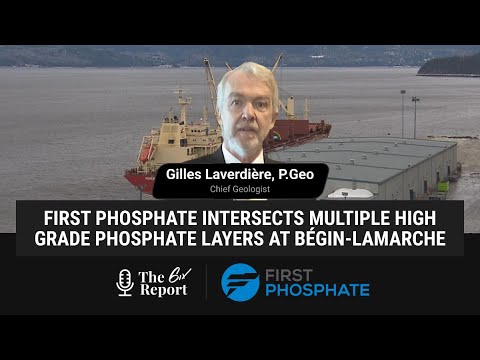
0:32 Hello everyone and welcome to The 6 Report. I'm here with Gil Laverende, Chief Geologist of 1st Phosphate, to discuss their recent press release of the initial drill results of its phosphate project in Quebec, Canada. Nice to have you on, sir. I want to start this off by asking you what lithium iron phosphate is actually and its uses. Because it's not the same type of phosphate used in the farming industry, is that correct?
0:57 Yeah, that's correct. The lithium iron phosphate, that's the cathode active material that goes into the EV batteries. But phosphate is used in farming is also used in the LFP batteries. It's the, It comes out of the ground from the rocks, but it's a process that is different.
1:24 The phosphate for farming is only purified to about 40%, while the phosphate that we use in lithium-ion phosphate batteries has to be purified to 100% or close to 100%. So that's the main difference.
1:43 Thank you. And based off your recent press release, your team discovered 4 high-grade phosphate layers. How do these phosphate deposits typically form? And from my understanding, your project is a little more rare in nature as it consists of a clean igneous carbonate type rock as opposed to a typical sedimentary rock. Correct? Yeah, that's right. Basically, there's 2 way the phosphate forms. One way is deposited into the ocean floor, you know, for many hundreds of thousands of years. And usually, in the ocean floor, there's a lot of other elements that come with it. Sometimes, very bad elements like thorium, uranium, and scandium. So this is a problem for
2:34 the EV battery, LFP batteries. In our situation, our igneous phosphate, it's forming kind of, it's a molten rock. It's like lava, but it's deep seated. And the lava itself, there's some areas rich in iron, titanium and phosphate. And these form crystal, they crystallize.
3:02 And then after that, they drop, you know, like a grain of sand into the water. It will go down to the bottom. But these crystals, they also go down to the bottom and they make layers for forming for hundreds of thousands of years. So those phosphate layers form from different times in history when lava
3:24 was coming out of a volcano, I suppose. Well, in fact, this lava, this molten rock doesn't come out from the volcano. It sits in the ground. It doesn't erupt on surface. So it's cooling there for hundreds of thousands of years. In our case, it's about 1 billion years ago.
3:48 And so they formed there for a long, long, long period. That's why we had very thick layers of phosphates in our area, in particular. And your initial finding show grades of 7.8% to 10.6% phosphate. Did these results meet your team's expectations? Yeah, absolutely. Last summer and last fall, we did some surface reconnaissance and sampling. And we, many of our samples were in that range 8 to up to 20%
4:24 phosphate. So but these are all like chosen samples. So it doesn't really represent the grade of what we have. So that's why we need to drill to have a more continuous sampling and have the effective grade on the ground. So right now from, you know, 8, 10%, that's what we've got on the ground and the same type of rock that we found in the drilling is the final surface. So we're just confirming our previous findings.
4:54 Okay, thank you. And how does that stack up to comparable projects? Like if you could please actually share any comparable projects, so investors and speculators can refer to them and do their own further due diligence on this rather niche market. Okay. Well, there are not that many igneous phosphate deposits, but if we look at Quebec, what we can have at Lac-Port-au-Port deposit, which is from Marianne. That's 7% phosphate, but it's 250km north of us. The Min Arnaud is in the Seycille area. It's about 4% and
5:38 it's close to Seycille and the deep sea port. The Lac Arignal, this is another project that Phosphate is working on. That 1st phosphate is working on. That's about 5.2% phosphate. It's about 100 kilometers north of this project we're working on right now. The Bourget deposit is a small deposit. It's about 30 kilometers out of us and it's 10%. So it's the same formation that our project at Vézina marched. So now we think that the project is kind of a higher grade than these other projects. And the beauty of it is that it's right in the middle of already constructed infrastructures you know, Taipei Road close to the port of Saguenay, so It's well located and seems to be richer than the other projects in Quebec.
6:37 What can people expect in terms of an exploration program from 1st Phosphate in 2023? Right now, we're finishing our 4,000-metre drill program that we started in February. Then we're going to take some time to analyze the results and plan the next, the follow-up drilling later in May. One thing is that, you know, this may be in a month or so, it's going to be the breakup period. It's more difficult to work, even though we will be able to work on our property. But we want to take like a little rest to think about, you know, the next step. So next step should be another dual program, maybe 5,000 to 10,000 meter to bring the property to a resource estimate, or even maybe a preliminary assessment economy work.
7:36 Perfect, thank you so much. And if you wanna learn more about 1st Phosphate, you can go to firstphosphate.com. Thank you so much for your time, sir. Thank you very much. Thank you for having me.