Phoevos Pouroulis
CEO at THARISA PLC
Replay available
Interim Results hosted by Tharisa (JSE:THA) on Investor Meet Company, held 2026-05-21.
Automated transcript · Written by software from the replay's audio. It can mishear names and figures; the replay is the record.
0:01 Good morning, ladies and gentlemen, and welcome to the THARISA PLC investor presentation. Questions are encouraged. They can be submitted at any time via the Q and A tab that's just situated on the right hand corner of your screen. Please just simply type in your questions and press send. The company may not be in a position to answer every question it receives during the meeting itself. However, the company can review all questions submitted today and will publish our responses where it's appropriate to do so on the Investor Meet company platform. Before we begin, as usual, we would just like to submit the following poll. And if you could give that your kind attention, I'm sure the company would be most grateful. And I'd now like to hand you over to CEO, Phepos Perullis. Good morning, sir. Good morning, and welcome, everyone, to this half year results presentation for our financial year 2026. With me today in the room is our CFO, Michael Jones, and CFO designate, Jacques Breitenbach, who will be taking over from Michael from the August 1 as Michael enters his retirement.
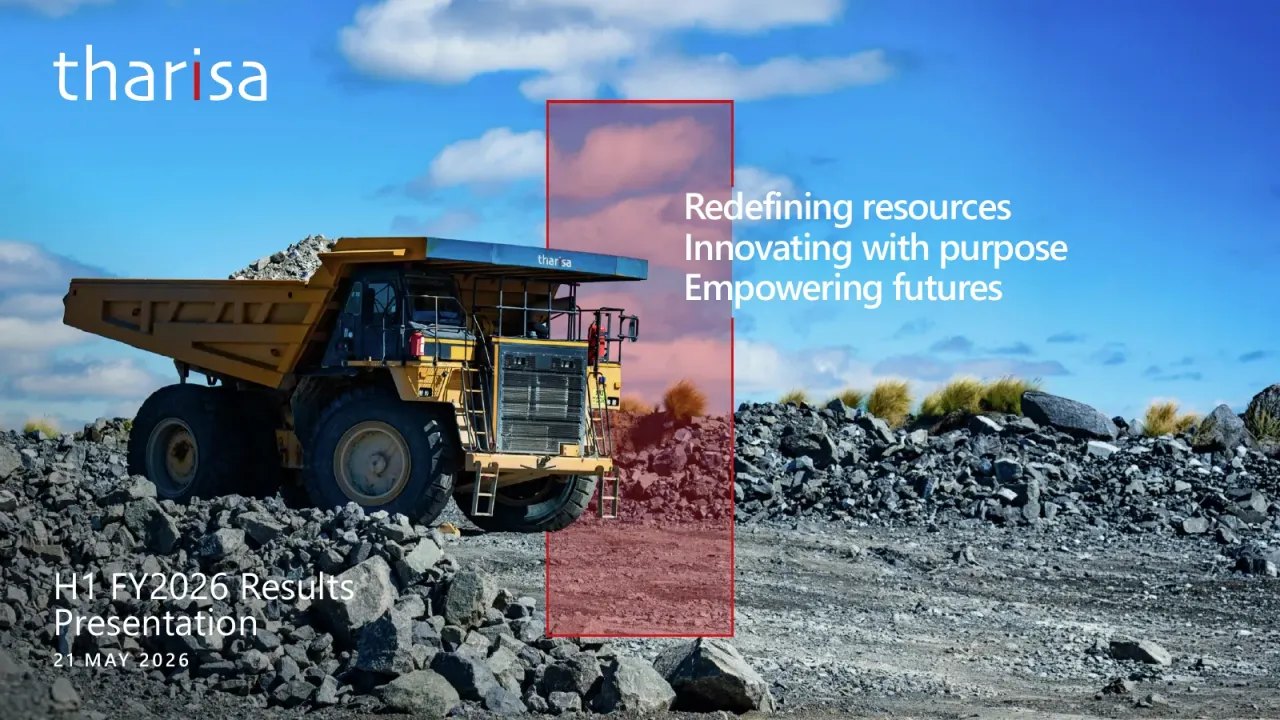
0:58 So really starting off with our intent and purpose statement of redefining resources, innovating with purpose, and empowering futures, and we'll unpack those three pillars during the course of this morning. This is our agenda for the day, running through predominantly the financial highlights for the half year, but really touching on what we're doing beyond just mining and looking into our vision 2030 and our strategy around commercializing some of these innovative
1:33 initiatives. I'd like to take a moment now to share a video that's been created by our team that spans across South Africa and Zimbabwe. So Jake, over to you if you could share that video. Thank you.
1:54 The world depends on the responsible use of its natural resources. At THARISA, we are redefining how those resources are unlocked through an integrated multi commodity approach that delivers multigenerational value. Safety is our license to operate. It's our core value. It's embedded in every aspect of our business from planning and design to execution on the ground because our people are at the heart of everything we do. Our core product model enables the simultaneous extraction of platinum group metals and chrome concentrates, maximizing resource efficiency, minimizing environmental impact, innovating with purpose.
2:40 As a low cost open pit operation with integrated processing, we extract full utility across the value chain consistently and at scale. This disciplined long life approach defines the THARISA investment case. A long life asset base, disciplined capital allocation, and a cash generative business model designed to perform across cycles, Our underground transition marks a significant step forward, extending our life of mine by more than sixty years and strengthening long term value for our stakeholders. It's an investment not only in our business, but in empowering the future of the South African economy and the communities in which we operate.
3:31 As part of our unwavering commitment to South Africa's future, we have pledged R10,200,000,000 to drive local growth, industrial capacity, and inclusive development. Sustainability at THARISA is not an add on. It's fully embedded in how we operate. From responsible water and land stewardship to meaningful, impactful community engagement, we are committed to creating shared long term value. Our vision extends beyond South Africa. Karo Platinum is a next generation PGM mine under construction in Zimbabwe, advancing our strategy to build a globally relevant integrated resource group.
4:17 Through downstream beneficiation and innovation, we are unlocking new opportunities across our resource base, extending value beyond extraction and into application from infrastructure development to decarbonization to energy storage. Our purpose is clear. Redefining resources, innovating with purpose, empowering futures. THARISA, an integrated resource group, future focused, and committed to playing a pivotal role in the global transition decarbonization journey, delivering value with lasting intent.
5:14 Great. Thank you for your attention, while we ran through that video. I'd like to touch on the nonfinancial highlights for the first half of the year, and really, we start off with safety, which is a core value of ours. It's not necessarily a priority. It's entrenched in everything we do. And we're extremely pleased with our safety record at the THARISA mine at point zero three incidents per 200,000 man hours worked. While we strive for zero harm, we we do realize, the impact, that having core value of safety has on people's lives, and we strive to send everybody home safely every day. Very pleasing to note at Caro, zero LTI frequency rate during the construction period over the last two hundred thousand man hours worked.
6:07 And the significant milestone at our mining operations at THARISA Minerals, three years lost time injury free. But when we equate that into volume, and tonnage that was moved over that period, equates to a 125,000,000 tons of waste and reef mine. So significant movement of, ore, waste, and machinery, during that period of time. Just to remind everyone, our half year production results, we produced 753,300 tons of chrome concentrate, pretty much flat, from the comparable period, but importantly, chrome prices, increasing just over 12% to $284 per ton, during the comparable period.
6:57 PGM production was up again from the first half of last year to 73,100 ounces, but really the standout feature of this half year is an 85% increase in our PGM basket price, to just short of $2,600 per ounce. In terms of progress and development, significant progress has been made at the THARISA Mine with the first blast at the Apollo Portal earmarking our underground development, and those plans are ahead of schedule as at the end of April. Our portal development at the Apollo West Mine is a 134% of the plan, so ahead of schedule.
7:44 Important to note is that project is fully funded, and has that funding for not only the West Portal, but also the East Portal Orion development, as we transition over the next eight years to a fully underground mechanized Borden Pillar Mine. Also pleasing to note is the successful factory acceptance testing on the first megawatt hour class scale of our Redox one iron chromium flow battery system, and this really is the first step into proving the commercial viability of the technology utilizing our own resources to create the electrolyte for long duration energy storage solutions that the world requires. Just in terms of a capital markets update, we are establishing a level level one ADR program with JPMorgan appointed as the depository bank. We're anticipating this listing to go live on the June 8.
8:46 Coral Platinum really is the next, development project that has been underway for a number of years now, but important to note is that we've invested significantly in this project, $241,000,000 to date, and you can see the progress, and we'll unpack that a bit later during the presentation.
9:07 Our mining contract has been mobilized, EPSA. The equipment is arriving, and they have started with open pit waste stripping in preparation for building up run of mine stockpiles ahead of the concentrator and commissioning later next year. Also important to note is that we've continued with our exploration program with 26 kilometers of underground drilling having been completed, and this really to increase our resource and confidence to unlock additional underground potential of at least fifty years, on the Great Dike. Just to remind everyone, we are targeting 226,000 ounces of PGM production from our first ten years of open pit mining at the Caro Mine.
9:57 To remind everyone again our three pillars, which really underpin our focus areas, and that is really redefining resources, optimizing what we have, creating sustainable value, and rethinking the approach in terms of maximizing recovery of the metals that we mine. Innovating with purpose, creating solutions to unlock value through technology, empowering futures, looking at sustainability in terms of creating long term employment upliftment of communities for generations to come. At this point, I'd like to hand over to Michael Jones who will run through the financial highlights for the half year. Thank you, Pheboz. Good morning, and welcome to interim results for the six months ended 03/31/2026.
10:48 Our co product business model of producing both platinum group metals and chrome concentrates not only differentiates us from our peers, but is again proved the resilience of the THARISA model. If we look back over this past period, the commodity prices and what is believed that there's a fundamental shortage and deficits in PGMs particular have really supported our business model going forward contributing significantly to cash flow generations. So for the six month period we generated $96,400,000 of operational cash flow. This has enabled us to continue investing in not only sustainability of operations, but also in our growth projects such as Cora Platinum.
11:34 Just to give an indication of the impact of the improved PGM basket price in particular, the peak funding required for the underground mining project was a $173,000,000 and the back of these stronger prices very pleasing that has reduced the peak funding by some $45,000,000. However, we have secured and I'm pleased to say all the full underground mining finance required of a $179,000,000 in terms of facilities and asset backed financing. As mentioned, we do not invest only in the sustainability of operations, but also in our growth projects. Over this past financial period, we invested a $103,500,000 in our future. Of that amount, 65,500,000 was invested in sustaining CapEx, so that's really the open cost fleet. We still have some eight years left of of open cost mining, as well as the plants that we have on-site.
12:33 Underground CapEx, while we've budgeted just over $76,000,000 for the full year, we only incurred $16,300,000 in the first six months. There will be a rapid expansion as we go through the second six months, as we invest in the underground mining fleet. We have continued to invest on a disciplined basis in Cora Platinum and we matched the cash flows available to certain selected projects such as Shiringhazi Dam and infrastructure for the power stations and power lines, and we invested $21,400,000 over this particular period. I'm just going to touch on some of these highlights of these numbers and then have a look in more detail at the revenue and costs going forward.
13:18 Very pleasing, revenue is up 28 at $359,400,000 and that's really on the back of the strongly improved PGM basket price. EBITDA pleasing 138.1% increase to $104,300,000 profit before tax also strongly up at $69,900,000 translating to earnings per share of 15.8¢ per share, that's up 532%, and very pleasing, the board approved an increased interim dividend payout of 2.5¢ per share, the comparable period is 1.5, and that equates to a 15.9% payout. Just analyzing the revenue in more detail, thank you.
14:06 As mentioned, increase of 28%, Pheus has already mentioned the 85.3% increase in the average PGM basket price, that averaged $2,599 per ounce. There's also an increase of 17.4% in overall PGM ounces sold. Notwithstanding the 12.3% increase in the average metallurgical grade chrome price that averaged $284 there was a slight decrease as we managed the working capital, is this a timing issue in terms of a decrease in overall tons of chrome concentrates sold. If we look at the breakdown of the revenue, and we look at this on an FCA basis, so typically we sell chrome, metallurgical grade chrome on a CAF basis, which includes insurance and freight, and that's a cost of transports and the goods from mine to final port destination in Indonesia and China.
14:55 Stripping that out to make an X gate revenue, the PGMs contributing just under 60% to the overall revenue, and chrome just over 40%. Just to touch on the pie charts on the right, which shows the revenue pull split, mean the revenue earnings. The pull split for example for rhodium, equates about 10% of the production, but contributes some 35% to overall revenue on the back of very strong rhodium prices.
15:24 Gross profits, we continue to maintain very healthy gross profit margins, very pleasing to maintain at 30.3% and a gross profit of a $108,900,000. Now this chart I really like because it gives us a snapshot of what happened over the last six months. So if you have a look at the half year starting with 2025, the EBITDA of 43,800,000, we've spoken about the impact of the increase in the PGM volumes, and as Phevis mentioned, the star performer, the PGM prices make a significant contribution to our increase in EBITDA. Chrome volumes as mentioned slightly down, some mining cost inflation. In mining commodities, I just remind the audience that is we purchase some run of mines, stockpiles strategically to optimize the throughput through the plants and ensure we have full throughput.
16:17 So that's a mining commodity purchase of run of mine ore, small processing costs, adjustments, inventories, just a favorable movement in inventories six months to six months, and that's an income statement movement coming through and translating to that very healthy $104,300,000 EBITDA. Unit cost, this is a very busy slide going through, I'm just going to pick on some of the numbers. So on this table on the left, the tons milled flat at 2,700,000 tons that affects the part capacity for throughput. The online cash cost per ton milled down marginally 8.8% at $51.8 per ton. Just to note in terms of computing that cost, that excludes deferred stripping, so accountants capitalize the deferred stripping, in other words we're stripping ahead of our requirements, that deferred stripping amount amounts to $33,500,000 and we get the benefit of that going forward as you access the reef that has been exposed, but it does however include the cost of the purchased run of mine ore.
17:20 The chrome inland logistics and freight costs up marginally 6.8 percent at $86.5 per ton. And just to note that there was the impact of the Middle East conflict on the cost of fuel and therefore knocking on to the freight costs and was subsequent to this reporting period. I am pleased to say that from a chrome pricing point of view, the chrome price has adjusted to compensate for that increase in overall freight costs. The one I think really key number on this slide is an all in cost for platinum group ounce sold. So if we look at our business model, are co producer of both platinum group metals and chrome. So if we offset the chrome revenue and we say we're a PGM producer, we're getting an all in sustaining cost excluding the quarry platinum investments of $268 per ounce.
18:13 This needs to be seen in the context of a current basket price of some $2,800 and a payable percentage of 80%, showing you the robustness and resilience of our co product business model. What's even more pleasing is if you then say we're an all in cost producer of only platinum and to compare to some of our peers, we get a negative cost of $2,822, and again one of the key contributors to that is the very strong rhodium price, which while contributing some 10% to the pull split, contributes some 35% to our overall revenue. The only other number I'd like to highlight on this slide, and I think it's very relevant in the current market looking forward, is diesel and all in cost in the mine costs. It comprises 10.9% impact of the Middle East conflict going forward on diesel will therefore impact on those costs.
19:09 Thanks, Fivas. As mentioned previously, we continue to invest in the sustainability of our operations as well as the expansion. We incurred a capital expenditure for the year of the six months for $103,500,000. As mentioned, the deferred stripping which is where accountants have the fund is $33,500,000. Total capital commitments at March 31 stood at 120,200,000, largely related to the underground mine development with Cora Platinum having capital commitments of $27,700,000. Looking to the full year, the budget is a $165,900,000. Just to mention that budget excludes the deferred stripping and I'd expect that to be marginally lower than for the first six months and also excludes the Cora Platinum as we fund that project based on availability of funding, we'll touch on that shortly.
20:04 It does however include the $76,700,000 that we mentioned earlier to be spent on the underground development. Our balance sheet remains extremely healthy and is well positioned to fund our ongoing investments in our respective projects. We are at an investment heavy stage of our development. Cash and cash equivalents, $184,300,000. Total debt, a $130,300,000, and so a net cash of $54,000,000 on the balance sheet. Just a touch on it of the total debt, 42,100,000 is short dated, revolving credits and such facilities going forward, and the predominant portion 80% is dollar based, and then just some very healthy financial ratios.
20:52 A current ratio of 2.3 times, and as mentioned a net cash positive position, so a negative debt to equity ratio of 6.1%. If we just move to the graph in the middle of the page, and I think this really reflects our investments and our commitment to financial discipline. Net cash from operations is $96,400,000. If we have a look at our sustaining CapEx, and to us the underground is part of our sustaining CapEx while it's a separate project, because it expands a life of mine in excess of 60. We incurred $83,900,000, leaving us with a positive free cash flow remaining of $12,500,000, and then we look at our investment in the future not only in Quara but the beneficiation projects being undertaken by the likes of Arco Metals, incurring $21,400,000 and giving us free cash flow of $8,900,000, a negative 8,900,000 overall.
21:55 Dividend policy is to clear a dividend of 15% of consolidated profit after tax. That is an annual basis. Our practice has been to declare an interim dividend of 40% of the annualized half year, so very pleasing that the board approved an increased dividend of 2.5¢, which equates to 15.9% of our consolidated net profit after tax. That is a very high level overview of the financial results, and I'd like to hand over to Pheboz. Thank you, Pheboz. Thank you, Michael. So just touching on the markets, platinum group metals and chrome markets, I think to note current spot prices at the May 18 for our PGM basket at the THARISA mine is $2,805 per ounce, and that's really on the back of a very unique pro split, which contains 52.9% platinum, 15.9% palladium, 10.5% rhodium, very little gold, significant ruthenium at 16%, and 4.5% iridium.
23:04 When we contrast that with Zimbabwe and the Karo platinum price at $2,359 per ounce as at the May 18. We see a more balanced platinum palladium smith, 43.5% platinum, 38.3 palladium, rhodium at 3.8%, and a fairly significant gold contribution at 8.6%, ruthenium at 3.8%, and iridium at 1.9%. So very balanced baskets across the two geographies and, geographical locations. I think what's key to note here is that we've just in the middle nearing the end of platinum week, and while there are varying views, the general consensus is that prices will remain firm, demand stable, and in most cases, we're still forecasting deficits across all five e elements, rhodium, platinum, palladium, ruthenium, and iridium.
24:08 What's interesting is really the AI digital data storage, e glass demand drivers as future demands with proliferation of data centers and AI, high speed processing technologies evolve and are, deployed, and the application of platinum group metals in those technologies and the potential demand drivers there, which historically have not fully been appreciated and a lot of discussion around those future facing technologies. But still, we look at internal combustion engine as the main driver for
24:49 platinum group metals, and the lower battery electric vehicle penetration is definitely supported of combustion engines for longer. And we're seeing those patterns, particularly in Europe and North America, reverting away, from BEV to hybrid, vehicles and, internal combustion engine vehicles. So supportive on a fundamental basis in terms of the automotive industry. And then we look at investment and jewelry demand. Really, we saw a material uptick last year in China as the disparity between gold and platinum was very apparent, a shift towards platinum investment and jewelry, as well as the futures exchange being launched towards the end of last year, providing ability for traders and users of, the metal to hedge positions going forward. So, certainly, positive demand out of Asia and particularly China.
25:57 When we look at chrome, it is unique commodity. It is what makes stainless steel stainless. Current spot prices at $305 per metric ton offer a six month average of 284. So to Michael's point, increase in in those revenues, I think compensating for some of the increased freight costs. Demand is strong and stable and really is driven by stainless steel application uses and demands. And what we're seeing is new uses and new applications for stainless steel beyond the traditional means. And a lot of those applications utilize ferretic stainless steels, which are the high chrome content stainless steels in construction, particularly rebar, as well as infrastructural, type of application. So very positive
26:51 link between South Africa, which hosts more than 75 of the world's chrome resources and has grown significantly as a key contributor to Chinese and Asian stainless steel supply. Stainless steel supply in 2025 was up at 64,200,000 tons with China between Indonesia and China accounting for more than 60% of that output. So the nexus between South Africa and China is strong, and, we see an annual compounded growth rate of around three and a half to 5% in terms of demand. When we equate that to tonnage requirement, that's an additional 1,000,000 tons of chrome concentrate that's required on an annual basis, to satisfy that growth rate. So we talk about deficits in the PGM market. I think we're going to be talking about chrome deficits deficits going into the future.
27:51 We've touched on the market fundamentals really and what's underpinning the strong pricing environment, and it's really around a tightness in supply on both fronts. And I think where we've really benefited from our coproduction model is the almost countercyclical earnings base that chrome and PGMs have created. They both currently are trading at, at healthy levels, but we certainly believe there is potential for upside on the chrome front and and perhaps on the PGM basket. When we look at the THARISA mine and we look at the vast nature of our resource over 5,400 hectares and resources of 655,000,000 tons, reserves of over 108,000,000 tons, we look at the potential of a multigenerational mine, and this is where we're very pleased with the development of our underground expansion at the Apollo Pit.
28:52 And this next picture really highlights the progress in terms of the three portal development, very large portals, five to six meters high, and equivalent, four to five meters in width. And this really allows us to develop at scale and achieve the volumes that we desire to feed our plant over the next three years as we get to steady state of 255,000 tons per month at the West Mine, and then we transition at the East Pit, which continues operations. And we have a sort of hybrid mine, underground and open pit. But by twenty thirty three, twenty thirty four, we'll be achieving over 6,000,000 tons from our underground development on the MG 2 and MG 4.
29:40 Moving further north to the Great Dike, we're blessed with a significant resource base there, over 23,900 hectares, a resource of a 178,000,000 tons that we've
29:55 defined with 12,000,000 ounces of resources there, unlocking reserves of 24,800,000 tons, 2,300,000 ounces of PGMs, which is really scratching the surface and delineates the open pit life of mine of at least ten years. In the current PGM pricing environment, there's potential for us to extend the pit shells and lengthen that life to perhaps twelve years and and beyond depending on the economics. As mentioned, we have concluded our underground drilling, which has the potential to unlock at least fifty more years of underground development. Great progress has been made in terms of the development, with the appointment of EPSA, a tier one Spanish mining contractor that has, seamlessly integrated into the Zimbabwean operating model and has started with the reef stripping and preparing the open pit for bulk mining.
30:57 All the metallurgical test work on the base metals and precious metals has been completed. Earthworks complete. Bulk water and power have been secured, which are critical infrastructure components. And we are approximately fifteen months away from first ore and mill from financial close, and and we'll we'll unpack that development with Michael as we
31:23 progress. Here you can see the open pit mining contractor, the large scale Libre ninety three fifty, and triple seven dump trucks from Caterpillar moving some of the waste stripping. So we talk a lot about innovating with purpose, but what does that really mean? And we encapsulate this in our wholly owned subsidiary called Arco Metals, and this is an integrated research hub where we look at applications and uses for the metals that we mine. And we have four distinct locations, Arco Metals Renewable Energy Center, the Challenger Plant, which is responsible for producing chemical and foundry grade chrome concentrates, Arco Metals beneficiation site, that's our Pyramid facility, AMTDC, that's our facility
32:14 at the university where we do our research, lab scale desktop studies, and then NCP where we are we are busy constructing our refinery of the chloroplast process. So we have two verticals, a PGM smelting and refining objective whereby we use a DC smelter to
32:37 smelt and produce an alloy, and then use a chloroplast process to produce metal two three nine five purity, for onward cell. And we're busy commercializing that stream. And then in terms of our chrome beneficiation, we have two verticals there. Obviously, the redox flow battery, which we'll unpack shortly, as well as the special alloys, which have multiple uses, but really looking at bypassing the ferrochrome stage and producing raw stainless steel. Not to mention not to forget to mention our Vulcan and Vulcan X processes, which are optimally designed for ultrafine chrome recovery, and those are being deployed at scale at the THARISA mine and through collaboration and joint ventures
33:27 potentially to other sites in the Bushveld Complex. So just a recap on REDOX one. These are long duration grid scale energy storage systems. They can last up to twenty years and provide uninterrupted power for baseload storage. So what's key here, the difference between a lithium ion battery and a flow battery, is that the storage and the energy are decoupled. So the duration that you require is a function of how much electrolyte you install. So this becomes a baseload solution up to twenty four hours storage, and then deployment of energy is defined by the number of stacks that you install. So I think the key highlight is that we've done the factory acceptance testing on the megawatt class scale, iron chrome flow batteries, and we are deploying that to customers of which THARISA PIMEN is, the first customer which we are coupling with, some solar infrastructure that we've installed already,
34:31 and the second unit will be going into Europe. I think we shouldn't forget, our competency in terms of our marketing and sales as well as logistics. Key components, capturing value through the chain, the ability to deliver our products to end users in a cost effective timely manner, as well as be front facing in terms of our ability to price our commodities with end users, particularly in the stainless steel and ferrochrome markets. And we look to that competency growing in terms of PGMs as we migrate to produce PGM metal. The impact that we create through our investments is significant. We employ, including contractors, close to 4,800 people, and the multiplier effect and the ability to impact lives through education, through investment and upliftment is material, and it's something that we hold very true
35:31 to our hearts in terms of our core value of upliftment and securing sustainable jobs for generations to come. We talk about multigenerational minds. These are hundred year plus resources. So that measured, disciplined approach of project execution is key to ensure that we make the right decisions for long term stakeholder value. In terms of our vision 2030, the objective here is to deliver on our expansion and growth opportunities, which is the THARISA underground, the CARO commissioning of phase one open pit, but also commercializing our Arco Metals technologies. And this really is borne out again through our three pillars. But let's look at the investment case because that's really why we're here, and we have an experienced management team with a strong track record. We have tier one assets that position us in the top 10 PGM producers and top top four chrome producers by 2029.
36:36 Caro doubles our PGM output and really gives us a second large cash generating unit, and the focus here is really to get that project up and running in the shortest possible time. Our fully integrated model using logistics marketing as well as innovation has really proven its resilience and the ability to unlock value throughout the cycle. And that really is illustrated here when we look at our investment case and you look at where we are positioned on the cost curve. So based on the costs, the all in sustaining costs that Michael mentioned, it puts the THARISA mine on a PGM basket price at the lowest end of the cost quartile.
37:21 We forecast CARO also to be in the lower end of that cost quartile at around R14,000 per PGM ounce. This is a rand based graph based on peer analysis, and it really shows you where we are cemented in that lowest cost quartile. When we look at ourselves in comparison to our PGM peers, the FTSE two fifty and all share, you can see we traded a significant discount on an EV to EBITDA multiple basis in 2026 and looking forward. These are based on fact set consensus pricing. And then on a price to earnings ratio as well, significant upside. So we believe there's deep value in our investment case.
38:11 With that, I'd like to hand over to Ilya to run us through the q and a, and thank you all for your time and attention this morning. Perfect, guys. If I may just jump back in there very briefly, and thank you very much indeed for your presentation this morning. Ladies and gentlemen, please do continue to submit your questions just by using the Q and A tab that's situated on the right hand corner of your screen. I just want the team to take a few moments to review those questions that have been submitted already. Just like to remind you that a recording of this presentation, along with a copy of the slides and the published Q and A can all be accessed via your investor dashboards. Guys, we have received a number of questions throughout your presentation this morning, and thank you to all of those on the call for taking the time to submit their questions. But Ilya, at this stage, so I'll hand over to you to chair the Q and A with the team, and I'll pick up from you at the end. Thank you.
38:59 Fantastic. Thanks very much. Let me start with the diesel question, and this one doesn't relate so much in terms of pricing. But there is a question here with regards to the Gulf Conflict. Are you forecasting shortages in diesel or other oil based products you rely on? And if you could delineate your answer between South Africa and Zimbabwe, please. I suppose that's for you, Fiwis. Yeah. Thanks, Julia. And as the war broke out, our our number one risk was security of supply. So we have one of the tier one oil traders as our key supplier at the Theresa Mine. We engaged with them on an early basis to ensure security of supply. They gave us assurances, and, their sources are not limited to the Gulf Of Hormuz, but are more globally diversified.
39:50 Beyond that, we went out and looked for secondary and tertiary supply, and we secured additional flow of diesel into, the site as well as securing additional bunkering and storage of fuel. So we're comfortable, that we've mitigated as far as possible the supply side risk. The focus now is looking at, consumption and minimizing consumption. I have mentioned before that we've been trialing fuel additives that have shown positive reduction, not only in fuel savings, but also in carbon emissions, as well as looking at, our traffic management, haulage distances, payload management, making sure that our our trucks are loaded appropriately, and we're targeting around a 10% saving per cubic meter of rock moved and mined.
40:46 Not insignificant, and and that's the team is focused on. Moving further north to Zimbabwe, there are multiple importers and suppliers into the country. We have not seen or witnessed any concern around, supply side issues. Again, the very same parties that we deal with in South Africa have well established, supply routes into country, and the same conversations and discussions have been had with multiple suppliers and supply routes coming into the country. Bearing in mind that we're slowly mining at the moment, so our diesel consumption is limited. But as we build up and we build our fuel depot on-site, this becomes a key factor to consider, and bunkering and fuel storage capacity becomes pretty significant.
41:42 When we look at our mining fleet for the underground, obviously, less onerous on waste because we're on reef development. We are looking at hybrid and electric drivetrains for some of our equipment to to mitigate or minimize some of that fuel consumption, but that's more forward looking. Thank you. And let me combine two questions here for you, firstly. The one is what is the latest situation on logistics? Are you only using road transport, and which ports are you using? And the second part of the question is it relates more to how making up for export volumes against the rail maintenance shutdown in the North and Northeast corridors. Given that we've used very little ray rail, it shouldn't affect us, but please outline the logistics generally.
42:31 Yeah. So a key, again, in terms of managing the flow of our material and the costs is actually an increase in rail year on year. So this half year, we moved around 22% of our cargoes via rail, very little last year. So there's a concerted effort to secure rail, to secure slots, and to move our cargoes for multiple reasons. Road is still predominantly the main export channel or mechanism. We exported 60% of our cargoes through Maputo, 40% predominantly through Richards Bay, and much smaller volumes through Durban. So weighted towards Mozambique, and we're looking at that blend as well in terms of export channels.
43:21 And least cost routing is the focus here. Alright. Let's stick with chrome. There's a question here. South African ferrochrome is on the brink of a return. A significant number of ore will be out of the market tightening supply to China. At which levels are you expecting this to support ore prices? I guess it's just a market related question where we see the market. Yeah. So so by our calculations, if both Simanco and Ferro Simanco and Glencore resume ferrochrome production, the pipeline or inventories ahead of their furnaces, we estimate to be between 800 to a million 800,000 tons to a million tons. So, yes, that will pull ore out of the market on a pretty structural basis because you'll need to maintain that pipeline inventory.
44:11 So it will be supported supportive of current prices and potentially a tightening of supply into Chinese port inventories, which have maintained a higher level, which was anticipated with the slowdown and and shutdown of a lot of ferrochrome capacity over the last twelve to eighteen months in South Africa. So net supportive of chrome prices going forward. Fantastic. Just one last one on the chrome. Just something came through. I suppose it ties in with rail with the private railing possible on Transnet's network that was allowed last week. What opportunities might this open up for THARISA and possibly when? Yeah. So so we have seen, as I mentioned, increase in availability through some of these public private partnerships on the siding side, and we believe this will unlock future potential in terms of rail capacity and rolling stock.
45:05 It does take time, but it's certainly focused on looking at multiple access points to utilizing rail, which have now become more the more options are more available to us. So, yeah, we we should start seeing that rail road ratio increasing over time. Ideally, we'd like it to revert back to the 8020 that we had pre COVID, 80% rail, 20% road for multiple reasons, efficiency, effectiveness, and cost. Okay. Let's move north of the border, and there's two questions, and I'll let you answer them separately as I read them out. The first one is progress on the Zimbabwean government sign off, please.
45:51 Yeah. So we've made great progress. I was in Zim a couple of weeks ago meeting with a high level government delegation. So we've aligned on the final outstanding matters. We have execution ready agreements to be signed and to go through the process. It is a pretty protracted process because we are dealing with three different government ministries, but the positive feedback that I can provide our shareholders and investors is that we have agreement and alignment with the government who are our partners in the project with the 15% interest. So it's a procedural process now in terms of signing, gazetting those agreements, and there are a number of statutory instruments that need to be implemented in terms of the fiscal incentives and agreements that we've negotiated with the government.
46:46 So, very pleased with the progress we've made. We are now going through the process of, executing and implementing, that agreement. K. If possible, could you talk to some of them some of the terms that you that you're looking for? And most importantly, are there any forex conditions attached to any documents that we signed with the Zimbabwean government? So we will have a full disclosure at the time of of signing, but just in general, the the key considerations were around fiscal stability and ensuring that, you know, at the very least, while we have, debt packages, included or or utilized to complete the project, we have stability around forex, free flow of capital.
47:37 In terms of the special mining lease, those are well documented and known, 15% corporate tax, importation, duty free of of capital goods, and so forth and so on. So what's been key is getting that security around fore Forex conversions and so forth. So I think it's slightly premature to to go into the specifics, but safe to say that that has been really the the key negotiating point with government to to provide that protection and security for our investment going forward. Michael, don't know if you'd like to add. I think from a government point of view, I don't think I think we are making good progress.
48:25 We are addressing what the lenders would require in terms of the ability to emit and pay in dollars. So it's a fiscal stability provisions that are absolutely key to securing that that that that funding package. So good progress has been made, and hope we can make it nice in the near term. It will take a long time. Not a long time. It will take time. It is a regulatory process we need to follow. Interesting. Thank you. I suppose on the back of of agreeing on this, there's a question here. Why is the car financing taking so long, especially in today's healthy PGM basket price? Suppose the two are tied with regards to getting the fiscal stability. Sure. Of course. They absolutely are tied. I think that to secure that project financing that we do require is that we do need to have signed and obtained that fiscal agreement with the government.
49:13 So it's a parallel process that we have been working on. I think we're very well aware of while it's a tier one asset from a PGM source, and everyone who wants to expand into PGMs really needs to be going into Zimbabwe if they wish to to grow their their their PGM base. We're all aware of the historical fiscal jurisdiction risks that have occurred in Zimbabwe over the years. Yes. It is changing from a financial environment point of view, but it does limit your flexibility in terms of who is willing to take the jurisdiction risk supported by THARISA. We are well advanced, with the DFI, in closing out on the a a shorter term or shorter dated funding package to allow us to progress.
49:59 Having said that, THARISA as a whole is fully committed to the particular project and bringing it to account. We continue to invest in on a disciplined capital approach, so we identify key projects, and we've identified some additional projects now that we will continue to fund, but in a very disciplined capital approach methodology while we secure that funding. So to all accounts, I believe that at the time that we announced the fiscal stability agreements, we should also be able to announce progress on that funding. Thank you. If you were just changing tact a little bit, the question here is I know we've got a a carbon reduction plan in place, but the question relates here to what's happening to the proposed solar installation at the THARISA mine.
50:47 Yep. So it's been paused by lack of grid connectivity in the region or capacity, I should say, and we're in discussions with Eskom to to resolve that issue. So the project has been submitted to the regulator for approval, and it's been stalled at that level. There are current rounds of discussions and and debates. We're not the only one in the Northwest Region that has faced a similar, bottleneck in terms of, grid accessibility, in terms of wheeling the power into the grid, and then off taking it at the THARISA mine. So it's it's stalled the project, unfortunately, beyond our control, but, the teams have been working, with with ESCOM to find a solution, to to get access to the grid and upgrade the infrastructure to allow additional power to go in. So, we'll keep, the markets appraised as to the progress on that front, but, we believe we are making some progress.
52:00 Thank you. Just back to the capital markets update, I suppose, with relation to our ADR proposed ADR program. Given your valuation, are you considering a main market listing or even decamping to The US in its entirety? Yeah. I think it's a great question, and we do have the opportunity to migrate to a main premium listing on the LSE, and it's under consideration as we speak. You would have seen, our ADR one program going live in The US, and that remains an attractive jurisdiction. And we're looking at optionality, over time, with promoting our equity story in The US on the back of huge interest around critical minerals and strategic minerals, of which all of our commodities fall into both categories.
52:50 And we have noticed heightened interest from The US and and European strategic investors. So, yes, it is in terms of our optionality and accessibility to a broader investor community and ideally to get to indexation levels so that we can get funds tracking our equity. Thank you. Perfect, guys. If I may just jump back in there, and thank you very much indeed for being so generous of your time then addressing all of those questions that came in from investors this morning. And of course, if there are any further questions that do come through, we'll make these available to you immediately after the presentation has ended. But, Phevis, perhaps before really now just looking to redirect those on the call to provide you with their feedback, which I know is particularly important to yourself and to the company. If I could please just ask you for a few closing comments just to wrap up with, that'd be great.
53:45 Yeah. Absolutely. So thanks again for your time. I think it's been a really good half year period, and we're looking to the second half to improving in terms of our PGM and chrome output, albeit with some headwinds in terms of inflationary cost pressures on the back of increased diesel prices, but we believe we we have a number of mitigation measures in place. But I'd really like to take this opportunity to thank Michael Jones, our CFO, who's been with us for more than fifteen years and has really set the capital discipline and the foundation of our finance department and the reporting standards that you've all witnessed and experienced, and just wish him well in his retirement.
54:31 And in the same token, Jacques to the team. I think he's joining at a very exciting time, and we look forward to working together with Jacques. So, Michael, thank you, and thank you everyone for your attention this morning. Perfect, Pheidos. That's great. And thank you all once again for updating investors this morning. Could I please ask investors not to close this session as you'll now be automatically redirected for the opportunity to provide your feedback in order the management team can really under better understand your views and expectations. This won't take a few moments to complete, but I'm sure it'll be greatly valued by the company. On behalf of the management team of THARISA PLC, we would like to thank you for attending today's presentation. That now concludes today's session, so good morning to you all.
Follow Tharisa PLC into a list and get an email when it puts out news.
CEO at THARISA PLC
CFO at THARISA PLC