Transcript
Automated transcript · Written by software from the replay's audio. It can mishear names and figures; the replay is the record.
0:03 I'll say good morning, good afternoon, or good evening, depending on where in the world you're signing in from today. We got a bit of an international audience, so I appreciate people signing in from around the world. Really appreciate your time. I'm lucky enough to have with me today, Matt Wilson, CEO of Sterling Metals. Matt, how are you today? Doing all right, Romeo. Thanks for having me today. Awesome. Here's how today's going to work, just for the folks in the room. So I know certainly some of the audience today is unfamiliar with Sterling Metals. So Matt's going to run through a quick presentation, kind of introducing the company. But also get into some
0:32 recent news. I'll also look at the Verify model, which is exciting. And then I've got some questions based on that presentation. But this is also an interactive event. So I'd love to get to a couple of questions from the audience as well. We're targeting about 45 minutes or a little less today. But if you get your questions in early in the chat button at the bottom of the screen, we'll certainly try to get to a couple of them. If for whatever reason I can't get to your question today, I'll still make sure the Sterling team gets them. They'll be able to get back to you using either your phone number or email, depending on what you entered at registration. The other thing I'll say is the bottom of your screen as an attendee, you'll see a meeting request button. If you'd like to hit that, you can request a meeting with the Sterling Metals team. I'll try to connect you following today's event. Last piece of boring housekeeping since people filtering to the room is that this is being recorded and will be available for replay this afternoon Eastern time. I'll be posted on this exact same link, but also on Six's YouTube page. So that's where you'll be able to find it.
1:20 But enough out of me, I'm eager to get into the protein. So Matt, I'm going to throw it to you to start sharing today's presentation. Thanks, Romeo. And thanks everyone for being here. The web is a little bit slow, I apologize. This is Serling Metals. I'd like to introduce the team. We'll jump right into it. My name is Matthew Wilson. I'm CEO, founder, and director. I've spent about 17 years in venture capital in mining, 8 years running exploration companies. I'm also the chief investment officer of a company called Earth Labs, running about a $70 million fund focused just on junior mining. Our technical team, the most important part of this of course, is led by Dr. Neil O'Brien and Jeremy Nimi. Dr. Neil O'Brien, our chief
1:58 geologist, spent about 19 years, 18 years as the SVP of exploration at Lundin Mining and still on the board of NGEX, watching the exciting developments at the Vicuna District take place with Philo and NGEX and Lundin Mining. So really interesting parallels, just NGEX had a $30 million market gap in 2009, known the entire Vicuña district, and now has created about $35B of value. Just the good thing to know about the stages of these things, where It takes time, but when these things work, they really work. And so it's a real nice thing to have them on the team. Jeremy Nimi took Noront exploration from 2 million tons, 20 million tons up in the Ring of Fire in Northern Ontario, which we hear so much about in the Ontario Critical Metal push, which is something that's very important for our project. Also taking GoldQuest from 300,000 ounces to about 3 and A04 million ounces of copper and gold in a BMS deposit in the DR. On the capital market side, very strong. We have Mark Goodman from the Goodman family, Ned Goodman, Dundee Capital Markets as our chairman. Richard Petricio is an advisor who he and I worked together for about 17 years, helped very much in the foundation of NextGen, which is probably the best undeveloped asset, not just in Canada, but in the world.
3:12 And just understands the way that you take things from the beginning and then forward in the best possible way. So, plus on both capital market side and on the technical side. As we talked about in terms of Ontario and the critical metal push, I think we often underestimate where things are in the world. Our Sioux Copper project is a large copper system, which is highlighting where you are within Canada. We are 20 kilometers off the Trans-Canada Highway. That red dotted line that you see, the dashed figure there, is a rail line that runs right into the deep water port of Sault Ste. Marie, you know, original hub in Canada that access to all of the Great Lakes, a wonderful place with 100,000 people. So access to workers, access to technical capacity, and just a great place to be able to operate a large copper project, allowing us to work year-round and at very industry-leading costs.
4:01 When you zoom in, we've created recently a large kind of base of operations, which we've named Copperstone Ranch. It's 15 minutes north of Sault Ste. Marie, 6.5 acres, large core storage facility, and about a 45 minute drive to our project up the highway. Again, what these things do is it just it allows you, it allows you as a junior to do 2 things. 1, it allows you to have cost advantage in terms of drill costs, less dilution, quicker turnaround times, and just more efficient exploration. And then of course, on the CapEx side, when you remove the need for new roads or power or rail, you just, and then have access to a workforce in a city of 100,000 people an hour away, you really get 2 different advantages that will play into economics as you move down the road. So a great thing to be able to do. And because of our cost advantages, we're able to put new things and fun things into our workflow. And so recently, we finally got a core scanner going from geologic AI, where we're going to use AI technology to access real-time assay data, real-time spectral light data in terms to increase the ability of us both to know what we're drilling in the ground, but also to understand the best way to target in real time.
5:11 Data comes back in 24 to 72 hours. So when you're dealing with a junior company that takes, you know, 2, 3 months when you're lagging on assay time, it's a real advantage to be able to put these things into practice. And of course, because of where we are, we're able to do that. To the project itself, in copper, you need big cracks in the earth that create a lot of copper. One of the overlooked cracks that often is not associated with copper but should be is the Mid-Continent Rift running around Lake Superior. 16 billion pounds was produced in North Michigan for about 100 plus years in the Cuban Island Peninsula. Like sheets of native copper, like pure copper just sitting in the ground that was being mined. It was actually the largest source of copper in America before the porphyry was discovered in the southern US. Other things of note, Eagle and Eagle East, really rich high-grade copper and nickel deposit within Lundin Mining that was bought for 400 million by Rio while Neil was actually at Lundin Mining, so a lot of familiarity with the rift, which was recently merged into the company Talon. I like to create Talon as an analogue, not just because it's on the rift. You see the 35m here of almost 60% equivalent.
6:16 If you were able to wander through their PEDECOR group, you saw gobs of core where you could see a reflection in it that core was so strong. They went for a long time, 15Mt at a percent Nickel and some Copper, and then just recently were able to discover their bolt zone. I think that what's really important is again, it's just the time that these things take to push things forward. But one of the big messages about the rift here is that when you look at these things that are on the rift, the sediment hosted things in white pine 230 million times at 1%, they get very special when you have copper around the rift and our rocks are dated to the exact same age as the Duluth complex, which is the 4.4 billion tons up on the left of 0.6 copper nickel cobalt pgms up there. So really good macro situation to be in. The project itself, very focused to where things have been over the last 60 years. One of those stories, fractured ownership, past production, lost in time kind of thing, but it's really important to highlight that there were 2 mines on this project when you zoom into the Mid-Continent Rift. So we thought about big crack in the earth that has copper.
7:17 And then here you have 2 mines that operated. The Copperport mine, 1 million and a half tons, just over a percent copper on the left side of your screen. The Tribec mine is of real interest. 4 breccia pipes, porphyry related, the grade being the most important. 7 million tons reported at almost 3 percent copper. So you know that this project can create some really interesting grades that were mined and recovered. And in the middle here was a porphyry that was discovered in the 60s and then again kind of lost. Phelps Dodge came up here and drilled a few holes, Miranda was in here, but for the most part, as you see by the drill collars that you see on the screen historically, most of the focus was on the areas of past exploration and not when you look at this as some sort of larger system. This is a fun slide we were just able to put together and you'll see a big gap in that tri-bag area and we're still putting data together but giant copper systems don't hide very well and when you look at all the dots on your screen these are all grab sample showings from across this 30 kilometer copper system so again giant crack for copper 2 old mines and a 30 kilometer system which is which is endowed with copper from beginning to end. So our MEPS discovery, which we're going to get into here, is really just the tip of the iceberg when you look at this as a system as a whole.
8:29 The soils that we did kind of exemplify the area of expertise that we have at the moment as we continue to build out. We've only been drilling for about a year and a half and acquired this project in May of 2024. So there's a continuous learning process here, but there's one thing that you can see again, even in the soils within this 8 kilometre corridor, is that the MEPS discovery is really just at the top of it all, and we've recently moved the drill break down to the bottom left of that soil corridor just as an effort to continue to expand the story.
8:59 All right, So let's hit MEPS right now. So we've discovered the MEPS zone with a hole in May of 2025, so last year. In our first 4 holes, we drilled copper each time. Within this zone, there's not 1 hole that we have drilled that does not have copper in it. Even when you look at the holes that don't look like they have a lot of copper. There are sulfides, there's pyrite. This is definitely a large system that is already a kilometre long. And when you look at it in section, you start to see the zones really starting to come together. The initial thought was that there was this porphyry, these porphyry dike. So I mentioned that there was a porphyry discovered in 1961. It was a later stage porphyry and kind of low mineralization. What we had discovered with our, with our whole of 260 meters of over a percent equivalent last year is this pre-mineralization porphyry, something that carried these fluids rich in boronite and chalcopyrite.
9:54 And the thought process was that this porphyry dike, kind of like fingers to a hand, would lead you down. And what we've come to seemingly understand as we kind of spin this model around a little bit is that it's much more of a flat line sill than it is a dike that's leading you down. The zones are very continuous that lead for above 500 meters down, about 500 meters wide. And again, with this kilometer that's going. And when we examine the highest grade portion of this if we just step out and start to see the purple here is that the legend kind of disappears but the purple here is over 1 percent copper equivalent the hole that we drilled today if you'll see in the press release is right down through the middle, a vertical hole that was trying to test that dike, that dike swarm idea, seeing what was below it. You'll see that there's this very rich copper center to it. I think today the release was 8.5 meters of 4.75 copper equivalent. That's this hole that's running up here. But what was really interesting and is an evolving part of the story is when you see this 60-meter zone down at the bottom here carrying over 0.8 copper equivalent, that's about 0.2 copper and 0.1 percent moly located in a breccia.
10:59 And if you look at just the hole alone, it starts to formulate a little bit better. You just start to see the zonation that we're seeing very continuously, these flat-lying sills that exist really across this 400 by 500 meter body. And the moly is becoming a really interesting thing that we started to point out. And again, something that we've really stressed in that press release is as the source. So this new breccia below, we were targeting something that was the feeder of it all, realizing the copper is horizontal, but finding this new moly breccia depth and the moly is becoming something that is an interesting story to tell. You're seeing these much higher grade areas of molly that are starting to build up as we move laterally as well. So molly is really important for us because it's a sign of a strong porphyry system, the classic thing. This is not in an area that is classically a porphyry area. Usually you find these in the mountain ranges. What we're seeing right now is, again, a lot of similarities to porphyry systems, but in Ontario rocks related to the Kewenaw and related to this Mid-Continent Rift. So this continuous copper story running for 1 kilometre continues to build and the holes that we did were just, we're drilling through the middle and starting to put it together. Where we're going to drill next, which I think is an extremely important part of this story.
12:15 So when we were dealing with something that we thought was vertically oriented, we were drilling below it to try and figure out what was going on below. We've hit this moly breccia, the copper kind of fizzles out as we see, And so now what we're doing is we're moving laterally. And we see already that there's a 50 meter of 1% copper equivalent hit over here. What we've done is in the next series of poles that you're gonna see, we've moved east as we move all the way out a kilometer here, trying to see the lateral extent and try and see the flatline continuity of this fluid conduit that's running through this porphyry unit. As the releases kind of continue to come out, that will be the story that we play, and hopefully fill in the gaps here while we see this corridor emerge.
13:04 Once again, we recently put out through social that we've moved the rig. I think that there's always a balancing act for juniors as you move through exploration. It's a tough thing because you have this area that is good and looks like it's something that could be a mine and you push forward on it. But there is a 30-kilometre mineral system here, this 8-kilometre long soil anomaly, and as you can see on your screen, a lot of copper in outcrop that's coming to surface, boronite and talcopyrite, breccias, quartz veining, whatever you're trying to find when you're looking for these big systems. And so what we're trying to do is balance it out a little bit. This is a very large area that is ripe for discovery. I think that the great, it's always a good line I like to quote from Neil, which is, you need to avail yourself to discovery. So basically you need to drill other places. And I think that everyone that's come to site so far, you know, this next area is really good and it's something that can develop. And So you want to drill that and you want to keep going on it. You need your assays to come back to kind of understand the continuity and where it is. But also we want to be able to explore other places. So we've drilled a few holes up in the Northeast where you see these soils kind of emerge over here.
14:13 We're drilling right now in this circular feature of soils down here we've called gimlet, which is one of the largest concentrations of copper and boronite we've seen in outcrop thus far. And so what we're doing is we're kind of balancing it. And one of the great things about where we are is that you can do that. There's no helicopter, there's no issue with moving around, you can build trails. And again, because you're 20 minutes off the TransCanada, there's a lot of access and a lot of accessibility and ease that's part of the approach. With the core scanning tools that we have that we're starting to put in, I'm very excited to see how that all works out as we push this forward, because you can then see your targeting minerals, your zonation, your vectoring into where you're trying to go within this large system. That one again, when you step back, is a 30-kilometre system filled with copper on surface that we're trying to figure out where the multitude of possible mines will be. So MEPS discovery, extremely exciting. All the assets you're going to see, a lot of the assets you're going to see coming forward are from MEPS.
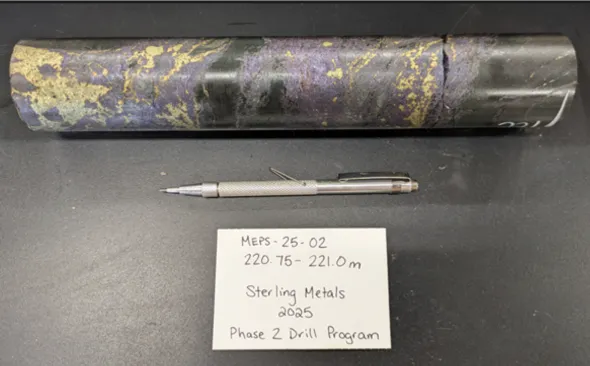
15:08 We've drilled 33 holes, 36 holes as of today, I believe, and we've released 12. I would say that the, so from about, so until about hole 28, 29, we're within the MEP zone, building out the continuity, and seeing how these these sills, this porphyry-related high-grade mineralization continues, and then the bulk tonnage around it. I think that that continuity of the system is really important. And when you look at other companies in this space, and I was going to throw a comp table on, but it wasn't quite ready yet. So, but you look at these things out there, you look at your surge coppers, you look at your corex coppers, you look at your Asisco Metals, you look at your North Isles, 0.3 to 0.35 large bulk tonnage. What we think we have here is some combination of all of this. You have a giant system, you have continuous copper from surface, establishing something in a very low strip ratio and a very long mine life. But then you have this richness of Copper, this Boronite, this replacement of rock with 40% Copper, seeing just gobs of Purple and gobs of Boronite.
16:12 And I think that there's a combination of targeting here that we're trying to do, Something that would be very rich within this 30km system. You already have a 7Mt breccia of 3% that's been mined. So there's this combo of targeting that we're doing and trying to move this forward at the same time, but can be assured that when you have a system like this associated with a macro like the mid continent rift, that's something very special is sitting here. And we're just trying to do our best to find it. Is it's the cake was baked a long time ago. And so it's something that we're ready to uncover. So drilling continues. And I think that I end on the very short coverage of ZTEM that we have here. Initially, you know, every copper company that I know, at least that I look at, has some sort of big red blob that's associated with some sort of target.
17:00 I think that what we've looked at here is just these large shear structures that we've associated with with the rock type that we have. The biggest thing that we are searching for, and if you go through our releases or if you go through our core library which is on our website, which I encourage everyone to do, we try and show all of the core. The biggest thing for us is the term permeability. So how do fluids get into the rock? Where are there large areas that fluids can be trapped or that they can find their way into? When you see all of these copper showings across the property, It can be great, it's great for sure, but then it can also be a challenge because where is it that you go to target? What we're targeting right now and kind of what we're seeing is that when you see these fingers, these large shears, seems very much to relate to larger zones of permeability that seem to be pushing things up from depth.
17:49 This is an 800 meter slice. So these large areas are possibly where these large porphyry areas have large porphyry rocks have kind of come in where you see all these fluids that come in and have pushed this up. So the association with this is something we're exploring as well, looking to expand these surveys. And as you can see, it's a very narrow coverage on our list. So, yeah, so that would be us. That's a sum up of it all. I think that I'll have the slide deck open so we can go through questions. I'm conscious of the fact that in previous presentations, I wasn't able to answer enough questions. And so I wanted to just do a quick run through. Please reach out any time, info at sterlingmetals.ca, follow us on LinkedIn and on X, but I'll switch over to questions now for everyone Awesome. Thanks, Matt, and I appreciate your timing usually when a CEO says 15-minute presentation That's code for 45. So appreciate your time.
18:42 You got through pretty pretty speedy So if you don't mind I got some questions to run through and then we'll go through some of the great questions that have come in through the chat. Just as a reminder for the dozen or so folks who came in late, there's a request meeting button at the bottom of your screen. You can press that to request a meeting with Matt at any point during today's event. So one thing I wanted to ask about, people just getting familiar with Sterling, I was wondering if you could walk us through, I love doing retrospectives, you walk us through how the MEPS discovery came about, what made the team initially confident that this area was really worth the drilling that you put into it? Yeah, so I'm gonna skip back to, Let me just skip back to a slide. I think it's pretty important. So, when we went through the drill database when we were part of this project, the company that previously had it had just drilled a large porphyry intercept, I think it was 315 metres, 0.15 copper.
19:33 And then this breccia, 50 metres at 1%. And, you know, it was extremely interesting, a lot of synergies between our team, the capital we had. And really, I try to stress enough that when you looked at the soils that we had and you look at the prospecting, we really started where just people left off. I mean this porphyry was discovered in the 60s and so when we drilled our holes initially, we used geophysics and soil sampling, now crop, and there's this wonderful 6 meter wide basically splattering of boronite on a rock face that really led us to the drill hole that we drilled in May of last year. It wasn't the discovery hole, it was the first drill hole, and that was I think 360 meters of 0.36. But what was in that drill hole that got us going is that there was this pre-mineral porphyry, this different fluid conduit that was ripe with boronite and chalcopyrite. And just for those listening, boronite is only significant because it carries 64% copper, and chalcopyrite carries 33% copper. And it's really a sign of an upgrading, a strength of a system that adds more copper and really is just a much more promising copper system and kind of a sign that you're in the heart of it all. And so when we drilled that, we were all on site and we named it the GFP, as it was a good Friday when we drilled it. And so we said it was a great Friday because of where we got to. But that was really what got us going. I think that was the clue, right? We raised 1000003 in March to drill these 4 holes in
21:04 and around this historic area. When we drilled that, we raised $2M just enough to prove our concept. And then in the 6th hole of our program, we drilled this discovery hole that was 260m of over a percent copper that had this 68 meter zone of a percent and 0.5 copper and a bunch of gold from this one high grade gold hit. But really, this replacement level boronite, this 9 meters of 6% that we had, and today's release we had, I think, 8 meters of 4.5 or 4% copper. And so it was really the tenor, there's no pyrite, it's just very, very high grade copper. And then this porphyry that had never been found before. And of course, when we went into the historical logs, you start to see that it had been found. People didn't know about it, they just didn't really know what it was. It's really just building on previous work and then kind of getting people on the ground and walking it.
21:58 Again, this thing didn't, it's not really hiding that well. Even the holes that we didn't hit that much. We still had 70m of this porphyry and 100m of 0.1m, for example, but it might have been outside of the corridor. I think that the strength of the copper And then the breadth of this broad system, this giant mineral system is really what got us going. Great. No, I appreciate the history lesson. I always find that interesting. One thing I wanted to know, and it's kind of a tricky question to answer, so I'll leave it to you. Well, this kind of hit right across 33 holes, and the system's still open in every direction. How is your team going to know when the timing is right to start working towards a Maiden Resource? And what results would tell you that moment has arrived? This is it, go for it. I think that a Maiden Resource is only good if you have economics attached to it.
22:47 And we are already thinking about it. In the world of needing to compare things, apples to apples, right? I mean, our business is all relative comps. So one of the things that is hard is that, you know, you get inundated with holes that are phenomenal and 1500 meters deep. And I think that what sets this project apart is again this giant rental system and something very special here, but where it is and the fact that everything comes right to surface and I mean, you could argue the strip will almost be nothing. If you were to create a mine pit for the first few years. I think that for us, we're starting to think that way, bring people on to think that way. And I think that when you get your costs set, we're trying to understand what our costs would be applied to this, then you would put a resource to paper.
23:34 I think we are very much still defining the extent of this resource. I think that our drilling, you know, you've got this kilometre here and then we're going to step out a kilometre and then you've got breccia outcrops and showings all the way over here. Like this is a very large area. And again, then you have your system in general. But I think that when you had something that economically speaking would be a viable mine, which is very much relevant for where you are, the time you're in, I mean, something, you know, if you had a very low level production at 0.35 equivalent, where 75% is copper and it's 50,000 tons a day, there's still, I think 10% of Canada's copper production. So I think that the relevance of where we are, the time we live in with copper and how it's moving forward is, we'll press this forward. And I think that once you tie some economics to it, on the cost side, you probably put a resource together in terms of how that would apply and very quickly move into a NAV.
24:29 Great, I appreciate that. That's a tough question. I appreciate you want to shoot for it. One question I had, beyond the 40% land expansion, are there specific historical targets, for example, near Palm Lake North or Minox 5253 that you're gonna prioritize in the 26, 27 program? And when is that transaction expected to actually close?
24:49 That transaction should close, I believe, on August 25th. For the most part right now, that area is an extension of the Greenstone Belt. So what you're dealing with here is these old Ontario rocks. Some are good for this and some are bad. And on that land package you have porphyry outcrop, you have indications of other breccias, and then you have copper showings all the way down to the far east. It also runs right into essentially the rail line. And I think that for us, you know, there's mag on that property. That's a very early days. We already have a 30 kilometer system. For me, I think that everything here is in play. So it will be part of our targeting process, but certainly not on my, not on the list drill targets that I'm associating with right now. Okay, great. I appreciate that. I want to add with Sterling's 297 kilometers squared and big package showing far denser copper occurrences than Viridian's larger neighboring land. Is Adeline a near-term priority alongside Sue Copper or is that a longer dated optionality play?
25:51 So Adeline is really how this all got going, right? So when we had sail pond out and we found, you know, I founded this out of COVID And Adeline is a result of Neil and I fly fishing in northern Labrador and meeting each other for the first time. And he brought this project to my attention. And that is a wonderful project. And Viridian, partnered with BHP, has gone and stayed 2,600 square kilometers all around it. Our first go-around of drilling was not great, to say the least. But again, we focused on 1 area of known. I think that that project is very prospective. It's not on my list at the moment. It's in good standing right now.
26:37 I think that as cost of capital drops, you would definitely start to look at doing
26:41 something up there again. Again, that's a very copper-rich area, wholly different. Oddly enough, though, coincidentally enough, the exact same age rocks or within about 50 million years, exact pretty much the same age rocks there as it is here, all related to the Q&A and proper showings. Great. One of the strategic questions we get in the middle of the summer, after the 520% share price gain and the TSX Venture 50 recognition, congratulations by the way, how is Sterling planning to keep investor attention through the traditionally quieter systematic drillout phase? Yeah, I think that I have a curse of the Venture 50. It seems that I can't hold onto it the second time, but, you know, I think that The excitement of our first, you know, that first hole was extremely exciting.
27:35 And I think that we're now starting to see the repetition and I think that as we step, we'll see it more.
27:44 I think that, 2 things, 1, there's not a lot of bid in the market right now. I think that, you know, it's a time where it can be frustrating. But I think that as you continue to put out this story, I think that eventually the continuity of this is what's going to really matter. And at some point, you know, you are able to put together like, oh, back to the envelope, this is what a resource is gonna be. Oh, back to the envelope, this is kind of what it would look like economically. And as we balance the act of new discovery, expanding this discovery, and kind of putting this together as a real story and something that's viable in this time, so you can advance quickly. I think that's what you do, right? And you keep putting news out and you keep kind of tying people in. I think that for me, it's not, is something really great here, right?
28:35 It's that, can we find it? And I think that we are, the expertise, the access, the cost of capital for us, and the technology we use, I think that that associates a story where you're able to access this. You're drilling all year. You're going to continue to have things that we talk about. And so the engagement here is really just bringing people along for the journey. And I hope people do that because something really special is here. We've already found something that's really good. And I think that the constant, you know, verifying that with people is, pun intended, is the idea here. So that's why we put these models on, the core library up. I want everyone to be able to see everything. This is a journey, right? And I think that we've put together enough that there should be a story here that people get really excited about.
29:25 And I think it's only going to get better as we push it ahead. Great. Well, I wanted to ask about, because obviously there's a lot of historic mines in the region, Tribag, Coppercore, etc. How do today's MEPS and Gimlet grades compare to those, what those historical mines actually ended up producing?
29:42 So the best grades that we have would compare, And there are reports in the 70s that I was reading that was saying that there's, so TriBag was 4 breccia pipes, completely vertically preserved, which is, which is very important because one of the things that everyone was worried about coming into this project is these are really old rocks. There's probably a lot of faulting and fracturing and moving and all this stuff. But you have a lot of preservation in the system, both horizontally where we are and vertically over there. And in Tribag, there are reports of mining up to 20% copper in certain zones. You can still walk around Tribank and kick boulders of chalcopyrite. There's 1 brettrapipe that has a bunch of tungsten in it. People use the UV light, the old workings.
30:29 And so The grade that was there, the best grades that they were mining are kind of the best grades that you're seeing where we are.
30:37 And so that does compare in terms of the quality of the copper that you're seeing. Tech drilled historic resource up there, looking, I think, for more in the 70s. It's 200 million tons of 0.15 or something, but guaranteed there is more up there to talk about. But yeah, when you see the strength of copper that you deal with here, you're seeing the same thing. You see the same thing over in Tribeck. Then actually, when you jump over to Copper Corp, I mean, Copper Corp was a sheeted vein mine, it was much smaller, but you can walk around and find massive, massive samples of calcicite just sticking out of the ground at Copper Corp, we're just there doing it. And then you see drill core that was there, that's related to porphyry dikes and floods of that, you know, just things that tie the whole system together and show you that the grade is very, that this intense grade that you see in our drill core is not like a one-off. It's not this one time hit where it's never been seen anywhere else. So it's a great question because if it's a full system of 30 kilometers and you see this, you know, where is that all coming? How does that all tie together? So, so very comparably in the best in the best areas that we're hitting so far. Yeah, awesome. One question from the chat that just kind of slides in, so I'll ask it as a corollary. Have you included, this is Toredo from the chat wants to know, have you included historical drill results into the current model to incorporate all that information?
31:56 So the historical drilling, yes, yes we have, We have all of it for sure. Our geos have most of those old logs from Phillips Lodge memorized. And some of the drilling that we set out to the east is based on old holes. The 50 meter 1% breccia hit over here, for example, was a hole that was drilled by Copper Road Resources in 2023 right before we got the project. So that's in there. A lot of the historic drilling, these gray holes that you see in the model here, which I don't have grades for, are historic hits into the jogger and porphyry. So one of the things that was done prior to us being here was in the 60s, there was a porphyry that was discovered, which is what brought Phelps Dodge up the drill 5 holes looking for all this moly.
32:46 And the Jogren porphyry had historic resource of 20 million tons of 0.15 copper and 0.05 moly, give or take. And so that's there. We haven't targeted Jogrin. The holes 11 and 12 that we released today were drilled to kind of get into the bottom of Jogrin. It's a very vertical structure, that porphyry unit.
33:09 And we were kind of curious to see what was going on underneath it. And then when we drilled down and kind of just found same old Jogrin, we weren't as excited. So that was really why we stopped those holes. So possibly if you're building a pit to push out there, it matters and you'd have to drill it at some point. There's really interesting GFP outcrop and copper on the north side of that. So we have all of the holes in there, but we have not incorporated them all that you were seeing today, because we have not drilled it. And it's not really relevant to the continuity of this ore body, or potential ore body, sorry, as for the story today. Yeah, appreciate that extra context. That's helpful. I have one question that's reflected in the chat and also a question that came in over email. Some version of do you need to raise this summer? The version I'll ask is, do you have enough currently in the Treasury to fully fund the 20,000 metre program and the QCX integration? Or should investors be expecting other financing this year?
34:01 Yeah, so we had $11M at the end of March. And we drilled 16 and 500 meters already. So the last 3,500 meters, we definitely have money for. We probably have, I think that, you know, Depending on where bills and invoices are, you're looking at $7M, $7,500 kind of thing. We've done 16,500m for about $4M, which is pretty great. We bought the ranch, put all this infrastructure together. Definitely spent a whole bunch of costs up front just because we plan to be here for a long time. So with 7 million in the bank, you know, cost of drilling is 200 to 250 Canadian meter. You burn 150 to 200 a month on team and everything like that. So when you put the math together at the rate that we're drilling right now,
34:45 Yeah, you definitely can fund the program. I think that there is always, you know, in a junior market, unfortunately in our business, you don't make any money until year 20 from here, I guess. But yeah, it's, you know, when we did our raise in November, so for context, we raised $14 million in November at $1.50. So the stock is, I think, $85 after this whole today. So we raised $14 million at $1.50. There was 0.5 warrant at $3. The group of shareholders that came in are wonderful and very experts in the space. And the support that we have with our current shareholders, the fund and other people is really great. I think that from the context of the investor, you're always worried about that, the hit down in terms of where the story was. But everyone, you know, I wrote a check and everyone was writing into that. The big thing with the story is that there are no founder shares really in this story. There's no free stock at a penny. And I don't really care when that happens with everyone else.
35:47 I think it's great. But in this sense, there's no... Everyone's written checks at higher levels. So we're all very conscious of dilution.
35:56 And so we're going to try and do for the... We're all shareholders. So for the best interest of everyone, We're going to work with it. So again, lots of news to come. We're going to try and have something out every 2 or 3 weeks. We've now caught up to the lab. So you've seen us start to put news out on a very regular basis. So hopefully assays cooperate and we have things like people get really excited about and then ideally you do something that is not, you know, fully long term marketed. It's a lot of strategic people who understand the significance of the asset. Yeah, it makes sense. I'm going to kind of combine 2 questions here. And that's, I know of all the catalysts you've mentioned coming up, all the asset results, C-TEM expansion, the Gimlet geophysics. Speaking personally, what are you most excited about? What do you see as most significant for the story of the ones coming up? Which one's standing out to you as 1 that's going to be impactful for the project?
36:44 So in terms of the area, like which one's most exciting in terms of, so personally, which 1AM I most excited about for the targets? Yeah, yeah, that's right. Is that true? Yeah, that'll work, yeah. Right, well, I think that, that's a pretty interesting question. That's not leading at all. I think that, yeah, you know what, Gimlet, we just got there. So it's hard for me to, I'm very excited about Gimlet because the concentration of copper there, There's a whole bunch of structure that runs into each other there.
37:19 The geophysics is very exciting there. But we just got there. And we don't have IP on that area. We're deciding to drill instead of do IP because we think that, you know, the 3,400 grand that you could spend doing IP, which I think is very relevant and will be a part of the story of Maps soon. It's better when you have drilling to go with it. It's actually backwards for, because of our accessibility and cost advantage, we're able to do that. So I'm very excited about Gimlet for the prospectivity of the scale that's there. I think that, you know, we, on the way down, we have a trail that runs, that runs, if you can, that we have a trail that runs from, that's maps, and then we built this trail that runs down to Gimlet and this is Gimlet in here. And literally along the trail while we were making a trail which is a 3 kilometer trail we uncovered I think 4 or 5 different breccias ripe with chalcopyrite, boronite, and over and over again just by literally making a road we found more copper. So I think that in the sense of those 2 things, I kind of see them exciting together. I'm not sure I'm more excited about 1 or the other. I think MEPS and all of this is related, right? So I'm very excited about the continuity in MEPS.
38:37 Very, very excited. And I'm very confident that that will come together. I think that from surface all the way down this broad horizon of copper, even in rocks that are not overly welcoming, these mafic, these gabbros, that just don't allow fluid flow to come in, you're still seeing 0.2, 0.3, like life of mine material that will be mined for forever. And so I think that that makes me extremely excited about maps because I think it's a really wonderful fundamental thing to build on. And then in the north, it's very early there. That's a completely different kind of geology up there. It's abandoned iron formation that allows amazing fluid flows of sulfides. So I think that that on my list of the 3 I would be less excited but most interested up there in terms of unknowns if that answers that question at all. No, absolutely. I was Just looking for insight on what you personally are excited about. I think we got a good sense of it. Last one for me and then we'll do rapid fire from the chat.
39:38 It's my personal opinion that jurisdiction matters more and more in the current climate, particularly for critical minerals projects. And I think most companies in tier 1 jurisdictions aren't getting the credit they deserve for it right now in the market. For folks watching, in your perspective, what does the project of this scale, in this location, actually mean for investors, but also strategically for Ontario? I think that it's all about doability. And we get, again, it matters a lot. Using that same example of 50,000 tons a day at 0.35, or 75% of that 0.35 is copper, that would be about half of Ontario's current copper production. So Ontario has this massive push into critical metals, and it's wonderful to see we're in this quad area, Wawasoo, Sudbury, and Timmins, you know, Northern Ontario, 100 years plus of mining history, so much talent, so many skill sets, so much accessibility, the highway, the rail line, a deep water port that could be a source of, no, that you could even, you could create a hub for copper from around the Great Lakes, right?
40:42 And so I think that it matters a lot. And being able to have this skill set around you. And then also as a junior, being in this jurisdiction where you can be politically supported, where you can deal with grants when you look around, when you can deal with the fact that you can access this property all year at a low cost. It just enables your, it reduces your dilution, it increases your efficiency, it allows you to do things that you would never drill if it was really hard to reach. And I know that because we were up in Labrador where you needed a helicopter. So you just can't drill everything that you want to and you can't even get to the parts of the project you want to. In this case, you walk through the woods. It's an active logging area. So you have wonderfully maintained logging roads that run through here.
41:28 Very supportive community. I think that it's, It is an under an understated part of our business where the final economics that are associated with the project, which are of course of paramount importance, that's what you value things on is future cashflow, right? So we forgot it, we forget sometimes about the cost and we think only about the revenue. And so I think that on the scale of doability for a junior, this project really stands out. Yeah, no, appreciate that very much. Now I am gonna do rapid fire from the chat. We'll get to a couple. Probably not gonna get to all these, but the ones that I don't, I will be sending through to the team so you can get back to them separately. One person just want to know and they asked it right off the bat so I want to make sure I get to it. They want to know what your current situation for Sterling is with community relations. So we're in Batchewana, we're in Batchewana Bay And I think that we spent our first 2 years in the backyard of Dan and Diane Shelleys in Batchewana.
42:28 Dan's dad worked at Tribank. We've been active in Batchewana. We're now 15 minutes north of the Sioux and Goulet River where we work very closely with all parts of the community, whether you're in Sioux, First Nations or locals in Goulet. It's been an amazing thing to be able to find electricians right away. It's that we've amazing, blessed with an amazing team. So I think that, I don't, I, the community relations for me, I think that we were, we were very welcomed as we came in here, try and be open and transparent and again, chat with everyone about what's going on. And yeah, so I think there's been really good. Awesome. 1 from H Flinker from the chat wants to know, does the MOLLE make you eligible for additional provincial or federal funding sources? I don't think about, I don't think additional.
43:15 So copper is the most critical of all critical metals in my opinion. I think that I love waking up in the morning and being able to find copper because every second of the day you need copper. And moly is one of the 31 on that maple leaf that the government shows. You also have scandium here and you have uranium and you have, there's tungsten in the project and cobalt and all these different things. And so I think MOLLE more than anything, I don't think it's an additional credit. I think that it makes it additionally important as a source of these things. And again, in a doable project within Ontario, I think it's more that it just highlights that there's, I wanted to highlight that in the press release because it's an additional critical metal that so it's extra good, but I don't think it adds extra funding. More just adds a nice byproduct credit and then just maybe a different push.
44:08 Appreciate that. Last question I'll go to is a geological one that was just dropped in the chat by Tordo. They said, people may get confused when using the term porphyry copper as it tends to reflect young mountain ranges, such as Chile, BC, Western US, et cetera. He wants to know, in your opinion, what's the geological model that applies to this copper mineralization in mid-continent rift-related rocks? Yeah, so I'm not a geologist. And I will say that I am doing geology through osmosis. I'll do my best here. So, this was this porphyry, one of the first things that anyone said to me when I said that this was a porphyry copper project in Ontario, they said that was impossible. Because they're in Archean rocks in Ontario, and so Archean, the greenstone belt here, where all the gold is usually associated around here.
44:56 I think that my eyes have been opened very much to the more senior geologists that I meet are very like, yeah, this totally could be a porphyry. And one of the things that gave us comfort right away is 2 of the best porphyry experts in the world, Dick Sillitoe and Jose Perea came up in 2019 and wrote a paper on the historic porphyry joggerin and dated the mineralization at this porphyry, as well as the tri-bank breccias. And then that was who dated the project and associated the porphyry and the breccias with the Mid-Continent Rift. So that has been repeated right now by a PhD at U of T. I think there's someone at lakehead who wrote the same thing. So this has been dated and I think back to the 80s it had been dated. So this has been dated now 6 or 7 times and expressed as a porphyry system. I think the big piece, so I'm not so worried about that part in terms of the establishing of that and generally people will come up to the project to agree with that. I think that there are multiple different kinds of things on this project. There are certain mineralizing styles that you would scream IOCG.
45:56 There's clear porphyry evidence and I'm sure that there's some VMS stuff on here. There are gold cobalt pits. The 6 metres of 3 grams gold 5 kilometres away, that's different. So I think that there's multiple things going on here, but the porphyry itself is relatively undisputed at this point. I think that it's going to be different because of where it is. The flat-lying sill nature of it is really what made it unique in terms of just changing the model. Instead of following your fingers down to your hand as kind of as a dike swarm would do, you need to follow it horizontally and see where that porphyry goes down. As we like to say, this didn't come from a meteor. So you have all this evidence to support porphyry, all of these papers, all of the stating, which is great. And I just think that it's not, you know, you're not dealing with a classic porphyry system within the Chilean porphyry belt where it's gonna act in this way. It will have its own fun pieces to it. And that's kind of part of the puzzle that we're unraveling and part of the fun.
46:52 Awesome. As a fellow geologist by osmosis, I certainly appreciate you taking a crack at that. I'll say, Matt, generally, we're about to turn a pumpkin here at the 45-minute mark. Thank you so much for running through the presentation, but also spending a good a half hour letting me and the audience grill you here Really appreciate it for anybody who thinks of the perfect question to ask or didn't get your question answered during today's event Please do still reach out and you can always use that request meeting button at the bottom of the screen or as he's put up reach out directly to Sterling Metals here. But Matt, thank you so much. This was fun. Thanks everybody for joining. Thanks so much, Romeo. That was great. That was great. Thanks so much, Romeo. That was great. Thanks so much, Romeo. That was great.