Transcript
Automated transcript · Written by software from the replay's audio. It can mishear names and figures; the replay is the record.
0:00 Say good morning, good afternoon or good evening, depending on which time zone you're in. I learned recently that British Columbia has its very own time zone now. So a particular welcome to those guys joining us. I still don't know what time it is there. I've got with me today Matt Wilson, CEO of Sterling Metals, to talk about critical Canadian copper. Very excited for today's conversation. Here's how it's gonna work for folks in the room. Matt's gonna run through a presentation that will include Verify, so you can take a good look at the project. Then I've got some questions for him. I know some have already been sent in over email from you guys, so really looking forward to going through those. But this is also an open forum so there'll be questions in the chat. Please feel free to ask at any point during today's event. We'll try to get to as many questions as we can. So if for whatever reason I don't get to your question today, we probably just ran out of time, but I'll make sure the team gets it so they can get back to you either phone or email afterwards. There's also a contact
0:49 or a request meeting button at the bottom of your screen, which you can use to get in touch with Sterling Metals afterwards. Please do press that and I'll try and get you in contact with the team soon after today's event. Last piece of boring housekeeping, This is being recorded and will be available for replay. It'll come in the exact same link, but you'll also be able to get it on Six's YouTube channel. So without further ado, I'll throw it over to Matt to go through presentation, get into the protein of today's event. Thanks a lot. Good to be here again. We're going to try something today just to basically bring everyone to where we are in Sterling today. So the idea is kind of project analogues, why we're so excited still. You know, despite the price of the stock, why, why we think that, you know, you're on the precipice of something very, very special and why we think this is Canada's new critical copper belt at this time. So I think of it very much. I woke up this morning and I thought of this quote of, you know, Buffett's famous quote of price is what you pay and value is what you get. And our venture market is so volatile these days, you have a, you know, you just don't know what's going to happen on any given day. And so on very low volume, we've cut very low, you know, almost cut in 0.5 in the last 5 weeks. So nothing has really changed.
2:03 And so the value of what we're preaching right here in terms of what we're offering is the same as what it was when the stock was $1.30. You're still getting this team, you're getting the right kind of timing. The location is something we really stress and we'll go through. And then very much the scale, grade and approach and we'll tie approach into team, but the scale and grade here is really what is building and something I'm excited to kind of take everyone to. So just on the team again, we've made some real changes, some changes of late. People who were always very close to the story, but now are much more in an official role. Albert Contardi and Richard Petriccio have come on the board. Both of them have worked, I've worked with them or around them for the last 20 years, basically. Rich out of Pine Tree, when we worked together, Rich helped found NextGen, still on the board of NextGen, chairman of Iso-Uranium.
2:50 And NextGen is a $10 billion Canadian critical metal company. And it's very important just in terms of the funding, the way that this went, the struggles NextGen went through for the first 8 years as they were building this up. And then of course, where they are today and how to push this forward, both strategically and practically. And then Albert coming on as chairman, very astute, has been around the venture market for a very long time, lots of different successes that he's had. So we're fortunate to add these people to an already strong team. You see the names on the bottom here, things that have been built again over time. Neil Bryan, of course, always something I always think about. I get to chat to a lot of his colleagues and to him, of course, where NGEX was actually the exact same market cap that we are. In September of 2009, they were $30 million, and they owned the entirety of the Vicuña district. $40 billion of value later, there's a lot more positivity surrounding those assets. But it was one of those things where they had Jose Maria, they had Filo, they had Lunawasi, they had all these different things in the company.
3:53 And the approach to kind of building it out is something that we are sort of trying to emulate here where start with your first asset, start with something you think that can be very good, and then continue to build and build. And the key here is that you have scale, grade, team, and approach. And I think that the biggest thing for us, and I'll highlight this at the beginning, and usually I put this at the end, I thought at the beginning, is that we put out, the way that we're approaching this, it's a puzzle, right? The way that we're approaching this problem is that you have this 30 kilometer copper project, this great team, these really great assays here, you've got this bulk scenario, but you need to drill a lot in porphyry, right? And so with our, we're going to call it the Sterling working IP, right? And I think that the low drill costs, the no seasonality, our use of core scanning, our expertise, the supportive community, and of course the working environment just north of Sault Ste. Marie where there's just a joy of the team to kind of do this. This cycle allows for rapid discovery. I think as we go through this, you'll see what we're talking about.
5:00 As we move forward through this next 12 months especially, this becomes more and more important. I think the geologic AI took us a little bit of time to get going. But I mean, you're getting 90 element XRF data very quickly. You're getting hyperspectral data. You're getting core photos that you can send around the world that look like You have a hand lens. And so when you put all these things together, it equates to being able to do things very quickly and efficiently and sustainably, less drill holes, less bothering of the ground. So the timing here is very important. We're gonna go into this, why this is so critical. We're talking about copper, data centers on the top of the midterm arguments everywhere you go, the electric grid. I mean, we've all heard about why copper is something that you just you just need. And I, you know, I, I stress that, you know, lots of people talking $10 copper, you're free when talking about we're not going to have enough copper to build anything.
5:48 And I think that that scenario plays itself out. But in Canada, I think that we're all buying into this scenario. Why sterling is so critical, why it matters so much is because each country needs their own copper. And if you don't have your own copper, then you're going to be in trouble when you're trying to keep up with the future of innovation. And these stats always amaze me. I think that I'm just blown away always in Canada is such a strong resource focus that, you know, our production of copper is 1% of the world's production. We export half of it. We consume twice as much as we actually produce in Canada. And you just have this scenario where a project that is doable, something that you can advance quickly and efficiently and throughout this cycle is something that should carry a premium for sure because it's something that you can kind of take advantage of right now. So we'll jump into the project again just for people who don't know.
6:42 We're now into the scale of it all. So the Sioux Copper Project, which is what we're talking about, again, in Canada, in Ontario, the Sioux Copper Project resides on the Mid-Continent Rift. And I won't talk about this for too long, but I will stress that for copper projects, you need a big crack in the earth. Right. And so the Duluth complex and Sioux are the exact same age. Our porphyry project is the same as the same copper pulse that created 4.5 billion tons of 0.6% copper over Duluth complex. It's a little bit younger than the Talon complex over there, though our porphyry discovery, we haven't dated yet, so it could be the exact same. And talon, of course, the 45 meters of 60% copper. Also, the 5 million tons of native copper in North Michigan. Also, eagle, which Neil O'Brien with Lundin Mining bought, which broke the concentrator because of too much copper at the beginning of production and all the sediment hoses that you see in North Michigan. And I talk about this because of where we are for the prospect of scale. So when we're talking about pore-free copper, which is 80% of the world's copper supply.
7:48 And you get these big pulses of mineralization that occur. This is one of those things that you're dealing with a scalable system and a big crack in the earth that has this. And one of the things that is new that we're going to talk about is just as we go through this presentation, I think it's really important, I want to put this up front, it's just copper ore bodies that are related to rifts. And so there's a large rift-related porphyry belt in upper Mongolia, the same rift actually that created Norilsk, coincidence, Norilsk and Tallinn, who knows, but I think that it's just really important to show 2 things. 1, there's a vertical extent to all of these ore bodies. The black that you see in your screen or the gray in the bottom indexing, those are the copper ore bodies within the porphyry system. And one of the things that struck me is that these very large porphyry systems, when you look at cross-sections of all of them, you get a lot of similarities on 2 things. 1, discontinuous ore bodies.
8:44 It's not one big blob like we all think about with porphyry is it's kind of these high grade zones and then the pluses that you see everywhere are these porphyry stocks this this kind of this kind of center piece to it all that on the shoulders or on the sides or or within hides these big copper ore bodies And so when we go through the presentation, just kind of keep these images in mind. Vertical extent, A, and discontinuous ore body, B. And then of course the size and the grade of what you're looking for. Back to where we are just really quickly in terms of Ontario, we're just, we're right north of Sault Ste. Marie.
9:20 Our ranch here, our ranch here is 15 minutes north of the Sault, you drive right up into the project. I put this in here just to jump in to show again just the scale. So when we were dealing with discontinuous ore bodies, when we're dealing with 40 million ton copper systems, just remember that our discovery is just the first piece of this puzzle. It's bookended by the Tribag copper mine, which produced just under 7 million tons of under 3% copper and the Copperport mine, which was about
9:45 1 million and a half tons of just over 1 percent copper. All related to the same system and all these yellow dots on your screen are copper showings. We also acquired this year this new ground over here which is the majority of the greenstone belt that is associated with the rift. And so what we're dealing with is a very large copper system. But we're here to talk about today for the most part is what we've discovered to date.
10:06 So it's about a 2 kilometer footprint now that we're dealing with. You see a lot of drill assays here and there. I thought that today what I would want to present is that these are all the results that you have seen, but when you look at it as a grade shell, this is something we've only recently done. So the purpose of today is like, where are you today, and where are you going to drill next, and what does that mean, right? So the grade shell here is a 0.15 copper equivalent cutoff, which I think probably is what your copper equivalent cutoff would be in terms of a resource. It's what we use to show it. Again, recall those images, right? You've got discontinuous ore bodies, you've got these ideas of a large body and then pieces of it being more high grade, right? This is a 2 kilometer footprint, 20 football fields by about 700 meters north-south, right? So what you've got here is a very large footprint of bulk tonnage mineralization, And then within it, if you look at all the assays, it kind of tells a story, but when you look at it in gray shell, it looks much better.
11:06 So again, the point, the 0.5 cut off, your purple on your screen there, is when we talk about the horizontal continuity within this system, you start to see it. And I stress that one of the things that is preventing the continuity of these pieces here is just drill density in terms of what we've done. But when you look at this as a grade shelf, you see this very large area of a 0.2 cutoff.
11:31 And then you see these higher grade zones within it that are highlighted in purple. Now again, the purple is 0.5% cut off. Remember our discovery hole, which was 260 meters of 1.05%
11:42 copper equivalent, and then that had that wonderful 70 meter zone of over 3, you have 10 meters of 5% within a hole that we've released this year, you got a lot of 20 of 1, 20 of 2, 20 of 3. So we've used this as 0.5 just to kind of demonstrate, but certainly not the grade that would be 0.5. Point here is it's more just the ore body itself in the shape, and recall that the ore bodies in those RIF-related porphyry examples shape around a soft of some sort. When you remove the equivalent and you do just copper,
12:12 this is what it looks like. And so that blob that you see there in the bottom right here, that goes away. And again, we're trying to remember about the examples that we were talking about.
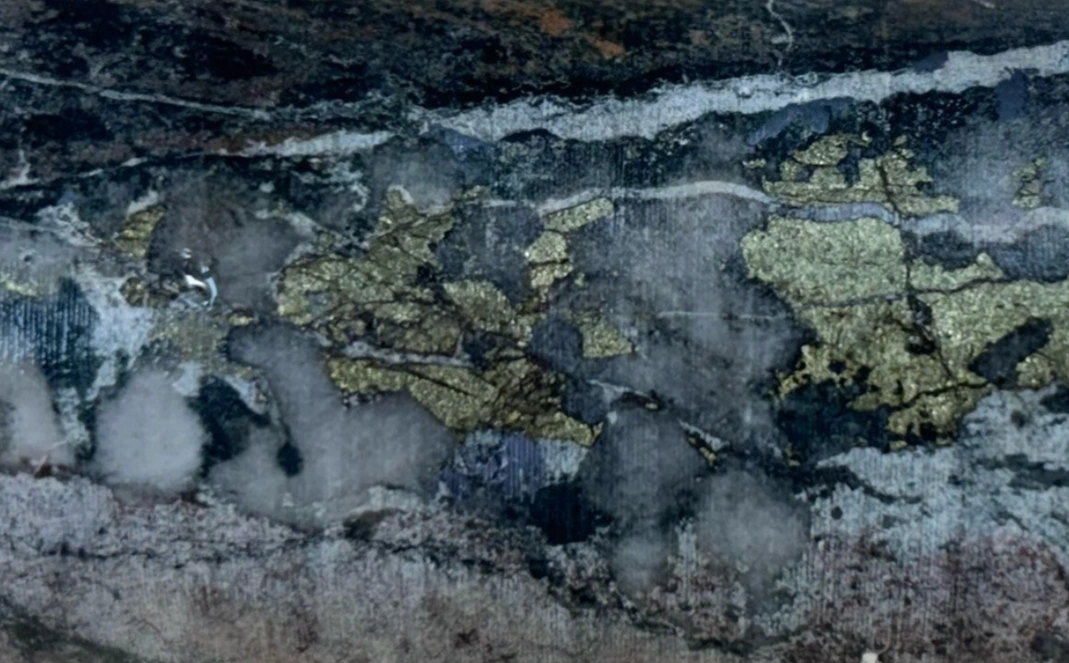
12:27 And so the thought process here is you've got this copper ore body that's forming on the shoulder of this porphyry stock. And the porphyry stock is highlighted by the moly that we've drilled. Moly is 5 times the value of copper. And so it's obviously a very, very economic mineral. The hole that we had drilled this porphyry stock, which was hole 16 this year, that came back with 160 meters of I think about 700 ppm moly, and so it was pretty much 0.3% copper equivalent. Most important part is it bottoms in 0.2% moly, which is like having 1% copper equivalent. And again, if copper forms on the shoulders of something that is very large as a stock, the thought process for us is that you've got copper that can form all around it, and you're sort of seeing that form in terms of the copper that we're seeing here.
13:13 So what do we do next? Where are we going with this next? Why is the grade shell so important? Well, it highlights a very good start, right? It highlights probably a couple hundred million tons that you've got here on resource forward looking statement. And you've got a good continuity of grade that comes to surface, right? So the reason that matters is you've got these high grade zones that can create a payback period that's much faster than if you were mining a homogeneous, for example, 0.3. You've got zones that can go from 0.5 to 1 to 2 and above that you can kind of get your payback going. Your IRR generally would double in a lot of the scenarios where you have a good payback zone. What I wanted to highlight about where we're going next is when you put our drill traces into this copper shell. This is into the copper equivalent shell 0.3. Recall this is the poor free stop. You'll notice, interestingly, that in this area there are no drill traces.
14:06 You'll notice in this area there are no drill traces. You'll notice behind here, you'll notice that this is just getting going in terms of finding the vertical extent of this project. And when you turn this, oh not working as turn, and when you turn it it looks like the same thing. And so basically what we're missing is this gap that finds its way around that that moly ore body which is perceived to be the stock. One other thing that you'll notice here is some sort of fluid pathway,
14:36 these vertical fluid pathways that are kind of forming, that are also very important. So one of the things that we had talked about at the beginning is 1, ore bodies form around the stock, 2 is there's some sort of vertical extent for these systems, and one of the things that we had tried to find with some of the deeper holes earlier this year was the vertical extent, and you'll see that that was kind of over on this side, right?
14:57 But now, what we have discovered with our drilling is that it was actually more on the east side of the middle of the project. And so what we are doing right now is moving to drill that. So you've got this bulk style mineralization occurring at surface, you've got all of these open areas, open at depth and at extent, and when you kind of go back into plan, what we just released over here where it was 100 meters of 0.4, you have these boronite and massive magnetite veins, and you've created this 2 kilometer footprint. It's easy to stress that this is sort of just getting started, and as you move back into the system, recall again that you're on a 40 million ton crack. In 18 months, we put together what we think is a start of what looks like it's going to be a, what looks like it could be a critical copper project in mind. And because of the way that we explore this project, we think that over the next 3 to 6 months you can really advance this project quickly through the zones that we have now sort of put together and that's sort of the focus of the the company as of right now.
15:56 In the meantime what we've also done is we've drilled across this 8 kilometer corridor. We talked about the Gimlet prospect, we talked about there's a banded iron formation up here, we've done a lot of prospecting across here so this map will fill in. There will be lots of news to come on all those things. We use drilling a lot, like some people use geophysics, so when you're drilling at $130 at the drill bit and you have core scanning, it's actually a lot easier to go prospect drill and do wildcat drilling than it is to, for example, run IP lines. So an IP survey would cost you 500 grand. You can drill 100 grand in 6 holes and then basically just say, okay, now I kind of know what's in the ground. So our drilling and prospecting kind of took us through these places, lots of exciting things, but we use that basically you stick a few holes into an area and get a much better sense of things than you would from geophysics. So at this point that's That is where the company is at.
16:50 Lots of news to come. We've drilled 61 holes this year. I think we probably put out 30. We should have a lot more coming in the near term. And yeah, I'll leave this open for questions and go from there. Awesome, Matt. And I appreciate you sticking to 50 minutes because you do have a lot of questions in the chat and over email. So let's try and get to as many as possible. I got some technical ones if you don't mind, just before we get started. But then I promise I'll get to all the Great questions that are in the chat and came over email.
17:17 1 I wanted right off the bat, you colored the Eastern pad 850 meters from the nearest hole which is a, it's a pretty long way to go on a first pass. So what did hole 20 tell you that 18 months of MEPS drilling couldn't?
17:33 Yeah, so what that told us is again back into, I can't see you in this view, but I'll take it back to the view. So what that told us is basically that the foot, again, this continuous porphyry footprint is very large, right? I think that that could be a new fluid zone and structure over there. So you're not sure yet about continuity of a 2 kilometer pit, right? That is way too early to tell. But what you can say is that you have semi-massive, you've set big fluids. How about that? You have very strong fluids. You get these 3 or 4 centimeter molybdenum veins that are basically chock full of molybdenum. You get boronite and topopyrite within the same kind of setting that you would have over at the center of the deposit. And so The biggest thing for this is that because it's so early and we're just getting going, this isn't something that has had 4 cycles of copper exploration that's gone with it.
18:23 So to hit something like that early on, to see those kinds of rocks, I mean, that would be something you would chase on its own without the rest of the project and probably be pretty excited. So I think that what that rule tells us is that this system, where we are, is very important. So back into this corridor that we had here that we've talked about, it kind of tells you that you're in the right place where the MEPS discovery is. Great, I appreciate that. I know the release says the eastern rocks look different from maps, different alteration and not much porphyry in the core so far. So is the east the edge of the map system or is that kind of a second center at this point? What's your thinking there? You know, right now, I'm going to say that that's too early to tell exactly what it is. But right now, I would say that from the drilling we have done and looking at it, there's the Mali makes it very similar. Right. So again, intrusive center can be very big.
19:17 I mean, you know, the Highland Valley is 8km. So I think that I would say that in this scenario, you have a lot of similarities, but there's a different structure running through it. So it's possible that you have a different kind of fluid uprising here. That is a to be determined piece. Great, no, appreciate it. Last couple of really technical questions and we'll run it out a bit. I know the best copper in hole 20 sits in that massive magnetite with chalcopyrite. And you called that a distinctive feature for targeting. For the non-geologists in the audience, why does magnetite help you find the next high-grade shoot? So far, the best, one of the associations we've had with high grades is magnetite. You have it in hole 20 from last year, actually. Like you get these areas of, we call them magnetite veins.
20:08 So you get in hole 26 this year. So let me just take you into a section.
20:16 So in hole 26, in here, in here, you have, not there, up in the top there like this, what you have is these almost replacement magnetite veins that kind of come through the system. And those magnetite veins are the same thing you're seeing over here. And what happens is with the magnetite comes boronite and chalcopyrite and a little bit of gold. Again, it's a distinctive unit that doesn't seem to be associated with the porphyry system that we first made the discovery on. I think that's the biggest thing is that the the strength of the fluids, the heat that comes with it, you get gold, you get again, you get boronite on these things, but it's not in that stratigraphy that you see in here, right? You don't see, it's not in this continuity that plays out there. And so it's its own feature that's happening. And so I think that from a targeting perspective, it's a separate piece. And so, you know, magnetite should be very magnetic. It should be something that you can explore. But again, one of those, you know, we've had some people up and they're like, look, you just saw those veins. You would think that this might be an IMCG system.
21:28 And so, you know, one of the things about this system that's playing itself out right now is it feels like there are a lot of things all happening at once. There is a VMS architecture that's creating the stratigraphy, there is the porphyry, of course, the multi-phases of porphyry that we've discovered, verified, and found. And then, you know, you're in a greenstone belt in Ontario, So you have orogenic gold capacity and these sort of things. And then you have this, you know, IOCGs in the Rift or in the Mid-Continent Rift are a thing, there are IOCGs in Missouri and people have written PhD theses on them. So I think that in general, in projects that can become very special, Usually there's a lot of things happening at once. And so for this, I think one of the reasons why we get so excited about the potential here, you know, much beyond what we've put together thus far is, is that you have all of these things all happening in 1 spot, right? And so clearly there was some crack and some reaction that happened that created this all.
22:23 And Neil's theory is really, because that you're at the juncture here between the mid continent rift, right? Which is this copper event 1.1 billion years ago. And then this very, very large crack in the earth called the Kapskasing structure, which runs from exactly basically where we are to the James Bay, is that you kind of have this environment, which is the perfect spot for porphyry formation, but also this VMS architecture, but also for agenda gold and all these things that have
22:45 kind of come together. So that's kind of one of the reasons why we're highlighting it's like it's a little bit different over there, not associated with it, because you could just have things over printing each other. Great. I appreciate that. This one, obviously getting into forward looking statements as a part of this presentation are the whole 19 bottoms and rising molly with that felsic porphyry dike, which is the same signal you saw at the bottom of hole 16 when you found that molly copper stock in September. So does that mean, to the best of your knowledge right now, the stock runs under the hole 2km? Yeah. So that is the prevailing theory at the moment. It's a really good question. Much like those porphyries at the beginning, which I can take us back to, but you've got this molly soil footprint that kind of runs like this if you were at surface.
23:32 And you've got stock at the bottom here, and then you've got molly over here. And so you've got this connecting 1 kilometer piece right now. When we drill deeper over on the western side of the project, you have this 50 meters of 1% here. You get these magnetized veins over in this piece. But you don't get the same porphyry stock that we found so far at depth. That doesn't mean it's not there. But right now you're seeing it over this 1 kilometer stretch. And then again, back to those ore bodies where copper forms on the shoulders. There's a total possibilities. We kind of push this through that you've got this moly stock that runs for this kilometer or more. We have Porphyry and Mollie and outcrop another kilometer to the northeast from hole 20. So you've got this very large kind of Mollie footprint, which is very fitting in a porphyry setting because porphyries carry a lot of molybdenum in them. And so that is again indicative of kind of your core. So one of the things we did this year is drill a bunch around and try and figure out, are we in the core? Right. That's one of the pieces that is very important. Right. So when you do commit the next 30,000 meters of drilling, are you in the right spot?
24:32 And so it seems very much like we are in the right spot because hole 19 is actually really important, even though the grade wasn't really that great. The incredible filling of these veins with molybdenum, right? Like you get just massive amounts of molly and very in these concentrated spots. And then also little dots of boron and cobalt that kind of relate. So the idea is that it all kind of connects over here. You could have different uprisings and things like that. But yeah, that's that's the theory. Cool. I appreciate. I think that's really neat. One thing I wanted to ask, and
25:04 I'm just zooming out a bit now, first of all, I was surprised nobody in the chat asked cost per meter so I'll just ask it myself. But you're 53 holes, 22,000 meters this year, pasture minimum, you're not stopping, 20 minutes off the TransCanada, year-round drilling. But what does a meter cost you compared to particularly, let's say a fly-in for free camp? Yeah, so I think that one of the, again, back to that setting of low drill costs.
25:28 So you're probably, you know, I hesitate to say exactly what each of the pieces are, but all in together when you include core scanning, when you include assays, if you if you're a core scanning doing assays at the lab and drilling, so forget team for a second. You're probably at about 220, I would say a meter at $10 for orange and core, which is coming. So maybe 230 Canadian a meter. I never understand how you throw all in costs together because you could be prospecting or doing geophysics. But like at the drill rig, that's probably what it is. And again, that's why we've used drilling to kind of step across this 8 kilometer corridor. Really, I mean, you know, you can go around the world and you go up in the Andes and do 1500 US a meter. You can go up into the triangle and 4 months here. You know, like I'm not.
26:13 It's one of those things that just It just really is a fortunate thing here, because you can drill all year round for 220 a meter. And then we have this camp, this 6 and 1 1-1 1-1-1 acre ranch that we've purchased, that is just also an extremely important part of this project, because
26:32 you eat, sleep, and rest there, right? We're right off the Trans-Canada Highway. There are 9 people that can sleep there. You roll into bed in the morning with a coffee and you see the night's core from the morning before. It goes into the Geologic AI core scanner. You get your results in 48 hours. And so for all of, so you're, you're doing things in real time to allow yourself for discovery to happen faster
26:51 at a very reasonable rate of expiration. Thank you. I got a double barrel question here for you. So bear with me. But the Eastern Holes average around 0.3%, but the MEPS core runs 1 to 3%. So how should an investor sitting in the room today hold a bulk tonnage number and a high grade number in their head at the same time on 1 project? And the second half of the question is, what do you think the market's getting wrong right now about the story? So all right, that is a double-blur question. So I think that it's why I positioned this great shell the way that I did. So there is obviously the gold in the discovery hole was 200 grams over 0.6 meters, which we haven't replicated. We've hit 20 grams, 15 grams, you know, there's definitely a big gold component here and put it together yet. And you see these areas again, like, if we go across, you know, even the last few holes, you get 20 meters of 2.5, 20 meters, 2.5, 20 meters of 2, you get like 100 meters 0.8, you get this, this area, these areas of higher grade, we just put 0.5 for the shell.
27:54 And again, I think that what is important for the investor, I think, and not necessarily what people are getting wrong, but it all ties in is that, you know, the grade variability here is the key to the story. The fact that you can operate this with limited infrastructure needed, the fact that you could build a mine here with limited infrastructure needed, the skilled workforce of Sue, the ability of Sue to contribute and be there for this project from people and support. And I think that when you have grade that you can mine early on in your mine life that is like this, that makes it very different than a 0.3 homogeneous result. We put out the bulk tonnage because of course, that's what you're going to mine for 30 years, right? That's the idea.
28:41 And I think that the other piece that is part of that question is that it's not like this is done. That is why I tried to show the drill traces here. Because when you look at the copper shell and you see all of these gaps, it seems like we've been drilling for a really long time. Trust me. But, you know, in 18 months, you know, we had to focus on different things, right? We focus on understanding this high-grade zone. We've just realized the stratigraphy as we've drilled east to west, right? I think the core of this project only probably has about 15,000 meters on it, right? And so this is such a glaring gap. And there's no reason that grades shouldn't connect. And there's no reason that there shouldn't be a vertical extent. And there's no reason there should be no source of copper fluids. This isn't a meteor that landed here. Right? So I think that the grades are indicative of what can be Both from a mining perspective, but also from what we are looking for as we continue to drill and the scale is more the bulk piece, right? So even if you look at traditional porphyry, you look at galore creek, there's like pods of these high grades within this giant bulk tonnage shell of 0.2 really, right? And so again, if you drop, if we run back into the porphyry analog, right? Again you've got these like pods that form the cell look this is a horizontal horizontal layer and then you get these bigger things as you move down at depth right. And I think that That is where we are going now, right? It's like, all right, we figured out the center. We got a really good starting point.
30:05 You've got the grade that shows you how strong the system is. I mean, you don't see a lot of for free projects with 40% copper replacing all with boronite like that we have and cobalite and the ability to upgrade the system like they have. And then you have the scale, right? So this didn't come from nowhere. So you've got grade and scale. And now we're really honing in on that one area that we were just showing and just, you know, it's a kilometer by kilometer. So it's not exactly a small thing. But again, you're drilling a 5 centimeter drill hole into a very large area. So
30:36 to have all of that already exposed itself at surface in 18 months, and I guess we put out drill results up to 15 months of drilling. So not a lot of time that we put into it. And I think that it's only getting better from here. Awesome, I appreciate that, Matt. I'm now gonna get into audience questions because I know there's a whole bunch. We'll try to rattle through as many as we can. A couple that came in over email. One person wanted to know what Dr. Neil O'Brien, who was quoted in previous press releases, thinks about the current draw results.
31:07 Yeah, so I think that most of what I'm trying, one of the reasons I highlight team first is that I'm definitely not that smart. So I've been doing this 20 years and seen a lot of different projects, but Neil has successfully built out and been part of some pretty big porphyry banks in his life. And even before he was with Lundin Mining, he was the GM of Cominco running Mexico, where there's 4.5 billion ton porphyries with 0.5% and 20% breccias. And one of the first things that actually we looked at when we did our due diligence here is he actually compared it a little bit to Cananea, which is 4.5 billion tons of 0.5 in North Mexico. I think that what I'm saying here is reflective of what Neil is saying. And the whole point is that the grades here are, it's a search, right, in terms of trying to find your fluid source.
31:54 Obviously, we would love to have hit 70 meters of massive boronite across the entirety of the project. I think that the point, though, is that you have to work your way out and then you're working your way up and down.
32:06 And so, you know, the same thing I'm saying is exactly what Neil is saying. It's like, well, this is super promising and you're pushing this forward. And I think that Neil's big point also, And then, you know, I've been able to sit down with a lot of guys who own the stock and have built up porphyries and really fun copper districts. And a lot of them are like, yeah, build this out. You know, you've got something special here. Keep drilling and figure it out. And then also continue to drill the rest of your project because, you know,
32:33 there's a lot here that is exciting. And so it's one of these things that this, we believe this is a camp scale project. That's Neil's big theory as well. And that will be something in the next 12 months, we start to drill out a little bit too. But yeah, it's kind of what I'm saying. It's very, we're pretty much on the same page in terms of what I'm saying and what Neil's saying. Yeah, great, appreciate that. There's a number of questions. This is in the chat and on email. People asking, what's your estimated cash runway today?
32:59 And the sometimes spoken question that follows it is, are you going to have to raise your current share price? So they're great questions because as one of the largest shareholders, I always am thinking about that.
33:14 Probably have about 3.5, $4 million right now. I think that it is always the necessity of the CEO to raise money, no question about it, because we don't make any money in our business. We don't make money for 10 to 20 years, right? So to think that you're not going to raise money as a junior is not a good thing. How you raise money I think is the most important part. So are you raising strategically? Which strategically can be with the investor base you have, is strategically can be with an external, like is that mid to your major. Raising is not all, it's not all made equal the way that you raise. And so there are a lot of different things that are out there. Obviously the stock at 60 is a lot different than when the stock's at 150, it kind of just changes your approach.
34:06 So I won't be the person that's gonna take the company down to 0, no question about that. I think that that's not a very good idea, but ideally what you're doing is trying to position, whatever it is that we do is positioning it so that it has the largest way, the largest runway as you continue to build out the discovery, right? So whatever I think is the best, I being us, the board, the team, and everything like that, as well as current shareholders, Just kind of tying together, like, all right, what is it that we do to make sure that this goes forward fastest? And then, of course, keeps the most upside locked in, because we've worked very hard to keep the share structure with 50, 52 million shares, right? So it's kind of a roundabout way of saying that, Yes, of course, you have to raise money. No, I haven't decided exactly how to do it. But there are a lot of options. But that I am extremely vested and aligned with the shareholders as are the entirety of the board. And you saw Rich when he came on is about 6-7% of the company.
35:00 So A lot of people who own a lot of stock will bought stock way higher than this. Right. So I think that's also the big point. It's not like a story that has a bunch of 1 cent founders shares. We had rolled this back. So I think my cost on this is like a 7 dollars or 6 dollars. So whether that's positive or negative when you associate the company with me. But yeah, so it's one of those things that we're very aware of where we are in the market and we've all bought stock way higher. And so yeah, that's the so we're thinking about it. I appreciate that. I think that answered a lot of questions in chat. You guys let me know if there's some individual ones that you still want to tackle. I'll try and keep on the same topic. Trevor wanted to know if you have any government sources possible for funding. So the government does a 250 grand, give or take, Ontario Junior Exploration Grant. We thank them for that. So they provide this generally, there's about 250,000 dollars that goes in. There are a lot of fun innovation things that people are looking at right now. I really urge the government to be fun. There are a lot of critical metals in this project. There's rhenium, scandium, and tungsten, and cobalt, and all these other things that you're not going to spend the time trying to figure out how to get them out of the rock.
36:09 I think that the government is thinking very hard, especially in Ontario. You know that there is this critical metal push in Ontario. There's a road being built to the brink of fire for critical metals, right? And so that's a lot of money and a lot of time and a lot of effort. This is particularly easier when you compare it to where it is and the skilled workforce that's nearby. So there are a lot of different things that you can pull out of this industry. And so you get the grant there. And I think that the government is, you know, we just joined the Ontario Mining Association. I think we're there on Monday. I think it was us, Cadillac and Generation Mining.
36:42 And so there's a lot of conversation about how best to, how best the government can support. I don't worry about it as much from a financial perspective. It's more just how do you make this thing move faster, move faster so that we can get the copper out of the ground and into, you know, into Canada sooner than later. That's great, Dan. I certainly, for my personal belief, think faster is the route that Ontario is taking. So glad to see it. One person wanted to know why you think Sterling stocks specifically sort of disconnected from the copper price.
37:13 Yeah, so I mean, mining companies have lost $712 billion since the start of the Iran war. So I don't think it's just us that's disconnected from the copper price. But I think that, so I think sterling has exceptionally dropped, I would probably say. I think that If you thought of it as a quarterly, I don't think that any of the TSXV is down 22% this year. So I think that the correlation between copper price and copper juniors is not really, I don't think that that is necessarily something that links itself to each other. And you know, gold is 4000 and most gold companies haven't rebounded even though gold's up $200. I think that there's a gap, right? So I think that the long term fundamentals for copper, I'll answer it this way. I think the long-term fundamentals for copper are pretty amazing.
38:03 And I think that there is going to be a competitive bid environment where copper projects that can be pushed forward in this cycle right now, when everyone needs copper,
38:18 are going to be things that mid-majors and majors alike are going to really care about. You see a lot of investments coming from mid-tiers and from majors into these copper companies that people are moving downstream because of the copper price. You see people who are the companies that are making lots of money are able to have this cash flow. And they're like, yeah, this is great because we don't have a pipeline. It's a 15 years of under supply. So I think I was reading that, you know, there's like it's just I think there was since 1990, there was like 200 copper discoveries and only 80 of them are mines.
38:49 So I think that there's this drastic under supply in a pipeline for copper. I think that at least in my reflection on my conversations with people, that's a big piece. So to your point on the disconnect, the disconnect is certainly not from the way that that copper producers are looking at the world. It's more just from the way that this liquid retail market is treating us. And so, you know, when we trade 20,000 shares and move from. 80 cents to 60 cents. So that's like 15 grand of volume. Right. So, you know, it's hard to sort of, it's hard to really, you know, it drives me nuts for sure, but it's hard to properly make that correlative call because it's just such a low volume. It's not like all of our shareholders are selling. It's just like 2 people or whatever. Sure. Decided they were pissed off 1 day. And so, and so, you know, we're aware of that.
39:38 And it's one of those things that ideally, you know, the market supports it and then you reprice it. But it's kind of the reality of the venture market is just that there are disconnects. And it's why, you know, the inefficiency of the venture market, so to speak, as I like to think about it is why, you know, as a chief investment officer of Earth Labs that I have a job, right, is that you pick up these things that are pretty attractive, but values because it's just this liquid market. Sure. I appreciate the extra context there. One person asked, any red flags with local communities at Sue? No, I don't think so. I think that there are generally, there will always be a balance between, We don't know how this project is going to turn out in terms of what the mining plan is or how the mine looks or any of those things. It's way too early for that.
40:25 I think that you have multiple different rights holders and stakeholders. 3 First Nations communities, the community of Sioux, you have private landowners on the project. And so conversations with everyone are always ongoing, they were ongoing before we even stepped foot on the project. And generally speaking, everything has been very supportive. I mean, we spent 2 years in the backyard of the guy who basically helped us discover this thing, brought us to the first outcrop. And so we were in Batchwana community in Batchwana Bay. And for the most part, it's been a very supportive place. Awesome. Thank you. I'm going to combine a couple of questions here. Somebody wants to know, are you preparing an MRE by the end of 2026? I'll just generally let you lay out the next set of catalysts for the company here.
41:11 Yeah. So as we go, it's kind of like the first step. And when your first step, and when you're doing things like this is you create a grade shell, right? So, and I'll bring it back to here. This is again, your copper equivalent grade shell.
41:25 There's our focus. There's 2 focuses right now, I think for the next 6 months specifically. And I'm just going to use 6 months because everything kind of changed pretty quickly. And at the pace we drill, usually you get a lot done in 6 months. But the pace, the focus right now is you've got 2 things that are kind of building here. You've got this bulk tonnage scenario where I think if you have, this is again, this is not a qualified opinion whatsoever, this back to the envelope. And I think that though, if you have 350 to 400 million tons here, given the grade variability and given the load strip and where you are in the world, et cetera, I think that you probably have something that works.
42:04 And so I don't think that we're there yet. I think so part of what we're trying to do is expand this and get to a point where you're like, okay, the MRE makes sense. Because the only time I would do an MRE is if we are confident that that MRE would make its way into a PEA very quickly that would show promising economics. And so those are all things that we are dealing with right now. So the drill program right now
42:27 is very focused on pushing this out. And at the same time, it's very focused on finding those fluid pathways for that vertical extent because for us, the 0.3 is not the end game here, right? Like tech was mining 2%, 2.5% copper. We've already shown that the grades here can be very special. So at the same time, where is the copper coming from? Right? And I think that, you know, you have to give yourself the, what is it, the chance for serendipity, right? So you got to drill some deeper holes, figure out where it's going. And like I said, like all those gaps that are in that are that are in the traces that you saw. And we'll just go back to that. I like this slide. Just kind of shows that where that Mollie stock is, is this you just don't have a lot of drilling.
43:13 Right. So so we will be doing 2 things at once, basically, which fortunately, it's all together, in an effort to figure out where those copper fluids are coming from and have, let's just say, our Talon vault zone moment, but with a poor prosthetic.
43:25 And again, because you've got this, the copper pulse from Duluth created this 4.6 billion tons of 0.6, and yes, nickel, yes, magnetic, yes, different things, but same year, 1.09, 1 billion years ago, give or take 2 million years. So same time. So, you know, the scale is there and that is a good grade, right? So, you know, grade is here and we've already proven that grade is here. So, this is not something that I would encourage everyone at least listening, at least the way that we're looking at it, we're not treating this like, oh, yeah, we're going to really be pushing 0.3 everywhere. I think that that would be great because of the grades, but I think that this can get a lot better. And one of the things that I'm hoping for catalysts to continue to show great develops continue to show continuity of these zones near surface. But also, again, that vertical depth, that vertical continuity of the zone or or again, when we go back to those ore body shapes like there can just be a gap here. And then all of a sudden, as you move down here, then that's where your giant high-grade copper ore body is. So you need to drill to find these things. And again, that's why we go back to process, right? We go back to that wheel, right? And it's not, you know, again, it's a 5 centimeter hole.
44:27 Neil and I were laughing because if you drill 200 meter holes, 25 meters apart, you actually only know about 0.0001% of the rock, right? So there's a lot of rock that's in like, that's a very tight space hole. So there's a lot of drilling to happen right now in the next 6 months. Again, that cost advantage, the fact that we don't have to stop is such a big thing here, right? You don't have to wait until June or July and I think that with real-time core scanning, real-time data feedback loops, and of course the expertise of our team, I think that we should give it a pretty good shot in the next 6 to 12 months. Awesome, thank you. Now I know there's some questions we're not going to get through today. I got time for about 2 more. So I'll go with a couple. One person wanted to know, are you thinking this at this stage, this is an underground mine or open pit?
45:11 So again, too early to say that, right? So I think that what you're seeing here on surface is the formation, you know, like you could imagine a pit. I think that if you all of a sudden found that this high-grade fluid zone went down here and you had hundreds of millions of tons of 1%, then you probably would talk about it differently. I think that we're not really thinking of it, You're thinking scenarios, right? So I think that the underground mine at Tribag was a breccia that went underground. They found vertical continuity at 600m.
45:41 And again, we're mining over 2%. So I think that it is too early to talk about what the mine is. It certainly is a good continuity of copper equivalent and copper at surface though. And something that we are obviously going through the motions on trying to figure that out. Great, appreciate it. And again, I know there's some questions we didn't get to, but I'll pass the team. One thing I wanted to close on today is what are you most excited about for the end of the year, Matt? I'm excited about where we're about to go drill, for sure. We've stepped around a little bit, we've chased up some zones which are really fun and interesting and exciting. I'm excited to, we're literally moving the rig as we speak to kind of test areas that are more in line with this central, what could be an ore body. I don't know why you can't call it that, but whatever.
46:32 But the learning we've had over this year is pretty staggering, right? Like we've drilled a lot and learned a lot. I think that this MOLLE stock piece, the fact that there's really no drilling anywhere here, here, and that this should all connect. I'm excited to kind of show that, to see that, and then very, very excited to start to see if, you know, one thing at a time, if there's vertical continuity of the grade. Because again, like when you see the grades that are in this project, there's reasons for it, the upgrading, and there's clearly very, very strong copper fluids that are making this happen. There's definitely multiple systems all in the same place. It has all the makings of a very special system. And I think that's why we're in a very short period of time, you're seeing this continuous zone.
47:23 And so, yeah, so I'm just every drill hole is very exciting and I'm very excited for where we are going right now to kind of build this model out around the stock around the core discovery. Awesome. Well, let's wrap it up there, Matt. Thank you so much. I know there were tons of you in the room today. Really, really appreciate everybody's questions. I know I didn't get to all of them. There were quite a few, but I will send them through to the Sterling team, the ones that we didn't get to. I'll make sure that they have an opportunity to get back to you. Matt, thanks so much for letting us all grill you and for going through the presentation and I hope you have a great rest of your day. Thanks Romeo, I appreciate everyone's time and reach out, invoitsterlingmetals.ca, follow us, we put up some fun videos lately on geologic AI with more to come. So please reach out anytime if there's further questions. We're always quick to try to be quick to respond. Awesome, thanks everybody. Have a great day. Thanks all.