Yashpal Sharma
chairman, managing director, and CEO at Skyways Air Services
Replay available
Skyways Air Services (NSE:SKYWAYS) Q2 2027 earnings call, held 2026-11-17. Watch the replay and read the transcript on 6ix.
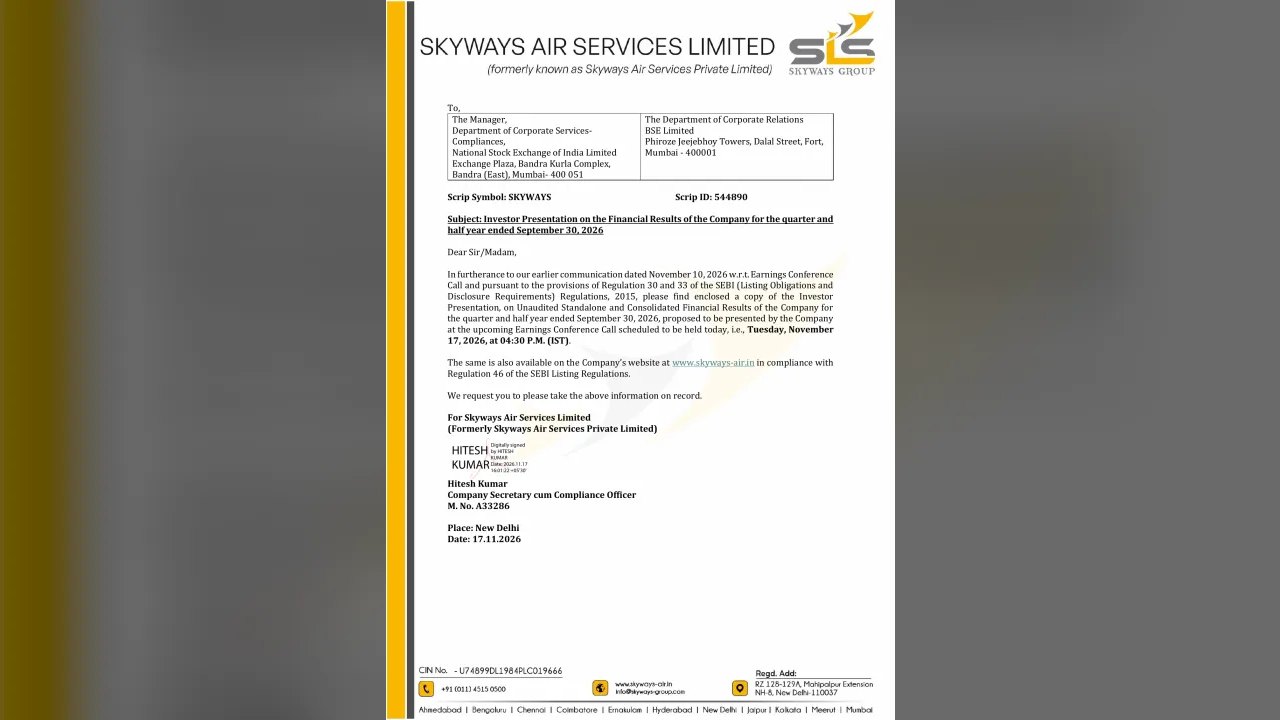
On 6ix: 6ix.com/event/skyways-air-services-limited-skyways-q2-2027-earnings-call
Automated transcript · Written by software from the replay's audio. It can mishear names and figures; the replay is the record.
0:00 Ladies and gentlemen, good day, and welcome to the Q2 FY 'twenty seven Earnings Conference Call of Skyways Air Services. As a reminder, all participant lines will be in the listen only mode, and there will be an opportunity for you to ask questions after the presentation concludes.
0:25 Please note that this conference is being recorded. I now hand the conference over to mister Yashpal Sharma, chairman, managing director, and CEO of Skyways Air Services. Thank you, and over to you, sir. Thank you very much. Very good afternoon, everyone. It's a pleasure for me to be here and on this second earnings call since the SKYWAYS Air Services got listed on the exchanges. This is a very important moment for us, not merely because we are reporting just another quarter, but because it reflects the consistency with which our strategy is beginning to convert into scale, profitability and shareholder value. Our H2 and H1 performances have been driven by a broad based growth across our air cargo and non air cargo businesses.
1:15 Air cargo volumes have grown significantly by 27% in this quarter for us, and we have seen a solid double digit growth also in the other verticals of logistics for the group. This is not growth which has been concentrated just by one geography or by one customer segment or even one service line. It's a growth which has spread across the verticals we have built. We are growing at nearly 3x the pace of the industry, both in India and overseas. The Indian export market grew roughly around 8% in this quarter, while Skyways grew three times of this. In the air cargo, we continue to remain number one player in the country, And we have improved our global rankings by two positions to go to number 42 at the end of the Q2.
2:06 This is truly a proud moment for Skyways and India. Our non air businesses, which have also seen a significant growth, delivered a strong momentum for us with H1 revenue growing from INR315 crores to INR566 crores over the last H1. This demonstrates that Skyways has created multiple growth engines to diversify its growth in air, ocean, express, cross border custom brokerage, trucking and other value added services, all are contributing significantly to our growth. Our past performance and our future rests on four growth pillars, which at Skyways, we call the Skyways Growth Quad, which is centered around being connected, scale driven, smart and being future ready.
2:59 These help us in deepening wallet share with current customers, acquiring new customers, expanding our technology led product suite and strengthening our global network through acquisition of larger carrier capacities. Each of these pillars is now moving significantly and working together, giving and adding steam to our efforts of growing our business. The commercial performance and the financial performance has also seen a significant rise for us. We've seen a consolidated revenue from operations grow 90.3% year on year. We have clocked INR 13 and 11.45 crores in Q2 of this year. EBITDA also increased by 96% to INR58.47 crores and our PAT has actually grown even better by rising 129.6% to INR33.18 crores this year.
4:01 These numbers have added up and given us a very solid H1 for FY twenty twenty seven, whereby revenues for this H1 have grown 90.3% to INR2527.9 crores with an EBITDA rise also of 90% in the H1 to INR108.6 crores and PAT growing at a very, very solid pace of 135% to INR59.97 crores over the H1 of last year. What is particularly encouraging is that this growth has come with improving profitability. Our BAT margins improved 43 basis points to 2.53% in Q2 and by 46 basis points to 2.37% in H1 total.
4:49 Our absolute profits have grown materially, marginally margins have expanded and return ratios have also got strengthened. We are currently operating at an annualized ROCE of approximately 23%. Even though this is one of the best in the industry, but this is not our destination. Our efforts will be to sustain it and wherever possible, improve it further through a very disciplined capital allocation, operating leverage and a technology led productivity improvements as we go along. Technology, ladies and gentlemen, is no longer just a support function in Skyways over the last few years. It has been central to how we win businesses, serve customers and expand margins.
5:36 Our platforms are giving customers greater speed, flexibility and a much better visibility of their business. We are able to offer multiple routing options, helping customers optimize their supply chain needs based on costs, transit times, capacity and service requirements. Technology is also very importantly helping us reduce transactional friction, making it faster and simpler for customers to move across borders, access the information and manage their supply cycle. This is helping us in two ways. First, it really helps us to deepen our wallet share with our existing customers and also by offering a wider and more integrated set of services to newer customers.
6:25 These new customers coming onto a platform, including customers who are actually wanting speed, transparency, digital control over their logistics operations. Equally important, a deeper integration of digital capabilities and technology led processes is improving operational productivity and scalability for us. As volumes grow, our systems allow us to handle complexity without a proportionate increase in the costs. This has been one of the key drivers, ladies and gentlemen, behind our margin expansion, and we expect technology to remain a structural lever for profitability improvement going forward as well. As we all know, India's logistics sector has been at an inflection point.
7:15 Rising exports, new airport capacities, other infrastructure improvements, the infrastructure strongly growing and expansion of manufacturing are creating durable tailwinds for this industry. As per media reports recently, we saw the non petroleum merchandise has grown 18%, yes, 18% to USD259 billion between April to October. And this is not just dependent on oil shipments alone. In October 2026, we saw merchandise exports alone stand at $49,470,000,000 compared with $34,100,000,000 last year, which is showing a strong demand for Indian goods across the globe.
8:01 Sectors such as pharmaceuticals, consumer electronics, semiconductors, defense products, automotive, textiles and agri products are driving meaningful export growth for the country. At the same time, India's widening middle class and expanding services sector are creating stronger domestic consumption. Customers today expect a wide range of products delivered to them much faster with greater visibility and reliability. This is precisely the environment in which technology led logistics becomes even more important and essential. Skyways is deliberately increasing its focus on these new age sectors. They demand speed, compliance, visibility, a very specialized handling and reliable cross border execution.
8:53 These are areas where our air cargo strengths, our global network, our tech stack and integrated service offerings can create a very meaningful advantage for customers. The global supply chain landscape is also creating opportunity for Indian exporters and Indian logistics service providers. New trade agreements, rising manufacturing investments and the diversification of global sourcing are encouraging companies to look at India as a more important part of their supply chain. Free trade agreements are creating further momentum by improving market access for Indian exporters, reducing friction across cross border trade. For Skyways, this creates an opportunity to become a stronger partner for Indian manufacturers, our exporters, MSMEs, global enterprises seeking dependable India to world connectivity.
9:45 International e commerce is another very important growth vector. It is enabling MSMEs, individual sellers and large corporates alike to reach global markets. Our express and e commerce logistics platform, Escard Edge, is designed to simplify cross border movement and make international trade more accessible for each enterprise as well as individuals. We are also working to deepen penetration into Tier three cities and beyond so that businesses in India's hinterland can access global markets with same ease as larger enterprises do. We recently even tied up with India Post to strengthen this very penetration.
10:33 The technology of EdCart has been giving steam to these small little shippers, small little vendors and even large enterprises to reach the global markets. New initiatives and milestones that we have been taking in this period also saw us take meaningful progress across several strategic initiatives that will strengthen both our near term execution and also our long term growth. We renewed our annual global agreement with Qatar Airways in this quarter as well, which is an important reformation of long standing and strategically significant airline relationship. The agreement is designed to further increase the
11:16 mutual air cargo volumes handled by both of us across our geographies. For us, these airline and shipping line partnerships strengthen our access to capacity on the world's most extensive global trade routes. Reliable capacity access is fundamental to our ability to serve customers consistently, especially during the periods of peak demands or supply chain disruption. We also established a warehouse in UK, Birmingham,
11:47 ladies and gentlemen, recently, enhancing our presence and service capability in a very important international market. It also complements our international network expansion and gives us a very strong physical foundation in a market, which is meaningful trade flows with India. With the India UK FCA now in place, we are confident that this step will further boost our business volumes, not just on India UK trade lane, but also for global customers seeking logistics solutions in UK. Our recent investment in Sage Route Logistics continues to advance our ability to provide smarter, more efficient logistics solutions. They have created a very solid land side operation capability for many complex logistics needs for sectors, especially like the renewable energy.
12:38 As Government of India pushes for greener avenues for its energy needs, this step will surely position Skyways Group very strongly for this vision of the Indian government. Together with Escart Edge, our twelfth order e commerce platform and Phantom Road Express, our trucking subsidiary, it reinforces our view that future of logistics will be shaped by companies that combine the physical reach and provide digital intelligence. During the period, we have also received an important recognition from two of our great partners, Emirates SKYWAYS Cargo conferred a special recognition on SKYWAYS in acknowledgment of our continued support, strong performance and consistent service quality across the key trade lanes.
13:22 Even IAG Cargo also gave us a valued business partner award. These accolades reinforce our strategy of building deep performance led relationships with global carriers, relationships that will strengthen our ability to secure reliable capacity and deliver consistent outcomes for our customers.
13:45 Ladies and gentlemen, talking on the way forward, we've always seen historically the second half of each year has always been more stronger than the first half. Skyways is definitely looking forward and targeting a revenue of over 5,000 crores for this full year. While we want to make sure we go towards this vision, this mission, we want to make sure that our profitability is also sustained at the current levels. Our confidence is grounded in several factors. First, the demand environment remains very supportive, particularly across exports of some key commodities like I mentioned, electronic, pharmaceuticals and automotive, where we are putting a very, very strong impetus.
14:31 Secondly, our carrier capacity arrangements provide a strong foundation to convert demand into dependable service and profitable volumes. Thirdly, our technology platforms are improving customer acquisition, wallet share increase, operating productivity and scalability to our business. On the strategic front, our tech platform, ASAP, is now it's in very final stages of testing. And across all aspects, we are making sure that this works perfectly well, and we are looking forward to launching this in the early part of the Q4 of this year. We have also set out a very clear plan for one of the five international geographies that we have planned for this year. And we expect the first of them to be operational in the Q4 of this year and the remaining geographies also expected to come online over the next two to three quarters post that as well.
15:28 We remain highly optimistic about both the near term and long term outlook for the organization. India's logistics sector is entering a period of structural growth, and Skyways is well positioned to participate in that growth through its integrated service, its modeling, its technology capabilities, its global networks, very, very strong carrier partnerships and most importantly, a very disciplined execution. Thank you very much. I'll pause for now and hand this over to our CFO, Himanshu Chagra, to take this forward and run you through our financial performance. Thank you very much.
16:11 Good evening, ladies and gentlemen. Thank you, Mr. Yashpal Sharma, and a warm welcome everyone on the Q2 and H1 FY 'twenty seven earnings call. Before I take you through the numbers of the quarter two and H1, I would request all of you to have a quick look back. Our operating revenue had more than doubled between FY twenty twenty four and FY twenty six and the Q1 results showed that the momentum continued. I am pleased to say that it has carried through the second quarter and the first half of FY twenty twenty seven as well.
16:45 Revenue growth of Q2 and H1 FY twenty twenty seven. In Q2 FY twenty twenty seven, our revenue from operations stood at INR1311.45 crores, which is up by 90.3% year on year basis and 7.8% quarter on quarter basis. For the first half, our revenue from operations stood at
17:10 crores approximately, up 90.3% over H1 FY 'twenty This growth came from all our service engines and importantly from volumes as well as realizations. Segment performance, if we want to have a look at the Air Cargo continues to be our forefront of our revenue engine and the revenue was up at INR983.42 crores in Q2, which is up 90.1% year on year. And if we talk about the H1, it stood at INR1959.79 crores, which is up 93.5%. Volumes, if you talk about the Q2, were 27,629 tonnes, which were up 27% year on year basis and 51,115 tonnes in H1, which is up 25.2.
18:01 Coming to the Ocean segment, revenue in the quarter two stood at INR247.1 crores, which is up 113.8% and INR 399.72 crores in H1, which is up 91.5%. Volumes in the Ocean segment stood at INR 9,165 teus in quarter two, which is up 15.9% and INR 17,187 teus in H1, which is up 16.7%. The Express, Cargo and the Parcel business also is showing upward trajectory for our business. Revenue was INR58.79 crores in quarter two, which is up 34% and INR121.38 crores in H1, which is up 48.2%.
18:49 We handle INR72,197 shipments in quarter two FY twenty twenty seven, which is up 8.4% and INR13497 67 shipments in H1, which is up 17.7%. Our customer base has also continued to be stabilized at 9,500 plus level and no loss of customers have been reported in the portfolio. Now, I'll take your attention towards the profitability. Our EBITDA in Q2 operating EBITDA stood at INR58.47 crores, which is up 96% year on year and an EBITDA margin of 4.46%. For H1 EBITDA stood at INR108.60 crores at an EBITDA margin of 4.3.
19:35 The profitability after tax was INR33.18 crores in Q2 and the profitability after tax margin of 2.53% and INR59.97 crores in H1, a PAT margin of 2.37%. The EPS, the basic earnings per share was NOK1.91 in Q2 and NOK3.6 in H1.
20:03 We are continuing to focus on converting growth into profitability and keeping our margin profile very very healthy. I'm also pleased to announce or share that our Board has declared a second interim dividend of 40p per equity share, which is 4% of the face value of rupees 10 each for the second quarter. The record date is scheduled at on Friday 11/20/2026 and the dividend will be paid as per the guidelines within the thirty days of the declaration. Coming on the balance sheet,
20:41 our returns on the returns and the leverage, our ROCE stood at 10.46% for the H1 and the ROE stood at 8.23% against the ROCE of 8.26% in H1 twenty twenty six. Our gross debt to equity has reduced to 0.58 as of 09/30/2026. The gross debtors realization period has also improved to sixty two point seven seven days vis a vis seventy five point one nine days, if we compare the H1 to the FY 2026, which shows good collection and the credit selection of the customers with the top, top customers and the collection cycle improving in the current period H1.
21:36 On the future outlook going forward, we feel that the volume trend across Air, Ocean and Express remains encouraging and our recent investment will definitely add towards further increasing them. Foreign container line, we have made a further investment in the subsidiary to reduce its debt, which are in line with the objects of our IPO.
21:57 PageRoot Logistics, which specializes in the road freight business and focusing on the renewable sector, which is done through our subsidiary, Braceport, which is our subsidiary has acquired 76% in StageRoot Logistics with a planned capital infusion to support its operation. In The UAE, our subsidiary Abito Global Freight is also setting up a subsidiary in free zone in Abu Dhabi to strengthen their presence in The Middle East. Asia,
22:28 our Board has approved expansion into five geographies in the previous quarter and we expect these offices to add volumes after the initial stabilization period is over. And we would aim at a reduced breakeven period for these offices, which historically has been a three to four years considering the volume and the customer base that we are targeting, we may get an early breakeven for these new geographies. Together, these should support our volume growth over time and we will keep growing with discipline on the margins and on the balance sheet front. We really thank all of our investors and stakeholders for their continued support and belief in us and we'll be very happy to answer your questions on the financials.
23:18 I would like now to hand over the call to the moderator to take it forward. Thank you very much and very good evening to you. Thank you. We will now begin with a question and answer session. If you wish to remove yourself from the question queue, you may press star and then 2. Participants are requested to use handsets while asking your question. Ladies and gentlemen, we will wait for a moment while the question queue assembles. Your first question comes from the line of Ganesh Wagh with API Advisors. Sir,
24:18 my first question is, what measurable benefits have the company's technology platform delivered in terms of the productivity, cost saving and the customer acquisition, sir? So yes, it's a great question. Basically, we've designed our technology platform is to offer customers a very quicker turnaround on the way they look at their pricing and their route needs. And this makes them to create their supply chain needs in a much faster way. So their access to our pricing, their access to the global capacities becomes faster, which brings in a faster way of them transacting with us and which means that we are able to expand our businesses with the customers in a very, very big way. Even transactionally, the customers are able to see a much faster because of our internal ERP, the transactional speed has been great. We have also been including some of the AI and OCR technologies now in our business, which are helping us to transact much faster and simplify some of our internal operational processes, which means that the customers are not just able to do a price point check with us or the routing needs, they're also able to look at how their the visibility of their milestone is also available for them. So it's quite an end to end experience that a customer gets, whereby they are choosing Skyways
25:51 solution over some of the other competitors, even if they are a global MNC or a local company, they are preferring to use Skyways in across air, ocean and express. Okay. Okay, sir. And my second question is, what is the current status and commercialization timeline for... Of the ASAP platform and the other technology initiatives, sir? Right. So as I mentioned in my address as well that the final testing stage is on now. We are in the final testing rounds and we are doing all the necessary critical analysis of each and every aspect of this tool. And we assume that this over the next two to five weeks, the entire testing would be complete and we will be able to do the official launch of this in the early phase of Q4 of this year.
26:43 Okay. And you had a very good financials for this quarter, sir. So I just want the breakup, like segment wise breakup for all these financials. Like you have mentioned H1 FY 'twenty seven revenues for all of this segment, but how it has been performed as compared to the H1 FY26, sir? Could you please give me that segment wise? So as we mentioned on the air side, the air freight numbers have doubled up almost 90% growth in the revenue. And the motion freight vertical has also doubled up, more than doubled up to 116%. And rest, the Express has also nearly grown by 80%, 85%. So which is translating to overall growth of 90 odd percent.
27:32 And the exact details are also shared in the presentation that we have given to the stock exchanges just an hour back before the earnings call. Okay. Okay. And do you also provide some kind of margin breakup for all these segments, sir? So as the margin, we have earlier also clarified in the previous quarter's call, the gross margin profile of the businesses are very similar. So we the business and the customer segments are also sometimes common across all these verticals. So the margin wise breakup of these revenue segments, we don't do, and it's at an overall basis. Okay. Okay. So one thing I noticed in the ratio slide, so our ROE and ROC, ROEs keep on declining, sir. So what is the major reason for this, like 22.37% FY 'twenty four, it just came down to 14.15 in FY twenty six. So what is the key reason for this?
28:36 So as you understand that we have done the pre IPO rounds and now the IPO as well. So on the expanded equity, the ROE is because of the denominator effect, right? If you analyze the current actual number, so this will translate into upwards of 16%, 16.5% ROE as well on the expanded equity, right? Okay, okay. And as we scale along further and this effective utilization of the IPO proceeds, which is already showing on the ROCE side, which is upwards of 22% if we analyze the number, 21% approximately. So this is already showing that the extended capital is put into use very effectively both on the pre IPO side and on the IPO side.
29:26 Okay. And I believe you have guided for some 5,000 of revenue top line that you wanted to achieve. So can you elaborate on that how you are going to achieve that, So like I had mentioned that historically, our H2 is greater than H1. This is what we've seen over the last decade or so. And looking at how we have managed to keep our volume growth, we are very confident that we will be able to achieve a very similar to H1 or actually better than H1 numbers in H2 as well. Okay. Got it. Got it, sir. And just on the industry side, one last question on the industry side. What do you think how H2 like the whole year is going to perform in terms of the whole industry, in terms of the volume, sir, carbon volumes and all?
30:18 What do you think is it in line with our expectation?
30:22 Yes, very much. I mean, if you look at the growth in the Q2 numbers, there has been a nice growth in the air cargo volumes. I talk about the air cargo volumes, there have been a decent growth of over 8% in the export side itself. And the imports have also grown pretty much in the similar lines. The domestic segment also remains robust. So this is pretty much in line with what we see. And as you can see the way the Indian exports is booming now, we expect this growth to get better. And if you look at our growth, we have been kind of growing 3x of the generally the growth that the country has been witnessing. And this is not just for now, even the last two, three years, four years, if you look at those numbers, we have been kind of growing at 3x, 4x of the volumes that India does. So Skyways is very confident that if the growth that the Indian we've seen the Indian Minister of Civil Aviation and the Ministry and overall rolling out for
31:27 the Indian air cover sector over the next five to twenty years, in fact. So that growth is pretty substantial. And if we, as Skyways, continue to outdo the Indian growth, we will grow at a very significant pace from here. The Indian capacity is also increasing. Just to answer your question a little deeper, capacities in India are also growing. If you can see that Air India has ordered aircraft, India has ordered aircraft, the other mean, the British Airways has added capacity to India, Virgin has added capacity to
31:58 India. So EVAYS EVA Airlines is coming in from December as well. So a lot of airlines and global carriers are looking at India because they clearly all of them have also done deep study of the Indian market and they anticipate a very solid growth for India and not just from the export perspective, but also import as well as domestic. So overall, the Indian logistics space looks in a very, very promising phase over the next decade, I feel. Right, right. And these geopolitical issues and all, this is not impacting our business, right? Well, these geopolitical issues actually separate the haves from the have nots. And if you look at how we have performed even in the difficult period of March and April when there were considerable amount of capacity decrease across the world, our volumes still grew.
32:48 And this is really on the back of the strong, like I said, our technology is helping us to penetrate the carriers' capacities and bring in more capacity for our customers through the technology and also through the carrier contract, the capacity contracts we have. So it really separates when the market gets tough, you are very clearly able to see who is the one, who is the service provider, who can get capacity for the customers and who cannot. And the global customers today, not just in India, but customers around the world need consistent support to move their goods. And if they see that a sizable player, we are a market dominant player, we are a clear number one in the country in terms of air cargo. So we are a choicest logistics provider, service provider, especially in the air cargo needs. And like we just mentioned that our non air business has been growing significantly and we've seen kind of a 90% increase or 80% increase in our non air businesses as well, this H1 over H1. We've gone to INR568 crores from INR315 crores from last year. So we are not just seeing how we are able to offer solutions for our air customers, but customers know that when Skyways is offering a solution across these products, we will deliver. We will make sure that whatever tag that we are offering the customers, we will deliver.
34:11 Right, right. And just one last clarification, sir. So despite we have a very good revenue growth in both Q2 and H1, our margins has been flattish trend. So any comment on that how we are going to improve our margin? Or this is a standard margin, sir?
34:30 So the margin, if you'll see, has improved both quarter on quarter and year on year basis. As you the whole the business assets, there is not a big shift possible, but there is a gradual shift possible in the EBITDA margins. And we are seeing that operating leverage coming in very nicely as we are scaling up The employee cost ratio and other overhead cost ratio to revenue tend to come down as we scale up business, right? So we have seen effective utilization of
35:08 the capital both on the financial capital and on the human resource capital that we have. And this trajectory we are confident that should continue on the margin improvement side also. Gradual process will continue and as more and more scale and more and more geographies will get added, eventually, the international offices margins is better than India export margin per se. And once the breakeven is achieved, even in the geographies that we are targeting, we can reasonably expect an improvement in the overall EBITDA margins over a period of one to two years. Okay. Any guidance on the margin front because the question why I'm asking this question because previous supply chains I believe is in the same line of business, right? And they are doing around 7% to 8% of EBITDA margin kind of a thing. So any kind of set, you said that you will be attained breakeven in next one to two years. So what will be our margin trajectory, sir?
36:06 So what we are targeting is a pad breakeven. On the name that you mentioned are asset heavier business than ours, right, into the overall supply chain, including the warehousing and contract logistics. So we are venturing into those areas gradually, maintaining a low CapEx profile, but at the same time, our net profit margins will be better from as compared to the other company that you mentioned. Okay. Okay. Got it, sir. Thank for the detailed answer, sir, best of luck for the future, sir. Yes. Thank you, Mr. Ganesh. Thank you, Ganesh.
36:51 You. Your next question comes from the line of Viti Jain with Jain Investments. Please go ahead. Sorry, could you say the name again? That is Viti Jain with Jain Investments. Okay. Hi. So my question is how much of this revenue per employee improved since this electronic platform went live?
37:23 Sorry. Can you repeat the question, please? My question is how much has the revenue per employee improved since these platforms, electronic platforms went live? So as as we talk about the 90% growth year on year and there has been a kind of a 15 growth in headcount. So the overall effective increase has been around 67% and that is where the revenue per employee has improved.
37:56 Understood. And how much has a self... Service booking in the SLS 100 x cut your cost per shipment?
38:07 So as the customer use both the kind of models, so all the services are available to the customers, whether they can use the online platform that we have and the offline email or a telephonic model that whenever the customer chooses. So once the online platform is at the efficiency obviously improved by 15% to 20% on an overall basis for all of us.
38:35 Understood. Thank you. That answers my question. You, Ms. Jain. Thank you, Ms. Jain. Thank you. Your next question comes from the line of Piyash Parker with Patel Investments. Please go ahead. Hi, sir. Thank you so much for the opportunity. Am I audible? Yes, Mr. Yash. Please continue. Hi, sir. So first of all, congratulations on good growth in the air cargo and ocean freight. So we see that the air cargo revenue grew by nearly 9394% in H1, which is significantly outpacing the volume growth of 25%. I guess the rate right now is somewhere around three eighty three per kg.
39:25 So could you provide an outlook on the sustainability of these higher EVs? And to what extent they are expected to normalize over the coming, let's say, two to three quarters from now?
39:40 Well, what we've seen is that there is obviously a fuel surcharge component, which sits in this yield that you have seen, right? And as the fuel surcharges will always go up and down, so we consider that there is always going to be on quarter to quarter basis, 5% to 10% variation in the fuel prices can always happen. And this is the trend that we've seen in the past as well. So we are not expecting to have any kind of a sharp decrease or increase in these rates, because if the normalcy of general freight rates other than the fuel is does not see a very big shift in very quick time. Usually, if there's a shift anything beyond 5% to 10%, it happens over a period of three to four quarters.
40:29 So we are looking at the global capacities available currently, the trends that we see, we don't really see that there is going to be any big shift in the air freight yields over the next couple of quarters, barring the fuel increase or decrease that might come along. Right. Also, sir, we can also see the same in the ocean cargo. So what are the key drivers that is also driving a significant increase in the revenue per TEU? And also, like, is there any improvement in the customer or trade mix that we are seeing and we are forecasting in our business? Yes. So ocean, bigger part of the business around the world, ocean freight is a very significant play.
41:18 And what we've seen or what we've witnessed in the last quarter or so is that due to the disruptions in some of the geographies in the world, which we are all aware of, that the shipping lines have had to change the routes in which they operate. And some of the touch points in these global routings have actually got shifted. And this is what has impacted some of the trade lanes in a much larger way. And obviously, as you must have seen in COVID, we had also that there was a global disruption in terms of the inventory available. So the global inventory of containers to get circulated, it needs the normalcy or the consistency of the shipping routes to happen in the way they have been happening. Because if, for example, containers are sitting at one port or one country, unless a container vessel comes around, they are not going to get rotated. So the consistency in which, say, for example, every weekly, if
42:14 there's a weekly routing of a container or a vessel, which goes on the service, they need to make sure that they call that port every time. And this disruption actually happened in March and April, but the routing got visible to the whole customer base and others around the world probably in May or June.
42:34 And as things hopefully will get normalized in The Middle East, we are confident that some positive signs that are here that we see from the world, things will slowly start getting normalized there. But ocean stability comes slightly at a slower pace because of the nature at which they operate rather than air cargo. So I think that the ocean capacities will remain pretty range bound over the next two to three quarters. We don't really see too much of change happening there. And
43:05 hopefully, some of these straits that are currently closed will open up and will fast track the movement of vessels and more normalization we'll get to see in the next quarter or so.
43:18 Okay. Makes sense, sir. Sir, last question from my end. So we see that you have also identified warehousing, cold storage and fulfillment services as part of the integrated logistics offerings. So could you elaborate on the current the existing warehouse infrastructure, particularly the extent of old versus leased facilities and also the use of third party warehousing partners? Are there any plans to expand this segment over the next two to three years as well?
43:51 So as we have grown in the last couple of decades, we have remained pretty much asset light. And that has been the ethos of the organization, not to be asset light, but asset sensitive. Wherever asset is very, very required is where we want to invest in. If it is backed by a customer demand, customer need, we will go in and invest in those critical assets. Otherwise, we want to pretty much remain asset light. That's been the thought of the organization. There's plenty of in some of the critical areas, we want to make sure that we invest so that
44:22 customers become sticky with us. And we are able to as we as one of the key aspects of our business is to bring cross selling. So a lot of customers need to ensure that you have warehousing, fulfillment services, distribution networks as part of your portfolio to give an end to end customer need to the customer. Customers today work on an omnichannel strategy. They don't just work with either the brick and mortar or just the online. Today, these strategies are pretty multifold in terms of their selling capabilities.
44:51 So we, being a very leading logistics service provider, want to make sure that wherever we need to invest in these, whether it is movable assets like trucks or refrigerated trucks or any other, we will go in, but largely we want to remain asset sensitive. To answer your question exactly on what we've built, so we've just recently concluding our cold chain facility here in Delhi, which will enable us to get about 200,000 cubic feet of cold chain capacity for the healthcare sector
45:23 as well as the food and vegetable sector. And also, we've recently operationalized one in Birmingham, UK, whereby we are targeting a very specific segment in the automotive side. And that will help us to grow the grow and acquire more customers in these areas. So we want to remain we want to collaborate with other logistics service providers in the market and use their capacities wherever there is a need. But if it means, like I said, if it means that a customer is committing us on a long term basis and or like I said, we want
45:57 to penetrate more in the pharmaceutical sector, that's a very key growth area for us. So their customers need those temperature control facilities, and we will, on a case to case basis, evaluate and go in and create some of those capabilities here and there. Right, sir. Makes sense. Thank you so much for patiently answering, sir. Thank you, Rajiv. Thank you very much.
46:22 Thank you. Your next question comes from the line of Karan Charma, an individual investor. Please go ahead. Hi, sir. Good evening. Thank you for giving me the opportunity, sir. Sir, I wanted to understand the revenue mix between exports and imports. Like, what percentage of our current revenue comes from the export and import? Like going forward, there's a completely an opportunity to increase its share of import business, particularly if the imports are less. Mr. Sharma. And we have been focusing on the imports in the last five to six years in a very, very big way. And we have seen a considerable growth in our volumes in the import segment as well. Even if you look at FY FY '24 to FY twenty six numbers on the air cargo side, we were at
47:14 a 2,500 tonnes on the air import side, which grew to 7,600 tonnes by the end of March, so FY twenty twenty six. And this year, we are looking at a very sizable, even a sizable almost 40% to 42% growth this year is what we are anticipating on the import numbers. And we clearly see that the Indian market, like I've mentioned in my opening address, that the customers in India today is seeking a larger portfolio of products, not just from India, but overseas. So India will remain
47:47 committed over on the import side, lot of raw material, lot of finished products will continue to flow into India. So it is a very strong endeavor for us to grow and this is also very low hanging fruit because a lot of these customers who are importing are already on board on one of our services. So that is helping us to cross sell and increase up our import volume. So you will see a very considerable increase in the import volume. And also like Himanshuji just mentioned, as we are now looking at opening up
48:17 five new geographies in the Asian market, and most of the import coming into India are coming to some of these Asian markets. And as we create our own footprint in these places, that will further add steam to our import volumes. And countries like Indonesia, Philippines, Malaysia, Singapore, China, some of these markets are really adding. We started offices in Vietnam, Thailand and some of these other economies. And we have seen because of setting up those offices, our volumes have got
48:48 an increase. And we feel that as we will create these footprints, we will in times ahead be able to give a very solid boost to our imports, not just in air but in ocean also. Sir, percentage wise, it will be like sixty-forty or seventy-thirty, like can we have like number on export? For now? You mean for now or future?
49:11 Now. I'll click a note. So currently, our import is roughly around 5% to 6% of our business and which we expect to keep growing year on year and we're targeting to have a very, very decent part of our business in the next four, five years coming in from imports like I said.
49:33 Nice to hear. Sir, one more question. In the previous call, right, you had provided guidance for now like current quarter, for the December quarter. Can you get like last time you did for September? So can we get this time also on Q on Q basis, like compared to September quarter, will December will do better?
49:53 Well, we are very confident that the way the markets are growing, the volumes have been are consistently growing for us as well. And we are very confident of a very solid H2 performance. So we look forward to Q3 also contributing in a good way to the H2 because usually the Q4 is stronger than Q3. So in the H2 there, you will see that shift. But overall, both the quarters will be at a very, very decent position is what we see from here. Thank you very much, sir. Congratulations, again for very good numbers. Thank you, sir. Thank you, Jeeva. Thank you very much. Thank you so much. Thank you. Your next question comes from the line of Divya Reddy with Sunshine Capital. Please go ahead. Hello. Yeah. Good evening. Am I audible?
50:43 Jeeva Reddy, you're audible. Please go ahead. So sir, I just wanted to know that what share of your bookings now come from your digital platform?
50:55 Around 15% to 20% on the overall basis, we are trying to increase our online penetration vis a vis the offline penetration. And this takes time because the customers also are used to working in a particular manner. And over these years, this number has grown. And we are trying to implement and educate and create a kind of integrative approach towards implementing technology
51:26 into the entire ecosystem where we and the client are communicating. But this is a gradual process and it's improving. Ms. Reddy, let me also come in here. This is Reshfa Sharma. So the new age products that we have set in, like the Express, is almost 95% to 96% through the technology, okay? So that is what is the new age products that are set in, the customers have been aligned pretty much in the Express and e commerce industry. So the customers' acceptance to your tools or the technologies as important as you having the tools. So we are seeing a good penetration coming in with the other products also, but the e commerce and Express will continue to drive the digital penetration for the group. And we see every quarter we are seeing an upward trend in how the customers are able to digitally transact with us.
52:21 Also sir, And to interrupt, the launch of ASAP also in the last quarter will further drive this online vis a vis offline percentage of our overall business because in the tier three and the tier four and the entire globe at large will be able to transact online with us. Okay. So I was asking that how many customers actively use the SLS Hike and SLS 100x? Around 15% to 20% of our business, know, the customers use you know, the platforms. As I mentioned, it's a process in the in the in the express side, it's nearly 100%.
53:08 Okay. Yes, that answers my question, sir. Thank you and all the best. Thank you. Thank you, Jeeve. Thank you. Your next question comes from the line of Dignesh with North Star. Go ahead.
53:31 Hi, everyone. Very good morning, and thank you for the opportunity. First, I have just two questions in my mind. The first one is, sir, your ocean and express are smaller than compared to air. So, sir, I just want to know what are your strategies going forward to increase it or will it be the same as historically?
53:51 So as I've mentioned that we historically, when the organization had started four decades ago, we started with Air Cargo. And over the last one decades point is where we started to work on the other logistics solutions and verticals. So and the real impetus has happened in the last five, seven years. And if you look at the growth that we've seen in H2 versus H1, where we've grown at 80% in the non air, so which includes ocean, express, trucking, other value added services.
54:23 So there is a very solid growth coming in on the non air businesses for us. And as we are a very professionally run organization and all the other products are also run by very industry specialists, so the XOs and the VPs who run these the Ocean Express and trucking solutions for us, they specialize in those industries. And they have been leading us on the front and building a very strong growth for us. And 80% growth, I think if we are doing, if we have done this in this H2, I think we are moving at a good pace and we will continue to strive forward and add substantial volume as well as revenues from these non air segments as well.
55:09 Okay. Okay. That clearly answers my question. And sir, another one was, sir, given the year FY 'twenty seven FY 'twenty eight, I mean, sir, given the higher base behind you, sir, so do we expect a little bit decrease in the growth or with it I just need your guidance on that. We are not talking of any degrowth at any stage. We are very confident of our volume growth. The organization has laid out a very strong foundation as well as a roadmap on customer acquisition, increasing our wallet share from the current customers. We feel over the next four to five years, we'll continue to see a very sustained volume growth of 25% to 30% year on year. So we are very, very
55:54 bullish on the prospects of the organization over the next five to ten years actually. Okay, great, sir. Okay, I got you on that. Thanks a lot, sir. And I'll give you an update. Thank you so much. Thank you. Thank you. Your next question comes from the line of Deepankar Bish with CCVIM. Please go ahead. Thanks for the opportunity, sir. Sir, can you tell me more about the platform that you're going to launch in q four?
56:26 Yeah. So this is actually, mister Bish, this is a platform that we built for creating a very solid integrated logistics solution for customers. Today, are largely trading offline across the country, especially in the Tier three, Tier four markets of the country where customers don't have access to good and big service providers like us. They need to get visibility of pricing, they need to get visibility of capacities, they need to book cargoes in real time basis as well. So our platform, ASAP, which is, like I said, in the end stages of its testing, will give this capability to the customers not just to see the price, but also book cargo in real time basis. They will be able to use the payment gateways to complete their transactions as well. So the tool is pretty powerful. We are very, very confident of positioning this tool and really creating a strong value for that small little cobbler sitting somewhere in the country trying to send a pair of shoes to probably country which is 10,000 kilometers away. So we want to make sure that that person does not have to look around whenever they want to transact. We want to add steam to their business, e commerce logistics, as you see, the cross border e commerce logistics is growing globally.
57:50 And in India, we are just at the tip of the iceberg. And the customers today are trying to through social platforms, through e platforms, they are trying to not just look at selling their products or their produce to Indian customers, but they can tomorrow sell their produce to 8,400,000,000 customers around the world. So that is the capability that ASAP will give them. It will give them access to capacities, not just in air, ocean, even express solutions end to end. And the airlines and the shipping lines, the integrators, we have done API integration with them. So there the platform will give them give this a very solid base on which customers would be able to transact and add speed to their business.
58:36 So what kind of revenue can we expect in FY 'twenty eight from this platform? We feel that the smaller markets in the country, the Tier two, Tier three, Tier four markets in the country, there's a if you look at the MSME sector, 45% of India's exports come from the MSME sector. And large part of the MSME actually sits in these smaller towns. They don't sit in the main city, right? And today, we know for a fact that they are actually working to the with the carrier going through sometimes four to five intermediaries. So when you create that visibility for customers to be able to transact to the source, it really adds a lot of business. So when they will be we are very confident of getting adding at least 15% to 20% in these markets, just from these smaller markets into our product portfolio.
59:36 Sir. Okay. Thank you. Thank you. Thank you. You. As there are no further questions from the participants, I now hand the conference over to Mr. Yashpal Sharma for closing comments. Over to you, sir. Thank you very much. Ladies and gentlemen, thank you for being part of this earnings call. All I would like to say to close this is, as we move forward, our focus remains on consolidating our leadership position in Air Freight. We have been the number one company in India for the last few years, and we are very confident and we'll continue to make India proud by keeping up this lead. We are also building our capabilities across the wider logistics ecosystem and we'll continue our growth in those areas as well. As technology sits at the core of our transformation, a growing global footprint will add and also a clear strategic direction to our business. We are very confident of the ability to capture these emerging opportunities and create sustainable value for customers around the world.
1:00:40 Guided by our growth cohort, we remain very focused on a disciplined execution, which has been our biggest strength and building a more integrated, diversified and a very future ready logistics organization. I want to extend my gratitude to all the stakeholders who are attached with us, including our investors for joining us, believing in us and for being part of the SKYWAYS growth journey to date. We look forward to your continued support as we continue to move towards a global leadership vision. Thank you very much and have a great evening. Looking forward to a great year end. Thank you. On behalf of Skyways Air Services, that concludes this conference. Thank you, everyone, for joining us, and you may now disconnect your lines.
Follow Skyways Air Services Limited into a list and get an email when it puts out news.
chairman, managing director, and CEO at Skyways Air Services
at API Advisors
at Jain Investments
at Patel Investments
individual investor
at Sunshine Capital
at CCVIM