Transcript
Automated transcript · Written by software from the replay's audio. It can mishear names and figures; the replay is the record.
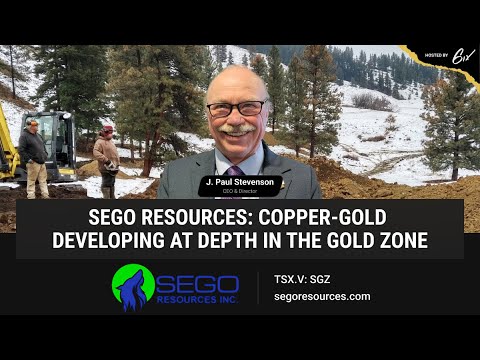
0:08 Hi everyone and welcome to Segoe Resources live investment summit today hosted by 6 and please introduce the CEO and director of Segoe, J. Paul Stevenson. Paul is going to walk us through his company presentation and after we'll be taking some questions live. Remember that you can ask your questions using the Q&A tab found on the right hand side of your screen at any time during today's presentation and talk. And as always, this event is being recorded and be available to watch on Six.com in the coming days. But, Jay Paul, without further ado, I'd like to pass it over to you.
0:37 Hello everybody. I'm here to talk about our drill results and on this first slide you can see how we've stepped back 50 meters in each of these holes. And the reason we're doing that is we do believe there's a blind copper gold porphyry, and I'll go into details why we are believing that in a moment. And we felt the best way to find it is to do methodical definition drilling of the gold zone, and a porphyry should be just below it or beside it. So, and We're now feeling from the results we got that we should come in from the north.
1:28 The reason we're thinking and are convinced there's a blind copper-gold porphyry here that and are convinced is a blind copper gold porphyry here is that in hole 59 you read the results where that big 24 gram ton gold kick is We believe that may have been Electrum because of the high silver that came with it. And there was also .95 copper and on either side of it, .1, a couple .2 copper numbers as well. In hole 55 from a previous drilling, our last drilling, again in the northern part of the zone, we did get 17 meters of 0.1 copper and all of the copper results contain excellent gold. So that's a good sign for us.
2:24 And also in our drill holes we've been doing thin sections, that's microscopic studies of the core and polished sections because we can't see, it's such a fine-grained intrusion that we can't see all of the alteration. So by doing microscopic studies of it, we can actually see the K-Feldspar alteration, we can see also a very, very fine-grained chalcopyrite is with the gold zone. So this existence of copper around the zone is important to us.
3:09 This slide is showing you how we're doing this. We're exploring the zone to find western and eastern edges. We think we have the eastern edge with the whole 58 not intersecting it, but that could be a number of reasons and we'll need to do some more drilling over there to make sure that that doesn't contain it. And we've been drilling to the west. So the idea is to get the strike length of the gold zone and that diorite intrusion. And you can see on this slide how far back we step with Hole 59. And we have intersected this gold zone from the north.
4:05 There are still 6 1⁄2 holes. We've only released half of hole 59 because that's all we received, but it pretty much covers the gold zone. I do believe we've left the gold zone and into other rocks below. And why are we doing that? Well, these deposits often, there's a mineralizing event. Perhaps this manzanite to the north, The orange color is a heat source. Perhaps there's other, we know there's a variety of intrusions in the area. On this slide, you can see the hatch mark pink, which is a micro diorite, the diorite porphyry, the monzonite.
4:53 And oftentimes the mineralized source is pushing mineral of different types depending on the sulfur content into other intrusions. So it's not rare to find 1 type of deposit, say all gold and then beside it copper gold in an even in a different intrusion not necessarily the same one you've got your gold in. So that's why we're doing a methodical
5:30 on section line drill program so that we can put these together easily into a 3D model that makes sense and where we can explore for the copper gold porphyry at the very same time that we're
5:47 drilling tonnage and resource in the gold zone. Because it's so fine-grained and there's absolutely no way of knowing if you're in the gold zone,
6:06 The other holes, we won't know until we receive the assays as to whether or not this zone is continuing. We'll be getting those assays over the summer. We shipped in batches. So I'm hoping in the next couple of weeks to have more assays and they'll extend probably well into July that we'll be releasing news on those. I'll go back to this this one. So we'll continue along the line where we've crossed the gold zone, stepping back 50 meters to 75 meter step outs
6:51 on section with the previous holes. And that's really the exploration technique we feel will give us the greatest opportunity to, 1, by increasing the depth of the gold zone, we increase the tonnage, and also that'll give us the opportunity to locate a blind copper gold porphyry if 1 exists and on our premises that it does exist. So you can see on this map that We have our latest drill campaign has given us section holes along the strike towards the southwest and as these holes come in we'll get a better idea where the edge is. I don't even know at this point whether hole 64, the most westerly hole, is the edge. So those are the things that we'll be looking for. And we'll also be watching for other intrusives and other types of mineralization as well.
8:15 As I said, we are expecting more assays. They'll keep coming. Typically, there'll be good ones and bad ones.
8:24 But the main thing is that we are increasing the size of the resource every time we go to depth or go out on length and intersect the gold zone. And that's really our game plan at this point. Continue drilling off the gold zone and doing that by step outs that will enhance our ability to locate a copper gold porphyry. I'm not sure that I've covered anything everything that everybody would want to see And so I'd like to start the questions now if there are any. Absolutely, Jay Paul. So we already have a few questions that we've already received effectively, but I'd like to remind everyone in the audience that if you do have questions, to submit them now using the Q&A tab found on the right hand side of your screen.
9:20 First question is though, how does this relate to other deposits, J-Paul?
9:27 We have seen in, for example, Mexico where there'd be an intrusion with a gold deposit, and the mineralizing intrusion, where this mineral came from, has mineralized nearby deposits that are polymetallic, numerous metals. In the alkalic variety, there's normally clusters of deposits, and if you take Kodiak to our north, They've been getting great intersections in a variety
10:07 of zones, which hopefully will be deposits. Copper Mountain has been mined for nearly, maybe even over 100 years now, off and on. And their deposits were originally the high-grade copper in tufts and that sort of thing, where the mineralizing agents of where the rock shattered well, went through very heavily to copper gold porphyry. And the other thing about alkalics is they open up quite a bit of depth, grade often increases the depth. So this is fitting in with that. We're in the same belt of rocks
10:51 as Copper Mountain, Kodiak, the new Afton Mine. This is really a very, what we call, metaliferous belt of rocks. No, fair enough, absolutely. The next question is, you know, what can you describe the relationship with First Nations? Yes, we're, we work with the Upper Similkum Indian Band, who are very knowledgeable about mining and exploration. I had the pleasure of meeting with them on Tuesday, which was our first face-to-face meeting in about 2 years. And we try to work completely with them and with the town of Princeton, but the First Nations are very valuable to us. The
11:50 reclamation work, site preparation, everything is done by First Nations crew, and it's just amazing work that they provide us. And there's a lot of knowledge there so we really enjoy working with them. It's a complete pleasure. Now that sounds good to me. What's the relationship like now with the the Minds ministry?
12:20 I know people complain about permitting time, but when you work closely with people like that, you realize it's a capacity issue. We try to work closely with our inspectors. We were just actually inspected the other day, Monday, for our reclamation work which we received a report right away, basically praising our work. There was nothing we had to improve. And that's again because of the Upper Samoa Indian Band, not because of us. They're the ones that do it. And we're in a point in this province, there's a, because of COVID, slowed a lot of things down.
13:11 But there's a lot of change happening in the permitting process. And so there are a number of ministries involved and not enough staff. But so when people complain about the length of time of permitting it, this is an issue that government has to work on. But The individuals that we work with are absolutely fantastic.
13:36 They're really great to work with, very knowledgeable. So we've maintained, and that goes back to my youth When the Ministry of Energy and Mines had better budgets, we used to have government regional geologists in the field working in areas where there was a lot of exploration activity. And Great friendships developed out of that. That's great. Based on today's presentation, what would you consider to be the biggest highlight in your opinion, or maybe the most important element that potential investors would want to walk away from today with? Well being a copper guy, I think the biggest thing is that this is the second drill hole where we've hit elevated coppers in it. And when we first started, because
14:40 this is an intrusive disseminated gold deposit, but it doesn't have the characteristic markers, geochemical markers of an intrusive related gold system. So from the beginning we've had this feeling that we're looking at a distal event from a copper gold porphyry. And I think our drilling, our previous drilling and particularly this drilling, we're seeing much more elevated copper in our core, which is really enhancing that belief that we are really looking for applying copper-gold porphyry. And also, with the enhanced copper is coming enhanced gold, so that is a very good sign that the copper gold porphyry would be copper gold rich.
15:31 Oh fair enough. Can you walk through for the audience maybe the 6 to 12 months of what your upcoming catalysts look like? We'll be having assays through July, weather dependent, because we're in southern British Columbia in a semi-arid region, we normally shut down for the fire season. We're on a ranch, a very old established ranch, private property, Linda Allison's Rancher.
16:04 So we don't take any risks in fire season. So if it's hot and dry in July and August, we will not be drilling. We normally start our next drill program in September or October. Again, weather dependent is how dry it is. And we drilled last year into December. That's normally when we stop drilling. And I should point out we drilled last November during the Atmospheric River.
16:39 Semi-arid region, worried about snow coming and water lines freezing and we got rain. We got mud, but you know, in a semi-arid region, mud is not a normal event. But our guys worked right through it. We have a tremendous, tremendous crew. We use Wayne Chopper, our drilling, his son Dustin and Kelly, the drill helper, and our field crew, Cody and Constantine, just worked right through it. They couldn't get meals because the town had lost its water power or part of it. But the grocery store was open so they were getting snacks and heating them up in the microwave in our warehouse. Coffee at the gas station, but they worked right through it. But normally, September, October is a great time to start work. It's great weather right up until mid-December easily.
17:38 Right, absolutely. Could you talk about any more permits that are required or the status on permits that you were acquiring? Our permit expired, expires on June 28th. We get five-year, multi-year area-based permits. We get five-year permits. It has been indicated to us that we can't get an extension if there's, If we want to go drilling before the new permits completed, we can't get an extension on our permit. And a lot of that, the reasoning behind that too, is that it's easier for a ministry to give you an extension on a permit if there are no issues, like reclamation, like consultation.
18:28 And consultation's a bad word to use. When consultation's got a formal meaning to it, we just consider it meetings when we meet with the First Nations. And as long as everybody's pulling together, then an extension isn't an issue. Right, absolutely. Well, listen, Paul, I'd like to remind first of all and foremost that we do have some time. So if you do have any questions, please submit them. But Paul, I wanna thank you right now for coming on today, going through your slides, going through your presentation, going through these nice question and answer period. If anyone has any questions after the fact, feel free to reach out to either J. Paul on the team or CYX.com. We can always make sure that these questions get to the team so that you can get your answers. You can also of course find more information about Sego Resources on their website, segoresources.com.
19:22 Paul, I want to hand things back to you for some final words before we wrap up the day. I'd also just like to know that for 2 years we haven't been working much in our office. The office phones are forwarded to me and I enjoy getting phone calls from shareholders. If anybody has questions or just wants to ask something, I really enjoy that. So please don't hesitate to call me. Either you'll see in our website an 800 number that'll come to my cell phone or the office number, it'll come to my cell phone. I have taken questions from shareholders while standing at the drill. That we have cell phone coverage on the site. So I'm always happy. I'll return your call if I'm not available. When you do call, just leave your number.
20:15 I'm really open to that. I really enjoy talking to our shareholders. Wonderful. Well, you heard it here. Call Jay Paul while he's at the drill site. But Jay Paul, I really appreciate it. And thank you again. With that, I think we'll wrap up for the day. Thanks very much, Cam. And thanks everybody that tuned in. Thank you. Thank you.