Eben Upton
Chief Executive Officer
Replay available
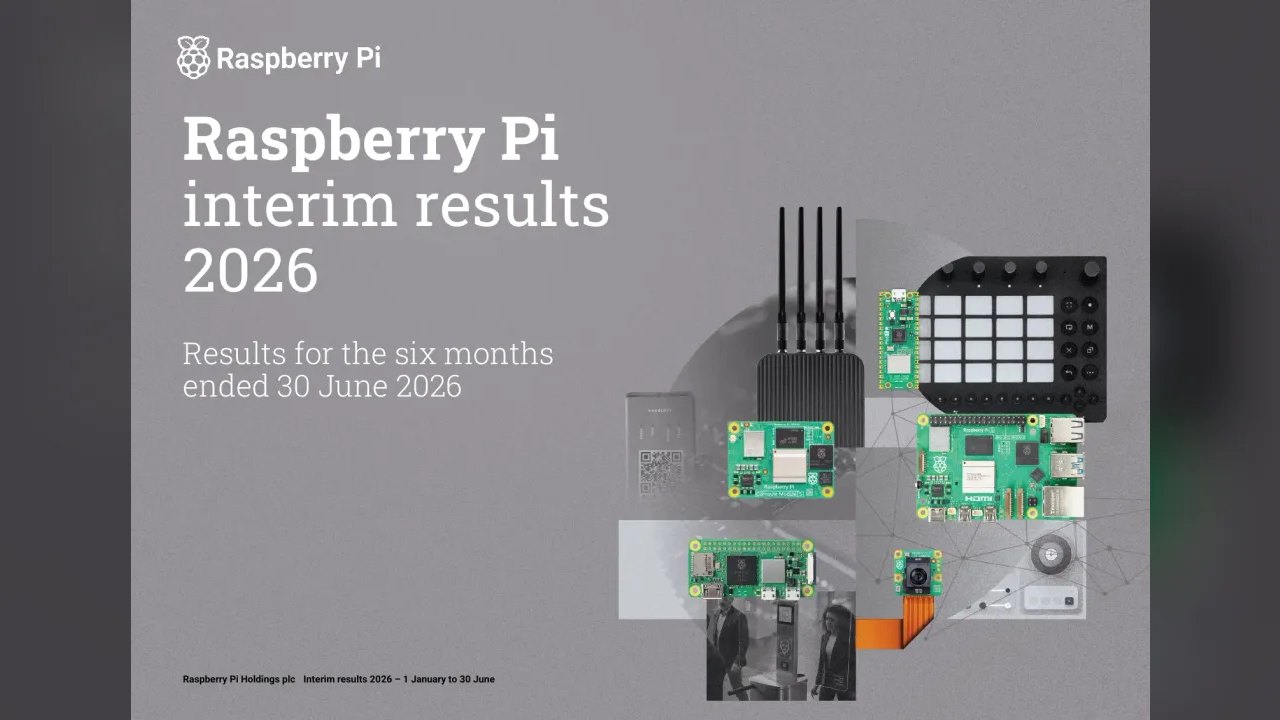
Raspberry Pi Holdings (LSE:RPI) Q2 2026 earnings call, held 2026-09-24. Watch the replay and read the transcript on 6ix.
On 6ix: 6ix.com/event/raspberry-pi-holdings-plc-rpi-q2-2026-earnings-call
Automated transcript · Written by software from the replay's audio. It can mishear names and figures; the replay is the record.
0:00 Good afternoon and welcome to the Raspberry Pi Holdings plc interim results 2026 investor presentation. Throughout this recorded presentation investors will be in lesson only mode. Questions are encouraged and they can be submitted at any time using the Q&A tab situated on the right hand corner of your screen. Simply type in your questions and press send. Before we begin I would like to submit the following poll and I would now like to hand you over to CEO Eben Upton. Good afternoon.
0:27 Good afternoon and welcome everybody. Welcome to our 2026 interim results. I'm Eben, joined today by my colleague Richard. We're going to take you through the first half financial results for the business, give you some updates on progress against our strategy, but I think first perhaps we could just take a quick look at some of the highlights of the half. I mean, quite simply, this was an exceptional first half for us. So record revenue, record profitability in the business. We shipped over 4 million units. We shipped 4.2 million Raspberry Pis and a half with our customer order backlog doubling to 2.6 million units. And all of this happened despite an incredibly challenging supply chain environment. Our diversified DRAM supplier base helped us weather the worst of that, helped us keep our products in production and in availability through the half. Despite these challenges, we kept innovating.
1:24 The half saw five new product and platform launches, improving support for AI workloads on Raspberry Pi 5, helping our OEM users through the memory crisis by giving them more memory density options on Raspberry Pi 4, and streamlining IoT deployments through improvements to our Raspberry Pi Connect platform. We kept investing in our OEM customers too, making targeted hires into our commercial team and our board-to-board program continued to deliver traction in the smart home and defense sectors with a number of meetings with C-suite members of the C-suites of UK listed industrials.
2:11 We kept investing in broader operational capacity too. We hired Tim Mamtora in March as our first Chief Operating Officer. He and his team are already building the repeatable processes that will allow us to continue to scale our business without sacrificing the engineering-led culture which makes Raspberry Pi Raspberry Pi. and together these developments give us confidence in our outlook for the rest of the year. We're expecting higher volumes in the second half than in the first half and we're expecting full year adjusted EBITDA to be above market consensus. So now I'll hand over to Richard for the financials. Great, so I think as Evan said, this was I think across almost all metrics a very good half. we had a strong improvement in unit volume it continued to grow half on half as you can see from the chart it's really progressed from actually the end of 2024 each half we've consistently grown finishing at 4.2 million units it was particularly good to see the demand was in compute modules raspberry pi 4 raspberry pi 5r higher our higher margin our higher value boards our latest boards That indeed, that demand was strong that left us with a backlog of units at the end of June 2026 compared to 600,000 at the end of 2025 to 2.6 million now.
3:41 and similarly over the period we've had to increase prices because of memory increases but pleased to see how the demand for products has held up through that period and indeed the demand for our four gigabytes and eight gigabyte versions of Pi 5, Pi 4 has continued to be very strong even though prices have had to go up. Overall that gross profit per board improved significantly because of those price increases and also because of the benefit of memory that we had acquired at the end of 2025 at lower costs that we have used in that first half. So overall, we ended up with gross profit up to 59 million, up from 33 million a year ago, and that dropped through to a profit of adjusted EBITDA, our key profit metric of 40.3 million compared to 19.4 million in the first half of 2025.
4:41 Sorry forgive me, it's a slight remote control this one. Moving on to the next slide, yes. 26% growth in our direct units. So overall, the units supplied by us, so manufactured in our factory and with Sony in Wales, grew by some 26%. The volumes with Farnell were a bit slower. And overall, we ended up with volumes up 17%. That was again said earlier, particularly strong growth in compute modules and Pi 5, Pi 4. We saw lower growth, probably slightly negative actually in the case of Pico and Xero, which you may know are our lower cost boards.
5:27 In the case of Xero, that volume was limited by access to supply. Our packager of the processor chip in Taiwan was somewhat distracted by data centers. That is now Thank you very much. That translated into a strong growth in revenue so with the increase in units and also an increase in the average selling price as I said we increased our prices because of needing to pass through the increased costs of memory so our prices went up about 42% leading to an over 90% increase in revenue through the period.
6:18 Our revenue comprises a mixture of things. It includes royalty income for Farnell. It includes the direct sales of boards. It includes the sale of accessories. It also includes the sale of memory chips and processor chips to Farnell to make Raspberry Pis. So it really does have a number of different things with quite different margin structures. So when we look at the business we focus more on gross profit and in particular gross profit per unit combined with the number of units that we've sold. Gross profit overall increased by 79% due to those higher sales I've talked about and also this improvement in gross profit per board. Gross profit per board, so that's the profit we're making from sale of boards divided by the total number of boards in the period, increased by 53% from $8 in the first half of last year to $12.20 in this half.
7:12 and that reflected a combination of factors it was the increase in the prices that we were selling and actually the way in which those took effect once we'd announced them but also this benefit of inventory that we brought in to the beginning of the year where we had bought at significantly lower prices before the increase in memory costs that we've seen really in the last six to nine months That beneficial effect has probably been largely consumed now by the time of the middle of the year. I think it's fair to say that the current cost of inventory that we are now holding, we're now putting into boards is much closer to the price at which we would buy further inventory at the moment.
7:59 The other standout was accessories. We had a very good half for accessories compared to the number of boards sold. It grew that gross profit per boards increased by The gross profit increased by 90% to $7.8 million compared to about half of that number a year ago at a number of about $1.90 per board sold, which is well above our target that we set ourselves of $1 per board. We saw particularly strong growth in computers and cameras. in SD cards displays but also in AI hats that we work we put together with our friends at Halo and we sell as an add-on to the Raspberry Pi. The Raspberry Pi is giving you additional compute for particularly for AI models such as neural Convalescent neural networks or also for large language models on the latest version with Halo. Overall, so a strong growth of gross profit in the period.
9:09 Moving on to the next slide. Just putting those together in terms of how did our EBITDA evolve through the period. We came into the first half of last year was 19.4 million. Unit growth has given us probably nearly $5 million of additional profit, so the additional units. That gross profit per board, so moving from $8 to $12 for each of those boards, is probably worth nearly $18 million of additional profit. some of that clearly because of the memory that we brought in and also some orders that we had placed in the tail end of 25 particularly good prices this year we think the value of that was probably a one-off if you will of somewhere between 10 or 15 million dollars and then the appreciation accessories and then in terms of overheads the research and development expenditure that we have that is is not capitalized it's research and development it's research it's software development which typically we don't capitalize that increased by about 700 000 that's predominantly some more heads but also inflation salary increases and then adjusted administrative costs this is more of the general central team be that sales be it Lotus Eaters like myself that grew by about 4.6 million that was a combination of there was some one-off effects of foreign exchange There's some additional bonuses
10:39 reflecting this much stronger performance that was probably there's about a million of extra accrual million and a half there and the remainder is really headcount increases and increases in salaries generally across the team. Allowing for those we ended with the half with the result of 40.3 million of EBITDA. The next slide sets out the income statement, very much the matters we've just covered recently. I'm going to skip over that one and I am going to move on to the description of the balance sheet here but I think the best way to express that is in the cash flow and how our cash flow has moved across the period.
11:25 We came into the beginning of this year with 28 million dollars of cash. EBITDA, the profits that we've just been talking about, contributed 40 million. we've then spent significantly on inventory that is almost entirely that increase in inventory that we are now carrying is 106 million of that is purchases of DRAM that we use in our boards I think that has and that is the position at the end of June that's put us into a much stronger position in terms of having nearly three months of inventory we've continued to add to that recently such that we have good confidence that we can meet our production plans for the remainder of this year and into the first quarter of next year but that memory obviously these days is at a significantly higher price than it was a few years ago that inventory at the end of June was funded in part by payables we bought significant amounts in June itself and therefore there was a payable at the end of the period that has started to reduce so this is we've seen a cash outflow continuing post the end of June and therefore we're drawing on our bank facilities we increased those facilities to 140 million have committed funds that was completed in early July which has given us a position where we're able to buy inventory where the opportunity arises to secure that future production
12:56 to secure good prices on the products such that we can maintain an attractive level of profitability but I think it's fair to say that in the second half the profit per unit will come down as those memory costs now are closer to market levels rather than based on prices from very good historic purchases receivables also we saw some outflow in those as at the end of June that was really a function of just how strong trading in the month of June was a very active month obviously compared to December which is a quieter month by the end of the We spent about 11 million on capex in in the first half very consistent with the guidance that we've given for the last few years of about 20 million of capex for any full year so that continues a little bit of tax leaving us with a closing position of about 8.4 million of tax As I say, I think in the second half those payables will reduce. They were particularly high at the end of June and we also expect to be buying and holding quite a bit of memory.
14:16 We can see the opportunity to do so. That will leave us probably with acquiring further inventory such that we would expect to see our debt levels at say 40 to 50 million. but I think we should flag that if opportunities arise, if there are good prices, if there is the opportunity to acquire the right memory, we will utilise some of the additional headroom we have on the bank facilities to add to that inventory to make sure that we go into next year in a particularly strong shape. Just touching on a final slide from me, memory purchases. I think one of the things that's notable is compared to the announcement that we made in early June about how strong trading was, a lot of the numbers I've talked about here are very much in line with that.
15:07 I think to me the additional feature, the additional new news probably is the strength of our position with memory purchases. I think Mike Buffham, our Chief Commercial Officer, has done a phenomenal job of talking to packages, manufacturers of memory to secure that. and that position I think is a step forwards from where we were even two or three months ago. How have we got into that position with a stronger position on memory? We've diversified suppliers. We now have approximately seven different companies providing memory to us compared to two a year ago. We have used our engineering skills to technically innovate to actually allow us to use two one gigabyte pieces of DRAM to create a two gigabyte board. I'm not sure I got the maths right on that.
16:05 and two lots of two to make four which gosh it's all binary how easy similarly on pricing we have I think minimise the disruption to our customers expectations of us by communicating quite clearly the reasons for price increases to be seen to be passing through price increases rather than gouging on selected products and really also providing in terms of a Raspberry Pi three gigabyte variant additional options for customers who maybe did not want to go to suffer the whole of a price increase that was necessary and we've continued to make strategic purchases we have seen the opportunity with our balance sheet with our connections our reputation to make further purchases from suppliers who in certain cases are keen to establish a presence elsewhere and we have been a very good we have been seen to be a very good partner to them in achieving that.
17:08 So I think overall a lot of activity in terms of securing memory and that's put us into a stronger position than we were say three months ago and I think in that good position hand over to Eben to talk some more.
17:23 Thank you Richard. So before we dive into the strategy update just to recap about the three pillars of our Thank you all for joining us. of the silicon bill of materials in each device. And the gradual migration, and we've seen this continue this year, the gradual migration of our customers to higher density skews, even in this constrained DRM environment, we have seen an increasing preference from many of our customers for high density skews.
18:14 Those are high density skews, they're higher ASP skews, and that higher ASP brings with it a higher unit profit. and then finally growing our margin participation, growing our participation in that margin. Obviously the board-to-board initiative is a particularly fertile source of direct relationships with OEMs of our three different routes to market. The direct OEM route is the route that allows us to capture the largest share of that unit profit margin in the device. a little bit more detail about product launches as we said five launches in the half that is a relatively quiet half for us compared to recent years but with some real strategic highlights and I think speak to the strategic direction of the business at the start of the half the second generation Raspberry Pi AI hat accessory co-developed with our friends at Halo and bringing generative AI capabilities to the platform. The original AI accessory very much focused on vision operations, very much focused on the classical network architectures, so convolutional neural network architectures.
19:28 This new product bringing with it both the ability to run smaller large language models and vision language models and also on the vision side then more modern architecture, so vision transformer based classification algorithms. In the middle of the period, the three gigabyte variant of Raspberry Pi 4, that's in direct response to specific OEM requests for an intermediate density point. We continue to be surprised by the extent to which our OEM customers aren't trading that. if anything are trading up for memory but we do have OEM customers who would who welcome the opportunity to invest fixed cost to do engineering to make engineering investments to take memory requirements out of their software platforms providing for you know if you think that four gig products really they're the heart in our modern products the Raspberry Pi 4 and Raspberry Pi 5 Four gigabytes really is the heart of the business.
20:22 We have an enormous number of four gigabytes OEM customers. It is challenging for a four gigabyte customer to come down to two gigabytes by providing that intermediate density point on the Raspberry Pi 4 platform. We're able to serve those customers who want to trade engineering effort for unit cost. And they're not quite in the half, just off the end, just into the start of July, at the start of this half. We have the programming jig for Compute Module 5. This is our part of our offering to our OEM customers who wish to be able to program Raspberry Pi compute modules in production at scale, designed to integrate with some of the work we've done around operating system assembly and imaging over the last couple of years. And in parallel with all these efforts, of course, we've seen a series of upgrades to Raspberry Pi Connect, our IT cloud platform.
21:08 Very different cadence for this from what I'm certainly used to. Certainly, if you imagine the cadence of hardware releases being on the order of years, the cadence of operating system software releases being on the order of months, quarters of months. This is a product which has seen multiple upgrades with a cadence of weeks across the half, that's driving continued strong growth in adoption both of the baseline Raspberry Pi Connect platform, the free Raspberry Pi Connect platform and the paid for Raspberry Pi Connect for Organizations platform. now we love uh we love case study slides we couldn't not feature this one i think in this slide deck um formlabs uh 3d printer company they're a long time raspberry pi uh adopter a very uh loyal uh adopter of raspberry pi technology uh outsourcing as with many of our rem customers uh outsourcing really the intelligence element the computer element at the heart of their professional 3d printers to us uh you know a wonderful gesture i guess one or every time an oem makes that choice, it is a gesture of commitment, it's a gesture of faith in the Raspberry Pi organization and the Raspberry Pi platform and it was wonderful to see the Formlabs, a Formlabs Raspberry Pi powered Formlabs 3D printer taking pride in place in one of the videos that was shown at this month's Apple event.
22:32 So these devices really do get absolutely everywhere. Really this has been here, we talked a little bit about products, but really I think the news about this half for us is it's been a period of organizational transformation for Raspberry Pi. We've been growing, we've been involving the executive team inside the organization. In March we appointed Tim Mamtora, a very old friend of mine, as our very first Chief Operating Officer and then this is Richard's last appearance in a results presentation. Tim Powell will be succeeding Richard as Chief Financial Officer from the end of next month.
23:18 We've been making targeted hires across the rest of the organization as well in engineering, in operations, in finance and in enterprise sales as we aim to both increase the organization's ability to develop innovative new products and then and so on. And we've been able to bring those products into our enthusiast, our industrial and our OEM customer base. There's been a focus in the new operations organization under Tim, there's been a focus really on building the capabilities, the structures and capabilities that we need to support the next phase of Raspberry Pi's growth. This is across the organization in engineering operations, but with a particular focus on manufacturing and supply chain operations, really driving Sony, our manufacturing partner, for the majority of our products driving their production capacity out to a million units a month which is where we believe it needs to be in order to support our growth admissions over the next few years.
24:15 We've been expanding the commercial team as well, both colleagues who support our approved reseller and authorised distributor channel and the partners who support the growing number of direct OEM engagements within the business. as we've deepened our relation our direct relationship with OEMs particularly with the OEMs who we meet through our board to board program these tend to be larger potential opportunities but they also tend to be opportunities which may require more targeted support from our organization or to get those opportunities over the line so we've been making those investments in our application engineering team to sustain to be able to sustain those engagements even as they require a little bit more touch as I say to get them over the line.
25:04 A word on competitive landscape, it really is a rapidly changing competitive environment at the moment and I think what we're seeing is we're seeing Raspberry Pi's core brand values, our very long-standing core brand values our industry leading cost structure which is underpinned both by proprietary technology and by that end-to-end engineering culture we've built really can go hunting for cost optimization opportunities throughout the entire technology stack our commitments to the very long-term support and very long-term availability of our products and the unmatched organic ecosystem that's grown up around Raspberry Pi so these are our long-standing brand values and I think what we're seeing this year we've seen over the last couple of years is he's starting to intersect with a set of new imperatives in this more complex environment we're living in so we're seeing a greater emphasis in many of our markets on sovereign capability for our American customers, North America, the United States accounts for roughly a third of our business and in that environment our customers have a particular focus now on the tariff implications of the tariff behaviour of their supply chain and there we are building our products, building the vast majority of our products in the United Kingdom we are differentially advantaged from a tariff perspective versus almost any other non-domestic manufacturing location for an American customer and finally we see a growing amount of regulatory burden a growing regulatory burden on our
26:34 customers who are building connected products our customers who are building IoT products are having to comply with an increasingly strict set of requirements in order to be able to legally ship those particularly the cyber resilience act is the most obvious example it is It's increasingly important not just to be able to build products but to keep those products secure over time, to have a story about how you keep them secure over time, an evidence story about how you expect to keep those products secure over time. And you're not just generating when you build a software image you're not just generating software of course you're also generating compliance artifacts which must be synchronized with that software build and many of the investments that we've made over the last few years in deepening the Raspberry Pi software ecosystem are really coming to bear and are becoming increasingly salient as people as many of our OEM customers many of our IoT focused OEM customers are confronting some of those challenges and of course all of this is happening in a much more challenging supply chain environment.
27:37 I think we are seeing signs this year one of the drivers of growth in sales, one of the drivers of growth in that backlog has been what we might call a flight quality that we have OEM customers we are meeting just as our existing OEM customers We are also seeing new OEM engagements which are driven by our OEMs who have designed with other modular platforms, OEMs who have chosen to outsource compute to other vendors where those vendors are now struggling to keep their products in production or OEMs who have chosen the in-house engineering solution OEMs who have chosen to make rather than to buy those in-house those in-house teams may also be struggling to secure the components they need so we are seeing people coming to us as a trusted partner to see them through this supply chain environment and of course for us that is an opportunity to meet new customers it's an opportunity to get in the faith of new customers to be of service to those customers and hopefully many of those customers will remain with us even even after the present supply chain environment has improved a little bit.
28:51 A few brief words on AI, we all know that we are living in an age of AI related disruption this couples into our business in numerous ways obviously we've already talked about some of the supply chain impacts of competing with the AI the hyperscaler AI build out for access to a number of components most notably storage components volatile and non-volatile memory but I think the more we see so many of our customers the applications that our IoT OEM customers are running have a very strong AI flavor to them and the more we see of how our customers are using AI the more convinced we become that there is a significant opportunity for us here we believe the thesis is that there is a centrifugal tendency over time a tendency for ai compute to migrate from the center of the network any given ai technology any given ai technique may start at the center of the network and over time as the devices at the edge of the network become more performant and as uh research effort in uh in ai drives down the compute requirement of a specific level of performance, that compute that starts at the center of the network will naturally migrate to the edge.
30:03 As it migrates to the edge, that migration brings with it improvements in reliability, in cost structure, in privacy, and in security. This does feel like a general rule. We absolutely see it today in visual AI. Many of our largest, many of our highest volume OEM customers today are using Raspberry Pi platforms to run visual AI algorithms, which would have been inconceivable to run at the edge of the network a decade ago. we are seeing the same thing already happen in generative ai we are seeing a collapse in the compute requirement of a given level of generative ai performance and so we believe that that transition from the center to the edge of the network which has taken roughly 10 years in the previous The previous AI applications and visual AI applications is likely to take place over the next two, three or four years in generative.
30:56 By the end of the decade, the vast majority of inference operations for generative AI will happen at the edge role at the core of the network. These trends in AI are driving demand across a very broad range of markets. I'm going to call out two today, those being smart home and aerospace and events. So some words on smart homes, smart environments. Customers like Homey are using Raspberry Pi technology, another very long-standing, extremely loyal a Raspberry Pi customer. They're using the Raspberry Pi platform to build intelligence into our everyday interactions with our environment.
31:41 I love this quote from Emil, we didn't have to reinvent the wheel. He says that really what he's doing there is he's articulating the core of the Raspberry Pi value proposition to our OEM customers that you don't have to become a computer company if you want to embed intelligence into a product at the edge of the network. You don't have to, you should not have to. become a computer company today you should be able to find some video outsource that too it's our aspiration to win that argument and when we've won that argument then to win the argument that the natural person to outsource this to is Raspberry Pi. This outsourcing is I think a very long-term trend that's been to our benefit over the last few years and it's been accelerated by The challenges around network pricing and availability as I've said by some of the challenges around regulatory complexity and of course vastly by the challenges associated with acquiring embedded engineering talent.
32:35 Many of our OEM customers are coming to us for compute solutions in order to avoid not just the cost but the administrative complexity of building and maintaining a team which can build and maintain in production the compute element at the heart of their we're allowing people to focus on their differentiating on their value add on their differentiating engineering not on the non differentiating engineering of being a computer company and then Defence are becoming an increasingly important potential market for us. There are a number of secular demand drivers going obviously here in the background, a trend in the West towards realignment, a recognition that we have probably wound down the size of our armed forces further than is wise.
33:22 a growing recognition driven probably by some of the experiences that are happening today in Ukraine of the importance of autonomy of advanced autonomy of distributed decision making in mobile platforms a pivot away I think from what we might call exquisite platforms towards high cost low volume platforms with very long development times of development times on the on the order of decades towards lower cost, a treatable lower cost consumable platforms and enabling that transition a move from only using military specification electronics to a growing focus on COPs, commercial off the shelf technology, as I say, as an enabler both for the cost and the availability and sustainability of these platforms.
34:11 as we look more at the defense market, really struck by the range of applications that Raspberry Pi fits very neatly into. Whether that's fixed hardware back at base, whether it's driving display screens or aggregating data in a fixed location, whether it is just deployed static hardware, So, sensor platforms in the field, RF decoys in the field, or whether it's providing intelligence and autonomy for mobile unmanned platforms like UAVs, USBs and UGVs. And all of these markets, just like our commercial customers, all of these markets stand to benefit from Raspberry Pi's distinctive value proposition. Industry-leading price performance, availability and long-term support, and the ability to manufacture these products and sustain them at scale.
35:03 A word on silicon. Silicon really remains at the heart of Raspberry Pi's medium term growth strategy. It has been and it continues to be an enabler for our single board computer and module business. We build silicon because it allows us to build better board level products, better modules, better SBCs than we could build otherwise. But increasingly, it's becoming a business for us in our own right, in its own right. We saw slightly lower sales in the first half of 2026 than we did in the comparable period in 2025. It was a strong comparable period, I think. We had a number of large OEM orders in that period. But then we followed July and August this year, absolutely fantastic months. August in particular, a record month for sales of the RP2350 platform, the two-year-old second generation microcontroller platform.
35:57 particularly strong sales and particularly strong and particularly broad-based sales for those products in China. We continue to develop engagements with tier one and tier two OEMs in the west. That's inevitably a slower burn because of the western engineering culture is inevitably a slower engineering culture but we're confident that those will mature into core into design wins. We have taped out in the second half, in the last month, we have taken out our next generation semiconductor product, expect to get that back at the start of next year and that may in due course lead to future board products, future innovative board products and future standalone semiconductor products.
36:44 And finally, a word on Outlook. um we expect the second half volumes to be higher than first half volumes what's going on there continued extremely strong demand um the backlogs that we both referred to earlier uh 2.6 million units at the end of the first half uh those are large backlogs they're probably verging on unhealthily large backlogs so there's a great focus in the organization at the moment on reducing those backlogs not to zero but the aspiration is to get those backlogs back towards the levels they were at at the start of the year. To support that we've been making a number of co-investments with our partners at Sony in order to increase their production rate and we expect that Q4 will see the full benefit of all of those investments.
37:30 Despite this taper off we saw some exceptional unit economics In the first half of the year, some of the price increases that we've put through interacted with the low cost inventory that we were holding, that we came into the air holding. Despite the taper off of those exceptional unit economics, we do, as a result of those increased unit volumes, expect adjusted EBITDA to exceed market estimates somewhat. We are now holding enough RAM, we have enough RAM in our hands and on secure order to meet our requirements for the remainder of this year and into next year and we're excited about what 2027 and 2028 will bring to Raspberry Pi. So I'm now happy to take questions. Fantastic. Eben Richard, thank you very much indeed for your presentation.
38:16 Ladies and gentlemen, please do continue to submit your questions using the Q&A tab situated on the top right corner of your screen. While the company take a few moments to review those questions submitted today, I would like to remind you that a recording of this presentation, along with a copy of the slides and the published Q&A, can be accessed via our invested dashboard. Eben Richard, as you can see, we have received a number of questions throughout today's presentation. and if I may now hum back to you and kindly ask you to read out the questions where appropriate to do so and I'll pick up for you both at the end. Thank you. Okay, let's do it. So you're going to read them out? I'm going to read them out. I'm just trying to mostly I'm going to familiarise myself with the order they arrived in.
38:54 What new products are in development? I think we share with another fruit named company a tendency not necessarily to talk enormously about what products we have in development. I mean I think we can say you know it is it's uncontroversial to say that we obviously need to be starting to think about the next generation of our two platforms. So we need to be thinking about the next generation of the big Raspberry Pi platform, the Linux-based platform, the thing which will eventually become Raspberry Pi 6. and the next generation of the smaller microcontroller platforms are the thing which will generate both Raspberry Pi Pico 3 and the next generation RP2 series microcontroller. Obviously we are still some distance where both of those platforms are still fairly, the five and two platforms are still fairly new but certainly we're now reaching a point in their life cycle where I think attention does turn to future products.
39:47 I think we've said that it's like you're likely to see more Raspberry Pi I think it's likely you will see from us over the next 12 to 18 months, you're likely to see from us Pico 2 products which have a broader range of network interfaces. We've talked about that in the past. and pretty much all of those you think about, we are one of the big hitter accessory items, power supplies, displays, cameras. I think it's fairly likely that we will try to find ways to extend that. As we get a better understanding of how our various customers, our enthusiast customers, our industrial and embedded customers, as we get a better idea of what they appreciate, what they like and what they don't like about our existing offering in that space, I think you'll see us broaden that offer out a little bit.
40:42 One day there'll be a six generally follows five, doesn't it? Yes, usually. We've got a couple of questions here.
40:50 One plus one is two. Yeah, thank you for that. Yes, I've got that right. I had to think hard. Can I bring my son to the next one? There's a couple of questions in here about our relationship with Arm. Yes. How's that relationship been developing? What's it like having them as a shareholder?
41:08 I mean, I've been an enormously supportive shareholder, obviously. They were a pre-IPO investor. they cornerstone the IPO, they bought a certain amount of the foundation's old block in April and Arm participated in that secondary sale. So I've been a very supportive shareholder. I often think of this, the substance of the question is what has having Arm as a shareholder done to the strategic relationship? I think I've always viewed this the other way around. I've always seen this as the shareholding recognising, validating, being a consequence of an existing strategic relationship. We have been every Raspberry Pi as an ARM computer.
41:56 I saw a huge number of ARM PCs as a child. The 1980s have great, great affection. The Archimedes have a great affection for the ARM architecture since childhood. So this is something that has always been important. I think that having the opportunity to have Arm as a shareholder has been very helpful for us. It has deepened the level I think where we can have these strategic discussions with them. There will be many more Arm based Raspberry Pi products in the future. I think they're excited about it. We see the roadmap, we see the products they've announced. We're excited about it. They do engage at all levels, senior levels within Orb as well.
42:36 We get great support from them. We're excited about the core roadmap. We're excited about the technology roadmap. We're excited about finding ways to integrate that roadmap with our own roadmap to keep building more high-performance arm-based products. We are a very happy arm partner, very happy arm licensee, very happy arm partner. The arm partner meeting in August is an absolute highlight. And they weren't mean to you when you released a risk five call. Indeed. What steps have been taken to ensure we remain a UK public company? As a UK shareholder, it would be extremely disappointing to see us taken over by a foreign entity.
43:17 I mean, I'm not sure. I'm not sure there is an enormous amount. There are an enormous number of specific things that one can do here other than, you know, we do our best. We are very proud. We try to be as amusing and entertaining in meetings like this to satisfy our UK shareholders that they continue to want us to be independent rather than...
43:36 So we are, look, we are a crowd. We're a proud UK listed public company. We chose the list in the UK. We design our products in the UK, manufacture our products in the UK, we are listed in the UK. We don't do any of these things for, I don't think we do any of these things for patriotic reasons. We do these things because we believe that the UK is the best place to do each of those three things. So we are, you know, we've had a fantastic experience I think as a UK plc. uh you know our aspiration what are we trying to grow here we are trying to build a globally meaningful business um from the uk based in the uk listed in the uk manufacturing in the uk uh and you know while we have the opportunity to we will continue to do that yeah um We have a CRA question. Let's do the Cyber Resilience Act question.
44:31 So this is a couple of questions about the EU Cyber Resilience Act and the requirement for full compliance in December next year. I think this is something that we have seen coming for a long time. It is it drove over the kind of five years, I guess over the period that we were designing Raspberry Pi 5, the awareness that there was going to be increasing government action and increasing government awareness around IoT security drove the incorporation into the Raspberry Pi 5 hardware platform and the Raspberry Pi, the Apple 2350, the second generation microcontroller, drove the incorporation of hardware features. It was pretty clear what hardware features would be required in order to allow, to give people at least the potential to build compliance solutions.
45:21 There's then a software layer on top of that. So we had largely by, I guess, two years ago when we launched 2350, we'd largely completed the process of delivering the underpinnings for CRA compliance. What you've seen subsequently is us then building out both the software level required particularly some of the support for secure updates for secure firmware updates on our platform but also then the tools that people need in order to build the regulatory artifacts certification artifacts that sit alongside so it's no longer enough to build a firmware. Yes I think the first bit we did because it's the right thing to do. Yes that's right
46:01 and you no longer it's no longer sufficient to simply build the firmware image you have to create the certification, you have to be able to generate the s-bomb as well and so a lot of those investments that we made in automating, systematizing the process of building the software image for a Raspberry Pi IoT device, the design of those systems incorporated the knowledge that people were going to have to conform to the CRAs and I think that's gone that's gone pretty well in terms of its impact on us as a business uh it is driving we already see it driving a tendency to use our software not just to buy our hardware devices but to use our software to use our systems when you're assembling the firmware and that's extremely attractive for us because it increases the stickiness of the it increases the stickiness of the platform once you've designed your Raspberry Pi and that's working well it increases the switching cost away from Raspberry Pi as a vendor so I think this is a this is something where you know like many of these things you see a difficult thing you see a challenge and at first you are sad that you're going to have to do some work and then after a little while you realize that having done that work are plank and not a plank in your story about competitive robotics.
47:25 Yes. Yes, your line I've heard a few times from the investors of If you want to buy shares in Raspberry Pi, spend some money on buying a competitor's product first and just appreciate the quality of what we've made.
47:37 The other question was about the UK government. We expect, and whether we are engaged with the UK government on this, particularly around ensuring that whatever legislation is passed permits you to continue to adopt open source software development methods. we we are not specifically engaged on this we do expect the UK government to largely be a follower here we don't expect the government here in the UK to dive I think there is a broad connection I think it's really important that we have a consensus, actually, that open source approaches are the approaches. Actually, open source approaches allied to machine learning tools, allied to AI tools, are the way to build systems which have that level of robustness that you'd be happy to deploy in the wild.
48:42 Changing gear. What's our expectation for unit sales in semiconductor business this year and in the medium term? How quickly should we expect this business to grow? I think in the short term, we're talking microcontroller sales. It would be very sad if it doesn't start with a one this year. So probably in the sort of 10 to 12 scale.
49:04 I think you can put a box around it, which is this is a, let's say, on the order of... yeah on the order of 30 billion business um we have an aspiration there are it's an oligopoly so it's a five-player oligopoly so roughly 75 to 80 percent of that goes to five vendors who i probably can't make i've probably named four of them behind a good day um but the remainder of that market is actually quite finally divided and so an aspiration to go at no more than 2% of the market is not outlandish at all. So I think we have an aspiration to grow the business out into the hundreds of millions of units. I think that getting into double digit millions is an important step along the road.
49:50 Obviously we still have to sustain, we've seen a great growth rate in these products since we launched them five years ago. I think we have to sustain that growth rate and obviously it becomes easier and harder to sustain big as you get bigger it becomes easier and harder to sustain large growth but i think there is an aspiration to do that where do we want to be i think we've said very consistently a decade after the ipo the aspiration is to have grown the uh the traditional business the boards and modules business um significantly and but for semiconductors to have come up alongside that come up underneath that to a point where they're rapidly coming now some of that heavy lifting i think will be done by asp i'm sure you know some of the will have higher ASPs, but a lot of that has to be done by volume. So I think we have, there are sort of two directions in which we are saying the business really needs to find a way into at least the hundreds of millions of units a year of silicone in order to meet those. In order to feel that we are, you know, these are exceptional pieces of hardware, they really are. They are, I think, connoisseurs, we've seen them described sometimes as connoisseurs, Mike, The better an engineer is, the more attractive they are to the Raspberry Pi Silicon platform.
50:59 So I think we have something that's very compelling. I think if we aren't able to get into that regime, then I would personally feel that we've somehow taken a great product and sold it short. We won't have failed technically, we will have failed in translating that technical excellence into market issue. A quick one from reference market consensus for adjusted EBITDA for the full year. I think we're seeing numbers in the sort of range of Low 60s, sort of 60-65, I think across the spread of analysts that we talked
51:34 to. I think when we reference market consensus there, that is market consensus as of yesterday evening, so I think market consensus may have moved this morning, so this is market, I think we are conveying a belief that that prior consensus was a little conservative relative to how we see the business performing in the target. um when do you expect to make a positive free cash flow um it is not something that is alien to us as an organization i mean i think from 2012 through to Even after I arrived, we were generating free cash flow. It wasn't just me. We have, I think over the last few years, we have invested significantly in CapEx, but more importantly, we have ridden through a very turbulent supply chain period. We've taken that opportunity to use our balance sheet. Yes, we've ended up with negative free cash flow.
52:33 I think the answer to this question is probably when do we think the turbulence and crisis over memory is going to stop. If we believe that is in 2028, which I think is probably now the earliest point, ideally when additional fab capacity overwhelms the demand from data centres, that is a period when we should see some scope to start to reduce inventory levels or at least hold them steady while the business is bigger.
53:02 I think you're in a situation at the moment where you're holding quite a lot of because you want to make sure that in the event of an availability shock you are able to make a product and at the same time holding that DRAM is expensive because DRAM is expensive for this. I think at the point where the market, when the cycle flips over, I don't think you're necessarily going to see us re-holding it. I think if the market flips over you're not going to see us holding three or four months and much less cash-receiving. So I think it is, had we not, I suspect we would be generating positive free cash flow, I know that we would be generating positive free cash flow now, if we had not had a memory and stress shock.
53:50 I'm pretty confident that once we get out the other end of this, the business will revert. What I still believe, having run the business since 2012, what I still believe is the natural behavior of Wall Street High, that it is a fairly cash-generative business. Okay. Probably margins have been improving lately, but are below the 2021 level. Is the plan to return to those levels or is that unrealistic? I think margin here, we're talking about gross profit as a percentage of revenue. That is something that I think we talked about before. Our revenue number does include a number of different lines with really quite different margin structures.
54:38 The royalty income that was, I think in 2021, 75% of our unit volume was going through Farnell at near 100% margin. Whereas now 75, 80% is direct. So the Farnell licensee piece is only 20%. So I think it will be some time before we think about going back to a 2021 level. The way that we view the business, certainly I do, is based on that gross profit per unit. What dollars are we making for each board shift? That allows us to stand back from which route is it going to market and really focus on what profit does it make rather than focusing on a percentage. I think if we tried to maintain a margin percentage, in this most recent year if we continue to press for that with prices going up so much we would have increased our yes we would have a temporary boost of profit but i think we would have opened up some quite frightening opportunities for competitors particularly in the far east to come and take away our very strong presence across all customers and it would have been a breach of faith
55:49 with our OEM customers I referred to you know a couple of very loyal customers there during the presentation when somebody designs Raspberry Pi into their product even without the CRA sort of enhancements it is an incredible incredibly sticky sockets you know we are constantly alive to any perception that we are exploiting the stickiness of those sockets in order to extract value from our OEM customers. The decision to pass through DRAM costs rather than to margin and passing DRAM costs through both ourselves and then our channel structure has been one of the most challenging decisions that I've had to make in my time at Raspberry Pi. I think it has been the right decision.
56:43 It does have this, it will have a negative effect on percentage margin. But as Richard says, when we manage the business, we manage the business to units. What do I look at every day? Units. I look at gross profit per unit. It's that decomposition of overall gross profit that has my attention every day. and I think we've talked about that over many years that it's remarkable the business that you've built and talked about across the world that we've not seen a significant assault on this business by low-cost competitors in China because they're not lower cost.
57:22 And a lot of that is about that humble approach. That's great guys sorry to interject there we are coming up to the hour so Eben if I may just ask you for some closing comments to wrap up.
57:34 Thank you. But this has been a spectacular half uh i think it has been you know we have had as i said we are we're a proud uk listed company we have a good experience as as a plc um this has been by far the best half of that two little bit years uh this has been my father best period it's been wonderful to um demonstrate the business's resilience during what is an extremely challenging uh time uh it is uh more than anything else uh it has been extremely satisfying to have been able to be of service to our customers, our enthusiast customers, our embedded customers, our industrial customers, to have been able to keep our product in production, to have been able to use some of our strategic memory inventory to minimise, to buffer and minimise and delay the impact of some of these cost structure changes you know we hope that people understand the effort that's gone in the organization and sort of last words I'd like to take the opportunity as I said this is Richard's last uh this is Richard's last uh set of Raspberry Pi results uh he's been with us since 2019 um uh he was our first full-time true finance officer and really a measure of the extent to which the business has evolved over the last seven years so I would just really very much like to take this opportunity to thank Richard for his and for his friendship as we took the business through just quite the most remarkable period of evolution so thank you I will miss you too
59:06 That's great guys, thank you very much once again for updating investors today. Could I please ask investors not to close this session as you now be automatically redirected to provide your feedback which will help the company better understand your views and expectations. On behalf of the management team, we would like to thank you for attending today's presentation and good afternoon to you all.
Follow Raspberry Pi Holdings PLC into a list and get an email when it puts out news.
Chief Executive Officer