Christine Trent
Equity Research Analyst, Macquarie
Replay available
Ramsay Health Care (ASX:RHC) Q4 2026 earnings call, held 2026-08-27. Watch the replay and read the transcript on 6ix.
On 6ix: 6ix.com/event/ramsay-health-care-limited-rhc-q4-2026-earnings-call
Automated transcript · Written by software from the replay's audio. It can mishear names and figures; the replay is the record.
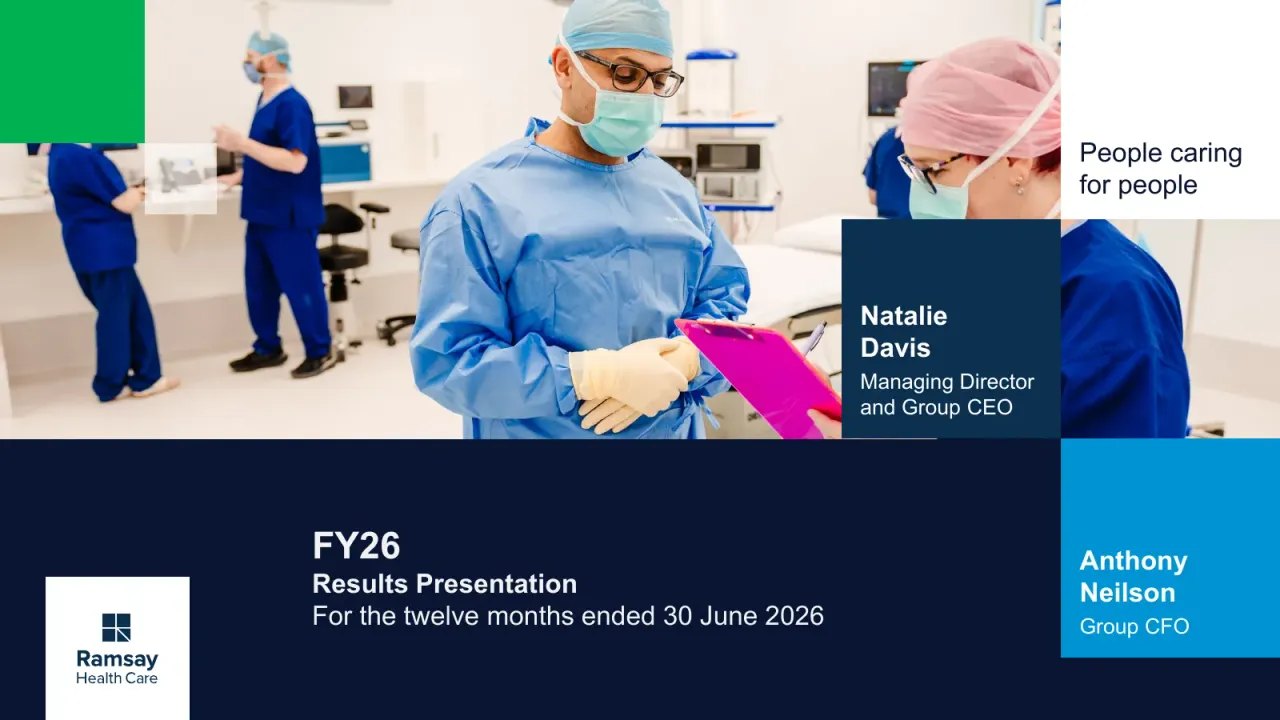
0:01 Good morning everyone and welcome to Ramsey Healthcare's full year results presentation for the 12 months ending 30th of June 26. I'm Natalie Davis, the Managing Director and Group CEO and I'm joined today by our Group CFO Anthony Nielsen. Today we will share our financial results and the significant progress we have made over the past year in transforming the business. I'm pleased that we are maintaining high patient MPS scores and clinical excellence in every region Building transformation momentum in the Australian business and improving performance and capital returns across the group. I'd like to thank our incredible people and our clinicians who dedicate themselves to our patients and are the foundation of our success.
0:47 Turning to slide four, we've made good progress delivering against our three key priorities. First, the multi-year transformation of our market leading Australian hospital business. Second, strengthening capital discipline and improving returns across the portfolio. And third, evolving our culture to innovate and accelerate delivery. Our strength and growth executive team and the capability they are building in key commercial and operational areas has enabled us to accelerate the pace of our transformation. In Australia, a high acuity growth focus, improved data utilisation revenue indexation and cost management has delivered underlying EBIT growth of 11.2% and a plus 30 basis points uplift in EBIT margin.
1:37 Importantly, we're also well progressed with our proposed separation of Ramsey-Sante, which is on track for completion in late 2026, subject to a shareholder vote in November. Turning to slide 5 and looking at the headline numbers in constant currency movements for the full year. Revenue was $18.6 billion, reflecting 4.2% growth compared to FY25, driven by 8% revenue growth in Australia. Underlying EBIT increased 11.8% and underlying NPAT increased 22.9%, reflecting focus on improving performance through transformation programs in each region. Reported NPAT was $329 million.
2:23 We strengthened capital discipline, focusing growth and development capex on Australia and procedural capacity, reflected in group ROIC increasing by 30 basis points and funding group ROIC plus 60 basis points to 6.3%. Our focus on performance improvement and cash conversion has seen Australia and both UK businesses net cash flow positive for the period and improved our funding group leverage to less than two times. The Board has determined a final fully franked dividend of 48.5 cents per share which is up 21.3% and taking the full year dividend to 91 cents per share up 13.8% on the prior period and representing a payout ratio of 60.3% of underlying earnings.
3:13 These results highlight the momentum building across our business and the positive impact of our strategic initiatives. Slide 6 provides more detail on our underlying result and the split between the funding group contribution and Rambisante. All regions improved performance. Australia reporting 11.2% growth in underlying EBIT on 8% growth in revenue. Both UK businesses reporting growth in earnings through operational initiatives, mitigating the impact of lower funding by the NHS. Grand Pistante's improved EBIT was driven by its Swedish business and performance improvement initiatives, more than offsetting the difficult funding environment in France. Moving to focus on each region.
4:00 Starting with Australia on slide 8, our transformation continues to build momentum driven by our Big Five hospital operations improvement initiatives. Our strategic focus on growing in high acuity and priority therapeutic areas Improving serialisation and focus on procurement initiatives has driven admissions and revenue growth and margin expansion. Pleasingly, we achieved this alongside improved patient, doctor and team NPS scores. With a new executive team in place, we've started to accelerate the execution of our 2030 strategy. We're looking forward to National Capital Private Hospital joining our ransom network next week and serving the local community.
4:45 During the year we also signed a new partnership agreement with one of our major insurers which will enable us to focus on collaborating to strengthen the private health proposition. We've grown our Ramsey Research and Development Network to 22 sites and continue to grow clinical trials activity with a 28% increase. Turning to the Australian results in more detail on slide 9. The business delivered 11.2% growth in underlying EBIT driven by higher activity and acuity levels and improved utilisation of treatment capacity, improved private health insurance indexation and effective cost management. We reported a 30 basis point improvement in underlying EBIT margin to 9.4%.
5:34 The impact of the new funding mechanism at Joondaloo Public Campus was partially mitigated to approximately negative $26 million by actions including a focus on timely discharge of patients, agency reduction, increased winter activity as our clinicians continue to provide excellent care to the local community. Underlying labour costs were flat as a percentage of revenue and lower excluding the impact of Joondalup funding, reflecting a focus on reduced agency use over the period. We were also able to lower supply costs as a percentage of labour through procurement savings. Our portfolio optimisation efforts have continued with foresight closed and excess land holdings put up for sale.
6:24 Before moving to the key drivers of our results, slide 10 details some of the underlying trends in the Australian private healthcare market. The market is showing improving fundamentals with hospital coverage continuing to grow as Australians prioritise their healthcare, growing by 2.5% per annum in the last three years, and payout ratios gradually improving, however with some ways to go. Acute private hospitals remain the predominant setting for private healthcare and are evolving their services to include day procedures. Downsharing from gold policies to silver hospital coverage continues, impacting private mental health and maternity in particular. Now delving deeper into Ramsey Australia's activity trends on slide 11.
7:13 Excluding the impact of Peel and Border Cancer Hospital, which have both returned to public operation, you can see we observe strong growth in our core surgical and day activity, coupled with higher inpatient acuity. Surgical admissions, which account for more than half of our total admissions, grew 4.1%, increasing 40 basis points as a percentage of our total admissions, reflecting our focus on growth in key therapeutic areas. Medical admissions were up 3.2% and rehabilitation admissions increased by 3.8%. And mental health admissions declined by 3.9%, but this was mainly due to declining day admissions, with overnight mental health admissions, which contribute the majority of our revenue in mental health, increasing by 0.9%.
8:06 Looking at funding types, private admissions grew 2.8%, public admissions increased by 9.5%, reflecting strong activity as you look, and a 7.7% increase in public and private activity. Day-only admissions increased by 3.8%, boosted by new surgical centres at Charleston and Caloundra, while overnight IFTAs increased by 3%, reflecting a higher overnight acuity mix. Moving to slide 12 and our strategic use of data insights and the uplift in our sales force are supporting growth in the number of visiting medical officers or doctor partners. Our share of complex therapeutic activity and improved theatre utilisation.
8:54 We achieved 3.3% growth in admitting VMOs enabled by improved catchment-based data insights. Our theatre utilisation improved to 70% in FY26 from 69% in FY25 as we opened an additional 22 new theatres during the 12-month period, indicating our success in increasing utilisation of theatres at our key sites. and we increased robotics usage supported by improved robotics utilisation tracking. Slide 13. Total capex was $365 million which was flat on the prior period and below the original forecast of $410 to $440 million, reflecting lower than forecast development spend as we focus on improving utilisation of existing facilities and the timing of reimbursements from landlords of $30.8 million, primarily associated with the development of key lease sites in Insula and Ballura.
9:57 Our development investment in Australia remains focused on increasing procedural capacity in major hospitals within growth corridors. In total, we opened 22 theatre and procedure rooms during the period. The increase in routine and maintenance capex reflects an investment in existing facilities to ensure strategically located sites are fit for purpose in the future and continue to meet high clinical safety and amenity standards. In financial year 27, we're planning to open 11 new theatres cath labs at sites including our largest hospital, Hollywood. In financial year 27, we'll continue with our key programs to drive the transformation of the business with our initiatives underpinned and enabled by our investment in data technology and AI.
10:48 We've defined our technology roadmap with priorities including the upgrade of our patient administration system which will be part of our broader revenue cycle management transformation to speed up cash collection, improve accuracy to reduce rework and streamline administrative manual processes. and a smart rostering system and team map to enable flexible working, reduce administrative burden for our hospital teams and improve effectiveness of our rosters. Moving to slide 15 and the outlooks. As we continue to focus on delivery of our multi-year transformations, Australia is targeting incremental year-on-year EBIT growth, both including and excluding the NatCap acquisition, and margin expansion driven by activity growth, improved capacity utilisation, revenue indexation in line with cost indexation, operational improvement initiatives and including a $10 to $15 million increase in investment in IT, technology and transformation.
11:52 National capital is expected to be underlying EPS accretive in the first 12 months of ownership. Transition operating costs are expected to be in the range of $9 to $11 million in financial year 27. Total capex for Australia is expected to be $380 to $410 million, inclusive of NatCap. Moving to the UK region on slide 16, where both our UK hospitals and Elysium businesses are focused on performance improvement plans to mitigate weakness in NHS funding. Basically, both businesses delivered an increase in underlying EBIT who were net cash flow positive. UK hospitals focused on acuity, private activity growth and cost management to mitigate NHS funding headwinds from Q2.
12:41 The Elysium turnaround is beginning to gain traction under the leadership of new CEO Joe O'Connor in weak market conditions through a focus on right-sizing our services to local demand and cost reduction. Moving to each business in turn, beginning on slide 17. Our UK hospitals delivered underlying EBIT growth of 10.3% in constant currency, successfully mitigating an 8% decline in NHS activity and tariff indexation below cost growth. The result was achieved through a focus on higher complexity NHS work and private activity growth of 2.9%, which drove a 6.7% increase in average revenue per admission. The business focused on disciplined cost management program resulting in labour costs as a percent of revenue declining by 30 basis points and the EBIT margin improving 80 basis points.
13:39 Turning to slide 18. Now we expect Ramsey UK to deliver EBIT growth in financial year 27 with the focus on driving higher acuity and growth in private medical insurance and self-pay activities. ongoing delivery of efficiency transformation programs across finance and operations including rostering initiatives and creation of finance shared services hubs and continuing to work closely with local and national NHS stakeholders to attract NHS work and target acuity. NHS tariff guidance for the year beginning 1 April 26 has been recently lifted to 1.24% The backdated amount related to 1 April 26 to 30 June 26 will be included in the FY27 results.
14:29 Turning to slide 19. Elysium's turnaround plan gained traction in the second half of FY26, delivering a 43% growth in underlying EBIT for the year. This was achieved through site and ward closures to match local demand, reduced central and agency costs, including a reduction in FTEs, and an average fee uplift of 4.4%, reflecting complexity of patient services. There was also a strong focus on working capital and a reduction in debtors, which combined with reduced capex for a positive cash flow. Elysium's reported result includes a net 13.2 million of costs associated with its restructure, including site impairments of net 9.9 million.
15:17 Our ongoing focus for Elysium on slide 20 is to continue delivering on the turnaround plan, which includes increasing conversion rates of new patient opportunities, including a focus on complex recovery services, further improvements to labour mix, including reducing agency costs further, negotiating with payors for appropriate pre-op lists reflecting service complexity. We're targeting EBAC growth in financial year 27 as the business turnaround continues to progress. Heading now to Europe, and on slide 21, we're on track with our separation plans for Ramsey Sante to support long-term value creation for Ramsey shareholders as we move towards a Ramsey shareholder vote in late November.
16:05 The business has continued to focus on performance improvement in both France and the Nordic. Moving to slide 22, and despite funding headwinds in France, Ramsay-Santo reported a reduced underlying loss in Europe. The Nordics region delivered a strong result, driven by Sweden's performance improvement, which included the impact of the new Saint-Goran eight-year contract and improved performance in its other services, including proximity care. France has multiple work streams on foot, focused on operational efficiency, which partially mitigated the funding shortfall. On slide 23, Ramzi-Sante's focus in financial year 27 will include cost control, efficiency and cash generation, growing profitable activity including growth in Sweden and the four-year impact of the new St. Grant contract and sustained advocacy for fair tariff outcomes in France.
17:08 Turning to slide 24, the proposed separation of Ramsay-Sante is well on track with the demerger meeting for the shareholder vote progressing towards 24 November 2026. The benefits of the demerger proposal include it simplifies Ramsay's portfolio, enabling us to focus on transformation and growth potential of our core Australian hospitals business, It also simplifies our reported financial profile through Z-consolidation of Ramsey Sante from Ramsey's financial statements. Z-mergers should improve Ramsey Sante's focus, an already established, independently managed and publicly listed business, to continue to pursue its European focus strategy and transformation.
17:55 There is limited separation complexity given Ramsey Sante already operates independently of Ramsey including separate financing and balance sheet arrangements. And it gives our shareholders the opportunity to retain ownership interest in Ransi Sante. Assuming shareholders vote in favour of the separation, Ransi Sante will be treated as a discontinued business line item in our financial year 27.5 and four-year results. Costs associated with the demerger will be detailed in the scheme booklet. Moving to sustainability on slide 25. And Ramsey remains on track with both our 2030 Scope 1 and 2 greenhouse gas emissions targets and our 2028 supplier engagement targets.
18:45 We're committed to working with our partners to understand and address emissions across our supply chain. However, our progress in this area is limited to how quickly our suppliers are able to reduce and manage their own Scope 1 and 2 emissions. As a result, we've revised our long-term net zero greenhouse gas emission targets, taking into account the current and anticipated commercial and operating environment. We'll now target net zero Scope 1 and 2 emissions by equity share by 2050 instead of 2040, and Ramsey UK and Elysium Healthcare will target net zero Scope 3 emissions by 2050. Our net zero scope three group target will be considered following engagement with our suppliers in line with our new term target.
19:33 I'll now hand over to Anthony to provide a more detailed look at our financial performance.
19:38 Thank you Natalie. Good morning everyone. Moving to our group financial performance on slide 27, it's important to note that all regions reported EBIT growth in local currency, reflecting positive transformation momentum in Australia, and a focus on operational improvement programs across all regions. This drove a 30 basis point improvement in EBIT margins to 6.2% with cost discipline resulting in a 20 basis point improvement in employee costs as a percentage of revenue and a 10 basis point improvement in medical supplies and consumables as a percentage of revenue. Underlying EPS grew 27% in constant currency. The underlying effective tax rate was approximately 35%, consistent with our guidance.
20:23 Reported tax was slightly higher at approximately 37%. These rates are high relative to corporate tax rates in the jurisdictions Ramsey operates, reflecting the impact of French CVAE, which is a corporate value-add tax, and Ramsey-Sante's loss-before-tax result in the FY26 period. The final dividend of 48.5 cents per share brings the full year dividend to 91 cents per share, up 13.8% from FY25, with a payout ratio of 60.3% of underlying earnings. Turning to slide 28, we continue to maintain a strong focus on cash generation. Operating cash flow reflects a 46% improvement in the funding group, coming from Australia and both UK businesses. offset by a negative working capital variance in Ramsey Sante, primarily reflecting the timing of payments from the French government versus the prior period.
21:22 The decline in CAPEX spend reflects capital discipline in development expenditures in Australia and the UK operations. This resulted in free cash flow of $697 million, which was relatively flat compared to the prior year. Net cash inflow from divestments mainly relates to sale and leaseback of four sites in France and the sale of hotdog investment in Australia. Dividends paid increased, reflecting the suspension of the dividend reinvestment plan for the final dividend in FY25. Moving to slide 29, our consolidated balance sheet remains stable, with key changes relating to The net impact of currency translation on the balance sheet was approximately $300 million reduction in net assets. An underlying increase in property plan and equipment includes the completion of developments in Australia, partially offset by the restructure of portfolios in all regions.
22:20 Working capital movements mainly relate to movements in Renzi-Sante associated with the timing of government receivables and the Elysian portfolio restructure resulted in a $300 million reduction to the right of use assets. Roche increased 110 basis points to 11% for the group. Turning to slide 30, and the funding group, which excludes Ramsey Sante, delivered underlying impact growth of 17.9% to $398.4 million, with a 5.2% increase in revenue in constant currencies. The result was driven by underlying EBIT growth across all businesses, with an improved performance in Australia of plus 11.2% in underlying EBIT, a plus 10.3% underlying EBIT contribution from our UK acute business and a plus 43.5% increase in underlying EBIT for a listing.
23:15 The result included a 7.3% increase in depreciation, reflecting the completion of major projects in Australia over the period. higher financing costs reflecting the increase in base rates over the period and reduced hedging compared to the prior period, and an underlying tax rate of approximately 29%. Roche for the funding group increased 124 basis points to 14.8%. Moving to slide 31, the funding group's leverage has decreased to 1.83 times and remains well below our target range of 2.5 times. Interest cover is also strong at 8.94 times. All businesses in the funding group were net cash flow positive for the year, showing a strong focus on improving cash flow, working capital management, capital allocation and returns across the funding group. We maintain liquidity of $1.066 billion, some of which will be utilised for the $251 million acquisition of NatCap next week. Leverage is expected to continue to be below our target range post this acquisition.
24:24 The weighted average cost of debt in FY27 is currently expected to be approximately 5.5% and approximately 60% of our funding group debt is hedged for FY27. In FY27, total net interest costs, inclusive of AASB 16 lease costs, for the funding group are forecast to be $280 to $300 million. On slide 32, Manzi-Santé remains well supported by its own funding arrangements. In July 2026, they announced the completion of a refinancing of €1.75 billion of senior debt, extending their tenor by two years to 2033 and including a change of control provision which is consistent with our proposed separation.
25:10 Its bank leverage ratio was 4.7 times at 30 June and liquidity stood at €487 million, comprising €185 million in undrawn bank facilities and €302 million in cash. Turning to slide 33, and as I have shown above in the results, our focus on improving capital management and cash flows delivered improved returns and lowered leverage for the funding group over the period. Disciplined cost management across the funding group resulted in underlying EBITDA margins of plus 60 basis points, and underlying employee benefits as a percentage of revenue declining 20 basis points. Activities over the period included a focus on revenue cycle management and improved working capital across all businesses with cash conversion in Australia improving by four days over the period and further work to do.
26:07 Focus on utilisation of facilities and portfolio optimisation resulted in a decrease in capex and improved capital allocation across the business. Cash generation from portfolio optimisation will continue in Australia and Elysium. These activities and focus on improved results drove an improvement in the funding group ROCHI to 14.8%. Turning to slide 34 and group CapEx was $734.2 million, a decrease of 6.1% in constant currency, reflecting disciplined development spend in Australia, focused on expanding procedural capacity. Lower capex in the UK and flat in Europe, reflecting our capital discipline in the current funding environment, mainly due to lower development and growth expenditures.
26:57 And routine and compliance spend was increased in Australia to ensure our hospitals are future fit. Our high clinical quality and safety standards and the inventiveness of our hospitals is maintained. Our forecast range for funding group capex in FY27 is $480 to $520 million. consistent with the FY26 spend of $488 million in constant currency. Overall, we made good progress from a financial perspective in FY26, with the company in a strong financial position to continue to deliver in FY27. With that, I'll now hand back to Natalie for the outlook and closing remarks.
27:37 Thanks, Anthony. And turning to slide 36. In closing, I want to reiterate our commitment to continuing delivery of our strategic priorities. In FY27, we expect to continue the positive momentum with EBIT growth expected in Australia and the UK businesses. We're looking forward to completing the national capital acquisition, caring for the local community and welcoming the team to Ramsey next week. We're preparing for the proposed separation of Ramsey Santé in December, subject to Ramsey's shareholder vote on 24 November. The Group Executive will host an Investor Day on 30 November to share our progress and plans as we continue to evolve Ramsey for the future.
28:22 I'm proud of the progress we've made as a team and our unwavering commitment to providing excellent care for our patients. Thank you for joining us, and we'll now open the floor for questions. Thank you. If you wish to ask a question, please press star 1 on your telephone and wait for your name to be announced. If you wish to cancel your request, please press star 2. If you are on a speakerphone, please pick up the handset to ask your question. Your first question today will come from David Lowe of UBS. Please go ahead.
29:03 Thank you for taking my question. Starting with slide 12 and the utilization trends, I can see that you've got much higher utilisation in the top five sites. Where do you think you can take the utilisation to? What's maximum and is it possible to get the lesser sites up to levels that you're seeing in the top five hospitals?
29:25 Thanks for the question. Yes, if you look at our distribution of utilisation across all of our sites, what you see is we have five sites and they tend to be are very large hospitals that have utilization in that range of about 80% to 85%. And that's broadly in line with what you would see as best practice around the world in this sector. So our focus has really been particularly in our large hospitals that are often adjacent to a public hospital and attract that complexity of work that we're known for. Our focus has really been particularly at those sites trying to attract more doctors and serve more patients and increase utilisation of those hospitals and that's in areas like cardiology and cancer care and orthopaedics. So that 80% to 85% would be our aspiration for a really good level of utilisation in one of our major hospitals.
30:24 And when we get close to that, that's when we consider increasing our procedural capacity.
30:32 Okay, great. Thanks for that. So it would seem that at the top five sites, you're quite close to meeting additional capacity.
30:38 Well, some of those sites, we're already in the process of adding capacity. So you would have seen in the presentation later on, we talk about where we're adding sites. We're adding theatres over the next 12 months. and they include a focus on some of our major sites like Westmead, St George and Hollywood. We're adding two theatres and two tap flats. So we've already been effectively prioritising our capital investment based on levels of utilisation.
31:12 Okay, thanks. And just the other topic I wanted to touch on was the OPEX, the IT OPEX that you've laid out for $10 to $15 million. Can you talk a little bit more about what you're spending on? Will that be a headwind to margins effectively, or do you expect that that investment will pay back quickly enough that it would be offset?
31:31 Yes, so what we've done with our technology roadmap is very clearly defined, a sequenced approach. So we're thoughtfully investing in technology. We know we need to... invested technology to enable our clinicians in our hospitals to reduce the administrative burden to improve our processes. And we're particularly prioritising two things at the moment. One, effectively, is an upgrade of our patient administration system, which is the backbone to revenue cycle management. So that starts with the patient admission itself. and then goes all the way through to coding and sending the bill out. So that needs to be upgraded and that will really help us in terms of the speed at which that process works and also make it much less manual than it is today and free up time for our clinicians.
32:26 So we will get started on that and that is quite a big system upgrade and we'll do that progressively. hospital by hospital. So it'll take a while for that to translate into benefits, but those benefits are significant. At the same time, we are focusing on effectively a new smart rostering system for our team. We have a workforce of 35,000 We have effectively legacy systems that our NUMS are using to roster team members at the moment. It's probably the thing that takes up a lot of their time. When I first joined Ramsey, I said very clearly from the NUMS that they would really appreciate a better way of doing that.
33:11 That's another one which we will start implementing over the course of the next 12 months. These things will take time to fully implement because it's not just about the system, it's about the change management and the processes around that. But we have thought very carefully around which investments to prioritise and we are working towards a plan where we can still invest in these investments but also simultaneously continue to focus on delivering year-on-year margin growth.
33:45 Great. Thank you very much for that. The next question will come from Tasha Crean of Evans and Partners. Please go ahead.
33:57 Good morning. Thanks for taking my questions. I was hoping for a bit more colour on the Australian EBIT growth outlook. You're talking about incremental growth excluding NADCAP. I'm just wondering how that compares to your language in FY26 of EBIT momentum. It sounds like weaker growth, but I'm just wondering whether I'm reading that wrong, so maybe you could clarify. Okay.
34:19 I think we're not giving guidance to the level that you're asking for. So what we're saying is we've been focusing over the last 18 months really on building our transformation momentum and we will continue to focus on those same initiatives that we've outlined today. So really focusing on growth and targeting growth above market growth and in particular in the high QED areas that we're known for. will continue to target revenue indexation in line with our cost indexation, and we'll continue on working on our own operational improvements, including procurement, and increasingly, as we implement our new system, a revenue cycle management process.
35:08 And so we are working towards margin growth year on year in the Australian business, but we will be investing... in a stronger business as well as we do that and we've called out the $10 to $15 million increase in OPEX that we're planning to make for IT and technology spend over the next 12 months as part of that.
35:29 Yep, okay, thanks. And just wondering if you could talk a little bit about the admissions trends in the second half, that surgical number of 4.1%. looks a bit softer than the 5.4% in the first half, but I think maybe you've made a couple of restatements there. So if you could just talk about some of the trends in admissions in the second half and whether you're still seeing strong growth as you saw in the first half.
35:53 Yes, so thank you very much for that question. So you'll see in the footnotes to that page that we have called out that we did reclassify some admissions that were made in the first half from surgical to medical, and those were a part of the work that we do at Jindalup Public Campus, which is one of our biggest campuses. So what you're seeing there for the year is more broadly reflective of what we also saw in the first half.
36:25 Okay, that's okay.
36:27 Does that help?
36:29 Yeah, that's great. Thank you. Your next question today will come from David Stanton of Jefferies. Please go ahead.
36:39 Good morning, team, and thanks very much for taking my questions. Perhaps we could focus on revenue growth for 27. Australia, you know, saw very impressive revenue growth. Do you think you can match that in percentage terms, you know, that kind of growth level in 27? And then perhaps I could follow up by asking the same questions for the U.K., both the UK hospitals and Elysium.
37:06 So revenue growth in the UK as well, specifically?
37:09 Yeah, sure. So basically in the UK, whether you think you're going to see positive revenue growth in constant currency in 27 for both the UK and for Elysium, please.
37:20 Okay. So if I start with Australia, so what you'll see in the revenue growth number there is broadly 8% revenue growth. and admissions growth on a like-for-like basis of around the 3% mark. So we've excluded the impact of Peel, but also the impact of Border Cancer Hospital, which we handed back to the public earlier this year. And so the rest of the 8% growth, therefore, is accounted for through post-revenue indexations. which we're targeting effectively our revenue indexation in line with our cost indexation as well as a focus on acuity of work and the focus on the work that we do very well and we have high market share in and that's what we do in our big major hospitals like cardiology and orthopaedics and cancer care in particular.
38:19 So that focus will continue. Those components effectively will continue to target into the next financial year, as we already are. So we'll continue to really focus on growth and specifically in the areas that I just mentioned. And we are increasing our focus on our business development managers who go out and talk to specialists about why they should choose Ramsey to perform their surgeries. There's a number of enhancements we continue to do in terms of the data we're providing our hospital teams around catchments and GP referral patterns. And so we continue to set an ambition for ourselves of growing above the market, particularly in the areas that we're focusing on.
39:09 and we will continue to aim for revenue indexation broadly in line with our cost growth and we also continue to target that acuity mix which supports that revenue line. If I turn to the UK and I'll speak to both businesses separately because it is quite different In UK hospitals this year, we had a very strong start to the year, and then we had the pullback of NHS funding from about November, December, and the team managed that very well in terms of flexing the cost base towards that lower level of activity, but also focusing on private work, as well as making sure that the work we're doing for the NHS is high acuity.
40:01 components support the revenue number you've seen today. When we look at the UK, at the moment in terms of the indicative activity plans that we've been given by the NHS for our hospitals, we are seeing growth there in those indicative activity plans, but we will continue to focus on acuity and we will continue to focus on private work, we think that's a significant opportunity for us, particularly in some of our hospitals that are in those commuter belts around the London area. So that will continue to do. And if there is any uncertainty on funding, we'll continue to really make sure that we're flexing our cost base and focusing on efficiency so that we can deliver the EBIT growth that we've got in our outlook statement.
41:01 With Elysium, we've experienced weak demand and what we have done over the past 12 months is really right-sized our available beds by geography effectively and by service line. So we've closed about 239 beds over the last 12 months. Broadly speaking, we're not planning on anything any more significant closures. We think we've probably done the most significant degree of right-sizing that we need to. So the focus now will be continuing to make sure that we're converting as many referrals as we're getting and really developing differentiated services and we've started to do effectively personalized services for very complex patient. That's our complex recovery services that we've called out. And we will continue with our turnaround plan and operational efficiency focus there as well.
42:10 Understood. So I guess, you know, put it in a nutshell, potentially maybe Australia, you know, that level of revenue growth is potentially a stretch target for 27, what you did in 26. And it sounds like, you know, You are targeting sort of positive revenue growth for Elysium in the UK in 27.
42:30 I'll leave you to draw your own conclusions for what I've said, but I think I've given you a good idea of what we're trying to balance and how we're going to achieve the profit growth in those businesses.
42:46 Understood. Thank you. Your next question will come from Davin Melanathan of Goldman Sachs. Please go ahead.
42:57 This morning, Natalie and Anthony, thanks for your presentation. I just wanted to start on the Australian business and the EBIT margin improvement that you have guided to. Thinking about the building blocks there, from my perspective, it looks like the timing of capacity coming on. you did sort of more openings in FY26, and then there's less going to 27. So I would think that should help your margins, just given it does take some time to ramp into those capacity. And then you've got procurement savings that happened into FY26. I assume that should continue into 27. And then you've got the Joondalup headwind that reduced in the second half, which I assume is going to help again into 27.
43:44 So I would think those three blocks are going to help your margins, but could you just comment on that? And then secondly, any other key drivers we should be thinking about?
43:55 Okay, thank you. That's a very thoughtful question. So if I start on capacity utilisation, yes, you're right, we did add 22 theatres over the last year. Some of them we've only just recently opened. So Strathfield for example in Sydney we've just recently opened and the capacity we've added to hospitals like Dunedin Private for example means that we are still very much focused on driving increases in utilization around that hospital attachment. As you say, the more that we can fill the existing capacity, the more that supports marginal contribution into the Australian results.
44:45 On procurement, I would say in the second half we started to get some traction in terms of what we're trying to do and there is overall a very significant opportunity there, as I've discussed before, because even though we're the largest private hospital operator in Australia, we traditionally have really been leaving most procurement decisions to individual hospitals and so on both the clinical and the non-clinical side we have been focusing on how do we actually create national tenders and national approaches and more transparency to our hospital team so they can also make better decisions. We did have success in the second half and you would have seen that that supported a decrease in our cost of supplies as a percent of revenue for the year and procurement is something that we will continue to target over the next 12 months.
45:42 We've just over the last couple of weeks rolled out what the team's called a switch and save dashboard for hospitals and This really gets down to a very practical level of medical consumables that hospitals are purchasing and provides the hospital teams the data on exactly the same type of consumable, which is very complex to do, you can imagine, and prioritises effectively for each hospital the opportunities they have if they switch to a different supplier and the amount that they can save. so that they can then effectively have conversations with clinicians in the hospital around switching over to better products. So that's something that we've just started to allow to our 20 major hospitals that will support procurement benefits over the next month.
46:40 And then in terms of the Junalip impact in 26, it was relatively equally phased, the impact of that funding agreement and our mitigation over the two halves. And so looking forward, we had a very significant impact from the change in the funding agreement because we shifted to the state price and historically that state price hadn't been increased enough to cover cost inflation, so there was a step down, effectively, in what we were paid. This year, the state price in WA has gone up by, I think, almost 3.9%, so it's much closer to our labour costs and cost increases in that hospital, and so that won't be a significant drag in terms of our F27 costs.
47:33 performance and we're very much focusing in Joondalup on partnering very closely with the local health district and continuing to serve that community. There is a growing need for healthcare there. It's a growing catchment. The government has funded the new public capacity there. So there's two wards that opened there in the last few months, known as KBOX. So that's been funded for the new year. We've also been progressively opening and getting funding for the mental health capacity that was built there. So we've received funding this year for the remainder of that capacity as well. So we will continue to work with the LHC there to continue to meet the needs of that community.
48:23 Thanks. And then if I think about So those are all great levers into 27. But if I think about some of your EVAs and the wage indexations that have come through, they used to step up in, say, periods like FY28. So how do you manage, I guess, the business to ensure you've got that recurring EBIT growth to occur into 28? Like what are some of the drivers you think that will start to help beyond a 12-month window?
48:55 If I step back and talk a bit about where we're up to on our EBAs, just recently we've had our Queensland EBA proposal endorsed by the team there. It follows relatively closely the public EBA, so it still needs to be endorsed by the Fair Work Commission, but the team has endorsed effectively a 14% increase over four years there, just to give you a sense of the Queensland uplift. And we will be beginning very soon the negotiation of our New South Wales EBA. So the current EBA ended on the 30th of June. We enter into that negotiation in terms of our current wage rates in New South Wales being a parity, largely speaking, with the public sector.
49:49 and the public agreement there, which was recently agreed, gives about a 3% yearly uplift for the next couple of years. I think the uplift that you're referring to is probably the Victorian EBA. We did, in the last 12 months, also finalise our Victorian EBA. As you'll all be aware, that public EBA there had a very significant uplift in wages recently. around November, December of 2027, calendar year. And our EBA has been agreed and approved by the team. It's actually a four-year EBA, and it will have a step-up around that period. The overall increase is around about 24% over the four years.
50:42 So that gives you a sense of the different EBAs in the state. at the current state. Our labour costs in general at the moment are running, you know, fairly closely in line with our revenue indexation. And, you know, broadly speaking, again, if you do broad maths and you have a look at the employee cost growth that we've disclosed for F26 at 7.9%, you know, broadly speaking, our labour costs are growing at about 5%. And, you know, we expect that level to continue over the next few years and that's before we probably foresee some impacts from the Fair Work Fair Value case as well flowing through. So you know our corporate plan effectively forecasts out our wage growth and we use that to inform our private health insurer negotiations and if there's any differences, then we will go back and renegotiate with our private health insurer partners.
51:50 We've also, as I've spoken to previously, been in the process of trying through those negotiations to negotiate effectively year-on-year revenue indexation which is linked to sector-wide metrics. And we're making good progress on that. You've seen the results. We have four agreements that effectively have a level of mapping towards and formula links to sector metrics year on year. And just to give you a sense of the size of that, that roughly when we look at our private revenues, so PHI-related revenues, that roughly covers about 48% of our revenue at the moment boost. type of contract.
52:38 Thanks, Natalie. Your next question will come from Andrew Goodsell of MST Marquis. Please go ahead.
52:50 Thanks very much for taking my questions. Just looking at the Australian business, just trying to understand where you are in your digital and data. I know you've spoken to this a bit and you've given us your CapEx spend. Could you give us a sense of what your OpEx was for digital and data in 26 versus 25, and then just that OPEX go forward?
53:12 So we really have stopped providing specifically what we're spending in that digital data transformation space. What we did say last year as we were entering this year is we were actually going to reduce some of the investment. If you recall, in the previous transformation effort, we had significant... resources around things like project management and change management. We're really focused on swimming down the team and then resetting the technology roadmap going forward. Now, as I've described, we've got a very well-sequenced plan that is going to help us and help support effectively those, what we call the Big Five Hospital Operations Initiative. So those initiatives will help to deliver value.
54:06 And at the moment, I would say the value from our investment so far has really come through on the data side in terms of the data that we're providing to our hospitals, particularly to support their discussions around growth, both in terms of catchments and referral patterns, but also in terms of utilisation of existing theatre and cath lab capacity. And also we've added data there on robotics utilisation as well over the last six months. So very much... And that data's been very heavily used by the hospital teams because it lets them make very practical decisions around where they have opportunities to better utilise the existing capacity where we're backfilling that capacity when we have cancellations or holidays, and also how we're continuing to grow and attract new doctors to the Ramsey network. So that's been a fantastic foundation, and just recently, as I mentioned, the procurement data insights that were provided are very similar in terms of very actionable by our hospital teams to make better decisions.
55:23 We've also rolled out over the last 12 months a remote facial monitoring system which is supporting our clinicians so we're also in parallel to some of those business technology initiatives continuing to look at technology initiatives to enable our clinicians and we're in the process of rolling out a system to support some of our oncology infusion services as well so We'll continue to very thoughtfully sequence what we're investing and try and manage overall at a business level to make sure that we're growing our margins for the overall business as we continue to make those much-needed investments.
56:09 Would the net of all of those initiatives be below where you were in 2025 and would you expect that to stay at these levels?
56:18 I think to your first part of that question, you know, yes, there were savings relative to FY25, as I described, but we are now at the point where we're starting to, you know, increase that investment in the targeted areas in a thoughtful way.
56:36 As we said, Andrew, we'll look at guidance next year. From the savings you've achieved this year, an extra $10 million to $15 million is coming into FY27. On that OPEX...
56:49 And then just quickly on UK, you've given us a lot of colour and turnaround. It's been a good turnaround, particularly with Elysium, but just trying to understand the environment there or just your understanding. Last year we had that sort of November overspend, I guess, and shutdown, but is that plausible this year or are there things in place to make that a bit more clear?
57:17 So I think Elysium and UK hospitals have different dynamics. So let me just separate those. So it was UK hospitals that really saw that pullback in activity funding around November, December last year that we then had to, it seems did a great job effectively, you know, tailoring and flexing the business based on that pullback. I think what we're seeing this year so far is the indicative activity plans that we're getting at a hospital level are supporting activity growth. And we're also, I guess, spreading out that activity growth more evenly or planning to spread it out more evenly throughout the year.
58:02 We've also seen just last week the NHS lift the tariff to 1.24% as well, which will support revenue growth in the UK hospitals business. I guess at this point, we're planning for activity growth, but we're also very conscious that things can change. and we know we need to develop our private work and that's both self-pay and private health insurance work in the UK business to really diversify our revenue stream and the team again made very good progress in the second half around self-pay in particular so as that pullback happened there were obviously patients on the NHS waiting list who needed to have their surgeries done and so our self-pay growth was higher in that second half.
58:57 And then we do have a very attractive proposition for private health insurer partners in the UK as well because we drive very high quality hospitals and we're a very efficient operator. So we'll continue to really grow that part of the business and provide a level of diversification Elysium was more of a, I guess it was less of that kind of pullback in November, December. It was more a shift in NHS policy towards more community-based care. And so we found we were experiencing fewer referrals into inpatient facilities and also faster discharges into the community. So that's really been a shift, I guess, in the approach by the NHS.
59:45 As I said, the team feels like we've done a substantive realignment of our supply of beds to the demand at a local geography and a local service level. And so the focus now really is on filling the capacity that we have and continuing to make sure we work on our costs.
1:00:09 Thank you. Your next question will come from Craig Wongpon of RBC. Please go ahead.
1:00:19 Thank you. There was mention of a new partnership agreement with a major insurer. I just wanted to see if you could elaborate more on this and the benefits you could expect.
1:00:31 Look, we don't tend to get into specific details of specific commercial arrangements. But what I would say is it's been very pleasing to, over the last 12 months, really discuss with private health insurer partners the opportunities we have to really modernise the care that we're delivering and to modernise the funding therefore of that care. One of the things we've worked on with a few of our private health insurer partners is really changing the way, for example, that mental health is funded. So we've had a traditional, I guess, inpatient care model and an inpatient funding model, and we're normally in legacy contracts paid in line with length of stay in one of our mental health clinics.
1:01:25 So it might be 21 days in terms of a mental health stay. But we know the community is changing. We know that there's a preference now towards community-based care. And we know that a lot of our workforce also and psychiatrists are also treating people in different settings and using telehealth more. And that follow-up from an inpatient stage is very important. And so we've been working with a number of our private health insurance partners to effectively changed the way that we're funded so we're not just funded for that inpatient stay but that we're funded and incentivised to support people post that stay into the community and that means that we can deliver better patient outcomes because we provide continuity of care and we are reducing that risk of that same patient being readmitted into a mental health clinic. And so that's a good example of, I think, the shift you'll see us continuing to make together with private health insurance around modern care delivery models and the funding then to support that.
1:02:43 Okay, thank you. That's helpful. Ben, just wanted to touch on the admissions growth. Like, within rehab, there was quite strong growth in the second half. Just wanted to understand if something had changed to drive that higher growth in the second half.
1:02:59 Not specifically but we have continued in rehab, if you look at our last two years of results, we have continued to see strong growth in rehab and this really is an aging population and a population with more chronic diseases and comorbidities and so if you do unfortunately have a fall and you live at home by yourself, It really does make a difference to be able to access that rehab treatment post-surgery and our team's doing an amazing job actually getting everyone literally back on their feet, exercising in the gyms and really able to go home and live an independent life. And so we continue to see the strong demand for rehab facilities and there's still an opportunity for us to do a better job of connecting our own rehab facilities with hospital care. So, you know, really providing, again, that continuity of care from hospital into rehab and really to help Australians live more independent lives for longer.
1:04:07 So I think, broadly speaking, that's what we've seen in that number.
1:04:11 Okay. And then on the UK businesses, both Elysium and UK Hospitals, There was a good improvement in margins in the second half. There were a few different factors that impacted in the period. I was just trying to understand, is that second half margin a good level to indicate for FY27, or is there puts and takes there around the initiatives you've experienced, the funding changes, to try and get a sense of if that second half margin is a good indicator for FY27?
1:04:48 One general comment on the UK and actually the European business is that the second half always looks stronger than the first half because of seasonality impact so that impact is obviously there in the result. With Elysium we did see an improvement in the margin in the second half and that really was the impact of the right sizing of our facilities which led to significant cost reduction as well as our ongoing focus on central costs coming through and the fee uplift being supported. I think we are seeing more momentum but what we're effectively saying is take the overall event for Elysium and assume we have growth in that overall EBIT for the year, just knowing that we do have that seasonality impact in the overseas businesses.
1:05:48 Okay, and then just my last question. The debt interest expense, the guidance there for a $20 million to $40 million increase, just wanted to understand what's driving that. I see base rates are assumed to be a bit higher, but is that also being driven by national capital or what's driving that increase?
1:06:05 Yeah, both, yes. So, yes, base rates are higher and, yes, we will draw down and increase leverage a small amount due to the NatCap acquisition.
1:06:15 Okay, thank you. Your next question will come from Laura Sutcliffe of Citi. Please go ahead. Thank you for taking my question.
1:06:28 Just going back to EBIT Margin Expansion in Australia, Across the call, you've mentioned quite a long list of drivers, but which are the one or two that are really going to move the needle at this stage in the transformation process, or perhaps another way to put it is, which one or two do you absolutely have to deliver on for the plan to work? I think it's hard to just call out one or two things that we need to land next year. We've set out effectively five focus areas for the Australian business and there are different stages but we do need to continue the momentum. So we do continue to focus on growth in high acuity areas. We do need to maintain our revenue indexation in line with our cost indexation.
1:07:20 And then we do need to work on our efficiencies and procurement is the one that we've probably started to get some traction on that we're well positioned in terms of the initiatives that we're launching at the moment into the business to create impact in this current financial year. Revenue cycle management, I think, is more kind of in the earlier phases where we're really building the foundation to then begin to deliver impact. So I think the visibility of the benefits in the P&L will probably be largely F28 and beyond. And then there are some benefits of agency reduction that we expect to come through in the next 12 months as well and that continues to be a focus but really managing our workforce and optimising rostering we'll only be able to do fully in terms of realised full potential of that once the smart rostering system is implemented and that's still a while away so hopefully you can get a sense of we're working on a number of things and there's very clear focus areas in the business to make sure that we're sequencing our efforts and seeing those benefits come through in year-on-year margin improvements.
1:08:47 Thanks. That's really helpful. And then just one more. In Australia this year, are you seeing lower flu-related admissions this year than you did last year?
1:08:59 Well, look, I think... It's overall very public. It's been less of a serious flu season this year. But we're obviously continuing to focus on growing our hospitals and our admissions and medical as well as surgical. So we continue to grow and we continue to target above market growth. Thank you. Your next question will come from Chris Cooper or Jade P. Morgan. Please go ahead.
1:09:37 Good morning. Thank you for taking the questions. The new partnership with the major insurer, I mean, that process seemed to start and finish more quickly and probably more amicably than some examples in the recent past. Are you able to shed any light on why you think those discussions seemingly are getting wrapped up a little bit more efficiently nowadays?
1:10:00 Well, there was a lot of work I think we spoke in February around entering into that negotiation and the preparatory work happens even before then. But I think we have been talking to our private health insurance partners about the need for us to have our cost inflation reflected in revenue indexation. I think it's very well understood that the cost across the sector in healthcare are rising and that there is sustained cost pressure. And private health insurers are more understanding of that and are beginning to come to the table. And the more that we can negotiate around an element of effectively year-on-year indexation that is linked to sector metrics What that does is it basically then frees up time for both teams to actually talk about how we change the funding structure itself and how do we strengthen the private health proposition because that's ultimately what we're trying to do here. We're trying to provide a very strong private health proposition to encourage more Australians to take up private health insurance and we need to do that collaboratively with our private health insurer partners.
1:11:27 So if we can avoid having to go back each year in the middle of a contract and renegotiate indexation, then that does mean that we can spend more time actually on trying to find the opportunities to strengthen that private health proposition and the mutual benefit of growing private health insurance coverage in Australia.
1:11:51 And in terms of those contracts that have built-in indexation, you said three of the smaller ones after the half-year result. You're now saying four, and that comprises, I think you said, 48% of your PHI revenue. So we infer from that the new one that has just been renegotiated, the large one, that's now got inbuilt indexation in it.
1:12:11 So I'm not making any specific comments on any one particular contract, but we have given you that 48% just to give you a sense of the coverage now that we do have.
1:12:24 Okay, thank you. And just one on cash. You made the comment yourself, Anthony, that each of the different businesses within the funding group were all net cash flow positive. I assume that's the first time that's happened. Regarding to EBIT growth for each of them in fiscal 27, can I just confirm that there's no sort of foreseeable reason why these businesses won't therefore continue to be net cash flow positive through 27 and probably 28 at this point?
1:12:56 Again, we're not giving specific guidance on each business, but in answer to your first part of the question, I haven't been here that long, but Kelly's nodding, saying yes, we believe that's the first time that businesses have been all net cash positive. So it is a fantastic effort across the board with all the initiatives and performance in UK and Australia that Natalie's talked about, and hopefully we can continue that momentum.
1:13:22 Okay, and just one final one. Lots of talk on the theatre utilisation. 22 new operating theatres in the year, obviously a decent uplift, about 5% or so. Some of those appear to be quite late in the year. So I guess the question is, would you anticipate continuing to grow OT capacity around that sort of big single-digit level in 27, or are we now in the process of focusing more on utilisation of that additional capacity rather than building more capacity?
1:13:53 So we're definitely focused on filling that capacity, but we've also got, you know, 11 new theatres or cath labs coming online this year. And, you know, we're adding capacity where we've already got high utilisation. So I mentioned some of the hospitals where we're adding the capacity, Hollywood, where we've got two theatres and two cath labs, St George's. and Westmead, they're all hospitals that have a high level of utilisation already. So they need the new capacity, and so when this new capacity opens, we'll be filling that capacity. But at the same time, we've got to still fill up some of the capacity that we opened in the last 12 months, particularly where we've got very significant investment from one site, so Joondal at Private in particular, that'll be a focus for growth over the next two to three years to really ramp up the private side. But even if I think back to the Northern, which we opened a while ago, we are still focusing on ramping up that facility.
1:15:06 So we're doing both at the same time.
1:15:11 Great, thank you. Your next question will come from Steve Queen of Jordan. Please go ahead.
1:15:22 Yeah, good morning. I just wanted to talk to margins in Australia. When I look at first half 26, adjusting out the impact or the headwind from June to luck, it looked like the EBIT margins up 30 to 40 basis points. Turning to second half, it's up 100, you know, stripping out June to luck. I'm just trying to understand, is that gap or that acceleration of the margin improvement pricing related? I mean, I know there's a number of contributors to this, but you indicated in the first half that you were pursuing perhaps clawing back some of the lack of indexation you hadn't received from insurers. And is that part of that?
1:16:09 And now that we're moving to dynamic pricing... can we sort of maintain that sort of gap that allows that margin to improve? Thanks.
1:16:20 So there was a higher margin uplift in the second half, but that can partially be explained by impacts last year, including in particular the cyclone that you'll recall that impacted Queensland. and that impacted in particular some of our big sites around the Gold Coast and Greenslopes as well. So part of that uplift effectively is really related to prior period impacts rather than what we've done in this year. There was an improvement in procurement benefits that started flowing through in the second half to support that uplift in the second half as well.
1:17:07 and we've hit on revenue indexation that, broadly speaking, looking forward, we expect revenue indexation in line with our cost indexation for F27 and we'll continue to focus on acuity to support further revenue growth per admission ahead of that.
1:17:28 Okay. And so do you expect to be able to shift that 48% or is that sort of dynamic pricing not likely to be achieved across the whole PHI base?
1:17:42 We are trying to implement a level of dynamic indexation in all of our negotiations. We basically negotiate with different insurers at different moments in time. So every time we will come up for a renegotiation, we will try and create an agreement where we can put that in place. I think it works for both sides. It really is a fair mechanism for indexation because it's referencing externally available benchmarks. And it does mean, as I said, that the teams on both sides, instead of almost every year, which has been the pattern over the last few years, going back to the table to renegotiate annual indexation, the teams can instead spend time actually thinking through how to create partnership agreements and how do we really modernised funding and modernised health care delivery, which is the conversations that we really do want to have with our private health insurers. So we'll continue to try and effectively make that part of our agreements going forward.
1:18:52 Okay, thanks Natalie. Second question for me is just on the portfolio review, in particular Australia again. and noticed that you've been able to make some small divestitures. I just wonder if there's further to come and then as part of a portfolio just interested in the allocation of some immediate capex to national capital. Is that to expand the operating theatre capacity within that hospital given how the strong levels of growth it enjoys? And also as part of the portfolio, sorry, is Warringal and Northern Hospital, are they at a point where they're going to sort of drive margin or are they still ramping to be a little bit of a drag in FY27? Thanks. Thanks.
1:19:47 That is a lot of questions in one question, but I will have a go. First of all, on our portfolio review of our hospitals, we do see the ownership of our hospitals as a strategic advantage. We have been reviewing the portfolio, really having a look at some of our smaller sites and what you've seen us do in a few examples, and I might talk through a couple. is look at sites that were really not being heavily utilised, where we have neighbouring sites that can provide that service and transferring the patients and the team and the doctors to nearby Ramsey sites. So if I take Glenferrie in Victoria, that is a surgical centre that we closed. It is close to the avenue in Masada, Ramsey Hospital. And so... effectively the vast majority of our patient services, our team and our clinicians have shifted to other Ramsey hospitals.
1:20:56 The rule in New South Wales, when we actually looked at the patients that we were serving, most of them were actually coming from Sydney. And so we'll be able to provide that continuity of service to those patients from our Wentworthville clinic and our Northside clinic. We've been making these decisions effectively at some of our smaller sites where we can consolidate our services and continue to provide services to the local community. We'll obviously continue to review our portfolio, but we don't have a significant plan of closures looking forward. NatCap CapEx. So NatCap, we're very excited next week to be finally having NatCap join the Ramsey network.
1:21:50 Obviously, once the NatCap becomes a part of Ramsey, we'll have a much better idea of exactly where and when we want to invest. But the plan at the moment actually on capital is to focus on building a kitchen at NatCap. At the moment, the NatCap hospital gets its food from the public hospital next door. The team has basically told us that the quality of that needs to be improved. And we are scaling up, as you know, across our Ramsey sites, our new food offer, which will be an at-your-request dining offer. and so at NatCap we're building a kitchen there to be able to provide that offer to patients which will improve experience and we also think that will pay off in terms of financial returns.
1:22:45 And as we get to know the NatCap team and their clinicians and the doctors in that area, We do understand that it has quite a high level of utilisation. It's got a very strong reputation and we have seen opportunities in our hospitals to expand either theatre or cath lab capacity. So we will put that in the plan once we get a little bit closer and understand exactly what is needed and what the opportunity is. They're Moringa and Northern. They're quite different. The Northern is a brand new greenfield hospital. That is really still focused on ramping up in terms of impact but it is delivering profitability and we continue to focus on really maximising the potential of the northern and we'll be ramping it up over the next few years. Warrington is a well-established hospital in Victoria right next door to the Austin and so it's a significant development but we have been progressively opening that development including three theatres last year and including the emergency department which we effectively have cross-launched a couple of weeks ago. and it's very pleasing to hear from the team that we're already getting quite a large number of people accessing
1:24:18 that service which will really provide rapid access to emergency services in that part of Melbourne and then where necessary we are then also treating those patients in the hospital and so Warringal is... I wouldn't call Warringal a drag. It's a very successful hospital that may continue to grow.
1:24:43 Fantastic. Thanks for answering all those questions. Your next question will come from Salah Hasadan of Bering Dowie. Please go ahead.
1:24:57 Yeah, good morning. Thanks for taking my questions. I'll try and stick to two. First one, Anthony, maybe for you, the... portfolio optimisation. Just wondering, where does retail pharmacy fit in to Ramsey these days? We haven't heard much about what's happening with that footprint. Does that still remain a core asset or does the retail pharmacy component, does that become part of some type of review as well?
1:25:21 So look, from a pharmacy performance in FY27, it was part of the whole focus around improving cash flow and improving returns. So pleasingly there is initiatives in the pharmacy business that have been underpinning performance in FY26 and that will continue into FY27. So we will continue to do performance improvements and that does include reviewing the whole portfolio and seeing how it fits into continued performance.
1:25:53 Just on that one, if you think about pharmacy, we have hospital dispensaries, which are clearly part of our hospital operations and integral to that. We then have pharmacies that are within the actual Ramsey Hospital, very close by. and then we have some community pharmacies that are in places where we don't have hospitals and we still really have an opportunity with the pharmacies that are on our sites or within our catchments to strengthen that connection again between the hospital care and the pharmacy care that we're providing.
1:26:32 Thanks for that and then just a follow-up, again maybe one for you Anthony, just reconciling from either Downtown Pat's or Holyone Funding Group, Is it correct that there's about an $8 million outside equity interest in the Holyoke Funding Group?
1:26:49 Sorry, minority interest in the Holyoke Funding Group?
1:26:52 Yeah, that's right.
1:26:56 There's a small portion.
1:27:00 Around $8 million, I think, is what I'd calculate.
1:27:04 Yeah, correct.
1:27:05 I'm just looking for the page. Thanks very much. That's all I had. Your next question will come from David Bailey of Morgan Stanley. Please go ahead.
1:27:18 Thanks, Morning. I'll try and be quick. So very strong underlying margin performance in 26, about 70 bits. Just wondering if you think you can replicate that again in fiscal 27?
1:27:29 Well, as we've said on this call, we're not providing specific guidance. I think I've already spoken through the plan we have to deliver year-on-year margin improvement, noting that we will be investing 10 to 15 million in IT and technology.
1:27:50 And I might have missed it. Did you say what the saving was in 26 on that digital and data spend?
1:27:54 No, we didn't.
1:27:56 Okay. Maybe just in terms of the comment around... indexation to offset cost inflation. I mean looking forward, are you expecting the insurers to be able to pull out costs or are you sort of thinking that premiums will increase going forward? So if there's perfect pasture on the hospital side, just wondering your thoughts as to the implications on the insurer and the consumer side.
1:28:21 Well, I think, first of all, we're looking to see the level of the payout ratio still increase back to levels that it was pre-COVID, and there is still a long way to go on that, as you've seen on the chart. So I think that's really important for Australians to know that the premium increases that they are being asked to pay are being passed through the hospitals to cover costs. And yes, it's important for private health insurers to run efficient businesses just like it's up to us to run efficient and effective hospitals, so that needs to happen as well. And we're very conscious of the affordability of private health insurance and we'll continue to engage with the government on sector-wide reform and providing more transparency and simplicity around private health insurer products. So I think the whole sector really needs to work on doing everything that they can to make sure that premiums continue to be affordable for Australians and hospitals and insurers are running as efficiently and effectively as they can.
1:29:42 So looking forward, given the wage increases coming through, it's your expectation you'll continue to be able to offset the cost inflation through indexation in 28-29?
1:29:54 So we're not giving specific guidance on 28-29 at this point, but what we are saying is we will continue to seek revenue indexation that is in line with our cost indexation.
1:30:07 Got it. Thank you. Your next question will come from Christine Trent of Macquarie. Please go ahead.
1:30:19 Morning, Natalie and Anthony. Thanks for taking my questions and for the thorough answers so far. I'll also try to be quick here. To start, just on utilisation of theatres, up 70% including the new sites. What was that on a like-for-like basis, just excluding those new sites, please?
1:30:35 We haven't given the like-for-like, but obviously it's been a very significant improvement on the like-for-like basis because we've added... Higher than the 70? So the 70 includes the impact of the new theatres. So the 90 basis point improvement would have been a lot higher if we had only taken a like-for-like.
1:31:00 Perfect. And then just on the provision 21 mil for the Fair Work Commission case, just your assumptions in that provision and maybe the number of nurses that might impact out of the 35k workforce, please.
1:31:11 Okay, so... That is a provision we've made which we've outlined in the accounts. It's specific to a clause in our New South Wales old EVA and so in the current EVA in New South Wales that clause has been amended and so what you see in the account is a remediation provision for annual leave loading related to a clause that was in the previous New South Wales EVAs and so there was an interpretation of that clause that was different to the way that we have historically been applying annual leave loading in New South Wales to nurses and that Fair Work Commission ruled in a decision in December 24 that our interpretation was not correct and we accept that decision.
1:32:08 We have been working since then on effectively the calculations to remediate. It has to be done on an individual team member level because you have to understand the roster that that person would have been rostered on during the time they've taken annual leave. And so we've been communicating with the team around our progress on that and we'll be remediating that in the next couple of months.
1:32:38 In just one final one, just given the recent step up in EBAs across the states, do you think we've reached a bit of an equilibrium here? Just trying to understand whether, I guess, future EBAs will come in at more standard levels, providing less of a cost shock other than what we've seen over the last 12 months?
1:33:00 I think we're still going to see the pressure on wages coming through. We are trying to effectively, as you've heard me talk to you today, negotiate EBAs with a longer tenure, so the Victorian and the Queensland EBAs that we've negotiated for four years to give us and the team more certainty around wages over the foreseeable future. But I do think that we just need to be conscious of the fair work value case and the impact of that. So we're still waiting for that decision. But we expect that that impact will be phased over a number of years and probably more towards, for us, the impact will be more towards the outer years of our planning period. both because of the phasing of the decision but also because of effectively the buffer we have between the rates that we pay and the entry-level award rate that's subject to that decision.
1:34:04 And so just one quick follow-up, just the number of nurses that are on award wages compared to EBAs at the moment, I would assume it's a small proportion?
1:34:13 Yes, our nurses are on the EBAs.
1:34:16 Yes, okay. Thank you. Okay.
1:34:28 Apologies to the operator. I think that's the end of the questions and thank you very much everyone for your thoughtful and very thorough questions today. We look forward to welcoming NatCap Hospital next week. It's an exciting moment for us, you know, a hospital with a leading reputation in the cabinet catchment. And as you've heard from today's call, the whole team is very much focused on continuing to deliver great health care right across Australia and in our global operations and continuing the transformation of Ramsey. We look forward to speaking more about it. Thank you. That does conclude our conference for today.
1:35:15 Thank you for participating. And you may now disconnect.
Follow Ramsay Health Care Limited into a list and get an email when it puts out news.
Equity Research Analyst, Macquarie
Equity Research Analyst, Jefferies
Equity Research Analyst, J.P. Morgan
Equity Research Analyst, Jarden
Equity Research Analyst, MST Marquee
Equity Research Analyst, Barrenjoey
Equity Research Analyst, Evans and Partners
Managing Director and Group CEO, Ramsay Health Care
Equity Research Analyst, Morgan Stanley
Equity Research Analyst, Goldman Sachs
Equity Research Analyst, RBC
Group CFO, Ramsay Health Care
Equity Research Analyst, UBS