David Stanton
Analyst, Jefferies
Replay available
Ramsay Health Care (ASX:RHC) Q2 2026 earnings call, held 2026-02-25. Watch the replay and read the transcript on 6ix.
On 6ix: 6ix.com/event/ramsay-health-care-limited-rhc-q2-2026-earnings-call
Automated transcript · Written by software from the replay's audio. It can mishear names and figures; the replay is the record.
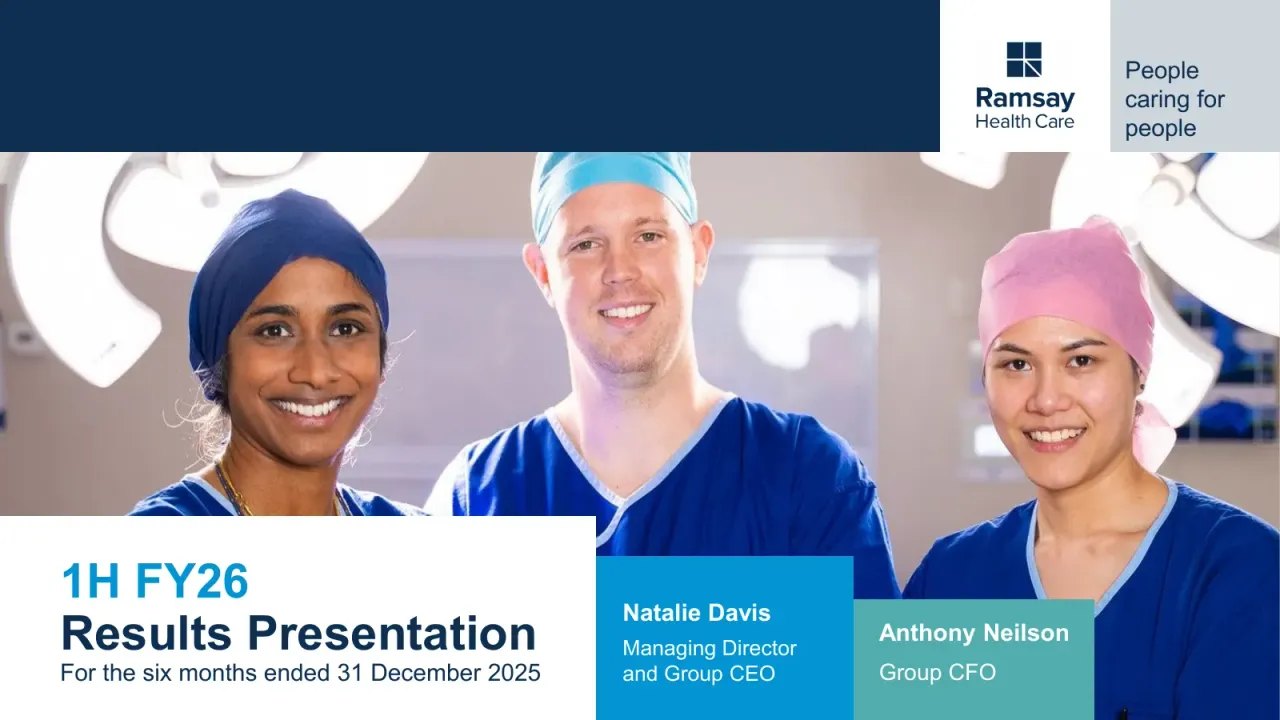
0:00 Good morning and welcome to Ramsey Healthcare's financial results for the six months to 31st of December 2025. My name is Natalie Davis and I'm joined today by Anthony Nielsen, our Group CFO, who commenced with Ramsey in late November. After 12 months in the role, I'm pleased to report that we're making good progress on our key priorities. The refresh of our Group Executive is now complete, strengthening capability and supporting the acceleration of our multi-year transformation program. We remain focused on delivery against the three priorities I first outlined this time last year that are shown on slide three. First, disciplined execution of the transformation of our market leading Australian hospital business. In the half we've improved patient, people and doctor MPS, grown admissions with a focus on higher acuity and have lifted our theatre utilisation.
0:55 Our second priority is strengthening capital allocation and improving returns across the portfolio. You will have seen last week's announcement regarding the proposed distribution of Ramsey's investment in Ramsey Sante to Ramsey shareholders. Subject to obtaining the relevant approvals, we believe this will simplify the group and enable focus on the transformation of the core Australian hospital business. We have also progressed the turnaround at Elysium by right-sizing the business for the current environment through site closures and reducing available beds. With Joe O'Connor joining as CEO in January, we expect the turnaround to continue to gain traction. Our third priority is evolving our culture to innovate and accelerate delivery.
1:41 I'm pleased to say that our group leadership team is in place, strengthening capability, and our patient and people MPS scores remain high across the group reflecting the commitment of our teams and clinicians and the quality of the care we provide. Turning to the half year results on slide five, we reported 7.3% growth in underlying EBIT and 8.1% growth in underlying NPAT and that was driven by Australia. The board has determined a fully frank dividend of 42.5 cents per share up 6.3% and representing a 60% payout ratio of underlying earnings. Slide 6 shows the underlying performance across each region and the contribution to the funding groups and the consolidated group results.
2:31 Australia was the key driver, reporting underlying EBIT growth of 7.1%, supported by good activity growth, higher acuity, improved PHI indexation and cost management, which together helped offset the impact of the new funding mechanism at Joondalup Health Campus. The team at Joondalup have progressed a range of operational programs, including a focus on reducing agency usage, which has also helped to partially mitigate this impact. A lower underlying net loss from Randvisante supported the results, reflecting growth in Sweden and performance actions in France that partially offset the government funding pressures in that market. Turning to the performance of each region and starting with Australia.
3:19 Slide 8 lays out our 2030 strategy where our vision is to innovate to be Australia's most trusted leading healthcare provider and to deliver long-term value for our shareholders through the five pillars of our strategy. Our strategy will innovate Ramsey. We will lead in local catchments, growing our services, patient care and relationships with specialists and GPs in communities around our strategically located hospitals. Differentiate ourselves in priority therapeutic areas, including cardiology, orthopaedics and cancer care. Create one-RAMSI advantages powered by digital and AI to capture the synergies enabled by our market-leading scale. Connect patient and doctor journeys from hospital care to community-based care.
4:07 And work with our communities and partners to shape Australia's leading healthcare system for the future. We will measure progress with clear financial and non-financial metrics and early indicators include our patient, doctor and people MPS metrics, growth in admissions, cost efficiencies through OneRAMC advantages and revenue indexation that better matches cumulative cost growth. Turning to slide 9, and through all the change underway, it's important to reinforce that our patients, people and clinical excellence remain at the heart of what we do and how we operate. We've leveraged Ramsey's strong reputation in clinical trials to launch a national Ramsey Research and Development Network, supporting 23% growth in clinical trials activity in the first half.
4:55 Growth in admitting VMOs and strong theatre utilisation contributed to good activity and market share gain. The changing environment in the delivery of private healthcare is creating opportunities for us, given our strong and stable reputation and portfolio strategically located at known facilities. The proposed acquisition of National Capital Private Hospital is a clear example of this, delivering us access to an attractive catchment area where we're not currently represented and a hospital with a strong reputation for clinical excellence. Our focus on utilisation across catchment areas has also seen some development projects postponed or reshaped, with development spend now expected to be below the bottom end of the guidance range.
5:42 We continue to drive cost efficiencies and maintain capital discipline through our Big Five hospital initiatives, supported by pilot programs across the business. Following last year's review, digital and data OPEX remains on track to be at or below FY25 spend. Turning to the Australian result on slide 10. The business delivered top line and profit growth despite the impact of the new funding mechanism at Joondalup. Revenue from customers increased 8.2%, driven by a 3.1% increase in hospital admissions and improved indexation. Revenue from our private hospital portfolio grew 8.7%. EBIT margins excluding Joondalup improved by 40 basis points on the prior period, driven by higher activity levels and case acuity, increased serialisation and improved PHI indexation relative to wage inflation.
6:41 Looking at activity in more detail on slide 11, our core surgical admissions grew 5.7%, with day admissions growing more strongly than overnight admissions. However, a higher acuity mix resulted in inpatient IPTAs increasing at a faster rate than inpatient admissions. We remain disciplined with our CAPEX spend in Australia, where it's focused on projects with good returns and strategic value. On slide 12, the major development projects in the half were the completion of Ramsey Private at Joondalup campus and the final phase of the expansion of Warringal in Melbourne, due to be completed in the second quarter of financial year 27. We have 23 new theatres and procedure rooms scheduled to open in financial year 26, concentrated in major hospitals in key catchment areas.
7:34 Development capex for the full year is now expected to be in the range of 170 to 190 million below our previously guided range, reflecting our disciplined approach to utilisation and capital allocation. Turning to the outlook for Australia on slide 13. In the second half, we'll continue to advance our multi-year transformation program in Australia. We aim to finalise negotiations on the Victorian and Queensland nurse EBAs by the end of this financial year. We will continue to work with our payers to recover both the gaps created by cumulative revenue indexation for low-cost indexation and future wage inflation, as well as innovating our funding to better support innovation in care models.
8:19 We have one major PHI contract renewal due in the second half. We expect EBIT growth momentum in Australia to continue in the second half, driven by growth in activity in our priority therapeutic areas revenue indexation, cost focus and partial mitigation of the impact of the new funding mechanism at Joondalup. We will continue to progress the proposed acquisition of National Capital Hospital which is expected to transition into the Ramsey portfolio in the first quarter of financial year 27 and be EPF accretive in the first 12 months of ownership. Turning to the UK region on slide 14, both businesses operating in challenging conditions The UK acute hospital business was impacted by NHS budgetary restrictions towards the end of the period.
9:10 This was mitigated by focus on high acuity and private work as well as operational initiatives. Elysium continues to face weak market demand from local authorities. The turnaround plan is underway and beginning to gain traction including central cost reduction, agency reduction, site optimisation and fee negotiation. Turning to the acute hospital business results on slide 15, the business delivered 3.5% revenue growth in constant currency, driven by a higher acuity case mix, increased private pay admissions and tariff indexation. NHS admissions slowed and declined in quarter two as NHS budgetary constraints began to impact activity.
9:56 A continued focus on managing complexity and consistent operational excellence helped to mitigate the impact of lower NHS volume. The result included backdated indexation. Excluding this impact, underlying EBIT margins improved 30 basis points to 9.3%. Turning to the outlook for the acute business on slide 16. NHS activity outlook for the third quarter, financial year 26, is expected to remain negative compared to the prior period. The UK hospital business will continue to focus on growing private volumes and driving operational excellence to help offset the NHS funding uncertainty, which we expect to prevail until the new NHS fiscal year.
10:43 As the leading private provider to the NHS, Ramsey UK remains well positioned to support the UK government's objectives to reduce elective surgery, outpatient and diagnostic waitlists when additional funding is anticipated to be made available in the new NHS fiscal year from 1 April, with a strong pipeline of patients through its outpatient clinics. On slide 17, Elysium has remained focused on its turnaround program, informed by the recommendations of the performance diagnostic completed in the second half of financial year 25. Key priorities include site optimisation, cost reduction and fee negotiation that better reflects the complexity of services we provide.
11:28 This resulted in the closure of 163 beds at underperforming sites in the first half, with five sites expected to be closed in the second half. A number of these properties have been put to market for sale. Turning to the outlook on slide 18, Elysium's new CEO Joe O'Connor commenced in January and is leading the performance improvement plan. We expect the ongoing focus on the plan and the initiatives already taken in 2025 will see the turnaround continue to gain traction. Turning to Ramsay-Sante on slide 19. As announced last week, we are progressing the proposed demerger of Ramsay-Sante via an in-specie distribution of our 52.8% investment to Ramsay shareholders.
12:17 While this process continues, we remain focused on the performance improvement programs across the European business, and particularly in France, which continues to face funding headwinds and broader market uncertainty. In the Nordics, the focus remains on continuing the performance momentum of the Swedish business and the turnaround programs in Denmark and Norway. Turning to Ramzi Sante's results on slide 20, and the business delivered a 4.4% increase in underlying EBIT in constant currency, driven by a strong result from the Nordics region, in particular the performance in Sweden. This was partially offset by weaker results in France, where the reduction in subsidies of €20 million compared to the prior period and the inadequacy of tariff indexation continue to pressure earnings.
13:10 Turning to the outlook for Ramsey Sante on slide 21, Across Europe, the focus remains on cost control, efficiency and cash generation, as well as continuing the performance momentum of the Swedish business. Activity growth in Europe is expected to continue in the second half, driven by day admissions, partially offset by the impact of a three-day French doctor strike in January. The new contract at Saint-Goran commenced 5 January 2026 for 8 plus 4 additional years on improved terms which will assist the Nordics' results. As outlined in detail in last week's announcement on slide 22, we believe that the proposed demerger of Ramsay Sanchez through in-specie distribution will simplify Ramsay and enable both organisations to focus on transforming their respective businesses.
14:01 We will update the market as we work towards the release of the demerger booklet and subject to receiving necessary approvals, currently expect to complete the in-specie distribution in December 2026. I'll now hand you over to Anthony to run through the financials in more detail.
14:19 Thanks, Natalie. Good morning, everyone. Natalie has already covered as much as slide 24, so I'll just highlight a few points, noting currency translation has impacted some of the movements on the P&L and balance sheet for this half. In this result, we have focused on underlying numbers, given the large non-recurring items in the UK region and Ramsey Stompe in the first half of last year. Items excluded from underlying profit this half were $11 million negative impact on net profit and primarily relate to transaction and restructuring costs. There is a detailed reconciliation shown in the appendix. Underlying NPAT showed strong growth for the half of 8.1% driven by activity growth across Australia and Europe combined with higher acuity across Australia and UK and revenue indexation in Australia.
15:11 There continues to be a focus on operational efficiencies across all regions to mitigate cost pressures. The underlying NPAT tax rate was 36%, slightly higher than last year. This reflects the impact of CVAE taxes in France, which calculated on turnover, despite France being in a pre-tax loss position in the first half. The full-year tax rate is forecast to be approximately 35%, reflecting a higher rate in Remzi-Santac. Operating cash flow on slide 25 improved 16.9% to $350 million for the period, driven by the performance of Australia and lower tax pay than the previous corresponding period which included the sale of Ramsey Sign Darby.
15:58 Improving our cash conversion is one of our key priorities in all regions and we are all investing in systems and processes to strengthen cash collection and drive cost out and efficiency programs across all businesses. CAPEX cash outflow increased from prior period mainly due to development projects in Australia. I will touch on CAPEX in more detail on slide 31. Dividends paid increased 20% reflecting the suspension of the dividend reinvestment plan for fiscal year 25 final dividend. Turning to slide 26, currency translation had a significant impact on the face of the balance sheet for this period to the tune of $84 million. Movements in working capital, primarily related to the Renzi-Sante, and the timing of periodic true-op payments with French government with advances repaid, reducing payables.
16:51 Consolidated net debt is $5.1 billion, and I'll show a separate breakdown between the funding group and Renzi-Sante on the coming slides. 67% of the consolidated group's floating rate debt in the second half of this fiscal year 26 is hedged at an average base rate of 3%. We have provided both the funding group and Renzi-Sante summary balance sheets in the appendix so you can see the group results excluding Sante. Turning to the funding group performance on slide 27, underlying impact grew 5% which was driven by good growth in Australia, partly offset by a lower contribution from the UK. UK margins were impacted by higher costs and lower occupancy at Elysium. Elysium cost efficiency initiatives began to gain momentum late in the half with continued focus on these initiatives in the second half.
17:46 Total financing costs including lease costs increased 1.3% in constant currency due to higher average base rates and a small increase in drawn debt during the half. Moving to the funding group debt and leverage on slide 28. Given the separate funding arrangements of the funding group and Renzi Sante, looking at the group's consolidated leverage is not a meaningful metric. The funding group shows leverage excluding Sante and is 2.22 times within our target range of less than 2.5 times and interest cover remains strong. Fitch has recently reaffirmed its BBB minus investment grade rating for the funding group. We have adequate liquidity in place for the purchase of the National Capital Hospital in FY27 and leverage is expected to remain within our target range of less than 2.5 times.
18:41 During the period, we successfully refinanced our key syndicated debt facilities, extending Kenner and reducing our margin by 30 basis points. While base rates are increasing, our weighted average cost of debt has declined 20 basis points since 30 June 2025, reflecting the refinancing of our facilities at these lower margins. We remain reasonably well hedged, with 65% of our debt hedged at an average base rate of 3.65%, which is below current spot rates for the second half of the year. Moving to Ramsay Sante's debt position on slide 29, and it remains well supported by its own separate funding arrangements, with Tenner extended significantly over the last 12 months. The business has Euro 391 million of liquidity available, with leverage of 5.3 times and the company is focused on improving cash flows and driving cost out and efficiency programs to reduce leverage over time.
19:42 Turning to slide 30 and our focus is on improving capital management, cost discipline and cash flows across the group. First, we are improving capital allocation and returns. A range of programs are underway to recycle capital into higher returning projects of the business and lift utilization of existing facilities and assets. In the overseas business, we will drive capital discipline and focus on maintenance projects and the optimisation of service and assets. Second, we need to strengthen both operating and investing cash flow. We have multiple initiatives in place to improve working capital with revenue cycle management, cost-out and efficiency programs being a key focus. We are also reviewing capital spend and will be pushing all these initiatives harder.
20:30 In the near term, our priority is maintaining our leverage and our credit rating at current levels. Looking at capital expenditure in more detail on slide 31, our focus is on capital discipline, with CapEx modified for the current environment with both UK and Ramsey Sante spend lower in local currency. Group CapEx increased $27 million between periods in constant currency terms due to higher Australian development CapEx, with focus on development projects increasing procedural capacity in Joondalup and Warringal. We have reduced the full year CAPEC range to between $755 to $795 million, which is $40 million below the previous range to reflect the lower spend.
21:16 I will now hand you back to Natalie to talk about the outlook.
21:21 Thanks Anthony. So to recap briefly, our strategic priorities remain clear, transforming our market leading Australian hospital business Strengthening our capital discipline and improving capital returns across the portfolio and evolving our culture of people caring for people to innovate and drive performance. Our financial year 26 full year results are expected to reflect the following. In Australia, we expect continued EBIT growth momentum driven by increased activity in priority therapeutic areas, revenue indexation, cost focus and partial mitigation of the impact of the new gingerlet funding mechanism. In our UK hospital business, we expect NHS activity in the third quarter to remain negative compared to prior period due to NHS budget constraints for the remainder of the UK fiscal year ending 31st of March.
22:14 Granting UK remains well positioned to support the UK government's objectives to reduce waiting lists and has a strong pipeline of patients through its outpatient clinics. when anticipated additional funding is made available in the new NHS fiscal year from 1 April. For Elysium, we'll remain focused on improving performance and expect the turnaround to continue to gain traction over the second half. In Europe, we expect activity growth to continue in the second half, driven by day admissions, partially offset by the impacts of the French three-day doctor strike in January. Our net financing costs are forecast to be 590 to 610 million and our underlying effective tax rate is expected to be approximately 35% given the high tax rate in Ramsay-Saint.
23:04 Group capex guidance has been reduced. We spend in the second half to be lower than the first half. Finally, the dividend payout ratio for the year is expected to be 60 to 70% of underlying net profit after tax and non-controlling interest. Overall, I'm very proud of the progress we have made and the commitment of our team members to providing excellent care for our patients while we transform and strengthen the business for the future. And with that, I'll open up to questions. Thank you. If you wish to ask a question, please press star 1 on your telephone and wait for your name to be announced. If you wish to cancel your request, please press star 2.
23:49 If you're on a speakerphone, please pick up the handset to ask your question. Your first question comes from Leanne Harrison of Bank of America. Please go ahead. Good morning, Natalie.
24:00 Good morning, Anthony. Thank you for taking my questions and congratulations on a very strong result for Australia. You know, what we saw, you know, compared to the results, the first quarter results that you mentioned at the AGM, we certainly saw an acceleration of growth both at revenue and EBIT in the second quarter. What are your expectations as we are in third quarter now and then for the fourth quarter as well? Can we expect that revenue growth and that EBIT growth to continue to grow at a faster rate? And what would be supporting those?
24:36 Thank you, Leanne, and thank you very much to the whole team in Australia for really focusing on growth and performance momentum over the half. I think what we've guided to today is really looking at year-on-year EBIT growth momentum continuing throughout the year. I think it's important to remember that there is seasonality in Australia and in some of our businesses it works the other way. So we do tend to have a lower EBIT result in the second half because of January when a lot of doctors are on holidays and we don't do as many surgeries in the business as well as Easter has a smaller effect. So what we're guiding to is the year-on-year EBIT growth momentum will continue and we're not saying anything more specific than that.
25:28 Okay, thank you. And as a follow-up, you know, you've renegotiated some of your PHI contracts over the last few months and, you know, with some good fee increases. Can you comment on, you know, seeing PHI premium increases in the vicinity of going to be about 4% or a little bit more from April of this year. How will those increases be captured in the fee terms on the contracts you've already negotiated?
26:00 Thank you for the question and it's been very pleasing to see that Australians have kept up their private health insurance coverage even through significant cost of living pressures. and I think the Minister when he approved the latest round of premium increases acknowledged the very significant cost increases and cost pressures that the private hospital sector is facing and we would expect those premium increases to be passed along to private hospitals to cover those cost pressures and the Minister has talked about the benefits payout ratio having decreased over time since COVID and his expectation that that would increase. And so we will be talking to all our private health insurer partners to ensure that the revenue indexation we receive on an ongoing basis reflects our genuine cost pressures and those pressures are real and they will continue into the medium term.
27:03 Thank you. I'll leave it there. The next question comes from Andrew Goodall at MST Marquis. Please go ahead.
27:13 Thanks very much. Just to focus on the UK, if I may, I guess just with Elysium, obviously you're doing some performance improvement there, but just wondering whether you can see that as a permanent resolution to something that might be more structural. And then secondly on UK, I saw that the NHS has got this idea of a sprint to the end of the financial year. with additional elective surgery, but that's not reflected in your comments. So just wondering what your thoughts were there as well.
27:43 Thank you for those questions. So focusing on the UK, and I'll take each business separately. With Elysium, we completed last year a very significant performance diagnostic, and the team has gone about implementing that under, first of all, the leadership of Nick Foster and now Joe O'Connor since he joined in January. We see a very significant improvement potential for our lithium from the current performance, which is very weak. We have focused a lot over the last six months on cost reduction, so central cost reduction. We've now done two phases of reducing FTE in that business. We've focused on reducing agency costs. And importantly, we focused on decreasing the number of available beds.
28:33 and the demand that I think we've experienced throughout the half has probably been weaker than we originally expected and so you see we've closed 163 beds in the half and we will continue to look at potentially site closures and putting properties up for sale to make sure that the services we provide really match the demand from the sector. However, having said all that, we see significant potential for us to turn around the performance and to continue focusing on both the top line through providing high-quality services for very complex patients and making sure that our fees reflect the quality and the complexity of the service we provide, improving our conversion rates, which we have improved in the past, but there's more opportunity to do that. when we get a referral to making sure that we convert all of those referrals and continuing to focus on costs and we continue to see more potential for that.
29:39 So we continue to be confident that that turnaround is continuing to gain traction and we saw an improvement in performance towards the end of the first half. On the UK and what's happening with the NHS, we're certainly seeing from the end of the first half, we're certainly seeing a step back in activity across our hospitals. A number of our hospitals have activity management plans in place. In some cases where those plans have been in place, we have managed to get effectively separate contracts to fund further activity. above that activity plan level. But overall, as we said, we expect negative NHS activity in quarter three and then we're well positioned when we anticipate there'll be more funding provided from April to grow our business over there.
30:41 And just a quick one for Anthony. Appreciate you breaking up the funding group. But just with the refis, if you had any sort of separate costs associated with that and if they were taken through the PML.
30:54 Anything that was small was in the non-recurring items for that. And we did take some items capitalised into the balance sheet.
31:06 Got it. Thank you. The next question is from David Lowe at UBS. Please go ahead.
31:14 Thanks very much. Natalie, if I could just start with Tundalup. So you're quite specific as to the headwind there. We can back-calculate from the comment about 40 basis points further, but just wondering, you know, relative to your expectations there in terms of the headwind, whether anything's changed, whether you've been able to mitigate it more than expected?
31:33 Yeah, so last year we talked about the new funding mechanism at Jindalup Public and the expected impact that would have. We also said we would partially mitigate that impact on the campus itself. We have continued to do that and I would say that the mitigation is in line with what we're expecting. and there's a number of things we've done there. We've worked to increase activity with the government. WA, like many states across Australia, experienced a very strong flu season and so we had additional capacity that's been funded at the beginning of the financial year in that flu season. but we're also continuing to work on our operational initiatives and there's been a big focus in particular on reducing agency at Ginger Luck which we successfully at the end of the half ran what we call a professional pathways program and that program attracts nurses out of non-hospital sectors so sectors like aged care into the hospital system.
32:41 We had a very successful recruitment drive, and I think around 50 nurses have started with us at the hospital, which will enable us to reduce agency at that hospital. We also, last week, we also had the pleasure of opening Joondalup Private. So that's the expansion of the private facilities. It's a very significant expansion. It creates, for the first time, dedicated private theatres in that campus. and we're now focusing on ramping up the growth in the private part of that hospital. So overall, I'd say the mitigation that we expected is on track and as we thought.
33:23 Okay, perfect. Thank you. Look, the other question I had was, I think certainly the revenue growth in Australia was a positive surprise. Just wondering, we can see the activity that you've broken out there and that calculates price increase, but within the activity is mixed a positive driver there? And can that trend continue on into this calendar year?
33:46 Yeah, I think what we saw in the half was pleasingly a focus by our teams on higher acuity work. And you can see that in the activity numbers. So not just in admissions, but in IPTA growth. And the fact that our IPTA growth was in line with admissions growth, I think has driven that positive mixed benefit. It came through on both surgery, but it also came through on some of our medical admissions. And so, you know, that's something that continues to be a focus for us. We're very focused on utilising our theatres as much as we can and thinking about our theatre utilisation in terms of catchment so that our major hospitals are very much focused on attracting high acuity work.
34:35 and then some of our smaller day centres and smaller hospitals that can then attract the lower acuity work. And so we're trying to really optimise the way we're thinking about our portfolio within catchments to focus on mix.
34:50 Okay, great. So it sounds like that can continue as a positive trend.
34:54 It will continue to be a focus for us.
34:57 Okay. Great. Great. Thanks very much. The next question is from Craig Wongtan at RBC. Please go ahead.
35:10 Thanks. Just wanted to understand about the Australian CAPEX. You know, the guidance there has been revised and your comments about being disciplined on CAPEX. Just wanted to see if you could provide any comments about how we should think about the run rate of CAPEX going forward.
35:25 Thank you. So what we're really doing and I just explained I think the catchment thinking that Stuart Winters in particular who's our new Chief Operating Officer is bringing to the business. We're continuing to really focus on existing theatre utilisation but we're also really thinking through our portfolio and how do we for example in Lake Macquarie catchments we open Charleston which is a day surgery. that was operationally separately managed to Lake Macquarie, which is our big hospital there. They're now all under the same leadership and we're now developing a catchment strategy across that. The other thing that Stuart is really focused on is thinking through how do we better use the physical infrastructure that we have in our existing hospitals to be able to add procedural capacity effectively and efficiently.
36:18 and I think St George is a good example of this where we're doing a development and we're effectively taking existing space within the hospital that's an ICU and converting that into a theatre space which is linked to the existing theatre complex and we're moving ICU into an area that was full of beds that were not being utilised. So what we're trying to do is, as we've said over the last year, is focus very much on procedural capacity adding beds by exception and utilising the existing assets that we have within a catchment fully before we're increasing procedural capacity. So you'll see very selective and strategic developments from us going forward. We're not yet guiding to next year on that.
37:12 Okay. And then I just wanted to move to the clinical trials aspect research and development network that you talked about. Could you just provide some more details around that and specifically the benefits that the Ramsey Group gets from having that network?
37:28 Thank you. It's a small part of our business but it's one that we're all incredibly excited about. With clinical trials, we have traditionally run a site-by-site model and we had around about 20 sites that were providing capacity to doctors who wanted to do research in our hospitals. To give you an example, it's very common and important in cancer care. So a lot of patients, when they're coming for treatment through their doctors, are looking for the latest chemotherapy drugs and treatments. And if we can provide access to clinical trials, we can provide actually leading treatment for patients. and we can also ensure that we're attracting doctors and we can actually see that doctors who do clinical trials with us actually have a higher NPS with Ramsey. So it's a small part of the business at the moment.
38:27 I think it has a significant potential and it's important to reinforcing our core hospital business because it does mean that we can provide leading care to patients and also attract more doctors to working with Ramsey.
38:44 Okay, makes sense. And then just my last question, one for Anthony. The comments you made about having cash conversion as a key priority, just trying to understand what you're focused on here. Is this about faster collections or something about claims? Could you just give us some colour on what you're trying to do there?
39:03 Yeah, thanks Steve. Yeah, look, definitely receivables improvement is a big driver that we have there in the revenue cycle management, looking at all of our systems and processes both from Australia and international perspective to get the base debtors down and the improvement through the billing cycle and cash collection, accuracy of billings, all of those sorts of things are a big driver that flows straight through to the bottom line if we can improve that working capital position.
39:34 Okay, thank you. The next question comes from David Stanton at Jefferies. Please go ahead.
39:44 Morning, team, and thanks very much for taking my questions. Impressive 5.7% growth in Australia in surgical admissions. Firstly, you know, bottom line, what's driving that? Is it the market growth at that level, or do you think you're taking share? And if so, how is that happening? Thank you.
40:03 Thank you David for the question. We think we're probably taking market share at the moment when we look at our growth relative to the market. I don't know if there's more market statistics coming out tomorrow so we'll see how that goes. I've spoken previously about the focus where we're doing on growth across our hospitals so over the last 12 months we've been providing to all of our hospital CEOs data that's very easy for them to use, which enables them to do a few things. First of all, it looks at every therapeutic area by doctor and it looks at data utilisation. It gives an indication of profitability of that work. It also gives an indication of to what extent is that doctor cancelling lists. and what period of time do they let us know if they are cancelling a list because the more time we have obviously the more we can then fill that data with other work with other doctors.
41:03 The other data set that we're giving to our hospitals is around catchments and more data around the specialists in that catchment that do work with us and don't do work with us as well as the GPs and the ones that are referring to specialists who work in our hospitals and other GP practices that are not. So that's been new, it's all in one place and it enables our team therefore to go and have conversations with doctors where we know we need to increase their utilisation. and it also enables us in terms of our business development managers and our GP liaison officers to be much more targeted around where they're spending their time to be able to attract new doctors to come and work with Ransi.
41:50 And I think the other thing that's been helping us over the last six months is obviously, you know, the very strong clinical reputation that we have but also our stability as a very strong business with ownership of our hospitals. And I think that's also been helping in the current environment to attract more doctors to come and work with Ramsey. And we're continuing to really focus on how do we improve and strengthen our doctor proposition and our proposition in our therapeutic areas that we're focusing on.
42:27 Understood. Thank you. And is it fair to say, given your previous commentary, with these upcoming EBAs, you believe that they'll more than likely be covered by the increases in PHR premiums, or what should we be thinking there?
42:44 So we continue to see wage pressure out into the medium term, and that's coming through from public sector nursing EBAs, and we have to be competitive to be able to attract the nursing workforce that we need in every state. The one that we are negotiating at the moment is in Victoria, and that's obviously against the backdrop of a very significant public sector EBA increase of 28% over four years, but significantly backdated to November, December 2027 calendar year. So we expect continued pressure on wages across Australia. and we will continue as we negotiate with private health insurers to cover that cost pressure and it's very genuine.
43:37 It's been experienced by the whole sector in terms of the revenue indexation that we're receiving. In some cases, we have now got what we call dynamic indexation in place. There's three contracts where we do this. and we're talking to more health insurers about this and what that basically does is once we agree the first year indexation, the second and the third year indexation in the contract are linked to externally referenced cost benchmarks so that those cost pressures when they're genuine and they're sector wide will be reflected in our revenue indexation. and the importance of that, apart from ensuring that we're paid fairly, is also freeing up management time to actually look at the structure of these funding agreements, the way we're providing care and innovating our care models and innovating the funding to support that. So that's the opportunity for us to work with our private health insurer partners to really innovate the proposition for Australians for private health care.
44:45 Thank you, very clear. And finally from me, companies talk to digital upgrades. Can you give us sort of an update on spending options and timing potentially? Thank you.
45:00 Thank you. So we've been in a bit of a reset I think on digital and data transformation and as we said last year, while we did that we focused on effectively maintaining and even possibly reducing the spend in that team. We've now got Dr John Doulis who's joined us as our Chief Technology Officer. John comes from HCA Hospitals in the US which I would say is one of the leading hospital health systems when it comes to thinking through how to really use technology and digital technology to drive better patient experience, team experience and business outcomes. So John joined in early November.
45:46 He's now at the point where he's got some very clear priorities for where he's going to work with the team on. and they're very much aligned with the big five initiatives that we've been talking about in our hospital so they're very much linked to operational improvement. The top three are really around revenue cycle management and in particular upgrading our patient admin system or PAS which is very outdated. That will enable us to speed up our revenue cycle management system and also improve accuracy in that system. The second one is around workforce and introducing a smart rostering system. That's something that will free up a lot of time around nurse unit managers who spend a lot of time on rostering at the moment with three legacy systems.
46:37 It's a pretty manual process. It will also give our team more flexibility. and the third one is thinking through how do we use technology to really track prosthesis and consumables as they're being sorted into our hospitals and used in our hospitals and then charged to private health insurers. So very clear priorities and we'll continue to keep everyone updated as to our technology roadmap.
47:09 Thank you. The next question comes from Davin Villanathan at Goldman Sachs. Please go ahead.
47:21 Thanks. Hi, Natalie. Hi, Anthony. Thanks for the opportunity. I just wanted to think through the Australian business and your revenue growth that you're demonstrating there. I think in the first quarter, you did a growth that was about 6.5%, and then in the half, you know, that stepped up to 8.2%. So clearly... some better momentum happening in that second quarter. Now, my understanding was in the first quarter, you had benefited from some high fluid emissions, and I wouldn't have expected that to continue. So perhaps could you talk through any sort of material changes that occurred over the second quarter to allow that level of growth to step up, please?
48:03 So that is true. So we do benefit in that July to August period from winter flu season. And that was a particularly serious flu in terms of the impact it had on Australians right around the country. So we did see more medical admissions and longer lengths of stay associated with those admissions. But as I've said, we continue to experience good growth through the half. And I think that's really was a continued focus by our hospital teams on recruiting doctors and utilising theatres. And you also would have seen in the results, we also shared that our public work increased a little bit. Some of that was at Joondalup, but some of that also was in New South Wales.
48:53 So that continues to also be an area of focus. So I don't think there was one thing I can point to to say it was due to that. It's a focus for us and we really continue to focus on that going forward in every major hospital and catchment that we have.
49:15 Great, thanks. And my next question is on your CapEx, which you have lowered in Australia. Now, I understand part of that is clearly you're utilising your existing facilities better, but just thinking about other changes you've made with CapEx delivery, as an example, I've noticed that your June cap-ex was also lower than your budget. Could you perhaps talk through any other changes you're making on the actual delivery of all these sort of growth initiatives and perhaps is that what's sort of helping that cap-ex lower as well? Thanks.
49:49 Yeah, I think Joondalup was a very well delivered project. We had a good delivery partner there and it was delivered on time and on budget, actually slightly earlier and that's hard to do. So I think that was a really good example of working well with a delivery partner. But most of the decrease in our guidance on CAPEX is really about us as a leadership team. You know, myself and Anthony, who are in the capital forum that we've described in the document, really stress testing with the teams around do we need to do this development proposal and do we need to do it right now? And, you know, really encouraging the teams to first of all focus on utilisation before bringing business cases to us. So it really is more that rigor around the way we're approving capital projects.
50:49 And my last one, just trying to understand the sort of digital and data spent in your P&L. I think you had about $19 million FY25. Could you sort of help us understand what was spent in the first half and what the expectation is for FY26, please?
51:08 Yeah, I think we've said before that digital and data spend will be at or below, if we can, that level of last year and we've said that we're on track. We're not going to split that between half.
51:22 Okay, thank you. The next question is from Laura Sutcliffe at Citi.
51:36 Please go ahead. Hello, thank you for taking my questions. Firstly, on the UK, is the volume headroom that you've seen in the third quarter enough that you could potentially end up with revenue in the second half being flat or going backwards versus the first half? Would you still expect that revenue can grow in the second half over the first half in the UK?
52:02 So we're not guiding to revenue in the UK, but... I will make a few comments. We do, as we've said in the release, we do see NHS activity being negative in the third quarter, and then we're well prepared as we anticipate new funding to come in in quarter four to grow NHS activity. But we're also focusing on acuity, so acuity of bits, and that's supporting the result that you've seen in the first half. and the team is also focusing on growing private, and that includes both self-pay and our agreements with private health insurers. So all of those factors we'll be focusing on.
52:49 And, of course, remembering seasonality in the UK is the opposite to Australia. So, you know, we see a weaker summer over there, which impacts the first half.
53:02 Are those activities you just mentioned, the mitigation, activities that you were mentioning earlier, or is there a bit more to the mitigation piece?
53:11 Yeah, so the mitigation is around growing our private work. So we focus very much on NHS work in that business, but we are putting more and more focus on private work, which you can imagine is more profitable for us than NHS work. We are focusing on acuity of mix, and we're also focusing on operational efficiencies and cost mitigation. We'll be stepping up the cost focus as well, given the uncertainty on the NHS funding front.
53:42 Okay, that's clear. Thanks. And then secondly, looking at some of Sante's reporting and the proposed distribution, Could you tell us if any of the mechanics around change of control there would potentially leave you in a position where you had to make payments to Sante or others?
54:07 So as Anthony explained today, the Sante debt is non-recourse to Ramsey Healthcare. And so the debt that we hold, the funding group, relates to Australia and the UK businesses. So when you think about the separation of Ramsay-Sante from Ramsay Health Care, in this case Ramsay-Sante is already a separate listed entity on the Euronext, it already has its own governance structure, it has its own debt structure and so the approvals will be happening mostly in the Australian context around our shareholders and putting a proposal to them through a scheme of arrangement around thinking through whether there's value to Ramsey Healthcare shareholders from effectively holding these two entities separately.
55:05 And we do think that there is strategic logic and it's quite strong. logic around, you know, effectively, Ramsey Sante is an independent entity focusing on their strategy of integrated healthcare in European markets, and Ramsey Healthcare really focusing on the priorities that we've laid out today, and in particular, the continued transformation of the Australian business. So I think it's important just to understand that there's, that Sante is non-recourse and there's no guarantees from Ramsey Healthcare.
55:39 Okay, thanks. I just thought I would clarify because the potential amount they mention in their documents is quite large. Thanks. The next question is from Steve Ween at Jarden. Please go ahead.
55:56 Good morning, Natalie. I just had a question with regards to the Victorian ABA. We've seen your offer that you've provided to the nurses just trying to understand what the reaction to that offer has been and whether or not you're getting recognition from the PHIs as to that step up that happens sort of in the back end I think of 28 where you're mimicking what happened in the public EBA in Victoria.
56:27 So we're in the process at the moment of negotiating the Victorian EBA with the unions and with our team and so I won't be commenting today on how that negotiation is going.
56:42 Okay. Then can I ask a bit of an extension of the EBA question which is you've mentioned in your presentation from an outlook perspective that you're attempting to close the funding gap from payers, the cumulative gap from payers versus the cost inflation. Can you talk to how that is possible? I mean I can see with the arrangements you've got in place already that you're covering current inflationary pressures in FY26 but how do you claw back some of those historical underpayments from the insurers?
57:22 I think the discussion that we have with our private health insurer partners, and this is a discussion that's really happening, you can see it at a sector level in regards to private hospital viability, but overall the premium increases that have been approved for private health insurers over the last five years since COVID have not fully been passed through to private hospitals, and that benefit payouts ratio has decreased over time. Now we believe that those premiums that Australians pay should be passed on to hospitals and the hospital sector is experiencing very genuine cost pressures and so that is the discussion that we have with our private health insurer partners and we've experienced as I've described an improved level of revenue indexation but we haven't yet managed to achieve that closure of that cumulative historic gap and that is a challenging discussion but we will continue to strive to achieve that and quite often as we're entering into new contract renewals for a number of years and looking at partnership opportunities and talking about dynamic indexation in the outer years, that is the opportunity for us to work through that cumulative gap because you can't really agree to dynamic indexation unless the base is correct or the
58:53 base is corrected over time. So it's a challenging discussion, but it's one that we continue to have.
59:01 Okay, great. And just some points to confirm. The coverage that you're getting from the insurers at the moment in FY26, how much line of sight do you have for that coverage to extend beyond FY26 relative to the EBAs that you've put in place?
59:21 So we always, when we negotiate with private health insurers, we always look at effectively the cost pressures that have been effectively locked in through EBA arrangements but we also do forecast out what we expect EBA pressure to be and if for some reason the EBAs end up being at a higher level, we will always go back to the private health insurers to discuss that. I think the dynamic indexation that I was describing is a way that that becomes a very fair discussion because it's referenced to external benchmarks which really do show whether there is genuine industry-wide cost pressure in the system.
1:00:05 Okay, so knowing what you know now, you can still say that your PHI coverage extends into FY27?
1:00:13 No, that's not what I'm saying. I'm saying there's a series of contracts that we have with private health insurer partners. We're in the process of negotiating one at the moment in the second half and so it's a rolling process. In some cases we have existing contracts in place but the three examples I've given on dynamic indexation that's in place in the outer years but in others we have contracts that will come up for renewal in the next year or two and we'll have to renegotiate that as well. So it's a dynamic process.
1:00:50 Alright. Maybe could you indicate how many of the insurers are on these dynamic – I mean you said three but are they the big ones or are they the more smaller ones?
1:01:00 We've said before that the three that we've got at the moment are not the major insurers.
1:01:06 Okay. Last one from me just with regards to the Joondalup offsets. Was there any evidence of that in first half or are we expecting that sort of more second half and beyond and then in addition is there any way we could sort of get a better understanding of the sequencing of data and digital because obviously the key point for this stock at the moment is the turnaround in margins in Australia and that can be a bit distorting unless we know what that sequencing looks like between first half and second half.
1:01:42 So the Joondalup mitigation I've described in I think a previous question so we're on track in terms of what we planned for Joondalup. In the first half there was the benefit from a public activity which was due to the flu season and the pressure that was putting on the health system in WA. We then obviously over the half focused on putting in cost and operational initiatives including that focus on agency reduction which we recruited that group of nurses into Gingerlup around November, December, takes a period of time. obviously for them to be trained so that we can reduce agency spend.
1:02:31 So we're continuing to focus on it and the flu impact won't be repeated in the second half but you'll see other operational initiatives having more impact like the one I've just described. The digital and data OPEX, I think what we've said is this year is really one of a we're keeping that spend in line with the current year or less. We very much, John is really focused on his priorities and developing that roadmap going forward. We're on track overall for the year. And we really do understand as a management team that we're aiming here to get year on year margin growth in the Australian business. And so we will think about very much the digital and data investments we make ensuring that they're connected to operational initiatives that have payoffs so that we can then reinvest in further digital investment as it's required, but understanding that over time we are all focused on improving the performance of the Australian business.
1:03:43 Okay. I'll leave it there. Thanks a lot. Thank you. The next question comes from Sol. Thanks. Good morning Natalie and Anthony. I'll try and stick to two questions. First one, Natalie, you mentioned I think at the AGM that theatre utilization had improved by about 1% in the first quarter of fiscal 26. I'm just wondering if you had any comments about where that went in the second quarter of the fiscal year?
1:04:15 I thought we had given you that number and we've given you a 12 months rolling number, 130%, so 1.3% in the last 12 months in terms of theatre utilisation. So that's on slide 9. Sure. So the assumption being that it's improved into the second quarter versus the first though?
1:04:39 So we're seeing overall improvement in theatre utilisation and that's including the impact of new theatres that we've opened over that time. So obviously as we increase admissions and IPTAs that fills the existing theatres but then we open capacity and we have to fill up that new capacity as well. The 1.3% improvement over the last 12 months I think was a very strong result given that there was a very large number of new theatres opened in that time, 16 new theatres. Sure. And then just a follow-up. I note in the presentation of the wholly owned funding group result that labour costs and contractor costs on a constant currency basis was up 6%.
1:05:29 I just wanted to see whether there was any disparate growth rates between the UK and Australia in that, or is that reflective of sort of both regions in terms of their labour cost inflation?
1:05:41 I'm going to pass that one to Anthony.
1:05:44 Yeah, thanks, Phil. Look, there's nothing materially different. It's largely reflected between both regions with similar numbers, give or take, in the wages. Great, thank you. That's all I had. The next question comes from Sasha Klein at Evans and Partners. Please go ahead.
1:06:05 Morning. Thanks for taking my questions. Just a bit of an extension to one of the earlier questions. It looks like you've removed the reference to revenue indexation being greater than or equal to labour cost inflation. I'm just wondering if anything's changed on that front. And I think your labour cost growth in Australia was circa 7.8 or something like that?
1:06:25 Yeah so the 7.8 I think you're referring to is the growth in the total labour dollars and so that includes both activity and wage inflation as well as any mixed impact and activity you know within the region of 3.1 excluding the impact of peels so you can get a sense from that as to what's happened with wage inflation. and similarly on the revenue line in terms of Australian revenue and that level of implied indexation, noting that there's always a mixed impact as well.
1:07:05 Yep, but does that previous statement around 26 and 27 still stand?
1:07:11 I think what we said in the last statement was saying is a leading indicator that revenue indexation... was in line with cost indexation and that continues to be the case in the half. So we're definitely experiencing improved revenue indexation relative to both what we paid historically and relative to cost indexation. But as I've described on the call, it's an ongoing focus for us and we need to continue to make sure as we renew contracts that we're achieving that.
1:07:48 Yeah, I guess I'm just wondering, I think that statement previously applied to 27 and I can't see it unless I'm missing it. So, I mean, are you suggesting it's maybe been a little bit harder to close the gap than expected? I'm just trying to...
1:08:02 I think you're reading into something that wasn't there in the first place. So that comment that the AGM was in relation to the performance in the first quarter, it wasn't an outlook statement into F27. Okay.
1:08:17 And then second question, just on the UK, I'm just wondering the proposed NHS tariff increase, I'm just wondering if there's any scope for that to be increased as we've seen in previous years given some of the award wage increases that have come through?
1:08:33 Yes, so I think that is a good question. So we saw effectively the tariff being guided to 0%, 0.03% in the UK. That reflected, broadly speaking, a 2% assumption on wages in the UK, in the health sector, offset by an efficiency assumption of about 2%. I think a few weeks ago, we've seen a wage number come out of the NHS that's more likely to be around 3%. And so historically, when that's happened, at least over the past two years, we have seen effectively a backdating tariff increase it may not be the full amount of the difference.
1:09:19 It's not guaranteed. So Nick Costa would say that there have been some years where that hasn't been played back and backdated. So we have to wait and see. But in the past two years, there has been an adjustment if wages have been higher than what has been assumed, but we don't know yet.
1:09:41 Okay. Can I sneak one more quick one in on the UK? Yes. In terms of the NHS activity, are you expecting a full rebound into 27 given some of the, I mean, I guess the government's recommitment to sort of closing or reducing the wait list and using private hospitals to do that?
1:10:00 I think it's very hard for all of us to really know. It depends very much on, you know, the budget in the UK, therefore the budget that gets given to the NHS. As you know, this government has previously been very clear that their election priority is to reduce wait lists and that there's a very important role for the private sector to play in doing that and we are the largest provider of NHS services in the UK. We are well positioned, but it's very hard for us at this point, I think, as it is for everyone in the UK to be certain of what will happen. It really does depend on budget outcomes and political outcomes in the UK.
1:10:49 Okay, great. Thank you. The next question comes from Andrew Payne at CLSA. Please go ahead.
1:11:00 Morning, thanks for taking my questions and congrats on the results. Just wanted to circle back to Elysium. Really just wanted to know if you think the current performance there is leading to a shift in your longer term plans for that business or do you think you'll continue to focus on adjusting cost base and keep things like growth capex on hold?
1:11:21 For the moment the posture is that the focus is on performance improvement so any growth CapEx is on hold, continues to be on hold, and the focus very much is on making sure that we're managing costs and managing the services we provide to the local levels of demand. There's also a focus in the turnaround around thinking through how we actually improve the offers that we're providing into the market. We've previously called out Nuro as an area where we think we need to reposition our services towards a slightly lower complexity, lower acuity cohort where there's a bigger demand pool.
1:12:06 The team is also focused at the moment on bespoke packages and this really is, I think, somewhat unique to Elysium because we have a very, very good reputation of providing care to very complex individuals and so in a number of locations we are talking to local authorities to take individual patients with very highly complex needs and those packages are developed with pricing that's commensurate to the effort that we need to put in the care that we need to put around those individuals. I think we have more work to do in the future around thinking through how do we strategically position our services in the market, but very much at the moment the focus is on turning around the business and continuing to gain momentum from that in the results.
1:13:06 That's great. Yeah, that makes sense. Thanks. And just another quick one. any numbers you can give us around the expected contribution of national capital. I know you said it's expected to be EPS accretive in the first 12 months, but if you can give us any numbers, that would help.
1:13:24 Yeah, at this point, we're not giving out any numbers. So we're very excited about welcoming the NatCap team to the Ramsey family. That will happen, we think, around the end of July. At the moment we're in the transition planning period but it's a very attractive catchment area with high rates of private health insurance. It has a great leadership team in place. They have a good reputation with doctors and they do work in the complex therapeutic areas that we do and they have a very strong relationship with the Canberra Health Service. NatCap is very much a hospital, which is very akin to some of our major and very successful hospitals around the country.
1:14:17 Okay, that's great. Thanks. That's all I had. Thank you. The next question comes from David Bailey at Morgan Stanley.
1:14:26 Yeah, thanks. Good morning. The junior life aid boom was about $14 million. I'll just touch on an earlier question. How much was the benefit from lower digital and data spend in the first half?
1:14:37 So as I've said, we're not giving any half guidance on our spend, so we're on track to basically maintain or slightly lower our spend on digital and data for the year, but we're not providing any specific guidance on the half.
1:14:56 Okay, but it says in the pack that it was lower. How much lower was it?
1:15:02 I'm not providing any specific numbers on digital and data.
1:15:06 Fair enough. Okay. In terms of the commentary around PHI increases, it sounds like it's offsetting wage inflation at the moment. You made the comment that participation is still holding up but there is a significant increase in the proportion of exclusionary policies which looks to be a drag on utilisation. If we think into, you know, fiscal 27, you know, if price is matching your cost inflation, and there is potential for lower utilisation on the fact that people are downgrading their policies. Do you see a situation whereby you can grow your EBIT margins at 60 basis points implied by guidance and potentially the 100 basis points at the top end?
1:15:51 Thank you for the very detailed question. I think when we look at private health insurance coverage in Australia, and what we have seen is downgrading, as you've just mentioned, particularly from gold into silver and bronze policies. But the overall rate of hospital level coverage is staying at around about the 45% level. Now the significant impacts of that downgrading are being felt in particular in maternity and mental health that are only available on that gold level coverage. and that has probably a very significant impact particularly for younger people looking at whether to take up private health insurance because those two features are important.
1:16:41 And so we're very much a strong participant in the sector-wide discussion that is going on around how do we maintain the proposition for Australians around affordable private mental health and maternity level coverage. And I won't be going on specific, any specific guidance on margin in the after years, apart from saying that, you know, it's our focus as a management team and, you know, we're making progress. The transformation is underway. and we will continue to focus on lifting the performance in the Australian business with all the challenges that we're facing but also the opportunities that we have as Australia's largest private health care company.
1:17:34 And just one final one from me, just the Fair Work Commission Work Value Case, just the status of that and the expectations around potential FERFA wage increases, duration and from when they could potentially be implemented as well.
1:17:48 So that at the moment, the Fair Work Value case is before the Fair Work Commission. So we're also waiting to see where that eventuates. We are expecting, I think, a level of phasing to any increase that is approved in there. And I've previously said at the moment, when you look at our wages, we are above the ward wages. We therefore expect that and the combination of raising really to mean that the pressure from that in terms of sector-wide and our wage pressure will be more in the outer years rather than in the short term.
1:18:33 Thank
1:18:37 you. So I think that might be the last question. It was the last question. If you'd like to make any closing remarks.
1:18:46 Thank you. I wanted to thank you all for joining the call and for a really great set of in-depth questions on our business. As you've seen in the results, I laid out three very clear priorities for Ramsey Healthcare and we are well underway in terms of the work we're doing as a new group executive leadership team. to really capture the potential of Ramsey Healthcare. And we look forward to engaging with you all on that journey. Thank you. That does conclude our conference for today. Thank you for participating. You may now disconnect.
Follow Ramsay Health Care Limited into a list and get an email when it puts out news.
Analyst, Jefferies
Analyst, Morgan Stanley
Analyst, UBS
Analyst, MST Marquee
Analyst, Goldman Sachs
Analyst, RBC
Managing Director and Chief Executive Officer, Ramsay Health Care
Analyst, Citi
Analyst, Bank of America
Analyst, CLSA
Analyst, Evans and Partners
Group Chief Financial Officer, Ramsay Health Care
Analyst, Jarden