Automated Recording
System Message
Replay available
Panoro Energy (Oslo:PEN) Q2 2026 earnings call, held 2026-08-20. Watch the replay and read the transcript on 6ix.
On 6ix: 6ix.com/event/panoro-energy-asa-0n08-q2-2026-earnings-call
Automated transcript · Written by software from the replay's audio. It can mishear names and figures; the replay is the record.
0:00 Welcome to the webinar. Please stand by. The webinar will begin shortly. Please remain on the line. The webinar will begin shortly. Please remain on the line.
1:36 The webinar will begin shortly. Please remain on the line. The webinar will begin shortly. Please remain on
2:24 the line. The webinar will begin shortly. Please remain on the line.
3:51 The webinar will begin shortly. Please remain on the line. The webinar will begin shortly. Please remain on the line.
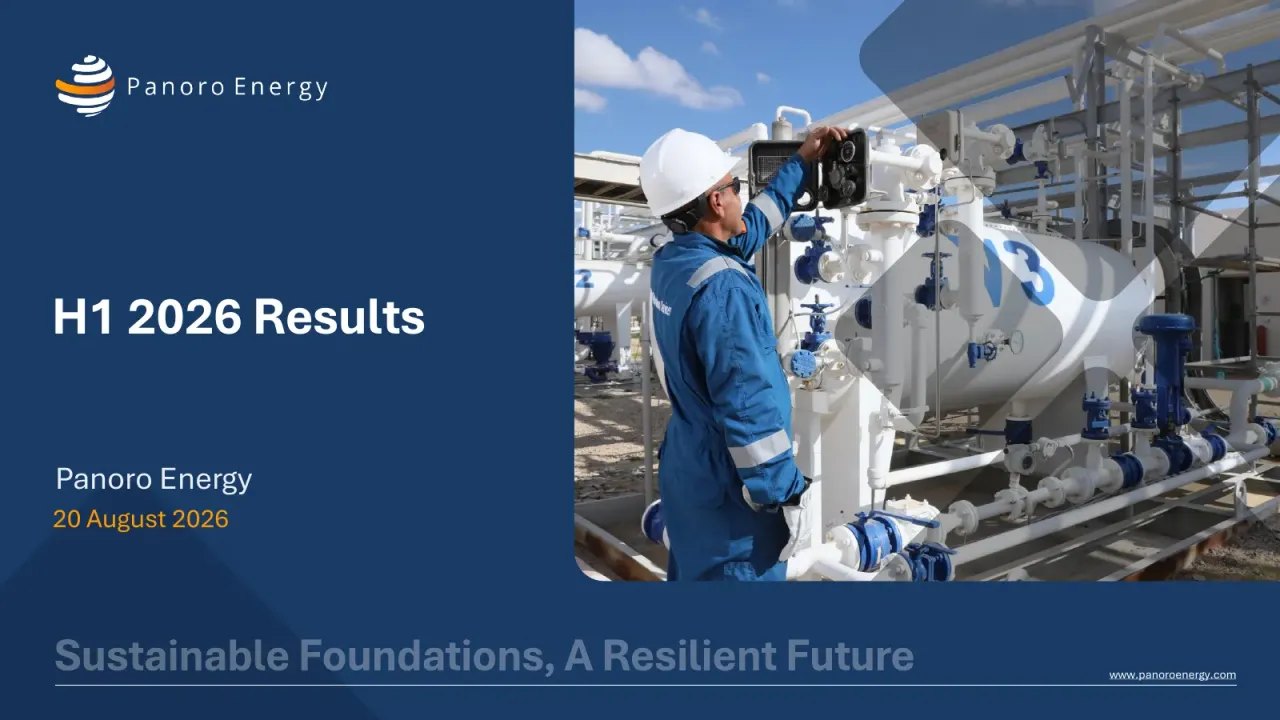
5:14 The broadcast is now starting. All attendees are in listen only mode. Good morning and welcome to Panoro's Half one Results Presentation. I would first like to draw your attention to this disclaimer. This presentation contains certain statements that are or may be deemed to be forward looking statements, which include all statements other than statements of historical fact. Forward looking statements involve making certain assumptions based on the company's experience and perception of historical trends, current conditions, expected future developments and other factors that we believe are appropriate under the circumstances.
6:08 Although we believe that the expectations reflected in these forward looking statements are reasonable, Actual events or results may differ materially from those projected or implied in such forward looking statements due to unknown or known risks, uncertainties and other factors. Next slide, please.
6:32 There will be time for Q and A at the end of the presentation. If you would like to ask a question during Q and A, you can raise your hand and you'd be prompted to unmute your microphone or you can submit written questions through the text box. I would now like to hand you over to Julian Balkanay, Panoro's Chairman, who will take you through some highlights of today's exciting news and our results. Thank you, Andy. Good morning, everyone. I'm joined today on the call by Eric D'Argentre, Panoro's CEO and President and Kathy Kadir, our CFO. Before we move to our half year result trading financial and operation update, I would like to say a few key words on the new transformational and accretive acquisitions that we have announced yesterday evening.
7:30 By now, you will have all seen the exciting announcement we made yesterday after market close, whereby we have signed a definitive agreement with DNO to acquire an indirect 9.09% interest in the gas producing block CI 27 offshore Ivory Coast. Before we talk in more detail in the next slide about our latest acquisition, I want to take a moment to reflect on how our well timed and strongly accretive M and A strategy that is part of our DNA has been a core driver of our growth in recent years. Since 2018, we have successfully completed acquisition of production asset in Tunisia, Equatorial Guinea, Gabon, and now Ivory Coast, establishing a robust and well diversified production business across forge reduction in Africa.
8:34 This latest acquisition, which will be our second this year, coming hot on the heels of our recent purchase of an additional 40% interest in Block G from Cosmos Energy. It would establish a false production leg to our business in a new first class jurisdiction that has a very strong oil and gas sector and which we believe can position us for further follow on growth opportunities at the right time. When we look at the business back then compared to today and following the number on this slide, they speak for themselves. Panoro is to the more resilient, better diversified business that it has ever been at any point in its history.
9:28 If you look at it, we have rapidly scaled our production from virtually zero at the start of 2018 to a current pro form a rate of around 20,800 BOE per day, firmly positioning Panoro as a leading independent producer in Africa. We have increased our 2P reserve by a factor of more than four with overall 2P plus 2C resources have increased by almost eight times to 183,000,000 BOE, illustrating the depth of organic growth reserves and resources opportunity we have within our portfolio today. Over this time and up to yesterday close, we have seen around a 4.5 time appreciation to Panoro share price in the same period.
10:23 It is important to note that when we have issued equity to fund external growth, we have always done so at a progressively higher valuation each time than the time before. With today at 28.77 NOK, we will issue share to DNO. Alongside this, we have responsibly used various form of debt financing and been careful to preserve what we believe to be a prudent and disciplined leverage profile. It has also allowed us to return substantial amount to shareholders, which including the cash distribution announced today, amount to a total of 950,000,000 NOK so far or roughly about 25% of our market cap as yesterday close, Delivering enhanced shareholder return over the long run is a backbone and core to our strategy.
11:25 Next slide, please.
11:28 Acquisition of indirect 9.09% interest in Block CI twenty seven. Moving on this acquisition itself, Block CI twenty seven is operated by the privately held excellent first class and long time established operator Foxtrot International, whose principal business is a 27.27 effective participating interest in the asset.
12:00 The DNO subsidiary, which Panoro is acquiring, hold an indirect 33.33% interest in Foxtrot, and therefore, an indirect 9.09% interest in that asset. Also joint venture partners in the asset include Petrosy, the National Oil Company, and CCSR. The consideration is $80,000,000 and the effective date of the transaction is 01/01/2025. It is important to highlight that there is no regulatory approval pending or required and there are no preemptive rights.
12:45 This transaction is therefore fully derisked and we expect completion to occur by the end of q three. I will let Eric to talk to you in further details about the asset, which holds the country's largest non associated gas and meeting over 70% of the country gas need. Net production for interest in the assets stand at approximately 3,334 BOE per day in the first half twenty twenty six and net 2P and 2C resources at 14,400,000 BOE. In term of funding to finance the acquisition, Panoro will issue 7,000,000 new shares to DNO, which will represent about 4.9% of outstanding Panoro share, plus issuance of those shares.
13:44 The share price is based on the VWAP for the last five trading desk preceding the announcement, so coming at a price of 28.77 NOK per share. Additionally, to diversify our credit profile, Panoro has placed a $50,000,000 senior unsecured bond carrying a 10.25% coupon with maturity in 2031. The bond was fully placed and subscribed into the private domain by two long standing strategic investors along primary insiders.
14:21 In summary, this new acquisition will continue to transform the scale, geographical diversity and longevity of Panoro portfolio and strengthen our capital structure, enabling us to deliver enhanced shareholder return over the long run, while also positioning us for further growth opportunities at the right time in Ivory Coast. Next slide, please. Some of you may not be too familiar with Cote D'Ivoire, so I think it is worth briefly touching on why the country fundamentals are extremely supportive for gas business supplying the domestic market here. Natural gas sit at the heart of Cote D'Ivoire power system, accounting for around 65 of electricity generation, which makes reliable domestic gas supply a strategic priority rather than a marginal fuel source.
15:21 The country has delivered consistently strong economic growth with the World Bank highlighting average real GDP growth constantly above 6% for the last years. And growth in every cost is not dependent on a single sector. Cote D'Ivoire has developed into one of West Africa most diversified and strong economy with a BB minus sovereign credit rating underpinned by agriculture, mining, services, manufacturing, and a growing hydrocarbon sector. Indeed, Cote D'Ivoire is a swimming oil and gas sector and has yielding some of the largest and most impactful oil and gas exploration discoveries in West Africa in recent years.
16:09 ENI with Balen and Kalau South discoveries, more recently, Murphy with Boubale discovery that was announced as being
16:17 commercial in June. I will now hand over to Eric, our COO and president, who will take you through the next slides. Thank you.
16:31 Thank you, Julien. Good morning, everyone. So I will take you through the presentation of CI 27 asset overviews. So that CI 27 is between twelve and fifteen kilometers offshore Ivory Coast in what we call shallow water with platform territories. This is the largest non associated gas accumulation in the country. And as Julia mentioned, meeting more than 70% of the domestic gas need. The asset was developed back in 1999 with the first two fields Foxtrot and Mahi and installation of the first platform PFA and the production has been increased and be very good and steady over the years.
17:34 In 2015, Foxtrot developed the Marlin and Monter accumulation, as you can see on the right hand side of the map with installation of a second platform, platform Bravo,
17:50 Today we have 12 well on production, both platform are equipped with all the required process to treat the gas and condensate, as well as gas compression. Now we've come back on the compression. There is a lot of we see and there is a lot of upside potential in the CI27 in those current fields and additional
18:18 appraisal fields or fields to be appraised, sorry. We have today Foxtrot started drilling campaign back four months ago on Foxtrot Field with five wells to be drilled in field wells. The first two wells have reached reservoir with higher pressure than expected, which is a very good news. It mean that the depletion assumed is lower than it is in reality. So more volume to be produced. So those volumes will be moved very shortly from 2P to PDPs proved developed and producing volumes and will help
19:12 extend the plateau, the production plateau and increase depending on gas demand. We are today producing an average of 200,000,000 skiffs per day for the last three to four years. If the demand grows, those well will be available to match the demand if it does speak. To come back on the potential, there is a potential as well in surface facilities to upgrade. There is the gas compression system
19:44 without entering too much in details, but the lower the pressure is on the gas well, the better and the longer it will deliver in life and the compression can be worked on and there is some compression project to be able to produce longer and drain more volume at lower pressure in future. So lots of potential way past the 2,034 PSC terms. Next, please. So in terms of gas and liquid sales agreement,
20:30 we have a very strong partnership in Ivory Coast. The vast majority of our gas produced is sold to CI Energy with CI Energy is key partner in Ivory Coast. CIE mission is to ensure supply of energy, but supply of energy meets the demand. They lead major structuring project in production, transport and distribution of energy with rural electrification. So CIE is a key partner derisking the gas export sales to the local consumers.
21:15 We have long term contract to the PSC term 2034 with a take or pay of SEK140 million per day. We are delivering average of SEK200 million as mentioned earlier and gas price that is around the US6.5 dollars per million BTU on the contract sales. Next, please. So once the group production updates, some of you will remember, we communicated last quarter that Panoro was on the way to 20,000 barrel of oil per day net,
22:09 once we would have recovered the full potential of the Ceiba field in Equatorial Guinea and
22:16 with the Mabomor Phase two drilling campaign in Gabon with the well on stream. We are already today at 17,500 net and that's a strong a very strong performance in the last quarter. We clearly on track to the 20,000 barrel of oil per day in 2027, including the recently announced transaction from last night that does accelerate the 20,000 milestone for the group. And on the pro form a basis, we would already be above the 20 And therefore, Panoro net is more on the road to 23,000 barrel of foot, but the net in 2027, once all the mentioned work would have been completed.
23:11 I would like to highlight our resilience in term of costs. It's important to note that our operating costs per barrel is at 23 today with $3 to $5 on what we call the non recurrent CapEx, meaning all the important integrity FPSO life extension, class extension that needs to be done on a yearly basis. So between $26 and $28 per barrel that makes Panoro very resilient in low price environment, which is a very good discipline to have. Next, please. On Equatorial Guinea Block G updates, As I said in my previous slide, a very strong performance in production, especially in the last quarter with some good reduction on good results on SABA recovery from MPPs and subsea clusters, as well as in productive investments, well intervention workover on the Okume complex that does illustrate the great potential of those two accumulations.
24:39 The latest production net to Panoro today is above 11,000 barrel of oil per day. And we have we are working on the future project with our partner and operator, Trador Energy. The recovery factor of the block is still low. Drilling campaign is being matured with our partner and the objective is to take FID for the future campaign in Okume Complex with a jackup, conventional jackup rig end of twenty twenty six for the FID, so that we should be able to drill on Okume Complex by Q1, Q2 twenty twenty eight.
25:28 Recovery factor is low, so any 1% additional recovery is 25,000,000 barrels to be produced. And that's the objective on the short, mid and long term of the partnership. Next, please. In Gabon, updates on Dussafu cornerstone asset. Dussafu is very prolific area and we continue to have a strong performance, good uptime and good production in this very prolific block. We are today drilling in Mabomu Phase 2 as it was announced previously.
26:15 The rig is on location during the first well. We have a campaign of delineation and infill wells for producing wells, maybe more depending on the results. There is some optionality for more wells. This Mabomu Phase two drilling campaign will take us back to the nameplate capacity of the installation at 40,000 barrel of oil per day. And another important milestone is we the partnership took FID on the Bourdon discovery that was announced last year. We have now FID the project, its work is ongoing on the jackup conversion to become the Mopu, a little bit like the Mabomu development.
27:06 And we have three wells to be drilled and the pipeline to be installed to connect the Bordeaux to the main pipeline. First oil of Bordeaux is expected for Q1 twenty twenty eight. So lots of things happening in Dussafu as well as the reprocessing of the recently shot seismic in Yuzigou Dumas that is as well covering the north part of the block and to mature the current and already recognized prospects. So bear with us on Dussafu, lots of things happening in the near term. Next, please. On Tunisia update, TPS assets, very stable production, above 3,000 barrel of oil per day, project being matured on workover, well intervention and additional development in our various concession.
28:15 We have managed in the last six to nine months to offset the natural decline by some productive investments and work on our wealth. So it's encouraging for future project. Next, please. I will take you through quickly on the Australia and Roto high graded prospect in Block E G 23. We have discussed and presented this in the past. It's very exciting prospects. We are now working on the coming development.
29:02 As you can see on the map, the Australia discovery in 2001, which is a gas gas condensate field accumulation and next to it, the Rodo in green. The Rodo field, it's an oil accumulation. There are a few kilometers away and our conceptual development plan is to install a drilling center in the middle and drill both accumulation in the same campaign and make what we call a commingle development. Engineering is ongoing for the web architecture, platform specification and pipeline design and installation. We will progress that and give some more news on this development next quarter.
29:56 Next, please. Thank you very much, Eric, for the for the operational review. This is Kazi Kadeer. I'm the CFO of Panoro, and I'll take you through the financial highlights. We have had a relatively stable quarter, you know, on an IFRS basis for the for for the second quarter. The half year results, as we published this morning, with the, you know, lesser liftings compared to the previous period in 2025, this is largely due to differences on how the the parcels are spread out through the course of the year.
30:52 And other than that, you know, there's no no major difference, which I would like to flag. However, the the eventful thing that happened during the quarter, right at the very end, was the completion of our acquisition of the enhanced interest in Block G in Equatorial Guinea, which has been now integrated into our financial statements. So you would expect to see a increase in assets and liabilities, which were consolidated through a purchase price allocation exercise on a provisional basis as of June 30 Because the completion only happened around mid June, there is very little reflected in the results with no sales and costs associated with the acquisition.
31:50 Henceforth, we have prepared details on a pro form a basis to facilitate analysis. On a pro form a basis, first half results are strong with the revenue of $130,000,000 and a pro form a EBITDA of 68,000,000 based on accounting policies and assumptions consistently used by Panoro as a group. We have been carrying a sizable amount of inventory as well at the end of the quarter with about unsold 1,300,000 barrels as of June 30. We continue to to make distributions to our shareholders. And this morning, we have announced a 50,000,000 krona distribution for for this quarter, which is expect to be expected to be paid by 09/21/2026.
32:57 Next slide, please. Again, just continuing on the team for shareholder distributions. I I will echo the points made by Julian that, you know, the company has consistently and returned the cash to the shareholders, and we will continue to make it part of our philosophy going forward as well. However, just to point out and repeat her like we always do is that the distributions are determined after taking into account various factors, including oil prices, operational performance, which which is, you know, what we bring to the equation every time we we make a decision to distribute.
33:48 Our capacity to distribute is determined under the bond terms, which is basically 50% of full year, you know, cash flow, which was determined to be about $21,000,000 for the calendar year 2026. So we have basically followed the guidance that we gave at the start of the year and following of, you know, in equal distributions throughout the year. Next slide, please. We are going to talk a little bit about liftings. So as I mentioned earlier, the the second quarter was, a stable quarter with no enhanced barrels added on an IFRS basis from the acquisition.
34:46 So following the completion of the Block G acquisition, we will expect a more pronounced second half of twenty twenty six with higher volumes and an improved frequency of liftings, which you would see that we are guiding about, you know, 1.3 to 1,500,000 barrels for three q. Again, this is all coming from the inventory we are carrying at at June 30, which which I mentioned a few minutes ago. The fourth quarter guidance again is is, you know, of a similar nature with, you know, consistent volumes available to be to be lifted in in in the fourth quarter. Next slide, please.
35:38 This is a busy slide, but, you know, the key points here are to, you know, guide towards the CapEx. CapEx guidance has remained unchanged, you know, at 55,000,000 on a core basis. Since we have now acquired Block G business, the $72,000,000 guidance for the full calendar year on a pro form a basis is now confirmed. On an IFRS basis up to end of June, we have spent only $12,500,000 year to date, which is the the current run rate at the moment, but expected to to increase because of the the higher percentage we are carrying in the in the assets we we have just acquired.
36:28 We are not giving any guidance at the moment on our newly announced acquisition in Ivory Coast. We will include the refined pro form a based guidance, you know, once we have made the completion of the acquisition. And, hopefully, we should be able to give all the details by the time of our third quarter results later this year. I will now leave Eric to conclude on the next slide and open up for questions. Thank you, Kessie. As a conclusion, I'd like to come back on today's presentation on the strong operational performance, the disciplined financial management of Panoro and the delivery of the growth strategy.
37:31 Panoro has three main pillar in its strategy, production and reserve in our asset portfolio. Gold production today is at record level, as I mentioned, at 17,500 barrels of oil per day without the additional announced transaction. We are above the 20,000 including CI27 transaction. We are drilling in Dussafu and as we speak with two pilot wells and four production wells. That's a very exciting project that will increase even more our production and delivery.
38:19 And we have material reserve and resources base with almost 170,000,000 barrels of oil equivalent in 2P plus 2C. And it's important to highlight that the very healthy position with 2P base with more than fifteen years of production in 2P volumes. That's a very good position to be in. So that's the first pillar. The second pillar of Panoro is to mature its asset portfolio and extend reserve life. We are doing this with the FID of Bordeaux as explained earlier in the presentation, Australia and Rhodeaux in EG23 is very exciting project. I have explained you the conceptual development plan we are working on.
39:09 We are targeting first oil and first gas on this coming development by mid-twenty twenty eight. That's a very exciting part of the business. And the three d seismic, again, shot last year in South Of Gabon is explaining and demonstrating the maturing and the work done on exploration and asset portfolio. So lots of project on this Pillar two. And the third one and very important one that Julien explained in his introductory slide on the corporate and external growth strategy. Panoro has a strong track record in its DNA, accretive M and A transaction.
40:00 We have announced earlier the block G with Cosmos Energy today with the DNO indirect interest in CI27 and that's a demonstration of strategy on growing the Panoro business. Thank you. Thank you very much. And we will now move to Q and A. The first question will come from Stephane Foucault.
40:49 Stephane, if you can unmute your microphone and ask your question, please. Yeah. Thanks, Andy, and good morning, everyone. I've got a few on Cote D'Ivoire. So the transaction has an effective date of early twenty five. There is a consideration of about $80,000,000 Is it what you expect to pay on closing in 3Q? That's my first question. And I was wondering whether you could talk about payback for the acquisition, maybe the remaining CapEx for you to do p, if there are any decommissioning and when that would happen. And lastly, so Panoro would hold a stake in Foxtrot.
41:36 So how do you see the mechanism for the cash from Foxtrot to go back to Panoro? Thank you. Thank you very much, Stefan. This is. I have a few questions, so I may ask you to to repeat some. I think I'll take the the the last one first. You know, there's a very well established mechanism, you know, from foxtrot to to the entities we will we will own in a in a, you know, few weeks few weeks or months time, which is basically a, you know, formalized arrangement between the the Foxtrot Road and up the chain, how the money distributes.
42:22 So what we see is that, you know, instantly when when funds are paid by the the, you know, buyer of gas. They land in dedicated accounts, and those accounts bank accounts have instructions to basically flow the money up the chain pretty much immediately. So there is hardly a lag of about, you know, a day or two from from collection to reaching, you know, the top of the chain. But, you know, financially speaking, the the the the way the, you know, funds flow is technically distributions from down the chain to to the top of the chain.
43:10 Thank you. So sort of dividend on a regular basis? Yes. Dividends on a regular basis, but it is a function of, you know, how the mechanism is designed. There's no lag. You know, it is on, you know, proceeds basis with that, you know, the funds are, you know, routing up the chain. Thank you. Okay. Then your other question was about Closing price. Closing price. Yes. So I'll let Julian answer that. Yeah. Good morning, Stefan. I, you know, phase, obviously, on what would be the timing, but I would say to be on, you know, more or less, we would expect, the closing price around $70,000,000 Okay. Thank you.
44:09 You had some additional question? Yes. Then maybe a sense of payback on the acquisition, if you add. And then I had some question around the technicality, some technicality on the asset. Yes. I believe the asset has been constantly generating between 17,000,000 to $20,000,000 in free cash flow per year. So on the self side, I would say it would be somewhere between it's 3.5 time. So, you know, it gives you an idea about the about the payback. Yeah. Great. Thank you. And then I have more question about the asset, which is the remaining CapEx to Polysieur 2P reserve and whether there are some decommissioning and by when?
44:57 Yes, this is Eric. The remaining CapEx, well, the ongoing drilling campaign has a budget of around $220,000,000 growth for the five wells that are being drilled on the Foxtrot Field and decommissioning is not we have numbers, there is obviously numbers on decommissioning, but it's not something that is imminent at all. As we said, there is more than five twenty BCF of 2P and almost more than 900 BCF of potential altogether with 2P, and the contract will undoubtedly be extended and the life of the field extended.
45:57 So just to add to that, Stefan, you know, we see that the remaining productive life is fifteen years or more for the assets. So, it's a very long dated stable steady profile inside the decommissioning is at the back end of that. Thank you. Thank you. The next question will be from Theodore Svein Nielsen. Theodore, if you could unmute your microphone and go ahead with your question please.
46:46 Good morning, guys. Thanks for taking my questions. A few questions. First, on the deal. The Ivory Coast deal definitely establishes you in a new country and a new jurisdiction. How should we think about this deal as a platform to do more M and A in the country? And what kind of opportunities do you see in the country? And and second question on the deal specifically, that is the I understand that the the the gas is priced at $6.5 per MMB two. Is that a fixed price for the entire volume, or is that a functional and a gas price or oil price? Yeah. Any comments around that would be useful.
47:39 Yeah. Thank you, Theodore. This is Julian. Yeah. You know? So, clearly, you know, it's a it's an exciting new entry for us in in a well established oral and casual diction as I mentioned earlier. You know? And, you know, obviously, you know, it's a it's a first step, and I think it's going to position us, you know, in the near future for full on growth opportunities. But, you know, I would say it will be the future, not right now. You know, first thing first, we have to close on this transaction, and, you know, we will have to digest it. Understood. Thanks. And on on the pricing, can you share some more details on how we should think around the pricing? Other than the $6.5 per MMBtu?
48:34 Yeah. Yeah. So the price so so so there's a a minimum fixed price of $6 per MMBtu and there's an indexation applied to that which has increased current pricing to around $6.50 per MMBtu. So there's a very, very stable minimum price and there's underpinned by a take or pay feature within the gas sales agreements. So there's virtually no volatility on 95% of the product sales from the asset.
49:23 Okay. Understood. A couple of more questions here on the overall production for your portfolio. You're talking about a few new wells in Gabon and EG in the second half of the year. From the portfolio excluding Ivory Coast, how much growth should we expect in second half? Sorry, Teodor, just you're asking about the production growth organically in the second half of the year or including pro form a the acquisition? Organically, excluding iOverco's assets.
50:12 Okay. Yes, that's Eric. Production growth, as I mentioned earlier, in Block G has been very strong, very good and positive in the first half of the year. We started the year a bit softly with some, know, the SABA subsea problems and some in Okumi as well. We have regained a very good level at almost 22,000 barrels of oil per day growth in Block G today. We were more in the fifteen, sixteen earlier this year. There is still work ongoing in productive investment in Okume, the workover unit is still in doing one intervention.
50:59 So we expect to increase. An important point I did not mention not to enter into much details, but the long term problems we had on water injection in the Seiba accumulation as well as in Okume has been repaired. And we see now a very positive effect on the Seiba production from the water injection. So that's very steady operation and we will regain potential on the long term basis on Saba with water injection. We have as well dedicated team working on the Sunflot cluster and C45 well intervention. That takes more time with supply chain and engineering, but we hope to do the intervention end of the year and next year on those wells. So yes, organically, Block G will continue to increase.
51:58 Tunisia will remain stable with slight increase. And importantly, and Dussafu, we have we will be on the increasing trend from now on with well coming on stream every two to three months on the Mabomor Phase two drilling and very shortly after the Bordeaux development. So yes, production will remain strong in 2026 and continue to increase in 2027. Okay. Thank you. And then final question that is just on accounting technicality for the Ivory Coast assets. I assume you will account for that or use full consolidation or will this be accounted for as associate company?
52:51 I think, Theodore, the the accounting as assessment at present is is the same how the vendor used to account for it. So it will be accounted as an associate, But we will obviously include the enhanced performer disclosures to capture the fundamentals on a, you know, like for like basis. Okay. Understood. That's useful. That's all from me. Thank you. Thank you. The next question is from Robert Boudegba.
53:54 If you could please unmute your microphone and ask your question, please. The This is my question. With the PLC extension in Gabon to 2053 and Panoro's focus on the long term asset, how is Panoro approaching government relation and local content strategy to ensure regulatory stability and sustainable partnership across the West African country, including Equatorial Guinea.
54:52 Thank you. Cesar. Thank you for your question. As you mentioned, yes, we have a long term extension on our PSC in Gabon 2053. Part of our policy and strategy in Panoro is to have a very healthy and positive relationship with all stakeholders, including the authority in each country where we operate. Local content is part of the strategy that we are monitoring and implementing with our partners when we are non operated.
55:39 And there is a strong local content policy and reporting and the regular reporting from our operator in Gabon as well as in Equatorial Guinea, where we have a regular meeting, operating committee meeting and other statutory meeting with government, national company and ministries to demonstrate our involvement in the local content and sustainability part of our operation. Thank you, Eric. And with no further questions, that will conclude today's Q and A and our webcast.
56:31 Thank you all very much.
Follow Panoro Energy ASA into a list and get an email when it puts out news.
System Message
Chairman, Panoro Energy
CEO and President, Panoro Energy
CFO, Panoro Energy
Analyst
Analyst
Analyst