Cobus Loots
CEO at PAN AFRICAN RESOURCES PLC
Replay available
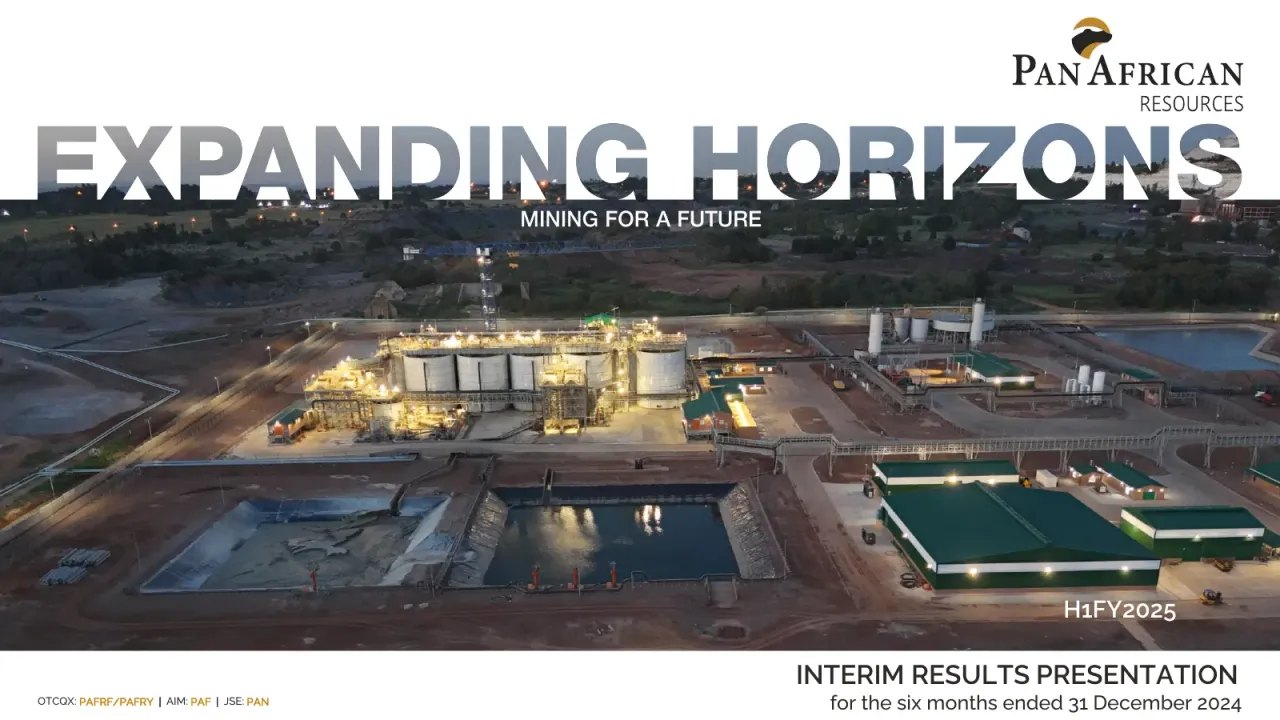
Interim Results hosted by Pan African Resources (LSE:PAF) on Investor Meet Company, held 2025-02-19.
On 6ix: 6ix.com/event/pan-african-resources-plc-paf-interim-results
Automated transcript · Written by software from the replay's audio. It can mishear names and figures; the replay is the record.
0:02 Good morning, ladies and gentlemen, and welcome to the PAN AFRICAN RESOURCES PLC interim results investor presentation. Throughout this recorded presentation, investors will be in listen only mode. Questions are encouraged. They can be submitted at any time via the q and a tab that's just situated situated on the right hand corner of your screen. Please just simply type in your questions and press send. The company may not be in a position to answer every question it receives during the meeting itself. However, the company can review all questions submitted today, and we'll publish those responses where it's appropriate to do so on the Investor Meet company platform. Before we begin, as usual, we would just like to submit the following poll. And if you could give that your kind attention, I'm sure the company would be most grateful. And I would now like to hand you over to CEO, Kopas Lutz. Kopas, good morning, sir. Good morning, and thank you to to everybody for making time to attend today.
0:52 I will go through the presentation
0:55 in a bit of detail and then open the floor for questions. So thank you again. If we just move on, the disclaimer and then the statement on forward looking statements on slide two and three. And then let's get right into the presentation in health and safety, which is obviously critical for a mining company such as PAN AFRICAN. We always say that we can't operate if we can't operate safely. It is very unfortunate that we had a fatal accident in December of last year at Oivanda Underground. That investigation is ongoing, but generally, PAN AFRICAN is moving in the right direction as far as safety is concerned. If you look at our underground mines, we are pretty much industry leading in South Africa.
1:44 Surface inherently our surface operations are are are are just very safe. And, I mean, South Africa as an industry in in terms of mining has done great work in in recent years. Last year was actually the best safety performance in the industry's history in terms of of of fatalities, etcetera, etcetera. So definitely moving in the right direction. And I think one point that the the special mention on the slide is is our project, the MTR construction, which we finished at the end of of last year. There's a 600 contractors on-site, and one has I think a thousand 1,800,000 shifts that that that were worked and and only one lost on injury, and that really is how one wants to build a project. So very proud of that achievement.
2:34 In terms of as a group overview on slide number eight, we have a unique portfolio of underground assets in South Africa and then surface remining or or tailings retreatment as we call it. And then, obviously, also the recent expansion into Australia that we will discuss in detail on some of the other slides. So slide number nine, the H 1 gold production, it was down slightly from the second from from the previous six months. But encouragingly, we are expecting a much improved performance in H 2, and that's really on the back of a full six months of production from our MTR operation recently commissioned, and in a better performance from from Evander underground, and then also some production ounces from the Australian asset, which which will come in in May and June. But then encouragingly, if you look at our forecast for FY '26, you know, we would be able to grow production from, let's say, 205 to 215 in the current year.
3:44 We will grow production quite materially to almost 300,000 ounces in the next year. And, you know, that that really, I think, is very attractive for the company and for investors. And then just in terms of a bit more perspective on on the group, we are repositioning the group in terms of a focus on lower cost, I. E, higher margin surface operations. And with the Australian business now coming in an MTR, about 60% of our production will come from surface and then the remainder from the underground at Evander and Barbaton. In terms of our operating environment in South Africa, we have a very long and established track record, and we have demonstrated we can operate successfully in the jurisdiction.
4:38 We've seen there's been a stabilization of the electricity situation, so it definitely is going better from that perspective. But, yes, I mean, we're quite comfortable to operate in South Africa. A lot of Africa in recent years has actually seen, in our view, deterioration of the investment climate in South Africa's, in some extent, but the trend, you know, to world class legal system and banking system. As we said, we have access to grid power. Our mining rights are are long dated. So we have an awful many tailwinds in our view. And then, obviously, the new jurisdiction where we operate is the Northern Territory in Australia, which is, in our mind, a tier one jurisdiction quite attractive.
5:26 They recently have improved the tax and royalty regime, and we find the the lower territory government to be incredibly supportive of of what we are building. So that's also, in our mind, a a very good jurisdiction with a an established management team that we have operating in Australia. In terms of the key features on slide 14, as I said, the production was down for the reasons that I've discussed principally the Evander underground and then some Eskom issues or just utility issues at Barberton that is now fixed, but we're expecting a much better performance. From a cost perspective, the costs in terms of all in sustaining costs did go up. It was impacted by the lower production from the Vanda underground.
6:14 And, we we're expecting a much improved unit cost performance in the in the half year of of ahead with a full six months of production from our MTR operation and then better performance from from Vanda. And in terms of the finances, I think another point to mention is that we had a quite a punitive, what we call a synthetic forward. It's effectively a hedge of gold that we had to do to fund or part fund the construction of MTR. So that also definitely impacted the results for the last six months. It was an opportunity cost of almost $18,000,000, and all of that hedge now washes out at the end of February. And then the group will have a pretty much full exposure, and shareholders would have pretty much will have pretty much full exposure to the excellent gold price that is prevailing at the moment.
7:08 Slide 15 just demonstrates how we've opened up our margins. Obviously, this sort of margin graph is looking even better now. And as we add further low cost production, the margins will continue to to improve. Let's let's just do spend a couple of minutes and and go into a bit more detail on each of our operations. So Ilekulu, fantastic asset flagship for the group. It is a very good performance in the six months, and you can expect a similar performance in the six months ahead. It's one of the lowest cost producers of gold in Southern Africa, just over a thousand $100 all in sustaining with almost nine years of life remaining. If you remember, we built Ilekulu in 2018.
7:55 There's a a capital bill of at that point of of approximately a $125,000,000, paid itself back in two years, two two or two and a half years, and I'm very proud of the team. And, obviously, at this gold price, Ilikulu is generating excellent cash, you can expect that that to continue into the future. Then the BTRP, this is was is a other sort of tailings operation, but smaller at Barbaton, but also a good performance performance, lowest cost producer in the group. And, I mean, this is really where we cut out sort of teeth in terms of tailings retreatment. We built and commissioned a BTRP 2013 to some $30,000,000 at the time, and we paid that back in eighteen months.
8:40 That's sort of, obviously, the sort of return that you want. Importantly, I think that the team has done really well in terms of now extending the life of the BTRP. So when we started production many years ago, we'd forecast that we would run out of material in 2021. We actually now, obviously, have been producing consistently, and the amount of gold that this plant has produced has been been incredible. But the team has now done well in terms of extending the life again. So we will be mining or remining the the Harper North tailings facility at Barbaton, and this extends the life of the BTRP to some seven years. So that's really an excellent result for us. Then slide 19, incredibly proud of of what our team has achieved at MTR.
9:27 You might recall that we bought all of this all of these tailings off a liquidator, and we paid 2,000,000 ounces, and we paid circa $2 an ounce. And, effectively, this was reserves on surface when we were done with the drilling. So that's really how you make money as you do transactions and acquire very attractive feedstock for for for the price that we paid. So MTR commissioned ahead of schedule, about $8,000,000 below budget, and this operation will be producing 50 to 60,000 ounces a year as a base case for for twenty years. It's an excellent addition to our tailings portfolio and a couple of additional growth opportunities.
10:15 We're actually now looking at expanding the plant from 50,000 to fifty fifty five to 60,000 ounces. So a 10 to 20% expansion, and we can get that done in twelve months by adding some tanks and and some Auken reactors in the front end. And then also longer term, we are looking at the next slide. So we're potentially looking at a standalone plant. So feasibility is being conducted at at this point, and it'll be complete by by September. But, yeah, quite attractive. And then if I just move back, there's potential, we think, to extend the life even further by acquiring some additional feedstocks or tailings facilities in the area. I mean, we really I mean, are the only sort of operator or operator that has deposition capacity and then also has a plant to the size. So what an excellent achievement for us in terms of MTR, and and very proud of what the team has achieved there. And it demonstrates that you can build and and operate successfully in South Africa. I mean, this whole plant was built in fourteen months, so an excellent achievement.
11:22 And, again, to just recap, 50,000 ounces all in sustaining costs going forward would be in the order of $1,000 an ounce. And clearly, I mean, those are excellent margins. And then just to add to the ESG benefits on slide 21, we're rehabilitating this area as we go, improving the water quality, eradicating illegal mining that has been so prevalent in this area. So it really is a win win for all of the stakeholders. We have great relationships with NGOs and others in this area, and they definitely acknowledge the the positive impact that PAN AFRICAN and NTR has had in all of this this area.
12:08 The student on slide 22, our vision is is building a world class surface tailings retreatment business, and I think we've been quite successful in terms of establishing ourselves in the space and definitely some more growth to come in in in the years ahead. TCMG in Australia, again, this is quite exciting for us. It's a tier one jurisdiction. We spent about a year looking at this asset before we ultimately push the button. The plant's 90% build, and we built in. We're building a we're building a stockpile a feedstock next to the plant. That's why we're quite comfortable in guiding production from TCMG in the near term, seven to 10,000 ounces by June. And then you can expect fifth 48 to to 60,000 ounces in in in the year year ahead. We're optimizing the mine plan. But, I mean, just to recap, it's not often that you can acquire for when we concluded this transaction in December, we paid just over 5% of our market cap for this asset. It'll be producing within six months.
13:21 And and, again, I mean, the the date that's being incurred for the for for this plant is in the order of 35,000,000 US. At the current gold price, that date is repaid in anywhere between six to twelve months. So those are the sort of returns that we find attractive. We are the biggest show in town in terms of this gold field now. We're the only producer that will have a plant. The plant will be building the 70,000 ton per month facility. It's three times the size of anything that's ever operated in this field. It's quite similar in a way to what we're doing on the tailing side is achieving economies of scale and in doing so, just opening up feedstock that that is potentially not viable for for smaller producers. So the life of mine that we have in terms of Australia is in the order of currently of eight years. I mean, that's only the start.
14:13 We're optimizing this production schedule at the moment, and you can expect some changes by September. The base case for us is 50 to 60,000 ounces a year. We'll try and stay on surface for as long as we can in Australia, and, I mean, we have reserves to do so certainly for three years or four years at this point. There will be some additional exploration drilling also in the year ahead. So we're excited about Australia and what this means for South Africa and then for for for PAN AFRICAN adding to our South African asset base. And then there are larger assets also as part of this portfolio in Australia. Warrigo, we've just commenced feasibility study. It's a copper gold play. So you can expect some news as far as Warrigo is also concerned in in the in the months ahead.
15:01 Our underground operations and the Vanda underground, admittedly, you know, I've said as as much before, but it's probably been the most difficult large capital project that we have undertaken in in as far as PAN AFRICAN is concerned. This project was delayed, admittedly, but the shaft is now commissioning we've commissioned, and we're ramping up. So we're seeing the benefit come through. So, yes, we expect a much better performance from the Evander underground in the second half. The guidance is some some 20 odd thousand ounces. And then in FY '26, you can expect a much improved performance. I'd say in the guidance is about 48 to 55,000 ounces for the Evanda underground. That also means the cost per profile goes down. Pretty much all your costs here are fixed, And hence, if you produce more ounces, then obviously the unit costs go down.
16:04 So, yes, it's not been the easiest asset for us. A couple of lessons we've we've learned, I have to say. But, yeah, I mean, expect a much improved performance going forward. Then Fairview at at Barberton, it was very nicely on track, and then we were tripped up with our electricity utility Eskom. And both the primary transformer and the backup transformers failing, and this really cost us dearly, but expect a better performance from Fairview in the six months ahead. This is really if you remember, flagship asset for the group, this is what it's where really everything start for PAN AFRICAN was at the the Barbaton mine. As far as Consort is concerned, Anshiba, I mean, these are the higher cost mines at Barbaton, but we've seen a turnaround at Consort. We we have a new mining contractor, and they slowly have been ramping up January in December, January, the the mine is generating profits again. So that's encouraging, and it's looking quite strong at this moment. So we think we can continue to improve. And going forward, Consort should be able to produce nine to 10,000 ounces a year and on that basis generate decent returns for us. The Sheba mine initially con continuous operations worked well, but it's not as productive as it has to be. So we've announced a restructuring.
17:35 We're consulting with our unions at this point. And yes. So certainly when we've committed to actually come start finalizing and completing this restructure by the end of June. So yes. I mean, you can expect Sheba's unit costs to come down and and for an improved performance from that operation going forward. Group all in sustaining cost, yes, the costs did increase as a result of lower production, but you can expect costs to come down on a unit basis going forward. And I think we're fairly competitive still. Obviously, the global industry because of increased margins and everything else has seen cost pressures. So the global average is sitting at about $1,500. The bulk of our portfolio, if you if if we sort of step back, Yukuli would produce at about just over $1,100, MTR circa $1,000.
18:28 Australia, we expect, say, circa $1,300 all in sustaining, and then a much better performance from the underground mines. So, yes, I think we can be quite competitive from a cost perspective going forward. Capital. The the other benefit or beauty, I think, in terms of PAN AFRICAN is we spent most of our growth capital, and, obviously, most recently with MTR, which came in under budget. So in FY '26, there's not an awful lot of growth capital or capital to be spent 50 to $60,000,000 total in the group, including sustaining CapEx. And that obviously then means even further increased sort of cash flow positive operations all around in terms of the group.
19:17 ESG, we're very proud of what the the difference we make in the areas where we operate, and we have a beyond compliance approach. All of pretty much all of our rehabilitation commitments or liabilities are fully funded. There's a small deficit as far as MTR is concerned that will make up the time. Other than that, like, first South African miner to commission large scale solar. We now have two large scale plants running. And and, I mean, you're expect some further announcements as far as renewables is concerned from that PAN AFRICAN. We also have a water treatment plant at at our Ibanda mine that we're expanding, so we'll pretty much use no potable water going forward. And then also, we'll start building a treatment plant at at at MTR in the next twelve months.
20:08 I won't dwell too much on the financial that I've discussed. So that some of the challenges and and also just the prospects. But, yes, I mean, going forward, no more punitive hedges and very attractive cash flow generation for the group. Just slide 42. In terms of our date, we're pretty much on on peak date as we speak given the large spend on MTR, and that date comes down very nicely, including us modeling an attractive dividend at the end of the year. So, I mean, in terms of dividends, historically, slide 43, we've been, in our minds, sector leading, and there's no reason for us not to to be able to continue to to pay a very attractive dividend to shareholders. But we've also said that that going forward, we will we will look to potentially reinstate an interim dividend or instate the interim dividend given the the stability of the operations and the attractive margins at the moment.
21:08 And then just very much slide 45 to conclude. It was a tough year or six months at Evander. We're getting through the that sort of batch now, and the operation will be a cash generator going forward. A bit of a challenge because the electricity electricity at, so so that's something we have resolved, and we are restructuring, Sheba as I've announced or we've announced. But, generally, I think the group is very well positioned. Obviously, MTR is, has been a game changer for us. TCMG is a game changer for us. So, yeah, it's quite quite an exciting time for PAN AFRICAN, and and we look forward to to certainly in the next six months and and and then very much the next financial year also. So thank you for joining us.
22:06 It's maybe useful then to move to questions from here. Absolutely. Okay. But if I may just jump back in there. Thank you very much indeed for your presentation this morning. Ladies and gentlemen, please do continue to submit your questions just by using the q and a tab that's situated on the right hand corner of your
22:21 screen. But just while the team take a few moments to review those questions that were submitted already, I'd just like to remind you that a recording of this presentation along with a copy of the slides and the published q and a can all be accessed via your investor dashboard. Kobus, as you can see there, we have received a number of questions throughout your presentation this morning. And thank you to all of those on the call for taking the time to submit their questions. But, Kobus, at this point, sir, if I may hand over to you just to read out those questions and give your responses where it's appropriate to do so. If And I pick up from you at the end, that'd be great. Thank you. Yeah. Great. So, I mean so I'll go just straight into the questions. And the first one is related to and congratulations on TCMG and and MTR. Yes. And then said that said that the Evander is not formed as it should, and there's a question then, know, what does it mean for the forecasts in terms of Evander going forward? So, yes, I think it's important to firstly just see all of this in in put all of it into perspective.
23:23 You know, PAN AFRICAN has done a great job, I think, in terms of diversifying our production away from only underground operations. So at 2018, I mean, we really only had the Evander and Barberton undergrounds. Now the Evander underground historically is a volatile operation. It has good halves and good years, and then it has challenging and difficult years. We've invested in the infrastructure, and that sort of investment, large scale capital investment is now nearing an end. So it's time for us to start pretty much harvesting from the Evander underground. The performance was very bad because the the fact that we had to rely on conveyors versus the vein shaft in the first six months. That vein shaft is now commissioned, we're slowly ramping up. So we're production from the Yvanta underground for the next six months of, call it, 18 to 20 odd thousand ounces.
24:20 And then for the next financial year, we've guided 48 to 55,000 ounces of production from the Yvanda underground. There's nothing wrong with Yvanda ore body. The Kimberley Reef that we're mining at Yvanda is really high grade. It's it's one of the the least exploited or mined basins on the Witts. It's quite simply a infrastructure and logistical challenge, and that's, you know, what we are dealing with. So, yes, let's put it into perspective. It it was difficult, but in if you look at the history of Evanda over the last couple of years, the pillar mining was exceptionally attractive or successful. It generated very good cash flows and returns. Last year, the mine delivered into its guidance.
25:06 So, yes, it's a it's a temporary setback and against the sort of scene against the bigger backdrop of what we are what we've set out to achieve as a group, it's manageable. The the cost also on Evander on an absolute basis are well controlled. It's quite simply an issue of units. So, yes, the cost will still be fairly high in the in the second six months. But then, you know, if we do our numbers going forward on the Evander underground, we should be able to produce at 15 $1,500 all in sustaining, and that's at a at a run rate of 50 to 55,000 ounces a year going forward. So the risks on on production and costs. Look. I mean, the this is for FY 2025.
25:56 This is a question to what are the risks on on on production and costs. As I said, it's pretty much a unit game. We're very comfortable with the surface operations and how they're performing and will perform. As I said, I mean, there's a the assets, there's a bit of restructuring work to do at Chiba. But other than than that, you should have a stable performance and certainly consult. You can expect a much better performance, as we said, four and a half thousand ounces for the half. And then we just need to get the sub vertical shaft to perform at Evander. As we've said, it is commissioned and it is ramping up at this point. It's not not at all order to get to sort of 20,000 ounces production for half with a shaft performing. So those are the risks. If I look at FY and and then clearly also just getting Australia up and running, but I mean, the Australian plant is 90% built. We'll commission in the next two months.
26:49 And as I said, we're building a stockpile right next to the plant. So those are the risks, but I think if you look at our production profile, you know, there are very few companies that can grow so materially in FY '26. So FY '26, you know, it's gonna be, we think, a game changer for for for the group. Full year production from MTR, Ilekulu performing, BTRP performing, much improved performance from from from Evander underground, and then a full year of production also from Australia. So that's quite attractive. So then there's a question on on TCMG and the revenue, sort of a very conservative pricing, 100%. What we're saying in terms of the Australian assets assets is sixty, ten thousand ounces by June, which is very attractive.
27:41 We're busy now just fine tuning our mine plan. But base case for Australia, you can expect fifth I think 48 to 60,000 ounces in the next financial year, and and you can expect that sort of production to continue as a base case. We also now initiated a feasibility into Warrigo, which is a copper gold project that's wholly owned. The data that is being incurred to fund the the project construction in Australia, it's all on the Australian balance sheet. At these gold prices, you can expect that date to be repaid in under twelve months, which is very attractive, and that obviously allows us then a lot of growth in terms of using the Australian balance sheet for the likes of Warigo and and elsewhere. So these are production profile, a life of mine about eight years currently that we've published.
28:30 But the questioning on, you know, the the timing and so the question on the feasibility for Warrigo, that's probably sort of be done before the end of this year, so before December. And then we are finding fine tuning our production profile for all of these sort of assets in Australia. But as I said, base case, 50 to 60,000 ounces going forward. Then there's a question on the hedge that's been very costly. I agree. But, you know, in retrospect, still, it was better than issuing equity at the time to fund MTR. I can assure you there's no way we're entering in in in into a transaction like this. Again, caps and collars, if we do any hedging, yes. And you can actually lock in a very attractive sort of margin in terms of caps and collars at the moment. But just a message to our shareholders and investors is that sort of come the end of this month, obviously, that costly hedge is done, and we are pretty much then fully exposed to the gold price.
29:35 Yes. And and, you know, there's always a question in terms of hedging. Do we hedge? If you sort of get hedging wrong, it's management fault. And and if if it goes well, then, you know, it's investors are are are astute. But, I mean, we would probably look at some level of caps and collars, but, you know, there's nothing at the moment that's that's that's put in place. And then there's a question from John again on production gold price, clear potential for increased dividends. We certainly would hope so. You know, given the current share price and impact South African with all in tax, will a consideration be given to share buybacks? There are some of the investors that are pushing for share buybacks. I mean, we are deep debt because of the growth that we have undertaken.
30:23 They just dig here. And, you know, we have said to the market at the current gold price, the group should be pretty much un ungeared in the next twelve to eighteen months. That's a great position to be in, and we continuously look at ways of of adding value. And and in time, a a share buyback could be part of that. Again, but certainly our our forecast at this point, we are in our forecast, we are allowing for for a nice increase in the dividend come the end of the year. And then there was a question, are there any further acquisition opportunities in the pipeline to expand production further? To be honest, I mean, I think we have more than enough on our plate. We're also very fortunate in that we don't have to as PAN AFRICAN go and buy anything else. Like, you know, we're gonna grow production from circa 200 to 300,000 ounces in the next six months.
31:18 So, you know, that's proper growth assets are long life. There's nothing that's running out in the short term. So there's no pressure us to do the deals. And, certainly, I mean, in our view there's no need for us to do so. So I think we've sort of broadly dealt with with most of the questions. Anything else? Cobus, no. Absolutely. Thank you very much indeed for being so generous of your time then addressing all of those questions that came in this morning. And, of course, if there are any further questions that do come through, we'll make these available to you immediately after the presentation has ended just for you to review. But, Cobus, perhaps perhaps before really just looking to redirect those on the call to provide you with their feedback, which I know is particularly important to yourself and the company, if I could please just ask you for a few closing comments to wrap up with, that'd be great.
32:15 Yeah. I mean, as I said, I think I mean, it's been a a transfer transformational period for the group. Things don't always go in a straight line. So, yeah, I mean, it's not the sort of best set of results for six months because of the the strength of the the Vanda underground. But we're very excited about about the prospects in the year ahead. And I think the group is excellently positioned to capitalize on on what is obviously a very attractive gold price. And it does feel to us as though this gold price might be around for some time, but we don't need the current prices to be very successful. So that's a great position to be in, and and thank you to everybody for making time to to and joining us today.
33:05 Kobus, that's great. And thank you once again for updating investors this morning. Could I please ask investors not to close this session as you'll now be automatically redirected for the opportunity to provide your feedback in order the management team can really better understand your views and expectations? This will only take a few moments to complete, but I'm sure it'll be greatly valued by the company. On behalf the management team of PAN AFRICAN RESOURCES PLC, we would like to thank you for attending today's presentation. That now concludes today's session. So good morning to you all.
Follow Pan African Resources PLC into a list and get an email when it puts out news.
CEO at PAN AFRICAN RESOURCES PLC