Cobus Loots
CEO at PAN AFRICAN RESOURCES PLC
Replay available
Full Year Results hosted by Pan African Resources (LSE:PAF) on Investor Meet Company, held 2025-09-15.
On 6ix: 6ix.com/event/pan-african-resources-plc-paf-full-year-results
Automated transcript · Written by software from the replay's audio. It can mishear names and figures; the replay is the record.
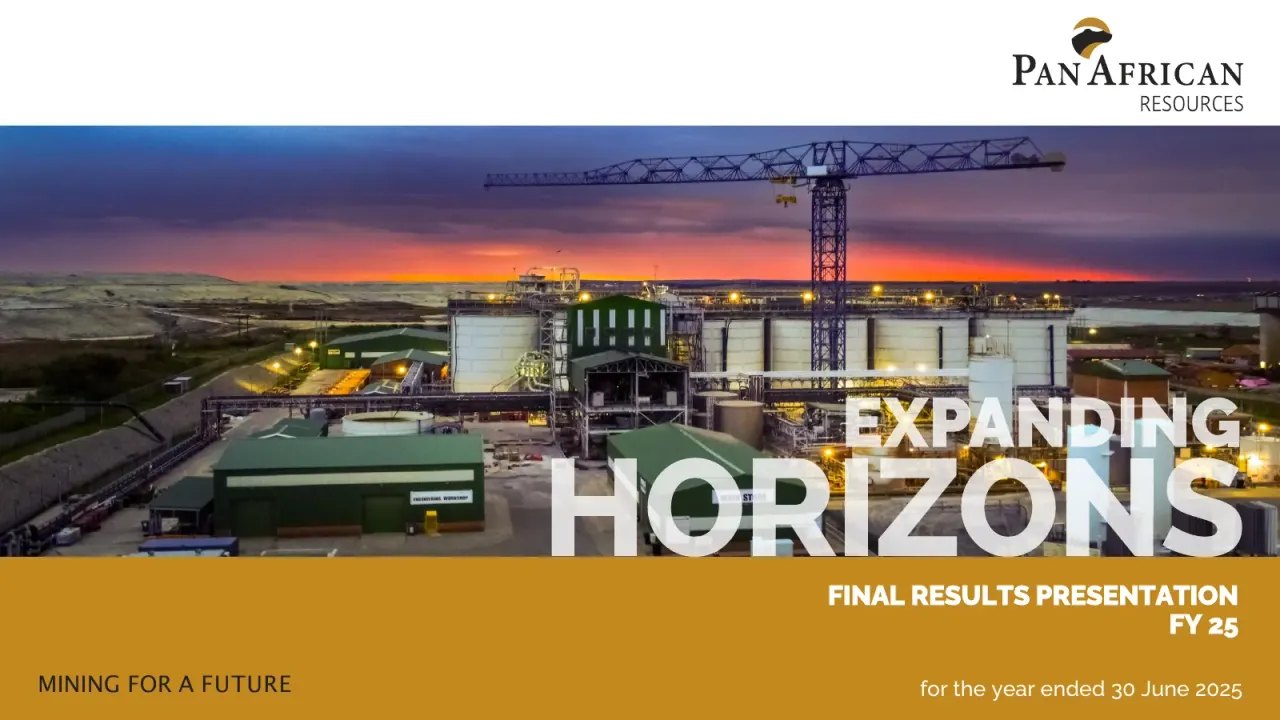
0:00 Good morning, and welcome to the PAN AFRICAN RESOURCES PLC investor presentation. Throughout this recorded presentation, investors will be in listen only mode. Questions are encouraged, they can be submitted at any time. By the q and a tab, right corner of your screen, just simply type in your questions and press send. The company may be in a position to answer every question received in the meeting itself, but the company can view the questions submitted today and publish responses where it's appropriate to do so. Before we begin, I'd like to submit the following poll. I'd now like to hand you over to CEO, Hope Sluts. Good morning to you, sir. Good morning, and thank you to all for your time in joining us today. So we're gonna run through the results presentation and then off to open for questions. Just disclaimers on slides two and three.
0:50 Health and safety, which is obviously key when you are operating in the mining space like we are. We have a safety leading safety record as PAN AFRICAN, and I think what a standout highlight in the year that's passed is all of our surface operations in South Africa and Australia ran without one single lost time or reportable injury. This the the underground operations in South Africa were less fortunate, and we had a couple of incidents and very tragic fatal accidents, and we're working very hard to towards ensuring that those do not recur. And we do believe in the years ahead, we can get to a position where we have very limited or or or certainly, I missed you have a zero harm working environment and to have all of our people return home safely at the at the end of every day.
1:45 Group overview, investment highlights, PAN AFRICAN diversified portfolio now with surface remining and underground assets. We did up just under 200,000 ounces of gold from two major mining jurisdictions being South Africa and Australia. This this established production of of the 200 odd thousand ounces is underpinned by high margin operating mines generating very strong cash flows certainly at this gold in this gold price environment. We're one of the very few gold producers that are able to grow as significantly or materially as we are in the next year. We forecast a minimum of 275,000 ounces of production for the next financial year, which is an increase of almost 40%, which I think is very attractive.
2:30 We have long life assets with a very big reserve base in terms of gold in the ground, proven track record in terms of delivery, and and take the leading dividends that we can discuss a bit later. Experienced management team, we've been around for many years in terms of running this business and building to building it to what it is today. And then just the existing asset base also gives us the ability to leverage for further production growth and earnings growth into the future. So I think that's quite exciting. Sorry. I'm just sort of getting trying to get to the the next slide here, which is the slide number nine. Share price has done very well, obviously, over the last years. I remember buying the first my first stock in in PAN AFRICAN in 2009 at at South in South Africa in terms 45¢, and currently, the share price is circa R18 or in the middle seventies in terms of p.
3:29 So it's been a great return for shareholders and that excludes the sector leading the evidence that we pretty much paid throughout. I think that further, you know, enhances the returns, a good base in terms of shareholders in South Africa, The UK and elsewhere. And I think the fact that we're moving to the main board or intending to move move to the main board of the LSE is both take us and expose us to other share shareholders a deeper pool of investors and then we would quite likely also attract index funds in terms of investment. That's a further catalyst in the months ahead. Group overview on slide number 10, it's a pretty unique portfolio of assets where we have three large asset complexes in South Africa, both other than MTR, all these assets have underground components and any surface.
4:25 MTR is exclusively surface remining, and in Australia, also a combination of surface and and underground. Just gonna trying to get to my next slide here. Apologies. A bit of it seems to be a bit of a delay in terms of the slide deck. Slide 12, just an operational snapshot of our key assets, which we will go into detail on some of the further slides. But importantly, going forward, about 60% of our production will be sourced from surface and, you know, that's gives us lower cost assets, more predictability, and and less volatility in terms of production.
5:20 So 60 odd percent of our production now comes from surface and circa 80% or more of our margin. So I think that's been a very good repositioning of the of the group in the past years. Our operating environment in South Africa and Australia, Barbiton mine is a track record of more than a 140 of operating successfully in South Africa. And we say that I mean, we go to great lengths to make ourselves less susceptible to issues as far as South Africa is concerned. We were the first miner to commission large scale solar. We'll talk a little bit about renewable energy initiatives in the next slides. All of our mining rights in South Africa are long dated, so there's no issue with mining rights.
6:11 And despite some of negative perceptions around the jurisdiction in South Africa, It's has a long track record in terms of successful underground and surface mining, and it has a well established legal regulatory framework and everything else. It's been quite stable and even from an Eskom perspective, our electricity utility, we've now seen almost ten months without any load shedding. So it's also assisted us. Stakeholder engagement, our social license to operate is very important for PAN AFRICAN, and we go to great lengths to make sure that we have good relationships with our employees, unions, all of the communities surrounding our minds. We make a meaningful positive difference in all these areas that we operate. We've never had protracted labor issues at any of our operations and and for the most part, we have multi year wage agreements in place and security as key for us when you're dealing in such a high value commodity such as gold, and we have an excellent team that makes sure that we can can continue to operate and that security is is taken care of.
7:22 If we then proceed to key features for the year that has passed, FY '25, so our year end is June. Production was up by some 6% and that was on the back of MTR producing and then also very limited production from Australia. So Australia will come into its own in the year that's a year ahead. Importantly, the second half of the financial year, achieved record gold production with these assets producing. And as I've said, we're one of the few producers that can actually expand production so materially in the year ahead. So our guidance is 275,000 ounces or more in the next year. That's an increase of 40 odd percent. Group all in sustaining costs were up.
8:07 There's been big cost pressures generally in the industry. I think there is a slide on costs a bit later in the deck. But for us also, the underground mines increased the unit costs in the year that's passed. We are guiding that costs will come down in FY '26 and we are very competitive when we compare ourselves to the rest of the global sector in terms of our all in sustaining costs. And then obviously the gold price and also increased production assisted us in terms of these set of financial results be that we delivered for the year that's passed really nice increase in profits cash flows, very strong balance sheet, and we'll talk about the degearing and dividends and everything else in some of the next slides.
8:57 So all in all, it was a positive year. We did still have a a hedge that was outstanding that for the most part we used to fund the construction of MTR that cost us in terms of opportunity cost some 30 odd million dollars. So importantly, we are as of the July 1, we are entirely un hedged. So investors have full exposure to the gold price going forward. Slide 16, our margins tells a very good story in terms of expanding margins. That's on the back of obviously excellent gold prices, but also the focus on lower cost, higher margin assets, and then the increasing production base. So then this slide 18, tailings retreatment, which has become the cornerstone business or flagship business for PAN AFRICAN.
9:54 Great track record in terms of commissioning these plants all the way from 20 Street from 2013. You can see we've double delivered on budget, on schedule. So this has been a great success for us. The most recent two operations, MTR and Tenet Mines, delivered in the last year. And again, it's not many operations or companies that can deliver two new flagship projects in one year, and that's really what we've done in FY '25. And at the bottom of the slide, also an increase in production profile in terms of tailings and and surface sources in the next years. If we then go on to just the performance per operation, and we can start with the BTRPs.
10:40 Let me just check this. Let's start with Ilikulio on slide 19. It's been a this was a great success for us. We commissioned in 2018. We still have nine years of life remaining, producing circa 50,000 ounces of gold a year at a very exceptional margin. All in sustaining costs were sub $1,100 in the year that's passed. So this is really is a great asset for us and will continue for many more years. The BTRP at Barbaton, we managed to extend the life of of this with our first gold tailings operation we commissioned in 2013 and when we initially commissioned BTRP, there's only scheduled to run to 2021. As I've said, we now in addition to having operated it until the sort of end of this financial last financial year, we've extended the life by another six years.
11:32 All of the CapEx that we need to spend for this life extension will be done in pretty much the next month or so. It's not a huge number. The all in sustaining costs for BTRP is excellent. It's the lowest cost producer in the group. Going forward, we expect an increase in in the costs as we now again retreat the what we call the Brambert tailings facilities. So this is the second time that we're retreating these tailings. It's been a really good excellent success story for us. And even after the six years, there's a long life ahead for the BTRP. So we have assets that are underground, and we would look to access into and and mine make in mechanized fashion, principally Royal Sheba. It's just up to now has been too low grade for for Barbiton, about three grams per ton, but these are large ore bodies.
12:22 They extend as far down as we'd get to look for them. So there's a long life ahead of the b BTRP after we have start finished in in terms of treating tailings. Then excitingly, MTR on slide 21. Just to recap, we bought all of this off a liquidator for a total of about $2 an ounce in reserve when we were done with our studies. So it's been a great success for PAN AFRICAN. We went and built this all those plant and infrastructure in fourteen months. Total capital was about a $130,000,000. At the current gold price, we estimate we will make all of this back in circa two years, so this is excellent. MTR currently does about 50,000 ounces a year.
13:08 We're busy with an expansion project that'll be done early in calendar to if for so calendar 2026. That's gonna expand the MTR operation to about 60,000 ounces per year and also bring down costs. In the last year, cost was slightly elevated just because of startup costs and a couple of other items, but we expect costs to settle to below $1,200 all in sustaining, which really means that this is a world class asset in terms of the margins. And we can be producing here for many years as we will discuss in the in the slide on slide 22. So we have more than 200,000,000 tons of tailings sitting on surface. These are just the tailings we currently own.
13:55 And obviously, the lifeline of MTRN as a base case would be circa twenty years. We are busy with a feasibility study to look to potentially construct another facility to treat some of what we call the Soweto cluster. If that did proceed, then it would pretty much double production from from this part of the world for PAN AFRICAN. So there's very significant growth that we have as part of our portfolio. We potentially might not do the big bang I. E. Like a completely new plant, but we as a as a second option, could look to further expand MTR. What would that look like? That would probably be sort of a 1.3, 1,400,000 ton per month operation versus currently a million, producing some seventy, seventy five thousand ounces, and you could do that quite successfully for fifteen years or so. And I think also interestingly, there are other tailings in this area that we do not yet own without the infrastructure and the team like like we have at PAN AFRICAN. These facilities are generally only a liability, so it is quite possible that through the life, we could look to consolidate even more tailings in this area and further grow the operation.
15:12 And then just one slide on just the environmental and socioeconomic benefits of this project. The area where we commissioned MTR was very difficult from an illegal mining perspective, pollution perspective. And the beauty with what we're doing here is we effectively treating these these tailings, reducing liabilities. We often say that we are turning legacy liabilities into profits. At the end of the life, there will be pretty much no liabilities of any size remaining, improved water quality, land would be freed up for other development and other other uses. So it's a win win for all legitimate stakeholders, these sort of operations that we run as PAN AFRICAN. So it's great to be involved in in assets like these. In slide 25, Tenant Mines, which is also an plant that we commissioned in the last year on schedule on budget.
16:10 We were very fortunate to actually secure this asset. Took us about a year in terms of due diligence before we got comfortable with what we were buying. Ultimately, we went and and paid less than 6% of our market cap at the time when we completed the deal, which was December of last year. And we we have a huge asset base. The plant that we've commissioned here at Tenant is three times the size of anything that's ever operated in this gold field. It's a major historical province, the highest grading gold field in Australia, in a tier one jurisdiction, the Northern Territory. So for many years, Northern Territory was not really open to new mines, a difficult royalty regime. All of that's changed. We find the government very supportive, and we look forward to expanding our business in that part of the world. As we've said, we've started production, and we're guiding forty, sixty, 50,000 ounces in the year ahead. We have a dominant land position in that part of the world. We have retained our very experienced in country Australian team. They're running the assets.
17:13 The the the area is underexplored. Certainly, I think very limited drilling below a 150 meters and very attractive economics and a long life of mine that we also have have as part of this project. Just a schematic on on slide 26 of what it looks like. As I say, it will follow a hub and spoke strategy with this plant that we've commissioned being three times larger than anything that's operated in this gold field. And then the mining, for the next three years or so, we expect to do about 50,000 ounces of gold a year. There's definitely scope for us to increase production from this gold field. Also, there's just on slide 29, just a a picture of what our plant at Nobles look like.
17:58 And then just sort of very briefly, sorry, to take one step back on slide 28. We are increasing mineral resources and reserves through modern exploration techniques and studies. And we see we're finding that this field is very prospective, limited drilling we've done. I mean, there's an asset war ago that we've acquired as part of the portfolio. Limited drilling, again, I've said, not yet upgraded the resource and reserves, but some of the grades, we find five five grams per ton gold and then anywhere from two to 10% copper. So at the moment, we focused on gold as far as as tenant is concerned, but definitely scope for the next years to look to to build Warwick, which will be a copper gold asset. If we then proceed to our underground mines, slide 31, the Vanda underground.
18:51 This was a disappointing year for Vanda in terms of production. We were behind in terms of commissioning the new infrastructure, so we constructed and designed a sub vertical shaft for wasting, and that construction took quite a bit longer than what we had hoped and anticipated. All of it is done now, and we reached steady state in April, so we now have proper wasting capacity. There's nothing wrong with the Evander ore body. It's one of the largest undeveloped ore bodies in the world, and we will, over time, bring this ore body to account. So we're quite comfortable in guiding very substantial increase in production from the Yavanda underground in the year ahead. Base case going forward sixty sixty five thousand ounces a year with all of the money that now being invested in terms of optimizing the infrastructure.
19:45 Fairview Mine at Barberton, as I've said at the in the introduction, hundred and forty years of mining, still discovering new ore bodies. We get the bulk of our ore from MRC ore body at Fairview and long life twenty three years of life remaining at Fairview. And clearly, Bobadden Complex at this gold price is generating very attractive cash flows for the group. Just very finally on underground on slide 33, Consort Mine turned a corner in the last year. We almost doubled production and we're quite comfortable that we can maintain production at these levels. That also means that Consort is now cash flow positive. We generated some R50,000,000 of free cash in the last year. So that's a big turnaround for Consort.
20:35 Shiba, also positively, we've restructured. We cut costs in terms of employees, so you can expect a better performance from Shiba Mine in the year that's in the year ahead. Group overview in terms of all in sustaining costs, slide 35. 85% of our portfolio produced at an all in sustaining cost of 14 and $25 per ounce. Very attractive world class, we like to think. The higher cost businesses at Sheba and Consort, as we've said, they are plans, so you should see those costs come down further in the year ahead. Slide 36, that just compares PAN AFRICAN to the rest of the global sector. As we've said, South African mines for the most part are known to be high cost, not the case with PAN AFRICAN. We compare very favorably favorably with the rest of the global gold sector.
21:26 Capital projects on slide 38, so this is the last year that we in FY '26 will be spending this amount of capital and I think we need to emphasize that we're bringing forward some capital spend just to give ourselves a bit more flexibility and also to further expand operations. So obviously, Tenant Creek, there's a better capital. This is in terms of bringing the asset to account. At MTR as we mentioned in previous slides we are expanding production from 50 to 60,000 ounces per year that expansion will be done January February at Ilekulu we also bringing for construction of a new pump station at what we call at the last tailings facility that we will be treating for the remaining eight to nine years of life. So bringing forward this capital will give us a bit more flexibility and certainly in this gold price environment and with the cash flows we're generating, it makes sense to spend some of the capital now.
22:28 So the PAN AFRICAN has been investing in our portfolio of assets through the cycle And, I mean, we're very able very much able to continue to spend capital and return shareholders return cash to shareholders in the form of dividends, buybacks, plus indeed, the other balance sheet as we will speak to in some of the next slides. ESG, as we've said, we make a meaningful difference in in a meaningful positive difference in the areas where we operate. We build schools, clinics. We've spoken about our plans in terms of renewable energy and and water. We're expanding our water retreatment capabilities, and we look to use very limited potable water in the group going forward. Governance and compliance, very much focused on on ensuring that we're compliant. And, I mean, we are currently dual primary listed on the Johannesburg Stock Exchange and London.
23:21 And going forward, as we said, we will look to access the or or move out London listing to the main market and then certainly before the end of December of this year. Just to conclude on renewables on slide 41, it's been a great journey for us. It makes sense from an economic return perspective. Also, it reduces our emissions, and it's quite possible. I mean, our aim would be in the next year to be 50% or or more renewable renewable space, and it's quite possible for us. We're different to sort of the the miners that huge use huge fleets of yellow equipment. In South Africa, we're mostly reliant on on electricity. So there's a lot of scope for us to expand renewables as we've been doing in the last years.
24:12 Won't talk too much about financials in in in on slide 43, but as we've said, it was an excellent year that's passed and we can expect a much better year going forward. We are unhedged. Our production going up, as we've said, by circa 40%, and we're bringing down the unit cost of production. Our guidance in terms of all in sustaining cost is $15.25 to $15.20 $15.75. So it's lower than where we've been for the last year. That also means on slide 44 that we are able to dig here. We we forecast that despite all the capital we've spent, despite the really nice attractive increase in dividends, we should still be ungeared or degeared from a net debt perspective before the end of FY '26.
25:00 That really is a good position for us to be in. And then we've spoken about dividends, and we aim to continue to give our shareholders a sector leading return in terms of dividends, and we are increasing the US dollar dividend forecast for that we are proposing at the upcoming AGM by almost 80% in the year and and that that AGM is beginning of December and dividend should should then be paid in sometime in December. So it really is a very attractive cash return to shareholders. We also continuing the buyback program that we've announced we announced before year end. And then just to conclude on f y twenty six, it's really will be in our assessment a year of growth delivered, capital's been spent, the investments have been made, and now it's time in this exit gold price environment to reap some of these benefits. So we will continue to focus health and safety and make sure we meet our production and cost guidance, execute on capital projects, obviously continue our focus on ESG renewables, recycling water, and then maintain our focus on generating sustainable shareholder returns as we've done for many years.
26:17 And growth is also something that's not off the table despite what we've done in the last years, but we will be very circumspect, very conservative as far as growth is concerned as we have been in the past years. That's a brief overview and thank you again for your time this morning. I suggest we then move on to questions if if if you're happy for us to do so. Yeah. That's great. Well, Kobus, thank you very much for your presentation. Ladies and gentlemen, please do continue to submit your questions. You can do so just by using the q and a tab that's situated on the top right hand corner of your screen. But just while Kopis takes a few moments for you the questions that have been submitted today, I'd like to remind you the recording of this presentation along with a copy of the slides and the published q and a can be accessed via your investor dashboard. As you can see, we have received a number of questions both presubmitted and throughout today's live presentation.
27:07 In Kopis, I'll hand back to you at this point to run through those, and I'll pick up from you at the end. Thank you very much. So let's go to the question. The first question, MTR and Tenant have been great acquisitions and execution has been excellent. Can you outline your growth in any diversification plans? Specifically, are you considering opportunities in other jurisdictions or commodities such as copper? Africa has many quality assets available at low prices but often lacking capital or effective management. Given your strong cash flows, how do you view such opportunities, and are you actively assessing acquisitions? I mean, we always look at or looking for opportunities, but the beauty with PAN AFRICAN and our business and our positioning now is that, you know, assets are longer life. We don't have to go and buy anything at expensive multiples at this point to grow production like we have that we forecast we will do, about 40% as we've seen in the next year. That's very attractive by itself.
28:05 Africa is challenging or a lot of Africa at this point is challenging. West Africa is is a number of jurisdictions are quite unstable. We just don't see the need for us to to go there at this point. We have more than enough to do in South Africa in terms of tailings, build building, expanding that business, and then, obviously, also Australia where we now have a great beachhead and in terms of tenant. And we will lots of exciting growth just in our own portfolio in Australia. So we never say no to looking at opportunities or we every time we assess an opportunity, we also learn a little bit more about our own portfolio and what we can do. But we're in a great position, and there's no need for us to do anything. I think our track record in terms of acquisitions also show that we are always incredibly disciplined as far as that's concerned. In terms of other commodities, I spoke about Warigo, which is copper gold.
29:00 So if there's one other commodity, it would be a copper gold sort of play, and we look forward to getting a feasibility out on Warigo and then taking it from there. The next question was or is consensus forecast revenue and profit appears to be very low to be low for FY '26. What gold price being used for this? And indeed, despite revenue and profit set to grow in '27, EPS forecast is slightly lower. There's no is there a specific reason? Yeah. It's an interesting one. I do think analysts have been lagging in terms of the gold price. In terms of in terms of our our planning and budgets, we budget at a much lower gold price than what's currently being received. But, I mean, we do get the comment that from from investors that sort of analysts need to relook at the gold price, and that really is is their call, not ours. But, I mean, we all have a very strong position as far as earnings and and cash flows are concerned.
30:01 And if y '27, there should be no reason for earnings to go down. I think it might have just been quite some way off. But, yeah, there's I mean, we do see continued earning growth in this gold price environment. Then what's company's capital allocation policy? What is the policy for dividends? So I mean, we our policy for the balance is basically 40 to 50% payout of discretionary cash flows after allowing for contractual debt repayments and other ones of items. As we said, we're quite proud of our dividend track record and then also the fact that we are able to pay a sector leading dividend. In terms of capital allocation, it's an interesting one. I mean, it's a balance between returning cash to shareholders in the form of dividends, limited buybacks, shareholders either like or hate buybacks.
30:54 You know, we think it's occasionally it does make sense and that's why we continue to buy back some of our stock. In terms of other capital priorities, the first priority is reinvesting in our business. Then we look also at growth, and, again, we've managed to successfully balance all of these requirements. And the beauty of the current gold price environment is that, yeah, it's not an issue for us to to to be able to meet all of the requirements as far as capital allocation is concerned. Yeah. Next question is a tenant. JV partners have reported excellent and increasing results at White Devil. Recent scoping study presented possibility of of a large 60,000 ounces production.
31:39 Results continue positively. Will Beth need to expand Noble's plant? Yeah. I think it's very encouraging why Devil is is one of the options we have as far as Noble's is concerned. One of the concerns around the tenant gold field in the past has been that they are a few the spot the positive scale, the likes of water go and why they will demonstrate we can find large deposits. So, I mean, it's very exciting for us. And there is scope to expand the tenant plant most definitely. Also, next question, also a tenant given market conditions and our financial strength is a potential for the Waragah project to be accelerated. Yeah. So, I mean, our big focus is being commissioned a plant, which we've done successfully, and now we're looking to optimize this business. But as we said, very exciting prospects for us as far as tenant in Australia is concerned. Then the next question, excuse me, if the approval is given for standalone development for the MTR, so we have a cluster, what we would be approximate timeline to production.
32:43 We could probably fast track sort of twenty four months or so to production. I think our base case for our business in terms of MTR is not to go and spend huge capital on a new plant, but clearly, let's wait for the feasibility study to be complete. But I think ideally, we we would might wanna do sort of sort of more conservative growth potentially. So as we said, expand into our operation one point from a from about a a million tons a month to 1.3, 1.4. That's gonna increase our production to seventy, seventy five thousand ounces high level for many years. That's a and it's quite an attractive position for us to be in. Then question again, Evander. A lot of development money has been spent, and it's showing to continuing the in the in the next fiscal year.
33:36 The positive results are now being seen from 24 to 25 level. What is happening with the level several Egoli project? This is usually being presented as increasing production by up to 60,000 ounces. It's still the case. Egoli's very much still there. We've been also being focused on just making sure that the existing HR business operates like it's supposed to, and that's will be the focus in the next year. The goalie is an attractive project, but given just our capital priorities, it's not something we're gonna be pursuing in the next year. We've successfully repositioned the business. The underground continues to be important, but surface and tailings is really where our focus is at this point given the margins and the the stability of these assets. So that's probably where we're gonna be growing in the next couple of years.
34:29 And that's where is the question, when do you expect listing on the main LSE market? So we've guided that we should have the process done before the end of December of this year. Our teams are working very hard to make sure we tick all the boxes. What capital has been allocated to exploration in Australia? I think the total capital budget for Australia is about 30,000,000 US in the next years in the next year. That includes developing open pit, starting to develop Juno underground and in exploration. So, yeah, as we said, very exciting just the the our finds in Australia. And there's a question. Can you give some flavor to the overall quantity of satellite tailing that aren't currently owned by PAF? It's difficult to quantify, but there are some very substantial tailings around.
35:19 So, yeah, it's it's it's in our base case, there's no need for us to go and buy other tailings 200,000,000 tons with Mogale and Soweto. It goes a long way. Even with an expanded operation, you could be producing for some fifteen years, but we're always looking for new opportunities. Question, do you envisage in the future and given the growth of the business and interim and the final dividend? It's something we'll look at, but I think the message is overall, we have a very attractive dividend. The board will reassess the merits of an interim at the top year results. But the point again is that I think sort of the dividend has grown by some 80% in the last year, so that's shareholders should be quite happy with that.
36:07 I think that brings us to the end of our q and a. If there's nothing else then we can conclude and thank you again for your time this morning. That's great. Well, Curtis, thank you very much for updating investors today. Can I please ask investors not to close the session? As now, we automatically redirect to provide your feedback, and all the management team can better understand your views and expectations. Of the management of PAN AFRICAN RESOURCES PLC, we'd like to thank you for attending today's presentation, and good morning to you all. Thank you, and, we look forward to speaking soon. Have a good day.
Follow Pan African Resources PLC into a list and get an email when it puts out news.
CEO at PAN AFRICAN RESOURCES PLC
CFO at PAN AFRICAN RESOURCES PLC