Replay available
Orchid Pharma (NSE:ORCHPHARMA) Q2 2027 Earnings Call
Orchid Pharma (NSE:ORCHPHARMA) Q2 2027 earnings call, held 2026-11-17. Watch the replay and read the transcript on 6ix.
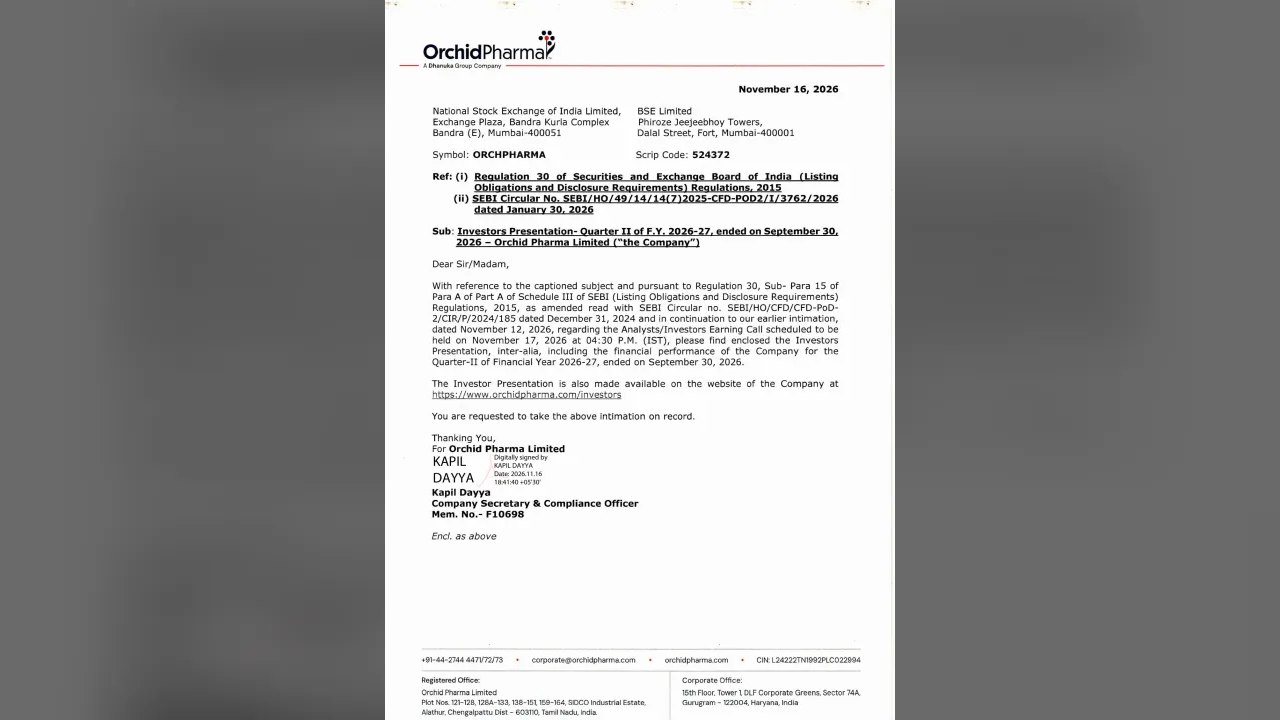
- Company
- Orchid Pharma Limited (NSE:ORCHPHARMA)
- Period
- Q2 2027 earnings call
- Date
- Tue, Nov 17, 2026, 9:34 AM ET
- Replay
- Watch the replay on this page · 53 min
On 6ix: 6ix.com/event/orchid-pharma-limited-orchpharma-q2-2027-earnings-call
Replay
Transcript
Automated transcript · Written by software from the replay's audio. It can mishear names and figures; the replay is the record.
0:00 Ladies and gentlemen, good day, and welcome to the Orchid Pharma Limited Q2 FY 'twenty seven Earnings Conference Call hosted by Systematics Group. As a reminder, all participant lines will be in the listen only mode, and there will be an opportunity for you to ask questions after the presentation concludes. Please note that this conference is being recorded. I now hand the conference over to Mr. Vishal Manchanda from Systematics Group. Thank you, and over to you, sir. Thank you, Dovan. Good evening, everyone. On behalf of Systematics Institutional Equities, I welcome you all to the q two FY twenty seven earnings call of Orchid Pharma.
0:49 We thank the Orchid Pharma management for giving us an opportunity to host the call. Today, we have with us the senior management of the company represented by Mr. Manish Danuka, Managing Director Mr. Brazil Danuka, Full Time Director Mr. Sunil Gupta, Chief Financial Officer Mr. Nishant Dalal, VP Finance and Mr. Kapil Daya, Company Secretary. I'll now hand over the call to the company management. Over to you, sir. Thank you, Vishal. Good evening, ladies and gentlemen. My name is Manish Dhanuka, and thank you for joining us to discuss our results for the second quarter and first half of financial year twenty seventwenty eight twenty sixtwenty seven.
1:35 As you are aware, the merger of Hanukkah Laboratories Limited with Orchid Pharma became effective on 07/10/2026 with an appointed date of 04/01/2024. All comparative figures have therefore been restated on a combined basis. Some of the statements we make today, including those on project time lines, product launches and licensing arrangements may be forward looking. They reflect our current expectations and are subject to uncertainty, so actual outcomes may differ. Let me begin with second quarter of financial year twenty seven. Revenue from operations grew by approximately 14% year on year to INR $3.41 crores from INR $2.99 crore in Q2 of financial year 'twenty six.
2:27 Sequentially, revenue grew by about 12% over Q1 of twenty twenty seven. Gross margin improved substantially by around eight percentage points to approximately 39% from 31% last year's numbers. Last year's numbers were weighed down by high cost inventory and related write offs. The quarter's improvement reflects the gradual normalization of that inventory position, supported by better volumes and a more favorable product mix. Margins will continue to vary with product mix and market conditions. EBITDA, including other income, rose by approximately 148% to INR52 crore from INR21 crore in Q2 of financial year twenty six, and EBITDA margin improved to 15% from 7%.
3:21 This performance was delivered despite some significant headwinds. Fuel and energy costs were nearly 30% higher year on year, which we are all aware due to the ongoing war in The Middle East. We also recognized an expected credit loss provision of approximately INR 5 crore as required by IND accounting standards and company's accounting policy. This is a provision, not a write off, and we expect to recover most of the underlying receivables. In addition, completion of Danupala Botry's merger required us to recognize an impairment loss of approximately INR 5 crore. This is also just a onetime impairment. Both are onetime accounting items.
4:08 They are fully reflected in the reported results and should be kept in mind while assessing the underlying improvement in the operating business. Even after absorbing these items, profit after tax was INR 28.6 crore in Q2 of 'twenty seven against a loss of INR 0.9 crore in Q2 of 'twenty six with earnings per share of INR 4.77. Turning to the first half, revenue from operations grew by approximately 15% to INR $6.45 crore, up from INR $5.62 crore in H1 of financial year twenty twenty six. Gross margin improved by around six percentage points to approximately 36% from 30% last year.
4:54 Part of this reflects normalization after last year's inventory correction and part comes from better volumes and mix. EBITDA for the half rose by approximately 148% to 77 crore from INR 31 crore in H1 of 'twenty six. And EBITDA margin improved to 12% from 6%. Profit after tax for H1 'twenty seven was approximately INR 32 crore. On costs, employee expenses were INR 59 crore for H1, almost flat against INR 58 crore last year, an increase of about 2% against revenue growth of 15%. Other expenses rose to INR 135 crore from INR 114 crore, mainly due to high power and fuel costs and higher selling and distribution expenses that come with the growth.
5:47 Our priority now is to convert the gross margin recovery into sustainable operating profitability through tight cost control and higher productivity. Working capital has also improved. Utilization came down to INR $4.12 crore at the end of September twenty six from INR $4.64 crore in March '26. Working capital days improved to 118 from and 37 and is receivable days to 100 from 113. This discipline is reflected in our cash generation with operating cash flow of approximately 18 crores in H1 of financial year twenty twenty seven. Following the merger, we have started focused integration initiatives across procurement, manufacturing, quality systems, product planning and support functions.
6:44 The benefits will build up progressively, and we expect the cost savings to become visible towards the end of financial year 'twenty seven. Now coming to some business updates. The AMS business continues to be run with financial discipline and its quarterly EBITDA drag has come down to approximately INR 1.5 crore. Given its strategic relevance in antimicrobial stewardship, we remain committed to building this platform responsibly, while staying accountable for the investment. The platform is being built to bring innovative products such as ORBLISEF and cefidrocol to patients in India. Turning to Exblifep now. We continue to build the commercial platform market by market.
7:32 Royalties and licensing fees from Exblifep are improving by each quarter. We are still in early phase of commercialization, but these results show that the platform has begun generating meaningful recurring income. In Russia, which was announced earlier, estimated ten year sales are approximately USD 178,000,000. In Latin America, that was signed recently, our first license agreement for Latin America, the estimated ten year sales are approximately $80,000,000 This long term value will depend on registration, launch and market development. In Europe, the business is still small, but the growth trajectory has been encouraging.
8:20 Of the five large European markets, only United Kingdom has yet to begin commercial sales. The U. K. Follows an innovative procurement model under which the government guarantees purchase of minimum annual quantities at a fixed price. Therefore, launch in U. K. Would be a big boost for our revenue and royalties. In The Middle East and South Africa, launches have been delayed by disruptions in the region and are now expected by Q1 of twenty twenty seven. We are also in discussions on potential partnerships in Australia, Southeast Asia, Japan and other Latin American markets and North Africa and are hopeful of signing three to four additional license agreements over the next two quarters.
9:10 These are still discussions and should not be treated as concluded arrangements. On Safegro coal, the project is at an advanced stage with INR 173 crore invested as of 09/30/2026. Our current target remains commissioning by December 26, followed by validation and initial batches between January and March of 'twenty seven. The inauguration is scheduled for January eighteen, 'twenty seven, and we expect Shinobi, Garti and Chai to participate in this. We are targeting the India launch for Q3 of twenty eight Q3 of twenty twenty seven, subject to successful validation, manufacturing license and the expected clinical trial waiver, commercial arrangements and other regulatory requirements.
10:05 Now coming to the seven ACA project. The 7ACA project remains the company's most important execution priority. Significant portion of the investment in the Jammu project has now been completed. The plant is designed for a capacity of 1,000 metric tons per annum and commercial operations are currently scheduled for March 2017. The pilot technology has been validated and work continues to work is continuing on improving yields against the committed parameters. While Q2 and H1 show an encouraging improvement, it would be premature to expect a straight line recovery. Pricing and demand in our core markets remain competitive, margins will stay sensitive to product mix and the benefits of integration and our strategic projects will come through progressively.
10:58 Our near term priorities are clear, protect and grow the core business, maintain cost and working capital discipline, strengthen the product mix, execute the seven ACA and Safedrochol projects safely and cost effectively. Over the long term, we remain constructive about the combined ORCHPHARMAT platform, backward integration into 7ACA, the cefidrochol access initiative, explicit commercialization and selective regulated market opportunities can make the business more resilient and diversified. Their value, however, will depend on consistent execution, prudent capital allocation and regulatory compliance.
11:45 Thank you for your continued trust and support. We now welcome your questions. Thank you very much. We will now begin the question and answer session. To questions. First question comes from the line of Buram Satti Suresh with Buram Financials.
12:42 Go ahead. Sir, good evening, sir. Given the opportunity. The Russia deal and the Latin America deal will be completed, but production batches start each time. And, again, American deal not mentioned in the previous. American deal already processed and the advanced stage hasn't any update. In future, OPM operating profit margin improved how much next year expected, how much percentage will you can understand, sir, know a little bit English.
13:35 Sure. For EGLICEF, the manufacturing is with the CMO. The product is already being manufactured and supplied to Europe and Middle East. And these two markets of Russia and Latin America will also be serviced. So supply is not the problem there. Based on the agreements, they will need to do the registration in those individual countries, and then the supply would start, which would take anywhere between twelve to twenty four months depending on country to country. Your next question was for The U. S. Market. So U. S. Market is currently not at advanced stages. I would say preliminary discussions are going on, but we don't have any time line right now of signing a deal in The U. S. Market. Mentioned Sorry, we mentioned Sorry.
14:24 You go ahead. Sorry? We mentioned the countries Tell me, sir. When we mentioned in the speech, they were the countries where we are in advanced discussion. Those were the countries mentioned and when we said that three to four announcements can be made in next two quarters, that was for the deals that are in advanced discussion. So we did not mention U. S. Purposefully because that is at the preliminary stage. Actually, time you can mention the U. Deal shortly, it will be completed. But present, you will not mention any time frame, any setbacks in USD?
15:14 I think some understanding gap. We said that next twelve months, most of the world would be covered. U. S. Specifically, we did not give any timeline. Preasonary discussions are going on. We will announce and confirm when we have more certainty. We can fund raising plans already mentioned. Amount... It... What price will you... Timeline, any updates, sir, in preferential issue? And the previous OPM also can... Are currently exploring with various investors.
16:00 There is no fixed time line or mode of investment decided by the company. We have just got the approval from the Board, then we will evaluate and we'll follow whatever the CV norms allow us to do. It is not immediate, not required, but you can time line, sir, fundraising plan and operating profit margin will improve in future. So again, we don't give very short term guidance. And like Mr. Mani said, a lot of the future plans are contingent on the market scenario. So we don't give any profit margin guidance as of organization policy. Fundraising plan, how much time it takes?
16:51 It depends on market condition, difficult to say. At least three months or six months, you are not? Like I said, difficult to say. It is your top two U. S. Venture funds or any local people? That's I think that would be a sensitive information. We should avoid that. Okay. Already you have mentioned U. S. American Venture. No, no. What mentioned? Sorry, I'm not able to understand. You mentioned what are you saying? You mentioned about U. S.... Raising plans, mutual funds and any particular on short term funds and mutual funds fundraising.
17:49 Fundraising plan, you can read the Board resolution. It is as per the market conditions and the investment demand. There is no defined right now, no definition. Okay. Thank you. Yes. Thank you. Our next question comes from the line of Harsh Shah with Avanor Capital. Please go ahead. Just one clarification. So we have reported an EBITDA excluding other income of around INR 24 crores. And in the opening remarks, we mentioned two one offs of INR 5 crore is the adjusted EBITDA of around INR 34 crore for this quarter, if we exclude those one offs?
18:40 Is my understanding correct? That's correct. Okay. That was the only question, Thank you. Thank you. Participants, you may press star and one if you wish to ask questions. Our next question comes from the line of Murli, an individual investor. Sir, I have a few questions. In the agreements that have been signed till now, my understanding is correct that the Latin American one does not include the large Latin American countries like Brazil, Argentina, etcetera, because it lists out eight or nine countries today?
19:31 Your understanding is correct. This is one piece of the Latin American market. We are discussing in advanced stages with other pieces as well. And Mr. Manish talked about that it's potentially in the next two quarters, we might be announcing those. Okay. And sorry, I missed the initial part. In terms of filing status, you are on track for the filing status in The U. S. For next year? So for this product is already approved in U. S? Not this product. I'm saying the other you had one or two products that were there in your pipeline, which you wanted to file. Yes. Those are we talked about broad time line of having five or six products by 2030. So some of them are in validation with this stage, some of them are in the various stages there.
20:24 Okay. And typically, you're H2 heavy, right, in terms of the flu season, etcetera. Do you see the same continuing this time as well? Yes. The past few years trend is like that. The second half sales has been higher compared to the first half. But it's difficult to say, I mean, last two years, the market has behaved in an erratic manner. But yes, we are hopeful that second half should be better. Okay. Some of your peers have started to report some price increases on the overall market. Do you see the same as well?
21:12 So I would divide cephalosporin into two categories with respect to our business. One is the injectables and one is oral. So we find that the injectable business has seen recovery. The oral businesses seem to still have some constraints, probably because of less demand or maybe too much capacity. So the injectables have definitely shown some promise in the last quarter. Okay. And so your last one on the six eighty five, sir, from Q4 or say Q1 of next year, would you be in a position to start external sales or will that be too early?
22:00 Q1 is the plan is to start up, but the plant commissioning Yes, external sales would start significantly later. First, we would start with internal consumption. Okay. Okay. So next year could be potentially better than this year. Is that something that we can issue? I don't know. It could be kind of a guidance that we don't want to actually give. I'm not sure guidance. This is a a narrative, right? We have no quantitative statements. Just we are looking I mean, are working towards growth every year. So I would say definitely 10.
22:49 Specifically, I should be giving this. Our next question comes from the line of Nikhil Upadhyay with SIMPL. I hope I'm audible. Yes. Just two questions. One is on the 788. Now there was a intermittent period one or two years back when the Chinese prices have fallen significantly.
23:38 Now based on the current pricing, which is existing, would you say based on our... In in house consumption, we would be breaking even or and how is the pricing trending now? So if you ask me, seven ACA fortunately has been quite stable in last five, six years. And you can say the price has hovered around $50 plusminus 10% depending and considering the current devaluation of Indian currency, we would say that it favors us significantly. But the price of seven is fairly stable. If you compare it to penicillin G, because penicillin G went up to more than $15 $16 $17 maybe $18 and came to $7 7% AC has been relatively much stable.
24:36 Okay. And like in terms of like middle, you mentioned that we are working on improving the yield. So... And so is the... And as I understand, there was an external consultant who was helping us. So is it a requirement from the consultants to reach that particular level? So is it in the scope of work to help us achieve that kind of improvement? Yes. So we have reached already the minimum required for commercialization as per the agreement with the consultant. And as in the agreement allows him to improve it further along with us, and the more the raw material cost improve, the more royalty he will earn. So there is an incentive in the agreement for them. So they are also working, and we are also working to improve our costs and yields.
25:29 Okay. And last question on this CLI, any clarity now you have, like in terms of how many years of benefit you will have or any sense if you can give? Unfortunately, no. Once we commercialize, I think that would be the right time to go again and ask for something on the letter. At that time, there is no communication from the DOP. Okay. But we also have this benefit of GST from in Jammu and also lower tax rate. So those two benefits will accrue. Because we've seen some companies where this has been a challenge, like even the GST benefit has not accrued to them, and there has been some, like, administrative issues which have come up. So how do you see that benefits accruing?
26:23 So there have been mixed examples. Some companies have started getting benefits also. So it depends difficult to generalize on this subject. We know some people started getting benefits also. It depends, you know, on your documentation and all those things. Okay. And we are also entitled for those then? Yes. We are. And lastly, the royalty now, we've been... Like, I think the scale up of new tie ups has significantly taken. Like, the pace has improved. But when do you see the, like, royalty income becoming significantly large now, like, in terms of the tie ups which we have done, within the next one or two years, would you say most of these geographies will have a commercial launch of the product or it would be beyond that?
27:21 There are you see, there are multiple markets and different markets have different challenges of registration. So there are markets like Latin America and Southeast Asia, where The U. S. And Europe registration kind of assures you of a faster registration timeline. So we expect these markets to start generating revenue much faster. And some of these countries have large population also. So we expect good volumes. Whereas there are other countries like Japan and Brazil where we are discussing, but the regulatory timeframe is a bit lengthy. So it will depend from market to market.
28:10 Overall, from today, you should significantly more market commercial sales. So wherever we are signed, they will take some time to register and start sales. But yes, two years from today, there should be more and more availability of the product globally. Okay. And lastly, our exclusivity remains still 32, two, 33 or would that also? Again, that depends on country to country. If you look at Europe, we will have 2,034 patent is already there. And country by country, we have also started receiving the patent term extension for the patent. That is the time extended due to the evaluation by the government. So Germany, we have received the PTE till two thousand thirty six November.
28:55 U. S, we are awaiting the PTE. Till that time, it is till '34. So it depends on each country, what the patent was filed and what the rules are. I think '34 is a fair assumption right now. Our next question comes from the line of Nikol Upadhyay with SIMPL.
29:44 Yeah. Thanks for the opportunity. Just one aspect of business. See, we had started this domestic business marketing, and we... The idea was that for a period, we'll have a secondary call. We have. But are you looking at more in licensing opportunities as well? Or... And today, how large is the product basket? And for next three, three years, how do you see the product basket mature? Yes. So you see this platform has been created to focus on the antimicrobial solutions. And I feel that at this point of time, Orchid is placed in a position where most of the new antibiotics, the cephalosporin injectable that are going off or are relatively new that need introductions into India, Orchid is placed to manufacture them.
30:49 I think in last or one quarter before the last one, we explained that we launched a product called ceftaroline, which was only supplied by Pfizer and Orchid only manufactures that API and we are promoting that product on the AMS portal on the AMS platform. With respect to the product basket, right now, we are selling 15 products, distinct products and 18 SKUs. We are going to introduce we have just recently introduced a new product that became off patent just three months back. It's Estrionom plus Avivacan, that's also a Pfizer product.
31:36 So we will continue to introduce new products, which go off patent and our overall objective is to become a very significant player in the antibiotics or antimicrobials segment and cater to the intensivist or infectious disease specialists and the clinicians who service the infectious diseases in the ICUs. That is the focus. Sir, just one additional point I wanted to understand in terms of hospital tire. Now we've been in the market for now almost one, one point five years. Is it still a challenge in terms of getting a panel with the hospitals and introducing the products or now it's relatively simpler and how many hospitals you would have covered as of now or are we internally?
32:35 So we are now working with more than 120 hospitals on a regular basis. And total, I think we have covered around 400 hospitals where where we would have got some entry, but 120 is a regular business. And we see almost, I would say, 10% to 15% growth every quarter. That's the trend for, I think, last four quarters for us. Sure. Sure. Thanks a lot. I'll come back in the queue. Thank you. We have our next question from the line of Yash Mehta with Aart Ventures.
33:29 Yes. Thank you for the opportunity. So I wanted to know what was the volume growth of vials in Europe this quarter? Can you come again, please? What was the volume growth of vials in Europe this quarter? We can't divert geography wise information that is confidential with the terms of the agreement of the licensing. Okay. I think you had given a figure of 50% Q on Q in Q1 FY 'twenty seven. Yes. We were just showing some trends earlier. Okay. So have those trends continued this quarter?
34:17 So there is some amount of growth, but like Mr. Manish explained, U. K. Is a market where the sales have not started yet. So the business model there works like the product is approved and all of that, but the government will the problem with antimicrobials is in terms of price and reimbursement. So they are trying a new approach where the government guarantees the volume and the price, and they keep it stocked in the hospital, whether it is needed or not. So since it's a first time model, it's just taking some time to kick off. Okay. And just a broader question on that on the Sephardos for API business. So what have been the trends currently in the market? So are we seeing the market bottom out from here Or is this going or is the quarter is it still early to say for the cephalosporin API business?
35:14 Like I said, we found the injectables to be doing better. For the oral products because the molecules are three or four only and they had grown to a, I would say humongous volume in the last ten years, last I would say five to seven years that and the growth was so tremendous that I think all the manufacturers also increased capacity significantly. But I think Indian players remain a very significant player. I mean, probably export more than the Chinese do in terms of oral cephalosporins. So that there seems to be strength with India. At the same time, the market has consolidated to just the three players.
36:04 So I am confident that I mean with people rationalizing the pricing strategies, the margins or the pricing should improve. In my opinion, this is a temporary phase where people are trying to just liquidate their higher capacities, but I think more sense will prevail with time. Okay. Thank you very much. I'm very hopeful that things would be better. Thank you. Thank you. Our next question comes from the line of Neeraj from Demak. Please go ahead.
36:58 Sir, if you see our other income for this quarter, there was a significant jump quarter on quarter and even on a year on year basis. Can you please understand what is help us understand what is happening here? Yes. So two things have contributed here. One is the contribution from the non cephalosporin business of Dhanuka, which has merged with Orchid Pharma. So some of the those products that Dhanuka manufactured, they have seen a jump during this quarter. And partly because of the formulation business that was already in our So we've had some intangible assets, which were old of Orchid, which we have sold. So that's one large jump this quarter.
38:08 Understood. And sir, like a couple of quarters back, you mentioned that as and when the royalty incomes become tangible enough, you will start disclosing it. So can we have some more disclosures around that? Like maybe in this quarter, how much was the royalty income? Can you help us understand a bit more on that? So I can say the current run rate of royalties and milestone payments that we have started receiving from this business is to the order of $3,000,000 to $4,000,000 per year. On an annual basis, you mentioned, sir? Annual run rate basis. So that's what we expect right now.
38:58 Okay. 3,000,000 to 4,000,000 on an annual basis currently? That's right. Yes. Okay. Thank you. Thank you. Maybe I have couple of more questions. I will come back in the queue. Thank you. Thank you. Participants, you may press star and one to ask a question. Our next question comes from the line of Vishal Manchanda from Systematics Group. Please go ahead. Good evening, sir. Sir, on the gross margins, we were at 39% this quarter.
39:46 Can we expect this to sustain in the subsequent quarters too? Like we said, it again depends on the product mix. Our endeavor is always to go for a more value added products in terms of optimizing our sales product mix. And that's what we try to go for. But it's difficult to say some quarters we are not able to manage that and we have to follow the trend as per our competitors, we have to reduce the prices for some products. But yes, I mean our endeavor is to keep it above 35%. And we manage that through a product mix management only.
40:34 Are we seeing any traction in Europe, probably where the margins are higher? So was that contribution higher this quarter and maybe that can subside in subsequent quarters? To be honest with you, Europe is not doing so well in terms of the demand. We are able to manage this through our complex injectable products for which we do not have any competition in India. And those products are really contributing to the gross margins. That is actually, I would say, key difference between Orchid's product basket in cephalosporin and the competitors.
41:20 So that is what is keeping our margins relatively high. And those products sell in Europe as well as in other including India and other not regulated markets, but not many players. Okay. So one of your competitors had seen an import alert sometime back for Europe markets. So we we haven't been able to derive any benefit out of... They coming out of the market? No, we did gain in some markets. We got the taxes, but they were not selling at a very high price, one or two. Did not have a first of all, they did not have a significant presence itself. And we definitely captured all those customers.
42:09 But I would say their presence in Europe was very insignificant to boost our sales. I mean, we have captured those customers, but that was insignificant. Okay. On Secuder call, have you been able to sign up for the India commercialization rights? It is at a you can say almost signature level. Japanese companies are extremely slow to respond. But I mean, it's a done deal. We have the assurance from that fee that we will be the partner and we've started working also towards that. And, sir, on seven ACA, we haven't seen any price correction in the recent past.
42:56 And even now, we are we are not seeing any price coming price coming off from where it was. Yes. Like I said, it has been fairly stable. If you look at Penicillin G, when was PLI was announced, the prices jumped very, very high levels and then they have dropped significantly. Somehow 7AC has been stable. And there's also not any correction in the downstream products like ceftriaxone, are they also stable? Yes. I would not say that they accrue too much of value addition. They are directly linked to the seven eighty five. So they are just a nominal value addition business because anybody who manufactures seven eighty five manufactures the downstream products.
43:48 It's just part of the business. Okay. Okay. And sir, is there a possibility that on seven ACA, your ramp up can be faster? Maybe you can reach 100% utilization, maybe in that maybe in two quarters. Is that also a possibility? Maybe there would be challenges, but... That is my wish also, but considering the players who have started fermentation factories before us, it would be wishful thinking. I mean, I have to be I mean, we are trying to take remedial actions. We're trying to learn from their mistakes, but it's difficult to give that kind of a commitment. And any other geography where emetazepam has been commercialized outside India apart from Europe?
44:38 Yes, Middle East. Okay. And so that's yet to ramp up? Yes. So like I said, they've got approval in February '26 only. And since then, their launches have been marked due to the war. They started selling, but ramp up has not been able to happen because of the war issue. So hopefully, next year will be better. So next year, South Africa should also start in Q1 calendar year next year. Okay. And just one final one on the planned ANDA filings. Any updates there? Like any filings that has happened or maybe anything around the corner? Not in the immediate, would say. At least six to eight months away.
45:30 Okay. Thank you. Thank you very much. Thank you. Our next question comes from the line of Neeraj from Damaq. Please go ahead. Yes. Hello. Thank you for the follow-up. Sir, in our previous quarter call, we specifically called out that there was a lot of pricing and competition in this particular drug called as Staphyxine. Any latest updates on this? What is happening here? Has the pricing improved? No. The status, I think, remains almost the same. I would say maybe marginal improvement, but nothing significant.
46:18 Understood. Hence, sir, in your opening comments, you mentioned that by the end of current financial year, you expect merger benefits to to flow through. I understand those benefits we will see on the cost side of things. But if I see from a capacity point of view, can you help us understand from our base business, excluding, you know, whatever new new projects is in the pipeline? So in terms of base business, what would be the capacity utilization for Orchid and the capacity utilization for the Hanukkah business, which was recently merged? Yes. So we plan to rationalize the capacities. I mean, there was a duplication of capacity, we will rationalize them. What we are trying to do is request the customers to approve from both the sites so that slowly we can rationalize the capacities and optimize the utilization at each of these facilities.
47:19 Can you give us some capacity utilization numbers like as of today, it's at X percent and going forward, it will increase so that we can see how much revenue can the current facilities generate, just to have some sense? Yes. The Zanuka facility generally operated at almost 80%, 90% capacity utilization and Orchid was at 60%. And we had significantly improved the capacities in Orchid also by the model making some of the blocks. So that we are now trying to create a situation where either plant can supply whichever product required from anywhere in the market.
48:06 So that discussion and modification is now in progress. Understood. And maybe, sir, last question in terms of like there were some like you took the approval for some potential fundraising options. Can we know the reason for this? Because I believe most of our CapExes are already in plan and most of has already been invested. And going forward, as you previously mentioned, we will receive to the tune of at least, let's say, 3,000,000 to 4,000,000 of royalty income, which I understand straightaway falls on the bottom line. So what's the reason for this incremental fund fundraising, the use of proceeds? Yes. So part of the fund will be used to fund the cost overrun of the 788 project.
48:59 Like we said, probably in the last quarter, there has been a cost overrun due to increase in the commodity prices during the last six to eight months. Part of it will be for the debt repayment that we have taken for the Safedrochol project. And partly, it will be for funding the downstream product investment. That was pending because we had to get the environment clearance and some approvals in Chennai. Those are now in place and we wish to start that investment. So these are the three major requirements for this one. Understood. Sir, if I can ask one more question, is it possible? Yes, sure.
49:46 Sir, on our Safedorical projects, if I remember correctly, around one, one and a half years back, you mentioned that currently the mandate which you have is for, you know, low income countries apart from India. But there is a optionality that, you know, that you might produce this for India as well. Any clarity on that optionality, sir? No, no. India is one of the key markets, major markets. So the licenses for 135 low and medium income countries, and India is one of those. But India is the largest market with respect to the antimicrobial resistance. We feel that maybe 30%, 40% will be consumed within India. So needed the optionality was selling in India license, not manufacturing.
50:33 Manufacturing, we are doing for 135 countries, including India. Including India. Okay. So maybe then the question changes to what about the optionality of selling in India? Any progress over there? Yes. So like I answered another question, it's we are at a situation where I mean, just short of signing the agreement, we got in Shneur, we have agreed to give provide the marketing license to us. Understood. And we can expect this project to be commissioned by Q3, Q4 of this financial year? Yes.
51:19 So the manufacturing will be completed by March '27. After that, we have to apply for the licensing to DCGI As it will be a new drug, I'm expecting at least six months for getting the license and I'm hoping we get the clinical trial waiver. Then hopefully by September, October, we should be able to commercialize the product. Understood. And can you please remind us, I you previously mentioned that you will be doing this on a fixed PBT kind of a margin of around 20%, 25%. So that remains, right? Nothing has changed over there. Can you please help us remind? Yes. That is for the manufacturing side.
52:06 Then we are having we are now negotiating a separate agreement. And that in that, we will consider some margin for the marketing side, distribution and marketing. Yes. Yes. So for the manufacturing side of things, what are the dynamics? What's the PBT percentage? Yes, it's around 20%, 20%. Understood. Thank you so much, sir. All the best. Thank you. Thank you. We have no further questions, ladies and gentlemen. I would now like to hand the conference over to the management for closing comments. Over to you, sir. Thank you. We wish to thank all the participants in this call for their interest in the company and for their insightful questions.
52:55 We remain committed to value creation in the company. Have a good evening, and gentlemen. Thank you. Thank you. On behalf of Systematics Group and Orchid Pharma Limited, that concludes this conference. Thank you all for joining us. You may now disconnect your lines.
Follow Orchid Pharma Limited into a list and get an email when it puts out news.
Latest news releases
- NSE:ORCHPHARMA — Orchid Pharma Limited has informed the Exchange regarding a press release dated October 24, 2026, titled "Announcement under Regulation 30 regarding the licensing and supply agreement with… · Sat, Oct 24, 2026
- NSE:ORCHPHARMA — Orchid Pharma Limited Press Release Jul 07 2026 · Tue, Jul 7, 2026