Adam Holland
CEO at MPAC GROUP PLC
Replay available
Interim Results hosted by Mpac Group (LSE:MPAC) on Investor Meet Company. Replay available.
Automated transcript · Written by software from the replay's audio. It can mishear names and figures; the replay is the record.
0:00 Good afternoon, and welcome to the MPAC Group PLC Investor Presentation. Throughout this quarter presentation, investors will be in listen only mode. Questions are encouraged could be submitted at any time via the Q and A tab situated on the right hand corner of your screen. Please just simply type in your questions and press send. The company may not be in a position to answer every question you received during the meeting itself. However, the company can review your questions submitted today and publish responses where it's appropriate to do so. Before we begin, I'd like to submit the following poll.
0:25 I'd now like to hand you over to Adam Holland, CEO. Good afternoon, sir. Hi, Charlie. Thank you very much. So over the next thirty or forty minutes or so, Duncan and I are going to tell you a little bit about MPAC. Duncan is going to talk you through the half one results. I'll give you an update on the progress we made on delivering our strategy in the first half of the year and then we'll finish with an outlook and a look ahead. Look, last eighteen months have been absolutely dominated by the impact of tariffs, geopolitical uncertainty, a slowdown in customer decision making and heightened margin pressure. You probably recall the work that we did last year to take costs out of our business. We delivered record gross margins last year and this year, those cost saving actions have contributed over £2,000,000 in reduction of administration costs in the first half of this year.
1:18 Those actions and the decisions that we've taken in the market this year have led to half one performance with the order intake up 43% on the same period last year, order book up just under 6% on the same period last year, revenues broadly flat and underlying operating profits have fallen. However, you know, we've worked very hard on our order book under real margin pressure. Now the other feature of the first half of this year, we announced back on the June 8 that we took the decision to sell the Lambert business. Lambert was a bespoke automation business really focused on product assembly. It's not core to our group strategy and we completed that sale in July and after £16,000,000 of proceeds, our net debt at the end of August was £43,000,000 For the bulk of the conversation today, we're going to focus on the continuing operations of the business and we'll present any data on a like for like basis except where we flag otherwise.
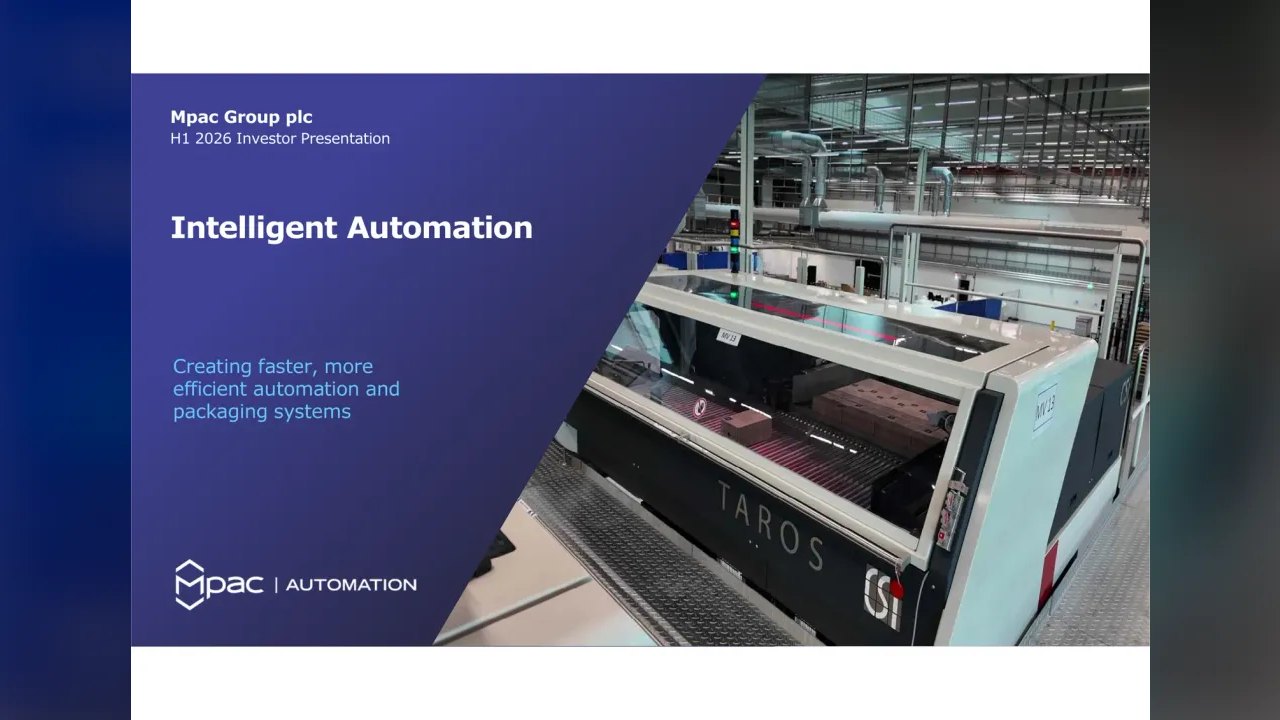
2:14 So in summary, order intake up, revenue flat, the order book stable. We're seeing margin pressure. We're responding with disciplined management actions on cost. The outlook for the full year is maintained under difficult market conditions. Next chart, please. Skip the photos. Very good. Okay. So let's come on to talk a bit about MPAC. We'll start with the pie chart in the top right hand corner of your screens now. About half of what we do in our business today supports customers in the food and beverage sector, about a third in it supports customers in healthcare and the remaining 20% supports other consumer packaged goods customers in a variety of other sub sectors. The group comprises four businesses today: Boston Conveyors and Automation providing robotic handling, wash down kind of raw food conveying upstream of the Langan and the Switchback businesses which offer secondary packaging machines out of the Mississauga and Beacon businesses in Canada and The Netherlands respectively.
3:19 So those secondary packaging machines take the output of BCA's raw food handling involved in putting products into cartons, into cardboard cartons or taking those cartons and putting them into larger corrugated cardboard cases. And then we come to the CSI business case conveying and palletising taking those cases through a factory to palletise and stack those cases onto wooden pallets, wrap them, label them for onward distribution. The CSI business operates out of Ramsdongsfjer in The Netherlands. We have two facilities in Romania, Mexico and field service and sales teams around the world including in Singapore. Last year we also opened an engineering centre in KL in Malaysia.
4:06 That team is building and supporting engineering activities across the rest of the group. Today we're about eight fifty people, nearly 600 are engineers and designers supporting customers in those sectors we talked about earlier. And I'll bring to life the kinds of customers that we operate within in those sectors as we come through the remaining charts. Next chart please. The way our group works, this is the cycle of business that we work through consultation, design and build, installation, monitoring and optimising. The bulk of our work, about 70%, 75% of our revenues, come from designing, building and installing original equipment into our customers' factories for them to produce products and package them.
4:51 The monitoring and optimising the service piece of our business makes up about 25% to 30% of our business. Consultation, that tiny little wedge at the top right hand corner of the chart here, it's a very, very small part of our revenue, almost negligible really, but it's a really important part of the sales cycle. It's where we win new customers, it's how we retain our existing customers, working with them ahead of decisions to place capital equipment out for tender to help them optimize not just the way the machinery works, but often actually looking at the way their packaging is designed and sometimes even the product itself to make it easier to flow through factories. Next chart, please. Now we operate in an attractive market. It's attractive in four ways.
5:39 First is, it's large. You know, it's a very large market. Every year about $60,000,000,000 worth of packaging machinery is bought by our customers somewhere on the planet. The competition that we come up against every day is fragmented. There are a large number of competitors. Some of them are much smaller than MPAC. Perhaps they are only operating in one particular region in the world or with a particular specialist piece of machinery that just does one task. Some are very, very big, multi billion revenues and some of those larger competitors have grown to the scale they are by acquiring some of the smaller businesses along the way and we've done the same. We've seen quite a lot of activity in M and A over the recent months and given the market pressures that we can see, I think that's perhaps understandable.
6:26 Now we're able to compete against even the largest of those competitors because our customers often make decisions on a technical basis. You know, reliability and the performance of equipment is absolutely key to customer decision making. Pricing is always important, but we are able to compete with those large behemoths in the industry because of the capability of our people, frankly. And the people are everything. You know, in MPAC, we often say MPAC is MPAC people. You know, our production lines keep operating twenty four hours a day, seven days a week, three sixty five days a year and sometimes in factories where there are virtually no people present. In our business, when the people go home at the end of the day, you know, we stop work. Our people designing, building, installing and service support to our equipment in the field, it's our people that make our business. Next chart please.
7:14 So when I talk to investors and listen to why investors are interested in us, you know, things come out. We talked a bit about the growth opportunities, the scale of the market. You know, are typically in growing markets over the mid term. Market growth is around about 4% year on year, but of course it's been challenging over the last eighteen months and we'll talk about that as we get into half year results. But over the mid term, it's a large and growing market. Our projects tend to have fairly long life cycles and that gives us a relatively long revenue coverage. So coming into the second half of this year, you can see on the chart there 78% revenue coverage from our order book over the second half revenues and that's up on the prior year. And a good proportion of the book and bill still to go this year will come from short cycle service business which we can rely on. It's been a very resilient business come rain or shine.
8:03 In the first half of this year, services made up about 23% of our total revenue. That's up a couple of percentage points on the first half last year and I'm really pleased with the progress particularly the acquired businesses have made, the businesses we bought in 2024 to drive service revenues. Our service revenues are demonstrably robust, know, and we continue to work towards a goal of 30% of our revenue coming from services in the future. Now return on capital employed, ROCE took a hit in the first half of this year under really quite intense margin pressure, down a couple of percentage points from the same time last year. You can see on the chart just under 12% there. But we've got our sights firmly set on getting back to better than 15% ROCE in years to come. So that's the mid term target. Next chart please.
8:50 I've presented a version of this chart multiple times now. I think in every half year and full year presentation we've shown how we've gone on with broadening our key accounts. And we continue to make good progress broadening our customer base within our target sectors in the first half of this year. Now that's really important for existing customers, not just those new customers that we win, But existing customers want access to the same engineers that designed their equipment perhaps ten years ago. They want to know that those designers are secure within our business, happy and thriving, and available to support them on the same machine in perhaps ten years' time. And the best way of retaining engineers, you know, is is to keep them highly utilized on projects. So broadening out our customer base and working with a larger group of customers keeps our engineers happy. Happy engineers are busy engineers.
9:39 So, you know, we we worked very hard on that. In the first half of this year, I'm delighted that we we secured 48 original equipment orders with 34 different customers. By value, 37% of those were new to the group. And and of that 37%, 7,900,000 pounds, nearly 8,000,000 pounds were strategic customers. And what I mean by that is they're customers who have the scale to place multiple orders with us in the future. As long as we do a good job on those first orders, we'll come back time and time again as they expand their operations and build new plants in the future. And you can see from the scale of that how important it is to our group. Nearly 13% of our original equipment orders in the first half came from those new strategic customers. It gives you a sense of how important this activity is.
10:25 In fact, we've got a case study of one of our original equipment projects on their next slide, so perhaps we'll go to that now. So I'm going to get a bit tacky on you for a moment and humour me. I get very excited by the capability of our equipment. In May this year, the CSI business was selected by one of the world's largest snack food producers for a large project that they are working on to automate on a new greenfield site in a development in Mexico. That facility will take seven bakery lines through a total of one kilometer of case conveyors and buffer decks that the CSI business will provide into four high speed C5000 layer palletisers. Now those palletisers take those cases, those cardboard corrugated cases and stack them onto pallets up to a height of 2.3 metres.
11:15 Imagine how large that is and the weight of that equipment. The palletisers then pass them onto wrappers which wrap them, label them and deliver out of that facility a pallet loaded with cases every fifteen seconds and we'll do that twenty four hours a day, seven days a week, three sixty five days a year with all the service support to achieve that in that critical performance. I think it's incredible. Now the customer selected CSI because of the innovative design. Easy for me to say. The those seven production lines, they feed those four central palletizers and actually we then go go through three wrappers. Any pallet can go to any one of three wrappers and that really clever design means a much, much smaller footprint within the factory than other layouts could have achieved. And there's a real operational logic to the way the design has been set out with empty pallets in one area of the factory, full pallets located in a different part of the facility, really easy for operators to understand how the system is performing.
12:17 And not least, we have installed more than $250,000,000 of equipment in factories across Mexico alone. So we've got an absolutely superb parts and service team operating out of Queretaro. It's a really exciting project for us. We'll continue to work on this and on the pipeline of future projects with the same customer that we're looking to secure in the future and of course that is really interesting to all of us. But before I get too far into the future, perhaps we should deal with the recent past, I'm going hand over to Duncan to hand the first half results. Thank you, Adam, and good afternoon, everybody. I'm really pleased to be presenting the h one twenty twenty six financial results in this, my first results presentation as CFO of the group.
13:03 As Adam's already covered, the trading environment in the first half of the year was challenging with global geopolitical and macroeconomic headwinds impacting on the timing and the levels of demand from customers. We took further mitigating actions at the beginning of h one to reduce the cost base on the back of similar measures taken in the middle part of twenty twenty five to consolidate our US footprint. We also successfully exited the lease of the facility we had in Cleveland, Ohio, avoiding the remaining lease obligation of approximately £1,000,000 and also improved liquidity through the agreement to sell the Lambert business, which we announced in early June this year. So I'll now turn to the financial highlights, which are presented on a continuing basis, therefore, exclude the Lambert business.
13:53 Order intake was 78,000,000 in the first half of the year, 43% up on the same period, 2025. It's worth, referencing that that 2025 period was impacted by early pronouncements on US tariffs. Revenue in the period was 71,000,000, a couple of couple of percent lower than h one twenty twenty five. It's worth also referencing that the order book coming into 2026 was approximately 20,000,000 lower than we enter 2025. So lower order book partly compensated by the strong order intake in the period. The order book at the end of June is 80,500,000. So further stabilization of that order book, but slightly up on the same point in 2025
14:41 and and up up slightly, from the position at the start of twenty twenty six. And as Adam's already mentioned, it provides good coverage, 78% coverage on our h two revenues. That's that's a a further level of coverage and comfort that they would have had at the same point in 2025. We have an order book where we understand the margins, and and and we look forward to delivering that in the second half of the year. Probably the the main story of the first half is that, you know, we did see a drop in gross profit margins 30%, versus, 37% in the prior period. Two factors really at play, in in in that reduction in margin. The first one is that the lower levels of activity in the marketplace have translated through into greater pricing pressure.
15:28 We're we're having to fight harder to win orders from customers. But also the fact that that order intake, is lower than we perhaps would ordinarily have expected, the timing of orders means that we are not seeing quite the level of balanced level of loading, we would like to see across our facilities, and that's weighed, heavily on the margin in the first half of the year. We took action, as Adam already mentioned, to reduce the cost base. That hasn't translated through all the way through to the bottom line. So we still see the headwinds from the gross margin deterioration, and we're reporting underlying PBT of £2,100,000 in the first half of the year. Underlying EPS is 5.7p. I'll touch on net debt and working capital in a subsequent slide.
16:15 Next chart, please. Touching briefly on sales in the period, 54,500,000 came from original equipment, 16,500,000 from our services business. Services business showed really good positive momentum in the sec in the first half of the year, and the businesses we acquired in 2024, CSI and BCA, made really good positive, progress. And and as Adam's already touched on, that's moved our group service revenues as a percentage of sales from, yeah, from from 21 up to near 23% in this first half of the year, moving towards our medium range target of 30% for the group. Touching on a few items in the in the the bridge, the underlying PBT bridge, the you'll you'll notice a 4,700,000 deterioration, which is from the 6.6 percentage points reduction in gross margin.
17:14 We've managed to mitigate some of that through nearly 2,000,000 of overhead cost savings. So significant management action in 2025 and the start of 2026 to try and mitigate some of that reduction in in in margin. And and it's important that we're clear that we have ensured to those actions that we maintain the core operational capability of the group so that when markets recover, and we do think they will recover, that we can respond to that increased demand as a group. Touching on a couple of the nonunderlying items as in previous periods, you'll notice that we have the amortization of acquired intangible fixed assets and then some pension related items, admin costs on the pension scheme and and income on the pension surplus.
18:07 There is a reorganization related credit, naught 900,000, and that relates primarily to us primarily to us exiting early the lease in Cleveland and and and saving the the ongoing lease obligations. And then finally, you'll notice that we are reporting a 7,200,000 loss associated with the the sale of the Lambert business that obviously didn't complete until after the period end, but we've committed to that transaction. And therefore, we recognize the 7,200,000 in the in the first half of the year. Next chart, please. Just briefly touching on some of the key balance sheet items. Before I do so, it's worth just stating that the balance sheet items related to the Lambert business are held as two separate line items in the balance sheet, both assets held for sale and liabilities held for sale.
19:00 That's that's how we are required to account for the business having made the decision and entered into the transaction before the period end. Also worth noting that the FY twenty five balance sheet is is as we originally reported. It's not been restated. Touching on the noncurrent assets line item, you'll notice quite a significant reduction that's associated with removing the goodwill and other intangible assets that we'd originally recognized on the acquisition of the Lambert business. They they get removed.
19:33 What remains is 96,000,000 of intangible assets associated with the BCA and CSI acquisitions. Also worth remembering that there's a 7,600,000 pension surplus associated with The UK defined benefit scheme that is currently going through, through the buyout process. Inventories have reduced. Some of that reduction is, associated with the sale of the Lambert business, but we have taken steps to reduce inventories in the continuing business, by by 1,500,000.
20:02 Networking capital at the end of the period was 6,900,000. That's quite a significant reduction from the 13,500,000 at the end of twenty twenty five. A significant proportion of that reduction is, associated with the Lambert business, which had quite high levels of net working capital at the end of twenty twenty five. And finally, I'll just touch on net debt, which was 54,000,000, at the end of June. That does not include the cash received from the sale of the Lambert business, which we received in the latter part of July to the position at the end of July. And as we've reported at the end of August is is a lower net debt position, and that net debt number 54 includes both our term loan, RCF and vendor loans and deferred consideration associated with the CSI business we bought in 2024.
20:54 Next chart, please. So talking moving on to cash. The first half of the year has been characterized by strong cash conversion in the ongoing business, 100% cash conversion off the back of a of EBITDA of 6,000,000 but offset by quite a significant cash outflow, nearly 4,000,000 from the Lambert business. That's a cash outflow that is is mirrored by a similar cash outflow in 2025. We repaid 3,500,000 of borrowings in the period. That's split 2,000,000 of of term loan and 1,500,000 of deferred consideration, which was related to the the CSI acquisition.
21:41 We have a further 1,500,000 that will be paid in early January twenty twenty seven. Pension contributions are at the same level as h 01/2025, and that's where we continue to pay into the escrow account. The the predominant amount of that is in in relation to The UK defined benefit pension scheme. CapEx is 1,400,000. It's worth just noting that that investment in CapEx is actually 36% lower than it was on a reported basis in h one twenty twenty five, and the reduction is a result of the fact that, you know, the balance was related to the investment in the Lambert business in in CapEx in in in 2025. Lease payments are as in previous years, and we we've incurred 3,300,000 in in respect of tax effects and and interest.
22:33 The group utilizes a term loan and RCF from HSBC. We have a very strong relationship with with HSBC. They've been very supportive and encouraging of of the group, and we have committed facilities with them through to the end of September twenty twenty seven. We continue to operate within interest and leverage covenant levels. Next chart, please. Finally, I wanted to touch on the sale of the Lambert business. We announced it in early June, and the transaction completed towards the end of July with receipt of gross proceeds of 16,000,000. The sale, which was a result of a strategic review of the latter part of 2025, means the group is now aligned around more scalable, full aligned packaging machinery solutions.
23:19 Since the acquisition, the Lambert business has been cash consuming through necessary investment in r and d and also working capital to the tune of over £15,000,000 since acquisition, including, as as just previously discussed, almost £4,000,000 in the first half of twenty twenty six alone. That significant capital investment has resulted in the one off noncash loss on sale of the business of 7,200,000. The balance sheet has been strengthened by the sale of the Lambert business. We've improved liquidity, and we've reduced the working capital burden, on the remainder of the group. Now hand back to Adam, who will take us through an update on strategy and the outlook.
24:07 Thank you, Duncan. I'm start by giving you a couple of examples of progress that we've made on strategy in the first half of this year. And I I said before that we were working very hard to move production into Romania, those two sites in Romania that we acquired as part of the CSI acquisition in 2024. Now since January this year, all electrical cabinet builds are now centralized in Romania for customers in EMEA and APAC. So flowing into other other factories around the MPAC GROUP for assembly for those customers around the Europe, Middle East, and Africa and the Asia Pacific regions. So it's a very significant change effective from January. Since April, all coated steel frames are now sourced or made by our business in Romania.
24:56 And in May this year, at the Global Interpac Trade Show in Germany, we showed the world our first Langan austrokartener built by the Romania team at CSI as well. We have also now built the first of a new generation of b one m Langan cartoning machines in Romania too for The US market. I think the team have made absolutely outstanding progress on on standing up that capability in Romania. We're really excited about what's still to come, but more of that next time we speak. Next chart please.
25:33 The second case study is an example of customer focused innovation and the impact that it can have on market access. In February, our BCA team in Boston was selected by one of the world's largest producers of protein foods to develop a new case conveyor and a new case packer. It's the first time we've ever won an order with this strategic customer and we won because of the incredible Affinity operator interface. You can see it on your screen on the right hand side. We developed it last year as part of our Horizon new product development and the customer saw it when we demonstrated it at the PAC Expo trade show in The US last year and they loved it. It's designed around ease of use. The innovative screen is designed so you navigate it just like you would a big a big iPhone or an iPad.
26:23 You know, it doesn't take any training for an operator to get familiar with the screen and understand how to navigate through and operate the machine.
26:30 And it can be used with a variety of different controllers as well. Whatever the control system is in the background running the machine, we can still use the Affinity interface for those customers despite the customer's preference on control system. So for customers who are looking to minimize training for new operators, that's really important. And why might that be something customers want? Well, perhaps the customer is dealing with high labor turnover in their factory and they have to train new operators every Monday morning. Or perhaps they have an aggressive growth plan and trying to ramp up production. They're recruiting rapidly into their organization and new people are joining the team all the time. These factors matter enormously to our customers and this was a key part of the decision making in our selection for that project. But the customer also really appreciated our localized US assembly in Boston, Massachusetts for this US application.
27:22 Now the scale of engineering and service support that the rest of the group could offer even to the smallest business in our group was something the customer highlighted. If you're one of the world's largest protein producers, it's really important that we've got the scale of service support and engineering support to keep pace. So that combination led to the win. As I say, it's the first order with this customer. It's really exciting. If I look ahead, it's the opportunities ahead that are really exciting for us as well. Again, I'm looking forward to giving you an update on that in future. Next chart, please. So the pillars of our strategy for the group, these five pillars around going for growth, outstanding customer service, innovation, people and operational excellence. We've had those as stable group strategy now since 2018.
28:12 Under customer growth, we've touched on a few things. We also launched new websites for all of our brands during the first half of this year. We have a new corporate website too and a common lead generation platform. You know, I'm I'm really pleased with how the acquired businesses are performing on order intake in the first half of this year. We've to enough about that already, so I won't repeat myself. Under innovation, we've already covered Affinity. I'm not going to present to you the other launch of our major new products in the first half of this year, the Taros four layer palletizer. There were new iPal launches in the first half of this year too. We saw the first subscription renewals from customers using our digital service solutions, things like the MPAC Replay and Cube Connect systems.
28:57 So a lot under innovation. There's too much for us to cover in the time we have available today. We also went live in June with our group ERP platform at BCN. If you thought Duncan sounded pleased to be presenting his first report as CFO, imagine how pleased he was with the visual launch in Boston earlier this year. We also wrapped up obligations on the lease of the Cleveland facility. So you might remember we consolidated operations in The Americas last year. We completed that consolidation with the exit of that lease in the first half of this year, and that was the positive on the non underlying exceptional items that Duncan referred to. Perhaps I should finish by focusing on people. People remain absolutely key to MPAC, and we've been investing in cross training, not just increasing flexibility within each of our businesses, within each facility, but really importantly, increasing the flexibility between our facilities. And I'm sure we're going to touch on that as we get into some of the Q and A later because it's central to how we've been able to perform in the first half of this year and what we see ahead.
30:04 Okay, I think it's probably enough on updates and strategy. We'll move to a kind of summary and outlook and then I'm going to hand over to questions. There are questions that you still want to ask, put them into the chat box and we'll do our best to answer them either immediately on the chat or after the call. So look, to summarize, I am delighted to have seen the completion of the sale of the Lambert business. Really good to have got that across the line in the first half of the year. But for me, the first half was characterised by five things: better order intake up 43%, a stable order book up just under 6%, actually another 2.5% up since the end of June. A resilient service business, really proving to be so, but we are seeing margin pressure. And the last piece, you know, the impact of those cost saving actions that we've taken. You know, Duncan talked about £2,000,000 realized on the p and l in the first half of this year. You know, that takes some doing and and well done to the team on achieving that.
30:58 Now looking ahead, the full year, outlook unchanged. The pipeline of future projects continues to grow. You know, it's it's larger now than ever before. It's filling faster than ever before. And that's really encouraging when we look ahead. But I have to say the timing of a full market recovery is still not clear. You know, we do not yet know the full impact of the recent tariffs between The US and Canada, the 50% tariffs announced in May and enacted in quarter three. But I am really pleased with the way that the leadership team at MPAC are responding to those conditions and making really good decisions under challenging market conditions. I'll pause there for questions. Thank you. Thank you very much Adam and Duncan for the presentation. We've got a few pre submitted questions that we'll start with, whilst people continue to submit their questions.
31:48 So Duncan, one of the questions is around the deferral of the pension and and whether that's a concern a deferral to pen next year and whether it's a concern. Thanks, Katie. I mean, the the straightforward answer is there is no concern. The the trustee continues to work with Aviva on the buyout process that requires significant resource, effort, and diligence on the part of the trustee. That process will not be completed this year, which is which is the reason the escrow isn't returned to the company this year. The company and trustees continue to collaborate well as they always have done, but it is clear that the the escrow will come back to the company, you know, during 2027.
32:38 Thank you, Duncan. Adam, if you could give some color on what has the change in your customer base been post Lambert sale? Yes. There's probably a couple of things I want to say. So so the first is around the the Lambert customer base and the rest of the group. You know, Lambert's focus on on bespoke automation of a customer's assembly process. If you go to a factory and you walk the line from from assembly through packaging and end of line and and and out to trucks, you know, taking taking product to a port or an airport or whatever it might be, You know, you might think that that's one joined up line. But often, that is not the case. You know, there's often an air gap. And sometimes that air gap might be thousands of kilometers, you know, a literally product being produced in one factory in one part of the world and then packaged in a completely different factory in a different part of the world. So a very significant gap.
33:35 And that, you know, is apparent to probably anyone who's been inside a factory and walked around. Now that is not true of every factory in the world, often true. And for us, what we found is in the years that we've been operating the Lambert business alongside other businesses within the group, average, one customer per year had any overlap between Lambert and the other businesses in our group. And very, very few of those projects ever actually involved working the same under the same roof. So very, very little synergy. For that reason, I'm not particularly concerned about dis synergies in the divestment. Probably the other piece I want to touch on there is a more significant change in the customer base, which is we're continuing to broaden our customer base.
34:25 You know, you'll have seen the the the chart we presented earlier just a a few minutes ago, a whole range of different customers listed there. Some you'll you'll certainly recognize, you know, blue chip multinational companies with with mega revenue turnovers and, you know, phenomenal history. And and some businesses that you might not recognize, but actually in their own in their own right are very large customers with significant revenues of their own. You know? And, you know, we've been working really, really hard to broaden out our customer base. I think that's really important. We're gonna continue to do so, and that that theme is gonna continue. Thank you, Adam. Another question is on how are you managing tariffs, if if you could touch on that. Yeah. Perhaps I'm gonna use this as an opportunity to talk about US and Canada. I think that's probably probably what this question had in mind.
35:19 Look. The first thing is we last year, we moved the we moved the parts spare parts facility from various businesses around The Americas into one location at Boston, in Boston, Massachusetts inside The US. And that obviously helped enormously when it comes to serving customers in The US. We moved many of our supply chains from Canada to The US for those spare parts supply, not all of them, and we're working hard on on those remaining supply chains for spare parts now to make sure that those are not exposed to to tariffs if we can possibly avoid them. You know, Duncan talked about, you know, the way that we're utilizing teams around the world, and and I mentioned about flexibility between our operations. Well, let me put that all together for you. You know, in the last few weeks, we have taken orders for customers in Europe that we will design and build in our facility in Canada and export from Canada into Europe.
36:13 It's a way of ensuring that our Canadian expertise is highly utilized on projects where it's it's really applicable. And and we have won projects in The US that we will build in European factories and in Boston. You know? And so that flexibility of being able to use different teams around the world or different projects in response to what is still a, you know, a highly volatile tariff situation. It's it's changing all the time. I think it's really important. You know, if you'd asked me the weekend before tariffs came in, the the 50% tariff came in, you know, what I thought was going to happen, I I would probably have echoed the the lines that I was hearing in the press from from Mark Carney and from and from Trump, you know, that I don't think either of them expected at the start of that weekend that tariffs were going to happen. They thought they had a deal. They didn't, and here we are with 50% tariffs. So, you know, we're responding to that and and working our way through the implications.
37:08 You know? I I I also think I I would say if we look ahead, we are conscious of one thing for the future, and that is you cannot predict it. You know, will tariffs still be in place at 50% levels in a year's time, in five years' time, in ten years' time, in a week's time? You know, I don't know. So we are planning scenarios to respond to those as as they might emerge. Thank you, Adam. There's a question whether Lambert was a strategic sale or a fire sale. Okay. There's a very clear answer. It was a strategic decision. You know, we we did a a review of the Lambert business. We thought very carefully about how it fits. And I I described all that kind of air gap between assembly of a product inside a customer's factory and the the packaging and end of line processes.
37:58 You know, that's really important. And, you know, we we once we've made that strategic decision yeah. Let me let me say that you don't have not every business has to fit perfectly within the group. It's okay to have a business in the group if it's staggering amounts of cash and profit every year. But as you've heard from from Duncan, for for us, our experience of the Lambert business over many highs and lows in the in the cycle in the market was that that wasn't the case. So, you know, we've made the strategic decision. We knew exactly what we wanted to do with that business. It was really important to us. We found a really good home for it. You know, that the customers of the Lambert business deserve a good future. The team in the Lambert business deserve a good future. I'm delighted with where the Lambert business has landed in the world.
38:44 But the timing of that sale, absolutely, is a response to the conditions that we found ourselves in. So a strategic decision, the timing, no accident. Thank you, Adam. Duncan, is this a structural change in the market, or do you expect margins to recover? We don't see this as a structural change. I mean, that's probably a very clear answer that I can give. So as markets recover to more normalized levels, you know, we we fully expect to see margins, the group's generating to, you know, to recover, you know, back up to to levels that we've seen in the past. It's probably also worth saying that, you know, our ambition around service revenues as a percentage of total revenues is to get it towards 30%.
39:33 I won't comment on on what margins are for OEM services because, you know, that's that's commercially sensitive. But, you know, as we as we drive service revenues, you know, I think people would expect us to see improving margins as well. Thank you, Duncan. There have been a couple questions around net debt. One states, a year ago, net debt was low forties, and today, it's 43,000,000. You've had 16,000,000 from the Lambert sale, and net debt has not changed in the past year. Can you go into this further? Yeah. Yeah. Absolutely. You know, I think it's worth saying that the, you know, the the challenging market scenario that that we we see in front of us is not only impacting margin, but but making making, you know, cash cash flow a focus for for us, for management.
40:25 I'll I'll repeat what I what I said during the presentation. You know, the cash generation of the ongoing group has been good, a 100% in the first half of the year, but we have seen a drain from a cash outflow in the Lambert business. There was a was a cash outflow in 2025. And, you know, that doesn't get repeated in 2027. You know, that that headwind is not with us anymore. We are continuing to contribute to The UK pension fund as as well as the the small US fund we have, but it's The UK one where we're contributing the most. There will come a time when those contributions cease, and and therefore, you know, that that kind of headwind is is not in the in in in in front of us. But right now, with the levels of profitability, whilst cash generation is good, you know, we're not generating free cash flow.
41:18 That's, you know, that's that's clear to to everybody. So as as activity levels and demand levels improve, you know, we think that will trade, you know, through into cash. But in the meantime, we continue to focus on cash management and and working capital management in particular and try and, you know, put our attention towards those those factors that we can influence in the meantime. Thank you, dunks Duncan. You mentioned about pension, and there's been a question asking whether you could explain the financial implications of your pension buyout deal with Aviva. Yeah. Absolutely. I mean, those those people that have followed MPAC for a number of years will, you know, will understand there's quite a bit of complexity around our UK defined benefit pension scheme In in terms of trying to to answer that in a straightforward way, I mean, the financial implications are that in time, the contributions into the scheme will stop.
42:18 The escrow, that's built up, we're paying those contributions into an escrow now, not not not to the to pension funds, will be returned to the company, and the company and the trustees will work towards the efficient windup of the scheme. But, you know, that that there's work to be done to to achieve that. So so that those are the broad financial implications of of the the buyout and the subsequent windup. And and in time, observers and investors will will notice that, you know, there are no more items in our income statement or balance sheet in respect to that. Thank you very much, Duncan. We've just got a few more questions if any viewers do want to ask any further questions.
43:06 So the next one is, what is the source of pricing pressures seen across the business? This is probably one for me. I mean, short answer is volume. We've been through cycles before. Know, get back to the two thousand and eight, 'nine financial crisis, you go through COVID and the chip shortages, you know, capital equipment markets are cyclical. There are periods of investment, and there are periods where our customers hold back on investment. And, you know, we're definitely in in one of those periods where the volume in the market is lower than we've seen in previous periods. We've talked about all the reasons for that, you know, already, so I wouldn't go back over old ground. It's probably also fair to say, though, that the you know, this has been a lower a longer low period than we perhaps have seen in previous cycles. And and I think there's something to be said about, you know, how many shocks we've had to the system, you know, not just one tariff shock, but a series of tariff shocks, not just, you know, some conflicts, but but widespread conflict in The Middle East and so on.
44:05 You know, they so so the you know, this this has been going on for a little while. And the result of that is that that long period of low volume with customers delaying decisions and holding back on investment means that the volume that is there to be won is being highly competed for. And some of those customers are also making decisions about the availability of cash and what they're gonna spend. You know, if you're a factory manager and you've got an outstanding new project that you want to launch with a a really good return on investment, but your, you know, your corporate center are saying, you know, there just isn't the cash to deploy into that that kind of a scalable project at this time. Your choice as a factory manager is to wait until cash can be afforded to be deployed or scale back and go for a different system, perhaps a simpler system.
44:54 And that tends to come with a lower price and lower margin point. So you know, the impact that we're seeing is a volume piece. And the question you've got to ask yourselves is, you know, do you think that is the new normal forever? You know, I do not believe that. I am absolutely of the firm opinion that we've seen these cycles before and these cycles tend to recover. When they do, they tend to come back quickly. I don't know when, know, and anyone who tells you they know what's going to happen in the future, think is kidding themselves and they're trying to kid you. But they will come back. Know, these volumes will come back and as the volume returns, the market, the margin will recover as well because it's that that pressure we're seeing that's coming through in in our margins. And in two ways, you know, perhaps it's worth just explaining that to help people tuned in today to understand what we're seeing. Our margins are impacted by two things. Firstly, the price pressure that we're seeing in the market, that's the sales price pressure. And the second thing is the timing.
45:48 You know, we're expecting an order next week and we've got engineers lined up to start work and that customer delays the decision by two, three weeks or two, three months, you know, are we doing with those engineers? You know, that underutilization of engineers is inefficient in our factories. That causes a marginal impact on us and when those orders do land, you know, the laws tell you that they all land at the same time, don't they? All of a sudden you go from underutilised to over utilised. So then you have teams working overtime, you bring in contractors to take on some of the work that can be offloaded to contractors. All of that's inefficient as well. Factories like stable, even production and that's not the world we're in. So price pressure, timing pressure both impact margin and those both go away as volumes pick back up again.
46:36 Now I'd say there's also a link to the point that Duncan touched on with cash. You know, how does cash improve in the future? How do we drive net debt down in the future? Well, as the volumes come back, deposits with new orders improve, that's a very important part. You've got to remember that although the order book is flat and we've been stable for a long time, we were £20,000,000 down during the first half last year. The order book declined more than £20,000,000 £20,000,000 on a like for like basis. That's a huge amount of order book deposits that we don't have in the bank right now in MPAC and as the order book grows again in the future, our cash balance will improve. The volume of cash milestones will help too. And the last point I'll make on kind of cash conversion from normal operations, Duncan told you the cash conversion is good in the first half of this year on profits in the first half of this year. As volumes pick up, we generate more leverage through the organization. That generates more profit. If we can maintain the same cash conversion or even just good cash conversion because it was excellent in the first half on the underlying business, that will generate an improvement in working capital.
47:43 So we can see lots of routes to improve our position in the future. That's on the normal piece of the business. Of course, if we get to a point where we stop contributing to The UK defined benefit pension scheme, that will also have a benefit. We finish payments on the existing deferred payments to the owners of the businesses we acquired in 2024. All of that starts to help with our cash on net debt position. Okay, so there's a lot in that but that was an excellent question. Katie? Thank you, Adam. And the last question. Order intake was strong in h one, and you said that the pipeline is now larger and building faster than last year. Could you give us a little more color on what you're seeing in the pipeline? Yeah, color, no. A number, yes. I'll give you a number.
48:32 The pipeline is about 5% larger at the end of July compared with the start of January this year, so in the seven months end of July. I'm sorry I don't have an August figure to give you but I can remember the July number. So the pipelines are 5% bigger. If I was to break that down by business or by region, you know, I think the standouts for me would be BCA and CSI. You know, the businesses we acquired in 2024 are really recovering really well to the disruptions we saw last year. The pipeline for those two businesses is above the 5% and really helping with the group average. All businesses have shown improvement versus the pre tariff levels of the pipeline in 2024. But you know, the pipeline is only the pipeline is interesting but the P and L is only as good as conversion of those orders.
49:26 Conversion of the pipeline into orders and orders to cash. So you know, we're going to keep making the right decisions. Not going to carry it away with the pipeline until we see it converting towards, until we see orders converting to cash. We're going to prepare the group for growth ahead and I think that's the right thing to do. So, keep making the right decisions in a challenging market. Thank you, Adam. There's been no more questions. If you just want to do a quick summary before the end of the webinar, that'd be great. Yeah. Thank you. I mean, I'll probably touch back on those five things I think that I've mentioned earlier. So the highlights for me, better order intake 43% up, stable order book 6% up, resilient service business. We are seeing margin pressure, but the impact of cost saving actions that we've already taken is starting to come through in the P and L and there's more to do in the second half. You know, on certain markets, but we're making the right kinds of decisions and I'm really confident in the leadership So to manage thank you ever so much for your questions today and I'm looking forward to the next update early next year.
50:29 Yes. Thank you. Perfect. Thank you, Katie, and thank you to the team for updating investors today. Could I please ask investors not to close this session as you now be automatically redirected to provide your feedback? On behalf of the management team of MPAC GROUP PLC, we'd like to thank you for attending today's presentation, and good
Follow Mpac Group PLC into a list and get an email when it puts out news.
CEO at MPAC GROUP PLC
CFO at MPAC GROUP PLC