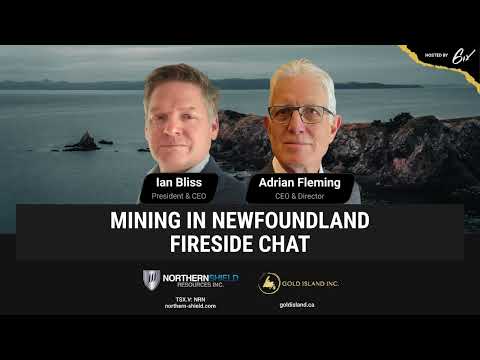
Automated transcript · Written by software from the replay's audio. It can mishear names and figures; the replay is the record.
22:22 on with solid state tellurium, lithium batteries. And the addition of tellurium to the lithium in these batteries, no more in its solid state, so it doesn't have a habit of bursting into flames like the lithium-ion batteries do, but they're much lighter for increased energy capacity, somewhere between 3 and 10 times the energy capacity of lithium-ion batteries. So you know one of people's concerns, especially in a country the size of Canada, is some of these electric vehicles don't travel very far on 1 charge battery. So if we can now get 3 to 10 times the charge by adding tellurium to it, you know, that's gonna make a very significant motivation to the EV world. And so Tellurium, I think, you know, if they sort out those 1 or 2 technical challenges, engineering challenges with these Tellurium lithium batteries, I think you're going to see it take off in a hurry.
23:17 So Comparing it right now, there's not a lot out there. There's a company called 1st Tellurium that has projects both in Colorado and 1 in BC. Again, these are alkaline-related Gold, Silver, Copper systems. I say you only get Tellurium as a by-product of these metals in these systems. You very rarely go to a Tellurium-only mine right now in the world. They're taking a little bit from some of the copper sludges in the copper spouting process. It's a by-product of these alkaline-driven Silver and Gold occurrences. I think a lot more people may figure out they actually have Tellurium in their systems. I was actually talking to somebody in Ontario that has an Arcanium equivalent of an alkaline-driven epithermal Gold system. I don't know how much Tellurium they have, but they told me they do have Tellurium in these systems.
24:15 In our case, the tellurium is not only important as a potential by-product and added value to any resource down the road, and obviously a very significant one if this battery technology takes off, but it's also a very good pathfinder and even a vector towards the copper porphyry. And again, it's also sort of a key characteristics of these alkaline driven systems. So once we sort of seen all this tellurium along with a few other elements, that's when we realised, hey, we have one of these alkaline driven systems that tend to produce not only the tellurium, but very high grades and large tonnages of gold. Cam, I'd like to ask Ian a question. Ian, if you think about gold and the value of gold and you're looking at press releases which are quoting grades And we think of some, you know, many, many gold deposits running around 2g per tonne.
25:08 If they're being mined open pit are quite viable. A gram of gold is worth about $60 at the moment. So a 2g per tonne Gold deposit, every tonne of Gold, every tonne of rock is worth about $120. What is a gram of Tellurium worth? Well right now it's actually, I think $85, actually quoted in yen, but it's $85 a kilogram right now. It's been as high as around 600, I believe, at one point in the past. It's known to fluctuate quite wildly. Part of the problem in its spot pricing is, I'd say about 90% of the world's Tellurium comes out of China and Russia, so we're not really sure of the true resources and we're probably going to find out the hard way 1 day when we're out of these resources.
26:04 Right now it's around US$85 a kilogram. Again, we tend to quote it in PPM, but it's an added value. Right now, the current price is not a big bananas to win right off the bat unless you have extremely high grades. Right. Very good. Thank you. Yeah. Well, good luck with that. And you know, there's a lot of companies now moving into the battery metals area. And for old gold geologists like me, you know, I'm on a steep learning curve, you know, to begin to understand firstly, you know, what might the industry of the world want in the next 10 to 20 to 30 years. We know that there's a big shortage of copper and nickel, but these battery metals are going to be very, very critical.
26:59 And, you know, they're out there. People are starting to look for them, but they do occur in different geological environments. And I think we as geologists working with public companies have an obligation to try and help people to understand the value of some of these other commodities relative to gold and copper and nickel, which you know, we look on, we look on our phone every day to look at what the price is. No, absolutely. I mean, that's a great point, Adrian. And I mean, you know, actually just broadly speaking, Do you guys think and believe that now's a good time to be in the mineral exploration game? What reasons might investors have to be optimistic looking forward? As we all know, it's very cyclical. Is it a good time? I'm enjoying it.
27:51 The markets are rough for a dirty stage story, but we still see it as an opportunity to get out there and get our work done. In the downturns, ultimately the markets are going to turn around. And it's given us that time as well to sort of move into Newfoundland a few years ago when there wasn't a lot of attraction into that space and set up ourselves. So, If you look at simply the battery metals, obviously these things you assume 1 day are going to take off, there's going to be a huge deficit in Copper. So we're all going to go to net 0. That's the benefit of the Root & Seller project. It's not only that we have the Gold there, but we do have some of these battery metals, particularly Copper.
28:38 I think it's an exciting time to be in the industry. It's tough, but hard work. You just grind it out and it's a good time to be setting up space in Newfoundland as well. Fair enough. What about you, Adrian? Yes, Cameron. We as people who live in a civilised environment these days, we consume a lot of stuff and I think people tend to forget that you know a lot of what we consume comes from farms but if it doesn't come from a farm it comes from a mine. And so modern civilization really cannot exist without mining. You know, you look at the projections for the demand for copper, the current world production of copper and the current group of larger mines that produce a significant amount of the world's copper are unable to keep up with the demand. The demand is rapidly growing as it is for nickel because of people becoming richer countries, becoming richer people, wanting to have, you know, not just a motor scooter, but a motor vehicle.
29:53 And, you know, with electrification of many different industries, there's, we in the mining industry have our backs to the wall in terms of trying to find new deposits and develop them to keep up with that demand. I think the other comment I'd like to make about a good time to be in the industry is just to hark back to what the mining industry is made up of. And so there are a number of very large companies, you know, Barrick, BHP, Rio Tinto and various others who are established. They have market capitalizations of billions of dollars. They have multiple mines. Mostly they're quite profitable. And then at the other end of the spectrum, you have people like Ian and myself who work in the junior exploration space, who for, to secure funding to do our work.
30:50 We sell shares in the public domain to people who are interested in investing in our companies because they're saying, well, you know, Adrian, he's hit a few home runs and he might hit another one so we'll put some money into his company. And you know with Ian who has a slightly innovative and different approach to exploration to many junior companies people would say well you know we like what Ian's doing because you know he he's thinking a little bit outside the box. So you've got this dichotomy of the little guys out there who are nimble, move faster, often make the significant discoveries which the larger companies purchase. So it's important, I think, that people understand some aspects of how the industry functions.
31:37 But in our case, you know, the market fluctuates and the appeal of junior exploration companies to the public at large, who we depend on for our funding, varies from time to time. So every now and again, you know, you need Adrian or Ian to make a significant discovery and that captures the public's attention again. And they say, boy, I heard about that company but didn't put money in it. And look, you know, they've quadrupled in price and they just got taken over by Kinmos and everybody made money. So we're right at the moment, the market sentiment for juniors like us, like Gold Island and like Northern Shield, is a little bit reserved.
32:26 There's not as much money as maybe there was a couple of years ago, but It's always cyclical. And so junior companies have to sort of sit out the storm and wait for the sunny days when you can top up your treasury again, or you hope you can find something substantial that will captivate the market's attention and you can go out and raise more money to keep doing your work. So the world needs metals. We are the nimble guys who go out there and do the hard yards and often find things that the big companies want. So I think it's always been a good time to be in minerals and in exploration. But there's sunny days and there's cloudy days.
33:12 No, that's very fair. We should remind everybody too, what other industry as an investor do you have this opportunity to make multiples literally overnight? And, you know, that's what has always been the interest in investing in juniors. I mean, it has sort of faded away a little bit in the past year, but it's the opportunity you have as an investor to make multiple returns on your investment. It's the excitement from our point of view as mining exploration companies to go in there and bang a rock in, especially if no exploration has ever happened in that area. It can change. I don't want to say it's quite overnight, but it's a very rapid transition or it can be in the future mining industry.
34:04 It's a wonderful context from anybody wanting to be looking in on the industry. I'd love to bring it back now just a bit to Newfoundland. Apart from the government of the province itself, How do Newfoundlanders respond to the mining in communities where you guys work? What are the relations like? I would say ubiquitously positive. And as I was saying before, Gold Island is a junior exploration company. We took on a bunch of properties from Sean Ryan. I had worked with Sean Ryan before in the Yukon. And over 2 years, we managed to be able to do enough work on all those to filter through and identify the 2 project areas which we think have potential, and we're still working on those.
34:55 But everywhere we've worked in Newfoundland, people have been very positive about what's going on. They all seem to be very aware of the companies that are seeing success and that's Marathon with the Valentine Lake project, and then Newfound Gold with this very high-grade deposit that they are working on up near Gander, but there are others there that I mentioned earlier that are doing very well. And, you know, there's this, I think, mining is an important part of Newfoundland's history. People recall the benefits to employment and the local economy from mining and they're very positive about what's going on in the island right now and the government is very supportive.
35:45 It looks great to hear. I'll just echo that. I mean, they were ubiquitously welcoming, very, very positive attitude. I don't think I've worked in a more welcoming place. I mean, when you're on the ATV trails or in the grocery stores or the restaurants and you're chatting to people, again, they're offering their assistance. Like, what can we do to help you get to your point? When you tell them the normal timeframe of exploration to mine development, of course, their heart sinks. But they're like, what can we do to speed that process up? They're there to work too. They want to be part of this, but they're incredibly welcoming to the mining industry. I've never had so much support.
36:32 I don't think anywhere. And again, it's also going back to the geological survey and the setup in the energy mines and resources. This project was discovered by a prospect that received grants from the government. And then, so he made that discovery by a little bit of backing from the government. Then a government geologist was in charge of compiling all the information from all the prospectors around Newfoundland, putting them on fact sheets and trying to sell these on behalf of the project, but on behalf of the prospectors at conferences around the world. And that's how we got introduced to this project and the prospector. And so it's not just the people being welcoming, the government has had a good strategy there of funding the prospectors early on, and there's the guys that are on the ground finding these things, and then it's helping them by marketing their material to the junior mining industry.
37:33 No, I mean, that's awesome to hear. Lots of positivity. I guess the real question is though, guys, I wanna know, have either of you been screeched in? No, I haven't actually. Not yet, not yet. Yeah. Something to look forward to maybe, something to look forward to maybe something to look like to maybe then I've been threatened with that. Yeah. Is that a positive or negative about the jurisdiction? I'm sure it's going to happen next time I'm on the island. There you go. Something to look forward to. Gentlemen, we touched on it at the start. We've talked around them throughout today, but you obviously both have projects there. And before we head out, I want to give you the opportunity to get on your soap boxes and talk about them. Talk about what's special and what you've been doing so far this year and what you're looking forward to, what catalysts are on the horizon.
38:23 I'd like each of you to have an opportunity, whoever would like to go first. Ian, why don't you go because You're in the more interesting battery metal space and Adrian's still chasing gold. Well, I'm still chasing gold too, but we say it's gold leveraged by tellurium and copper leveraged by the gold. But I mean, recent discoveries in Newfoundland have shown that the province does indeed hold world-class Gold deposits and mineral deposits. Nolan Shields focuses some tension on our relatively underexplored, perhaps the most unexplored tract of land, and that's on the Burnt Peninsula of Newfoundland. Some people see early-stage Greenfields exploration as a risk. We see it as an opportunity, an opportunity to find a tier 1 mass set near surface or at surface simply because no one has looked at it before.
39:16 This mineralization was discovered by a prospector a few years ago, but it has never seen methodical exploration by a junior mining company, or for that matter, a senior mining company. The property is being explored for epithermal Gold mineralization, as well as porphyry Copper. Now, epithermal Gold and porphyry Copper are already end members of the same system. But typically, if you're finding the epithermal Gold on surface, the copper porphyry is going to be too deep to get at. But occasionally, through nature, you can get the copper porphyry, what we call telescope on top of. And so You can now get the Copper 4-feet adjacent to the Gold-bearing horizon. Fortuitously, for Northern Shield and our shareholders, that seemed to have happened at the Rupensilver project. We've been working on the Gold side, more than the Copper the first few years on the project site.
40:05 It is an alkaline-driven system. These things are highly sought after but rarely found and they have the characteristic of being both high-grade and typically very large tonnages. Cripple Creek, Colorado are all alkaline-driven systems. They have the added benefit now of tellurium, which we use as a vector, but also as an added value, potentially a significant added value down the road. We have a very large Gold footprint, about a 6km strike length, about 5 different showings, all hosted within a very distinct and I think a very young volcanic complex. The Gold on the northern flanks is associated with a very high-grade Silver, up to 1,500g Silver, up to 900ppm Tellurium.
40:54 Again, a strong Silver-Gold-Tellurium association. We have a very large footprint in the middle of the Conquest Zone, about 700m by 700m and open in all directions, which is where we're getting fairly high-grade Gold up to 111g per tonne, visible Gold becoming more and more common. I think the last 3 trips we've had to the project site were identifying visible Gold. Now on top of that, we have this very large Copper bearing zone and that has all the earmarks of being the very top of a Porphyry Copper system. So we got the Gold there. I mean, everybody likes Gold, but we also have these battery metals, but if the copper core for you, and I don't think there's any or many copper core freeze on the Atlantic seaboard, and this could be 1. And I say, we're 10 minutes from deep water ports and existing infrastructure. So it's, you know, we like the opportunity, you know, alkaline driven system right next to infrastructure.
41:57 That's great to hear. Adrian, over to you. Yeah, let me just comment on a couple of things that Ian said first before talking about Gold Island. People, geologists like me, can sometimes be quite blinkered in that we're looking for gold. And it's very interesting to hear what Ian's saying, because you wouldn't really expect to find alkaline or porphyry style mineralisation on the island. And there are numerous examples in the exploration space over the last 100 years or so of geologists looking for commodity A who walked across commodity B without even recognising it. And then somebody comes on later on and says, well, that's commodity B. How come you guys didn't pick it up?
42:51 Could be a little bit embarrassing. So, you know, it's great to hear Ian and Northern Shield demonstrating, you know, some elements of thinking outside the box and departing from the conventional approach that many companies are using in Newfoundland. If we aren't on a major fault, we aren't going to find something. There's more to the island in terms of its potential than these orogenic Gold systems. Let me jump now, perhaps just to give you a little bit of an elevator pitch on Gold Island. Gold Island is about 2.5 years old. It was started on the back of a number of different areas on the island that Sean Ryan staked.
43:42 Power 1 Capital, a boutique merchant bank in Toronto, raised about $7.5 million for us to begin to explore those properties. That company, that one capital is headed up by Pat DiCapo and David D'Onofrio, who people will know from White Gold in the Yukon. So having spent about $3.5M on the island to date, we've been able to work on all the properties and identify which 2 we feel have potential and in due course, perhaps by the end of this year, would be ready to be drilled. So, Gold Island is still private. We've got just a little under $4 million still in the bank. So, we're in a reasonably good shape in terms of our treasury.
44:32 So, right at the moment, we're beginning to look at the scope of work that we'll do in this summer field season. But we're also looking at ways to take Gold Island public. And there's sort of 2 ways you can do that. One is to do an IPO, in public offering, where we would offer more shares. And that process takes a bit of time and costs some money. The other way to take Gold Island Public is to perhaps merge with another entity on the island that's already listed. And so we are having conversations with a couple of companies on the island with the view to taking Gold Island public by way of a corporate transaction.
45:23 Those discussions are still ongoing. I'm not at liberty to speak about whom we're talking to or when that might happen, but it would be good for during the balance of 2023 for Gold Island to become publicly listed. Eric Sprott put money into the initial capital raised back in 2020. And we're very pleased to have him as one of our major shareholders. People will know that Eric put money into a number of the different companies working on the island, in particular Newfound Gold, where he's put a very large amount of money into that deposit to assist them with the very large drill programs that they've got going on. And in fact, Eric was on the island a few weeks ago and made the keynote speech at a conference held in Ganda, which is in the center of the island.
46:25 People remember Ganda because when the 2 towers fell down in 2011, a lot of planes flying around the world were diverted to land in Ganda. And just as a example of what new found, new fees are like, of course, there's all these people whose planes suddenly is diverted to land in Gander, where are we going to accommodate them all? So the people of the town of Gander just opened the doors and said, we've got spare beds, we've got a couch, there's some carpet here, and All those people who suddenly found themselves not landing in New York, but Gander and Ware were taken into the homes of people in that town and treated very kindly. So It is a terrific part of the world to be in.
47:19 I've really enjoyed the time so far that I've spent on the rock. Well, gentlemen, it sounds like you both have very exciting projects, and I've really enjoyed speaking with both of you today. I want to thank you for coming on. I of course also want to thank everyone for joining us. If you have any questions for the teams that are represented here today, feel free to reach out and we'll be happy to connect you. But Ian and Adrian, with that, that's it for today. And I wish you both luck and have a good night. Cheers. Thanks, Tim. Good to meet you. Good luck in the Ashes, Adrian.